Ten Trends
Online Webinar - 28 October 2020
Derek Wenmoth
@dwenmoth #futurefocused
https://bit.ly/2Z4Y3qy
Thinking Globally
• Personalisation of learning for students
• Competency based education
• Global Skills shortages
• Changing nature of work
• Initial teacher education in crisis
• Equity
• Access to quality education
• Inclusion
• Changing demographics and social mobility
• Climate change
• Exponential and converging technologies
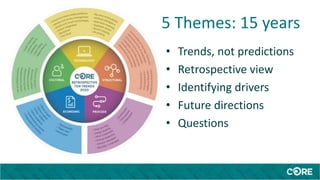
5 Themes: 15 years
• Trends, not predictions
• Retrospective view
• Identifying drivers
• Future directions
• Questions
Structural
• Educational institutions have become defined by
structures that serve to support what they do and
the ways they achieve this.
• A system and structures that are fundamentally
designed around uniformity and standardisation
will inevitably fail to provide the sort of settings in
which diverse learners will thrive and succeed.
Structural - trends
• Shift in ownership of learning –
learner agency
• Networks of schools, learning
ecologies
• Virtual/online learning
Structural - future
• Focus on learner, whanau and
community
• Redefining curriculum and
assessment
• Expanding the concept of school
Structural - questions
• What are the key drivers behind decisions made
in your setting around curriculum (e.g. subjects
taught), use of time, allocation of tasks to
teachers, design and use of learning spaces, etc?
• How might greater use of virtual/online learning
ensure all learners are able to access the
opportunities they need and deserve?
Process
In business terms, process is a collection of
related, structured activities or tasks that
produce a specific outcome.
Simply put, process may be understood as the
way we do things. Important here is to
understand that the way we do things will
inevitably reflect our language, culture and
identity, and the trends in this section must be
considered through these lenses.
Process - trends
• Open-ness, disintermediation
• Evidence and data use, inquiry
• Assessment practices
• Design thinking, gamefication
• Collaboration
Process - future
• Increasing collaboration – maturing of clusters
and learning ecologies
• Changes in assessment approaches
• Greater flexibility in terms of time, place and pace
of learning
• Schools becoming more intentionally inclusive
Process - Questions
• How is the learning journey of your children or
young people managed at present? Who owns
this and why?
• What evidence of design thinking and/ or
gamification exist in your setting? How is it used
and for what purpose?
• How is data being used in your learning setting to
empower both learners and teachers, and to
reduce the administrative workload for
everyone?
Technology
We are in a new decade and the pace of change
driven by new technologies and technological
advancements looks set to continue, even to
accelerate rapidly like no other time in history.
The important thing here is the pervasive nature
of technological change – it is not additive, it is
ecological. When you add a new technology you
don’t simply change something, you change
everything.
Technology - Drivers
• Digital literacy/fluency
• Digital Citizenship
• Curriculum Support
• Preparation for future workforce
• Supporting personalised learning
• Expanding access, addressing equity
• Improving efficiency
Technology - trends
• Personal mobile devices
• Advanced networks
• Social Media
• The cloud
Technology - future
• Personalised
• Ubiquitous
• Intelligent
• Interoperability
• Sustainability
Technology - questions
• How is your education setting strategically
planning for the rapid advancement of
technology that can support learning?
• What steps are you, your staff and community
taking to ensure you are keeping up to date
about technological developments so that you
are able to make informed decisions about
future technological investment and
programmes of learning in your organisation?
Cultural
The culture of an organisation is the product of the
beliefs and values, perceptions, relationships, attitudes,
and written and unwritten rules that shape and
influence every aspect of how it functions.
The culture of any learning setting directly influences
the relationships in it. It affects how everyone interacts,
leads, learns, develops and grows in that setting.
Organisational culture is a reflection of its leaders’
culture, ethics (or lack of them) and consciousness.
Cultural - Trends
• Shift in ownership of learning/learner agency
• Increasing diversity, UDL, inclusion
• Cultural narratives
• Place-based learning
• Embracing a digital culture
Cultural - Drivers
• Internal factors - leadership, staff expectations,
traditions and rules.
• Community factors - cultural or belief systems
represented, family/whānau educational experience
and expectations of their children, location and wider
environment of the learning setting.
• External factors - national educational policy and
resourcing factors, political decisions and actions,
globalisation, super-diversity.
Cultural - Future
• Shift in ownership – learner-centred
design.
• Diversity – expressions of language,
culture, identity.
• Digital – online safety, identity, artificial
intelligence.
Cultural - Questions
• To what extent do your organisation’s values, and
the practices that stem from them, resonate with
the issues identified in this trend?
• To what extent is the voice of learners and of your
community effective in helping determine the
culture of your setting?
• How is being digital considered as a part of the
culture in your setting?
Economic
The relationship between education and the
economy is important from two perspectives:
1. The benefit to society of having well educated
young people who are prepared to take up
employment that will contribute to the
growth of our economy.
2. The cost to society of investing in education,
such as the building of learning centres and
schools, teachers’ salaries, and curriculum
resources.
Economic - Drivers
• Periods of high unemployment
• Changing nature of work
• Changing nature of society
• Globalisation
• Impact of rapidly advancing automated
processes
Economic - Trends
• Maker culture, design thinking, computational
thinking, STEM
• Collaborative skills and mindsets
• Automation, robots, AI
• Teacher roles, teacher workload
Economic - Future
• Focus on high cost of current models
• Re-alignment of career aspirations
• Addressing systemic inequity
• Shifts from a ‘financial maximization’ mindset
Economic - Questions
• How are the issues identified in this trend used to
inform decisions about:
– Curriculum design?
– Career planning and advice?
– Teacher roles and responsibilities?
– Learning activities that require additional payments from
parents and whānau?
– Design and use of buildings/property?
• How do the ideas in the economy theme influence
your thinking about equity within our education
system?
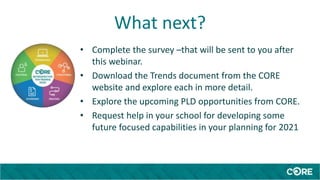
What next?
• Complete the survey –that will be sent to you after
this webinar.
• Download the Trends document from the CORE
website and explore each in more detail.
• Explore the upcoming PLD opportunities from CORE.
• Request help in your school for developing some
future focused capabilities in your planning for 2021
Thank You
derek.wenmoth@core-ed.org
@dwenmoth
http://www.wenmoth.net

Ten trends webinar october

  • 1.
    Ten Trends Online Webinar- 28 October 2020 Derek Wenmoth @dwenmoth #futurefocused https://bit.ly/2Z4Y3qy
  • 3.
    Thinking Globally • Personalisationof learning for students • Competency based education • Global Skills shortages • Changing nature of work • Initial teacher education in crisis • Equity • Access to quality education • Inclusion • Changing demographics and social mobility • Climate change • Exponential and converging technologies
  • 4.
    5 Themes: 15years • Trends, not predictions • Retrospective view • Identifying drivers • Future directions • Questions
  • 5.
    Structural • Educational institutionshave become defined by structures that serve to support what they do and the ways they achieve this. • A system and structures that are fundamentally designed around uniformity and standardisation will inevitably fail to provide the sort of settings in which diverse learners will thrive and succeed.
  • 6.
    Structural - trends •Shift in ownership of learning – learner agency • Networks of schools, learning ecologies • Virtual/online learning
  • 7.
    Structural - future •Focus on learner, whanau and community • Redefining curriculum and assessment • Expanding the concept of school
  • 8.
    Structural - questions •What are the key drivers behind decisions made in your setting around curriculum (e.g. subjects taught), use of time, allocation of tasks to teachers, design and use of learning spaces, etc? • How might greater use of virtual/online learning ensure all learners are able to access the opportunities they need and deserve?
  • 9.
    Process In business terms,process is a collection of related, structured activities or tasks that produce a specific outcome. Simply put, process may be understood as the way we do things. Important here is to understand that the way we do things will inevitably reflect our language, culture and identity, and the trends in this section must be considered through these lenses.
  • 10.
    Process - trends •Open-ness, disintermediation • Evidence and data use, inquiry • Assessment practices • Design thinking, gamefication • Collaboration
  • 11.
    Process - future •Increasing collaboration – maturing of clusters and learning ecologies • Changes in assessment approaches • Greater flexibility in terms of time, place and pace of learning • Schools becoming more intentionally inclusive
  • 12.
    Process - Questions •How is the learning journey of your children or young people managed at present? Who owns this and why? • What evidence of design thinking and/ or gamification exist in your setting? How is it used and for what purpose? • How is data being used in your learning setting to empower both learners and teachers, and to reduce the administrative workload for everyone?
  • 13.
    Technology We are ina new decade and the pace of change driven by new technologies and technological advancements looks set to continue, even to accelerate rapidly like no other time in history. The important thing here is the pervasive nature of technological change – it is not additive, it is ecological. When you add a new technology you don’t simply change something, you change everything.
  • 14.
    Technology - Drivers •Digital literacy/fluency • Digital Citizenship • Curriculum Support • Preparation for future workforce • Supporting personalised learning • Expanding access, addressing equity • Improving efficiency
  • 15.
    Technology - trends •Personal mobile devices • Advanced networks • Social Media • The cloud
  • 16.
    Technology - future •Personalised • Ubiquitous • Intelligent • Interoperability • Sustainability
  • 17.
    Technology - questions •How is your education setting strategically planning for the rapid advancement of technology that can support learning? • What steps are you, your staff and community taking to ensure you are keeping up to date about technological developments so that you are able to make informed decisions about future technological investment and programmes of learning in your organisation?
  • 18.
    Cultural The culture ofan organisation is the product of the beliefs and values, perceptions, relationships, attitudes, and written and unwritten rules that shape and influence every aspect of how it functions. The culture of any learning setting directly influences the relationships in it. It affects how everyone interacts, leads, learns, develops and grows in that setting. Organisational culture is a reflection of its leaders’ culture, ethics (or lack of them) and consciousness.
  • 19.
    Cultural - Trends •Shift in ownership of learning/learner agency • Increasing diversity, UDL, inclusion • Cultural narratives • Place-based learning • Embracing a digital culture
  • 20.
    Cultural - Drivers •Internal factors - leadership, staff expectations, traditions and rules. • Community factors - cultural or belief systems represented, family/whānau educational experience and expectations of their children, location and wider environment of the learning setting. • External factors - national educational policy and resourcing factors, political decisions and actions, globalisation, super-diversity.
  • 21.
    Cultural - Future •Shift in ownership – learner-centred design. • Diversity – expressions of language, culture, identity. • Digital – online safety, identity, artificial intelligence.
  • 22.
    Cultural - Questions •To what extent do your organisation’s values, and the practices that stem from them, resonate with the issues identified in this trend? • To what extent is the voice of learners and of your community effective in helping determine the culture of your setting? • How is being digital considered as a part of the culture in your setting?
  • 23.
    Economic The relationship betweeneducation and the economy is important from two perspectives: 1. The benefit to society of having well educated young people who are prepared to take up employment that will contribute to the growth of our economy. 2. The cost to society of investing in education, such as the building of learning centres and schools, teachers’ salaries, and curriculum resources.
  • 24.
    Economic - Drivers •Periods of high unemployment • Changing nature of work • Changing nature of society • Globalisation • Impact of rapidly advancing automated processes
  • 25.
    Economic - Trends •Maker culture, design thinking, computational thinking, STEM • Collaborative skills and mindsets • Automation, robots, AI • Teacher roles, teacher workload
  • 26.
    Economic - Future •Focus on high cost of current models • Re-alignment of career aspirations • Addressing systemic inequity • Shifts from a ‘financial maximization’ mindset
  • 27.
    Economic - Questions •How are the issues identified in this trend used to inform decisions about: – Curriculum design? – Career planning and advice? – Teacher roles and responsibilities? – Learning activities that require additional payments from parents and whānau? – Design and use of buildings/property? • How do the ideas in the economy theme influence your thinking about equity within our education system?
  • 28.
    What next? • Completethe survey –that will be sent to you after this webinar. • Download the Trends document from the CORE website and explore each in more detail. • Explore the upcoming PLD opportunities from CORE. • Request help in your school for developing some future focused capabilities in your planning for 2021
  • 29.