Opportunities from a more open and
           online world
  Lecture at China Open University, Beijing
              21 February 2012

                Gard Titlestad
              Secretary General
                    ICDE
Outline
•   Introduction
•   Global context
•   Trends in education
•   OER
•   Trends in ODL/Online learning
•   Convergence
•   What is on the ICDE radar?
Need for education
   - Education For All
• Irina Bokova, Director-General of UNESCO
  “Higher education: In less than 40 years,
  enrolments have increased fivefold. Globally it
  is estimated that demand will expand from
  less than 100 million students in 2000 to over
  250 million students in 2025.”


    Distance and online education can help
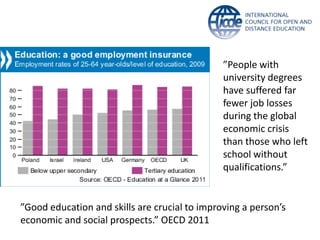
”People with
                                               university degrees
                                               have suffered far
                                               fewer job losses
                                               during the global
                                               economic crisis
                                               than those who left
                                               school without
                                               qualifications.”


”Good education and skills are crucial to improving a person’s
economic and social prospects.” OECD 2011
Example – global
   challenges
    Sustainable development and
    climate change
    Clean Water
    Population and resources
    Energy
    Green growth
    Organized crime
    Democratization
    Global ethics
    Rich – poor gap
    Health
    Peace and conflict
    Status of women
    IT – global convergence
Universities
Universities are increasingly faced with societal
challenges of national, regional and global
nature: Grand challenges

• Universities deliver through their three
  funcitons:
  – Education
  – Research
  – Innovation
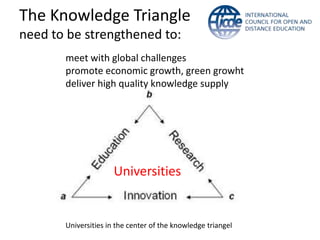
The Knowledge Triangle
need to be strengthened to:
       meet with global challenges
       promote economic growth, green growht
       deliver high quality knowledge supply


                      Universities


       Universities in the center of the knowledge triangel
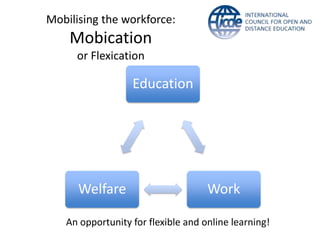
Mobilising the workforce:
    Mobication
     or Flexication

                  Education


      Welfare                       Work

   An opportunity for flexible and online learning!
High Quality education
          OECD:International Student Assessment
The Programme for
                  PISA
(PISA ) is an internationally standardised assessment

                 15-year-olds in schools.

PISA assesses how far students near the end of compulsory
education have acquired some of the knowledge and skills
that are essential for full participation in society.

In all cycles, the domains of reading, mathematical and
scientific literacy are covered not merely in terms of
mastery of the school curriculum, but in terms of
important knowledge and skills needed in adult life.
PISA and China
             What do we know?


http://www.oecd.org/document/7/0,3746,en_2649_35845621_49428807_1_1_1_1,00.htm
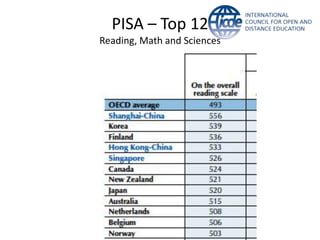
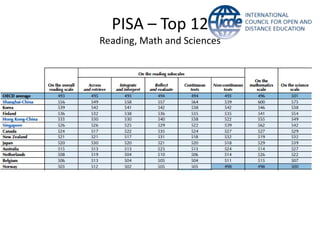
PISA – Top 12
Reading, Math and Sciences
PISA – Top 12
Reading, Math and Sciences
School failure
• Reducing school failure pays off for both
  society and individuals. More education
  attainment provides better labour market
  prospects and contributes to economic
  growth and social progress. The highest
  performing education systems across OECD
  countries are those that combine high quality
  and equity.

 Overcoming School Failure: Policies that Work
 February 2012
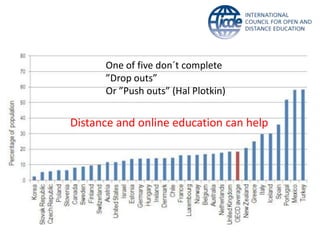
One of five don´t complete
      ”Drop outs”
      Or ”Push outs” (Hal Plotkin)


Distance and online education can help
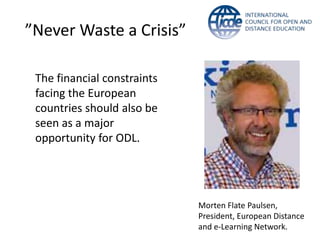
”Never Waste a Crisis”

 The financial constraints
 facing the European
 countries should also be
 seen as a major
 opportunity for ODL.


                             Morten Flate Paulsen,
                             President, European Distance
                             and e-Learning Network.
The traditional educational
      system is challenged
    ”many speakers referred worryingly to the
    growth of online and for-profit providers—
      suggests a growing concern at even the
     most elite institutions that the classroom
         experience is not all it could be”
Harvard Conference Seeks to Jolt University Teaching, February 2012
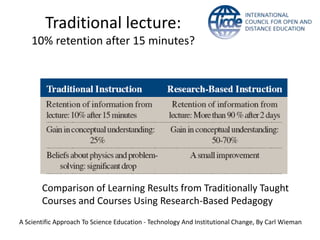
Traditional lecture:
    10% retention after 15 minutes?


       Comparison of Learning Results from Traditionally Taught
       Courses and Courses Using Research-Based Pedagogy
A Scientific Approach To Science Education - Technology And Institutional Change, By Carl Wieman
OER

In its simplest form, the concept of Open
Educational Resources (OER) describes any
educational resources (including curriculum
maps, course materials, textbooks, streaming
videos, multimedia applications, podcasts, and
any other materials that have been designed for
use in teaching and learning) that are openly
available for use by educators and students,
without an accompanying need to pay royalties
or licence fees.

               www.ocwconsortium.org/
Educational potential
• Increased availability of high quality, relevant learning materials can
  contribute to more productive students and educators.
• The principle of allowing adaptation of materials provides one mechanism
  amongst many for constructing roles for students as active participants in
  educational processes, who learn best by doing and creating, not by
  passively reading and absorbing.
• OER has potential to build capacity by providing institutions and
  educators access, at low or no cost, to the means of production to develop
  their competence in producing educational materials and carrying out the
  necessary instructional design to integrate such materials into high quality
  programmes of learning.

“A Basic Guide to Open Educational Resources”, (Butcher, Kanwar and Uvalic´-Trumbic´)
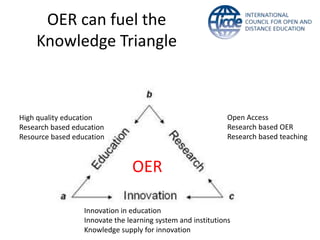
OER can fuel the
    Knowledge Triangle


High quality education                                        Open Access
Research based education                                      Research based OER
Resource based education                                      Research based teaching


                                OER

                  Innovation in education
                  Innovate the learning system and institutions
                  Knowledge supply for innovation
2012 World OER Congress
     20 – 22 June, Paris, France


Should all education resources funded
    with public money be OERs?
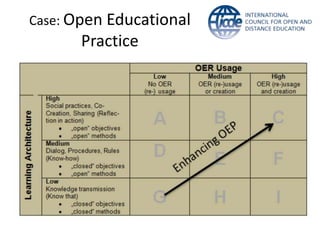
Case: Open Educational
       Practice
The OEP Guideline


• Step 1: Positioning your Organization in the
  OEP Map
• Step 2: Creating a Vision of Openness and a
  Strategy for OEP in an Organization
• Step 3: Implementing and Promoting OEP
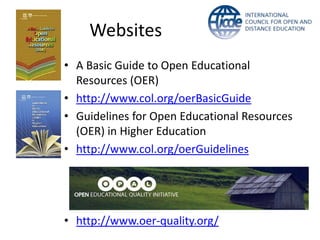
Websites
• A Basic Guide to Open Educational
  Resources (OER)
• http://www.col.org/oerBasicGuide
• Guidelines for Open Educational Resources
  (OER) in Higher Education
• http://www.col.org/oerGuidelines


• http://www.oer-quality.org/
Technology as
       facilitator
The rapid development of
information and
communication technology
(ICT) offers tremendous
educational opportunities to
provide new innovative,
accessible and more affordable
ways of learning.
                                 Mansoor Al Awar,
                                 Chairman, Middle East e-
                                 Learning Association.
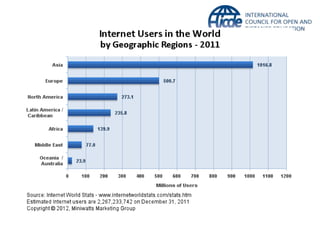
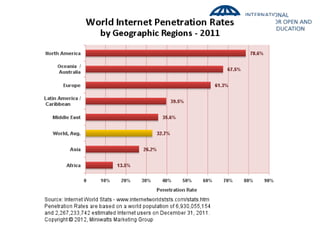
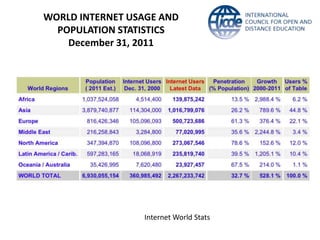
WORLD INTERNET USAGE AND
  POPULATION STATISTICS
    December 31, 2011


                 Internet World Stats
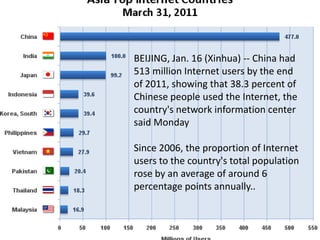
BEIJING, Jan. 16 (Xinhua) -- China had
513 million Internet users by the end
of 2011, showing that 38.3 percent of
Chinese people used the Internet, the
country's network information center
said Monday

Since 2006, the proportion of Internet
users to the country's total population
rose by an average of around 6
percentage points annually..
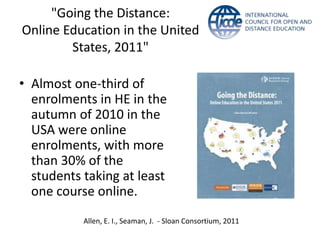
"Going the Distance:
Online Education in the United
        States, 2011"

• Almost one-third of
  enrolments in HE in the
  autumn of 2010 in the
  USA were online
  enrolments, with more
  than 30% of the
  students taking at least
  one course online.
           Allen, E. I., Seaman, J. - Sloan Consortium, 2011
”Higher education, is vulnerable
        to disruption.”
  Clayton M. Christensen, professor of
     business administration at the
        Harvard Business School.
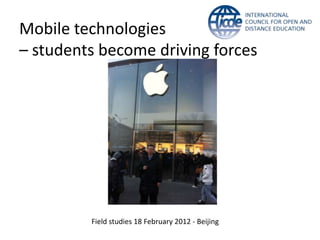
Mobile technologies
– students become driving forces


         Field studies 18 February 2012 - Beijing
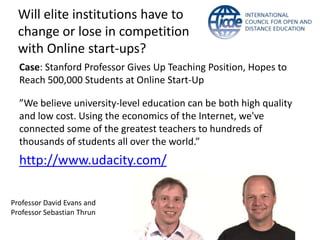
Will elite institutions have to
  change or lose in competition
  with Online start-ups?
  Case: Stanford Professor Gives Up Teaching Position, Hopes to
  Reach 500,000 Students at Online Start-Up

  ”We believe university-level education can be both high quality
  and low cost. Using the economics of the Internet, we've
  connected some of the greatest teachers to hundreds of
  thousands of students all over the world.”
  http://www.udacity.com/

Professor David Evans and
Professor Sebastian Thrun
Certificates for free online courses –
  what impact could that have for HEI?


  Case: MIT granting certificates for free online courses.


• Participants will watch five- to 10-minute
  video tutorials, read an e-textbook, and
  complete homework assignments, virtual
  laboratories and two exams. At the end of the
  course, they will receive a cumulative grade
  and a certificate from MITx.
• http://mitx.mit.edu/
                MITx MIT’s new online learning initiative
Convergence
Convergence (logic), the notion that a sequence of transformations come to the
same conclusion, no matter what order they are performed in. (Wikipedia)


Conventional, face-to-face universities are increasingly
moving into the delivery of online learning programs.
Many conventional universities have been unable to
adopt or adapt the strategies developed by distance
teaching organizations fast enough to ensure increased
access, quality, and sustainability through the use of
teaching technology.

International Council for Open and Distance Education, Global
Trends in Higher Education, Adult and Distance Learning (2009).
Convergence

  “The University of
  California has launched an
  online programme as a
  part of its goal to become
  the first top-rated
  American institution to
  award an online
  bachelor’s degree.” 2011
Convergence

             “The Task Force has concluded that online
             learning – however blended with on- or off-
             campus interactions, whether delivered in the
             UK or overseas – provides real opportunity
             for UK institutions to develop responsive,
             engaging and interactive provision which, if
             offered at scale, can deliver quality and cost-
             effectiveness and meet student demands for
             flexible learning.”


The Higher Education Funding Council for England (HEFCE) Collaborate to
compete, Seizing the opportunity of online learning for UK higher education, 2011
Convergence
• Distance Learning in British Universities – is it
  possible?
    – Conventional campus-based universities struggle
      to build and/ or expand sustainable distance
      learning provision.
    – The problem rests in an institutional lack of
      understanding about distance learning pedagogy
      and/ or a lack of capability to make the necessary
      institutional changes required to ensure that
      distance learning works

Helen Lentell, University of Leicester, 2012
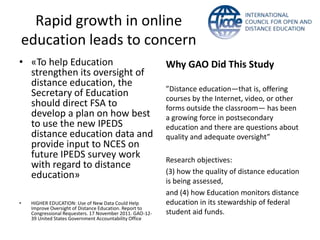
Rapid growth in online
    education leads to concern
• «To help Education                                       Why GAO Did This Study
  strengthen its oversight of
  distance education, the
                                                           ”Distance education—that is, offering
  Secretary of Education                                   courses by the Internet, video, or other
  should direct FSA to                                     forms outside the classroom— has been
  develop a plan on how best                               a growing force in postsecondary
  to use the new IPEDS                                     education and there are questions about
  distance education data and                              quality and adequate oversight”
  provide input to NCES on
  future IPEDS survey work                                 Research objectives:
  with regard to distance
                                                           (3) how the quality of distance education
  education»
                                                           is being assessed,
                                                           and (4) how Education monitors distance
•    HIGHER EDUCATION: Use of New Data Could Help          education in its stewardship of federal
     Improve Oversight of Distance Education. Report to
     Congressional Requesters. 17 November 2011. GAO-12-   student aid funds.
     39 United States Government Accountability Office
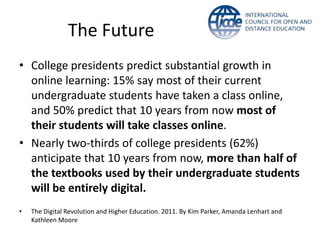
The Future
• College presidents predict substantial growth in
  online learning: 15% say most of their current
  undergraduate students have taken a class online,
  and 50% predict that 10 years from now most of
  their students will take classes online.
• Nearly two-thirds of college presidents (62%)
  anticipate that 10 years from now, more than half of
  the textbooks used by their undergraduate students
  will be entirely digital.
•   The Digital Revolution and Higher Education. 2011. By Kim Parker, Amanda Lenhart and
    Kathleen Moore
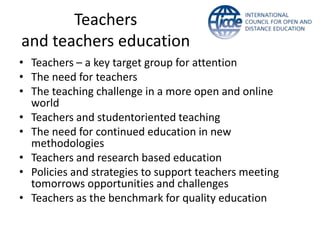
Teachers
and teachers education
• Teachers – a key target group for attention
• The need for teachers
• The teaching challenge in a more open and online
  world
• Teachers and studentoriented teaching
• The need for continued education in new
  methodologies
• Teachers and research based education
• Policies and strategies to support teachers meeting
  tomorrows opportunities and challenges
• Teachers as the benchmark for quality education
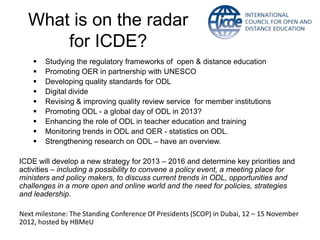
What is on the radar
      for ICDE?
       Studying the regulatory frameworks of open & distance education
       Promoting OER in partnership with UNESCO
       Developing quality standards for ODL
       Digital divide
       Revising & improving quality review service for member institutions
       Promoting ODL - a global day of ODL in 2013?
       Enhancing the role of ODL in teacher education and training
       Monitoring trends in ODL and OER - statistics on ODL.
       Strengthening research on ODL – have an overview.

ICDE will develop a new strategy for 2013 – 2016 and determine key priorities and
activities – including a possibility to convene a policy event, a meeting place for
ministers and policy makers, to discuss current trends in ODL, opportunities and
challenges in a more open and online world and the need for policies, strategies
and leadership.

Next milestone: The Standing Conference Of Presidents (SCOP) in Dubai, 12 – 15 November
2012, hosted by HBMeU
ICDE 25 World Conference

          Tianjin, China
   16th to 18th October 2013
  Host: Tianjin Open University
Opportunities
 from a more
open and online
 world – in the
  early dawn
Thank You!

titlestad@icde.org
   www.icde.org

Gard Titlestad. Opportunities from a more open and online world.

  • 1.
    Opportunities from amore open and online world Lecture at China Open University, Beijing 21 February 2012 Gard Titlestad Secretary General ICDE
  • 2.
    Outline • Introduction • Global context • Trends in education • OER • Trends in ODL/Online learning • Convergence • What is on the ICDE radar?
  • 3.
    Need for education - Education For All • Irina Bokova, Director-General of UNESCO “Higher education: In less than 40 years, enrolments have increased fivefold. Globally it is estimated that demand will expand from less than 100 million students in 2000 to over 250 million students in 2025.” Distance and online education can help
  • 4.
    ”People with university degrees have suffered far fewer job losses during the global economic crisis than those who left school without qualifications.” ”Good education and skills are crucial to improving a person’s economic and social prospects.” OECD 2011
  • 5.
    Example – global challenges Sustainable development and climate change Clean Water Population and resources Energy Green growth Organized crime Democratization Global ethics Rich – poor gap Health Peace and conflict Status of women IT – global convergence
  • 6.
    Universities Universities are increasinglyfaced with societal challenges of national, regional and global nature: Grand challenges • Universities deliver through their three funcitons: – Education – Research – Innovation
  • 7.
    The Knowledge Triangle needto be strengthened to: meet with global challenges promote economic growth, green growht deliver high quality knowledge supply Universities Universities in the center of the knowledge triangel
  • 8.
    Mobilising the workforce: Mobication or Flexication Education Welfare Work An opportunity for flexible and online learning!
  • 9.
    High Quality education OECD:International Student Assessment The Programme for PISA (PISA ) is an internationally standardised assessment 15-year-olds in schools. PISA assesses how far students near the end of compulsory education have acquired some of the knowledge and skills that are essential for full participation in society. In all cycles, the domains of reading, mathematical and scientific literacy are covered not merely in terms of mastery of the school curriculum, but in terms of important knowledge and skills needed in adult life.
  • 10.
    PISA and China What do we know? http://www.oecd.org/document/7/0,3746,en_2649_35845621_49428807_1_1_1_1,00.htm
  • 11.
    PISA – Top12 Reading, Math and Sciences
  • 12.
    PISA – Top12 Reading, Math and Sciences
  • 13.
    School failure • Reducingschool failure pays off for both society and individuals. More education attainment provides better labour market prospects and contributes to economic growth and social progress. The highest performing education systems across OECD countries are those that combine high quality and equity. Overcoming School Failure: Policies that Work February 2012
  • 14.
    One of fivedon´t complete ”Drop outs” Or ”Push outs” (Hal Plotkin) Distance and online education can help
  • 15.
    ”Never Waste aCrisis” The financial constraints facing the European countries should also be seen as a major opportunity for ODL. Morten Flate Paulsen, President, European Distance and e-Learning Network.
  • 16.
    The traditional educational system is challenged ”many speakers referred worryingly to the growth of online and for-profit providers— suggests a growing concern at even the most elite institutions that the classroom experience is not all it could be” Harvard Conference Seeks to Jolt University Teaching, February 2012
  • 17.
    Traditional lecture: 10% retention after 15 minutes? Comparison of Learning Results from Traditionally Taught Courses and Courses Using Research-Based Pedagogy A Scientific Approach To Science Education - Technology And Institutional Change, By Carl Wieman
  • 18.
    OER In its simplestform, the concept of Open Educational Resources (OER) describes any educational resources (including curriculum maps, course materials, textbooks, streaming videos, multimedia applications, podcasts, and any other materials that have been designed for use in teaching and learning) that are openly available for use by educators and students, without an accompanying need to pay royalties or licence fees. www.ocwconsortium.org/
  • 19.
    Educational potential • Increasedavailability of high quality, relevant learning materials can contribute to more productive students and educators. • The principle of allowing adaptation of materials provides one mechanism amongst many for constructing roles for students as active participants in educational processes, who learn best by doing and creating, not by passively reading and absorbing. • OER has potential to build capacity by providing institutions and educators access, at low or no cost, to the means of production to develop their competence in producing educational materials and carrying out the necessary instructional design to integrate such materials into high quality programmes of learning. “A Basic Guide to Open Educational Resources”, (Butcher, Kanwar and Uvalic´-Trumbic´)
  • 20.
    OER can fuelthe Knowledge Triangle High quality education Open Access Research based education Research based OER Resource based education Research based teaching OER Innovation in education Innovate the learning system and institutions Knowledge supply for innovation
  • 21.
    2012 World OERCongress 20 – 22 June, Paris, France Should all education resources funded with public money be OERs?
  • 22.
  • 23.
    The OEP Guideline •Step 1: Positioning your Organization in the OEP Map • Step 2: Creating a Vision of Openness and a Strategy for OEP in an Organization • Step 3: Implementing and Promoting OEP
  • 24.
    Websites • A BasicGuide to Open Educational Resources (OER) • http://www.col.org/oerBasicGuide • Guidelines for Open Educational Resources (OER) in Higher Education • http://www.col.org/oerGuidelines • http://www.oer-quality.org/
  • 25.
    Technology as facilitator The rapid development of information and communication technology (ICT) offers tremendous educational opportunities to provide new innovative, accessible and more affordable ways of learning. Mansoor Al Awar, Chairman, Middle East e- Learning Association.
  • 28.
    WORLD INTERNET USAGEAND POPULATION STATISTICS December 31, 2011 Internet World Stats
  • 29.
    BEIJING, Jan. 16(Xinhua) -- China had 513 million Internet users by the end of 2011, showing that 38.3 percent of Chinese people used the Internet, the country's network information center said Monday Since 2006, the proportion of Internet users to the country's total population rose by an average of around 6 percentage points annually..
  • 30.
    "Going the Distance: OnlineEducation in the United States, 2011" • Almost one-third of enrolments in HE in the autumn of 2010 in the USA were online enrolments, with more than 30% of the students taking at least one course online. Allen, E. I., Seaman, J. - Sloan Consortium, 2011
  • 31.
    ”Higher education, isvulnerable to disruption.” Clayton M. Christensen, professor of business administration at the Harvard Business School.
  • 32.
    Mobile technologies – studentsbecome driving forces Field studies 18 February 2012 - Beijing
  • 33.
    Will elite institutionshave to change or lose in competition with Online start-ups? Case: Stanford Professor Gives Up Teaching Position, Hopes to Reach 500,000 Students at Online Start-Up ”We believe university-level education can be both high quality and low cost. Using the economics of the Internet, we've connected some of the greatest teachers to hundreds of thousands of students all over the world.” http://www.udacity.com/ Professor David Evans and Professor Sebastian Thrun
  • 34.
    Certificates for freeonline courses – what impact could that have for HEI? Case: MIT granting certificates for free online courses. • Participants will watch five- to 10-minute video tutorials, read an e-textbook, and complete homework assignments, virtual laboratories and two exams. At the end of the course, they will receive a cumulative grade and a certificate from MITx. • http://mitx.mit.edu/ MITx MIT’s new online learning initiative
  • 35.
    Convergence Convergence (logic), thenotion that a sequence of transformations come to the same conclusion, no matter what order they are performed in. (Wikipedia) Conventional, face-to-face universities are increasingly moving into the delivery of online learning programs. Many conventional universities have been unable to adopt or adapt the strategies developed by distance teaching organizations fast enough to ensure increased access, quality, and sustainability through the use of teaching technology. International Council for Open and Distance Education, Global Trends in Higher Education, Adult and Distance Learning (2009).
  • 36.
    Convergence “TheUniversity of California has launched an online programme as a part of its goal to become the first top-rated American institution to award an online bachelor’s degree.” 2011
  • 37.
    Convergence “The Task Force has concluded that online learning – however blended with on- or off- campus interactions, whether delivered in the UK or overseas – provides real opportunity for UK institutions to develop responsive, engaging and interactive provision which, if offered at scale, can deliver quality and cost- effectiveness and meet student demands for flexible learning.” The Higher Education Funding Council for England (HEFCE) Collaborate to compete, Seizing the opportunity of online learning for UK higher education, 2011
  • 38.
    Convergence • Distance Learningin British Universities – is it possible? – Conventional campus-based universities struggle to build and/ or expand sustainable distance learning provision. – The problem rests in an institutional lack of understanding about distance learning pedagogy and/ or a lack of capability to make the necessary institutional changes required to ensure that distance learning works Helen Lentell, University of Leicester, 2012
  • 39.
    Rapid growth inonline education leads to concern • «To help Education Why GAO Did This Study strengthen its oversight of distance education, the ”Distance education—that is, offering Secretary of Education courses by the Internet, video, or other should direct FSA to forms outside the classroom— has been develop a plan on how best a growing force in postsecondary to use the new IPEDS education and there are questions about distance education data and quality and adequate oversight” provide input to NCES on future IPEDS survey work Research objectives: with regard to distance (3) how the quality of distance education education» is being assessed, and (4) how Education monitors distance • HIGHER EDUCATION: Use of New Data Could Help education in its stewardship of federal Improve Oversight of Distance Education. Report to Congressional Requesters. 17 November 2011. GAO-12- student aid funds. 39 United States Government Accountability Office
  • 40.
    The Future • Collegepresidents predict substantial growth in online learning: 15% say most of their current undergraduate students have taken a class online, and 50% predict that 10 years from now most of their students will take classes online. • Nearly two-thirds of college presidents (62%) anticipate that 10 years from now, more than half of the textbooks used by their undergraduate students will be entirely digital. • The Digital Revolution and Higher Education. 2011. By Kim Parker, Amanda Lenhart and Kathleen Moore
  • 41.
    Teachers and teachers education •Teachers – a key target group for attention • The need for teachers • The teaching challenge in a more open and online world • Teachers and studentoriented teaching • The need for continued education in new methodologies • Teachers and research based education • Policies and strategies to support teachers meeting tomorrows opportunities and challenges • Teachers as the benchmark for quality education
  • 42.
    What is onthe radar for ICDE?  Studying the regulatory frameworks of open & distance education  Promoting OER in partnership with UNESCO  Developing quality standards for ODL  Digital divide  Revising & improving quality review service for member institutions  Promoting ODL - a global day of ODL in 2013?  Enhancing the role of ODL in teacher education and training  Monitoring trends in ODL and OER - statistics on ODL.  Strengthening research on ODL – have an overview. ICDE will develop a new strategy for 2013 – 2016 and determine key priorities and activities – including a possibility to convene a policy event, a meeting place for ministers and policy makers, to discuss current trends in ODL, opportunities and challenges in a more open and online world and the need for policies, strategies and leadership. Next milestone: The Standing Conference Of Presidents (SCOP) in Dubai, 12 – 15 November 2012, hosted by HBMeU
  • 43.
    ICDE 25 WorldConference Tianjin, China 16th to 18th October 2013 Host: Tianjin Open University
  • 44.
    Opportunities from amore open and online world – in the early dawn
  • 45.