Connecting with users 
User Experience in Practice 
Katherine Wahl 
Usability/Accessibility Consultant 
October, 2014
About me
Agenda 
¤ User experience introduction 
¤ Interview introduction 
¤ Practical interview tips
User Experience 
Introduction
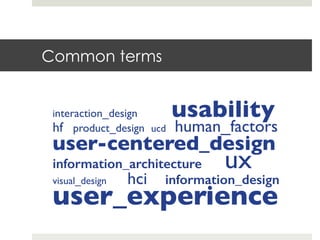
Common terms 
interaction_design usability 
hf product_design ucd human_factors user-centered_design 
information_architecture ux 
visual_design hci information_design user_experience
Usability 
Concept that has been around for generations, but only 
recently standardized and greatly expanded. 
¤ World War II – instrumentation 
¤ Software industry 
¤ Web explosion 
¤ Consumer devices 
¤ Medical devices
Usability 
"[Usability refers to] the extent to 
which a product can be used by 
specified users to achieve specified 
goals with effectiveness, efficiency 
and satisfaction in a specified 
context of use." - ISO 9241-11
Benefits of usability 
¤ Increased productivity 
¤ Decreased training and support costs 
¤ Increased sales and revenues 
¤ Reduced development time and costs 
¤ Reduced maintenance costs 
¤ Increased customer satisfaction
What are we trying to do? 
“The key to making things 
understandable is to understand 
what it’s like not to understand.” 
(Richard Saul Wurman)
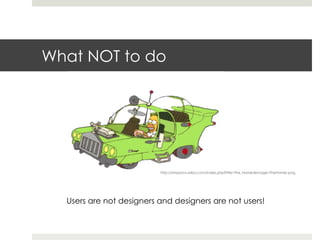
What NOT to do 
http://simpsons.wikia.com/index.php?title=The_Homer&image=TheHomer-png 
Users are not designers and designers are not users!
Interviewing users 
Practical tips
Interviewing users 
¤ A common method of obtaining user feedback 
¤ The researcher talks directly with the user in a one-on-one 
conversation 
¤ Often used in conjunction with other research methods 
like a usability test or contextual inquiry 
¤ There is no substitute for talking with real users
Interview skills 
¤ Comfortable talking to users 
¤ Empathy 
¤ Recognize the expertise of the participant 
¤ Listen 
¤ Set aside your own bias 
¤ Synthesize and analysis
Advantages 
¤ Versatility 
¤ Sessions can be set up and run quickly 
¤ Open to an iterative process 
¤ Not dependent on developers 
¤ Data is from real users 
¤ Opportunity to develop a deep understanding of users 
¤ Inexpensive
Challenges 
¤ Defining goals 
¤ Recognizing and eliminating bias 
¤ Listening carefully 
¤ Expecting the unexpected 
¤ Recording the session 
¤ Analyzing the data
Steps in the process 
¤ Preparation 
¤ Conducting the interview 
¤ Analysis 
¤ Reporting
Goals 
¤ Set reasonable goals 
¤ Discuss them with your client 
¤ Define what NOT to expect
Recruiting participants 
¤ Define your audience 
¤ How many participants should you include? 
¤ Plan your schedule
Writing questions 
¤ Draft and revise your questions 
¤ Be mindful of bias 
¤ Think about timing 
¤ Know the material well
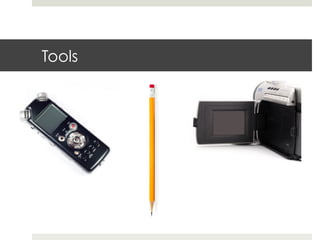
Tools
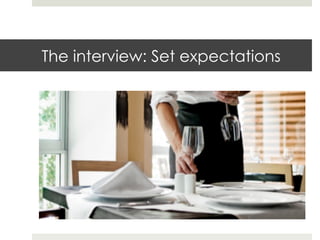
The interview: Set expectations
Talking with participants 
¤ Remember that the participant is the expert 
¤ Listen 
¤ Observe 
¤ Clarify 
¤ Record quotes
Be ready for surprises
Analysis 
¤ Review your data carefully 
¤ Look for themes and trends
Reporting 
¤ Make your report usable 
¤ Try to deliver results in person
Things to remember 
¤ Prepare thoroughly 
¤ The participant is the expert 
¤ Be mindful of bias 
¤ Listen carefully 
¤ Show empathy 
¤ Record quotes accurately 
¤ Review data immediately
Questions? 
Contact me at kwahl107@gmail.com
Bibliography 
Buxton, Bill. (2007). Sketching User Experiences: Getting the 
Design Right and the Design Right. Amsterdam, Netherlands: 
Morgan Kaufmann/Elsevier. 
Courage, Catherine & Kathy Baxter. (2005). Understanding 
Your Users: A Practical Guide to User Requirements Methods, 
Tools, and Techniques. Amsterdam, Netherlands: Morgan 
Kaufmann/Elsevier. 
Goodman, Elizabeth, Mike Kuniavsky and Andrea Moed. 
(2012). Observing the User Experience: A Practitioner’s 
Guide to User Research (2nd Edition). San Francisco, 
California: Elsevier/Morgan Kaufmann.
Bibliography 
Morville, Peter & Louis Rosenfeld. (2006). Information Architecture 
for the World Wide Web – Third Edition. Sebastopol, California: 
O’Reilly Media, Inc. 
Nielsen, Jakob. (1993) Usability Engineering. San Francisco, 
California: Morgan Kaufmann. 
Portugal, Steve, (2013) Interviewing Users: How to Uncover 
Compelling Insights. Brooklyn, New York: Rosenfeld. 
Quesenbery, Whitney & Kevin Brooks. (2010). Storytelling for User 
Experiences: Crafting Stories for Better Design. Brooklyn, New York: 
Rosenfeld. 
Schumacher, Robert. Editor (2009). Handbook of Global User 
Research. Amsterdam:, Netherlands: Elsevier/Morgan Kaufmann.

Connecting with users

  • 1.
    Connecting with users User Experience in Practice Katherine Wahl Usability/Accessibility Consultant October, 2014
  • 2.
  • 3.
    Agenda ¤ Userexperience introduction ¤ Interview introduction ¤ Practical interview tips
  • 4.
  • 5.
    Common terms interaction_designusability hf product_design ucd human_factors user-centered_design information_architecture ux visual_design hci information_design user_experience
  • 6.
    Usability Concept thathas been around for generations, but only recently standardized and greatly expanded. ¤ World War II – instrumentation ¤ Software industry ¤ Web explosion ¤ Consumer devices ¤ Medical devices
  • 7.
    Usability "[Usability refersto] the extent to which a product can be used by specified users to achieve specified goals with effectiveness, efficiency and satisfaction in a specified context of use." - ISO 9241-11
  • 8.
    Benefits of usability ¤ Increased productivity ¤ Decreased training and support costs ¤ Increased sales and revenues ¤ Reduced development time and costs ¤ Reduced maintenance costs ¤ Increased customer satisfaction
  • 9.
    What are wetrying to do? “The key to making things understandable is to understand what it’s like not to understand.” (Richard Saul Wurman)
  • 10.
    What NOT todo http://simpsons.wikia.com/index.php?title=The_Homer&image=TheHomer-png Users are not designers and designers are not users!
  • 11.
  • 12.
    Interviewing users ¤A common method of obtaining user feedback ¤ The researcher talks directly with the user in a one-on-one conversation ¤ Often used in conjunction with other research methods like a usability test or contextual inquiry ¤ There is no substitute for talking with real users
  • 13.
    Interview skills ¤Comfortable talking to users ¤ Empathy ¤ Recognize the expertise of the participant ¤ Listen ¤ Set aside your own bias ¤ Synthesize and analysis
  • 14.
    Advantages ¤ Versatility ¤ Sessions can be set up and run quickly ¤ Open to an iterative process ¤ Not dependent on developers ¤ Data is from real users ¤ Opportunity to develop a deep understanding of users ¤ Inexpensive
  • 15.
    Challenges ¤ Defininggoals ¤ Recognizing and eliminating bias ¤ Listening carefully ¤ Expecting the unexpected ¤ Recording the session ¤ Analyzing the data
  • 16.
    Steps in theprocess ¤ Preparation ¤ Conducting the interview ¤ Analysis ¤ Reporting
  • 17.
    Goals ¤ Setreasonable goals ¤ Discuss them with your client ¤ Define what NOT to expect
  • 18.
    Recruiting participants ¤Define your audience ¤ How many participants should you include? ¤ Plan your schedule
  • 19.
    Writing questions ¤Draft and revise your questions ¤ Be mindful of bias ¤ Think about timing ¤ Know the material well
  • 20.
  • 21.
    The interview: Setexpectations
  • 22.
    Talking with participants ¤ Remember that the participant is the expert ¤ Listen ¤ Observe ¤ Clarify ¤ Record quotes
  • 23.
    Be ready forsurprises
  • 24.
    Analysis ¤ Reviewyour data carefully ¤ Look for themes and trends
  • 25.
    Reporting ¤ Makeyour report usable ¤ Try to deliver results in person
  • 26.
    Things to remember ¤ Prepare thoroughly ¤ The participant is the expert ¤ Be mindful of bias ¤ Listen carefully ¤ Show empathy ¤ Record quotes accurately ¤ Review data immediately
  • 27.
    Questions? Contact meat kwahl107@gmail.com
  • 28.
    Bibliography Buxton, Bill.(2007). Sketching User Experiences: Getting the Design Right and the Design Right. Amsterdam, Netherlands: Morgan Kaufmann/Elsevier. Courage, Catherine & Kathy Baxter. (2005). Understanding Your Users: A Practical Guide to User Requirements Methods, Tools, and Techniques. Amsterdam, Netherlands: Morgan Kaufmann/Elsevier. Goodman, Elizabeth, Mike Kuniavsky and Andrea Moed. (2012). Observing the User Experience: A Practitioner’s Guide to User Research (2nd Edition). San Francisco, California: Elsevier/Morgan Kaufmann.
  • 29.
    Bibliography Morville, Peter& Louis Rosenfeld. (2006). Information Architecture for the World Wide Web – Third Edition. Sebastopol, California: O’Reilly Media, Inc. Nielsen, Jakob. (1993) Usability Engineering. San Francisco, California: Morgan Kaufmann. Portugal, Steve, (2013) Interviewing Users: How to Uncover Compelling Insights. Brooklyn, New York: Rosenfeld. Quesenbery, Whitney & Kevin Brooks. (2010). Storytelling for User Experiences: Crafting Stories for Better Design. Brooklyn, New York: Rosenfeld. Schumacher, Robert. Editor (2009). Handbook of Global User Research. Amsterdam:, Netherlands: Elsevier/Morgan Kaufmann.