
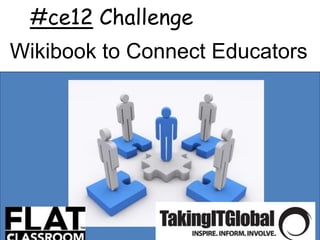
#ce12 Challenge
Wikibook to Connect Educators
#ce12 Challenge
Why aren’t more educators
      connecting?
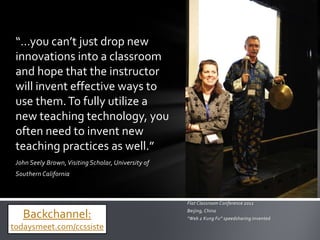
“…you can’t just drop new
 innovations into a classroom
 and hope that the instructor
 will invent effective ways to
 use them. To fully utilize a
 new teaching technology, you
 often need to invent new
 teaching practices as well.”
 John Seely Brown, Visiting Scholar, University of
 Southern California


                                                     Flat Classroom Conference 2011

   Backchannel:                                      Beijing, China
                                                     “Web 2 Kung Fu” speedsharing invented
todaysmeet.com/ccssiste
Community of Practice
• “communities of practice are formed by
  people who engage in a process of collective
  learning in a shared domain of human
  endeavor.” (Lave and Wegner)


    Backchannel:
 todaysmeet.com/ccssiste
        #ccsiste
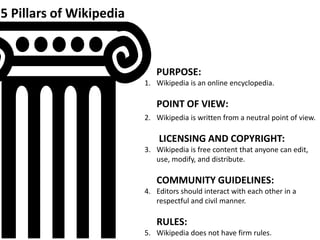
5 Pillars of Wikipedia


                            PURPOSE:
                         1. Wikipedia is an online encyclopedia.

                            POINT OF VIEW:
                         2. Wikipedia is written from a neutral point of view.

                             LICENSING AND COPYRIGHT:
                         3. Wikipedia is free content that anyone can edit,
                            use, modify, and distribute.

                            COMMUNITY GUIDELINES:
                         4. Editors should interact with each other in a
                            respectful and civil manner.

                            RULES:
                         5. Wikipedia does not have firm rules.
Community guidelines for classroom spaces.
 1. PURPOSE:
 What is the purpose of your website, web page, or document?
 2. POINT OF VIEW:
 What person or perspective is appropriate?

 3. LICENSING AND COPYRIGHT:
 What is the licensing of work posted to the site you are using? Who owns the work?
 What are the requirements for citing sources of work?
 Does the publication method and license use require additional permissions from those who
 are cited in the work?

 4. COMMUNITY GUIDELINES:
 Technology. Do members have an adequate grasp of the technology skills required to use the
 platform and troubleshoot problems? What online and community support is in place to help?
 Technopersonal. Have students learned to assume good faith on the part of other students
 and self-regulate responses when problems happen?

 5. RULES:
 What are the rules of your community? Do they evolve? What decisions are reserved for
 teachers?
Community guidelines for This Project
 1. PURPOSE:
 To create a living document to help educators in all disciplines to easily connect with others
 while raising the quality of discussions about collaborative scholarly work through a real-world
 experience as part of Connected Educators month 2012. This purpose may evolve .
 2. POINT OF VIEW:
 Third person is preferred unless it is a quotation which may be in first person.

 3. LICENSING AND COPYRIGHT:
 Creative Commons License Attribution 3.0 Unported License. Link to works. Make sure that if
 you quote it, that it can be shared freely with others under our license. We want anyone to be
 able to freely use what we write. Please put direct quotes in quotations with a link. Include
 Twitter handles, and blogs for each person cited.

 4. COMMUNITY GUIDELINES:
 Technology. Wikispaces help on top right side. You will have volunteers to help on the help
 page or if you’re on twitter, ,talk and share at #ce12challenge
 Technopersonal. Assume good faith on the part of other participants and self-regulate
 responses when problems happen.
 5. RULES:
 Edit and share on page http://connectededucators.wikispaces.com/Community+Guidelines
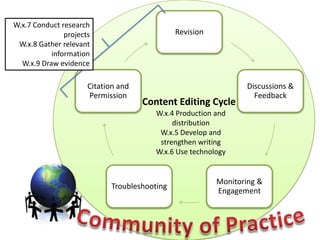
W.x.7 Conduct research
               projects                       Revision
 W.x.8 Gather relevant
           information
  W.x.9 Draw evidence

                      Citation and                              Discussions &
                      Permission                                  Feedback
                                     Content Editing Cycle
                                        W.x.4 Production and
                                             distribution
                                         W.x.5 Develop and
                                         strengthen writing
                                        W.x.6 Use technology


                                                         Monitoring &
                            Troubleshooting
                                                         Engagement
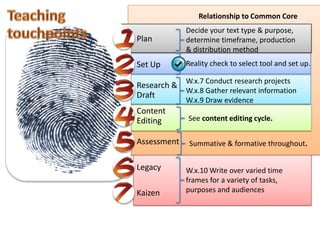
Relationship to Common Core
             Decide your text type & purpose,
Plan         determine timeframe, production
             & distribution method
Set Up       Reality check to select tool and set up.

             W.x.7 Conduct research projects
Research &
           W.x.8 Gather relevant information
Draft
             W.x.9 Draw evidence
Content
Editing       See content editing cycle.

Assessment    Summative & formative throughout.

Legacy       W.x.10 Write over varied time
             frames for a variety of tasks,
Kaizen       purposes and audiences
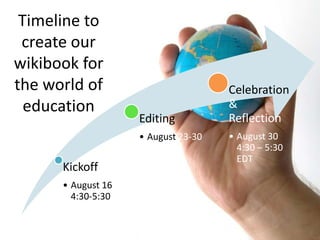
Timeline to
 create our
wikibook for
the world of                         Celebration
  education                          &
                    Editing          Reflection
                    • August 23-30   • August 30
                                       4:30 – 5:30
                                       EDT
      Kickoff
      • August 16
        4:30-5:30
Let’s invite
the world to
   join us!
Why is this
important?
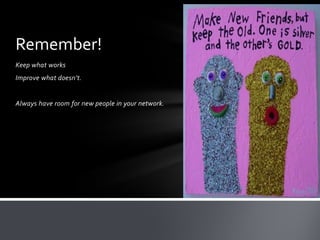
Remember!
Keep what works
Improve what doesn’t.


Always have room for new people in your network.
Questions/
conversation
#ce12 Challenge
Wikibook to Connect Educators

Connected Educator Challenge

  • 2.
    #ce12 Challenge Wikibook toConnect Educators
  • 3.
    #ce12 Challenge Why aren’tmore educators connecting?
  • 4.
    “…you can’t justdrop new innovations into a classroom and hope that the instructor will invent effective ways to use them. To fully utilize a new teaching technology, you often need to invent new teaching practices as well.” John Seely Brown, Visiting Scholar, University of Southern California Flat Classroom Conference 2011 Backchannel: Beijing, China “Web 2 Kung Fu” speedsharing invented todaysmeet.com/ccssiste
  • 5.
    Community of Practice •“communities of practice are formed by people who engage in a process of collective learning in a shared domain of human endeavor.” (Lave and Wegner) Backchannel: todaysmeet.com/ccssiste #ccsiste
  • 6.
    5 Pillars ofWikipedia PURPOSE: 1. Wikipedia is an online encyclopedia. POINT OF VIEW: 2. Wikipedia is written from a neutral point of view. LICENSING AND COPYRIGHT: 3. Wikipedia is free content that anyone can edit, use, modify, and distribute. COMMUNITY GUIDELINES: 4. Editors should interact with each other in a respectful and civil manner. RULES: 5. Wikipedia does not have firm rules.
  • 7.
    Community guidelines forclassroom spaces. 1. PURPOSE: What is the purpose of your website, web page, or document? 2. POINT OF VIEW: What person or perspective is appropriate? 3. LICENSING AND COPYRIGHT: What is the licensing of work posted to the site you are using? Who owns the work? What are the requirements for citing sources of work? Does the publication method and license use require additional permissions from those who are cited in the work? 4. COMMUNITY GUIDELINES: Technology. Do members have an adequate grasp of the technology skills required to use the platform and troubleshoot problems? What online and community support is in place to help? Technopersonal. Have students learned to assume good faith on the part of other students and self-regulate responses when problems happen? 5. RULES: What are the rules of your community? Do they evolve? What decisions are reserved for teachers?
  • 8.
    Community guidelines forThis Project 1. PURPOSE: To create a living document to help educators in all disciplines to easily connect with others while raising the quality of discussions about collaborative scholarly work through a real-world experience as part of Connected Educators month 2012. This purpose may evolve . 2. POINT OF VIEW: Third person is preferred unless it is a quotation which may be in first person. 3. LICENSING AND COPYRIGHT: Creative Commons License Attribution 3.0 Unported License. Link to works. Make sure that if you quote it, that it can be shared freely with others under our license. We want anyone to be able to freely use what we write. Please put direct quotes in quotations with a link. Include Twitter handles, and blogs for each person cited. 4. COMMUNITY GUIDELINES: Technology. Wikispaces help on top right side. You will have volunteers to help on the help page or if you’re on twitter, ,talk and share at #ce12challenge Technopersonal. Assume good faith on the part of other participants and self-regulate responses when problems happen. 5. RULES: Edit and share on page http://connectededucators.wikispaces.com/Community+Guidelines
  • 9.
    W.x.7 Conduct research projects Revision W.x.8 Gather relevant information W.x.9 Draw evidence Citation and Discussions & Permission Feedback Content Editing Cycle W.x.4 Production and distribution W.x.5 Develop and strengthen writing W.x.6 Use technology Monitoring & Troubleshooting Engagement
  • 10.
    Relationship to CommonCore Decide your text type & purpose, Plan determine timeframe, production & distribution method Set Up Reality check to select tool and set up. W.x.7 Conduct research projects Research & W.x.8 Gather relevant information Draft W.x.9 Draw evidence Content Editing See content editing cycle. Assessment Summative & formative throughout. Legacy W.x.10 Write over varied time frames for a variety of tasks, Kaizen purposes and audiences
  • 11.
    Timeline to createour wikibook for the world of Celebration education & Editing Reflection • August 23-30 • August 30 4:30 – 5:30 EDT Kickoff • August 16 4:30-5:30
  • 12.
  • 13.
  • 14.
    Remember! Keep what works Improvewhat doesn’t. Always have room for new people in your network.
  • 15.
  • 16.
    #ce12 Challenge Wikibook toConnect Educators

Editor's Notes

  • #14 Many people talk and whine. Others pontificate. We ACT. We will make it simple for others to join in online conversations by being welcoming and creating something that can be shared EVERYWHERE! Join us!
  • #16 Many people talk and whine. Others pontificate. We ACT. We will make it simple for others to join in online conversations by being welcoming and creating something that can be shared EVERYWHERE! Join us!