OPEN RESEARCH
CREET Academy, 11th January 2019
Dr. Rob Farrow
Dr. Beck Pitt
OER Hub / IET / LTI A / WELS
rob.farrow@open.ac.uk
@philosopher1978
2
01 Exploring Openness
A look at notions of openness and reasons to be open
02 Openness through the Research Cycle
Understanding openness as a feature of the entire
research process
03 Openness and Impact
Openness can be a route to impact
04 Benefits & Risks
An overview
05 Tips & Resources
Some materials that may be useful
06 Reflections
Concluding remarks and discussion
STRUCTURE
Exploring Openness
A look at notions of openness and reasons to be open
4
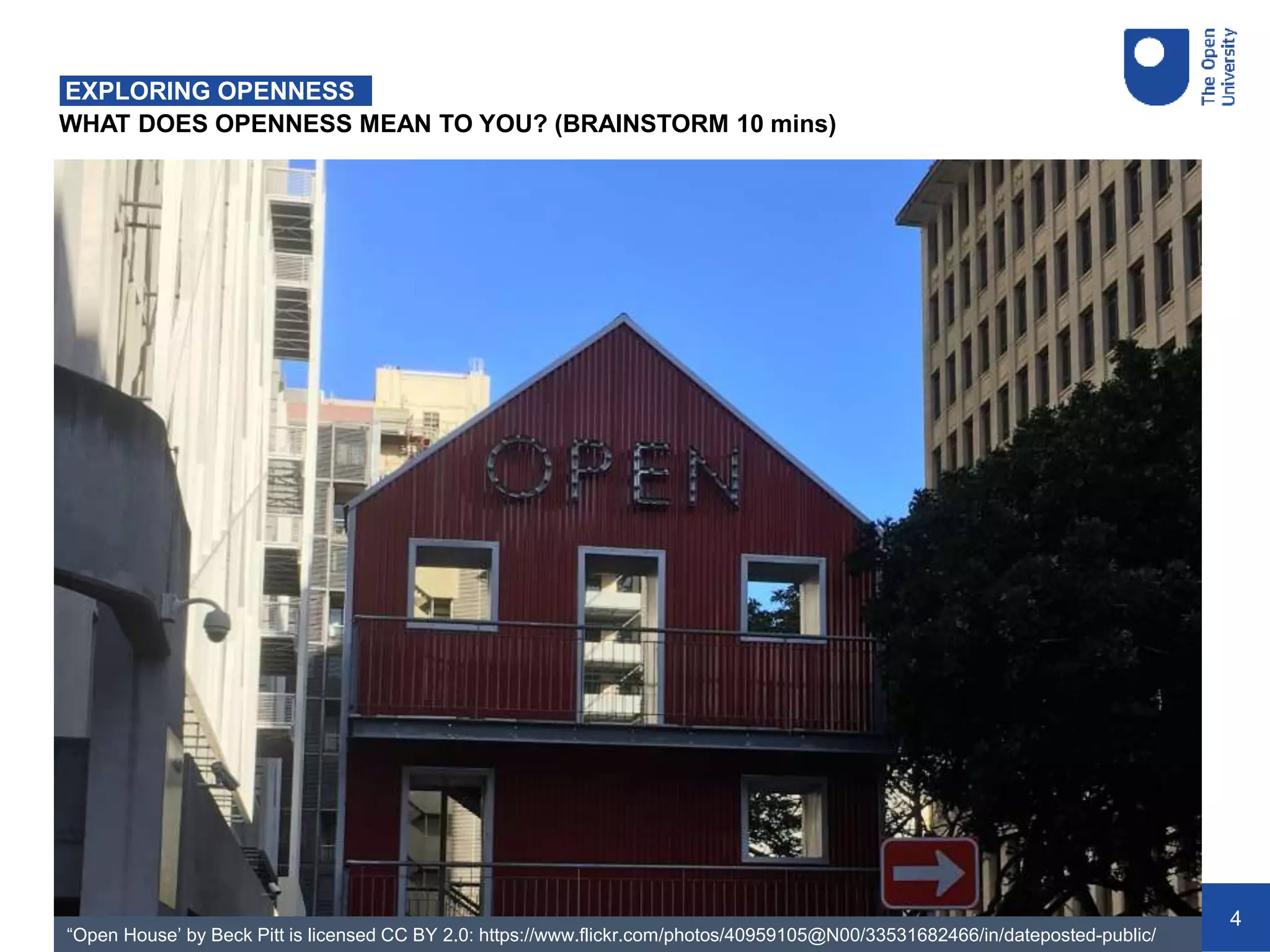
WHAT DOES OPENNESS MEAN TO YOU? (BRAINSTORM 10 mins)
EXPLORING OPENNESS
“Open House’ by Beck Pitt is licensed CC BY 2.0: https://www.flickr.com/photos/40959105@N00/33531682466/in/dateposted-public/
5
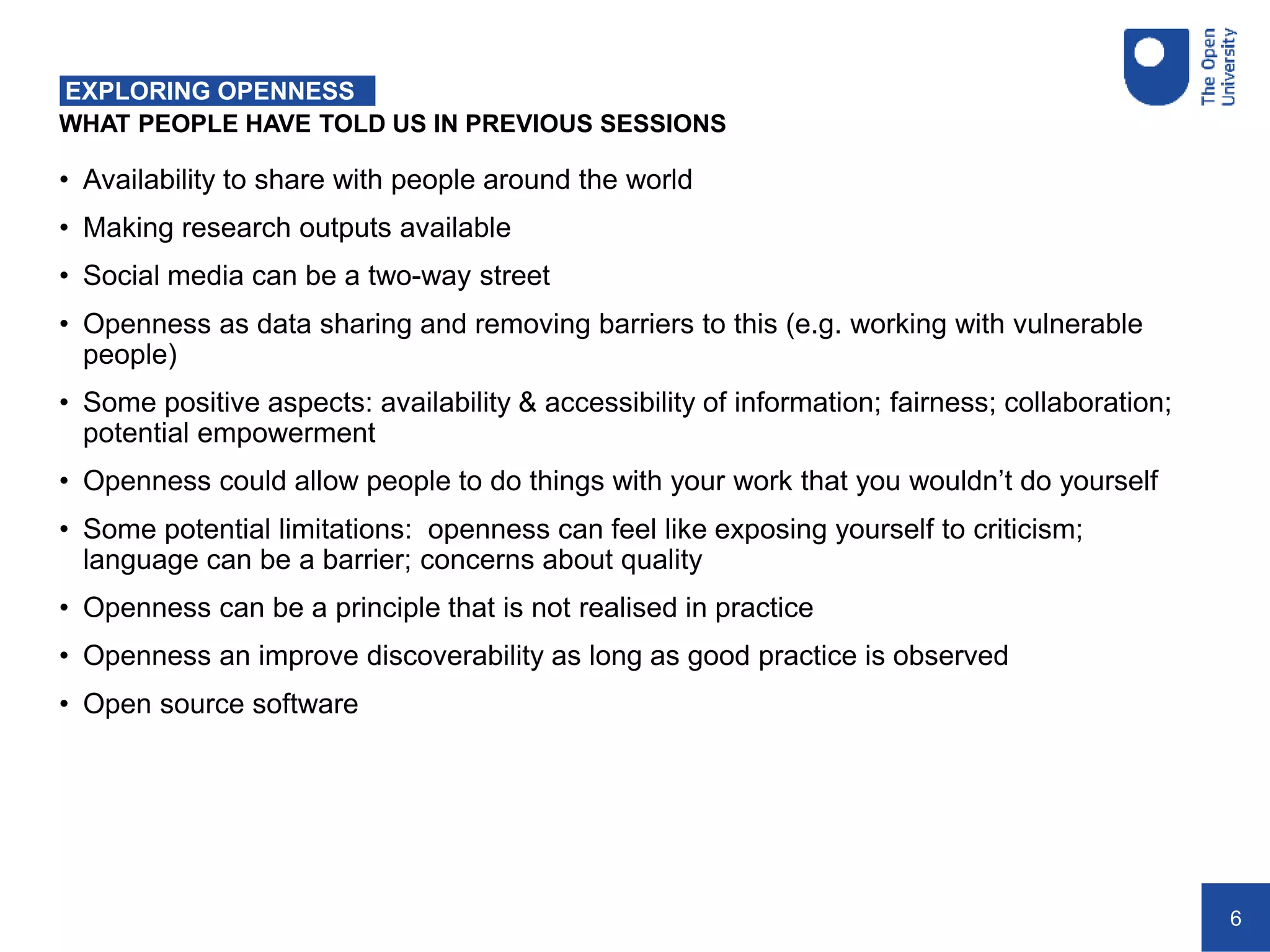
VITAE FRAMEWORK
EXPLORING OPENNESS
OPEN ACCESS
• Making scholarly publications available (online) to anyone regardless of their ability to pay
• Non-traditional dissemination strategies
OPEN DATA
• Making (raw) research data available to anyone for interrogation and reuse
OPEN PLATFORMS, TOOLS & SERVICES
• Opening access to code and software
• Tools to promote efficiency in research and scholarly communication
AN OPEN APPROACH TO CONDUCTING RESEARCH
• Open and collaborative approaches
• Stakeholder involvement
TRANSPARENCY AND PUBLIC ENGAGEMENT
• Raising awareness of research outputs more widely
6
WHAT PEOPLE HAVE TOLD US IN PREVIOUS SESSIONS
EXPLORING OPENNESS
• Availability to share with people around the world
• Making research outputs available
• Social media can be a two-way street
• Openness as data sharing and removing barriers to this (e.g. working with vulnerable
people)
• Some positive aspects: availability & accessibility of information; fairness; collaboration;
potential empowerment
• Openness could allow people to do things with your work that you wouldn’t do yourself
• Some potential limitations: openness can feel like exposing yourself to criticism;
language can be a barrier; concerns about quality
• Openness can be a principle that is not realised in practice
• Openness an improve discoverability as long as good practice is observed
• Open source software
7
AN ETHOS OF OPEN?
EXPLORING OPENNESS
Values: Commitment to social justice, parity of participation (Hodgkinson-Williams &
Trotter, 2018); widening participation (Gourley & Lane, 2009); human rights (Blessinger &
Bliss, 2016); duty (Caswell, Henson, Jensen & Wiley, 2008)
Plasticity/Agility: An excellent candidate for sloganizing is the word ‘open.’ Immediately
one uses it, the options polarize. To be open (depending on context) is to be not closed,
restricted, prejudiced or clogged; but free, candid, generous, above board, mentally
flexible, future oriented. (Hill, 2010[1975]:2)
Authenticity: I can list for you any number of examples of companies and organizations
that have attached that word “open” to their products and services […] All these append
“open” to a name without really even trying to append “openness,” let alone embrace
“openness," to their practices or mission. Whatever “openness” means. (Watters, 2014)
Ethos: Atenas and Havemann (2014) commented: “Notwithstanding the problematic
nature of the term ‘open’ when used in wider contexts, there does seem to be a shared
understanding of an underlying ethos of openness…”
Pragmatism: Not only are there different aspects of openness, but it may be that some are
mutually exclusive with others, or at least that prioritising some means less emphasis on
others. One way to consider openness is to consider the motivations people have for
adopting an open approach. (Weller, 2015:32)
8
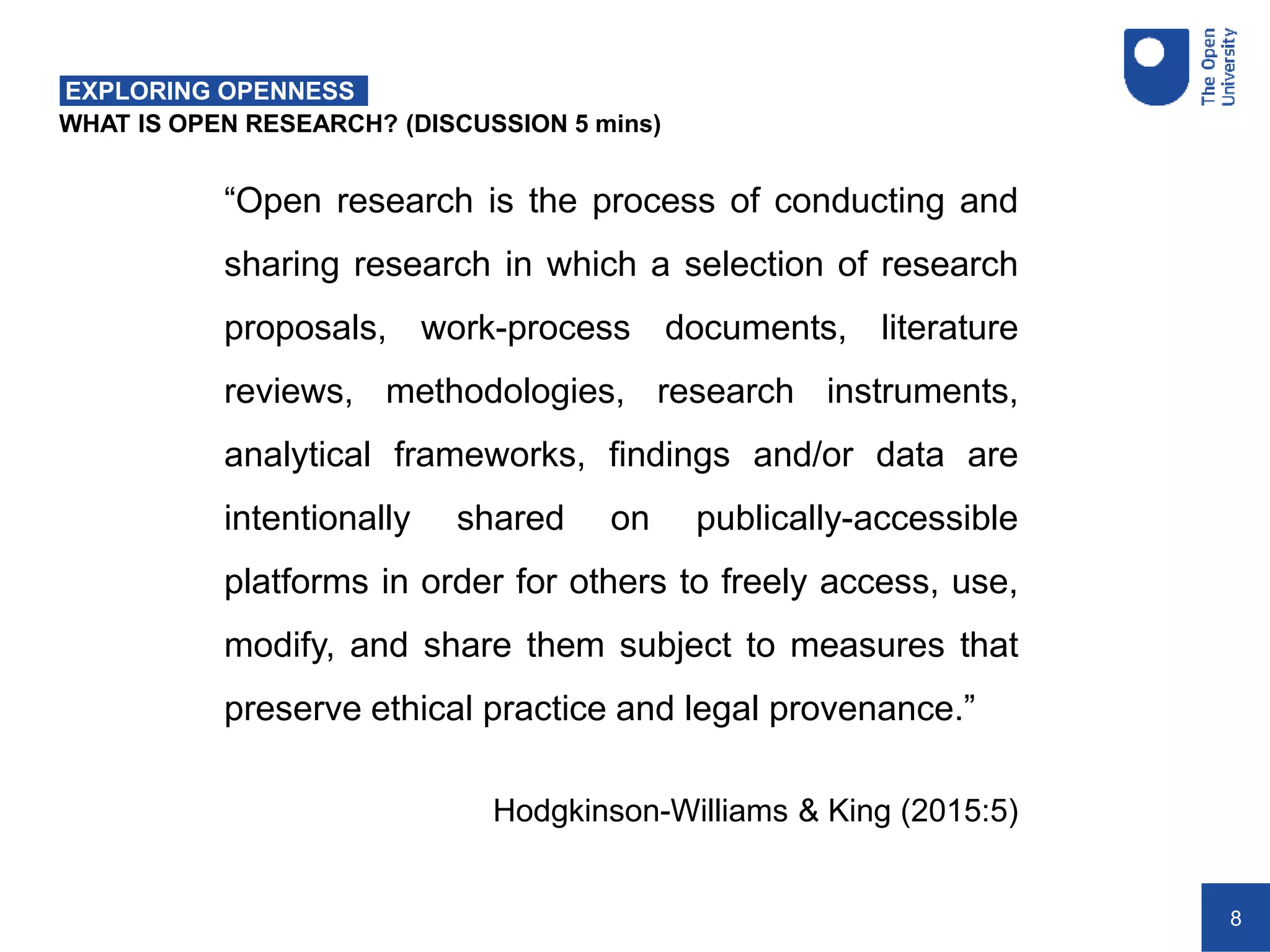
WHAT IS OPEN RESEARCH? (DISCUSSION 5 mins)
EXPLORING OPENNESS
“Open research is the process of conducting and
sharing research in which a selection of research
proposals, work-process documents, literature
reviews, methodologies, research instruments,
analytical frameworks, findings and/or data are
intentionally shared on publically-accessible
platforms in order for others to freely access, use,
modify, and share them subject to measures that
preserve ethical practice and legal provenance.”
Hodgkinson-Williams & King (2015:5)
Openness through the
Research Cycle
Understanding openness as a feature of the entire
research process
10
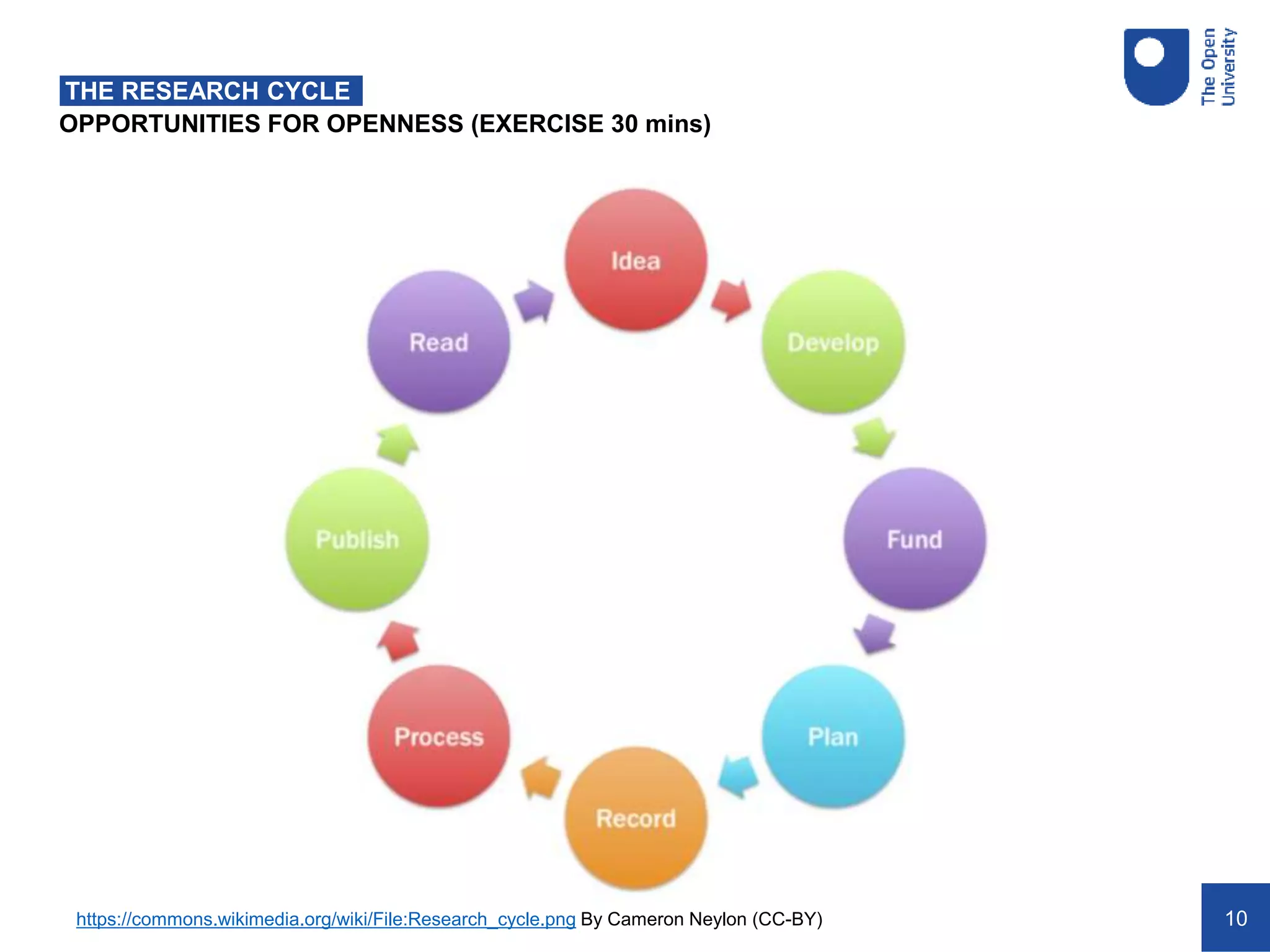
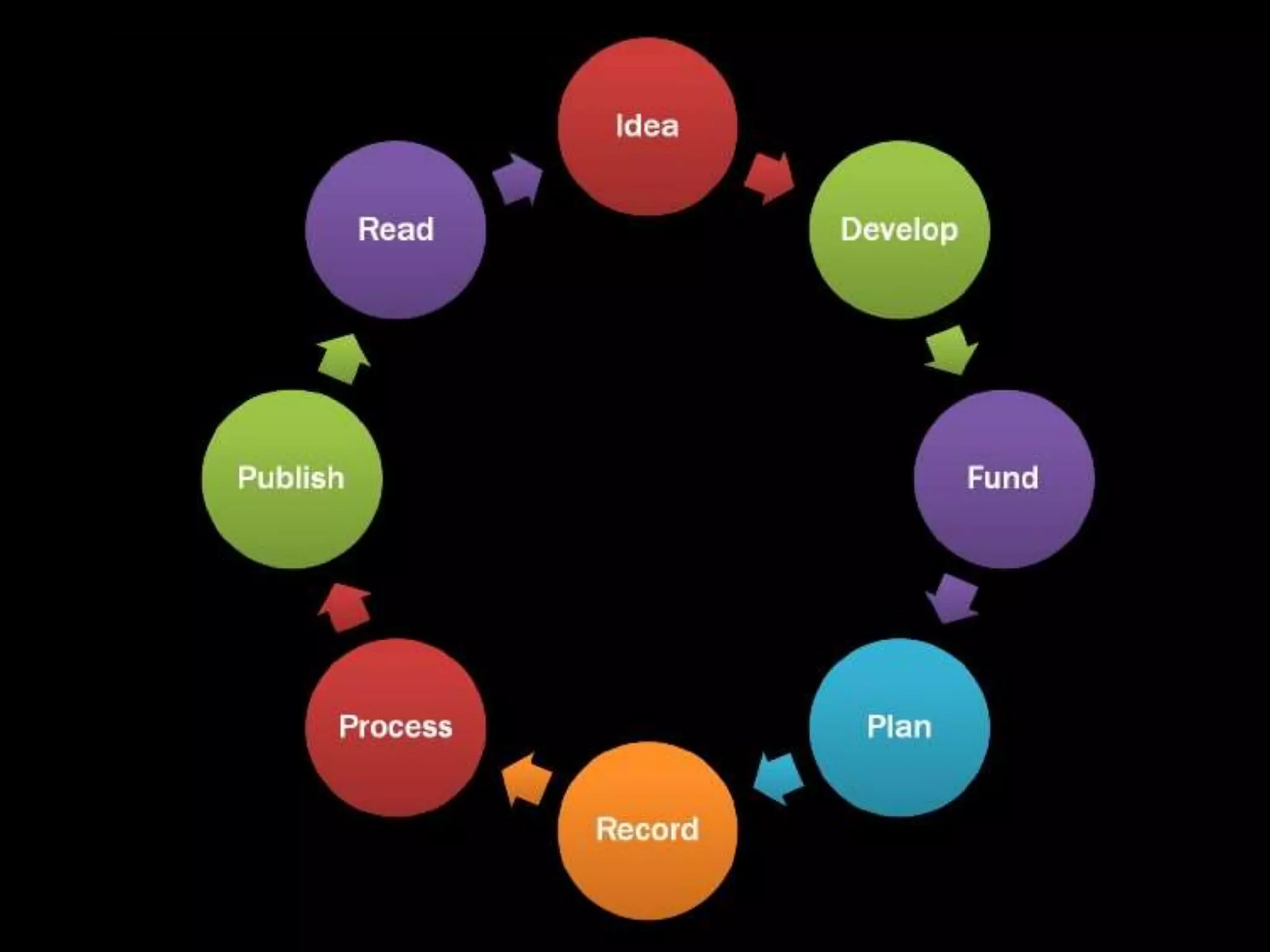
THE RESEARCH CYCLE
OPPORTUNITIES FOR OPENNESS (EXERCISE 30 mins)
https://commons.wikimedia.org/wiki/File:Research_cycle.png By Cameron Neylon (CC-BY)
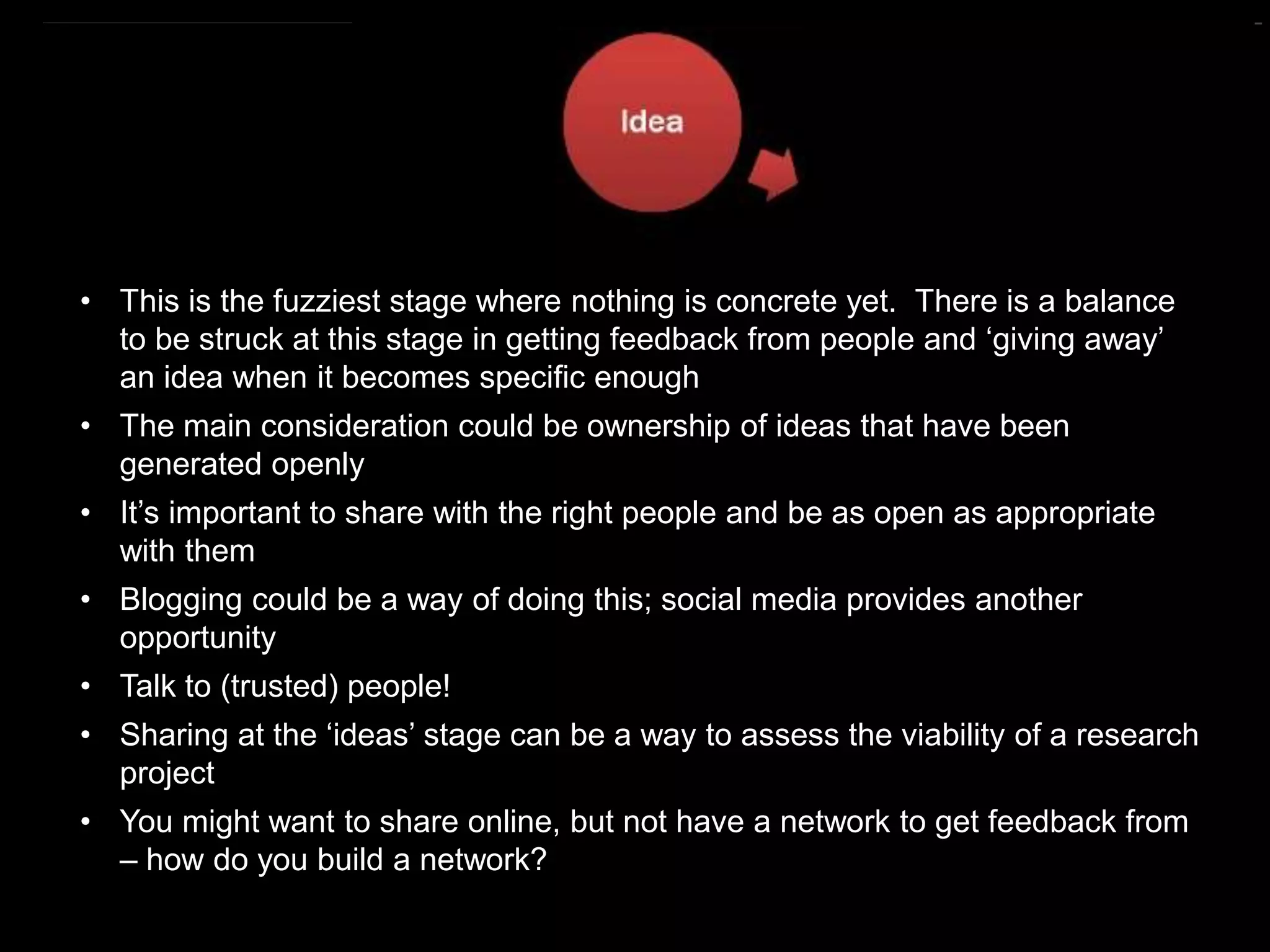
• This is the fuzziest stage where nothing is concrete yet. There is a balance
to be struck at this stage in getting feedback from people and ‘giving away’
an idea when it becomes specific enough
• The main consideration could be ownership of ideas that have been
generated openly
• It’s important to share with the right people and be as open as appropriate
with them
• Blogging could be a way of doing this; social media provides another
opportunity
• Talk to (trusted) people!
• Sharing at the ‘ideas’ stage can be a way to assess the viability of a research
project
• You might want to share online, but not have a network to get feedback from
– how do you build a network?
https://commons.wikimedia.org/wiki/File:Research_cycle.png By Cameron Neylon (CC-BY)
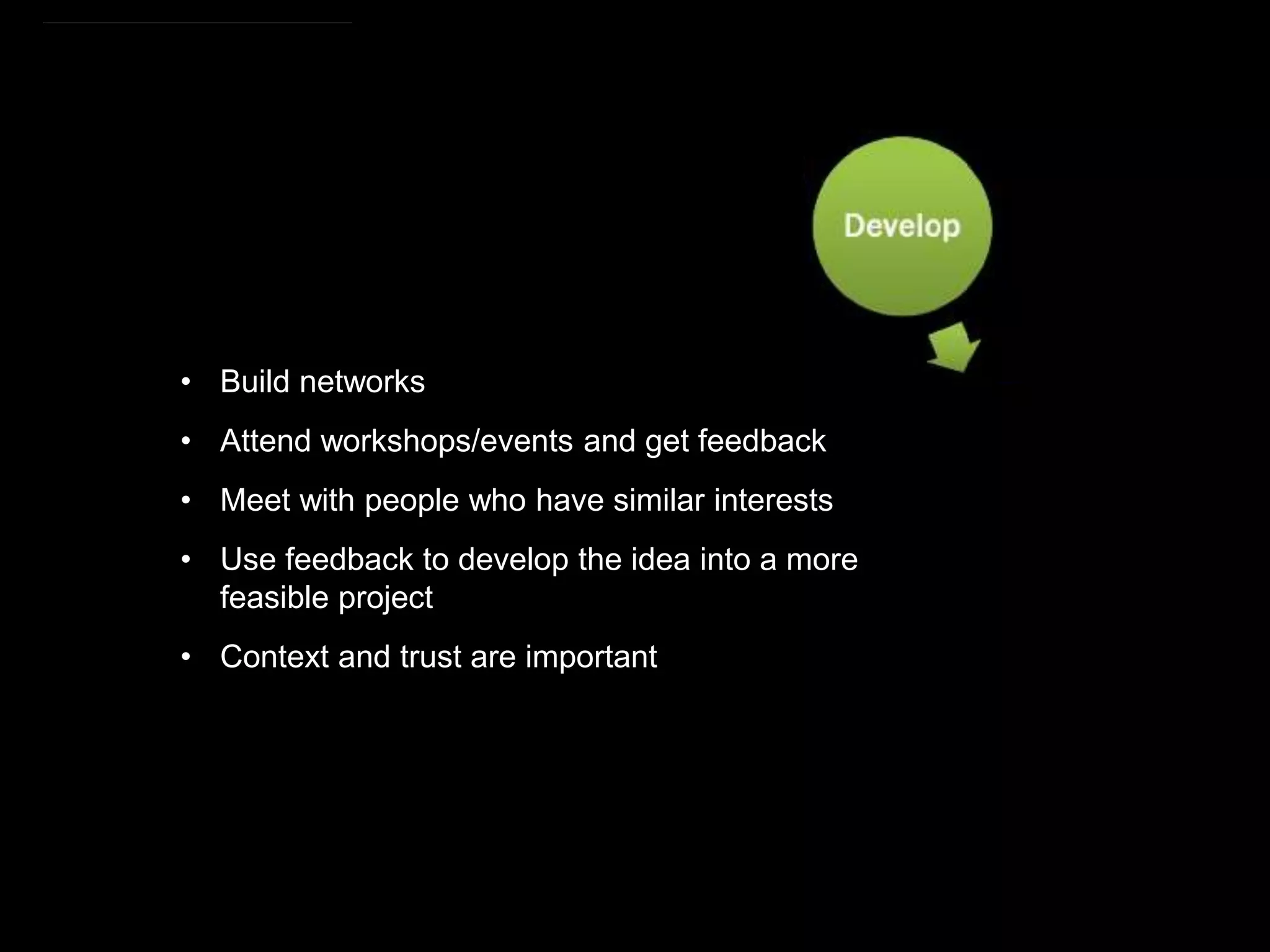
• Build networks
• Attend workshops/events and get feedback
• Meet with people who have similar interests
• Use feedback to develop the idea into a more
feasible project
• Context and trust are important
https://commons.wikimedia.org/wiki/File:Research_cycle.png By Cameron Neylon (CC-BY)
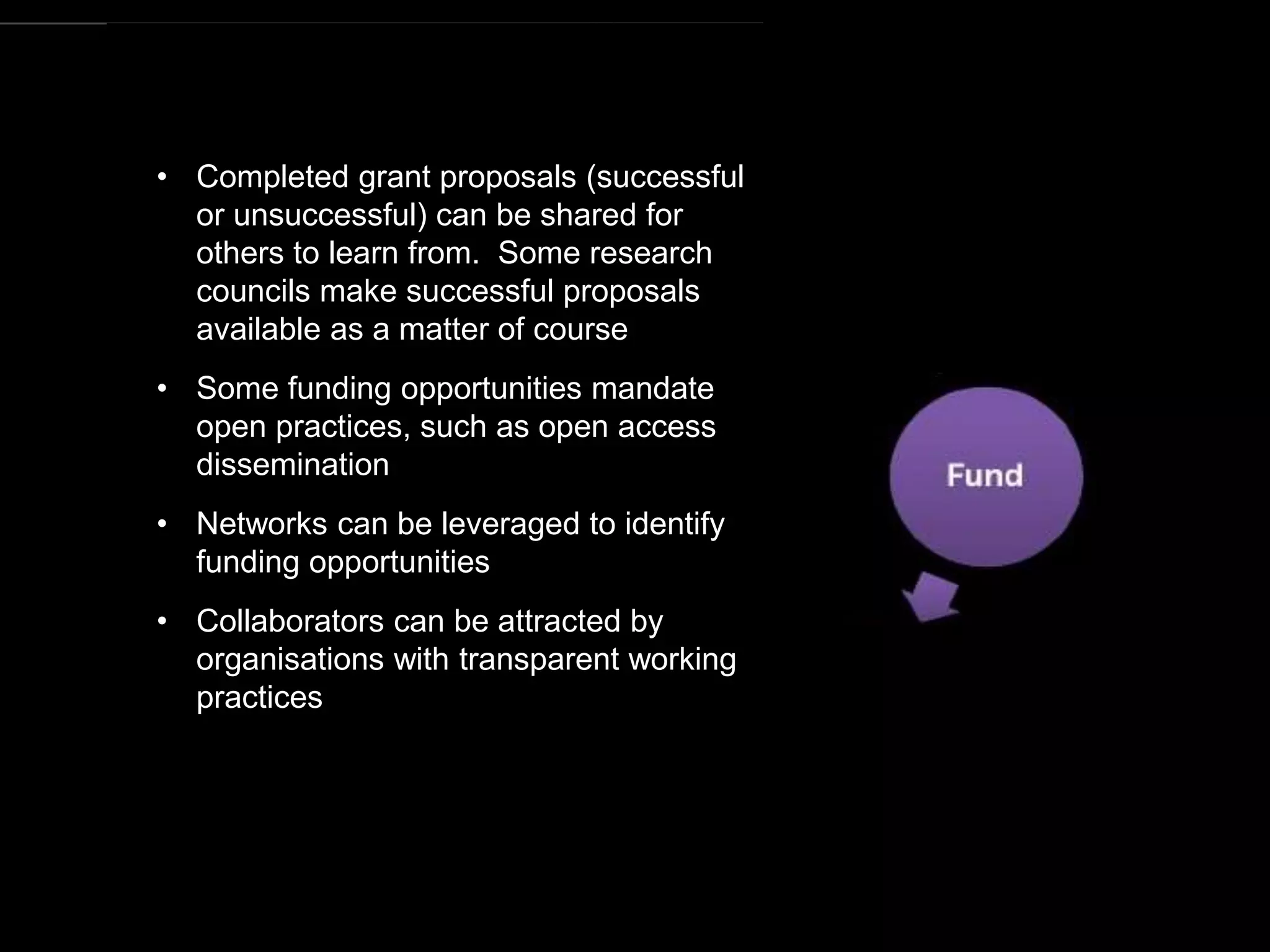
• Completed grant proposals (successful
or unsuccessful) can be shared for
others to learn from. Some research
councils make successful proposals
available as a matter of course
• Some funding opportunities mandate
open practices, such as open access
dissemination
• Networks can be leveraged to identify
funding opportunities
• Collaborators can be attracted by
organisations with transparent working
practices
https://commons.wikimedia.org/wiki/File:Research_cycle.png By Cameron Neylon (CC-BY)https://commons.wikimedia.org/wiki/File:Research_cycle.png By Cameron Neylon (CC-BY)
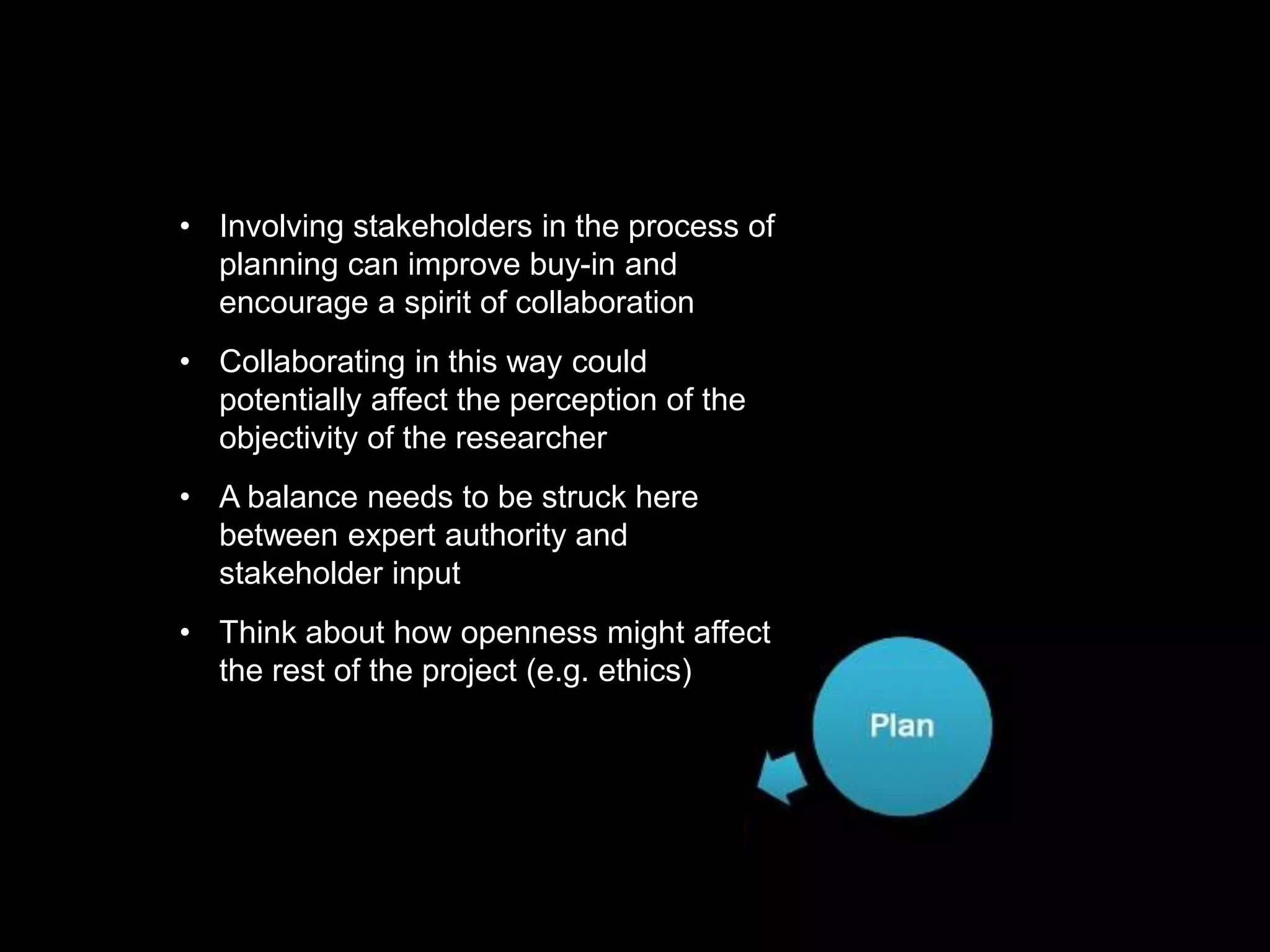
• Involving stakeholders in the process of
planning can improve buy-in and
encourage a spirit of collaboration
• Collaborating in this way could
potentially affect the perception of the
objectivity of the researcher
• A balance needs to be struck here
between expert authority and
stakeholder input
• Think about how openness might affect
the rest of the project (e.g. ethics)
https://commons.wikimedia.org/wiki/File:Research_cycle.png By Cameron Neylon (CC-BY)
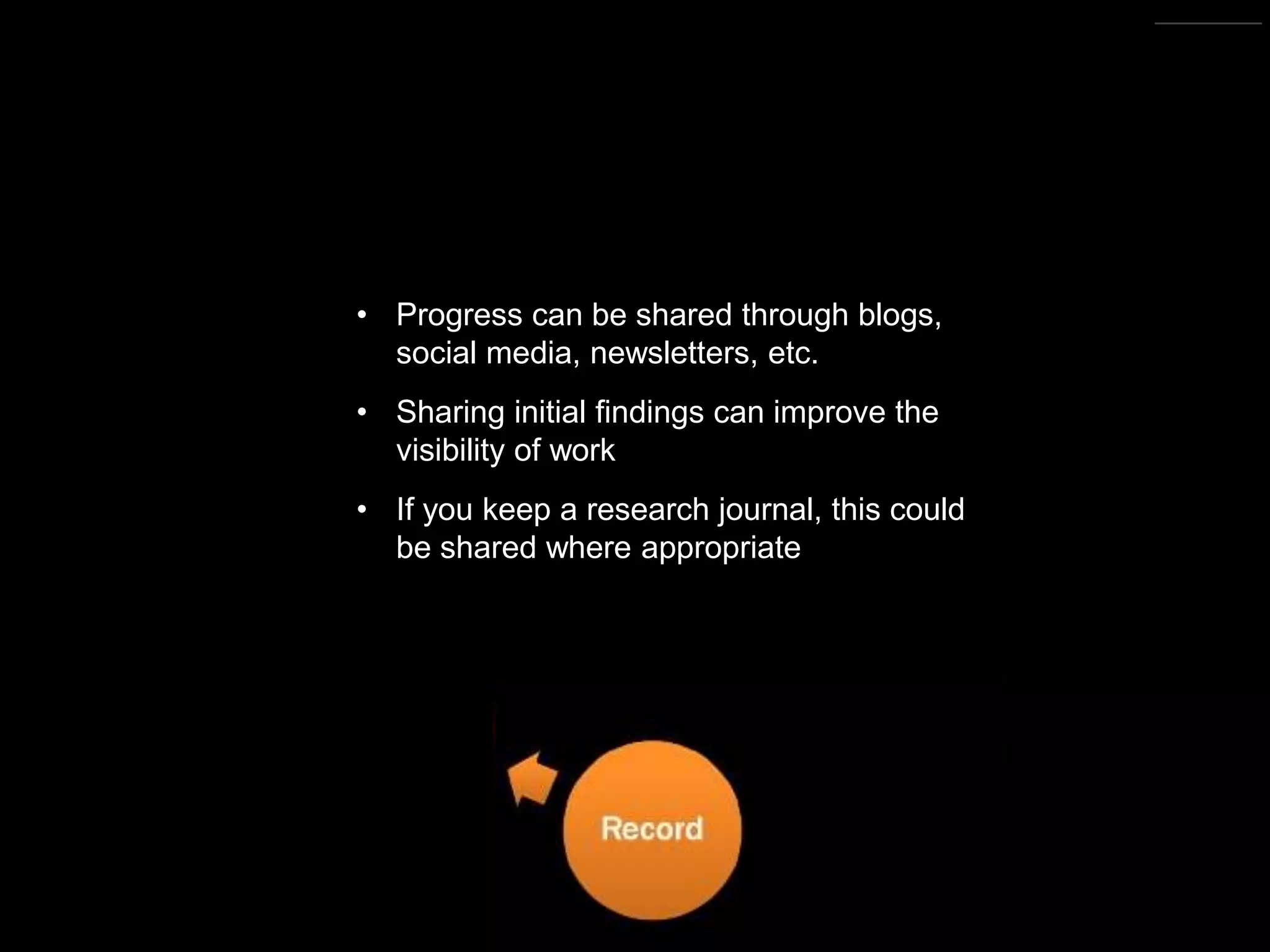
• Progress can be shared through blogs,
social media, newsletters, etc.
• Sharing initial findings can improve the
visibility of work
• If you keep a research journal, this could
be shared where appropriate
https://commons.wikimedia.org/wiki/File:Research_cycle.png By Cameron Neylon (CC-BY)
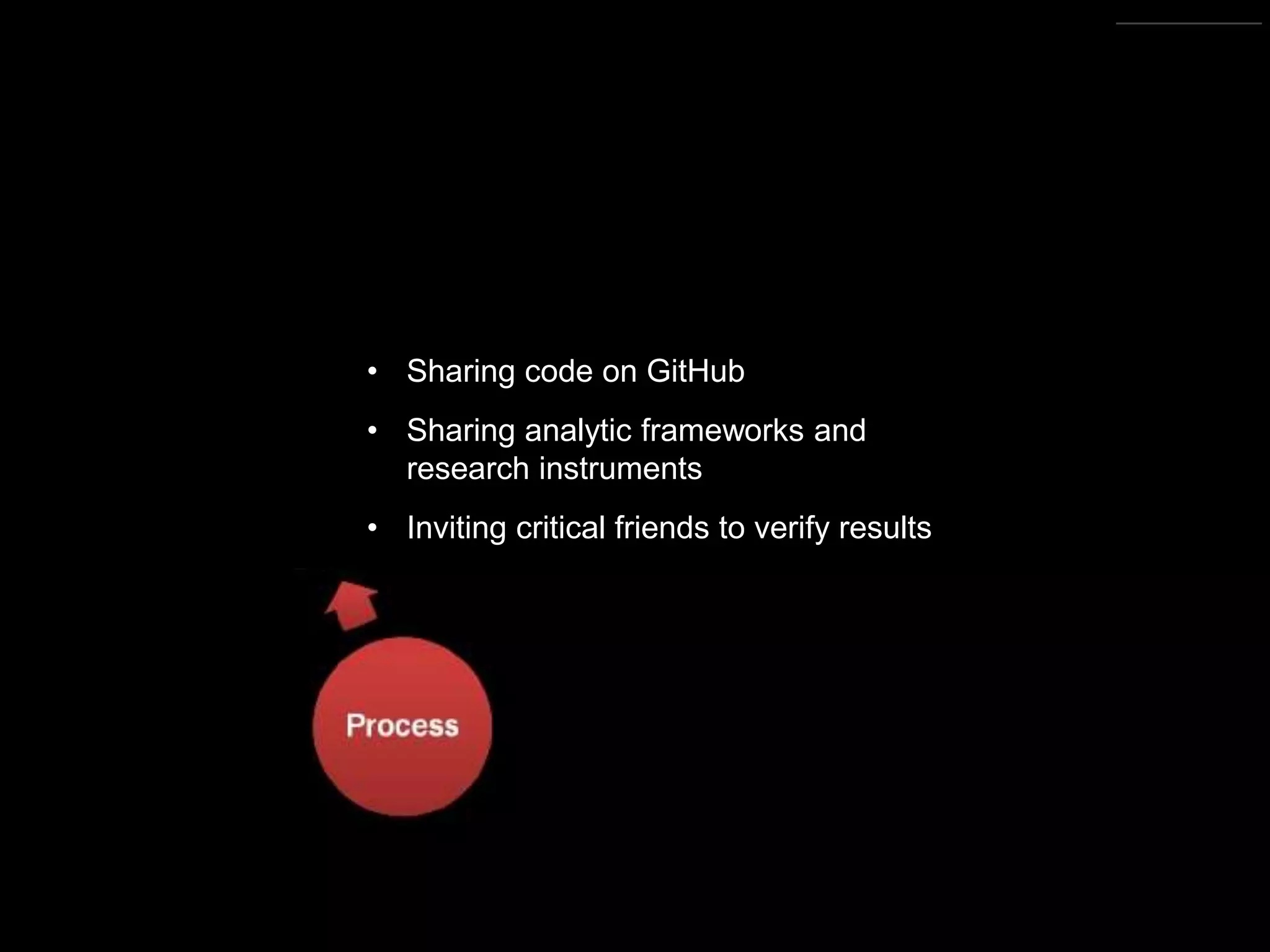
• Sharing code on GitHub
• Sharing analytic frameworks and
research instruments
• Inviting critical friends to verify results
https://commons.wikimedia.org/wiki/File:Research_cycle.png By Cameron Neylon (CC-BY)
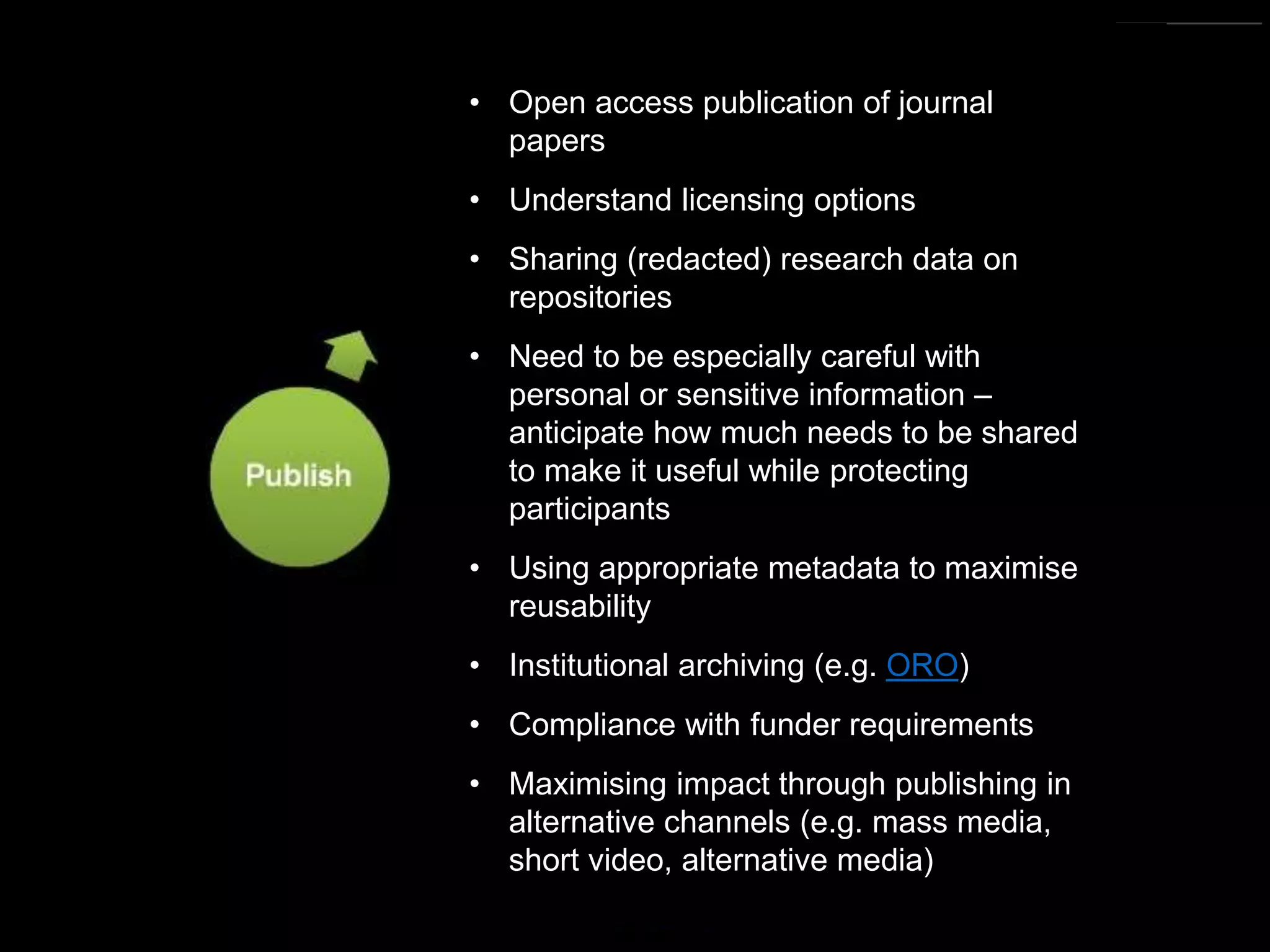
• Open access publication of journal
papers
• Understand licensing options
• Sharing (redacted) research data on
repositories
• Need to be especially careful with
personal or sensitive information –
anticipate how much needs to be shared
to make it useful while protecting
participants
• Using appropriate metadata to maximise
reusability
• Institutional archiving (e.g. ORO)
• Compliance with funder requirements
• Maximising impact through publishing in
alternative channels (e.g. mass media,
short video, alternative media)
https://commons.wikimedia.org/wiki/File:Research_cycle.png By Cameron Neylon (CC-BY)
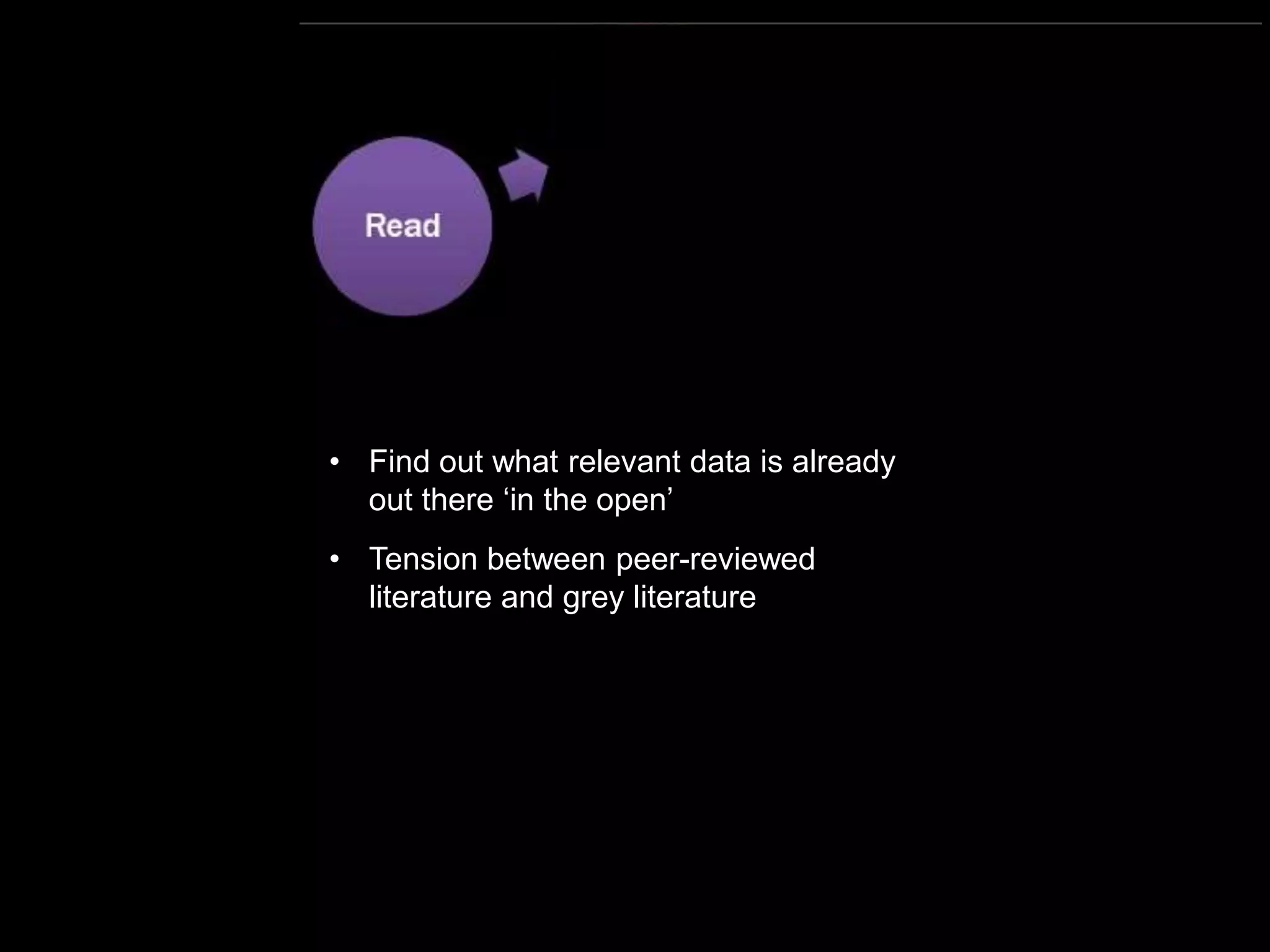
• Find out what relevant data is already
out there ‘in the open’
• Tension between peer-reviewed
literature and grey literature
Benefits and Risks
An overview of the effects of being open
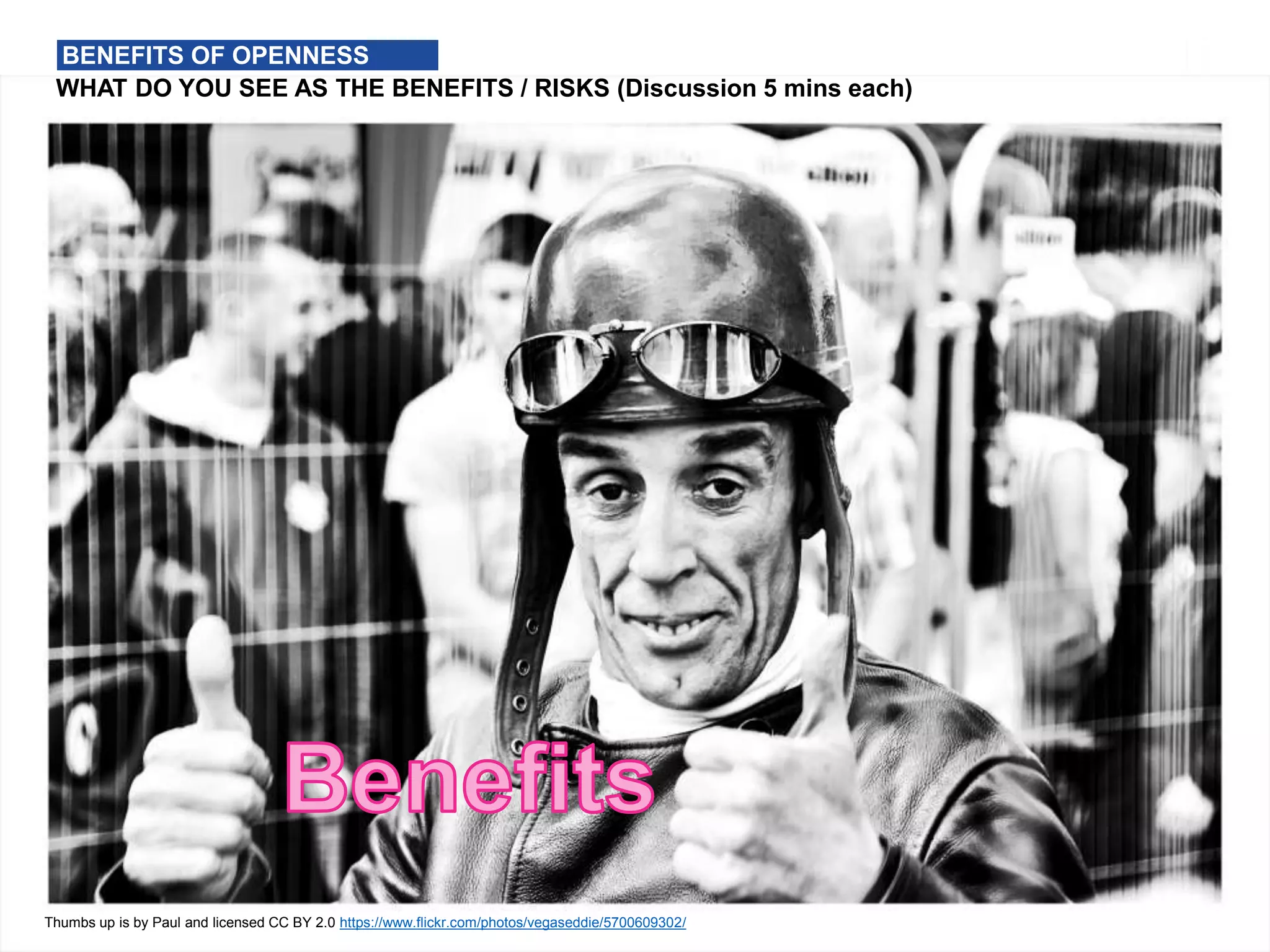
Thumbs up is by Paul and licensed CC BY 2.0 https://www.flickr.com/photos/vegaseddie/5700609302/
WHAT DO YOU SEE AS THE BENEFITS / RISKS (Discussion 5 mins each)
BENEFITS OF OPENNESS
By Alex E. Proimos (http://www.flickr.com/photos/proimos/4199675334/) [CC BY 2.0 (http://creativecommons.org/licenses/by/2.0)], via Wikimedia Commons
23
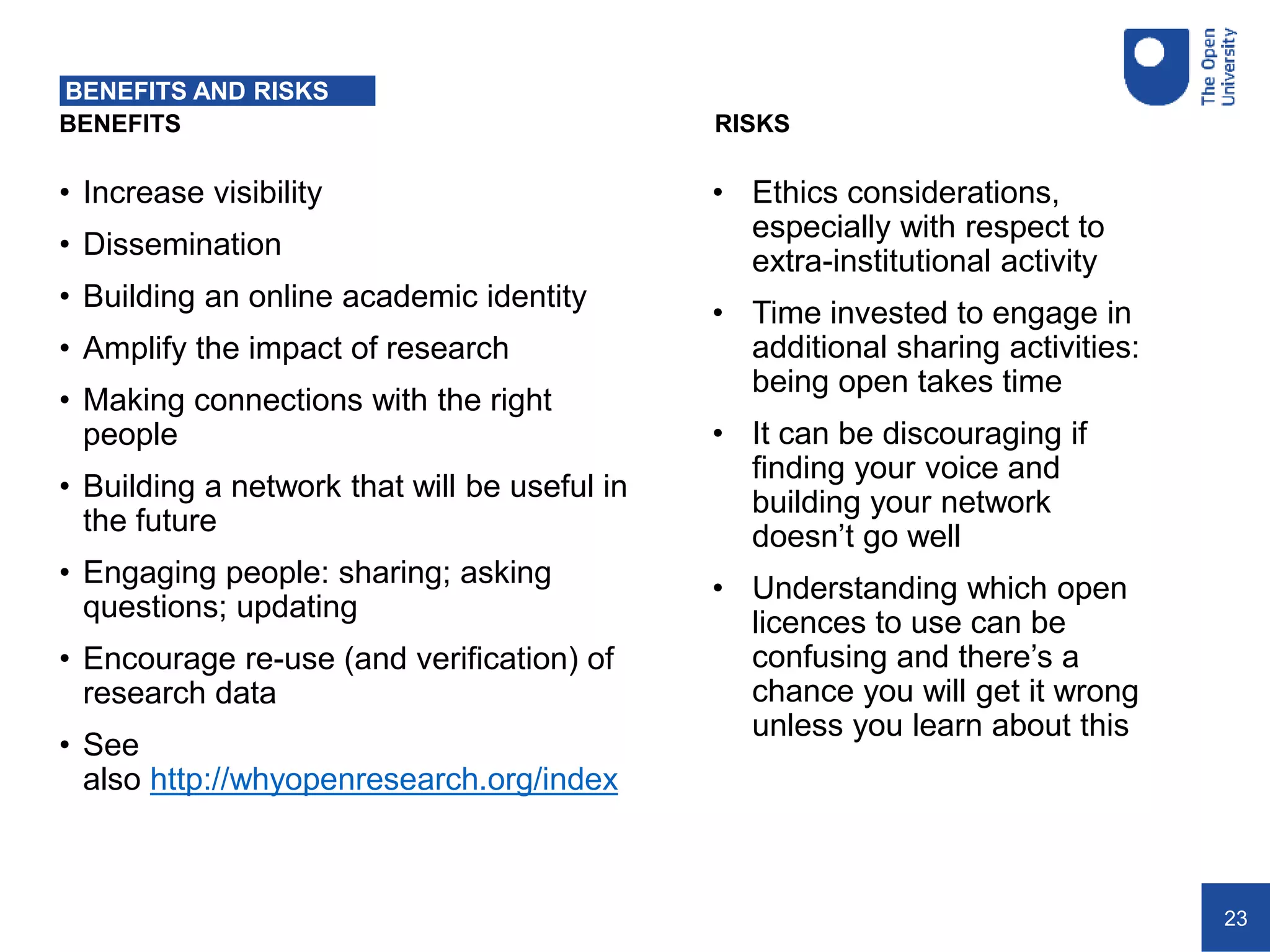
BENEFITS RISKS
BENEFITS AND RISKS
• Increase visibility
• Dissemination
• Building an online academic identity
• Amplify the impact of research
• Making connections with the right
people
• Building a network that will be useful in
the future
• Engaging people: sharing; asking
questions; updating
• Encourage re-use (and verification) of
research data
• See
also http://whyopenresearch.org/index
• Ethics considerations,
especially with respect to
extra-institutional activity
• Time invested to engage in
additional sharing activities:
being open takes time
• It can be discouraging if
finding your voice and
building your network
doesn’t go well
• Understanding which open
licences to use can be
confusing and there’s a
chance you will get it wrong
unless you learn about this
Openness and Impact
Perspectives
http://oerhub.net
• Building capacity in the OER research domain
• Conducting research into open education and OER
• Producing resources for the open education research
community
• Acting as champions for open practices in research and
scholarship
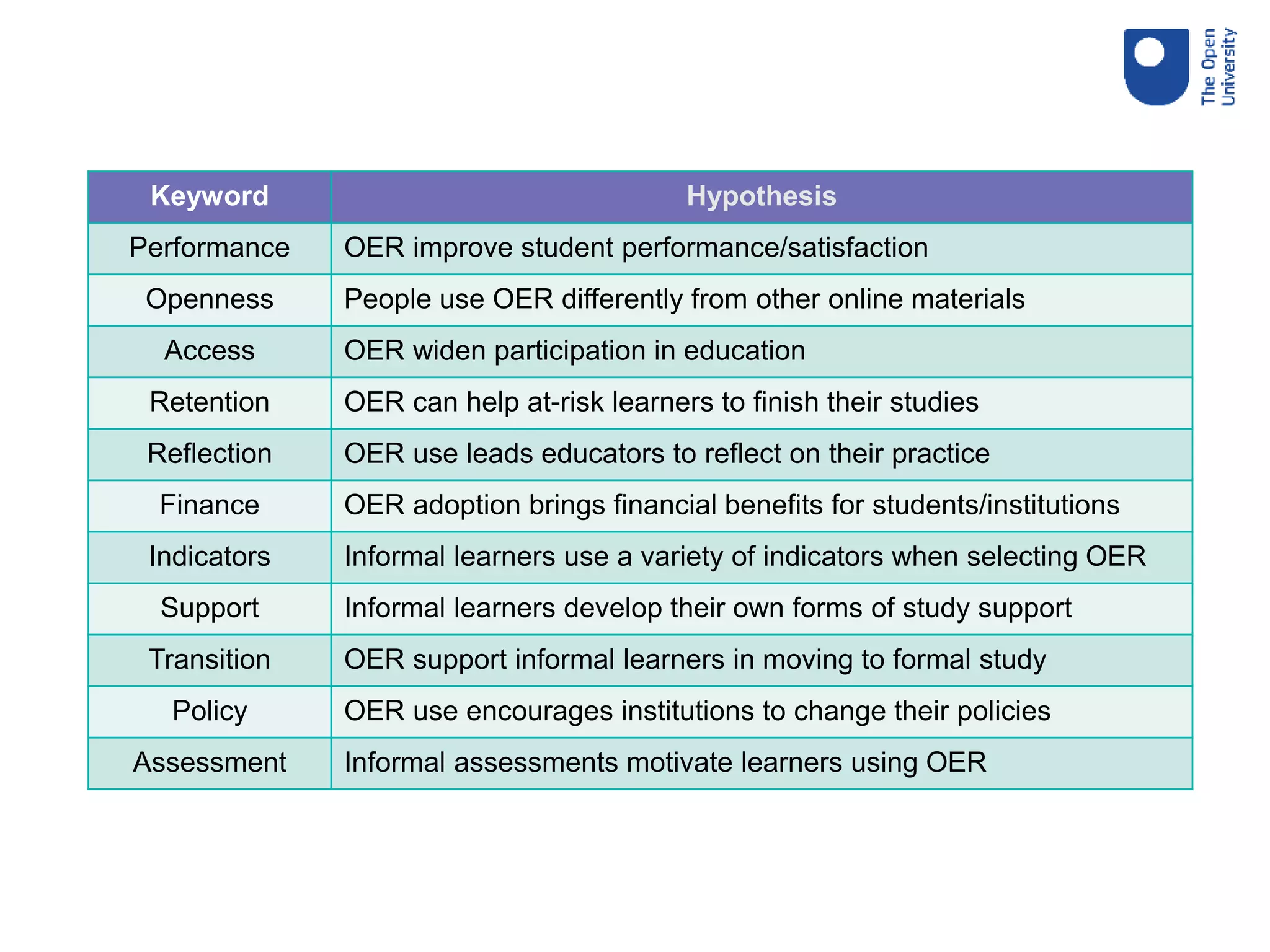
Keyword Hypothesis
Performance OER improve student performance/satisfaction
Openness People use OER differently from other online materials
Access OER widen participation in education
Retention OER can help at-risk learners to finish their studies
Reflection OER use leads educators to reflect on their practice
Finance OER adoption brings financial benefits for students/institutions
Indicators Informal learners use a variety of indicators when selecting OER
Support Informal learners develop their own forms of study support
Transition OER support informal learners in moving to formal study
Policy OER use encourages institutions to change their policies
Assessment Informal assessments motivate learners using OER
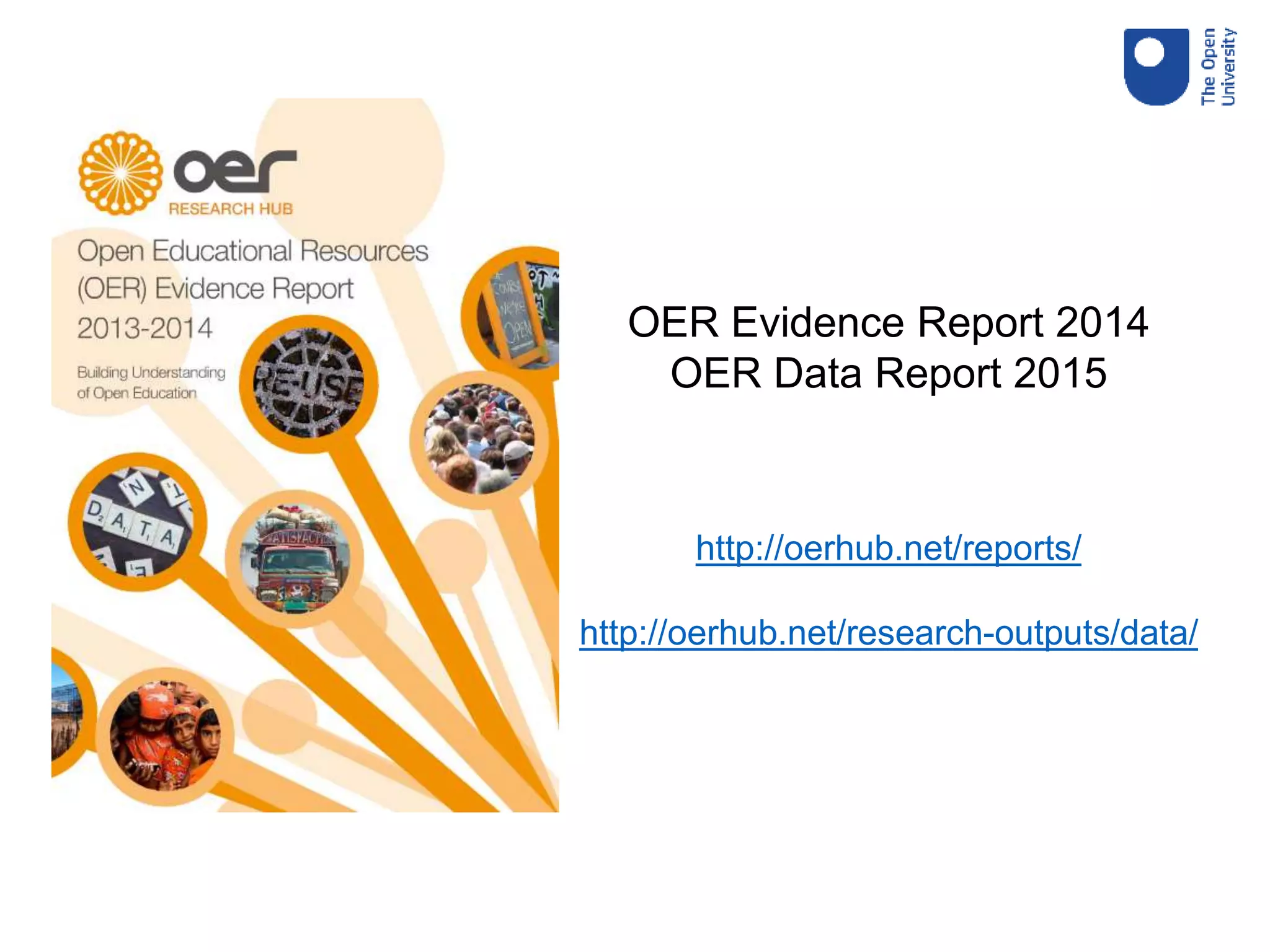
Project Co-PILOT
OER Evidence Report 2014
OER Data Report 2015
http://oerhub.net/reports/
http://oerhub.net/research-outputs/data/
31
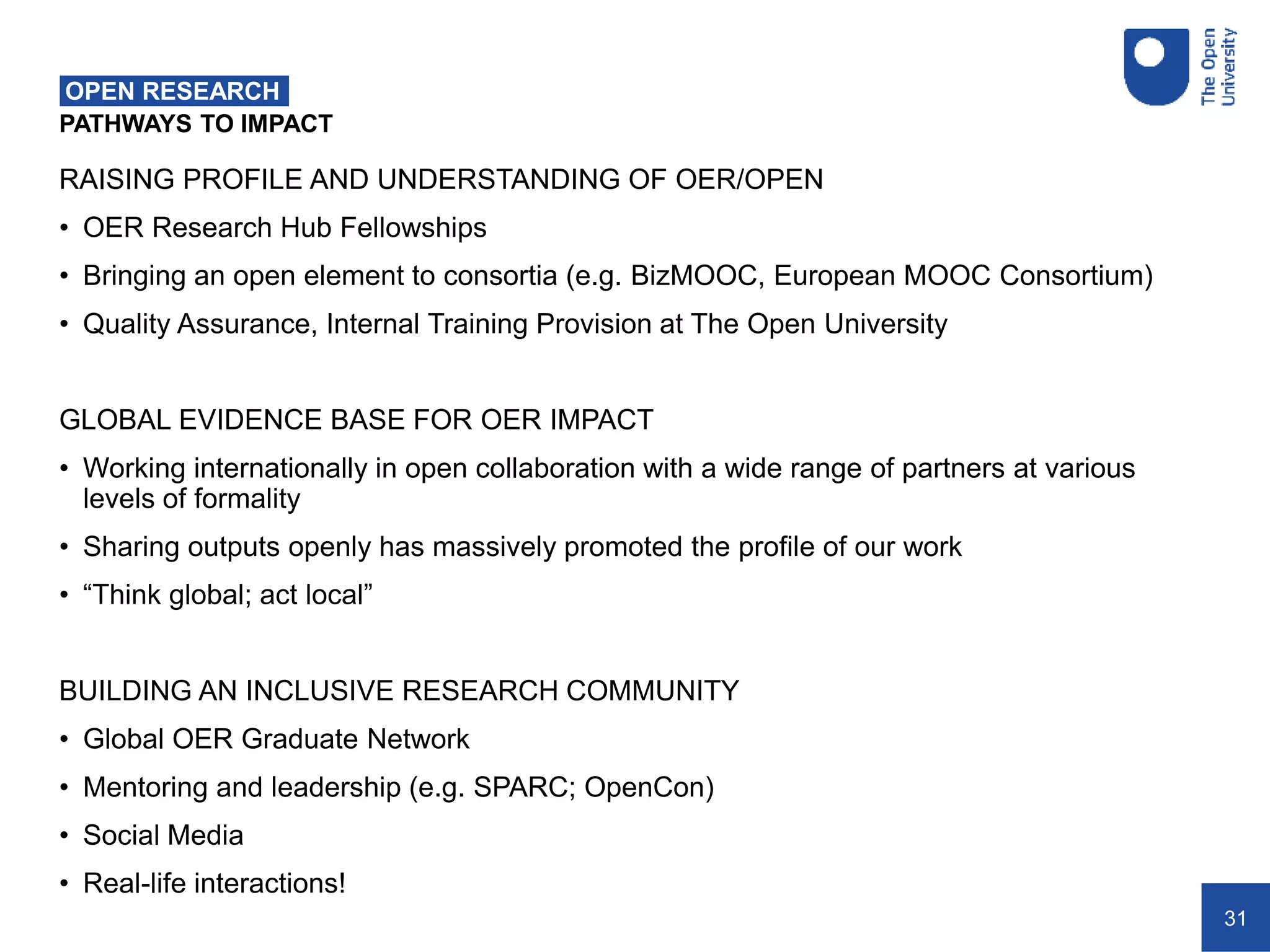
PATHWAYS TO IMPACT
OPEN RESEARCH
RAISING PROFILE AND UNDERSTANDING OF OER/OPEN
• OER Research Hub Fellowships
• Bringing an open element to consortia (e.g. BizMOOC, European MOOC Consortium)
• Quality Assurance, Internal Training Provision at The Open University
GLOBAL EVIDENCE BASE FOR OER IMPACT
• Working internationally in open collaboration with a wide range of partners at various
levels of formality
• Sharing outputs openly has massively promoted the profile of our work
• “Think global; act local”
BUILDING AN INCLUSIVE RESEARCH COMMUNITY
• Global OER Graduate Network
• Mentoring and leadership (e.g. SPARC; OpenCon)
• Social Media
• Real-life interactions!
32
PATHWAYS TO IMPACT
OPEN RESEARCH
PROMOTING OPEN PRACTICES AND VALUES
• Global OER Graduate Network
• Open dissemination (papers, data)
• Open Research!
• Ethical guidance for “open” (Farrow, 2016)
• Reuse of Evidence Hub code, research methods, etc.
CONSULTATION / INFLUENCE ON POLICY
• Evidence to House of Lords Select Committee on Digital Skills
• Creative Commons Policy Workshop
• ALT OER Guide for Policymakers
• Policy Registry on OER World Map
• Opening Educational Practices Scotland Workshops
33
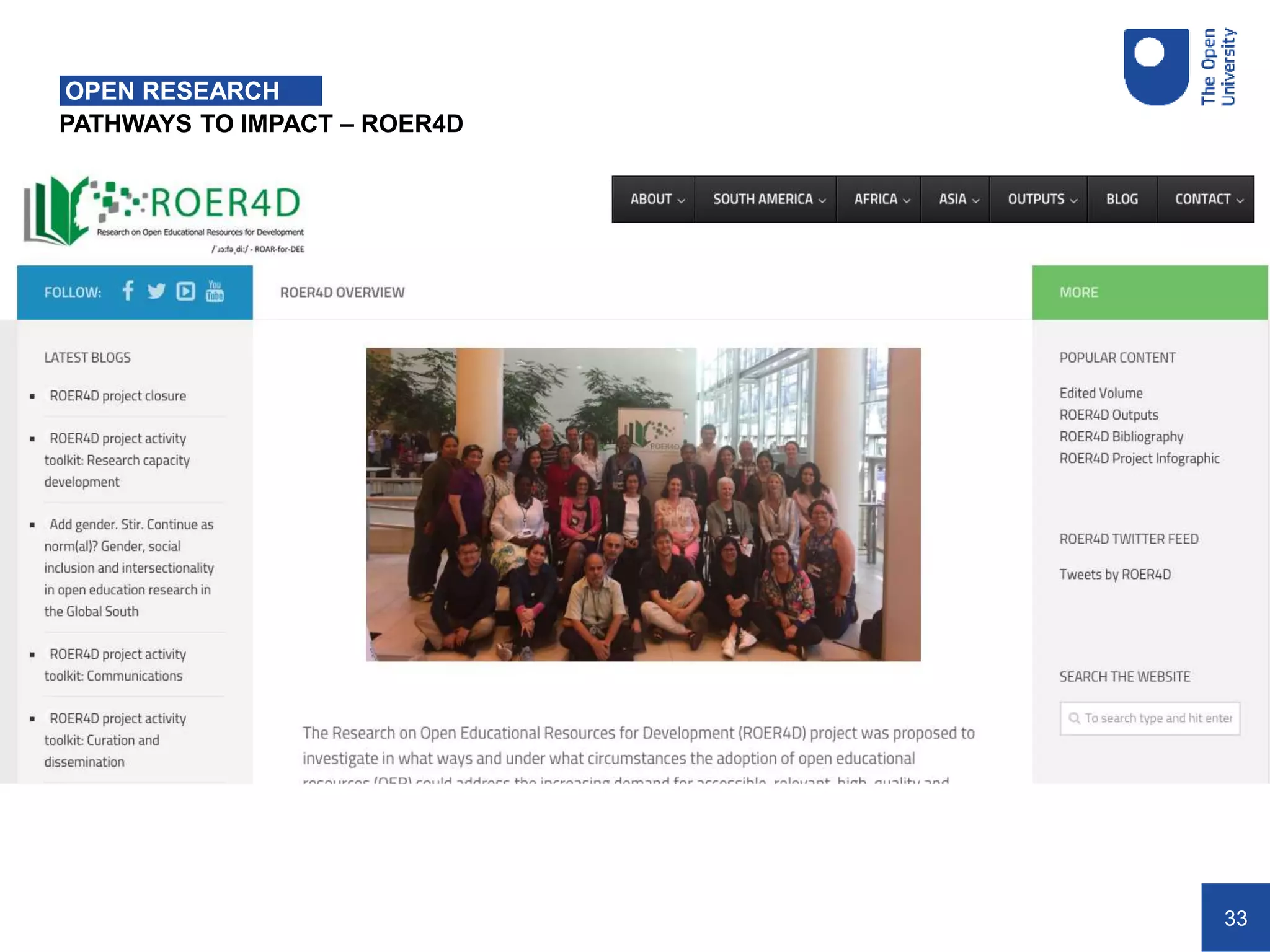
PATHWAYS TO IMPACT – ROER4D
OPEN RESEARCH
ROER4D
Tips & Resources
Some stuff you might find useful
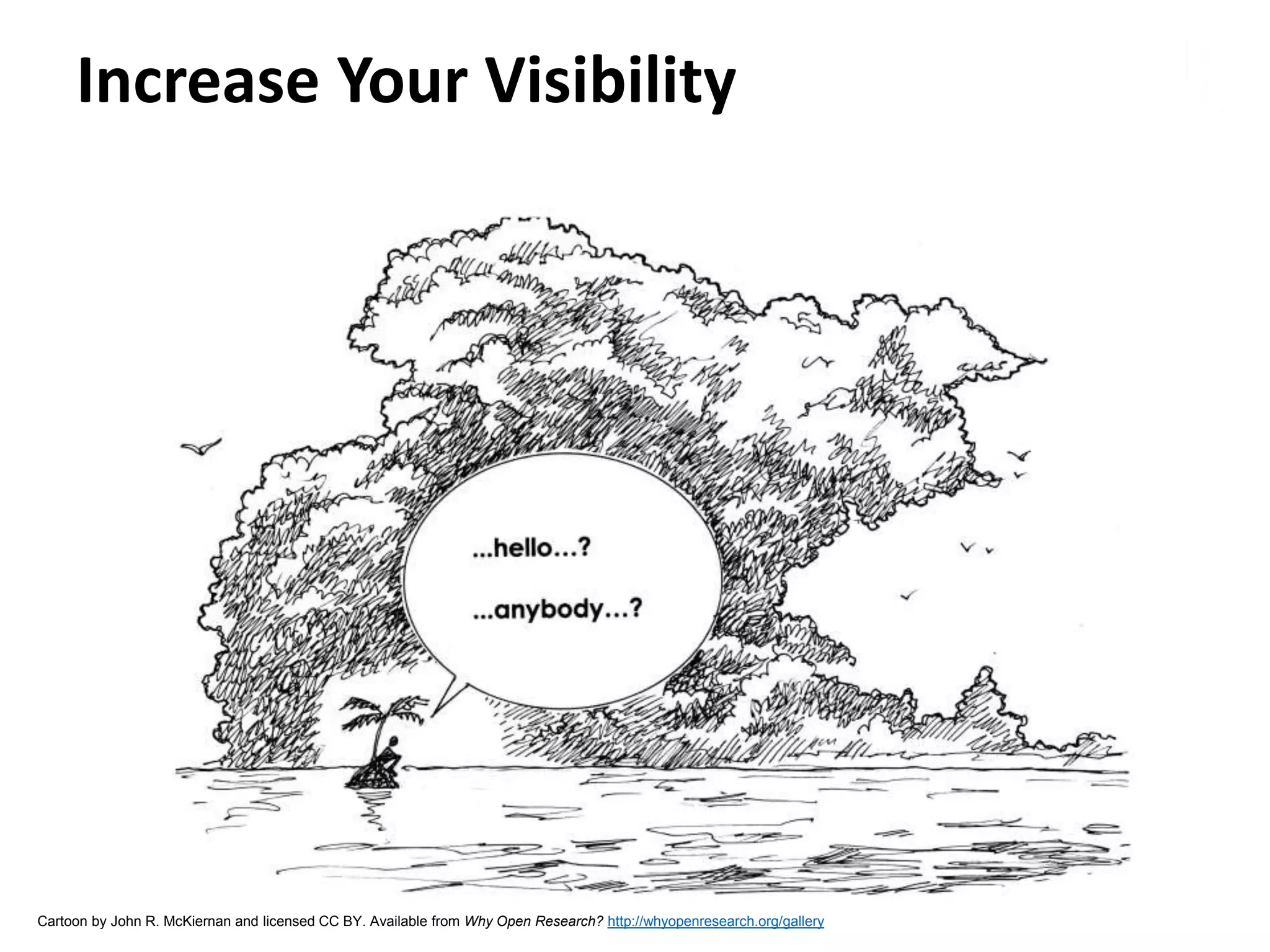
Increase Your Visibility
Cartoon by John R. McKiernan and licensed CC BY. Available from Why Open Research? http://whyopenresearch.org/gallery
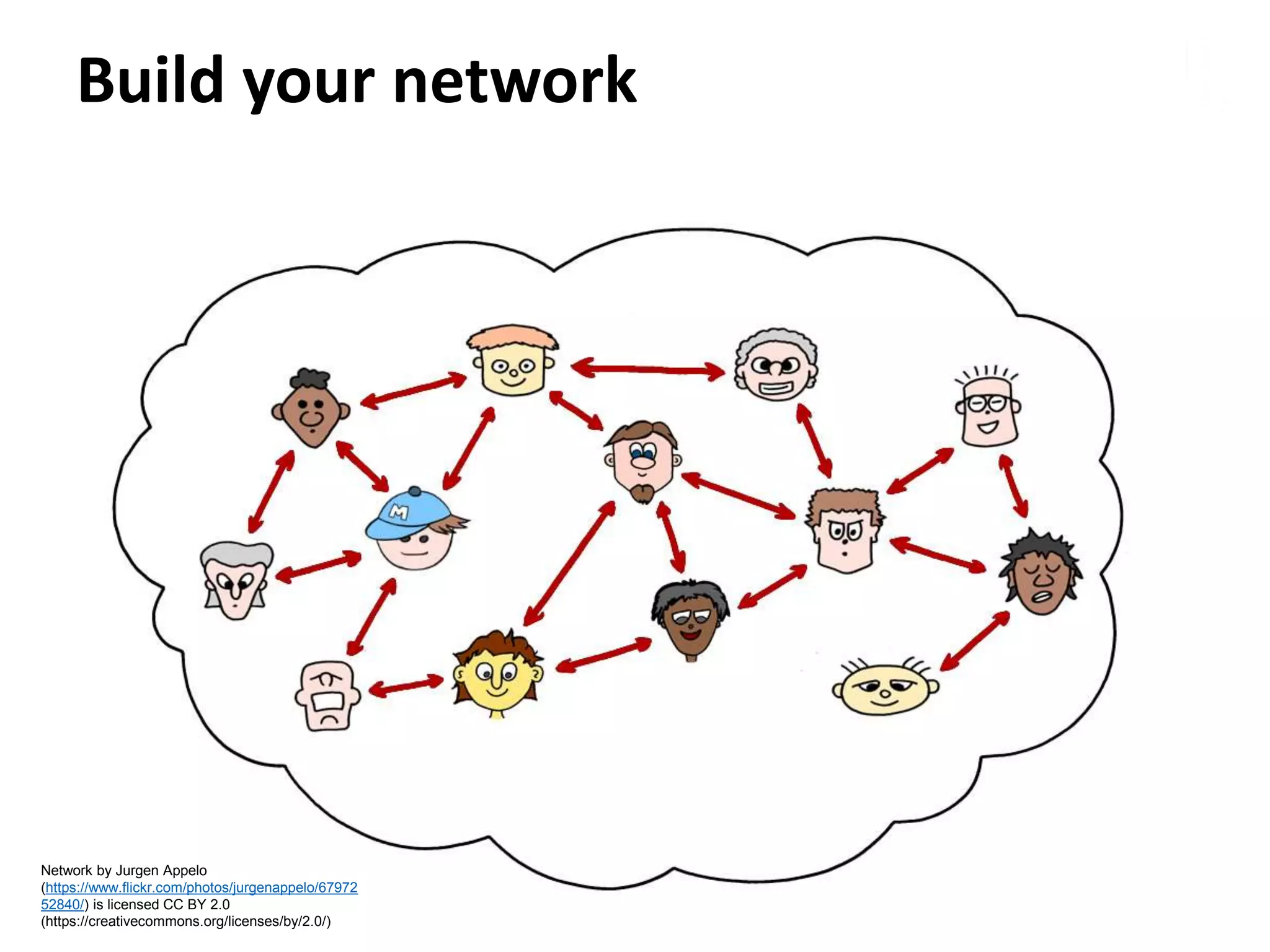
Build your network
Network by Jurgen Appelo
(https://www.flickr.com/photos/jurgenappelo/67972
52840/) is licensed CC BY 2.0
(https://creativecommons.org/licenses/by/2.0/)
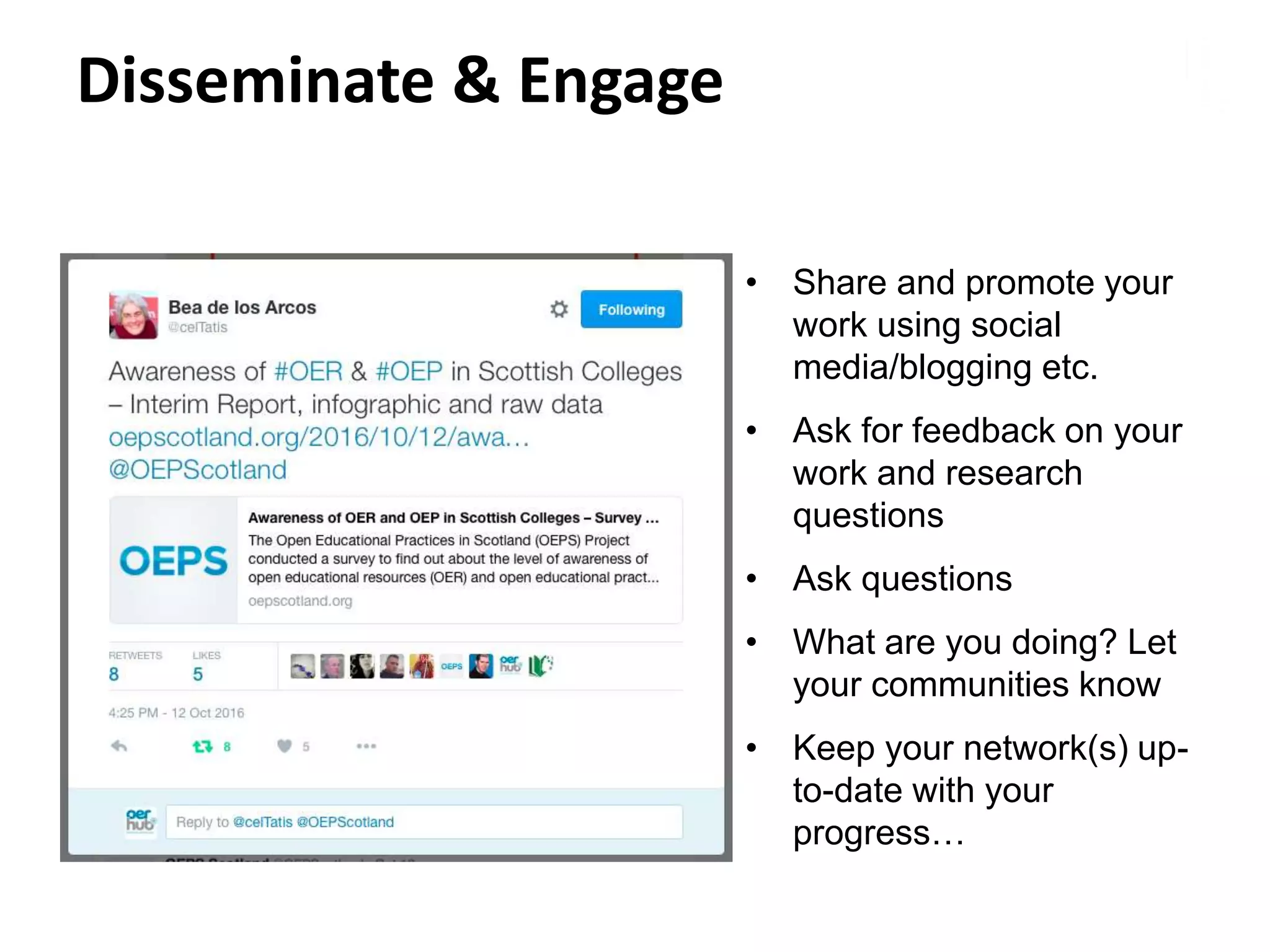
• Share and promote your
work using social
media/blogging etc.
• Ask for feedback on your
work and research
questions
• Ask questions
• What are you doing? Let
your communities know
• Keep your network(s) up-
to-date with your
progress…
Disseminate & Engage
Find your Voice
NowOpenbyBrianDysSahagunislicensedCCBY-NC-ND
https://www.flickr.com/photos/briansahagun/5788274239/
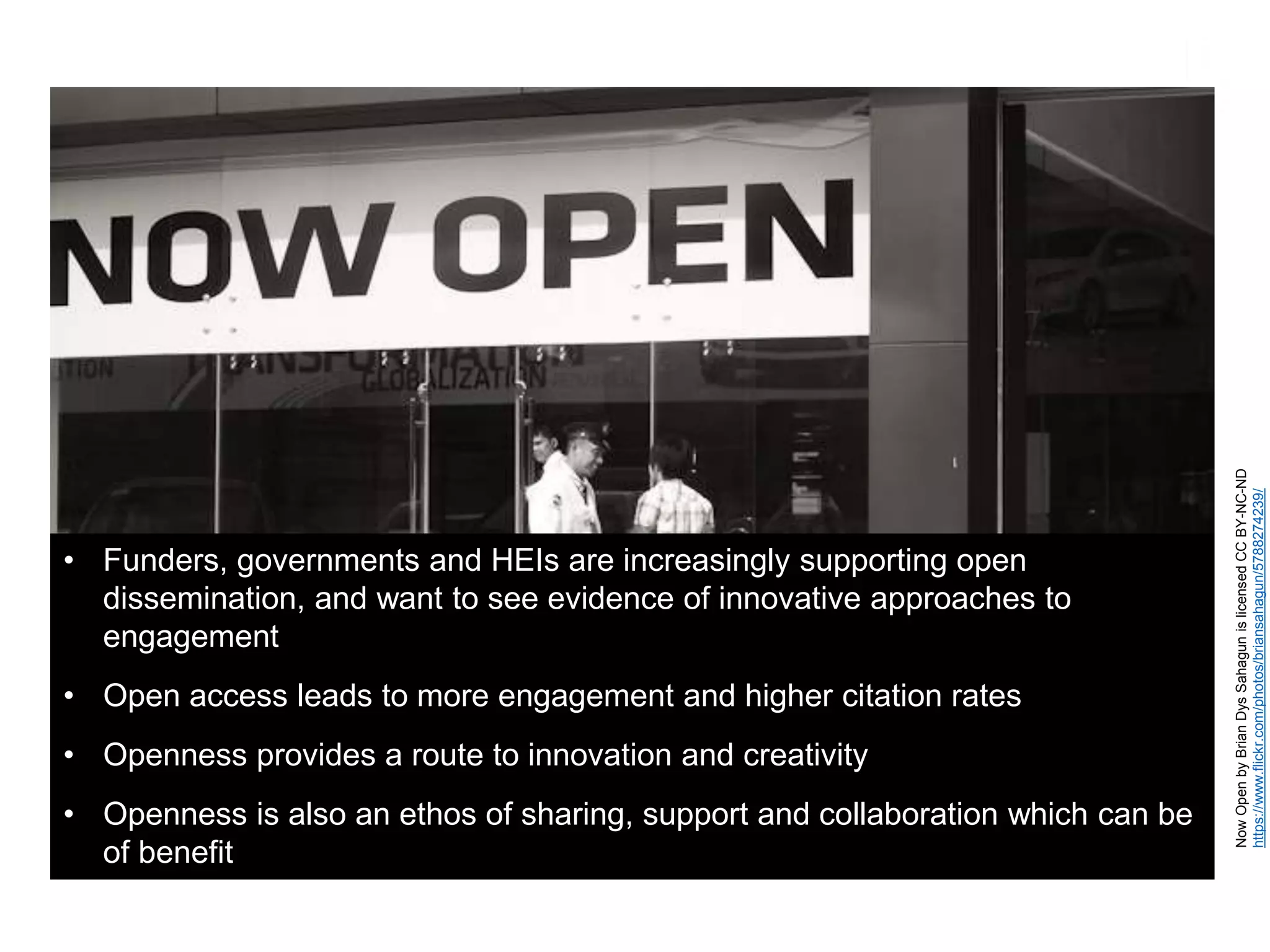
NowOpenbyBrianDysSahagunislicensedCCBY-NC-ND
https://www.flickr.com/photos/briansahagun/5788274239/
• Funders, governments and HEIs are increasingly supporting open
dissemination, and want to see evidence of innovative approaches to
engagement
• Open access leads to more engagement and higher citation rates
• Openness provides a route to innovation and creativity
• Openness is also an ethos of sharing, support and collaboration which can be
of benefit
41
RESOURCES
Caswell, T., Henson, S., Jensen, M., & Wiley, D. (2008). Open Educational
Resources: Enabling universal education. The International Review of Research
in Open and Distributed Learning, 9(1).
http://www.irrodl.org/index.php/irrodl/article/view/469/1001
Farrow, R. (2016). A Framework for the Ethics of Open Education. Open Praxis,
8(2), 93-109. http://dx.doi.org/10.5944/openpraxis.8.2.291
Farrow, R., Perryman, L.-A., de los Arcos, B., Weller, M. & Pitt, R. (2016). OER
Hub Researcher Pack. http://oro.open.ac.uk/48034/
Hill, B. V. (2010) [1975]. What’s open about open education? In D. A. Nyberg
(Ed.), The philosophy of open education. New York, NY: Routledge.
Gourley, Brenda and Lane, Andrew (2009). Re-invigorating openness at The
Open University: the role of Open Educational Resources. Open Learning, 24(1)
pp. 57–65.
King, T. W., Hodgkinson-Williams, C-A., Willmers, M. & Walji, S. (2016).
Dimensions of open research: critical reflections on openness in the ROER4D
project. Open Praxis, 8(2).
https://openpraxis.org/index.php/OpenPraxis/article/view/285
42
RESOURCES
OER Hub (2015). Open Research MOOC
https://courses.p2pu.org/en/courses/3230/open-research-2015/
Pitt, R; de los Arcos, B; Farrow, R & Weller, M.(2016). Open Research (Open
Textbook). https://openresearch.pressbooks.com/
Rolfe, V. (2016). Striving Toward Openness: But What Do We Really Mean? The
International Review of Research in Open and Distributed Learning, 18(7).
http://www.irrodl.org/index.php/irrodl/article/view/3207
VITAE (n.d.). What is open research? https://www.vitae.ac.uk/doing-
research/open-research-and-open-researchers/what-is-open-research
Weller, M. (2014). The Battle for Open. Ubiquity Press.
https://www.ubiquitypress.com/site/books/10.5334/bam/
Reflections
A chance to conclude by sharing thoughts
THANK YOU

Open Research (workshop)

  • 1.
    OPEN RESEARCH CREET Academy,11th January 2019 Dr. Rob Farrow Dr. Beck Pitt OER Hub / IET / LTI A / WELS rob.farrow@open.ac.uk @philosopher1978
  • 2.
    2 01 Exploring Openness Alook at notions of openness and reasons to be open 02 Openness through the Research Cycle Understanding openness as a feature of the entire research process 03 Openness and Impact Openness can be a route to impact 04 Benefits & Risks An overview 05 Tips & Resources Some materials that may be useful 06 Reflections Concluding remarks and discussion STRUCTURE
  • 3.
    Exploring Openness A lookat notions of openness and reasons to be open
  • 4.
    4 WHAT DOES OPENNESSMEAN TO YOU? (BRAINSTORM 10 mins) EXPLORING OPENNESS “Open House’ by Beck Pitt is licensed CC BY 2.0: https://www.flickr.com/photos/40959105@N00/33531682466/in/dateposted-public/
  • 5.
    5 VITAE FRAMEWORK EXPLORING OPENNESS OPENACCESS • Making scholarly publications available (online) to anyone regardless of their ability to pay • Non-traditional dissemination strategies OPEN DATA • Making (raw) research data available to anyone for interrogation and reuse OPEN PLATFORMS, TOOLS & SERVICES • Opening access to code and software • Tools to promote efficiency in research and scholarly communication AN OPEN APPROACH TO CONDUCTING RESEARCH • Open and collaborative approaches • Stakeholder involvement TRANSPARENCY AND PUBLIC ENGAGEMENT • Raising awareness of research outputs more widely
  • 6.
    6 WHAT PEOPLE HAVETOLD US IN PREVIOUS SESSIONS EXPLORING OPENNESS • Availability to share with people around the world • Making research outputs available • Social media can be a two-way street • Openness as data sharing and removing barriers to this (e.g. working with vulnerable people) • Some positive aspects: availability & accessibility of information; fairness; collaboration; potential empowerment • Openness could allow people to do things with your work that you wouldn’t do yourself • Some potential limitations: openness can feel like exposing yourself to criticism; language can be a barrier; concerns about quality • Openness can be a principle that is not realised in practice • Openness an improve discoverability as long as good practice is observed • Open source software
  • 7.
    7 AN ETHOS OFOPEN? EXPLORING OPENNESS Values: Commitment to social justice, parity of participation (Hodgkinson-Williams & Trotter, 2018); widening participation (Gourley & Lane, 2009); human rights (Blessinger & Bliss, 2016); duty (Caswell, Henson, Jensen & Wiley, 2008) Plasticity/Agility: An excellent candidate for sloganizing is the word ‘open.’ Immediately one uses it, the options polarize. To be open (depending on context) is to be not closed, restricted, prejudiced or clogged; but free, candid, generous, above board, mentally flexible, future oriented. (Hill, 2010[1975]:2) Authenticity: I can list for you any number of examples of companies and organizations that have attached that word “open” to their products and services […] All these append “open” to a name without really even trying to append “openness,” let alone embrace “openness," to their practices or mission. Whatever “openness” means. (Watters, 2014) Ethos: Atenas and Havemann (2014) commented: “Notwithstanding the problematic nature of the term ‘open’ when used in wider contexts, there does seem to be a shared understanding of an underlying ethos of openness…” Pragmatism: Not only are there different aspects of openness, but it may be that some are mutually exclusive with others, or at least that prioritising some means less emphasis on others. One way to consider openness is to consider the motivations people have for adopting an open approach. (Weller, 2015:32)
  • 8.
    8 WHAT IS OPENRESEARCH? (DISCUSSION 5 mins) EXPLORING OPENNESS “Open research is the process of conducting and sharing research in which a selection of research proposals, work-process documents, literature reviews, methodologies, research instruments, analytical frameworks, findings and/or data are intentionally shared on publically-accessible platforms in order for others to freely access, use, modify, and share them subject to measures that preserve ethical practice and legal provenance.” Hodgkinson-Williams & King (2015:5)
  • 9.
    Openness through the ResearchCycle Understanding openness as a feature of the entire research process
  • 10.
    10 THE RESEARCH CYCLE OPPORTUNITIESFOR OPENNESS (EXERCISE 30 mins) https://commons.wikimedia.org/wiki/File:Research_cycle.png By Cameron Neylon (CC-BY)
  • 11.
  • 12.
    https://commons.wikimedia.org/wiki/File:Research_cycle.png By CameronNeylon (CC-BY) • This is the fuzziest stage where nothing is concrete yet. There is a balance to be struck at this stage in getting feedback from people and ‘giving away’ an idea when it becomes specific enough • The main consideration could be ownership of ideas that have been generated openly • It’s important to share with the right people and be as open as appropriate with them • Blogging could be a way of doing this; social media provides another opportunity • Talk to (trusted) people! • Sharing at the ‘ideas’ stage can be a way to assess the viability of a research project • You might want to share online, but not have a network to get feedback from – how do you build a network?
  • 13.
    https://commons.wikimedia.org/wiki/File:Research_cycle.png By CameronNeylon (CC-BY) • Build networks • Attend workshops/events and get feedback • Meet with people who have similar interests • Use feedback to develop the idea into a more feasible project • Context and trust are important
  • 14.
    https://commons.wikimedia.org/wiki/File:Research_cycle.png By CameronNeylon (CC-BY) • Completed grant proposals (successful or unsuccessful) can be shared for others to learn from. Some research councils make successful proposals available as a matter of course • Some funding opportunities mandate open practices, such as open access dissemination • Networks can be leveraged to identify funding opportunities • Collaborators can be attracted by organisations with transparent working practices
  • 15.
    https://commons.wikimedia.org/wiki/File:Research_cycle.png By CameronNeylon (CC-BY)https://commons.wikimedia.org/wiki/File:Research_cycle.png By Cameron Neylon (CC-BY) • Involving stakeholders in the process of planning can improve buy-in and encourage a spirit of collaboration • Collaborating in this way could potentially affect the perception of the objectivity of the researcher • A balance needs to be struck here between expert authority and stakeholder input • Think about how openness might affect the rest of the project (e.g. ethics)
  • 16.
    https://commons.wikimedia.org/wiki/File:Research_cycle.png By CameronNeylon (CC-BY) • Progress can be shared through blogs, social media, newsletters, etc. • Sharing initial findings can improve the visibility of work • If you keep a research journal, this could be shared where appropriate
  • 17.
    https://commons.wikimedia.org/wiki/File:Research_cycle.png By CameronNeylon (CC-BY) • Sharing code on GitHub • Sharing analytic frameworks and research instruments • Inviting critical friends to verify results
  • 18.
    https://commons.wikimedia.org/wiki/File:Research_cycle.png By CameronNeylon (CC-BY) • Open access publication of journal papers • Understand licensing options • Sharing (redacted) research data on repositories • Need to be especially careful with personal or sensitive information – anticipate how much needs to be shared to make it useful while protecting participants • Using appropriate metadata to maximise reusability • Institutional archiving (e.g. ORO) • Compliance with funder requirements • Maximising impact through publishing in alternative channels (e.g. mass media, short video, alternative media)
  • 19.
    https://commons.wikimedia.org/wiki/File:Research_cycle.png By CameronNeylon (CC-BY) • Find out what relevant data is already out there ‘in the open’ • Tension between peer-reviewed literature and grey literature
  • 20.
    Benefits and Risks Anoverview of the effects of being open
  • 21.
    Thumbs up isby Paul and licensed CC BY 2.0 https://www.flickr.com/photos/vegaseddie/5700609302/ WHAT DO YOU SEE AS THE BENEFITS / RISKS (Discussion 5 mins each) BENEFITS OF OPENNESS
  • 22.
    By Alex E.Proimos (http://www.flickr.com/photos/proimos/4199675334/) [CC BY 2.0 (http://creativecommons.org/licenses/by/2.0)], via Wikimedia Commons
  • 23.
    23 BENEFITS RISKS BENEFITS ANDRISKS • Increase visibility • Dissemination • Building an online academic identity • Amplify the impact of research • Making connections with the right people • Building a network that will be useful in the future • Engaging people: sharing; asking questions; updating • Encourage re-use (and verification) of research data • See also http://whyopenresearch.org/index • Ethics considerations, especially with respect to extra-institutional activity • Time invested to engage in additional sharing activities: being open takes time • It can be discouraging if finding your voice and building your network doesn’t go well • Understanding which open licences to use can be confusing and there’s a chance you will get it wrong unless you learn about this
  • 24.
  • 25.
  • 26.
    • Building capacityin the OER research domain • Conducting research into open education and OER • Producing resources for the open education research community • Acting as champions for open practices in research and scholarship
  • 27.
    Keyword Hypothesis Performance OERimprove student performance/satisfaction Openness People use OER differently from other online materials Access OER widen participation in education Retention OER can help at-risk learners to finish their studies Reflection OER use leads educators to reflect on their practice Finance OER adoption brings financial benefits for students/institutions Indicators Informal learners use a variety of indicators when selecting OER Support Informal learners develop their own forms of study support Transition OER support informal learners in moving to formal study Policy OER use encourages institutions to change their policies Assessment Informal assessments motivate learners using OER
  • 28.
  • 30.
    OER Evidence Report2014 OER Data Report 2015 http://oerhub.net/reports/ http://oerhub.net/research-outputs/data/
  • 31.
    31 PATHWAYS TO IMPACT OPENRESEARCH RAISING PROFILE AND UNDERSTANDING OF OER/OPEN • OER Research Hub Fellowships • Bringing an open element to consortia (e.g. BizMOOC, European MOOC Consortium) • Quality Assurance, Internal Training Provision at The Open University GLOBAL EVIDENCE BASE FOR OER IMPACT • Working internationally in open collaboration with a wide range of partners at various levels of formality • Sharing outputs openly has massively promoted the profile of our work • “Think global; act local” BUILDING AN INCLUSIVE RESEARCH COMMUNITY • Global OER Graduate Network • Mentoring and leadership (e.g. SPARC; OpenCon) • Social Media • Real-life interactions!
  • 32.
    32 PATHWAYS TO IMPACT OPENRESEARCH PROMOTING OPEN PRACTICES AND VALUES • Global OER Graduate Network • Open dissemination (papers, data) • Open Research! • Ethical guidance for “open” (Farrow, 2016) • Reuse of Evidence Hub code, research methods, etc. CONSULTATION / INFLUENCE ON POLICY • Evidence to House of Lords Select Committee on Digital Skills • Creative Commons Policy Workshop • ALT OER Guide for Policymakers • Policy Registry on OER World Map • Opening Educational Practices Scotland Workshops
  • 33.
    33 PATHWAYS TO IMPACT– ROER4D OPEN RESEARCH ROER4D
  • 34.
    Tips & Resources Somestuff you might find useful
  • 35.
    Increase Your Visibility Cartoonby John R. McKiernan and licensed CC BY. Available from Why Open Research? http://whyopenresearch.org/gallery
  • 36.
    Build your network Networkby Jurgen Appelo (https://www.flickr.com/photos/jurgenappelo/67972 52840/) is licensed CC BY 2.0 (https://creativecommons.org/licenses/by/2.0/)
  • 37.
    • Share andpromote your work using social media/blogging etc. • Ask for feedback on your work and research questions • Ask questions • What are you doing? Let your communities know • Keep your network(s) up- to-date with your progress… Disseminate & Engage
  • 38.
  • 39.
  • 40.
    NowOpenbyBrianDysSahagunislicensedCCBY-NC-ND https://www.flickr.com/photos/briansahagun/5788274239/ • Funders, governmentsand HEIs are increasingly supporting open dissemination, and want to see evidence of innovative approaches to engagement • Open access leads to more engagement and higher citation rates • Openness provides a route to innovation and creativity • Openness is also an ethos of sharing, support and collaboration which can be of benefit
  • 41.
    41 RESOURCES Caswell, T., Henson,S., Jensen, M., & Wiley, D. (2008). Open Educational Resources: Enabling universal education. The International Review of Research in Open and Distributed Learning, 9(1). http://www.irrodl.org/index.php/irrodl/article/view/469/1001 Farrow, R. (2016). A Framework for the Ethics of Open Education. Open Praxis, 8(2), 93-109. http://dx.doi.org/10.5944/openpraxis.8.2.291 Farrow, R., Perryman, L.-A., de los Arcos, B., Weller, M. & Pitt, R. (2016). OER Hub Researcher Pack. http://oro.open.ac.uk/48034/ Hill, B. V. (2010) [1975]. What’s open about open education? In D. A. Nyberg (Ed.), The philosophy of open education. New York, NY: Routledge. Gourley, Brenda and Lane, Andrew (2009). Re-invigorating openness at The Open University: the role of Open Educational Resources. Open Learning, 24(1) pp. 57–65. King, T. W., Hodgkinson-Williams, C-A., Willmers, M. & Walji, S. (2016). Dimensions of open research: critical reflections on openness in the ROER4D project. Open Praxis, 8(2). https://openpraxis.org/index.php/OpenPraxis/article/view/285
  • 42.
    42 RESOURCES OER Hub (2015).Open Research MOOC https://courses.p2pu.org/en/courses/3230/open-research-2015/ Pitt, R; de los Arcos, B; Farrow, R & Weller, M.(2016). Open Research (Open Textbook). https://openresearch.pressbooks.com/ Rolfe, V. (2016). Striving Toward Openness: But What Do We Really Mean? The International Review of Research in Open and Distributed Learning, 18(7). http://www.irrodl.org/index.php/irrodl/article/view/3207 VITAE (n.d.). What is open research? https://www.vitae.ac.uk/doing- research/open-research-and-open-researchers/what-is-open-research Weller, M. (2014). The Battle for Open. Ubiquity Press. https://www.ubiquitypress.com/site/books/10.5334/bam/
  • 43.
    Reflections A chance toconclude by sharing thoughts
  • 44.

Editor's Notes

  • #9 It was previously noted that the open research process construed in this way involves some rethinking of the research process as it is traditionally taught at university.  For instance, the ethics approval that is required tends not to reflect possibilities for open dissemination of data.   There were also some concerns about openly sharing data and/or findings during the research process, especially for PhD students for whom this might constitute a big leap of faith.
  • #11 What difference can openness make to different stages of the research process?
  • #25 Impact is perhaps the element missing from the previous cycle…
  • #26 Short intro to OER Hub -
  • #27 Short intro to OER Hub -
  • #28 We have discovered that an independent party in the USA has launched a journal using these hypotheses to structure and focus submissions
  • #36 One consequence of this is increased visibility of your research – not just of you and your work but also of projects and your institution. Open Access publication means people outside an institution or not in academia can access your research, Global South or places with little/no access to research etc. Higher Citation rates
  • #37 Being networked is a catalyst Give prominence and connect with others Conversations
  • #38 Surveys too Robert Schwur blog post about our data: sharing data means folks can interrogate it, do new things, check your analysis etc. GO-GN blogs Katy example (MOOC completion rates using openly available data. Visualisation and blogged. Went “viral” and feat. In Private Eye etc.) Use slideshare (perhaps list useful platforms here or have new slide with them on?)
  • #39 Practice regular blogging etc. Twitter tag team example.