DOCTOR OF PHARMACY
II YEAR
Arrhythmia
170101
CHAPTER-1
Cardiovascular system
Dr. V. Chanukya (Pharm D)
Introduction
Arrhythmogenesis
• Electrical activity is initiated by the sinoatrial (SA) node and moves
through cardiac tissue by a tree-like conduction network.
• The SA node initiates cardiac rhythm under normal circumstances
because this tissue possesses the highest degree of automaticity or rate
of spontaneous impulse generation.
• The degree of automaticity of the SA node is largely influenced by the
autonomic nervous system in that both cholinergic and sympathetic
innervations control sinus rate.
• Most tissues within the conduction system also possess varying
degrees of inherent automatic properties.
• However, the rates of spontaneous impulse generation of these tissues
are less than that of the SA node.
• Thus these latent automatic pacemakers are continuously overdriven
by impulses arising from the SA node (primary pacemaker) and do not
become clinically apparent.
• From the SA node, electrical activity moves in a wave front through
an atrial specialized conducting system and eventually gains entrance
to the ventricle via the atrioventricular (AV) node and a large bundle
of conducting tissue referred to as the bundle of His.
• Aside from this AV nodal–Hisian pathway, a fibrous AV ring that will
not permit electrical stimulation separates the atria and ventricles.
• The conducting tissues bridging the atria and ventricles are referred to
as the junctional areas.
• Again, this area of tissue (junction) is largely influenced by autonomic
input, and possesses a relatively high degree of inherent automaticity
(about 40 beats/min, less than that of the SA node).
• From the bundle of His, the cardiac conduction system bifurcates into
several (usually three) bundle branches: one right bundle and two left
bundles.
• These bundle branches further arborize into a conduction network
referred to as the Purkinje system.
• The conduction system as a whole innervates the mechanical
myocardium and serves to initiate excitation–contraction coupling and
the contractile process.
• After a cell or group of cells within the heart is electrically stimulated,
a brief period of time follows in which those cells cannot again be
excited.
• This time period is referred to as the refractory period.
• As the electrical wave front moves down the conduction system, the
impulse eventually encounters tissue refractory to stimulation
(recently excited) and subsequently dies out.
• The SA node subsequently recovers, fires spontaneously, and begins
the process again.
• Prior to cellular excitation, an electrical gradient exists between the
inside and the outside of the cell membrane.
• At this time the cell is polarized. In atrial and ventricular conducting
tissue, the intracellular space is approximately 80 to 90 mV negative
with respect to the extracellular environment.
• The electrical gradient just prior to excitation is referred to as resting
membrane potential (RMP) and is the result of differences in ion
concentrations between the inside and the outside of the cell.
• At RMP, the cell is polarized primarily by the action of active
membrane ion pumps, the most notable of these being the sodium-
potassium pump.
• For example, this specific pump (in addition to other systems)
attempts to maintain the intracellular sodium concentration at 5 to 15
mEq/L and the extracellular sodium concentration at 135 to 142
mEq/L; the intracellular potassium concentration at 135 to 140 mEq/L
and the extracellular potassium concentration at 3 to 5 mEq/L.
• Electrical stimulation (or depolarization) of the cell will result in
changes in membrane potential over time or a characteristic action
potential curve
• The action potential curve results from the transmembrane movement
of specific ions and is divided into different phases.
• Phase 0 or initial, rapid depolarization of atrial and ventricular tissues
is caused by an abrupt increase in the permeability of the membrane to
sodium influx.
• This rapid depolarization more than equilibrates (overshoots) the
electrical potential, resulting in a brief initial repolarization or phase 1.
• Phase 1 (initial depolarization) is caused by a transient and active
potassium efflux (i.e., the Ikto current).
• Calcium begins to move into the intracellular space at about 60 mV
(during phase 0) causing a slower depolarization.
• Calcium influx continues throughout phase 2 of the action potential
(plateau phase) and is balanced to some degree by potassium efflux.
• Calcium entrance (only through L channels in myocardial tissue)
distinguishes cardiac conducting cells from nerve tissue, and provides
the critical ionic link to excitation-contraction coupling and the
mechanical properties of the heart as a pump.
• The membrane remains permeable to potassium efflux during phase 3,
resulting in cellular repolarization.
• Phase 4 of the action potential is the gradual depolarization of the cell
and is related to a constant sodium leak into the intracellular space
balanced by a decreasing (over time) efflux of potassium.
• The slope of phase 4 depolarization determines, in large part, the
automatic properties of the cell.
• As the cell is slowly depolarized during phase 4, an abrupt increase in
sodium permeability occurs, allowing the rapid cellular depolarization
of phase 0.
• The juncture of phase 4 and phase 0 where rapid sodium influx is
initiated is referred to the threshold potential of the cell.
• Not all cells in the cardiac conduction system rely on sodium influx
for initial depolarization.
• Some tissues depolarize in response to a slower inward ionic current
caused by calcium influx.
• These “calcium-dependent” tissues are found primarily in the SA
and AV nodes (both L and T channels) and possess distinct
conduction properties in comparison to “sodium-dependent” fibers.
• Calcium dependent cells generally have a less-negative RMP (–40 to –
60 mV) and a slower conduction velocity.
• Furthermore, in calcium-dependent tissues, recovery of excitability
outlasts full repolarization, whereas in sodium-dependent tissue,
recovery is prompt after repolarization.
• These two types of electrical fibers also differ dramatically in how
drugs modify their conduction properties.
• Ion conductance across the lipid bilayer of the cell membrane occurs
via the formation of membrane pores or “channels”
• Selective ion channels probably form in response to specific electrical
potential differences between the inside and the outside of the cell
(voltage dependence).
• The membrane itself is composed of both organized and disorganized
lipids and phospholipids in a dynamic solgel matrix.
• During ion flux and electrical excitation, changes in this sol-gel
equilibrium occur and permit the formation of activated ion channels.
• Besides channel formation and membrane composition, intrachannel
proteins or phospholipids, referred to as gates also regulate the
transmembrane movement of ions.
• These gates are thought to be positioned strategically within the
channel to modulate ion flow.
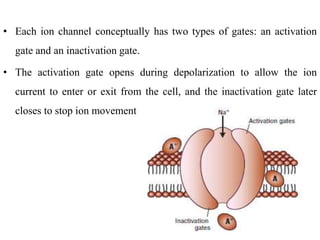
• Each ion channel conceptually has two types of gates: an activation
gate and an inactivation gate.
• The activation gate opens during depolarization to allow the ion
current to enter or exit from the cell, and the inactivation gate later
closes to stop ion movement.
• When the cell is in a rested state, the activation gates are closed and the
inactivation gates are open.
• The activation gates then open to allow ion movement through the
channel, and the inactivation gates later close to stop ion conductance.
• Thus, the cell cycles between three states: resting, activated or open,
and inactivated or closed.
• Activation of SA and AV nodal tissue is dependent on a slow
depolarizing current through calcium channels and gates, whereas the
activation of atria and ventricular tissue is dependent on a rapid
depolarizing current through sodium channels and gates.
Definition
• Arrhythmia is defined as loss of cardiac rhythm, especially
irregularity of heartbeat.
Arrhythmia mechanisms
• Cardiac arrhythmias occur because of abnormalities of impulse
formation or propagation.
Abnormal impulse formation
1. Abnormal automaticity -Automaticity is another term for
pacemaker activity, a characteristic possessed by all cells of the
specialised cardiac conduction system during health and, potentially,
by other cardiac myocytes during certain disease states.
• Under certain conditions like ischaemia and electrolyte imbalance, the
resting membrane potential of cardiac muscle cells may become less
negative.
• This can give rise to automaticity, i.e. spontaneous phase I
depolarisations.
• This has been implicated in certain arrhythmias like some types of
atrial tachycardia (e.g. digitalis-induced), and accelerated junctional
rhythm.
2. Triggered activity
• Triggered activity is initiated by after-depolarisations, which are
oscillations in the membrane potential initiated by the preceding
action potential.
• These may be early after depolarisations, i.e. occurring in phase 2 or 3
of the action potential, or delayed after-depolarisations, i.e. occurring
after repolarisation is complete.
• Early after-depolarisations have been implicated in tachycardias in
congenital and acquired forms of the long QT syndrome.
• Delayed after-depolarisations are implicated in some digitalis-induced
arrhythmias, right ventricular outflow tract tachycardia related to
exercise, etc.
(A) An early after depolarisation (EAD) occurring at the start of phase 3
of the cardiac action potential.
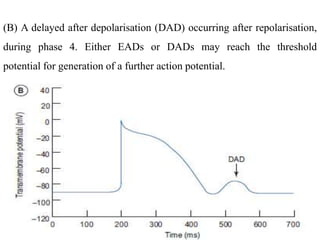
(B) A delayed after depolarisation (DAD) occurring after repolarisation,
during phase 4. Either EADs or DADs may reach the threshold
potential for generation of a further action potential.
• In both cases, after depolarisation may reach the threshold potential
required for generation of a new action potential.
• EADs are characteristic of the congenital and acquired long QT
syndromes.
• The prolonged action potential duration promotes reactivation of the
inward calcium current ICa which may directly cause EADs during
phase 2.
• Further more, action potential prolongation and ß-adrenoreceptor
stimulation promote calcium overload in the sarcoplasmic reticulum.
• This in turn leads to the spontaneous release of calcium in bursts by
the sarcoplasmic reticulum.
• The resultant increase in intracellular calcium concentration activates
the transmembrane Na+/Ca2+ exchanger which moves one calcium
ion out of the myocyte in exchange for three sodium ions and,
therefore, results in an EAD during phase 3.
• In the long QT syndromes, an EAD may initiate a form of
polymorphic ventricular tachycardia (VT) known as Torsade de
Pointes.
• EADs are more prominent at slow heart rates.
• DADs are seen during reperfusion following ischaemia, heart failure,
digitalis toxicity and in catecholaminergic polymorphic VT.
• They occur because of spontaneous release of calcium in bursts by the
sarcoplasmic reticulum, activating the Na+/Ca2+ exchanger as
described for EADs and resulting in a DAD during phase 4.
• A DAD may result in a single extrastimulus (‘ectopic beat’) or in
repetitive firing, that is, tachycardia.
• DADs are more prominent at rapid heart rates and during sympathetic
nervous stimulation of ß-adrenoreceptors.
• Abnormal impulse propagation
1. Re-entry
• Many clinically important arrhythmias are due to re-entry, in which an
activation wave front rotates continuously around a circuit.
• Re-entry depends upon a trigger in the form of a premature beat, and a
substrate, that is, the re-entry circuit itself.
A precise set of electrophysiological conditions must be met in order for
re-entry to occur.
1. There must be a central non-conducting obstacle around which
the re-entry circuit develops.
2. A premature beat must encounter unidirectional conduction block
in one limb (a) of the re-entry circuit,
3. Conduction must proceed slowly enough down the other limb (b)
of the re-entry circuit that electrical excitability has returned in the
original limb (a), allowing the activation wave front to propagate in a
retrograde direction along that limb.
4. The circulating activation wave front must continue to encounter
electrically excitable tissue.
Re-entry
• This is a function of the length of the re-entry circuit, the conduction
velocity of the activation wave front and the effective refractory
period of the myocardium throughout the circuit.
• Class I antiarrhythmic drugs block sodium channels and,
therefore, reduce the amplitude and rate of rise of the cardiac action
potential and in so doing, reduce the conduction velocity of an
activation wave front.
• Class I antiarrhythmic drugs may exert their major antiarrhythmic
effect by abolishing conduction altogether in areas of diseased
myocardium forming part of a re-entry circuit in which conduction is
already critically depressed.
• Class III antiarrhythmic drugs prolong cardiac APD and hence the
refractory period.
• If previously activated cells in a re-entry circuit (the ‘tail’) remain
refractory when the re-entrant wavefront (the ‘head’) returns to that
area, conduction will fail and re-entry will be abolished.
• Drug-induced prolongation of the refractory period may, therefore,
terminate and/or prevent reentrant arrhythmias.
Pathophysiology
• Supraventricular arrhythmias
• Common supraventricular tachycardias requiring drug treatment are
atrial fibrillation (AF) or atrial flutter, paroxysmal supraventricular
tachycardia (PSVT), and automatic atrial tachycardias.
• Other common supraventricular arrhythmias that usually do not
require drug therapy (e.g., premature atrial complexes, wandering
atrial pacemaker, sinus arrhythmia, sinus tachycardia).
1. Atrial Fibrillation and Atrial Flutter
• Atrial fibrillation is characterized as an extremely rapid (400 to 600
atrial beats/min) and disorganized atrial activation.
• There is a loss of atrial contraction (atrial kick), and supraventricular
impulses penetrate the atrioventricular (AV) conduction system in
variable degrees, resulting in irregular ventricular activation and
irregularly irregular pulse (120 to 180 beats/min).
• Atrial flutter is characterized by rapid (270 to 330 atrial beats/min)
but regular atrial activation.
• The ventricular response usually has a regular pattern and a pulse of
300 beats/min.
• This arrhythmia occurs less frequently than AF but has similar
precipitating factors, consequences, and drug therapy.
• The predominant mechanism of AF and atrial flutter is reentry, which
is usually associated with organic heart disease that causes atrial
distention (e.g., ischemia or infarction, hypertensive heart disease,
valvular disorders).
• Additional associated disorders include acute pulmonary embolus and
chronic lung disease, resulting in pulmonary hypertension and
corpulmonale; and states of high adrenergic tone such as
thyrotoxicosis, alcohol withdrawal, sepsis, or excessive physical
exertion.
2. Paroxysmal Supraventricular Tachycardia Caused by
Reentry
• PSVT arising by reentrant mechanisms includes arrhythmias caused
by AV nodal reentry, AV reentry incorporating an anomalous AV
pathway, sinoatrial (SA) nodal reentry, and intraatrial reentry.
3. Automatic Atrial Tachycardia's
• Automatic atrial tachycardias such as multifocal atrial tachycardia
appear to arise from supraventricular foci with enhanced automatic
properties.
• Severe pulmonary disease is the underlying precipitating disorder in
60% to 80% of patients.
• Ventricular arrhythmias
1. Premature Ventricular Complexes
• Premature ventricular complexes (PVCs) are common ventricular
rhythm disturbances that occur in patients with or without heart
disease and may be elicited experimentally by abnormal automaticity,
triggered activity, or reentrant mechanisms.
2. Ventricular Tachycardia
• Ventricular tachycardia (VT) is defined by three or more repetitive
PVCs occurring at a rate greater than 100 beats/min.
• It occurs most commonly in acute myocardial infarction (MI); other
causes are severe electrolyte abnormalities (e.g., hypokalemia),
hypoxemia, and digitalis toxicity.
• The chronic recurrent form is almost always associated with
underlying organic heart disease (e.g., idiopathic dilated
cardiomyopathy or remote MI with left ventricular [LV] aneurysm).
• Sustained VT is that which requires therapeutic intervention to restore
a stable rhythm or that lasts a relatively long time (usually longer than
30 seconds).
• Non sustained VT self-terminates after a brief duration (usually less
than 30 seconds).
• Incessant VT refers to VT occurring more frequently than sinus
rhythm, so that VT becomes the dominant rhythm.
• Monomorphic VT has a consistent QRS configuration, whereas
polymorphic VT has varying QRS complexes.
• Torsade de pointes (TdP) is a polymorphic VT in which the QRS
complexes appear to undulate around a central axis.
3. Ventricular Proarrhythmia
• Proarrhythmia refers to development of a significant new arrhythmia
(such as VT, ventricular fibrillation [VF], or TdP) or worsening of an
existing arrhythmia.
• Proarrhythmia results from the same mechanisms that cause other
arrhythmias or from an alteration in the underlying substrate due to
the antiarrhythmic agent.
• TdP is a rapid form of polymorphic VT associated with evidence of
delayed ventricular repolarization due to blockade of potassium
conductance.
• TdP may be hereditary or acquired.
• Acquired forms are associated with many clinical conditions and
drugs, especially type Ia and type III IKr blockers.
4. Ventricular Fibrillation
• VF is electrical anarchy of the ventricle resulting in no cardiac output
and cardiovascular collapse.
• Sudden cardiac death occurs most commonly in patients with
ischemic heart disease and primary myocardial disease associated
with LV dysfunction.
• VF associated with acute MI may be classified as either
• (1) primary (an uncomplicated MI not associated with heart failure
[HF]) or (2) secondary or complicated (an MI complicated by HF).
Bradyarrhythmias
• Asymptomatic sinus bradyarrhythmias (heart rate less than 60
beats/min) are common especially in young, athletically active
individuals.
• However, SA nodal function. Sinus node dysfunction is usually
repsome patients have sinus node dysfunction (sick sinus syndrome)
because of underlying organic heart disease and the normal aging
process, which attenuates resentative of diffuse conduction disease,
which may be accompanied by AV block and by paroxysmal
tachycardias such as AF.
• Alternating bradyarrhythmias and tachyarrhythmias are referred to as
the tachy–brady syndrome.
• AV block or conduction delay may occur in any area of the AV
conduction system.
• AV block may be found in patients without underlying heart disease
(e.g., trained athletes) or during sleep when vagal tone is high.
• It may be transient when the underlying etiology is reversible (e.g.,
myocarditis, myocardial ischemia, after cardiovascular surgery, during
drug therapy).
• β-Blockers, digoxin, or nondihydropyridine calcium antagonists may
cause AV block, primarily in the AV nodal area.
• Type I antiarrhythmics may exacerbate conduction delays below the
level of the AV node.
• AV block may be irreversible if the cause is acute MI, rare
degenerative disease, primary myocardial disease, or a congenital
condition.
Clinical presentation
• Supraventricular tachycardias may cause a variety of clinical
manifestations ranging from no symptoms to minor palpitations
and/or irregular pulse to severe and even life-threatening symptoms.
• Patients may experience dizziness or acute syncopal episodes;
symptoms of HF; anginal chest pain; or, more often, a choking or
pressure sensation during the tachycardia episode.
• AF or atrial flutter may be manifested by the entire range of
symptoms associated with other supraventricular tachycardias, but
syncope is not a common presenting symptom.
• An additional complication of AF is arterial embolization resulting
from atrial stasis and poorly adherent mural thrombi, which accounts
for the most devastating complication: embolic stroke.
• Patients with AF and concurrent mitral stenosis or severe systolic HF
are at particularly high risk for cerebral embolism.
• PVCs often cause no symptoms or only mild palpitations. The
presentation of VT may vary from totally asymptomatic to pulseless
hemodynamic collapse.
• Consequences of proarrhythmia range from no symptoms to
worsening of symptoms to sudden death. VF results in hemodynamic
collapse, syncope, and cardiac arrest.
• Patients with bradyarrhythmias experience symptoms associated with
hypotension such as dizziness, syncope, fatigue, and confusion.
• If LV dysfunction exists, symptoms of congestive HF may be
exacerbated.
Diagnosis
• A detailed history should be obtained, covering all of the symptoms
listed above.
• A characteristic of cardiac arrhythmias is their random onset.
• Symptoms occurring under specific circumstances are less likely to be
due to arrhythmia, but there are exceptions including certain
uncommon types of VT, some cases of supraventricular tachycardia
(SVT) due to an accessory pathway and vasovagal syncope (faints).
• Other key features of the history include:
1. A history of cardiac disease
2. Other diagnosed medical conditions
3. A full drug history, including over-the-counter medicines and
recreational drugs including alcohol
4. A family history of heart disease and of sudden unexpected death.
• Physical examination is essential but often normal between episodes
of arrhythmia.
• Mandatory investigation includes a 12-lead ECG and an
echocardiogram to detect structural heart disease.
• Other investigations for structural and ischaemic heart disease may be
indicated at this stage with the aim of detecting any underlying
structural heart disease.
• If the history does not include sinister features such as syncope or a
family history of sudden unexpected death at a young age, and the
resting 12-lead ECG and echocardiogram are normal, then the patient
can be reassured that they are extremely unlikely to have a serious
heart rhythm disturbance.
• The extent of further investigation will be dictated by how
troublesome the symptoms are.
• The most certain way of reaching a firm diagnosis is a 12-lead ECG
recorded during the patient's symptoms demonstrating arrhythmia.
• As many arrhythmias occur intermittently, some form of ECG
monitoring is often necessary.
• This may include a continuous ambulatory ECG (Holter) recording
for up to 7 days at a time if the symptoms occur frequently or, for
less frequent symptoms an event recorder, which may store ECG
strips automatically if it detects an arrhythmia or if activated by the
patient during their symptoms.
• An insertable loop recorder may be implanted subcutaneously and is
an ECG event recorder with a battery life of about 3 years, making it
a useful tool for the diagnosis of infrequent arrhythmias.
Treatment
• The use of antiarrhythmic drugs in the United States is declining
because of major trials that showed increased mortality with their use
in several clinical situations, the realization of proarrhythmia as a
significant side effect, and the advancing technology of nondrug
therapies such as ablation and the implantable cardioverter-
defibrillator (ICD).
Classification of antiarrhythmic drugs
• Drugs may have antiarrhythmic activity by directly altering
conduction in several ways.
• Drugs may depress the automatic properties of abnormal pacemaker
cells by decreasing the slope of phase 4 depolarization and/or by
elevating threshold potential.
• Drugs may alter the conduction characteristics of the pathways of a
reentrant loop.
• The most frequently used classification system is that proposed by
Vaughan Williams.
Classification of Antiarrhythmic Drugs
The cardiac action potential.
A. An action potential from ventricular myocardium. During diastole
(phase 4), the resting transmembrane potential is constant at -90 mV.
The upstroke (phase 0) of the action potential is due to the rapid
influx of Na+ ions.
• The early phase of repolarisation (phase 1) is due to efflux of K+ ions,
followed by a plateau phase (phase 2) at about 0 mV during which
influx of Ca2+ ions is balanced by efflux of K+ ions.
• Towards the end of diastole, influx of Ca2+ ions diminishes and efflux
of K+ ions increases, resulting in repolarisation (phase 3) back to the
negative resting membrane potential.
Contractile cell action potential
(B) An action potential from the sinus node.
• During diastole (phase 4), there is progressive depolarisation towards
a threshold potential at which an action potential is triggered.
• The upstroke (phase 0) of the action potential is less steep than in
ventricular myocardial cells because the sinus node cells lack ‘fast’
Na+ channels and so depolarisation is dependent upon influx of Ca2+
ions.
An action potential from the sinus node.
Class I
• Class I drugs act by blocking the fast sodium channels that are
responsible for the rapid depolarisation phase of the cardiac action
potential, thus reducing the rate of depolarisation (the slope of phase
0) and the amplitude of the action potential.
• The conduction velocity of an activation wavefront is determined
partly by the slope and amplitude of the cardiac action potential and
partly by the resistance to current flow through the myocardium.
• The effect of sodium channel blockade is a decrease in conduction
velocity.
• Certain re-entrant arrhythmias such as VT complicating previous
myocardial infarction depend upon slow conduction in part of the re-
entrant circuit.
• Class I antiarrhythmic drugs may critically slow or even abolish
conduction in these areas, thus terminating and/or preventing re-entry.
• The action potential in the sinoatrial and AV nodes does not depend on
fast sodium channels for depolarisation; instead, phase 0
depolarisation is carried by calcium channels.
• Class I antiarrhythmic drugs, therefore, have no direct effect on nodal
tissue.
• In addition to their effect on depolarisation, class I antiarrhythmic
drugs may also alter the APD (Action potential duration)and hence the
effective refractory period (ERP) via an effect on potassium channels
responsible for action potential repolarisation.
• Class I antiarrhyhmic drugs are subdivided into three groups
according to their effect on APD:
– Class IA drugs increase the APD,
– Class IB drugs shorten the APD
– Class IC drugs have no effect on APD.
• These effects may be assessed by measurement of the QT interval on
the ECG, which reflects average ventricular APD.
• Type Ia drugs slow conduction velocity, prolong refractoriness, and
decrease the automatic properties of sodium dependent (normal and
diseases ) conduction tissue. Type Ia drugs are broad-spectrum
antiarrhythmics, being effective for both supraventricular and
ventricular arrhythmias.
• Although categorized separately, type Ib drugs probably act similarly
to type Ia drugs, except that type Ib agents are considerably more
effective in ventricular than supraventricular arrhythmias.
• Type Ic drugs profoundly slow conduction velocity while leaving
refractoriness relatively unaltered. Although effective for both
ventricular and supraventricular arrhythmias, their use for
ventricular arrhythmias has been limited by the risk of
proarrhythmia. Collectively, type I drugs can be referred to as
sodium channel blockers.
• Antiarrhythmic sodium channel receptor principles account for drug
combinations that are additive (e.g., quinidine and mexiletine) and
antagonistic (e.g.,flecainide and lidocaine), as well as potential
antidotes to excess sodium channel blockade (e.g., sodium
bicarbonate, propranolol).
• Type II drugs include β-adrenergic antagonists; clinically relevant
mechanisms result from their antiadrenergic actions.
• Β-Blockers are most useful in tachycardias in which nodal tissues
are abnormally automatic or are a portion of a reentrant loop.
• These agents are also helpful in slowing ventricular response in
atrial tachycardias (e.g., AF) by their effects on the AV node.
• Type III drugs specifically prolong refractoriness in atrial and
ventricular fibers and include very different drugs that share the
common effect of delaying repolarization by blocking potassium
channels.
• Bretylium (rarely used) has additional actions in that it first releases
and then depletes catecholamines.
• It increases the VF threshold and seems to have selective
antifibrillatory but not antitachycardic effects.
• Bretylium can be effective in VF but is often ineffective in VT.
• In contrast, amiodarone and sotalol are effective in most
supraventricular and ventricular tachycardias.
• Amiodarone displays electrophysiologic characteristics consistent
with each type of antiarrhythmic drug.
• Amiodarone is a sodium channel blocker with relatively fast on-
off kinetics, has nonselective β -blocking actions, blocks
potassium channels, and has slight calcium antagonist activity.
• The impressive effectiveness and low proarrhythmic potential of
amiodarone have challenged the notion that selective ion channel
blockade is preferable.
• Sotalol is a potent inhibitor of outward potassium movement
during repolarization and also possesses nonselective β-blocking
actions.
• Ibutilide and dofetilide block the rapid component of the delayed
potassium rectifier current.
• Type IV drugs inhibit calcium entry into the cell, which slows
conduction, prolongs refractoriness, and decreases SA and AV nodal
automaticity.
• Calcium channel antagonists are effective for automatic or
reentrant tachycardias that arise from or use the SA or AV nodes.
Atrial Fibrillation Or Atrial Flutter
• Many methods are available for restoring sinus rhythm, preventing
thromboembolic complications, and preventing further recurrences,
however, treatment selection depends in part on onset and severity of
symptoms.
• If symptoms are severe and of recent onset, patients may require
direct current cardioversion (DCC) to restore sinus rhythm
immediately.
• If patients are hemodynamically stable, the focus should be directed
toward control of ventricular rate.
• Drugs that slow conduction and increase refractoriness in the AV node
should be used as initial therapy.
• In patients with normal LV function (left ventricular ejection fraction
>40%), IV β - blockers ( propranolol, metoprolol, esmolol),
diltiazem, or verapamil is recommended.
• If a high adrenergic state is the precipitating factor, IV β - blockers
can be highly effective and should be considered first.
• In patients with left ventricular ejection fraction ≤ 40%, IV diltiazem
and verapamil should be avoided and IV β -blockers should be used
with caution.
• In patients having an exacerbation of HF symptoms, IV digoxin or
amiodarone should be used as first-line therapy for ventricular rate
control.
• IV amiodarone can also be used in patients who are refractory or have
contraindications to β -blockers, nondihydropyridine calcium channel
blockers, and digoxin.
• After treatment with AV nodal blocking agents and a subsequent
decrease in ventricular response, the patient should be evaluated for
the possibility of restoring sinus rhythm if AF persists.
• If sinus rhythm is to be restored, anticoagulation should be initiated
prior to cardioversion because return of atrial contraction increases
risk of thromboembolism.
• Patients with AF for longer than 48 hours or an unknown duration
should receive warfarin (target international normalized ratio [INR] 2
to 3) for at least 3 weeks prior to cardioversion and continuing for at
least 4 weeks after effective cardioversion and return of normal sinus
rhythm.
• Patients with AF less than 48 hours in duration do not requir warfarin,
but it is recommended that these patients receive either IV
unfractionated heparin or a low-molecular-weight heparin
(subcutaneously at treatment doses) at presentation prior to
cardioversion.
Intravenous Antiarrhythmic Dosing
Side Effects of Antiarrhythmic Drugs
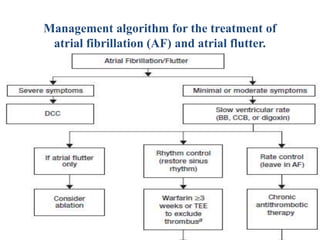
Management algorithm for the treatment of
atrial fibrillation (AF) and atrial flutter.
a) If AF <48 hours, anticoagulation prior to cardioversion is
unnecessary; may consider transesophageal echocardiogram (TEE) if
patient has risk factors for stroke.
b) Ablation may be considered for patients who fail or do not tolerate
on antiarrhythmic drug (AAD).
c) Chronic antithrombotic therapy should be considered
in all patients with AF and risk factors for stroke regardless of
whether or not they remain in sinus rhythm. (BB, β-blocker; CCB,
calcium channel blocker [i.e., verapamil or diltiazem]; DCC, direct-
current cardioversion.)
Paroxysmal supraventricular tachycardia
• The choice between pharmacologic and nonpharmacologic methods
for treating PSVT depends on symptom severity.
• Synchronized DCC is the treatment of choice if symptoms are severe
(e.g., syncope, near syncope, anginal chest pain, severe HF).
• Nondrug measures that increase vagal tone to the AV node (e.g.,
unilateral carotid sinus massage, Valsalva maneuver) can be used for
mild to moderate symptoms.
• If these methods fail, drug therapy is the next option.
• The choice among drugs is based on the QRS complex.
• Drugs can be divided into three broad categories:
1. Those that directly or indirectly increase vagal tone to the AV node
(e.G., Digoxin);
2. Those that depress conduction through slow, calcium-dependent
tissue (e.G., Adenosine, β-blockers, calcium channel blockers)
3. Those that depress conduction through fast, sodium-dependent tissue
(e.G., Quinidine, procainamide, disopyramide, flecainide).
• Adenosine has been recommended as the drug of first choice in
patients with PSVT because its short duration of action will not cause
prolonged hemodynamic compromise in patients with wide QRS
complexes who actually have VT rather than PSVT.
• After acute PSVT is terminated, long-term preventive treatment is
indicated if frequent episodes necessitate therapeutic intervention or if
episodes are infrequent but severely symptomatic.
• Serial testing of antiarrhythmic agents can be evaluated in the
ambulatory setting via ambulatory ECG recordings (Holter monitors)
or telephonic transmissions of cardiac rhythm (event monitors) or by
invasive electrophysiologic techniques in the laboratory.
• Transcutaneous catheter ablation using radiofrequency current on the
• PSVT substrate should be considered in any patient who would have
previously been considered for chronic antiarrhythmic drug treatment.
• It is highly effective and curative, rarely results in complications,
obviates the need for chronic antiarrhythmic drug therapy, and is cost-
effective.
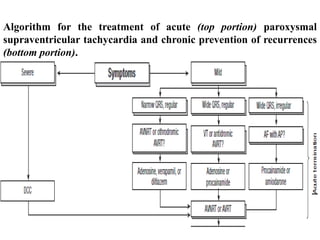
Algorithm for the treatment of acute (top portion) paroxysmal
supraventricular tachycardia and chronic prevention of recurrences
(bottom portion).
• (AAD, antiarrhythmic drugs; AF, atrial fibrillation; AP, accessory
pathway; AVN, atrioventricular nodal; AVNRT, atrioventricular nodal
reentrant tachycardia; AVRT, atrioventricular reentrant tachycardia;
DCC, direct-current cardioversion; ECG, electrocardiographic
monitoring; EPS, electrophysiologic studies; PRN, as needed; VT,
ventricular tachycardia.)
Automatic atrial tachycardias
• Underlying precipitating factors should be corrected by ensuring
proper oxygenation and ventilation and by correcting acid–base or
electrolyte disturbances.
• If tachycardia persists, the need for additional treatment is determined
by symptoms.
• Patients with asymptomatic atrial tachycardia and relatively slow
ventricular response usually require no drug therapy.
• In symptomatic patients, medical therapy can be tailored either to
control ventricular response or to restore sinus rhythm.
• Nondihydropyridine calcium antagonists (e.g., verapamil) are
considered first-line drug therapy for decreasing ventricular response.
• Type I agents (e.g., procainamide, quinidine) are only occasionally
effective in restoring sinus rhythm.
• DCC is ineffective, and β-blockers are usually contraindicated
because of coexisting severe pulmonary disease or uncompensated
HF.
Premature ventricular complexes
• In apparently healthy individuals, drug therapy is unnecessary because
PVCs without associated heart disease carry little or no risk.
• In patients with risk factors for arrhythmic death (recent MI, LV
dysfunction, complex PVCs), chronic drug therapy should be
restricted to β-blockers because only they have been conclusively
proven to prevent mortality in these patients.
Ventricular tachycardia
1. Acute Ventricular Tachycardia
• If severe symptoms are present, synchronized direct-current
cardioversion (DCC) should be instituted immediately to restore sinus
rhythm.
• Precipitating factors should be corrected if possible.
• If VT is an isolated electrical event associated with a transient
initiating factor (e.g., acute myocardial ischemia, digitalis toxicity),
there is no need for long-term antiarrhythmic therapy after
precipitating factors are corrected.
• Patients with mild or no symptoms can be treated initially with
antiarrhythmic drugs.
• IV amiodarone is now recommended as first-line therapy in this
situation.
• Procainamide or lidocaine given IV is a suitable alternative.
• Synchronized DCC should be delivered if the patient’s status
deteriorates, VT degenerates to VF, or drug therapy fails.
2. Sustained Ventricular Tachycardia
• Patients with chronic recurrent sustained VT are at extremely high risk
for death; trial-and-error attempts to find effective therapy are
unwarranted.
• Neither electrophysiologic studies nor serial Holter monitoring with
drug testing is ideal.
• These findings and the side-effect profiles of antiarrhythmic agents
have led to nondrug approaches.
• The automatic ICD is a highly effective method for preventing sudden
death due to recurrent VT or VF.
• Patients with complex ventricular ectopy should not receive type I or
III antiarrhythmic drugs.
3. Ventricular Proarrhythmia
• The typical form of proarrhythmia caused by the type Ic
antiarrhythmic drugs is a rapid, sustained, monomorphic VT with a
characteristic sinusoidal QRS pattern that is often resistant to
resuscitation with cardioversion or overdrive pacing.
• Some clinicians have had success with IV lidocaine (competes for the
sodium channel receptor) or sodium bicarbonate (reverses the
excessive sodium channel blockade).
4. Ventricular Fibrillation
• Patients with pulseless VT or VF (with or without associated
myocardial ischemia) should be managed according to the American
Heart Association’s guidelines for cardiopulmonary resuscitation and
emergency cardiovascular care.
• After successful resuscitation, antiarrhythmics should be continued
until the patient’s rhythm and overall status are stable.
• Long-term antiarrhythmics or ICD implantation may or may not be
required.
• Symptomatic carotid sinus hypersensitivity also should be treated with
permanent pacemaker therapy.
• Patients who remain symptomatic may benefit from adding an α-
adrenergic stimulant such as midodrine.
• Vasovagal syncope has traditionally been treated successfully with
oral β-blockers (e.g., metoprolol) to inhibit the sympathetic surge that
causes forceful ventricular contraction and precedes the onset of
hypotension and bradycardia.
• Other drugs that have been used successfully (with or without β-
blockers) include fludrocortisone, anticholinergics (scopolamine
patches, disopyramide), α-adrenergic agonists (midodrine),
adenosine analogs (theophylline, dipyridamole), and selective
serotonin reuptake inhibitors (sertraline, fluoxetine).
Bradyarrhythmias
• Treatment of sinus node dysfunction involves elimination of
symptomatic bradycardia and possibly managing alternating
tachycardias such as AF.
• Asymptomatic sinus bradyarrhythmias usually do not require
therapeutic intervention.
• In general, long-term therapy of choice for patients with significant
symptoms is a permanent ventricular pacemaker.
• Drugs commonly employed to treat supraventricular tachycardias
should be used with caution, if at all, in the absence of a functioning
pacemaker.
1. Atrioventricular Block
• If patients with Mobitz II or third-degree AV block develop signs or
symptoms of poor perfusion (e.g., altered mental status, chest pain,
hypotension, shock) associated with bradycardia or AV block,
transcutaneous pacing should be initiated immediately.
• Atropine (0.5 mg IV given every 3 to 5 minutes, up to 3 mg total
dose) should be given as the pacing leads are being placed. Infusions
of epinephrine (2 to 10 mcg/min) or dopamine (2 to 10 mcg/kg/min)
can be used in the event of atropine failure.
• These agents will not help if AV block is below the AV node (Mobitz
II or trifascicular AV block).
• Chronic symptomatic AV block warrants insertion of a permanent
pacemaker.
• Patients without symptoms can sometimes be followed closely
without the need for a pacemaker.

6b arrhythmia

  • 1.
    DOCTOR OF PHARMACY IIYEAR Arrhythmia 170101 CHAPTER-1 Cardiovascular system Dr. V. Chanukya (Pharm D)
  • 2.
    Introduction Arrhythmogenesis • Electrical activityis initiated by the sinoatrial (SA) node and moves through cardiac tissue by a tree-like conduction network. • The SA node initiates cardiac rhythm under normal circumstances because this tissue possesses the highest degree of automaticity or rate of spontaneous impulse generation. • The degree of automaticity of the SA node is largely influenced by the autonomic nervous system in that both cholinergic and sympathetic innervations control sinus rate.
  • 3.
    • Most tissueswithin the conduction system also possess varying degrees of inherent automatic properties. • However, the rates of spontaneous impulse generation of these tissues are less than that of the SA node. • Thus these latent automatic pacemakers are continuously overdriven by impulses arising from the SA node (primary pacemaker) and do not become clinically apparent. • From the SA node, electrical activity moves in a wave front through an atrial specialized conducting system and eventually gains entrance to the ventricle via the atrioventricular (AV) node and a large bundle of conducting tissue referred to as the bundle of His.
  • 4.
    • Aside fromthis AV nodal–Hisian pathway, a fibrous AV ring that will not permit electrical stimulation separates the atria and ventricles. • The conducting tissues bridging the atria and ventricles are referred to as the junctional areas. • Again, this area of tissue (junction) is largely influenced by autonomic input, and possesses a relatively high degree of inherent automaticity (about 40 beats/min, less than that of the SA node). • From the bundle of His, the cardiac conduction system bifurcates into several (usually three) bundle branches: one right bundle and two left bundles.
  • 6.
    • These bundlebranches further arborize into a conduction network referred to as the Purkinje system. • The conduction system as a whole innervates the mechanical myocardium and serves to initiate excitation–contraction coupling and the contractile process. • After a cell or group of cells within the heart is electrically stimulated, a brief period of time follows in which those cells cannot again be excited. • This time period is referred to as the refractory period.
  • 7.
    • As theelectrical wave front moves down the conduction system, the impulse eventually encounters tissue refractory to stimulation (recently excited) and subsequently dies out. • The SA node subsequently recovers, fires spontaneously, and begins the process again. • Prior to cellular excitation, an electrical gradient exists between the inside and the outside of the cell membrane. • At this time the cell is polarized. In atrial and ventricular conducting tissue, the intracellular space is approximately 80 to 90 mV negative with respect to the extracellular environment.
  • 8.
    • The electricalgradient just prior to excitation is referred to as resting membrane potential (RMP) and is the result of differences in ion concentrations between the inside and the outside of the cell. • At RMP, the cell is polarized primarily by the action of active membrane ion pumps, the most notable of these being the sodium- potassium pump. • For example, this specific pump (in addition to other systems) attempts to maintain the intracellular sodium concentration at 5 to 15 mEq/L and the extracellular sodium concentration at 135 to 142 mEq/L; the intracellular potassium concentration at 135 to 140 mEq/L and the extracellular potassium concentration at 3 to 5 mEq/L.
  • 9.
    • Electrical stimulation(or depolarization) of the cell will result in changes in membrane potential over time or a characteristic action potential curve
  • 10.
    • The actionpotential curve results from the transmembrane movement of specific ions and is divided into different phases. • Phase 0 or initial, rapid depolarization of atrial and ventricular tissues is caused by an abrupt increase in the permeability of the membrane to sodium influx. • This rapid depolarization more than equilibrates (overshoots) the electrical potential, resulting in a brief initial repolarization or phase 1. • Phase 1 (initial depolarization) is caused by a transient and active potassium efflux (i.e., the Ikto current).
  • 11.
    • Calcium beginsto move into the intracellular space at about 60 mV (during phase 0) causing a slower depolarization. • Calcium influx continues throughout phase 2 of the action potential (plateau phase) and is balanced to some degree by potassium efflux. • Calcium entrance (only through L channels in myocardial tissue) distinguishes cardiac conducting cells from nerve tissue, and provides the critical ionic link to excitation-contraction coupling and the mechanical properties of the heart as a pump. • The membrane remains permeable to potassium efflux during phase 3, resulting in cellular repolarization.
  • 12.
    • Phase 4of the action potential is the gradual depolarization of the cell and is related to a constant sodium leak into the intracellular space balanced by a decreasing (over time) efflux of potassium. • The slope of phase 4 depolarization determines, in large part, the automatic properties of the cell. • As the cell is slowly depolarized during phase 4, an abrupt increase in sodium permeability occurs, allowing the rapid cellular depolarization of phase 0. • The juncture of phase 4 and phase 0 where rapid sodium influx is initiated is referred to the threshold potential of the cell.
  • 13.
    • Not allcells in the cardiac conduction system rely on sodium influx for initial depolarization. • Some tissues depolarize in response to a slower inward ionic current caused by calcium influx. • These “calcium-dependent” tissues are found primarily in the SA and AV nodes (both L and T channels) and possess distinct conduction properties in comparison to “sodium-dependent” fibers. • Calcium dependent cells generally have a less-negative RMP (–40 to – 60 mV) and a slower conduction velocity.
  • 14.
    • Furthermore, incalcium-dependent tissues, recovery of excitability outlasts full repolarization, whereas in sodium-dependent tissue, recovery is prompt after repolarization. • These two types of electrical fibers also differ dramatically in how drugs modify their conduction properties. • Ion conductance across the lipid bilayer of the cell membrane occurs via the formation of membrane pores or “channels” • Selective ion channels probably form in response to specific electrical potential differences between the inside and the outside of the cell (voltage dependence).
  • 15.
    • The membraneitself is composed of both organized and disorganized lipids and phospholipids in a dynamic solgel matrix. • During ion flux and electrical excitation, changes in this sol-gel equilibrium occur and permit the formation of activated ion channels. • Besides channel formation and membrane composition, intrachannel proteins or phospholipids, referred to as gates also regulate the transmembrane movement of ions. • These gates are thought to be positioned strategically within the channel to modulate ion flow.
  • 16.
    • Each ionchannel conceptually has two types of gates: an activation gate and an inactivation gate. • The activation gate opens during depolarization to allow the ion current to enter or exit from the cell, and the inactivation gate later closes to stop ion movement.
  • 17.
    • When thecell is in a rested state, the activation gates are closed and the inactivation gates are open. • The activation gates then open to allow ion movement through the channel, and the inactivation gates later close to stop ion conductance. • Thus, the cell cycles between three states: resting, activated or open, and inactivated or closed. • Activation of SA and AV nodal tissue is dependent on a slow depolarizing current through calcium channels and gates, whereas the activation of atria and ventricular tissue is dependent on a rapid depolarizing current through sodium channels and gates.
  • 18.
    Definition • Arrhythmia isdefined as loss of cardiac rhythm, especially irregularity of heartbeat. Arrhythmia mechanisms • Cardiac arrhythmias occur because of abnormalities of impulse formation or propagation. Abnormal impulse formation 1. Abnormal automaticity -Automaticity is another term for pacemaker activity, a characteristic possessed by all cells of the specialised cardiac conduction system during health and, potentially, by other cardiac myocytes during certain disease states.
  • 19.
    • Under certainconditions like ischaemia and electrolyte imbalance, the resting membrane potential of cardiac muscle cells may become less negative. • This can give rise to automaticity, i.e. spontaneous phase I depolarisations. • This has been implicated in certain arrhythmias like some types of atrial tachycardia (e.g. digitalis-induced), and accelerated junctional rhythm.
  • 20.
    2. Triggered activity •Triggered activity is initiated by after-depolarisations, which are oscillations in the membrane potential initiated by the preceding action potential. • These may be early after depolarisations, i.e. occurring in phase 2 or 3 of the action potential, or delayed after-depolarisations, i.e. occurring after repolarisation is complete. • Early after-depolarisations have been implicated in tachycardias in congenital and acquired forms of the long QT syndrome. • Delayed after-depolarisations are implicated in some digitalis-induced arrhythmias, right ventricular outflow tract tachycardia related to exercise, etc.
  • 21.
    (A) An earlyafter depolarisation (EAD) occurring at the start of phase 3 of the cardiac action potential.
  • 22.
    (B) A delayedafter depolarisation (DAD) occurring after repolarisation, during phase 4. Either EADs or DADs may reach the threshold potential for generation of a further action potential.
  • 23.
    • In bothcases, after depolarisation may reach the threshold potential required for generation of a new action potential. • EADs are characteristic of the congenital and acquired long QT syndromes. • The prolonged action potential duration promotes reactivation of the inward calcium current ICa which may directly cause EADs during phase 2. • Further more, action potential prolongation and ß-adrenoreceptor stimulation promote calcium overload in the sarcoplasmic reticulum. • This in turn leads to the spontaneous release of calcium in bursts by the sarcoplasmic reticulum.
  • 24.
    • The resultantincrease in intracellular calcium concentration activates the transmembrane Na+/Ca2+ exchanger which moves one calcium ion out of the myocyte in exchange for three sodium ions and, therefore, results in an EAD during phase 3. • In the long QT syndromes, an EAD may initiate a form of polymorphic ventricular tachycardia (VT) known as Torsade de Pointes. • EADs are more prominent at slow heart rates.
  • 25.
    • DADs areseen during reperfusion following ischaemia, heart failure, digitalis toxicity and in catecholaminergic polymorphic VT. • They occur because of spontaneous release of calcium in bursts by the sarcoplasmic reticulum, activating the Na+/Ca2+ exchanger as described for EADs and resulting in a DAD during phase 4. • A DAD may result in a single extrastimulus (‘ectopic beat’) or in repetitive firing, that is, tachycardia. • DADs are more prominent at rapid heart rates and during sympathetic nervous stimulation of ß-adrenoreceptors.
  • 26.
    • Abnormal impulsepropagation 1. Re-entry • Many clinically important arrhythmias are due to re-entry, in which an activation wave front rotates continuously around a circuit. • Re-entry depends upon a trigger in the form of a premature beat, and a substrate, that is, the re-entry circuit itself.
  • 27.
    A precise setof electrophysiological conditions must be met in order for re-entry to occur. 1. There must be a central non-conducting obstacle around which the re-entry circuit develops. 2. A premature beat must encounter unidirectional conduction block in one limb (a) of the re-entry circuit, 3. Conduction must proceed slowly enough down the other limb (b) of the re-entry circuit that electrical excitability has returned in the original limb (a), allowing the activation wave front to propagate in a retrograde direction along that limb. 4. The circulating activation wave front must continue to encounter electrically excitable tissue.
  • 28.
  • 29.
    • This isa function of the length of the re-entry circuit, the conduction velocity of the activation wave front and the effective refractory period of the myocardium throughout the circuit. • Class I antiarrhythmic drugs block sodium channels and, therefore, reduce the amplitude and rate of rise of the cardiac action potential and in so doing, reduce the conduction velocity of an activation wave front. • Class I antiarrhythmic drugs may exert their major antiarrhythmic effect by abolishing conduction altogether in areas of diseased myocardium forming part of a re-entry circuit in which conduction is already critically depressed.
  • 30.
    • Class IIIantiarrhythmic drugs prolong cardiac APD and hence the refractory period. • If previously activated cells in a re-entry circuit (the ‘tail’) remain refractory when the re-entrant wavefront (the ‘head’) returns to that area, conduction will fail and re-entry will be abolished. • Drug-induced prolongation of the refractory period may, therefore, terminate and/or prevent reentrant arrhythmias.
  • 31.
    Pathophysiology • Supraventricular arrhythmias •Common supraventricular tachycardias requiring drug treatment are atrial fibrillation (AF) or atrial flutter, paroxysmal supraventricular tachycardia (PSVT), and automatic atrial tachycardias. • Other common supraventricular arrhythmias that usually do not require drug therapy (e.g., premature atrial complexes, wandering atrial pacemaker, sinus arrhythmia, sinus tachycardia).
  • 32.
    1. Atrial Fibrillationand Atrial Flutter • Atrial fibrillation is characterized as an extremely rapid (400 to 600 atrial beats/min) and disorganized atrial activation. • There is a loss of atrial contraction (atrial kick), and supraventricular impulses penetrate the atrioventricular (AV) conduction system in variable degrees, resulting in irregular ventricular activation and irregularly irregular pulse (120 to 180 beats/min). • Atrial flutter is characterized by rapid (270 to 330 atrial beats/min) but regular atrial activation. • The ventricular response usually has a regular pattern and a pulse of 300 beats/min.
  • 33.
    • This arrhythmiaoccurs less frequently than AF but has similar precipitating factors, consequences, and drug therapy. • The predominant mechanism of AF and atrial flutter is reentry, which is usually associated with organic heart disease that causes atrial distention (e.g., ischemia or infarction, hypertensive heart disease, valvular disorders). • Additional associated disorders include acute pulmonary embolus and chronic lung disease, resulting in pulmonary hypertension and corpulmonale; and states of high adrenergic tone such as thyrotoxicosis, alcohol withdrawal, sepsis, or excessive physical exertion.
  • 34.
    2. Paroxysmal SupraventricularTachycardia Caused by Reentry • PSVT arising by reentrant mechanisms includes arrhythmias caused by AV nodal reentry, AV reentry incorporating an anomalous AV pathway, sinoatrial (SA) nodal reentry, and intraatrial reentry. 3. Automatic Atrial Tachycardia's • Automatic atrial tachycardias such as multifocal atrial tachycardia appear to arise from supraventricular foci with enhanced automatic properties. • Severe pulmonary disease is the underlying precipitating disorder in 60% to 80% of patients.
  • 35.
    • Ventricular arrhythmias 1.Premature Ventricular Complexes • Premature ventricular complexes (PVCs) are common ventricular rhythm disturbances that occur in patients with or without heart disease and may be elicited experimentally by abnormal automaticity, triggered activity, or reentrant mechanisms. 2. Ventricular Tachycardia • Ventricular tachycardia (VT) is defined by three or more repetitive PVCs occurring at a rate greater than 100 beats/min.
  • 36.
    • It occursmost commonly in acute myocardial infarction (MI); other causes are severe electrolyte abnormalities (e.g., hypokalemia), hypoxemia, and digitalis toxicity. • The chronic recurrent form is almost always associated with underlying organic heart disease (e.g., idiopathic dilated cardiomyopathy or remote MI with left ventricular [LV] aneurysm). • Sustained VT is that which requires therapeutic intervention to restore a stable rhythm or that lasts a relatively long time (usually longer than 30 seconds). • Non sustained VT self-terminates after a brief duration (usually less than 30 seconds).
  • 37.
    • Incessant VTrefers to VT occurring more frequently than sinus rhythm, so that VT becomes the dominant rhythm. • Monomorphic VT has a consistent QRS configuration, whereas polymorphic VT has varying QRS complexes. • Torsade de pointes (TdP) is a polymorphic VT in which the QRS complexes appear to undulate around a central axis. 3. Ventricular Proarrhythmia • Proarrhythmia refers to development of a significant new arrhythmia (such as VT, ventricular fibrillation [VF], or TdP) or worsening of an existing arrhythmia.
  • 38.
    • Proarrhythmia resultsfrom the same mechanisms that cause other arrhythmias or from an alteration in the underlying substrate due to the antiarrhythmic agent. • TdP is a rapid form of polymorphic VT associated with evidence of delayed ventricular repolarization due to blockade of potassium conductance. • TdP may be hereditary or acquired. • Acquired forms are associated with many clinical conditions and drugs, especially type Ia and type III IKr blockers.
  • 39.
    4. Ventricular Fibrillation •VF is electrical anarchy of the ventricle resulting in no cardiac output and cardiovascular collapse. • Sudden cardiac death occurs most commonly in patients with ischemic heart disease and primary myocardial disease associated with LV dysfunction. • VF associated with acute MI may be classified as either • (1) primary (an uncomplicated MI not associated with heart failure [HF]) or (2) secondary or complicated (an MI complicated by HF).
  • 40.
    Bradyarrhythmias • Asymptomatic sinusbradyarrhythmias (heart rate less than 60 beats/min) are common especially in young, athletically active individuals. • However, SA nodal function. Sinus node dysfunction is usually repsome patients have sinus node dysfunction (sick sinus syndrome) because of underlying organic heart disease and the normal aging process, which attenuates resentative of diffuse conduction disease, which may be accompanied by AV block and by paroxysmal tachycardias such as AF.
  • 41.
    • Alternating bradyarrhythmiasand tachyarrhythmias are referred to as the tachy–brady syndrome. • AV block or conduction delay may occur in any area of the AV conduction system. • AV block may be found in patients without underlying heart disease (e.g., trained athletes) or during sleep when vagal tone is high. • It may be transient when the underlying etiology is reversible (e.g., myocarditis, myocardial ischemia, after cardiovascular surgery, during drug therapy).
  • 42.
    • β-Blockers, digoxin,or nondihydropyridine calcium antagonists may cause AV block, primarily in the AV nodal area. • Type I antiarrhythmics may exacerbate conduction delays below the level of the AV node. • AV block may be irreversible if the cause is acute MI, rare degenerative disease, primary myocardial disease, or a congenital condition.
  • 43.
    Clinical presentation • Supraventriculartachycardias may cause a variety of clinical manifestations ranging from no symptoms to minor palpitations and/or irregular pulse to severe and even life-threatening symptoms. • Patients may experience dizziness or acute syncopal episodes; symptoms of HF; anginal chest pain; or, more often, a choking or pressure sensation during the tachycardia episode. • AF or atrial flutter may be manifested by the entire range of symptoms associated with other supraventricular tachycardias, but syncope is not a common presenting symptom.
  • 44.
    • An additionalcomplication of AF is arterial embolization resulting from atrial stasis and poorly adherent mural thrombi, which accounts for the most devastating complication: embolic stroke. • Patients with AF and concurrent mitral stenosis or severe systolic HF are at particularly high risk for cerebral embolism. • PVCs often cause no symptoms or only mild palpitations. The presentation of VT may vary from totally asymptomatic to pulseless hemodynamic collapse. • Consequences of proarrhythmia range from no symptoms to worsening of symptoms to sudden death. VF results in hemodynamic collapse, syncope, and cardiac arrest.
  • 45.
    • Patients withbradyarrhythmias experience symptoms associated with hypotension such as dizziness, syncope, fatigue, and confusion. • If LV dysfunction exists, symptoms of congestive HF may be exacerbated.
  • 46.
    Diagnosis • A detailedhistory should be obtained, covering all of the symptoms listed above. • A characteristic of cardiac arrhythmias is their random onset. • Symptoms occurring under specific circumstances are less likely to be due to arrhythmia, but there are exceptions including certain uncommon types of VT, some cases of supraventricular tachycardia (SVT) due to an accessory pathway and vasovagal syncope (faints). • Other key features of the history include: 1. A history of cardiac disease 2. Other diagnosed medical conditions
  • 47.
    3. A fulldrug history, including over-the-counter medicines and recreational drugs including alcohol 4. A family history of heart disease and of sudden unexpected death. • Physical examination is essential but often normal between episodes of arrhythmia. • Mandatory investigation includes a 12-lead ECG and an echocardiogram to detect structural heart disease. • Other investigations for structural and ischaemic heart disease may be indicated at this stage with the aim of detecting any underlying structural heart disease.
  • 48.
    • If thehistory does not include sinister features such as syncope or a family history of sudden unexpected death at a young age, and the resting 12-lead ECG and echocardiogram are normal, then the patient can be reassured that they are extremely unlikely to have a serious heart rhythm disturbance. • The extent of further investigation will be dictated by how troublesome the symptoms are. • The most certain way of reaching a firm diagnosis is a 12-lead ECG recorded during the patient's symptoms demonstrating arrhythmia. • As many arrhythmias occur intermittently, some form of ECG monitoring is often necessary.
  • 49.
    • This mayinclude a continuous ambulatory ECG (Holter) recording for up to 7 days at a time if the symptoms occur frequently or, for less frequent symptoms an event recorder, which may store ECG strips automatically if it detects an arrhythmia or if activated by the patient during their symptoms. • An insertable loop recorder may be implanted subcutaneously and is an ECG event recorder with a battery life of about 3 years, making it a useful tool for the diagnosis of infrequent arrhythmias.
  • 50.
    Treatment • The useof antiarrhythmic drugs in the United States is declining because of major trials that showed increased mortality with their use in several clinical situations, the realization of proarrhythmia as a significant side effect, and the advancing technology of nondrug therapies such as ablation and the implantable cardioverter- defibrillator (ICD).
  • 51.
    Classification of antiarrhythmicdrugs • Drugs may have antiarrhythmic activity by directly altering conduction in several ways. • Drugs may depress the automatic properties of abnormal pacemaker cells by decreasing the slope of phase 4 depolarization and/or by elevating threshold potential. • Drugs may alter the conduction characteristics of the pathways of a reentrant loop. • The most frequently used classification system is that proposed by Vaughan Williams.
  • 52.
  • 53.
    The cardiac actionpotential. A. An action potential from ventricular myocardium. During diastole (phase 4), the resting transmembrane potential is constant at -90 mV. The upstroke (phase 0) of the action potential is due to the rapid influx of Na+ ions. • The early phase of repolarisation (phase 1) is due to efflux of K+ ions, followed by a plateau phase (phase 2) at about 0 mV during which influx of Ca2+ ions is balanced by efflux of K+ ions. • Towards the end of diastole, influx of Ca2+ ions diminishes and efflux of K+ ions increases, resulting in repolarisation (phase 3) back to the negative resting membrane potential.
  • 54.
  • 55.
    (B) An actionpotential from the sinus node. • During diastole (phase 4), there is progressive depolarisation towards a threshold potential at which an action potential is triggered. • The upstroke (phase 0) of the action potential is less steep than in ventricular myocardial cells because the sinus node cells lack ‘fast’ Na+ channels and so depolarisation is dependent upon influx of Ca2+ ions.
  • 56.
    An action potentialfrom the sinus node.
  • 57.
    Class I • ClassI drugs act by blocking the fast sodium channels that are responsible for the rapid depolarisation phase of the cardiac action potential, thus reducing the rate of depolarisation (the slope of phase 0) and the amplitude of the action potential. • The conduction velocity of an activation wavefront is determined partly by the slope and amplitude of the cardiac action potential and partly by the resistance to current flow through the myocardium. • The effect of sodium channel blockade is a decrease in conduction velocity.
  • 58.
    • Certain re-entrantarrhythmias such as VT complicating previous myocardial infarction depend upon slow conduction in part of the re- entrant circuit. • Class I antiarrhythmic drugs may critically slow or even abolish conduction in these areas, thus terminating and/or preventing re-entry. • The action potential in the sinoatrial and AV nodes does not depend on fast sodium channels for depolarisation; instead, phase 0 depolarisation is carried by calcium channels. • Class I antiarrhythmic drugs, therefore, have no direct effect on nodal tissue.
  • 59.
    • In additionto their effect on depolarisation, class I antiarrhythmic drugs may also alter the APD (Action potential duration)and hence the effective refractory period (ERP) via an effect on potassium channels responsible for action potential repolarisation. • Class I antiarrhyhmic drugs are subdivided into three groups according to their effect on APD: – Class IA drugs increase the APD, – Class IB drugs shorten the APD – Class IC drugs have no effect on APD. • These effects may be assessed by measurement of the QT interval on the ECG, which reflects average ventricular APD.
  • 60.
    • Type Iadrugs slow conduction velocity, prolong refractoriness, and decrease the automatic properties of sodium dependent (normal and diseases ) conduction tissue. Type Ia drugs are broad-spectrum antiarrhythmics, being effective for both supraventricular and ventricular arrhythmias. • Although categorized separately, type Ib drugs probably act similarly to type Ia drugs, except that type Ib agents are considerably more effective in ventricular than supraventricular arrhythmias.
  • 61.
    • Type Icdrugs profoundly slow conduction velocity while leaving refractoriness relatively unaltered. Although effective for both ventricular and supraventricular arrhythmias, their use for ventricular arrhythmias has been limited by the risk of proarrhythmia. Collectively, type I drugs can be referred to as sodium channel blockers. • Antiarrhythmic sodium channel receptor principles account for drug combinations that are additive (e.g., quinidine and mexiletine) and antagonistic (e.g.,flecainide and lidocaine), as well as potential antidotes to excess sodium channel blockade (e.g., sodium bicarbonate, propranolol).
  • 62.
    • Type IIdrugs include β-adrenergic antagonists; clinically relevant mechanisms result from their antiadrenergic actions. • Β-Blockers are most useful in tachycardias in which nodal tissues are abnormally automatic or are a portion of a reentrant loop. • These agents are also helpful in slowing ventricular response in atrial tachycardias (e.g., AF) by their effects on the AV node. • Type III drugs specifically prolong refractoriness in atrial and ventricular fibers and include very different drugs that share the common effect of delaying repolarization by blocking potassium channels.
  • 63.
    • Bretylium (rarelyused) has additional actions in that it first releases and then depletes catecholamines. • It increases the VF threshold and seems to have selective antifibrillatory but not antitachycardic effects. • Bretylium can be effective in VF but is often ineffective in VT. • In contrast, amiodarone and sotalol are effective in most supraventricular and ventricular tachycardias. • Amiodarone displays electrophysiologic characteristics consistent with each type of antiarrhythmic drug.
  • 64.
    • Amiodarone isa sodium channel blocker with relatively fast on- off kinetics, has nonselective β -blocking actions, blocks potassium channels, and has slight calcium antagonist activity. • The impressive effectiveness and low proarrhythmic potential of amiodarone have challenged the notion that selective ion channel blockade is preferable. • Sotalol is a potent inhibitor of outward potassium movement during repolarization and also possesses nonselective β-blocking actions. • Ibutilide and dofetilide block the rapid component of the delayed potassium rectifier current.
  • 65.
    • Type IVdrugs inhibit calcium entry into the cell, which slows conduction, prolongs refractoriness, and decreases SA and AV nodal automaticity. • Calcium channel antagonists are effective for automatic or reentrant tachycardias that arise from or use the SA or AV nodes.
  • 66.
    Atrial Fibrillation OrAtrial Flutter • Many methods are available for restoring sinus rhythm, preventing thromboembolic complications, and preventing further recurrences, however, treatment selection depends in part on onset and severity of symptoms. • If symptoms are severe and of recent onset, patients may require direct current cardioversion (DCC) to restore sinus rhythm immediately. • If patients are hemodynamically stable, the focus should be directed toward control of ventricular rate.
  • 67.
    • Drugs thatslow conduction and increase refractoriness in the AV node should be used as initial therapy. • In patients with normal LV function (left ventricular ejection fraction >40%), IV β - blockers ( propranolol, metoprolol, esmolol), diltiazem, or verapamil is recommended. • If a high adrenergic state is the precipitating factor, IV β - blockers can be highly effective and should be considered first. • In patients with left ventricular ejection fraction ≤ 40%, IV diltiazem and verapamil should be avoided and IV β -blockers should be used with caution.
  • 68.
    • In patientshaving an exacerbation of HF symptoms, IV digoxin or amiodarone should be used as first-line therapy for ventricular rate control. • IV amiodarone can also be used in patients who are refractory or have contraindications to β -blockers, nondihydropyridine calcium channel blockers, and digoxin. • After treatment with AV nodal blocking agents and a subsequent decrease in ventricular response, the patient should be evaluated for the possibility of restoring sinus rhythm if AF persists.
  • 69.
    • If sinusrhythm is to be restored, anticoagulation should be initiated prior to cardioversion because return of atrial contraction increases risk of thromboembolism. • Patients with AF for longer than 48 hours or an unknown duration should receive warfarin (target international normalized ratio [INR] 2 to 3) for at least 3 weeks prior to cardioversion and continuing for at least 4 weeks after effective cardioversion and return of normal sinus rhythm. • Patients with AF less than 48 hours in duration do not requir warfarin, but it is recommended that these patients receive either IV unfractionated heparin or a low-molecular-weight heparin (subcutaneously at treatment doses) at presentation prior to cardioversion.
  • 70.
  • 71.
    Side Effects ofAntiarrhythmic Drugs
  • 72.
    Management algorithm forthe treatment of atrial fibrillation (AF) and atrial flutter.
  • 74.
    a) If AF<48 hours, anticoagulation prior to cardioversion is unnecessary; may consider transesophageal echocardiogram (TEE) if patient has risk factors for stroke. b) Ablation may be considered for patients who fail or do not tolerate on antiarrhythmic drug (AAD). c) Chronic antithrombotic therapy should be considered in all patients with AF and risk factors for stroke regardless of whether or not they remain in sinus rhythm. (BB, β-blocker; CCB, calcium channel blocker [i.e., verapamil or diltiazem]; DCC, direct- current cardioversion.)
  • 75.
    Paroxysmal supraventricular tachycardia •The choice between pharmacologic and nonpharmacologic methods for treating PSVT depends on symptom severity. • Synchronized DCC is the treatment of choice if symptoms are severe (e.g., syncope, near syncope, anginal chest pain, severe HF). • Nondrug measures that increase vagal tone to the AV node (e.g., unilateral carotid sinus massage, Valsalva maneuver) can be used for mild to moderate symptoms. • If these methods fail, drug therapy is the next option. • The choice among drugs is based on the QRS complex.
  • 76.
    • Drugs canbe divided into three broad categories: 1. Those that directly or indirectly increase vagal tone to the AV node (e.G., Digoxin); 2. Those that depress conduction through slow, calcium-dependent tissue (e.G., Adenosine, β-blockers, calcium channel blockers) 3. Those that depress conduction through fast, sodium-dependent tissue (e.G., Quinidine, procainamide, disopyramide, flecainide).
  • 77.
    • Adenosine hasbeen recommended as the drug of first choice in patients with PSVT because its short duration of action will not cause prolonged hemodynamic compromise in patients with wide QRS complexes who actually have VT rather than PSVT. • After acute PSVT is terminated, long-term preventive treatment is indicated if frequent episodes necessitate therapeutic intervention or if episodes are infrequent but severely symptomatic. • Serial testing of antiarrhythmic agents can be evaluated in the ambulatory setting via ambulatory ECG recordings (Holter monitors) or telephonic transmissions of cardiac rhythm (event monitors) or by invasive electrophysiologic techniques in the laboratory.
  • 78.
    • Transcutaneous catheterablation using radiofrequency current on the • PSVT substrate should be considered in any patient who would have previously been considered for chronic antiarrhythmic drug treatment. • It is highly effective and curative, rarely results in complications, obviates the need for chronic antiarrhythmic drug therapy, and is cost- effective.
  • 79.
    Algorithm for thetreatment of acute (top portion) paroxysmal supraventricular tachycardia and chronic prevention of recurrences (bottom portion).
  • 80.
    • (AAD, antiarrhythmicdrugs; AF, atrial fibrillation; AP, accessory pathway; AVN, atrioventricular nodal; AVNRT, atrioventricular nodal reentrant tachycardia; AVRT, atrioventricular reentrant tachycardia; DCC, direct-current cardioversion; ECG, electrocardiographic monitoring; EPS, electrophysiologic studies; PRN, as needed; VT, ventricular tachycardia.)
  • 81.
    Automatic atrial tachycardias •Underlying precipitating factors should be corrected by ensuring proper oxygenation and ventilation and by correcting acid–base or electrolyte disturbances. • If tachycardia persists, the need for additional treatment is determined by symptoms. • Patients with asymptomatic atrial tachycardia and relatively slow ventricular response usually require no drug therapy. • In symptomatic patients, medical therapy can be tailored either to control ventricular response or to restore sinus rhythm.
  • 82.
    • Nondihydropyridine calciumantagonists (e.g., verapamil) are considered first-line drug therapy for decreasing ventricular response. • Type I agents (e.g., procainamide, quinidine) are only occasionally effective in restoring sinus rhythm. • DCC is ineffective, and β-blockers are usually contraindicated because of coexisting severe pulmonary disease or uncompensated HF. Premature ventricular complexes • In apparently healthy individuals, drug therapy is unnecessary because PVCs without associated heart disease carry little or no risk. • In patients with risk factors for arrhythmic death (recent MI, LV dysfunction, complex PVCs), chronic drug therapy should be restricted to β-blockers because only they have been conclusively proven to prevent mortality in these patients.
  • 83.
    Ventricular tachycardia 1. AcuteVentricular Tachycardia • If severe symptoms are present, synchronized direct-current cardioversion (DCC) should be instituted immediately to restore sinus rhythm. • Precipitating factors should be corrected if possible. • If VT is an isolated electrical event associated with a transient initiating factor (e.g., acute myocardial ischemia, digitalis toxicity), there is no need for long-term antiarrhythmic therapy after precipitating factors are corrected.
  • 84.
    • Patients withmild or no symptoms can be treated initially with antiarrhythmic drugs. • IV amiodarone is now recommended as first-line therapy in this situation. • Procainamide or lidocaine given IV is a suitable alternative. • Synchronized DCC should be delivered if the patient’s status deteriorates, VT degenerates to VF, or drug therapy fails.
  • 85.
    2. Sustained VentricularTachycardia • Patients with chronic recurrent sustained VT are at extremely high risk for death; trial-and-error attempts to find effective therapy are unwarranted. • Neither electrophysiologic studies nor serial Holter monitoring with drug testing is ideal. • These findings and the side-effect profiles of antiarrhythmic agents have led to nondrug approaches. • The automatic ICD is a highly effective method for preventing sudden death due to recurrent VT or VF. • Patients with complex ventricular ectopy should not receive type I or III antiarrhythmic drugs.
  • 86.
    3. Ventricular Proarrhythmia •The typical form of proarrhythmia caused by the type Ic antiarrhythmic drugs is a rapid, sustained, monomorphic VT with a characteristic sinusoidal QRS pattern that is often resistant to resuscitation with cardioversion or overdrive pacing. • Some clinicians have had success with IV lidocaine (competes for the sodium channel receptor) or sodium bicarbonate (reverses the excessive sodium channel blockade).
  • 87.
    4. Ventricular Fibrillation •Patients with pulseless VT or VF (with or without associated myocardial ischemia) should be managed according to the American Heart Association’s guidelines for cardiopulmonary resuscitation and emergency cardiovascular care. • After successful resuscitation, antiarrhythmics should be continued until the patient’s rhythm and overall status are stable. • Long-term antiarrhythmics or ICD implantation may or may not be required.
  • 88.
    • Symptomatic carotidsinus hypersensitivity also should be treated with permanent pacemaker therapy. • Patients who remain symptomatic may benefit from adding an α- adrenergic stimulant such as midodrine. • Vasovagal syncope has traditionally been treated successfully with oral β-blockers (e.g., metoprolol) to inhibit the sympathetic surge that causes forceful ventricular contraction and precedes the onset of hypotension and bradycardia. • Other drugs that have been used successfully (with or without β- blockers) include fludrocortisone, anticholinergics (scopolamine patches, disopyramide), α-adrenergic agonists (midodrine), adenosine analogs (theophylline, dipyridamole), and selective serotonin reuptake inhibitors (sertraline, fluoxetine).
  • 89.
    Bradyarrhythmias • Treatment ofsinus node dysfunction involves elimination of symptomatic bradycardia and possibly managing alternating tachycardias such as AF. • Asymptomatic sinus bradyarrhythmias usually do not require therapeutic intervention. • In general, long-term therapy of choice for patients with significant symptoms is a permanent ventricular pacemaker. • Drugs commonly employed to treat supraventricular tachycardias should be used with caution, if at all, in the absence of a functioning pacemaker.
  • 90.
    1. Atrioventricular Block •If patients with Mobitz II or third-degree AV block develop signs or symptoms of poor perfusion (e.g., altered mental status, chest pain, hypotension, shock) associated with bradycardia or AV block, transcutaneous pacing should be initiated immediately. • Atropine (0.5 mg IV given every 3 to 5 minutes, up to 3 mg total dose) should be given as the pacing leads are being placed. Infusions of epinephrine (2 to 10 mcg/min) or dopamine (2 to 10 mcg/kg/min) can be used in the event of atropine failure.
  • 91.
    • These agentswill not help if AV block is below the AV node (Mobitz II or trifascicular AV block). • Chronic symptomatic AV block warrants insertion of a permanent pacemaker. • Patients without symptoms can sometimes be followed closely without the need for a pacemaker.