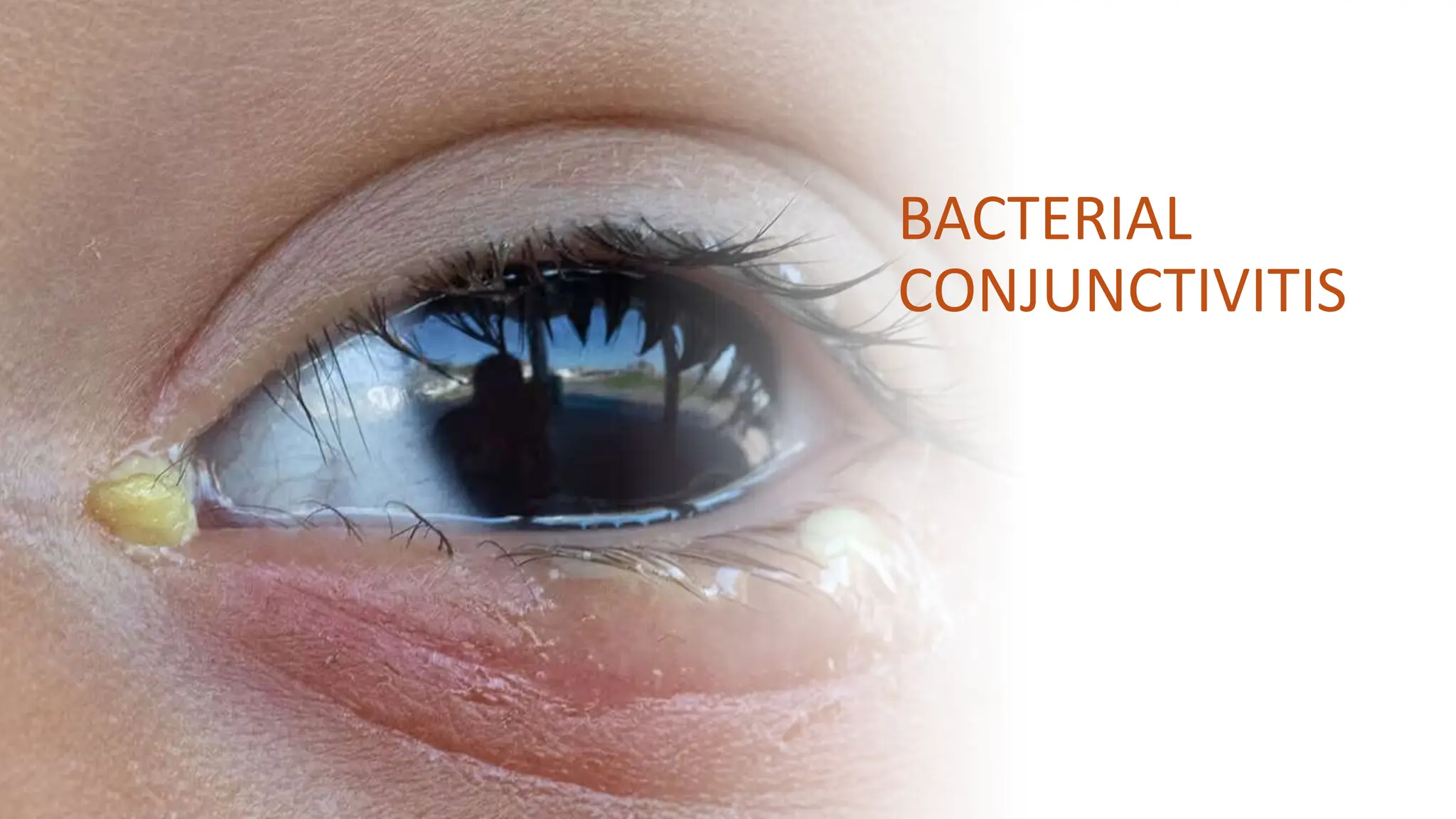
BACTERIAL
CONJUNCTIVITIS
Definition: Bacterial conjunctivitis is inflammation of the conjunctiva
as a result of bacterial infection.
Conjunctivitis, or pink eye, is an irritation or inflammation of the
conjunctiva, which covers the white part of the eyeball.
It can be caused by allergies or a bacterial or viral infection.
Conjunctivitis can be extremely contagious and is spread by contact
with eye secretions from someone who is infected.
Causative organisms
Pathogens responsible for causing bacterial conjunctivitis include
Neisseria species,
Chlamydial species,
Staphylococcus species,
Haemophilus species,
Streptococcus pneumoniae, and Moraxella species.
Acute bacterial conjunctivitis is commonly caused by S. aureus, S.
pneumoniae, and Haemophilus species. In children, Streptococcus
and Haemophilus infections occur frequently.
Predisposing factors
 Since these bacteria are usually spread from other infected inviduals,
poor hygenic habits may increase the risk of infection
 Poor contact lens hygiene, Contaminated cosmetics
 Crowded living or social conditions such elementary schools, military
barracks etc
 Ocular diseases including dry eye, blepharitis, and anatomic
abnormalities of the ocular surface and lids
 Chronic use of topical medications
 Immune compromise
According to Mode of infection
1. Exogenous infections may spread:
• Directly through close contact, as airborne infections or as
waterborne infections
• Vector transmission (e.g., flies)
• Material transfer such as infected fingers of doctors, nurses,
common towels, handkerchiefs, and infected tonometers.
2. Local spread may occur from neighboring structures such as
infected lacrimal sac, lids, and nasopharynx.
3. Endogenous infections may occur very rarely through blood, e.g.,
gonococcal and meningococcal infections.
CLINICAL TYPES OF BACTERIAL CONJUNCTIVITIS
Acute bacterial conjunctivitis,
Hyperacute bacterial conjunctivitis,
Chronic bacterial conjunctivitis, and
Angular bacterial conjunctivitis.
Acute bacterial conjunctivitis
Acute bacterial conjunctivitis is characterised by marked conjunctival
hyperaemia and mucopurulent discharge from the eye.
So, clinically, it is called acute mucopurulent conjunctivitis.
It is the most common type of bacterial conjunctivitis.
COMPLICATIONS
Marginal corneal ulcer
Superficial keratitis
Blepharitis or dacryocystitis
HYPERACUTE CONJUNCTIVITIS OF ADULTS
(GONOCOCCAL CONJUNCTIVITIS) - Etiology
• The disease affects adults, predominantly males.
• Gonococcal infection directly spreads from genitals to eye.
• Presently, incidence of gonococcal conjunctivitis has markedly
decreased.
COMPLICATIONS 1. Corneal involvement - Diffuse haze and oedema,
central necrosis, corneal ulceration or even perforation. 2. Iridocyclitis
3. Systemic complications - Gonorrhoea arthritis, endocarditis and
septicaemia.
CHRONIC BACTERIAL CONJUNCTIVITIS
Chronic bacterial conjunctivitis is frequently associated with
continuous inoculation of bacteria associated with blepharitis. The
most common cause of chronic bacterial conjunctivitis is
Staphylococcus aureus.
Predisposing factors
1. Chronic exposure to dust, smoke, and chemical irritants.
2. Eye strain due to refractive errors, convergence insufficiency.
3. Abuse of alcohol, insomnia and metabolic disorders.
ANGULAR BACTERIAL CONJUNCTIVITIS
1. Predisposing factors are same as for ‘simple chronic
conjunctivitis’.
2. Causative organisms Moraxella Axenfield (MA) is the commonest
causative organism. MA bacilli are placed end to end, so the
disease is also called ‘diplobacillary conjunctivitis’. Rarely,
staphylococci may also cause angular conjunctivitis
TREATMENT
Acute bacterial conjunctivitis is empirically treated with a broad-
spectrum topical antibiotic. Treatment with a broad-spectrum topical
antibiotic for five to seven days is usually effective.
Aminoglycosides
Gentamicin
Tobramycin
Chloramphenicol
Fluoroquinolone
Ciprofloxacin
Ofloxacin
Levofloxacin
Polymyxin B/Neomycin
Tetracycline
Thank you

BACTERIAL_CONJUNCTIVITIS, Ocular microbiology

  • 1.
  • 2.
    Definition: Bacterial conjunctivitisis inflammation of the conjunctiva as a result of bacterial infection. Conjunctivitis, or pink eye, is an irritation or inflammation of the conjunctiva, which covers the white part of the eyeball. It can be caused by allergies or a bacterial or viral infection. Conjunctivitis can be extremely contagious and is spread by contact with eye secretions from someone who is infected.
  • 3.
    Causative organisms Pathogens responsiblefor causing bacterial conjunctivitis include Neisseria species, Chlamydial species, Staphylococcus species, Haemophilus species, Streptococcus pneumoniae, and Moraxella species. Acute bacterial conjunctivitis is commonly caused by S. aureus, S. pneumoniae, and Haemophilus species. In children, Streptococcus and Haemophilus infections occur frequently.
  • 4.
    Predisposing factors  Sincethese bacteria are usually spread from other infected inviduals, poor hygenic habits may increase the risk of infection  Poor contact lens hygiene, Contaminated cosmetics  Crowded living or social conditions such elementary schools, military barracks etc  Ocular diseases including dry eye, blepharitis, and anatomic abnormalities of the ocular surface and lids  Chronic use of topical medications  Immune compromise
  • 5.
    According to Modeof infection 1. Exogenous infections may spread: • Directly through close contact, as airborne infections or as waterborne infections • Vector transmission (e.g., flies) • Material transfer such as infected fingers of doctors, nurses, common towels, handkerchiefs, and infected tonometers. 2. Local spread may occur from neighboring structures such as infected lacrimal sac, lids, and nasopharynx.
  • 6.
    3. Endogenous infectionsmay occur very rarely through blood, e.g., gonococcal and meningococcal infections.
  • 7.
    CLINICAL TYPES OFBACTERIAL CONJUNCTIVITIS Acute bacterial conjunctivitis, Hyperacute bacterial conjunctivitis, Chronic bacterial conjunctivitis, and Angular bacterial conjunctivitis.
  • 8.
    Acute bacterial conjunctivitis Acutebacterial conjunctivitis is characterised by marked conjunctival hyperaemia and mucopurulent discharge from the eye. So, clinically, it is called acute mucopurulent conjunctivitis. It is the most common type of bacterial conjunctivitis. COMPLICATIONS Marginal corneal ulcer Superficial keratitis Blepharitis or dacryocystitis
  • 9.
    HYPERACUTE CONJUNCTIVITIS OFADULTS (GONOCOCCAL CONJUNCTIVITIS) - Etiology • The disease affects adults, predominantly males. • Gonococcal infection directly spreads from genitals to eye. • Presently, incidence of gonococcal conjunctivitis has markedly decreased. COMPLICATIONS 1. Corneal involvement - Diffuse haze and oedema, central necrosis, corneal ulceration or even perforation. 2. Iridocyclitis 3. Systemic complications - Gonorrhoea arthritis, endocarditis and septicaemia.
  • 10.
    CHRONIC BACTERIAL CONJUNCTIVITIS Chronicbacterial conjunctivitis is frequently associated with continuous inoculation of bacteria associated with blepharitis. The most common cause of chronic bacterial conjunctivitis is Staphylococcus aureus. Predisposing factors 1. Chronic exposure to dust, smoke, and chemical irritants. 2. Eye strain due to refractive errors, convergence insufficiency. 3. Abuse of alcohol, insomnia and metabolic disorders.
  • 11.
    ANGULAR BACTERIAL CONJUNCTIVITIS 1.Predisposing factors are same as for ‘simple chronic conjunctivitis’. 2. Causative organisms Moraxella Axenfield (MA) is the commonest causative organism. MA bacilli are placed end to end, so the disease is also called ‘diplobacillary conjunctivitis’. Rarely, staphylococci may also cause angular conjunctivitis
  • 12.
    TREATMENT Acute bacterial conjunctivitisis empirically treated with a broad- spectrum topical antibiotic. Treatment with a broad-spectrum topical antibiotic for five to seven days is usually effective. Aminoglycosides Gentamicin Tobramycin Chloramphenicol Fluoroquinolone Ciprofloxacin Ofloxacin Levofloxacin Polymyxin B/Neomycin Tetracycline
  • 13.