Class Outline
• Measuring Consumer Preference
– Problem with intentions-to-buy and self-reported methods
– Conjoint Analysis
Preferences
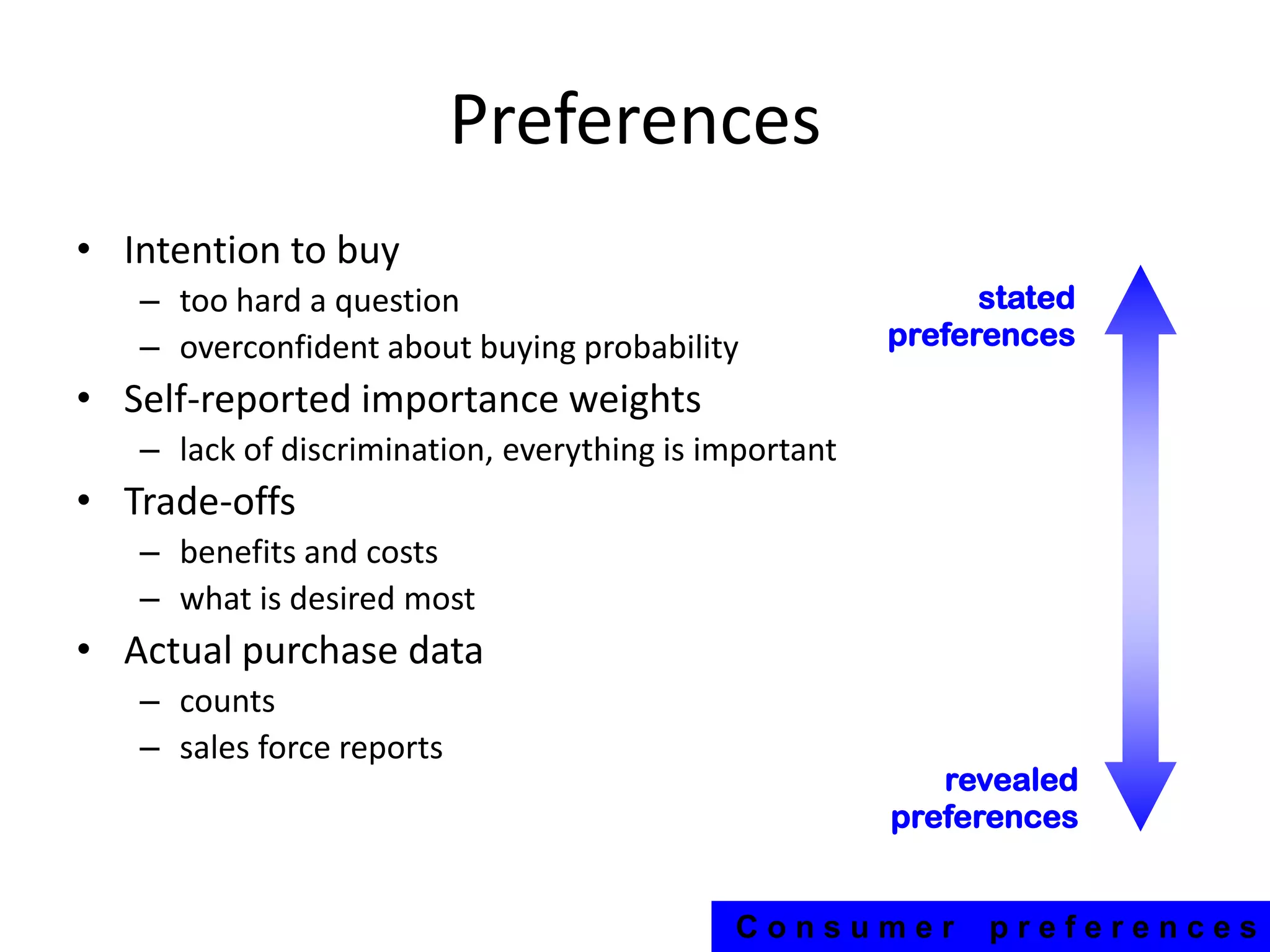
• Intention to buy
– too hard a question
– overconfident about buying probability

stated
preferences

• Self-reported importance weights
– lack of discrimination, everything is important

• Trade-offs
– benefits and costs
– what is desired most

• Actual purchase data
– counts
– sales force reports

revealed
preferences

Consumer

preferences
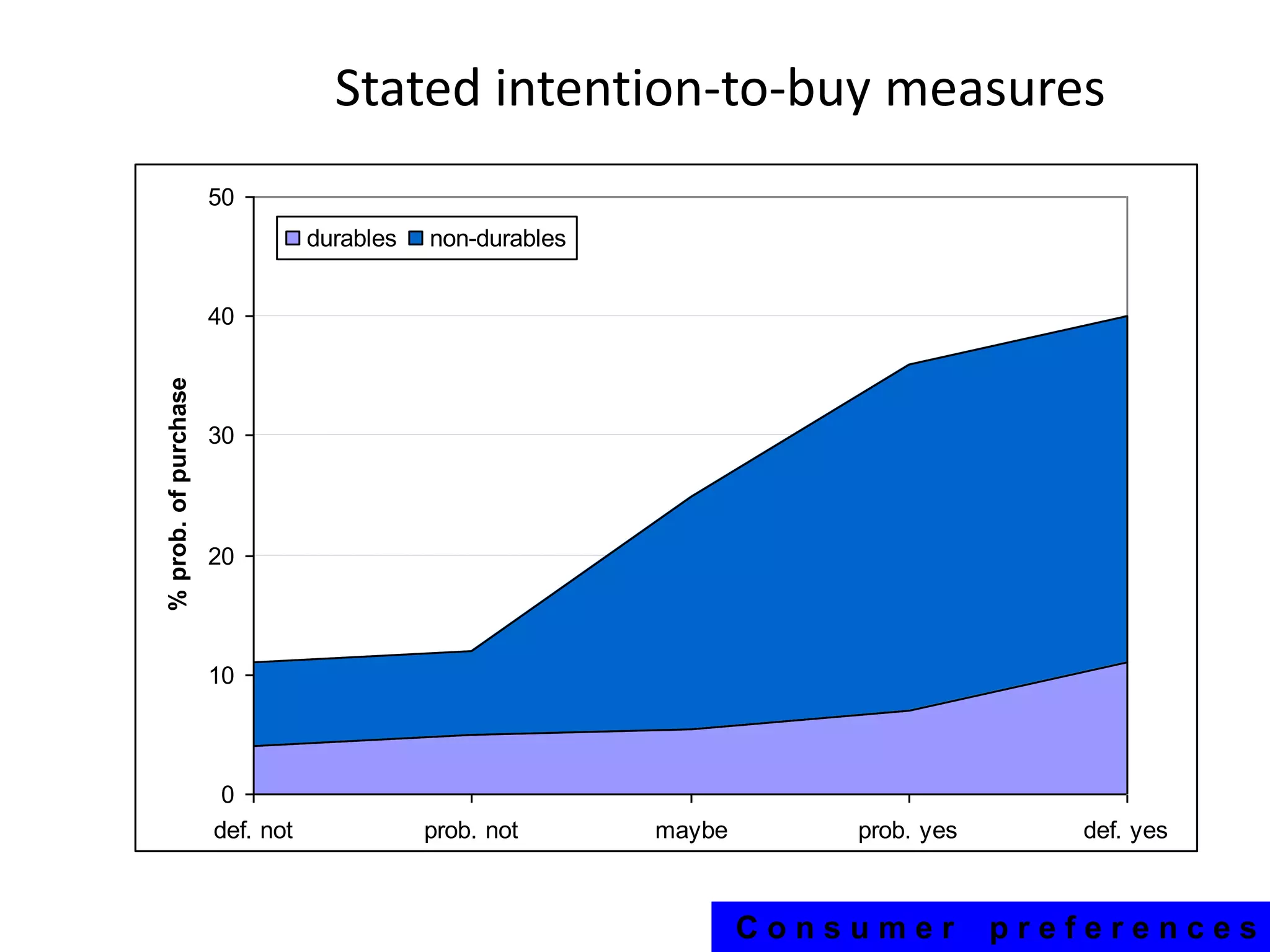
Stated intention-to-buy measures
50
durables

non-durables

% prob. of purchase

40

30

20

10

0
def. not

prob. not

maybe

prob. yes

Consumer

def. yes

preferences
How to Learn What Customers Want?
• Ask Direct Questions about preference :
– What brand do you prefer?
– How much RAM do you prefer?
– How much hard disk space do you prefer?
– What type of monitor do you prefer?
– What price do you prefer?

• What is the problem with this?
Problems with Direct Questioning
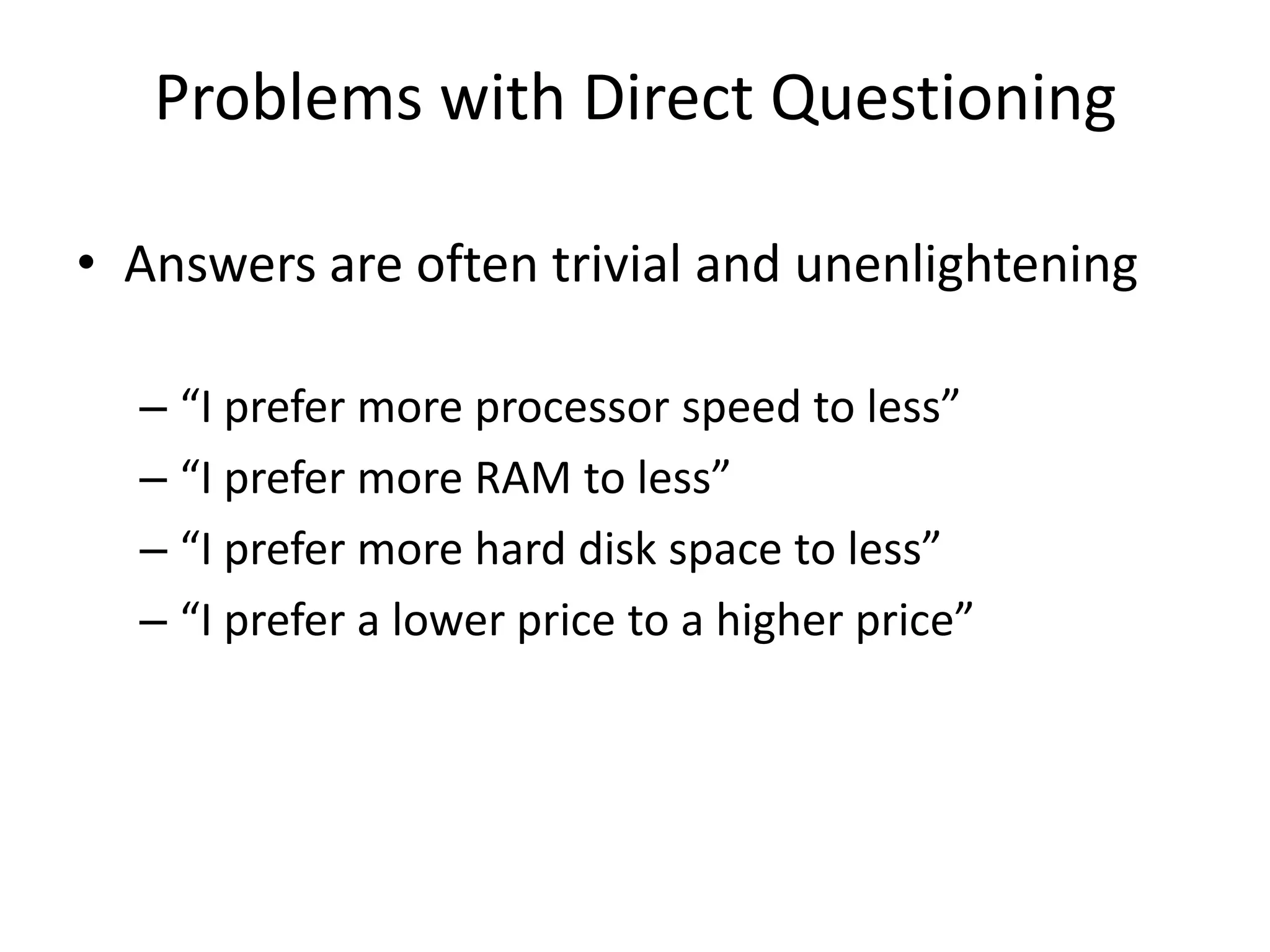
• Answers are often trivial and unenlightening
– “I prefer more processor speed to less”
– “I prefer more RAM to less”
– “I prefer more hard disk space to less”
– “I prefer a lower price to a higher price”
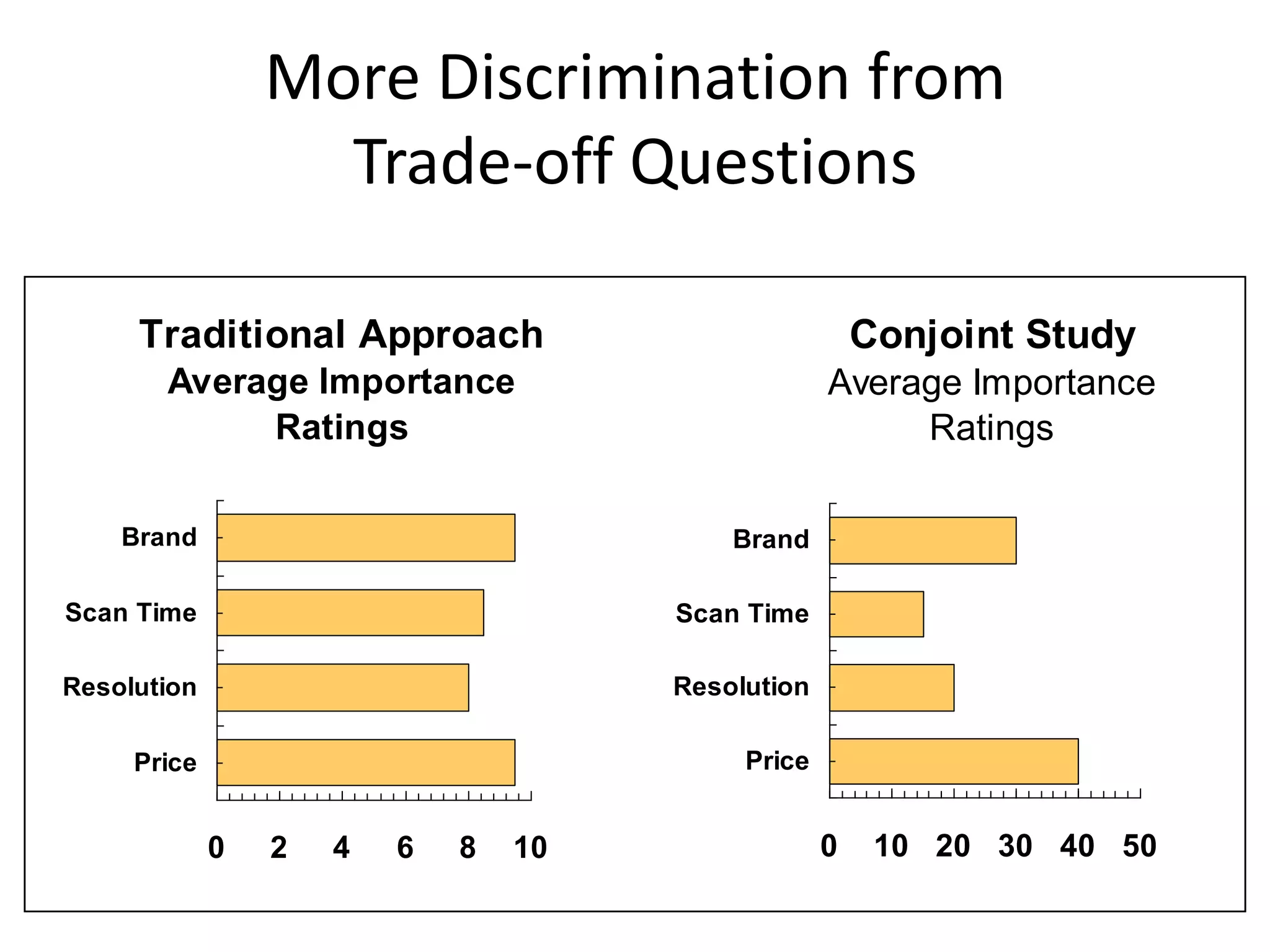
More Discrimination from
Trade-off Questions
Traditional Approach

Conjoint Study

Average Importance
Ratings

Average Importance
Ratings

Brand

Brand

Scan Time

Scan Time

Resolution

Resolution

Price

Price

0

2

4

6

8

10

0

10 20 30 40 50
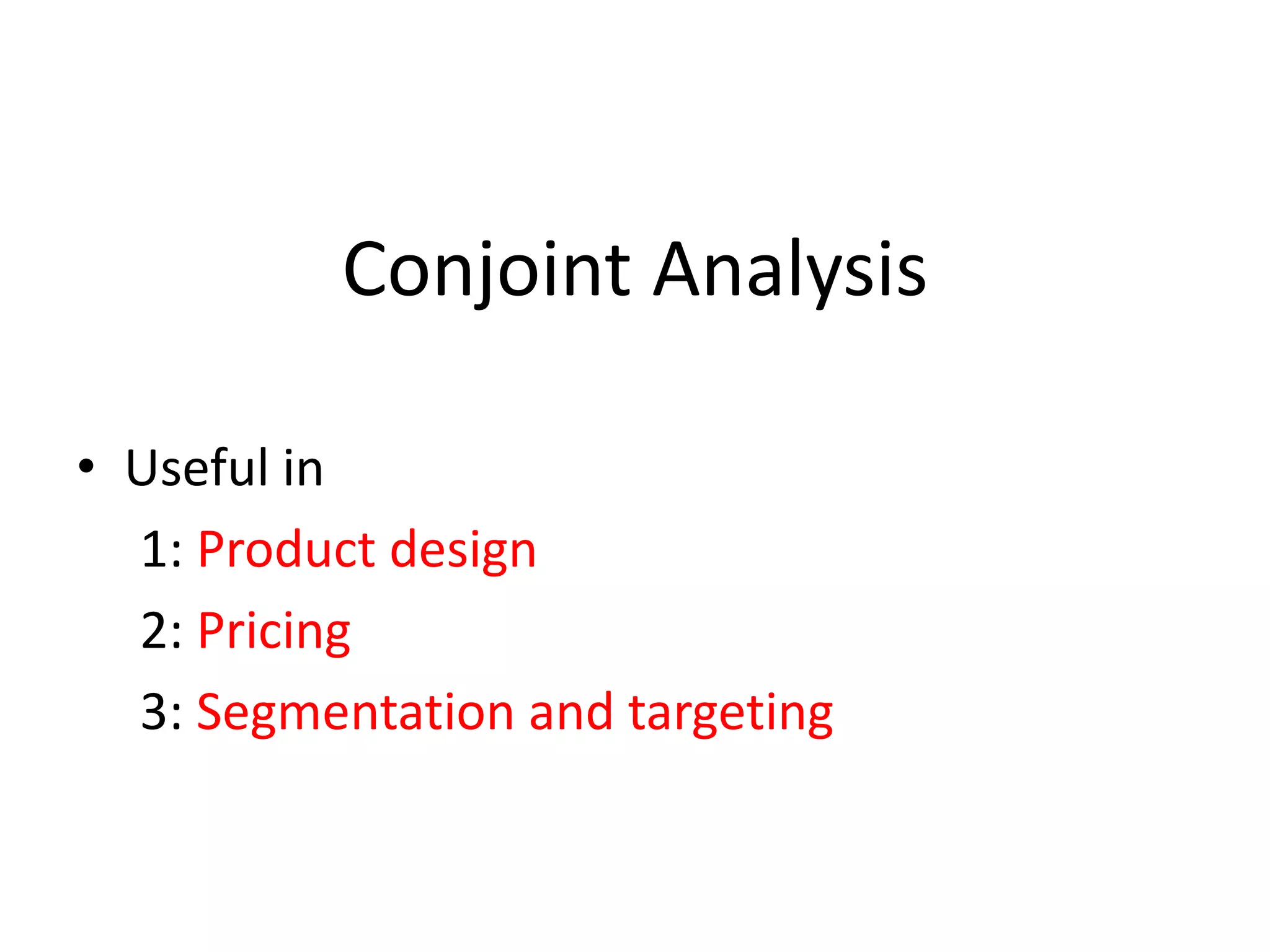
Conjoint Analysis
• Useful in
1: Product design
2: Pricing
3: Segmentation and targeting
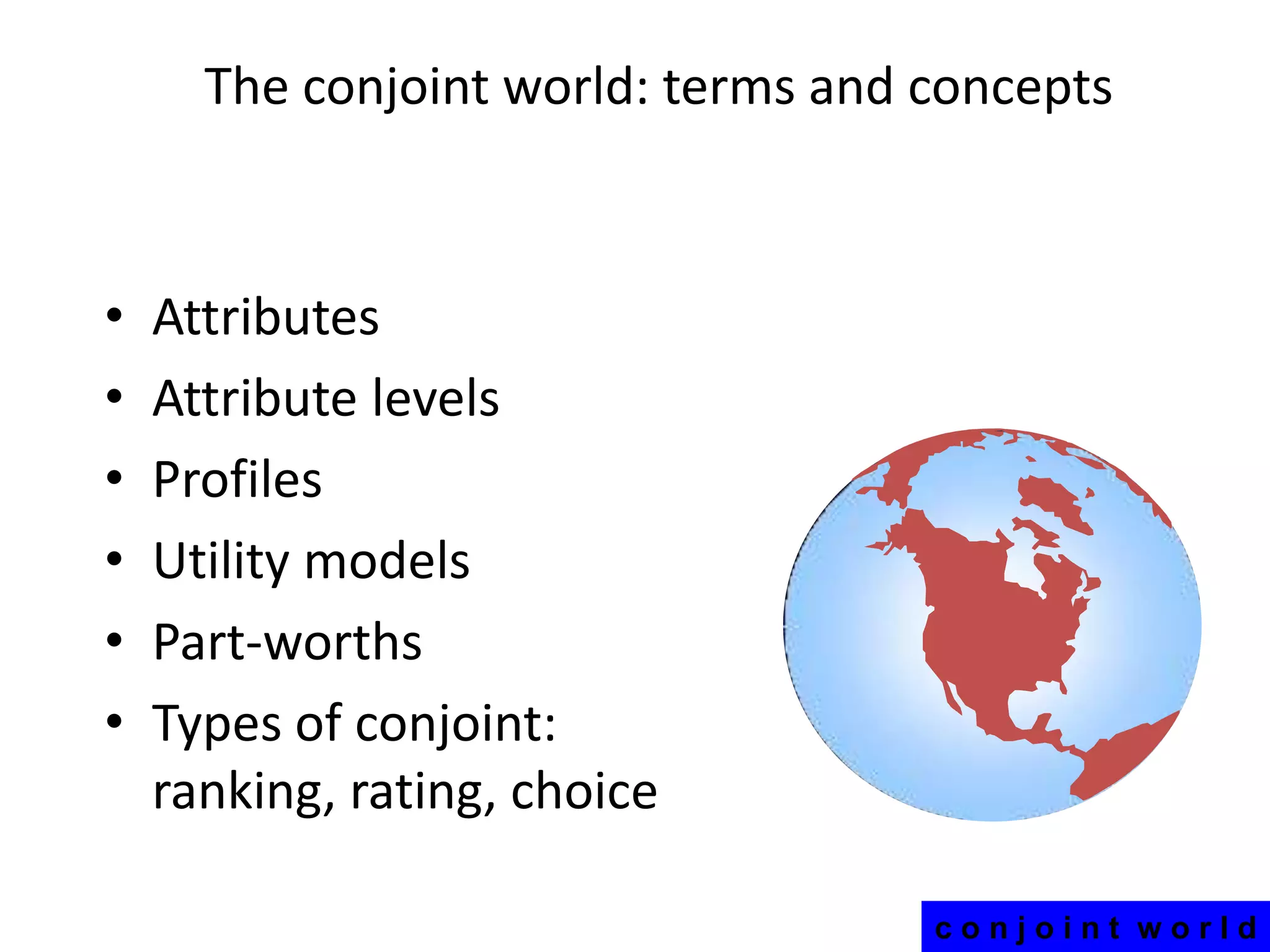
The conjoint world: terms and concepts

•
•
•
•
•
•

Attributes
Attribute levels
Profiles
Utility models
Part-worths
Types of conjoint:
ranking, rating, choice
conjoint world
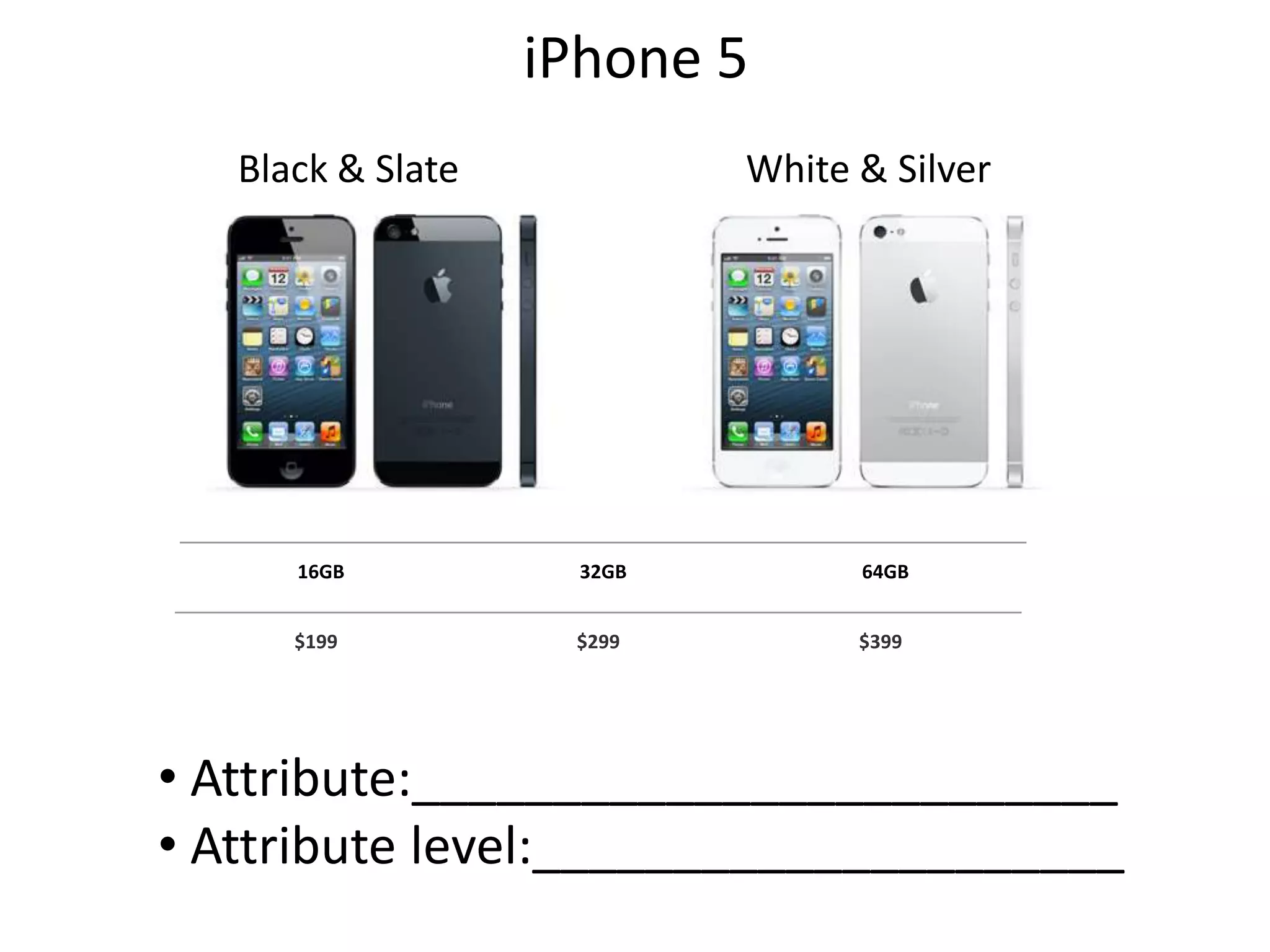
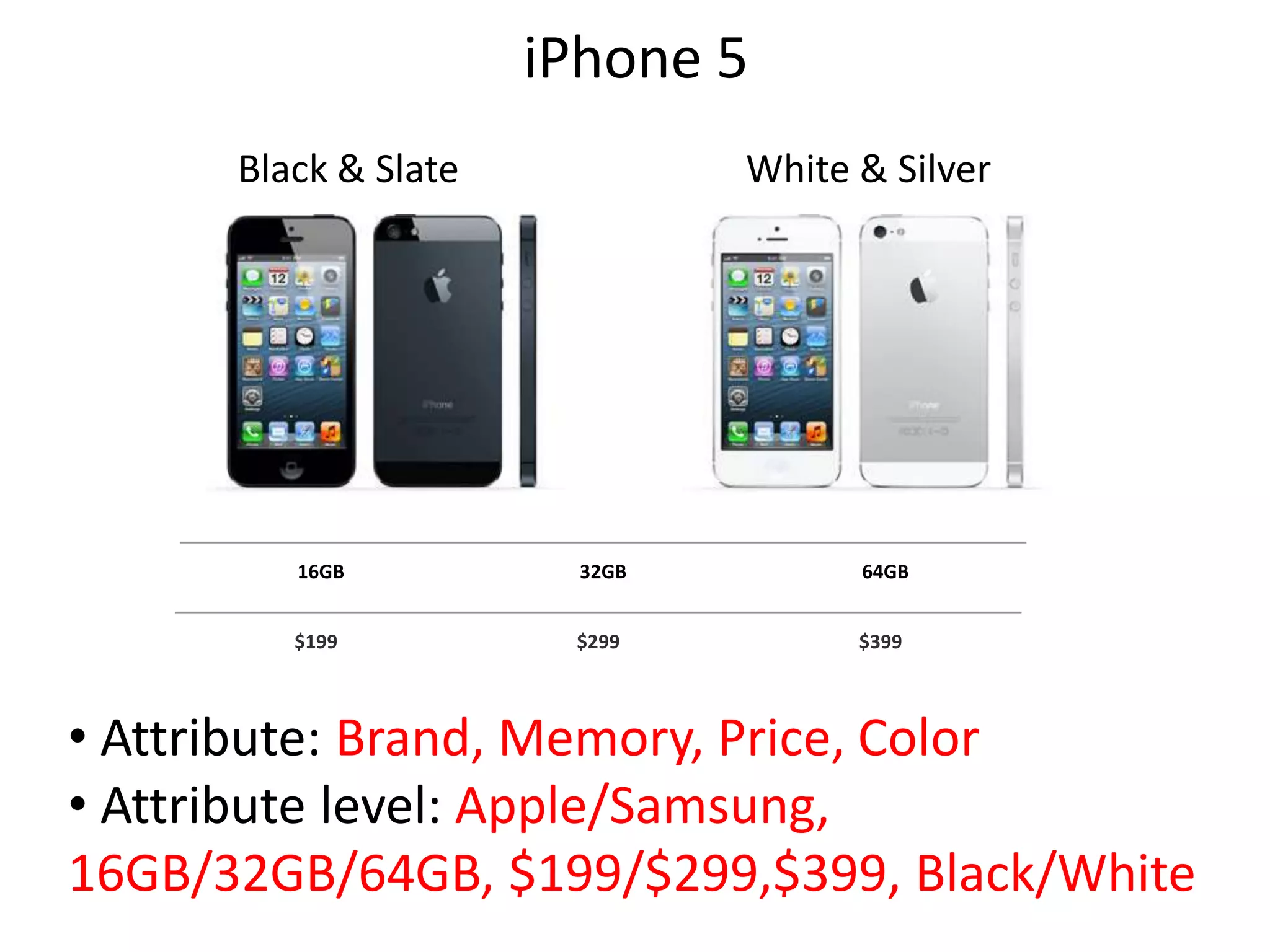
iPhone 5
Black & Slate

White & Silver

16GB

32GB

64GB

$199

$299

$399

• Attribute:_________________________
• Attribute level:_____________________
iPhone 5
Black & Slate

White & Silver

16GB

32GB

64GB

$199

$299

$399

• Attribute: Brand, Memory, Price, Color
• Attribute level: Apple/Samsung,
16GB/32GB/64GB, $199/$299,$399, Black/White
Conjoint Analysis
• Conjoint Analysis: A technique that enables a
researcher to estimate consumers’ valuations of
different attributes
– Allows us to understand how consumers make
trade-offs among attributes of products and
services
– How much are consumers willing to pay for
different attributes?
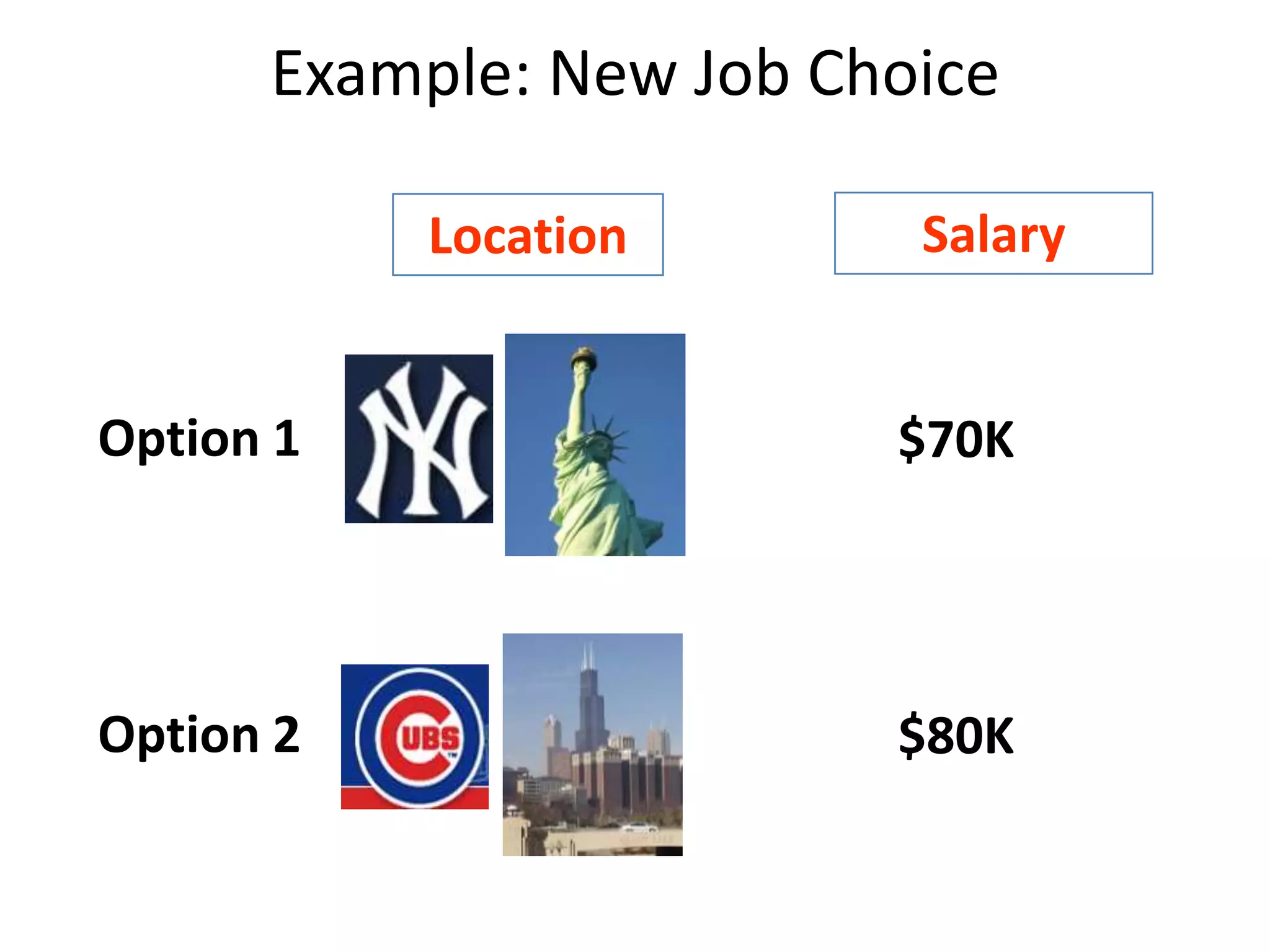
Example: New Job Choice
Location

Salary

Option 1

$70K

Option 2

$80K
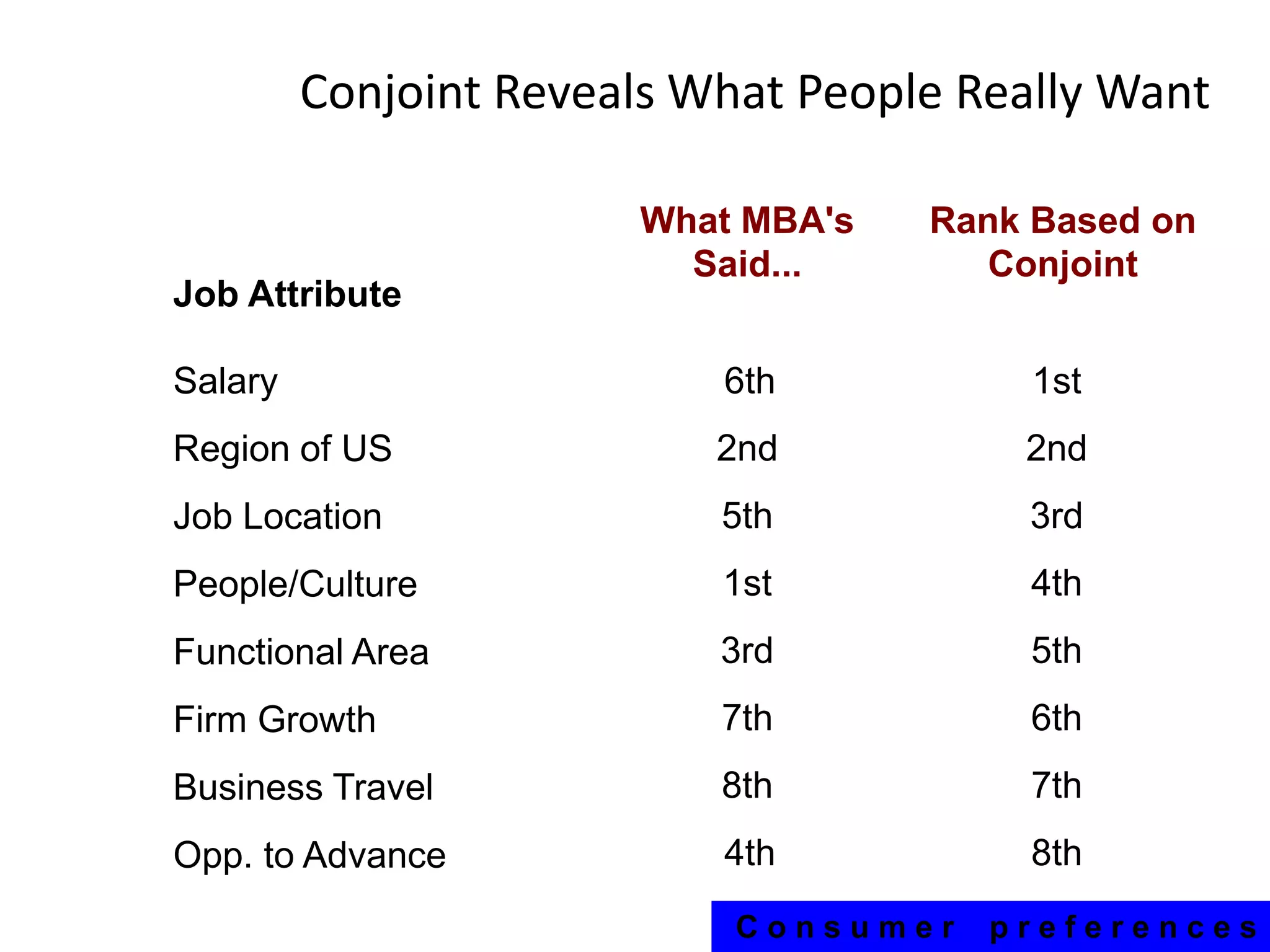
Conjoint Reveals What People Really Want
What MBA's
Said...

Rank Based on
Conjoint

Salary

6th

1st

Region of US

2nd

2nd

Job Location

5th

3rd

People/Culture

1st

4th

Functional Area

3rd

5th

Firm Growth

7th

6th

Business Travel

8th

7th

Opp. to Advance

4th

8th

Job Attribute

Consumer

preferences
Conjoint Analysis - Intuition
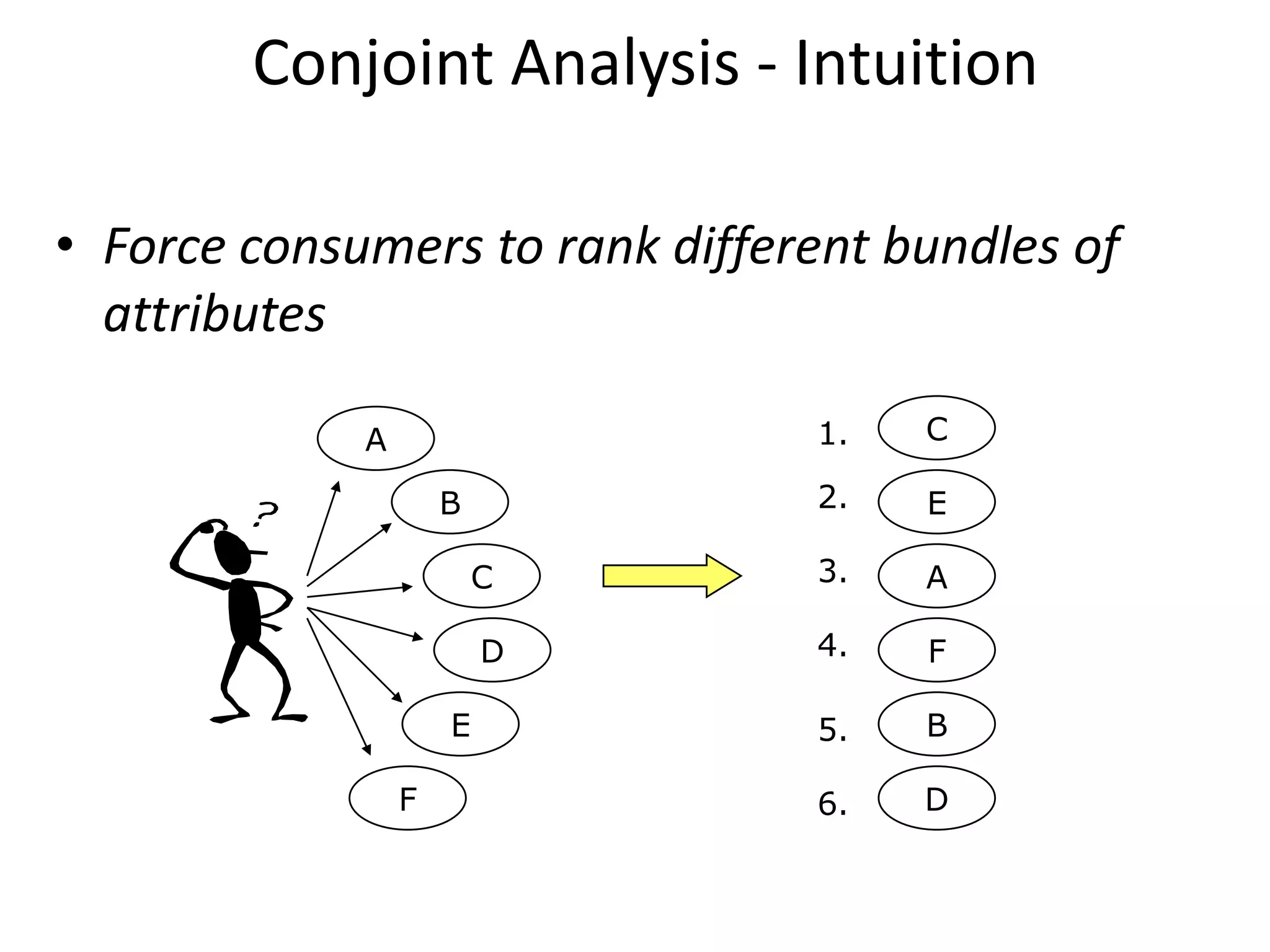
• Force consumers to rank different bundles of
attributes
1.

C

2.

E

C

3.

A

D

4.

F

5.

B

6.

D

A
B

E
F
Conjoint Analysis - Intuition
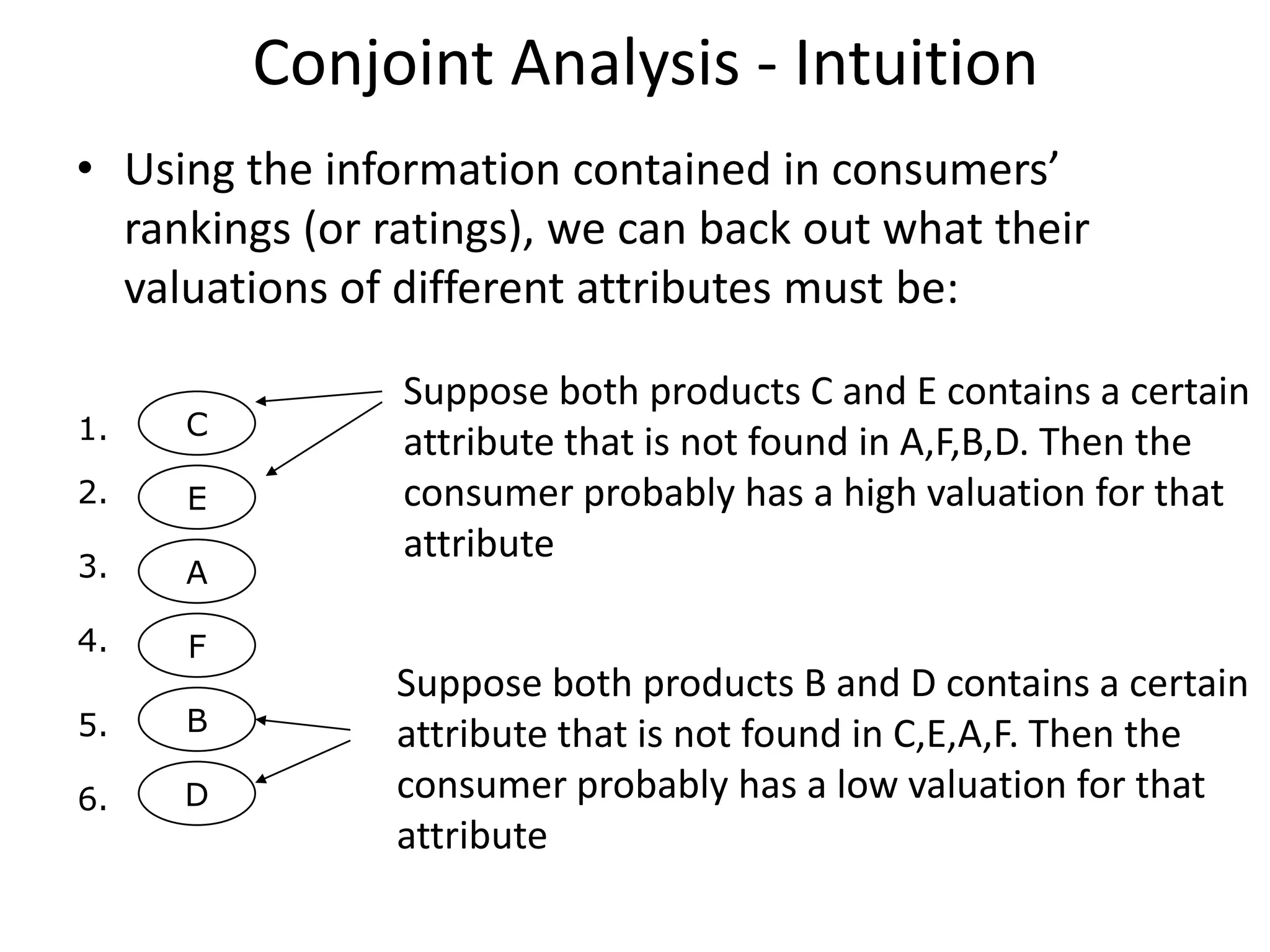
• Using the information contained in consumers’
rankings (or ratings), we can back out what their
valuations of different attributes must be:
1.

C

2.

E

3.

A

4.

F

5.

B

6.

D

Suppose both products C and E contains a certain
attribute that is not found in A,F,B,D. Then the
consumer probably has a high valuation for that
attribute
Suppose both products B and D contains a certain
attribute that is not found in C,E,A,F. Then the
consumer probably has a low valuation for that
attribute
Conjoint Analysis: Procedure
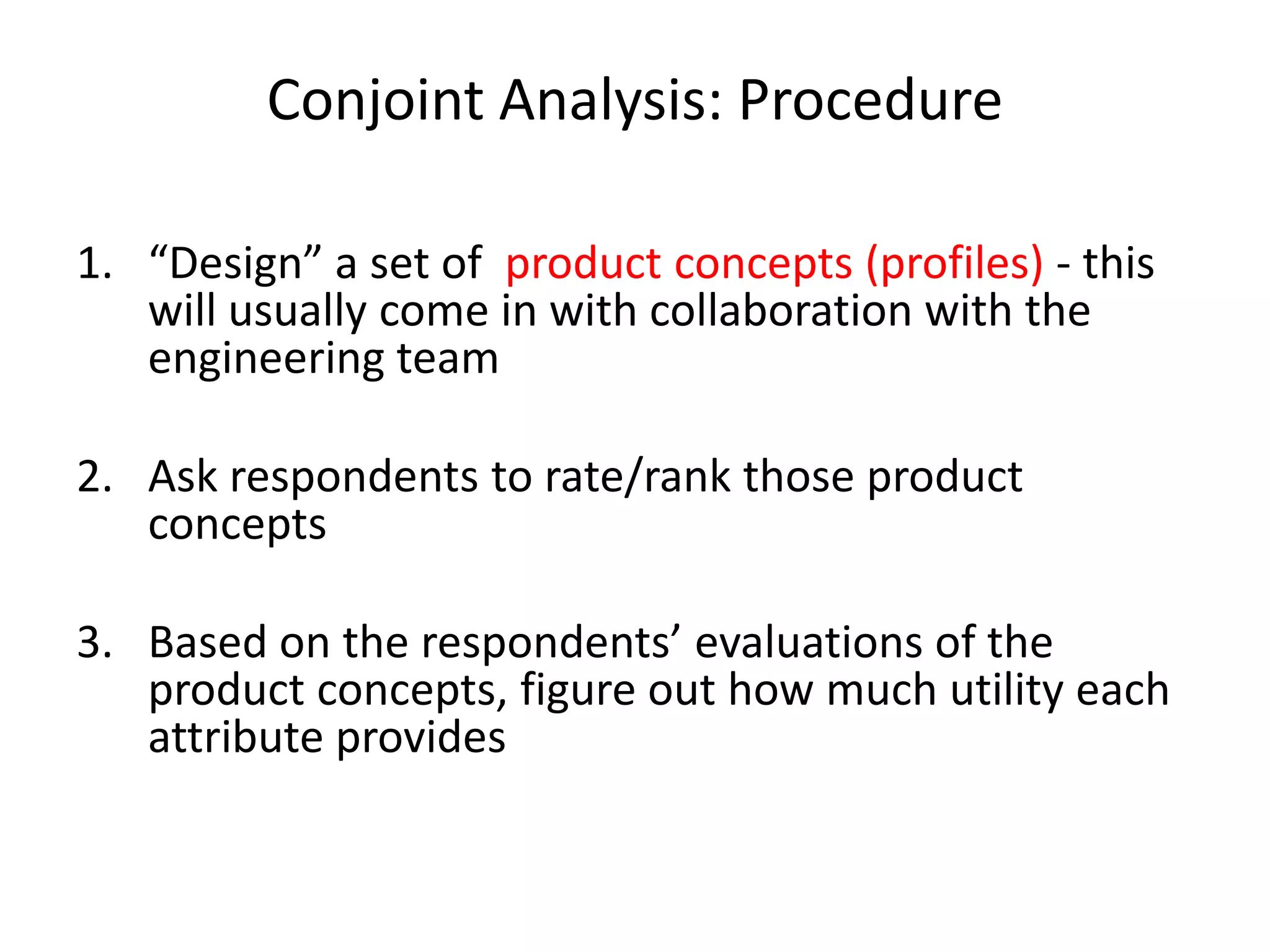
1. “Design” a set of product concepts (profiles) - this
will usually come in with collaboration with the
engineering team
2. Ask respondents to rate/rank those product
concepts
3. Based on the respondents’ evaluations of the
product concepts, figure out how much utility each
attribute provides
Exercise: Smartphone Choice
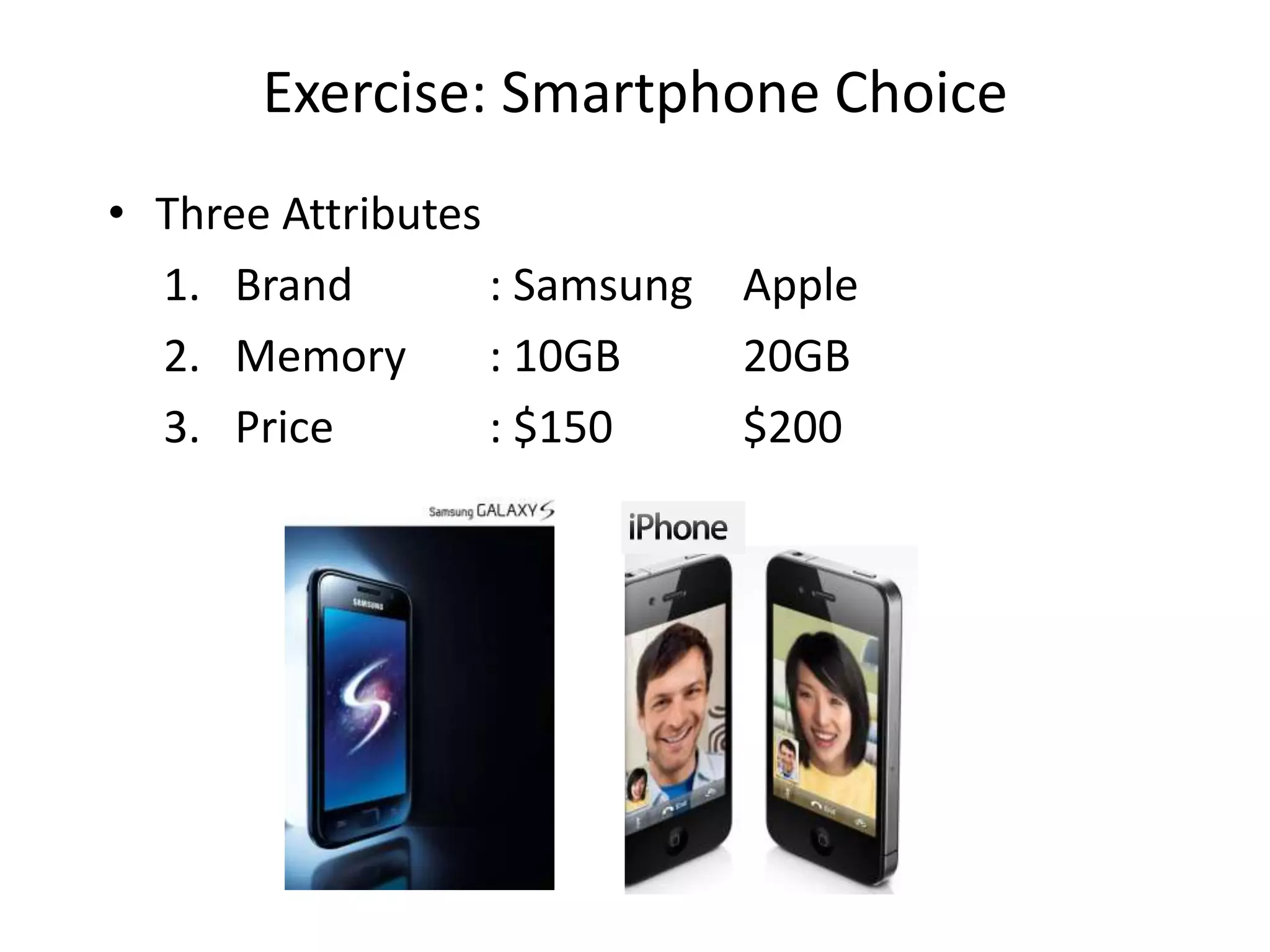
• Three Attributes
1. Brand
: Samsung
2. Memory
: 10GB
3. Price
: $150

Apple
20GB
$200
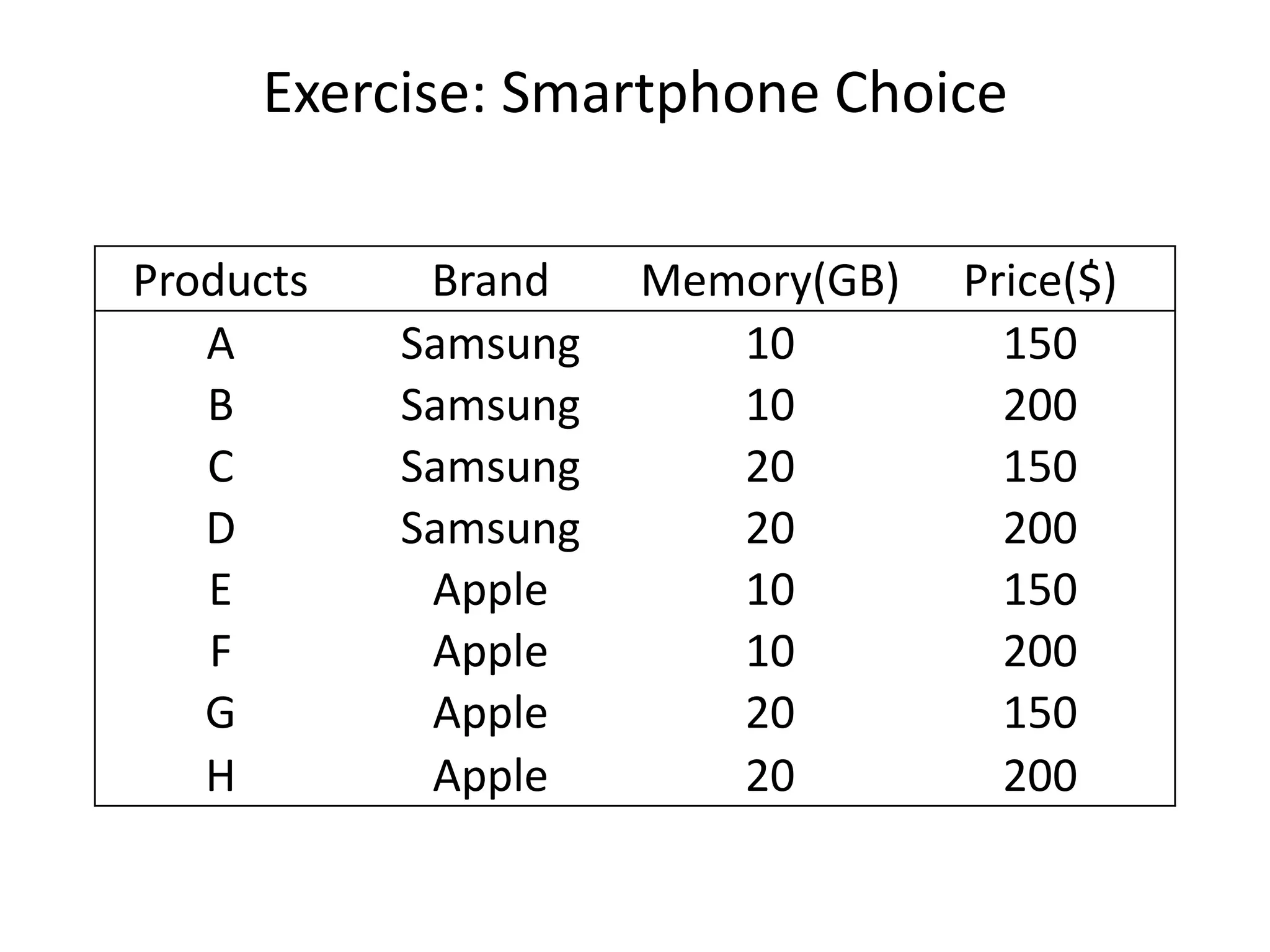
Exercise: Smartphone Choice
Products
A
B
C
D
E
F
G
H

Brand
Samsung
Samsung
Samsung
Samsung
Apple
Apple
Apple
Apple

Memory(GB)
10
10
20
20
10
10
20
20

Price($)
150
200
150
200
150
200
150
200
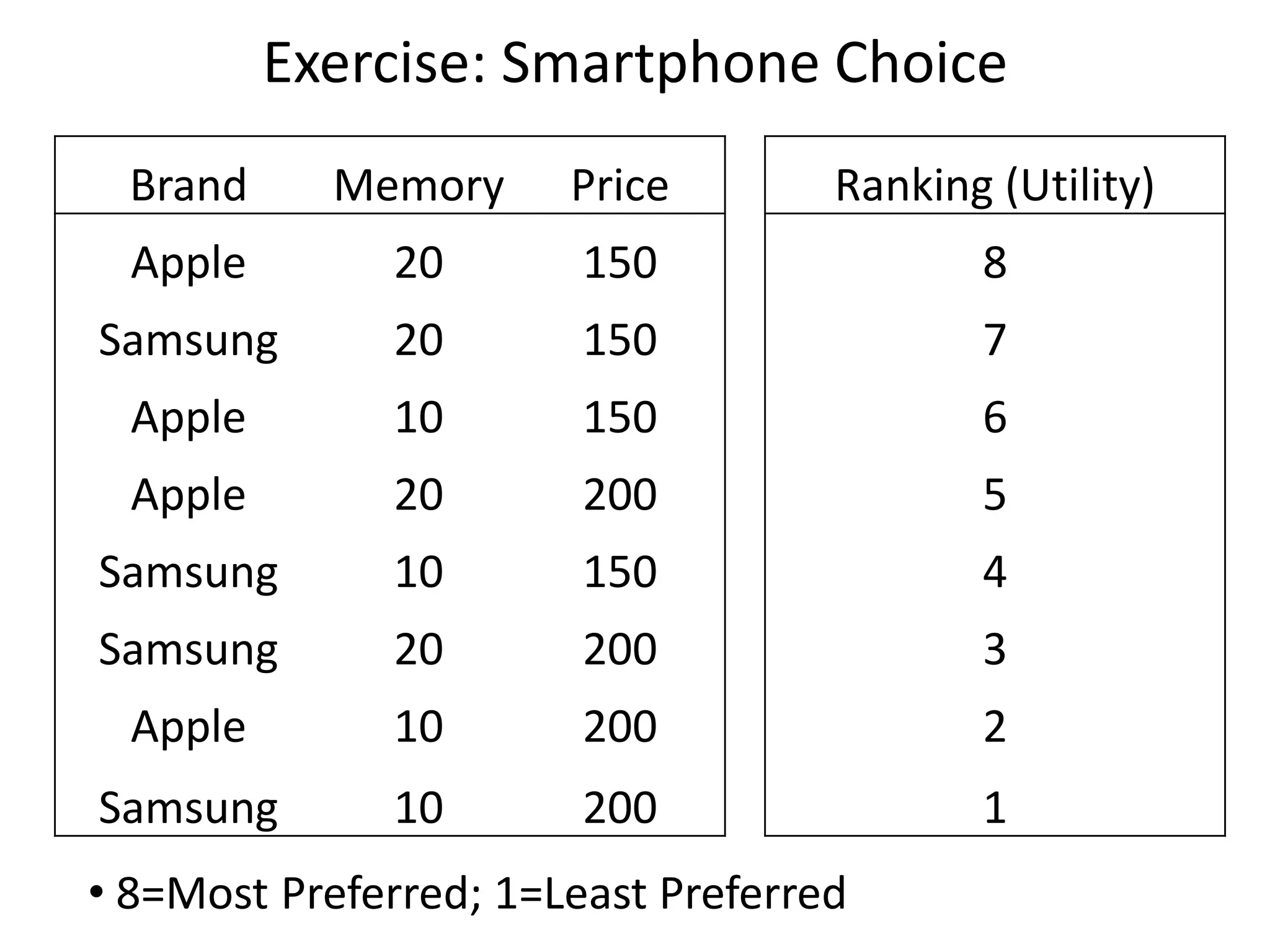
Exercise: Smartphone Choice
Brand

Memory

Price

Ranking (Utility)

Apple

20

150

8

Samsung

20

150

7

Apple

10

150

6

Apple

20

200

5

Samsung

10

150

4

Samsung

20

200

3

Apple

10

200

2

Samsung

10

200

1

• 8=Most Preferred; 1=Least Preferred
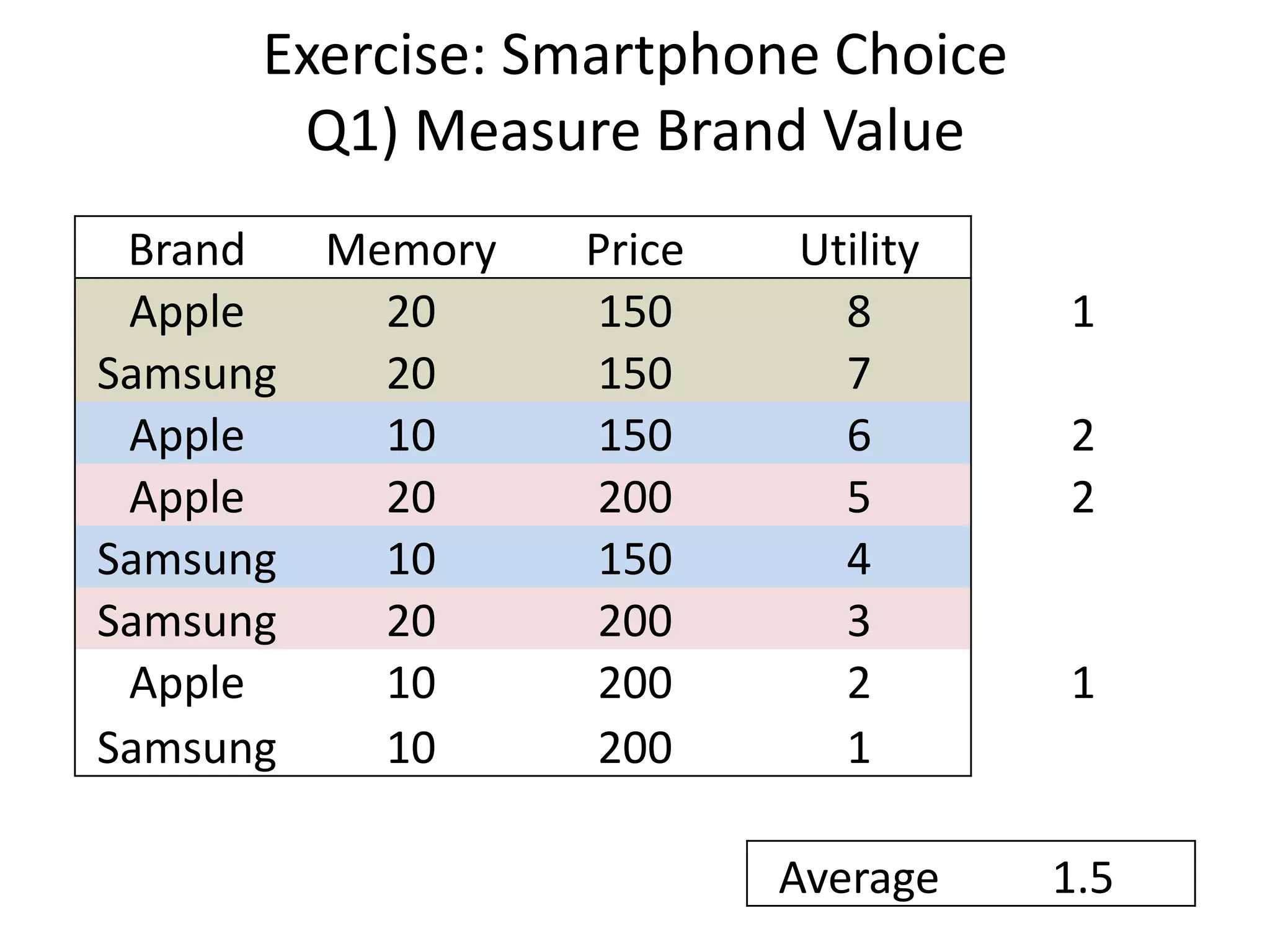
Exercise: Smartphone Choice
Q1) Measure Brand Value
Brand
Memory
Apple
20
Samsung
20
Apple
10
Apple
20
Samsung
10
Samsung
20
Apple
10
Samsung
10

Price
150
150
150
200
150
200
200
200

Utility
8
7
6
5
4
3
2
1
Average

1

2
2

1

1.5
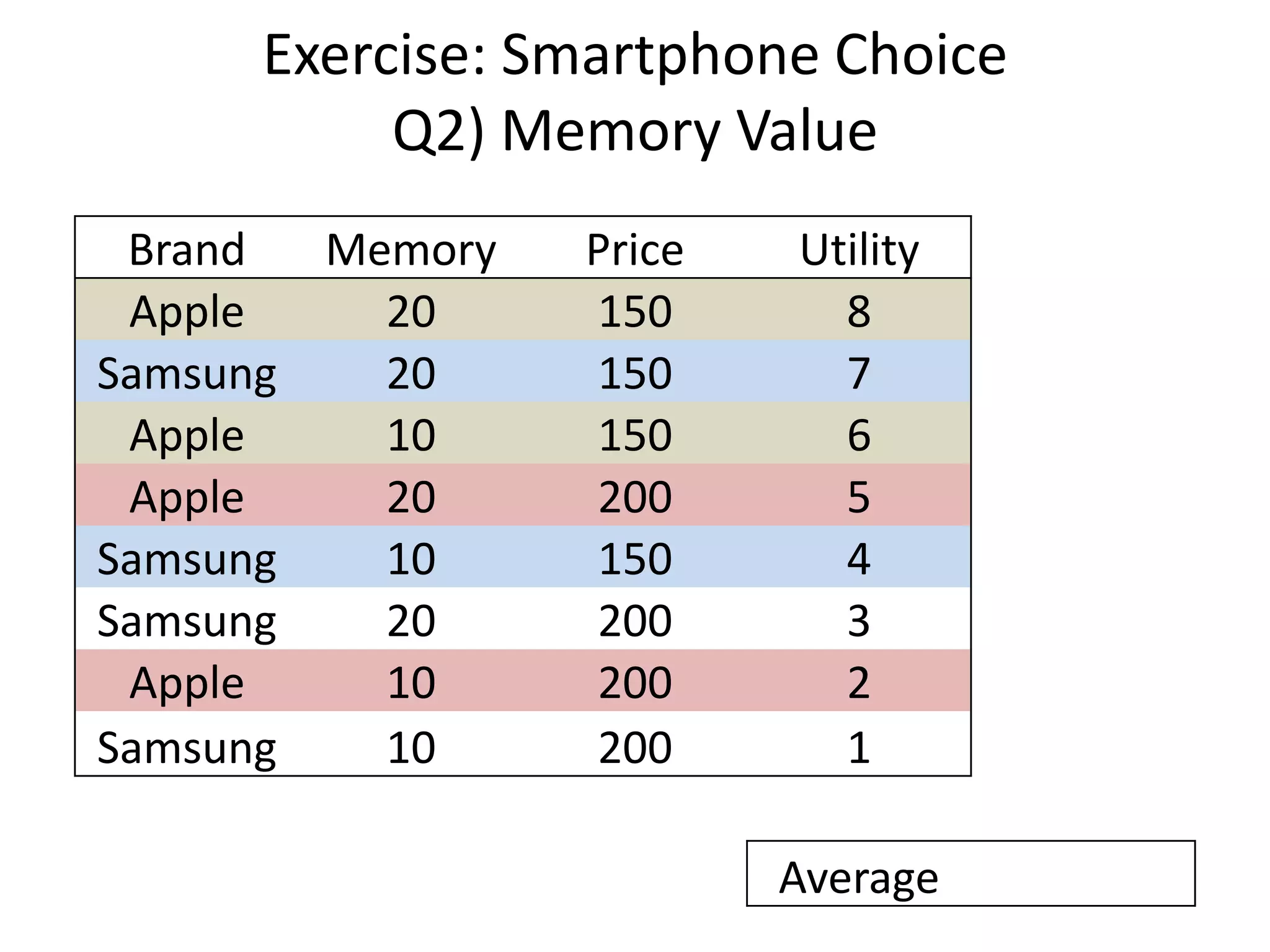
Exercise: Smartphone Choice
Q2) Memory Value
Brand
Memory
Apple
20
Samsung
20
Apple
10
Apple
20
Samsung
10
Samsung
20
Apple
10
Samsung
10

Price
150
150
150
200
150
200
200
200

Utility
8
7
6
5
4
3
2
1
Average
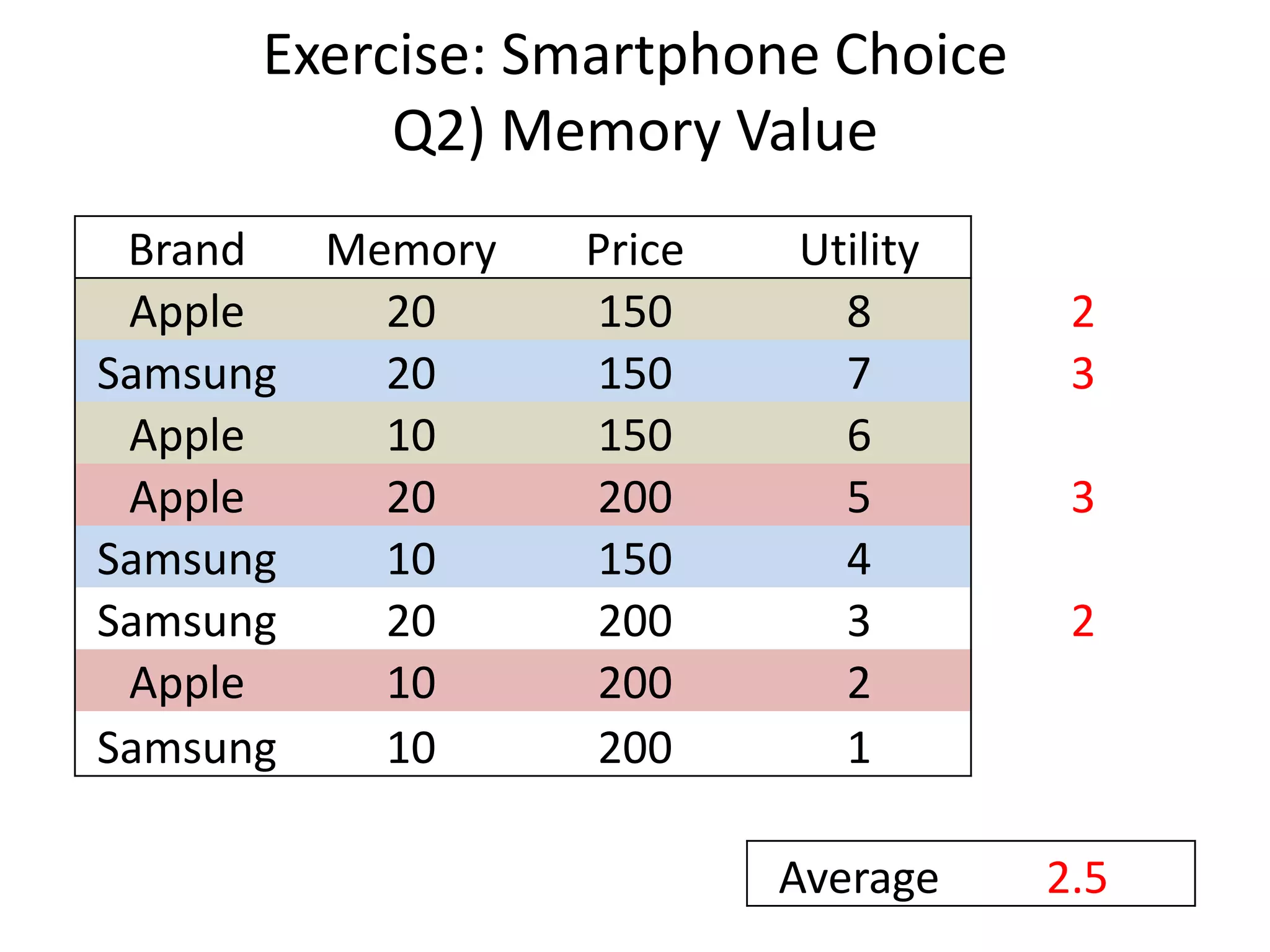
Exercise: Smartphone Choice
Q2) Memory Value
Brand
Memory
Apple
20
Samsung
20
Apple
10
Apple
20
Samsung
10
Samsung
20
Apple
10
Samsung
10

Price
150
150
150
200
150
200
200
200

Utility
8
7
6
5
4
3
2
1
Average

2
3
3
2

2.5
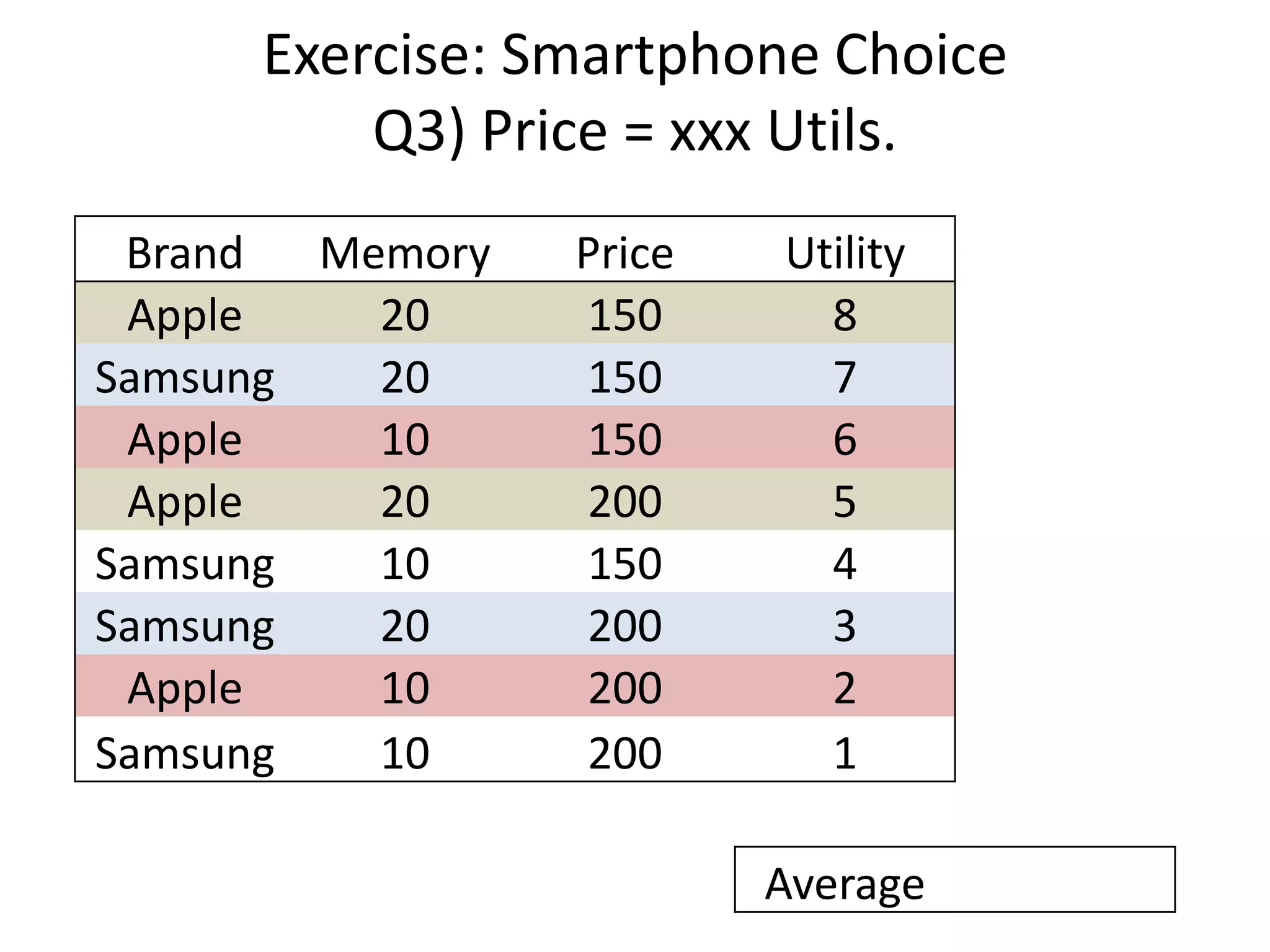
Exercise: Smartphone Choice
Q3) Price = xxx Utils.
Brand
Memory
Apple
20
Samsung
20
Apple
10
Apple
20
Samsung
10
Samsung
20
Apple
10
Samsung
10

Price
150
150
150
200
150
200
200
200

Utility
8
7
6
5
4
3
2
1
Average
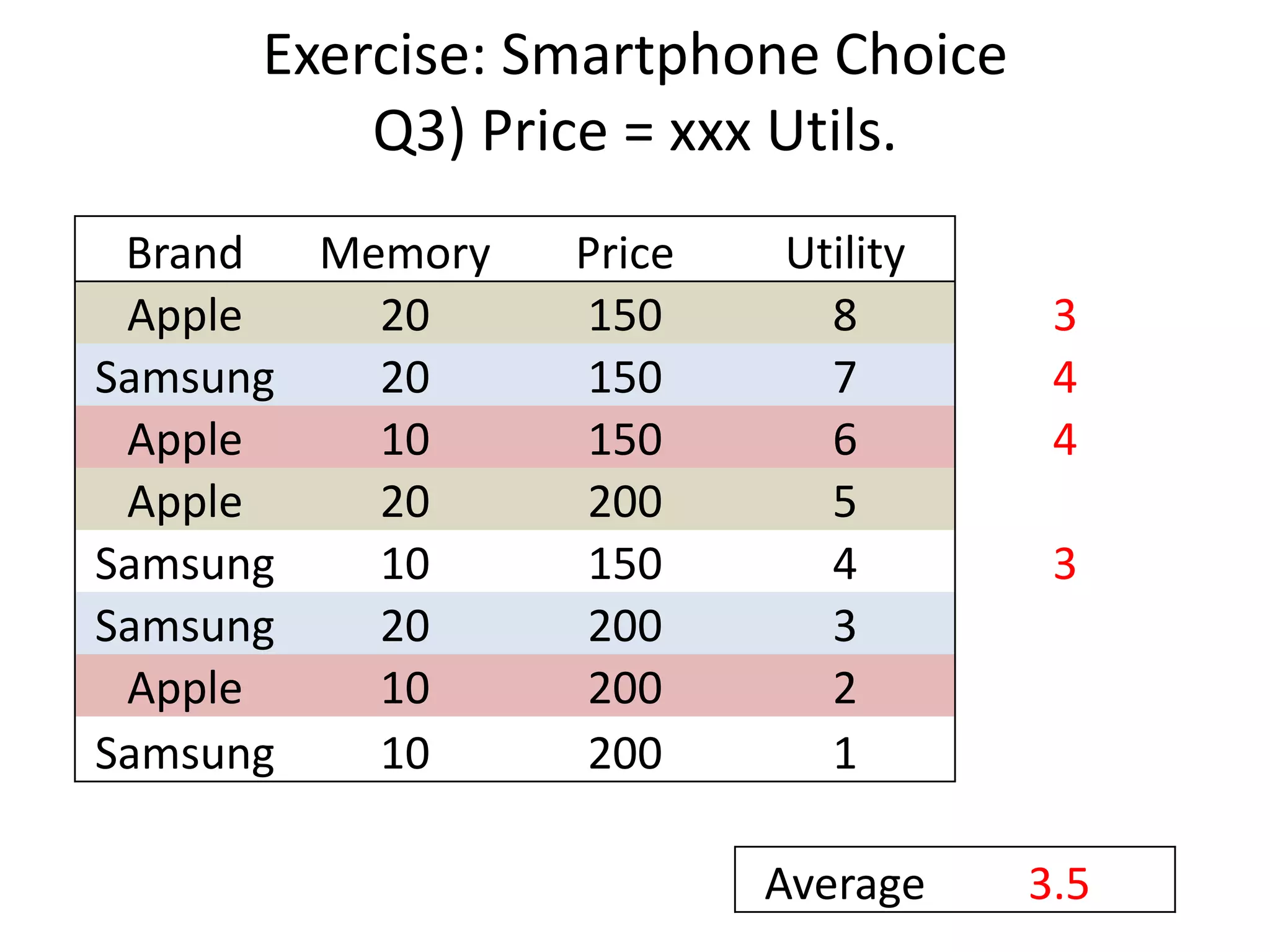
Exercise: Smartphone Choice
Q3) Price = xxx Utils.
Brand
Memory
Apple
20
Samsung
20
Apple
10
Apple
20
Samsung
10
Samsung
20
Apple
10
Samsung
10

Price
150
150
150
200
150
200
200
200

Utility
8
7
6
5
4
3
2
1
Average

3
4
4
3

3.5
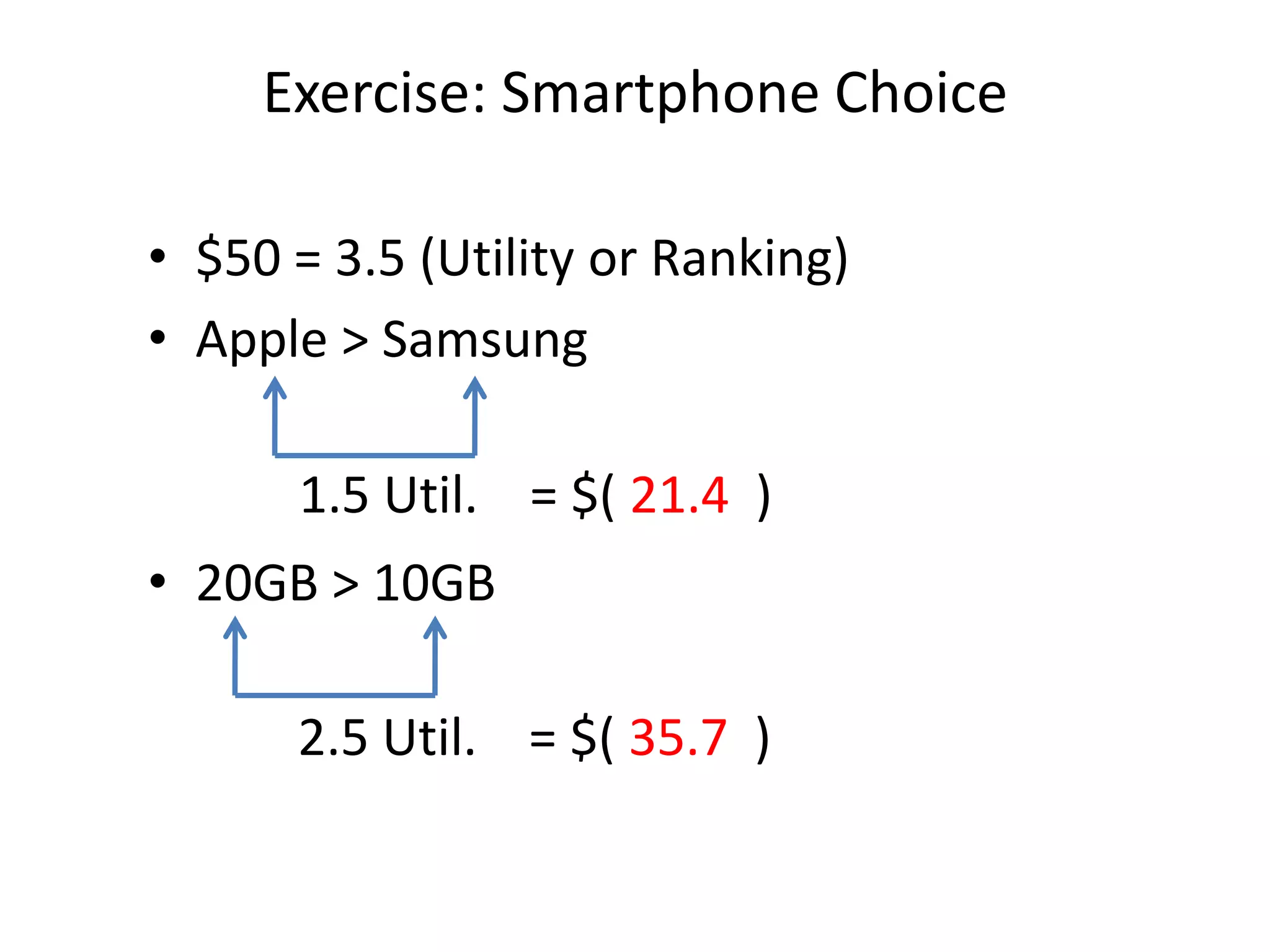
Exercise: Smartphone Choice
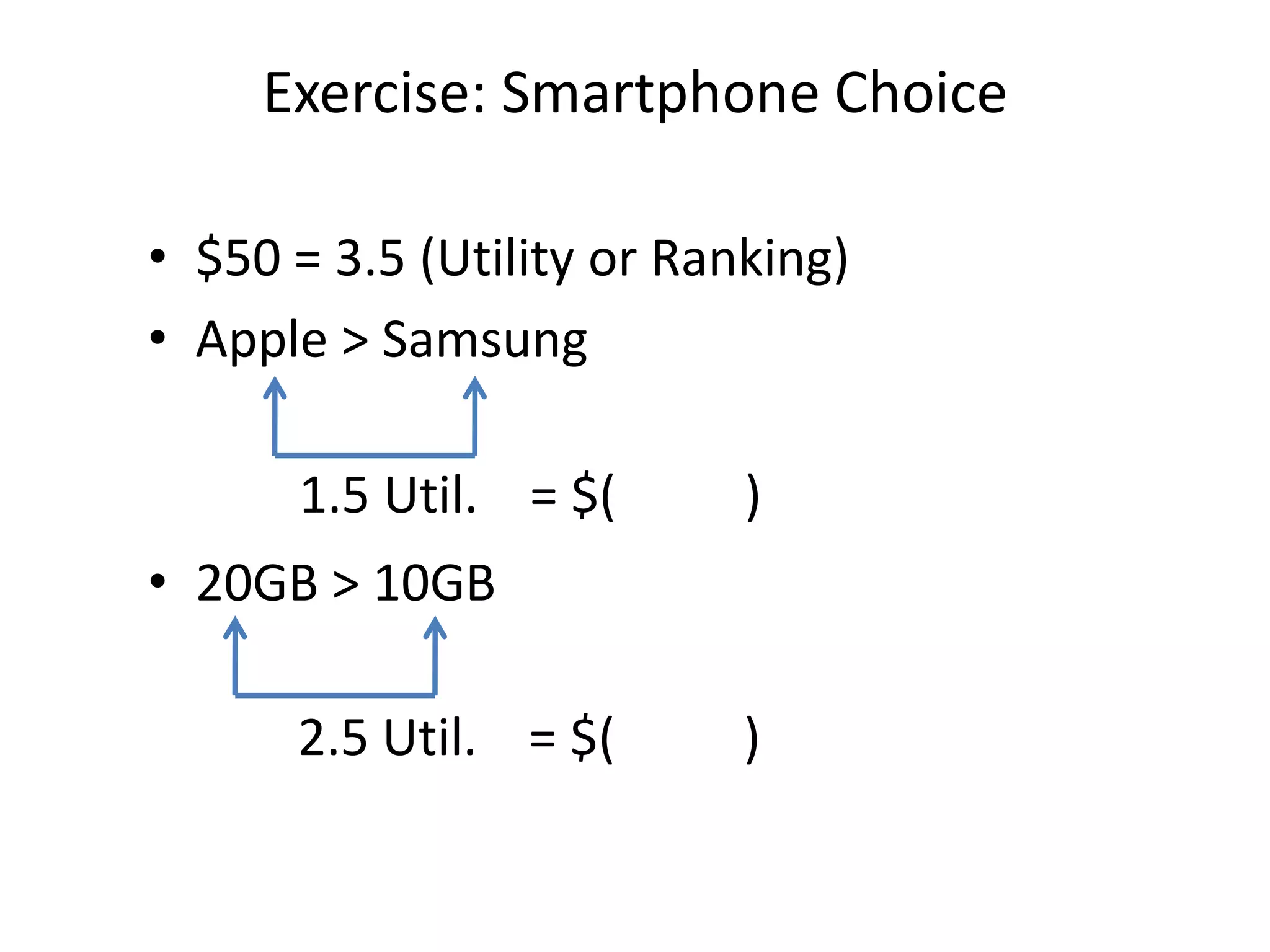
• $50 = 3.5 (Utility or Ranking)
• Apple > Samsung

1.5 Util. = $( 21.4 )
• 20GB > 10GB

2.5 Util. = $( 35.7 )
Exercise: Smartphone Choice
• $50 = 3.5 (Utility or Ranking)
• Apple > Samsung

1.5 Util. = $(

)

• 20GB > 10GB

2.5 Util. = $(

)
Exercise: Smartphone Choice
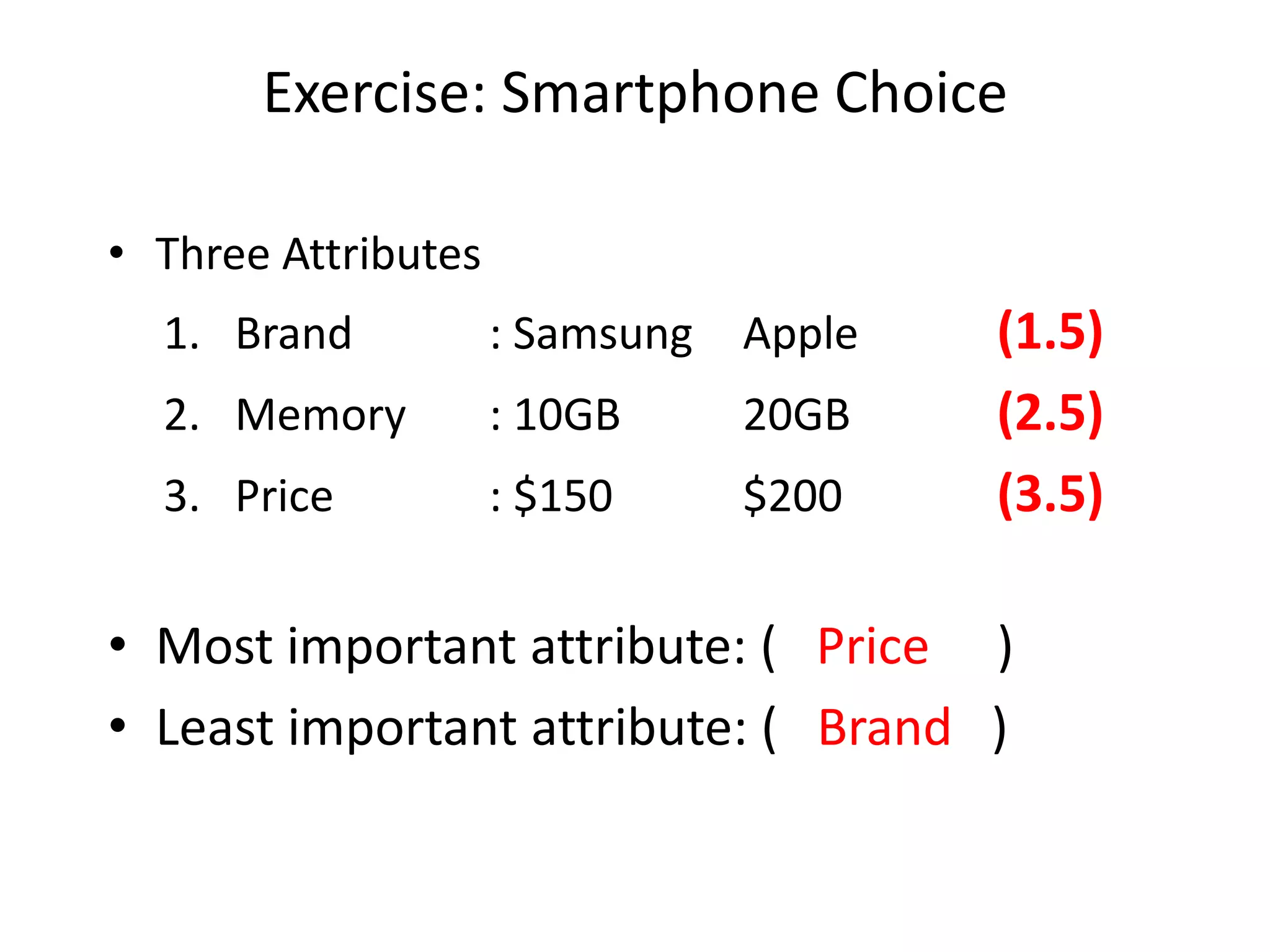
• Three Attributes
1. Brand

: Samsung

Apple

2. Memory

: 10GB

20GB

3. Price

: $150

$200

(1.5)
(2.5)
(3.5)

• Most important attribute: ( Price )
• Least important attribute: ( Brand )
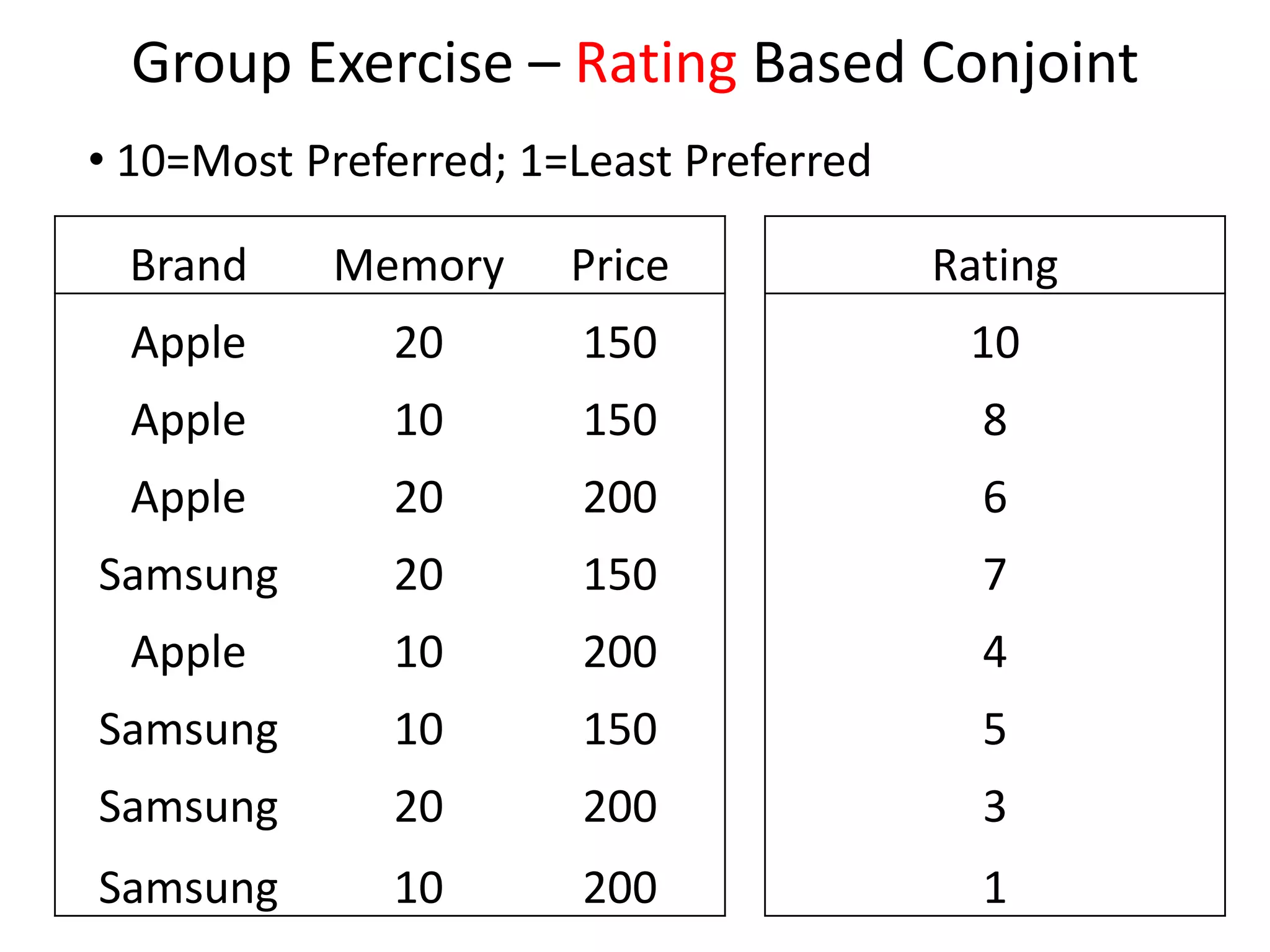
Group Exercise – Rating Based Conjoint
• 10=Most Preferred; 1=Least Preferred
Brand

Memory

Price

Rating

Apple

20

150

10

Apple

10

150

8

Apple

20

200

6

Samsung

20

150

7

Apple

10

200

4

Samsung

10

150

5

Samsung

20

200

3

Samsung

10

200

1
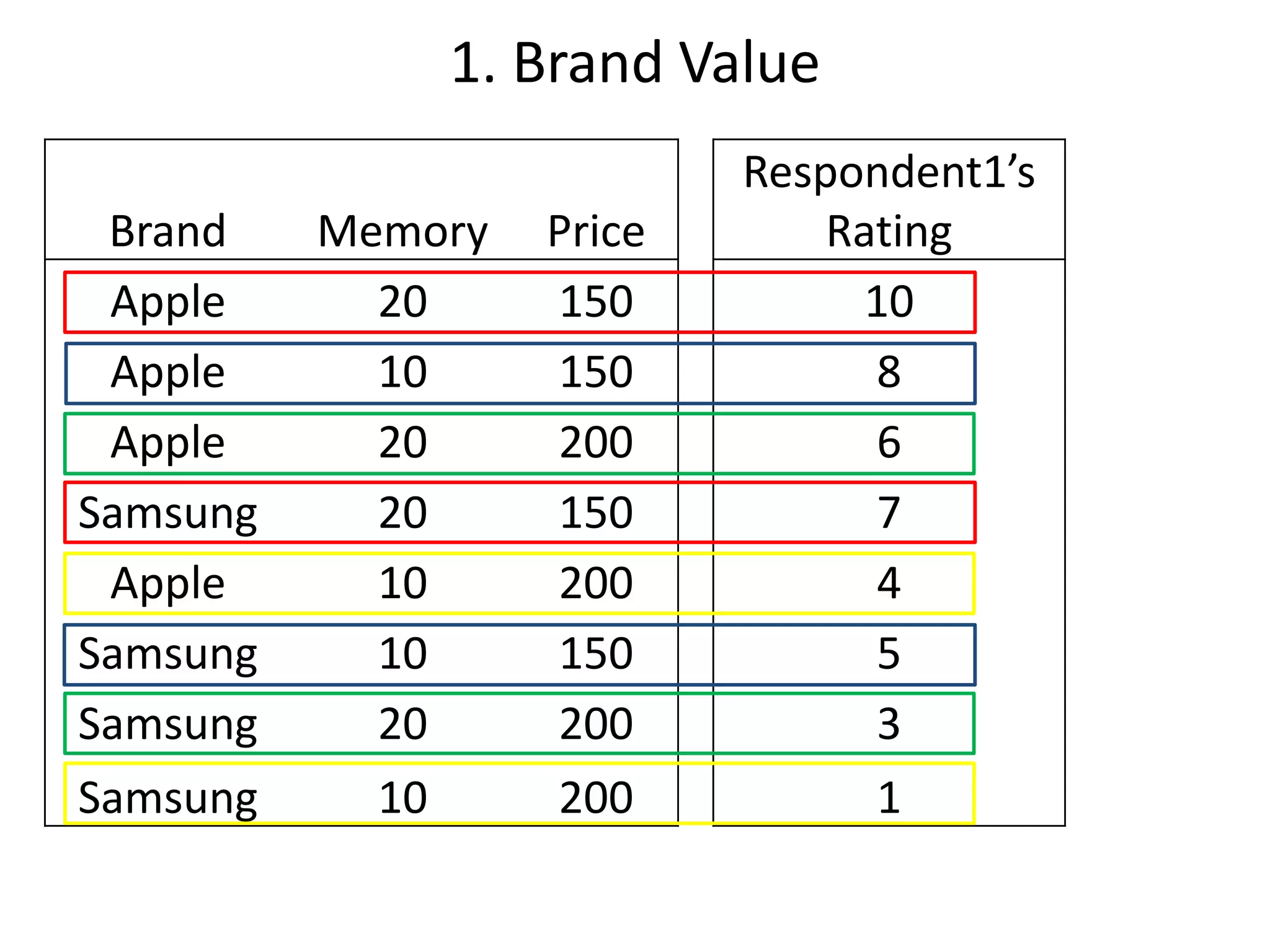
1. Brand Value
Brand
Apple
Apple
Apple
Samsung
Apple
Samsung
Samsung
Samsung

Memory
20
10
20
20
10
10
20
10

Price
150
150
200
150
200
150
200
200

Respondent1’s
Rating
10
8
6
7
4
5
3
1
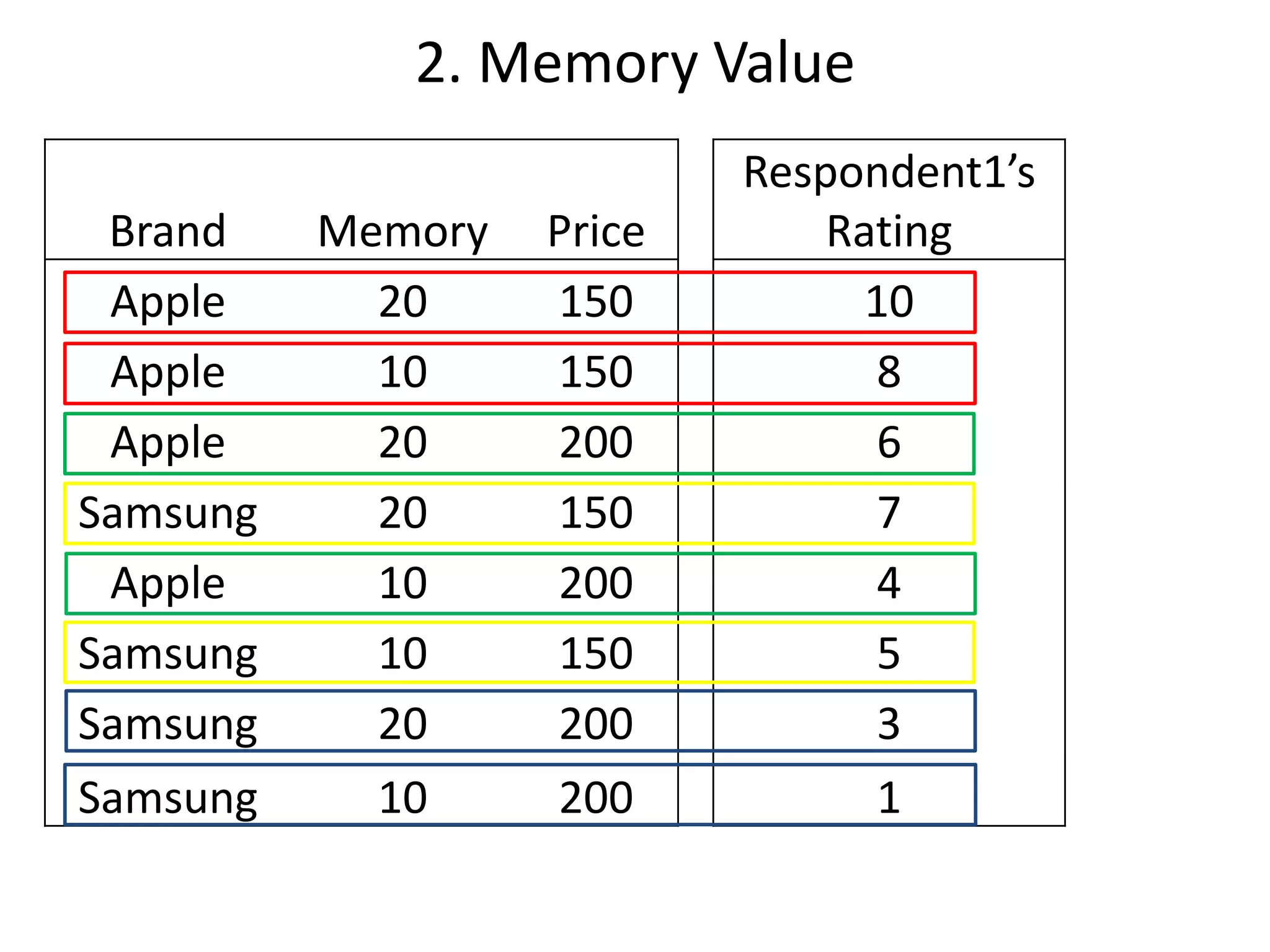
2. Memory Value
Brand
Apple
Apple
Apple
Samsung
Apple
Samsung
Samsung
Samsung

Memory
20
10
20
20
10
10
20
10

Price
150
150
200
150
200
150
200
200

Respondent1’s
Rating
10
8
6
7
4
5
3
1
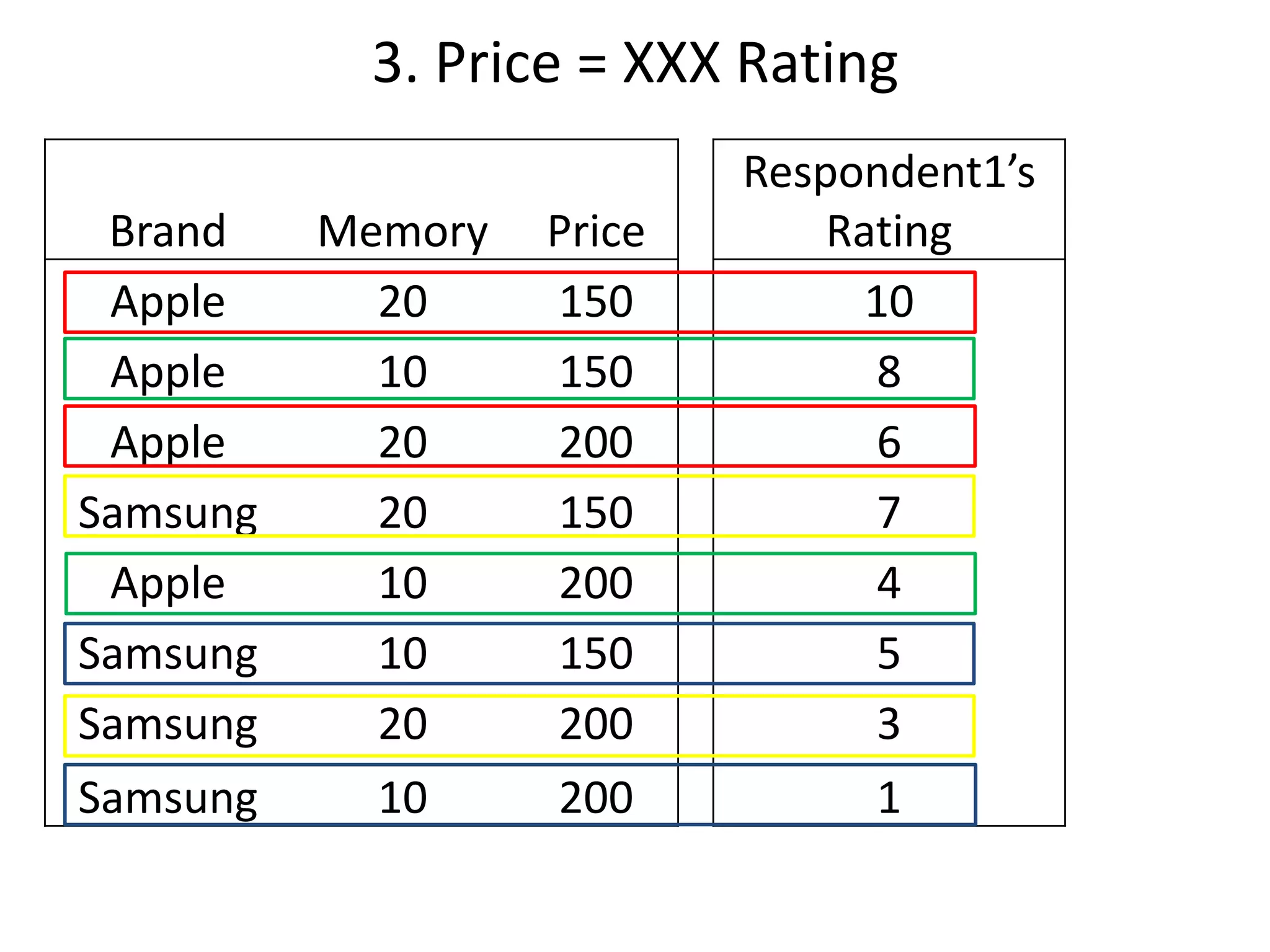
3. Price = XXX Rating
Brand
Apple
Apple
Apple
Samsung
Apple
Samsung
Samsung
Samsung

Memory
20
10
20
20
10
10
20
10

Price
150
150
200
150
200
150
200
200

Respondent1’s
Rating
10
8
6
7
4
5
3
1
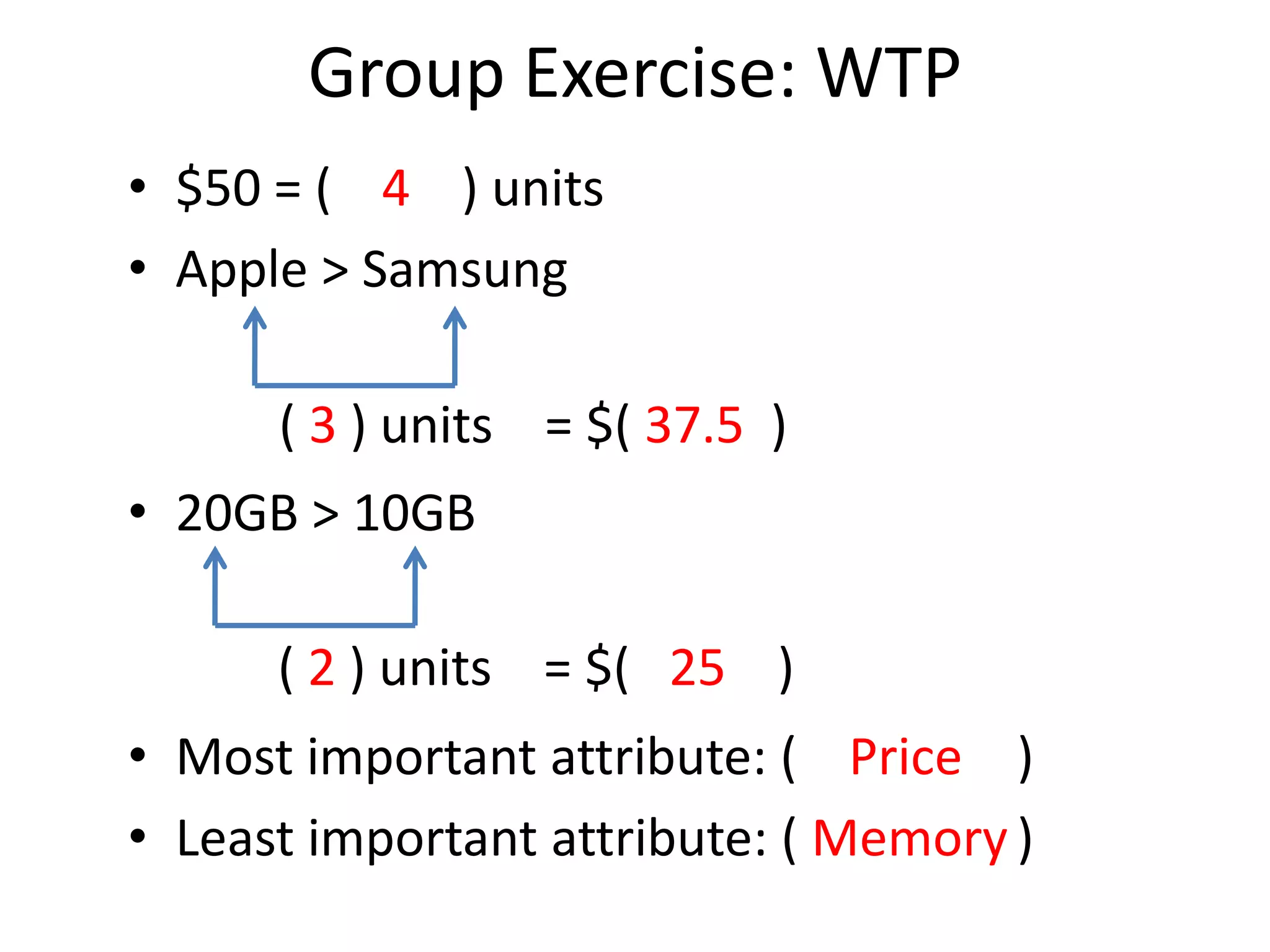
Group Exercise: WTP
• $50 = ( 4 ) units
• Apple > Samsung

( 3 ) units = $( 37.5 )
• 20GB > 10GB

( 2 ) units = $( 25 )
• Most important attribute: ( Price )
• Least important attribute: ( Memory )
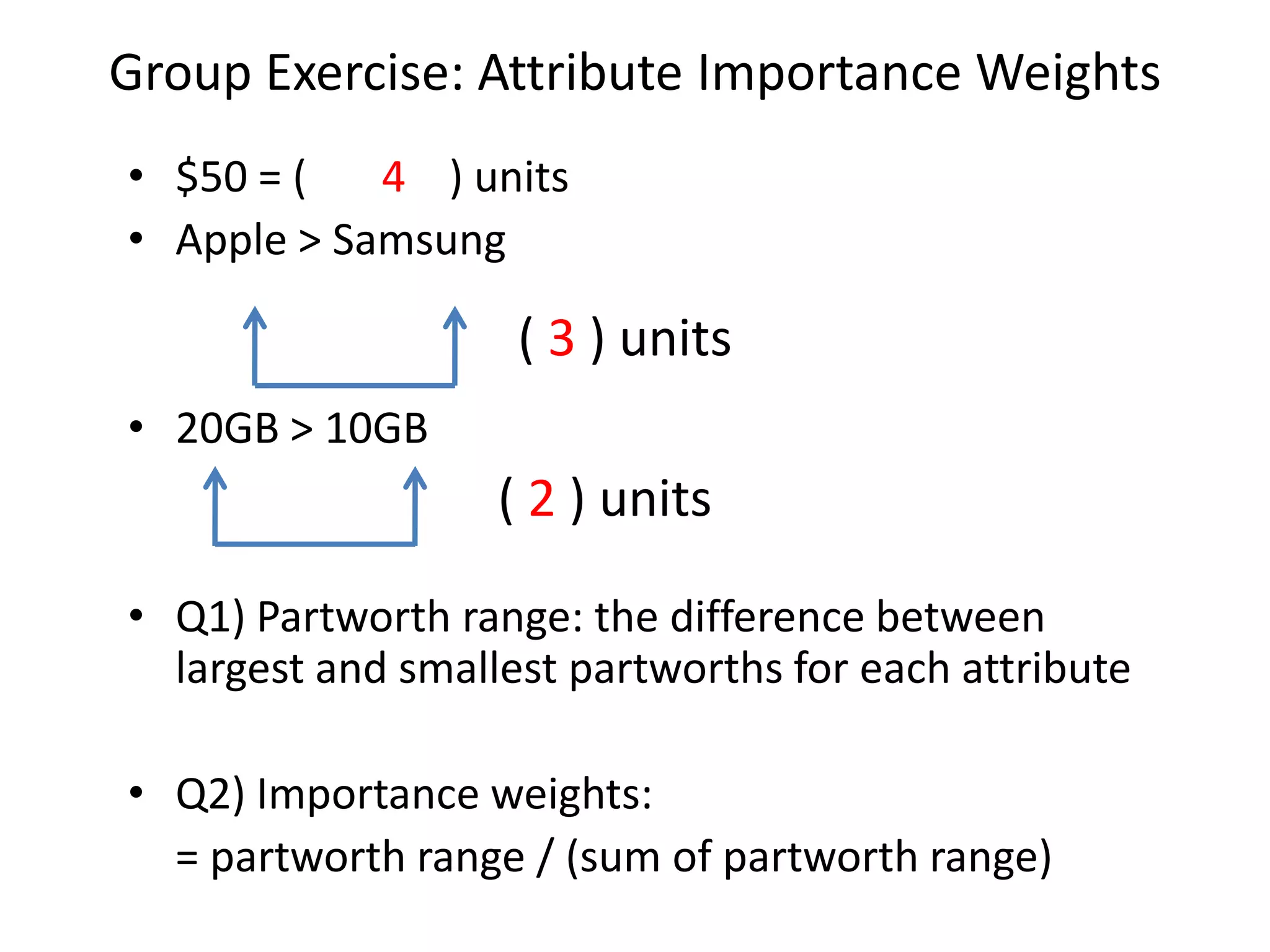
Group Exercise: Attribute Importance Weights
• $50 = (
4 ) units
• Apple > Samsung

( 3 ) units
• 20GB > 10GB

( 2 ) units
• Q1) Partworth range: the difference between
largest and smallest partworths for each attribute

• Q2) Importance weights:
= partworth range / (sum of partworth range)
Group Exercise: Attribute Importance Weights
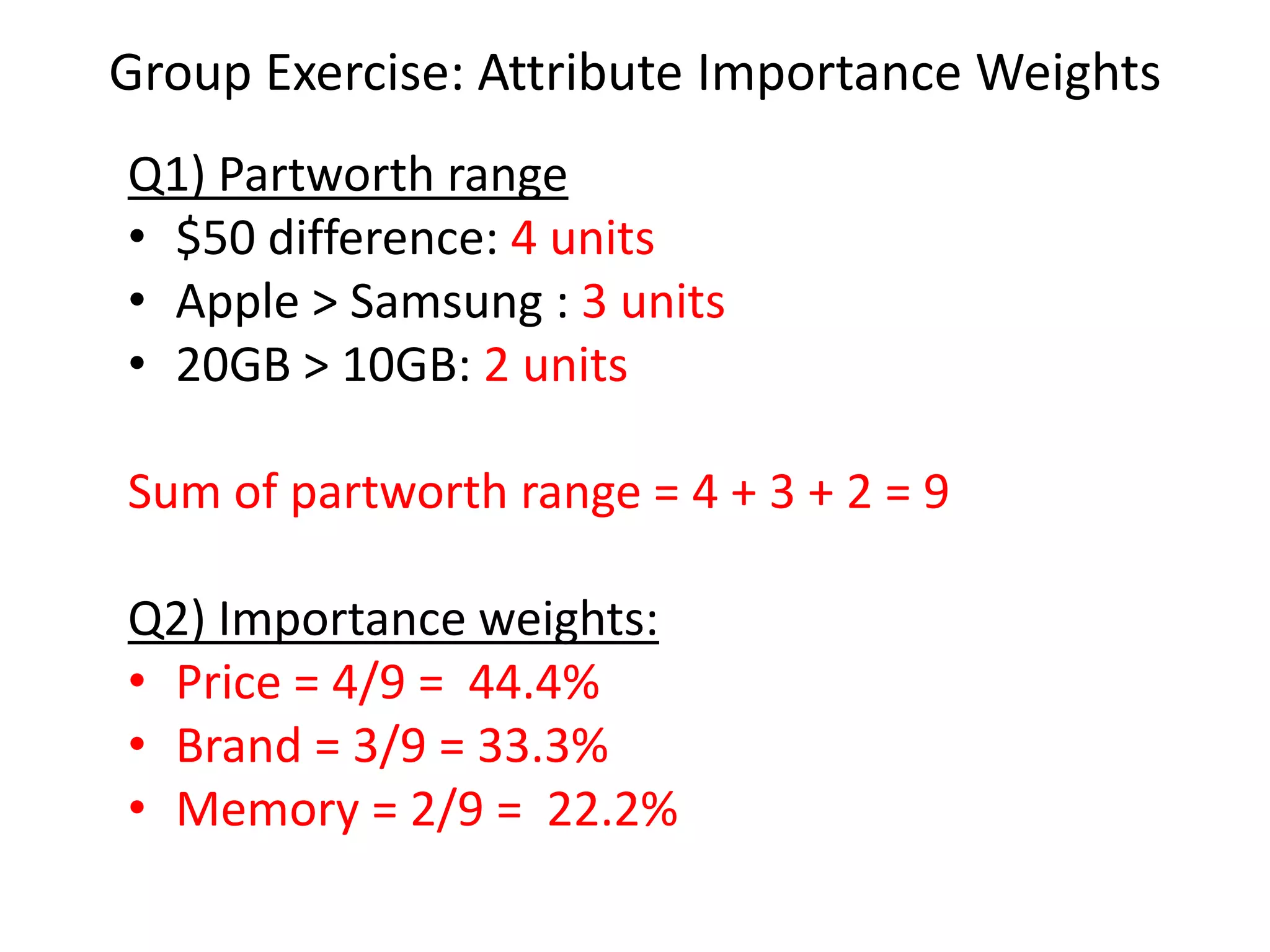
Q1) Partworth range
• $50 difference: 4 units
• Apple > Samsung : 3 units
• 20GB > 10GB: 2 units
Sum of partworth range = 4 + 3 + 2 = 9
Q2) Importance weights:
• Price = 4/9 = 44.4%
• Brand = 3/9 = 33.3%
• Memory = 2/9 = 22.2%

Conjoint Analysis - Part 1/3

  • 1.
    Class Outline • MeasuringConsumer Preference – Problem with intentions-to-buy and self-reported methods – Conjoint Analysis
  • 2.
    Preferences • Intention tobuy – too hard a question – overconfident about buying probability stated preferences • Self-reported importance weights – lack of discrimination, everything is important • Trade-offs – benefits and costs – what is desired most • Actual purchase data – counts – sales force reports revealed preferences Consumer preferences
  • 3.
    Stated intention-to-buy measures 50 durables non-durables %prob. of purchase 40 30 20 10 0 def. not prob. not maybe prob. yes Consumer def. yes preferences
  • 4.
    How to LearnWhat Customers Want? • Ask Direct Questions about preference : – What brand do you prefer? – How much RAM do you prefer? – How much hard disk space do you prefer? – What type of monitor do you prefer? – What price do you prefer? • What is the problem with this?
  • 5.
    Problems with DirectQuestioning • Answers are often trivial and unenlightening – “I prefer more processor speed to less” – “I prefer more RAM to less” – “I prefer more hard disk space to less” – “I prefer a lower price to a higher price”
  • 6.
    More Discrimination from Trade-offQuestions Traditional Approach Conjoint Study Average Importance Ratings Average Importance Ratings Brand Brand Scan Time Scan Time Resolution Resolution Price Price 0 2 4 6 8 10 0 10 20 30 40 50
  • 7.
    Conjoint Analysis • Usefulin 1: Product design 2: Pricing 3: Segmentation and targeting
  • 8.
    The conjoint world:terms and concepts • • • • • • Attributes Attribute levels Profiles Utility models Part-worths Types of conjoint: ranking, rating, choice conjoint world
  • 9.
    iPhone 5 Black &Slate White & Silver 16GB 32GB 64GB $199 $299 $399 • Attribute:_________________________ • Attribute level:_____________________
  • 10.
    iPhone 5 Black &Slate White & Silver 16GB 32GB 64GB $199 $299 $399 • Attribute: Brand, Memory, Price, Color • Attribute level: Apple/Samsung, 16GB/32GB/64GB, $199/$299,$399, Black/White
  • 11.
    Conjoint Analysis • ConjointAnalysis: A technique that enables a researcher to estimate consumers’ valuations of different attributes – Allows us to understand how consumers make trade-offs among attributes of products and services – How much are consumers willing to pay for different attributes?
  • 12.
    Example: New JobChoice Location Salary Option 1 $70K Option 2 $80K
  • 13.
    Conjoint Reveals WhatPeople Really Want What MBA's Said... Rank Based on Conjoint Salary 6th 1st Region of US 2nd 2nd Job Location 5th 3rd People/Culture 1st 4th Functional Area 3rd 5th Firm Growth 7th 6th Business Travel 8th 7th Opp. to Advance 4th 8th Job Attribute Consumer preferences
  • 14.
    Conjoint Analysis -Intuition • Force consumers to rank different bundles of attributes 1. C 2. E C 3. A D 4. F 5. B 6. D A B E F
  • 15.
    Conjoint Analysis -Intuition • Using the information contained in consumers’ rankings (or ratings), we can back out what their valuations of different attributes must be: 1. C 2. E 3. A 4. F 5. B 6. D Suppose both products C and E contains a certain attribute that is not found in A,F,B,D. Then the consumer probably has a high valuation for that attribute Suppose both products B and D contains a certain attribute that is not found in C,E,A,F. Then the consumer probably has a low valuation for that attribute
  • 16.
    Conjoint Analysis: Procedure 1.“Design” a set of product concepts (profiles) - this will usually come in with collaboration with the engineering team 2. Ask respondents to rate/rank those product concepts 3. Based on the respondents’ evaluations of the product concepts, figure out how much utility each attribute provides
  • 17.
    Exercise: Smartphone Choice •Three Attributes 1. Brand : Samsung 2. Memory : 10GB 3. Price : $150 Apple 20GB $200
  • 18.
  • 19.
    Exercise: Smartphone Choice Brand Memory Price Ranking(Utility) Apple 20 150 8 Samsung 20 150 7 Apple 10 150 6 Apple 20 200 5 Samsung 10 150 4 Samsung 20 200 3 Apple 10 200 2 Samsung 10 200 1 • 8=Most Preferred; 1=Least Preferred
  • 20.
    Exercise: Smartphone Choice Q1)Measure Brand Value Brand Memory Apple 20 Samsung 20 Apple 10 Apple 20 Samsung 10 Samsung 20 Apple 10 Samsung 10 Price 150 150 150 200 150 200 200 200 Utility 8 7 6 5 4 3 2 1 Average 1 2 2 1 1.5
  • 21.
    Exercise: Smartphone Choice Q2)Memory Value Brand Memory Apple 20 Samsung 20 Apple 10 Apple 20 Samsung 10 Samsung 20 Apple 10 Samsung 10 Price 150 150 150 200 150 200 200 200 Utility 8 7 6 5 4 3 2 1 Average
  • 22.
    Exercise: Smartphone Choice Q2)Memory Value Brand Memory Apple 20 Samsung 20 Apple 10 Apple 20 Samsung 10 Samsung 20 Apple 10 Samsung 10 Price 150 150 150 200 150 200 200 200 Utility 8 7 6 5 4 3 2 1 Average 2 3 3 2 2.5
  • 23.
    Exercise: Smartphone Choice Q3)Price = xxx Utils. Brand Memory Apple 20 Samsung 20 Apple 10 Apple 20 Samsung 10 Samsung 20 Apple 10 Samsung 10 Price 150 150 150 200 150 200 200 200 Utility 8 7 6 5 4 3 2 1 Average
  • 24.
    Exercise: Smartphone Choice Q3)Price = xxx Utils. Brand Memory Apple 20 Samsung 20 Apple 10 Apple 20 Samsung 10 Samsung 20 Apple 10 Samsung 10 Price 150 150 150 200 150 200 200 200 Utility 8 7 6 5 4 3 2 1 Average 3 4 4 3 3.5
  • 25.
    Exercise: Smartphone Choice •$50 = 3.5 (Utility or Ranking) • Apple > Samsung 1.5 Util. = $( 21.4 ) • 20GB > 10GB 2.5 Util. = $( 35.7 )
  • 26.
    Exercise: Smartphone Choice •$50 = 3.5 (Utility or Ranking) • Apple > Samsung 1.5 Util. = $( ) • 20GB > 10GB 2.5 Util. = $( )
  • 27.
    Exercise: Smartphone Choice •Three Attributes 1. Brand : Samsung Apple 2. Memory : 10GB 20GB 3. Price : $150 $200 (1.5) (2.5) (3.5) • Most important attribute: ( Price ) • Least important attribute: ( Brand )
  • 28.
    Group Exercise –Rating Based Conjoint • 10=Most Preferred; 1=Least Preferred Brand Memory Price Rating Apple 20 150 10 Apple 10 150 8 Apple 20 200 6 Samsung 20 150 7 Apple 10 200 4 Samsung 10 150 5 Samsung 20 200 3 Samsung 10 200 1
  • 29.
  • 30.
  • 31.
    3. Price =XXX Rating Brand Apple Apple Apple Samsung Apple Samsung Samsung Samsung Memory 20 10 20 20 10 10 20 10 Price 150 150 200 150 200 150 200 200 Respondent1’s Rating 10 8 6 7 4 5 3 1
  • 32.
    Group Exercise: WTP •$50 = ( 4 ) units • Apple > Samsung ( 3 ) units = $( 37.5 ) • 20GB > 10GB ( 2 ) units = $( 25 ) • Most important attribute: ( Price ) • Least important attribute: ( Memory )
  • 33.
    Group Exercise: AttributeImportance Weights • $50 = ( 4 ) units • Apple > Samsung ( 3 ) units • 20GB > 10GB ( 2 ) units • Q1) Partworth range: the difference between largest and smallest partworths for each attribute • Q2) Importance weights: = partworth range / (sum of partworth range)
  • 34.
    Group Exercise: AttributeImportance Weights Q1) Partworth range • $50 difference: 4 units • Apple > Samsung : 3 units • 20GB > 10GB: 2 units Sum of partworth range = 4 + 3 + 2 = 9 Q2) Importance weights: • Price = 4/9 = 44.4% • Brand = 3/9 = 33.3% • Memory = 2/9 = 22.2%