Class Outline
• Regression Analysis
• R-square
• Regression Analysis Using Excel
• Interpretation of Regression Output
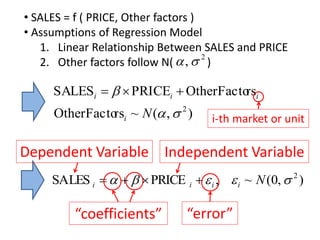
• SALES = f ( PRICE, Other factors )
• Assumptions of Regression Model
1. Linear Relationship Between SALES and PRICE
2. Other factors follow N( )
2
,
),(~rsOtherFacto
rsOtherFactoPRICESALES
2


Ni
iii 
ā€œerrorā€
),0(~,PRICESALES 2
 Niiii 
ā€œcoefficientsā€
i-th market or unit
Independent VariableDependent Variable
iii   PRICESALES
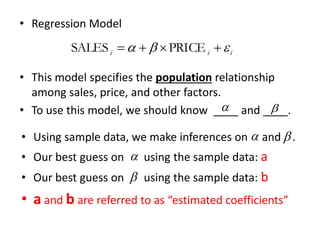
• Regression Model
• This model specifies the population relationship
among sales, price, and other factors.
• To use this model, we should know ____ and ____.
• Using sample data, we make inferences on and .
• Our best guess on using the sample data: a
• Our best guess on using the sample data: b
• a and b are referred to as ā€œestimated coefficientsā€
 


 
SALES
PRICE
100
120
140
160
180
200
220
240
1.7 2.2 2.7
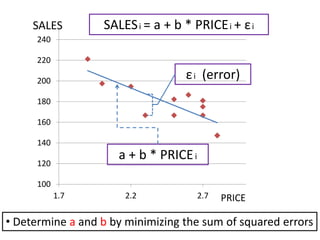
a + b * PRICEi
εi (error)
• Determine a and b by minimizing the sum of squared errors
SALESi = a + b * PRICEi + εi
Exercise
• Determining a and b
• Use ā€œRegression Exercise 2.xlsxā€
• Use Excel ā€œSolverā€ and ā€œData Analysisā€
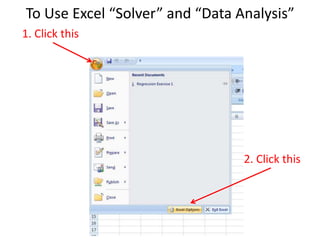
To Use Excel ā€œSolverā€ and ā€œData Analysisā€
1. Click this
2. Click this
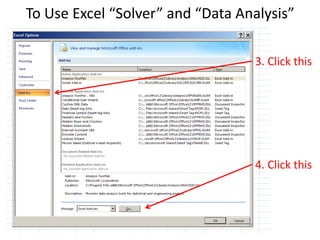
To Use Excel ā€œSolverā€ and ā€œData Analysisā€
3. Click this
4. Click this
To Use Excel ā€œSolverā€ and ā€œData Analysisā€
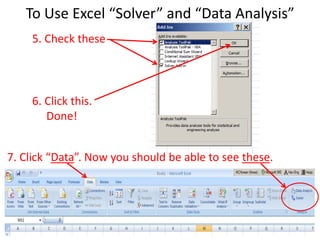
5. Check these
6. Click this.
Done!
7. Click ā€œDataā€. Now you should be able to see these.
Use of Regression Model
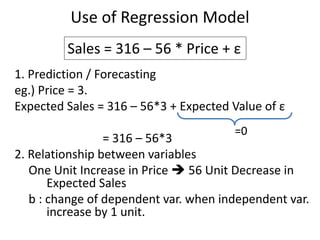
1. Prediction / Forecasting
eg.) Price = 3.
Expected Sales = 316 – 56*3 + Expected Value of ε
= 316 – 56*3
2. Relationship between variables
One Unit Increase in Price  56 Unit Decrease in
Expected Sales
b : change of dependent var. when independent var.
increase by 1 unit.
Sales = 316 – 56 * Price + ε
=0
In-Class Exercise
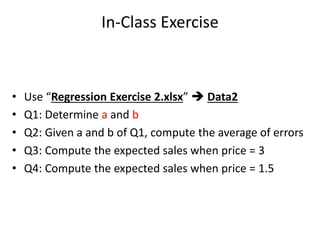
• Use ā€œRegression Exercise 2.xlsxā€  Data2
• Q1: Determine a and b
• Q2: Given a and b of Q1, compute the average of errors
• Q3: Compute the expected sales when price = 3
• Q4: Compute the expected sales when price = 1.5
Explanatory Power of Regression:
R-square
: a measure of the _________ of
the regression model
Explanatory Power of Regression Model:
R-square
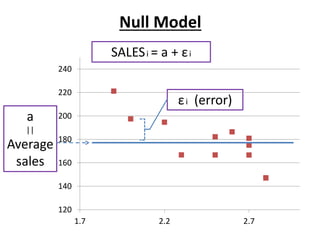
• Assume that we do not have ā€œRegression Modelā€
• Sales = f (Some Unknown Factors)
• SALESi = a + εi  Null Model
a
||
Average
sales
εi (error)
SALESi = a + εi
120
140
160
180
200
220
240
1.7 2.2 2.7
Null Model
SALES
PRICE
100
120
140
160
180
200
220
240
1.7 2.2 2.7
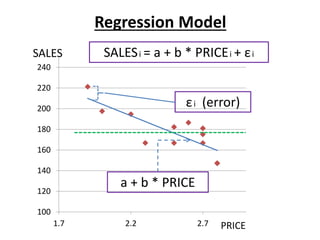
a + b * PRICE
εi (error)
SALESi = a + b * PRICEi + εi
Regression Model
Explanatory Power of Regression Model:
R-square
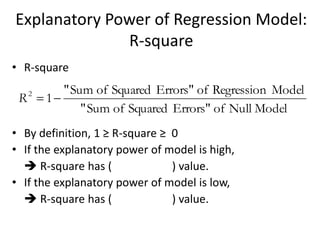
• R-square
• By definition, 1 ≄ R-square ≄ 0
• If the explanatory power of model is high,
 R-square has ( ) value.
• If the explanatory power of model is low,
 R-square has ( ) value.
Null ModelofErrors"SquaredofSum"
ModelRegressionofErrors"SquaredofSum"
12
R
In-Class Exercise
• Use ā€œRegression Exercise 2.xlsxā€  Data2 R-
Square
• Q1: Compute R-Square
Performing Regression Analysis
Using Excel
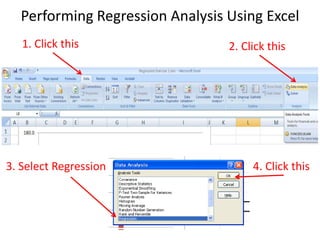
Performing Regression Analysis Using Excel
2. Click this1. Click this
3. Select Regression 4. Click this
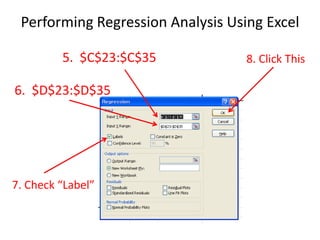
Performing Regression Analysis Using Excel
7. Check ā€œLabelā€
5. $C$23:$C$35
6. $D$23:$D$35
8. Click This
Performing Regression Analysis Using Excel
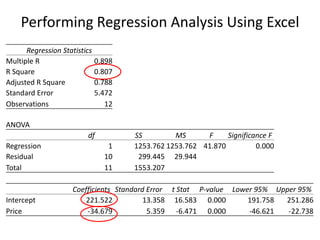
Regression Statistics
Multiple R 0.898
R Square 0.807
Adjusted R Square 0.788
Standard Error 5.472
Observations 12
ANOVA
df SS MS F Significance F
Regression 1 1253.762 1253.762 41.870 0.000
Residual 10 299.445 29.944
Total 11 1553.207
Coefficients Standard Error t Stat P-value Lower 95% Upper 95%
Intercept 221.522 13.358 16.583 0.000 191.758 251.286
Price -34.679 5.359 -6.471 0.000 -46.621 -22.738
Interpretation of Regression Output
ANOVA
ANOVA
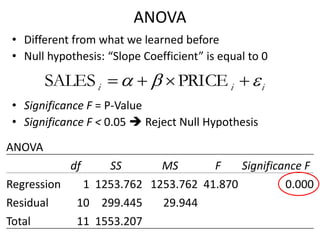
df SS MS F Significance F
Regression 1 1253.762 1253.762 41.870 0.000
Residual 10 299.445 29.944
Total 11 1553.207
• Different from what we learned before
• Null hypothesis: ā€œSlope Coefficientā€ is equal to 0
• Significance F = P-Value
• Significance F < 0.05  Reject Null Hypothesis
iii   PRICESALES
ANOVA
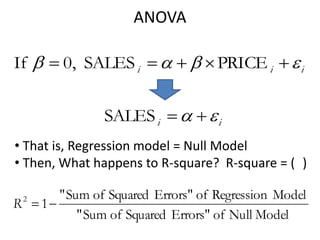
iii   PRICESALES,0If
ii  SALES
Null ModelofErrors"SquaredofSum"
ModelRegressionofErrors"SquaredofSum"
12
R
• That is, Regression model = Null Model
• Then, What happens to R-square? R-square = ( )
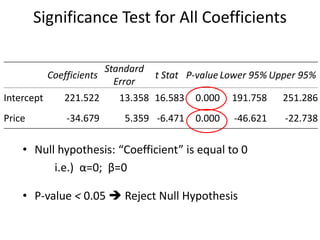
Significance Test for All Coefficients
Coefficients
Standard
Error
t Stat P-value Lower 95% Upper 95%
Intercept 221.522 13.358 16.583 0.000 191.758 251.286
Price -34.679 5.359 -6.471 0.000 -46.621 -22.738
• Null hypothesis: ā€œCoefficientā€ is equal to 0
i.e.) α=0; β=0
• P-value < 0.05  Reject Null Hypothesis

Introduction to Regression Analysis

  • 1.
    Class Outline • RegressionAnalysis • R-square • Regression Analysis Using Excel • Interpretation of Regression Output
  • 2.
    • SALES =f ( PRICE, Other factors ) • Assumptions of Regression Model 1. Linear Relationship Between SALES and PRICE 2. Other factors follow N( ) 2 , ),(~rsOtherFacto rsOtherFactoPRICESALES 2   Ni iii  ā€œerrorā€ ),0(~,PRICESALES 2  Niiii  ā€œcoefficientsā€ i-th market or unit Independent VariableDependent Variable
  • 3.
    iii  PRICESALES • Regression Model • This model specifies the population relationship among sales, price, and other factors. • To use this model, we should know ____ and ____. • Using sample data, we make inferences on and . • Our best guess on using the sample data: a • Our best guess on using the sample data: b • a and b are referred to as ā€œestimated coefficientsā€      
  • 4.
    SALES PRICE 100 120 140 160 180 200 220 240 1.7 2.2 2.7 a+ b * PRICEi εi (error) • Determine a and b by minimizing the sum of squared errors SALESi = a + b * PRICEi + εi
  • 5.
    Exercise • Determining aand b • Use ā€œRegression Exercise 2.xlsxā€ • Use Excel ā€œSolverā€ and ā€œData Analysisā€
  • 6.
    To Use Excelā€œSolverā€ and ā€œData Analysisā€ 1. Click this 2. Click this
  • 7.
    To Use Excelā€œSolverā€ and ā€œData Analysisā€ 3. Click this 4. Click this
  • 8.
    To Use Excelā€œSolverā€ and ā€œData Analysisā€ 5. Check these 6. Click this. Done! 7. Click ā€œDataā€. Now you should be able to see these.
  • 9.
    Use of RegressionModel 1. Prediction / Forecasting eg.) Price = 3. Expected Sales = 316 – 56*3 + Expected Value of ε = 316 – 56*3 2. Relationship between variables One Unit Increase in Price  56 Unit Decrease in Expected Sales b : change of dependent var. when independent var. increase by 1 unit. Sales = 316 – 56 * Price + ε =0
  • 10.
    In-Class Exercise • Useā€œRegression Exercise 2.xlsxā€  Data2 • Q1: Determine a and b • Q2: Given a and b of Q1, compute the average of errors • Q3: Compute the expected sales when price = 3 • Q4: Compute the expected sales when price = 1.5
  • 11.
    Explanatory Power ofRegression: R-square : a measure of the _________ of the regression model
  • 12.
    Explanatory Power ofRegression Model: R-square • Assume that we do not have ā€œRegression Modelā€ • Sales = f (Some Unknown Factors) • SALESi = a + εi  Null Model
  • 13.
    a || Average sales εi (error) SALESi =a + εi 120 140 160 180 200 220 240 1.7 2.2 2.7 Null Model
  • 14.
    SALES PRICE 100 120 140 160 180 200 220 240 1.7 2.2 2.7 a+ b * PRICE εi (error) SALESi = a + b * PRICEi + εi Regression Model
  • 15.
    Explanatory Power ofRegression Model: R-square • R-square • By definition, 1 ≄ R-square ≄ 0 • If the explanatory power of model is high,  R-square has ( ) value. • If the explanatory power of model is low,  R-square has ( ) value. Null ModelofErrors"SquaredofSum" ModelRegressionofErrors"SquaredofSum" 12 R
  • 16.
    In-Class Exercise • Useā€œRegression Exercise 2.xlsxā€  Data2 R- Square • Q1: Compute R-Square
  • 17.
  • 18.
    Performing Regression AnalysisUsing Excel 2. Click this1. Click this 3. Select Regression 4. Click this
  • 19.
    Performing Regression AnalysisUsing Excel 7. Check ā€œLabelā€ 5. $C$23:$C$35 6. $D$23:$D$35 8. Click This
  • 20.
    Performing Regression AnalysisUsing Excel Regression Statistics Multiple R 0.898 R Square 0.807 Adjusted R Square 0.788 Standard Error 5.472 Observations 12 ANOVA df SS MS F Significance F Regression 1 1253.762 1253.762 41.870 0.000 Residual 10 299.445 29.944 Total 11 1553.207 Coefficients Standard Error t Stat P-value Lower 95% Upper 95% Intercept 221.522 13.358 16.583 0.000 191.758 251.286 Price -34.679 5.359 -6.471 0.000 -46.621 -22.738
  • 21.
  • 22.
    ANOVA ANOVA df SS MSF Significance F Regression 1 1253.762 1253.762 41.870 0.000 Residual 10 299.445 29.944 Total 11 1553.207 • Different from what we learned before • Null hypothesis: ā€œSlope Coefficientā€ is equal to 0 • Significance F = P-Value • Significance F < 0.05  Reject Null Hypothesis iii   PRICESALES
  • 23.
    ANOVA iii  PRICESALES,0If ii  SALES Null ModelofErrors"SquaredofSum" ModelRegressionofErrors"SquaredofSum" 12 R • That is, Regression model = Null Model • Then, What happens to R-square? R-square = ( )
  • 24.
    Significance Test forAll Coefficients Coefficients Standard Error t Stat P-value Lower 95% Upper 95% Intercept 221.522 13.358 16.583 0.000 191.758 251.286 Price -34.679 5.359 -6.471 0.000 -46.621 -22.738 • Null hypothesis: ā€œCoefficientā€ is equal to 0 i.e.) α=0; β=0 • P-value < 0.05  Reject Null Hypothesis