



Marketing Research on – 3G Preference  A Conjoint Analysis ALOK PRATAP SINGH	Ph. 9266351033E-mail:alokpratap347@gmail.com
Plan of the PresentationDefining the marketing objective.Identify marketing problem and research problem The business modelMarketing research methodologyTabulation and Analysis
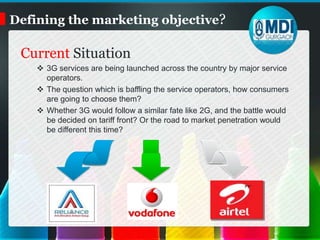
Defining the marketing objective?Current Situation3G services are being launched across the country by major service operators.
The question which is baffling the service operators, how consumers are going to choose them?
Whether 3G wouldfollow a similar fate like 2G, and the battle would be decided on tariff front? Or the road to market penetration would be different this time?Marketing problem“How the customers are going to choose 3G services? Is pricing going to be deciding factor? How can service operator increase their market share?”Our marketing problem
Marketing research problemOur marketing research problem“To Determine criterion which weigh heavily in choosing among different service providers?”“To determine the price elasticity of demand and its impact on sales”“What combination of variable would gives us maximum sale and the optimum output?”
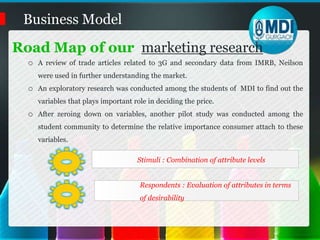
Business ModelRoad Map of our  marketing researchA review of trade articles related to 3G and secondary data from IMRB, Neilson were used in further understanding the market.An exploratory research was conducted among the students of  MDI to find out the variables that plays important role in deciding the price.After zeroing down on variables, another pilot study was conducted among the student community to determine the relative importance consumer attach to these variables.Stimuli : Combination of attribute levelsRespondents : Evaluation of attributes in terms of desirability
The Research MethodologyObjective/Theoretical FrameworkMathematical ModelY = ∑ axWhere	Y = degree of preference	a = model parameter to be estimated statistically	x = attribute of service operator that constitute the choice criteria
The Research Methodology	SurveyPersonal In Home InterviewsStructured Questionnaire Ordinal Scale Sampling Design ProcessTarget PopulationElements – Male or Female above 16 years to 60 years of age.Sampling Units – Mobile phone users with data usage(SMS)Extent – GurgaonTime – 2011Sampling FrameAll the students of MDI, Gurgaon
The Research MethodologySampling TechniqueSample with replacement and non probability sampling i.e. Convenience Sampling.Sample SizeA sample size of 32 has been chosen. Data Preparation & AnalysisConjoint Analysis
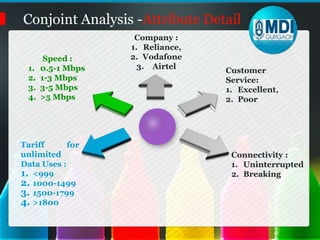
Conjoint Analysis -Attribute DetailSpeed : 0.5-1 Mbps1-3 Mbps3-5 Mbps>5 MbpsCompany : Reliance, Vodafone AirtelCustomer Service:Excellent,PoorConnectivity :UninterruptedBreaking Tariff for unlimited Data Uses : <9991000-14991500-1799>1800
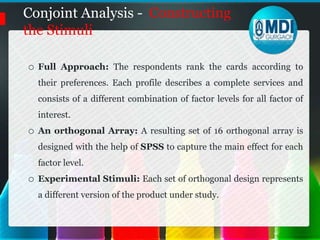
Conjoint Analysis -  Constructing the StimuliFull Approach: The respondents rank the cards according to their preferences. Each profile describes a complete services and consists of a different combination of factor levels for all factor of interest.An orthogonal Array: A resulting set of 16 orthogonal array is designed with the help of SPSS to capture the main effect for each factor level.Experimental Stimuli: Each set of orthogonal design represents a different version of the product under study.
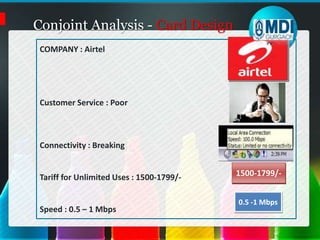
 Conjoint Analysis - Card DesignCOMPANY : AirtelCustomer Service : PoorConnectivity : BreakingTariff for Unlimited Uses : 1500-1799/-Speed : 0.5 – 1 Mbps1500-1799/-0.5 -1 Mbps
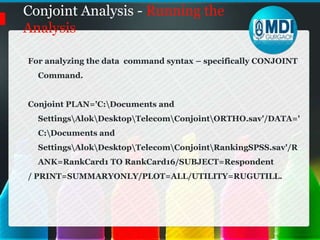
Conjoint Analysis - Running the AnalysisFor analyzing the data  command syntax – specifically CONJOINT Command.Conjoint PLAN='C:\Documents and Settings\Alok\Desktop\Telecom\Conjoint\ORTHO.sav'/DATA='C:\Documents and Settings\Alok\Desktop\Telecom\Conjoint\RankingSPSS.sav'/RANK=RankCard1 TO RankCard16/SUBJECT=Respondent/ PRINT=SUMMARYONLY/PLOT=ALL/UTILITY=RUGUTILL.
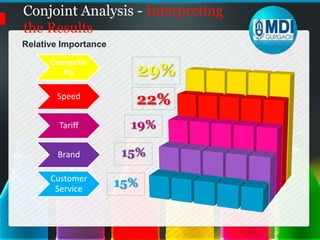
Conjoint Analysis - Interpreting the ResultsRelative Importance29% 22% 19%15%15%
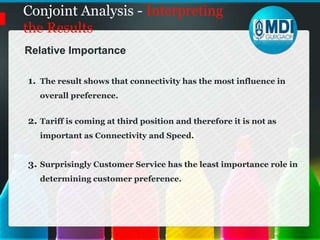
Conjoint Analysis - Interpreting the ResultsRelative ImportanceThe result shows that connectivity has the most influence in overall preference.Tariff is coming at third position and therefore it is not as important as Connectivity and Speed.Surprisingly Customer Service has the least importance role in determining customer preference.
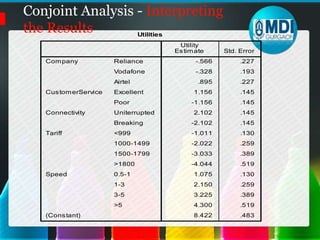
Conjoint Analysis - Interpreting the Results
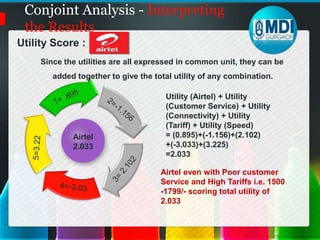
Conjoint Analysis - Interpreting the Results Utility Score :Since the utilities are all expressed in common unit, they can be added together to give the total utility of any combination.1= .895Utility (Airtel) + Utility (Customer Service) + Utility (Connectivity) + Utility (Tariff) + Utility (Speed)= (0.895)+(-1.156)+(2.102)+(-3.033)+(3.225)=2.0332=-1.156 Airtel2.0335=3.223= 2.102Airtel even with Poor customer Service and High Tariffs i.e. 1500 -1799/- scoring total utility of 2.033 4=-3.03
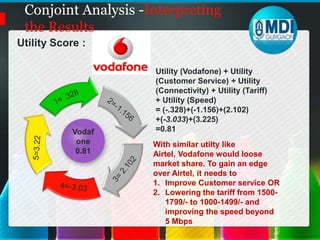
Conjoint Analysis -Interpreting the Results Utility Score : Utility (Vodafone) + Utility (Customer Service) + Utility (Connectivity) + Utility (Tariff) + Utility (Speed)= (-.328)+(-1.156)+(2.102)+(-3.033)+(3.225)=0.811= .3282=-1.156 Vodafone 0.81With similar utilty like Airtel, Vodafone would loose market share. To gain an edge over Airtel, it needs to Improve Customer service OR Lowering the tariff from 1500-1799/- to 1000-1499/- and improving the speed beyond 5 Mbps5=3.223= 2.1024=-3.03
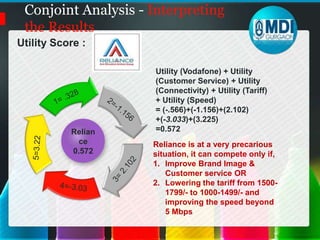
Conjoint Analysis - Interpreting the Results Utility Score : Utility (Vodafone) + Utility (Customer Service) + Utility (Connectivity) + Utility (Tariff) + Utility (Speed)= (-.566)+(-1.156)+(2.102)+(-3.033)+(3.225)=0.5721= .3282=-1.156 Reliance 0.572Reliance is at a very precarious situation, it can compete only if,Improve Brand Image & Customer service OR Lowering the tariff from 1500-1799/- to 1000-1499/- and improving the speed beyond 5 Mbps5=3.223= 2.1024=-3.03
Conjoint Analysis - Interpreting the ResultsUtility Score: It’s obvious increasing Speed is technically not feasible for the Companies.  Therefore they will either resort to Connectivity,  Customer Service or Lowering the tariff. In case of Reliance, which has a low Brand Image, it should concentrate on uninterrupted connectivity and following it up with Brand Building exercise. Third option for them is improving the Customer Service.

3G War: Who will be the winner?

  • 1.
    Marketing Research on– 3G Preference A Conjoint Analysis ALOK PRATAP SINGH Ph. 9266351033E-mail:alokpratap347@gmail.com
  • 2.
    Plan of thePresentationDefining the marketing objective.Identify marketing problem and research problem The business modelMarketing research methodologyTabulation and Analysis
  • 3.
    Defining the marketingobjective?Current Situation3G services are being launched across the country by major service operators.
  • 4.
    The question whichis baffling the service operators, how consumers are going to choose them?
  • 5.
    Whether 3G wouldfollowa similar fate like 2G, and the battle would be decided on tariff front? Or the road to market penetration would be different this time?Marketing problem“How the customers are going to choose 3G services? Is pricing going to be deciding factor? How can service operator increase their market share?”Our marketing problem
  • 6.
    Marketing research problemOurmarketing research problem“To Determine criterion which weigh heavily in choosing among different service providers?”“To determine the price elasticity of demand and its impact on sales”“What combination of variable would gives us maximum sale and the optimum output?”
  • 7.
    Business ModelRoad Mapof our marketing researchA review of trade articles related to 3G and secondary data from IMRB, Neilson were used in further understanding the market.An exploratory research was conducted among the students of MDI to find out the variables that plays important role in deciding the price.After zeroing down on variables, another pilot study was conducted among the student community to determine the relative importance consumer attach to these variables.Stimuli : Combination of attribute levelsRespondents : Evaluation of attributes in terms of desirability
  • 8.
    The Research MethodologyObjective/TheoreticalFrameworkMathematical ModelY = ∑ axWhere Y = degree of preference a = model parameter to be estimated statistically x = attribute of service operator that constitute the choice criteria
  • 9.
    The Research Methodology SurveyPersonalIn Home InterviewsStructured Questionnaire Ordinal Scale Sampling Design ProcessTarget PopulationElements – Male or Female above 16 years to 60 years of age.Sampling Units – Mobile phone users with data usage(SMS)Extent – GurgaonTime – 2011Sampling FrameAll the students of MDI, Gurgaon
  • 10.
    The Research MethodologySamplingTechniqueSample with replacement and non probability sampling i.e. Convenience Sampling.Sample SizeA sample size of 32 has been chosen. Data Preparation & AnalysisConjoint Analysis
  • 11.
    Conjoint Analysis -AttributeDetailSpeed : 0.5-1 Mbps1-3 Mbps3-5 Mbps>5 MbpsCompany : Reliance, Vodafone AirtelCustomer Service:Excellent,PoorConnectivity :UninterruptedBreaking Tariff for unlimited Data Uses : <9991000-14991500-1799>1800
  • 12.
    Conjoint Analysis - Constructing the StimuliFull Approach: The respondents rank the cards according to their preferences. Each profile describes a complete services and consists of a different combination of factor levels for all factor of interest.An orthogonal Array: A resulting set of 16 orthogonal array is designed with the help of SPSS to capture the main effect for each factor level.Experimental Stimuli: Each set of orthogonal design represents a different version of the product under study.
  • 13.
    Conjoint Analysis- Card DesignCOMPANY : AirtelCustomer Service : PoorConnectivity : BreakingTariff for Unlimited Uses : 1500-1799/-Speed : 0.5 – 1 Mbps1500-1799/-0.5 -1 Mbps
  • 14.
    Conjoint Analysis -Running the AnalysisFor analyzing the data command syntax – specifically CONJOINT Command.Conjoint PLAN='C:\Documents and Settings\Alok\Desktop\Telecom\Conjoint\ORTHO.sav'/DATA='C:\Documents and Settings\Alok\Desktop\Telecom\Conjoint\RankingSPSS.sav'/RANK=RankCard1 TO RankCard16/SUBJECT=Respondent/ PRINT=SUMMARYONLY/PLOT=ALL/UTILITY=RUGUTILL.
  • 15.
    Conjoint Analysis -Interpreting the ResultsRelative Importance29% 22% 19%15%15%
  • 16.
    Conjoint Analysis -Interpreting the ResultsRelative ImportanceThe result shows that connectivity has the most influence in overall preference.Tariff is coming at third position and therefore it is not as important as Connectivity and Speed.Surprisingly Customer Service has the least importance role in determining customer preference.
  • 17.
    Conjoint Analysis -Interpreting the Results
  • 18.
    Conjoint Analysis -Interpreting the Results Utility Score :Since the utilities are all expressed in common unit, they can be added together to give the total utility of any combination.1= .895Utility (Airtel) + Utility (Customer Service) + Utility (Connectivity) + Utility (Tariff) + Utility (Speed)= (0.895)+(-1.156)+(2.102)+(-3.033)+(3.225)=2.0332=-1.156 Airtel2.0335=3.223= 2.102Airtel even with Poor customer Service and High Tariffs i.e. 1500 -1799/- scoring total utility of 2.033 4=-3.03
  • 19.
    Conjoint Analysis -Interpretingthe Results Utility Score : Utility (Vodafone) + Utility (Customer Service) + Utility (Connectivity) + Utility (Tariff) + Utility (Speed)= (-.328)+(-1.156)+(2.102)+(-3.033)+(3.225)=0.811= .3282=-1.156 Vodafone 0.81With similar utilty like Airtel, Vodafone would loose market share. To gain an edge over Airtel, it needs to Improve Customer service OR Lowering the tariff from 1500-1799/- to 1000-1499/- and improving the speed beyond 5 Mbps5=3.223= 2.1024=-3.03
  • 20.
    Conjoint Analysis -Interpreting the Results Utility Score : Utility (Vodafone) + Utility (Customer Service) + Utility (Connectivity) + Utility (Tariff) + Utility (Speed)= (-.566)+(-1.156)+(2.102)+(-3.033)+(3.225)=0.5721= .3282=-1.156 Reliance 0.572Reliance is at a very precarious situation, it can compete only if,Improve Brand Image & Customer service OR Lowering the tariff from 1500-1799/- to 1000-1499/- and improving the speed beyond 5 Mbps5=3.223= 2.1024=-3.03
  • 21.
    Conjoint Analysis -Interpreting the ResultsUtility Score: It’s obvious increasing Speed is technically not feasible for the Companies. Therefore they will either resort to Connectivity, Customer Service or Lowering the tariff. In case of Reliance, which has a low Brand Image, it should concentrate on uninterrupted connectivity and following it up with Brand Building exercise. Third option for them is improving the Customer Service.