Introduction to
Conjoint Analysis
Adapted from Sawtooth Software, Inc. materials
Different Perspectives, Different Goals
 Buyers want all of the most desirable
features at lowest possible price
 Sellers want to maximize profits by:
1) minimizing costs of providing features
2) providing products that offer greater overall value
than the competition
Demand Side of Equation
 Typical market research role is to focus first
on demand side of the equation
 After figuring out what buyers want, next
assess whether it can be built/provided in a
cost- effective manner
Products/Services are Composed of
Features/Attributes
 Credit Card:
Brand + Interest Rate + Annual Fee + Credit Limit
 On-Line Brokerage:
Brand + Fee + Speed of Transaction + Reliability of
Transaction + Research/Charting Options
Breaking the Problem Down
 If we learn how buyers value the components of
a product, we are in a better position to design
those that improve profitability
How to Learn What Customers Want?
 Ask Direct Questions about preference:
 What brand do you prefer?
 What Interest Rate would you like?
 What Annual Fee would you like?
 What Credit Limit would you like?
 Answers often trivial and unenlightening (e.g.
respondents prefer low fees to high fees,
higher credit limits to low credit limits)
How to Learn What Is Important?
 Ask Direct Questions about importances
 How important is it that you get the <<brand,
interest rate, annual fee, credit limit>> that you
want?
Stated Importances
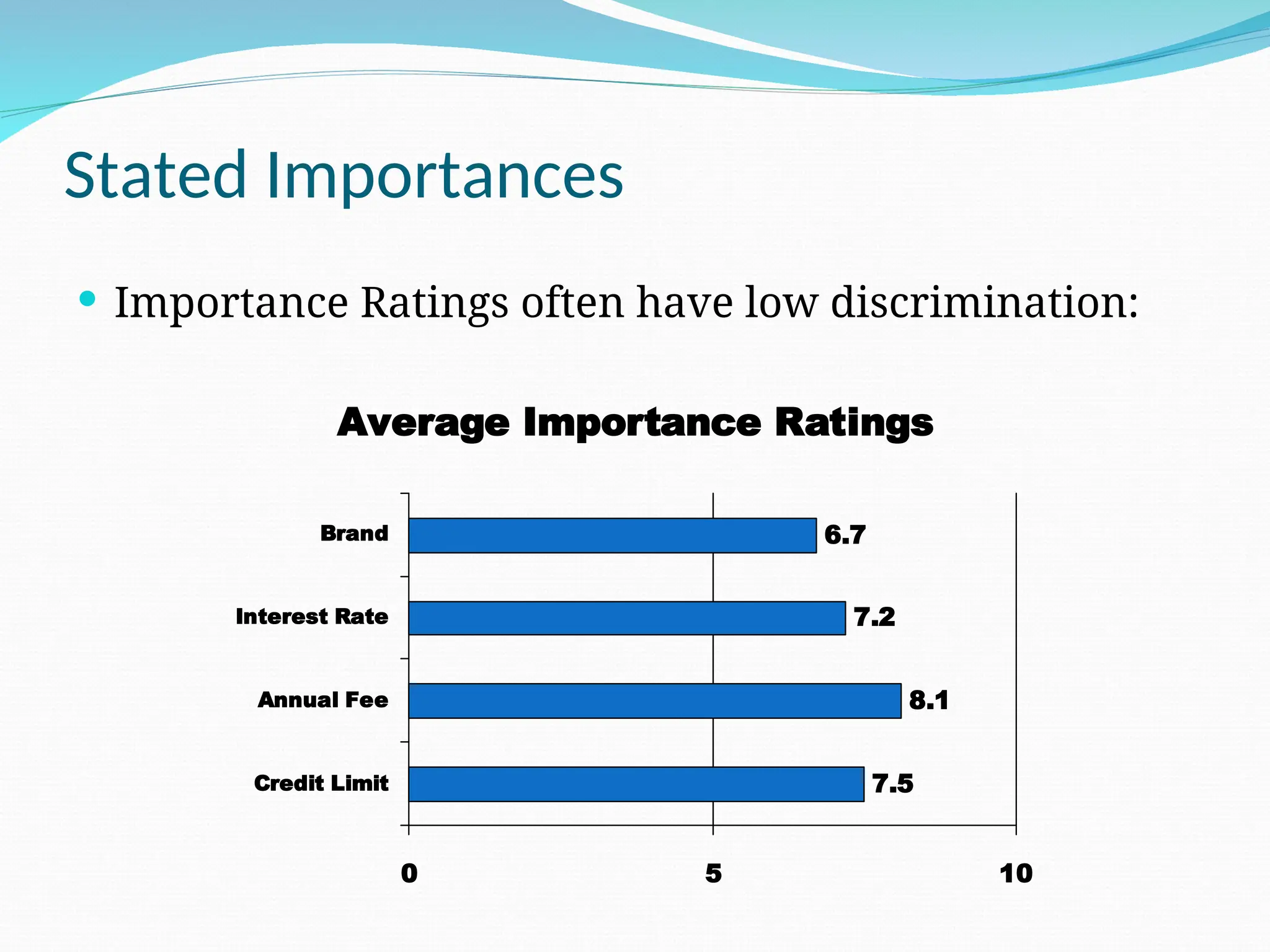
 Importance Ratings often have low discrimination:
Average Importance Ratings
7.5
8.1
7.2
6.7
0 5 10
Credit Limit
Annual Fee
Interest Rate
Brand
Stated Importances
 Answers often have low discrimination, with
most answers falling in “very important”
categories
 Answers sometimes useful for segmenting
market, but still not as actionable as could be
What is Conjoint Analysis?
 Research technique developed in early 70s
 Measures how buyers value components of a
product/service bundle
 Dictionary definition-- “Conjoint: Joined
together, combined.”
 Marketer’s catch-phrase-- “Features
CONsidered JOINTly”
Important Early Articles
 Luce, Duncan and John Tukey (1964), “Simultaneous Conjoint
Measurement: A New Type of Fundamental Measurement,” Journal of
Mathematical Psychology, 1, 1-27
 Green, Paul and Vithala Rao (1971), “Conjoint Measurement for
Quantifying Judgmental Data,” Journal of Marketing Research, 8 (Aug),
355-363
 Johnson, Richard (1974), “Trade-off Analysis of Consumer Values,”
Journal of Marketing Research, 11 (May), 121-127
 Green, Paul and V. Srinivasan (1978), “Conjoint Analysis in Marketing:
New Development with Implications for Research and Practice,”
Journal of Marketing, 54 (Oct), 3-19
 Louviere, Jordan and George Woodworth (1983), “Design and Analysis
of Simulated Consumer Choice or Allocation Experiments,” Journal of
Marketing Research, 20 (Nov), 350-367
How Does Conjoint Analysis Work?
 We vary the product features (independent variables) to
build many (usually 12 or more) product concepts
 We ask respondents to rate/rank those product concepts
(dependent variable)
 Based on the respondents’ evaluations of the product
concepts, we figure out how much unique value (utility)
each of the features added
 (Regress dependent variable on independent variables;
betas equal part worth utilities.)
What’s So Good about Conjoint?
 More realistic questions:
Would you prefer . . .
210 Horsepower or 140 Horsepower
17 MPG 28 MPG
 If choose left, you prefer Power. If choose right, you
prefer Fuel Economy
 Rather than ask directly whether you prefer Power over
Fuel Economy, we present realistic tradeoff scenarios
and infer preferences from your product choices
What’s So Good about Conjoint?
 When respondents are forced to make
difficult tradeoffs, we learn what they truly
value
First Step: Create Attribute List
 Attributes assumed to be independent (Brand, Speed,
Color, Price, etc.)
 Each attribute has varying degrees, or “levels”
 Brand: Coke, Pepsi, Sprite
 Speed: 5 pages per minute, 10 pages per minute
 Color: Red, Blue, Green, Black
 Each level is assumed to be mutually exclusive of the
others (a product has one and only one level level of
that attribute)
Rules for Formulating Attribute Levels
 Levels are assumed to be mutually exclusive
Attribute: Add-on features
level 1: Sunroof
level 2: GPS System
level 3: Video Screen
 If define levels in this way, you cannot determine
the value of providing two or three of these features
at the same time
 Levels should have concrete/unambiguous
meaning
“Very expensive” vs. “Costs $575”
“Weight: 5 to 7 kilos” vs. “Weight 6 kilos”
 One description leaves meaning up to individual
interpretation, while the other does not
Rules for Formulating Attribute Levels
 Don’t include too many levels for any one attribute
 The usual number is about 3 to 5 levels per attribute
 The temptation (for example) is to include many, many
levels of price, so we can estimate people’s preferences
for each
 But, you spread your precious observations across more
parameters to be estimated, resulting in noisier (less
precise) measurement of ALL price levels
 Better approach usually is to interpolate between fewer
more precisely measured levels for “not asked about”
prices
Rules for Formulating Attribute Levels
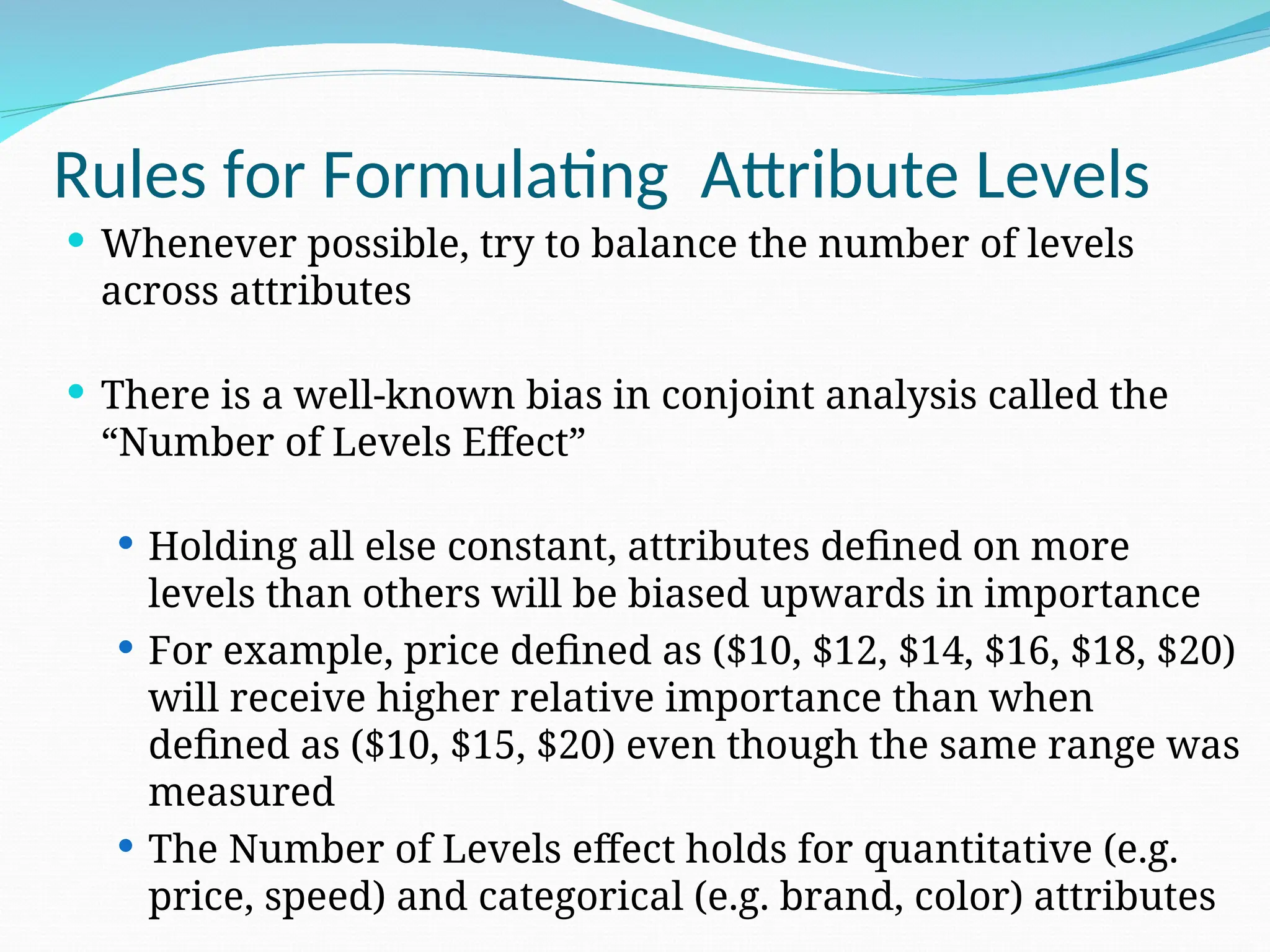
 Whenever possible, try to balance the number of levels
across attributes
 There is a well-known bias in conjoint analysis called the
“Number of Levels Effect”
 Holding all else constant, attributes defined on more
levels than others will be biased upwards in importance
 For example, price defined as ($10, $12, $14, $16, $18, $20)
will receive higher relative importance than when
defined as ($10, $15, $20) even though the same range was
measured
 The Number of Levels effect holds for quantitative (e.g.
price, speed) and categorical (e.g. brand, color) attributes
Rules for Formulating Attribute Levels
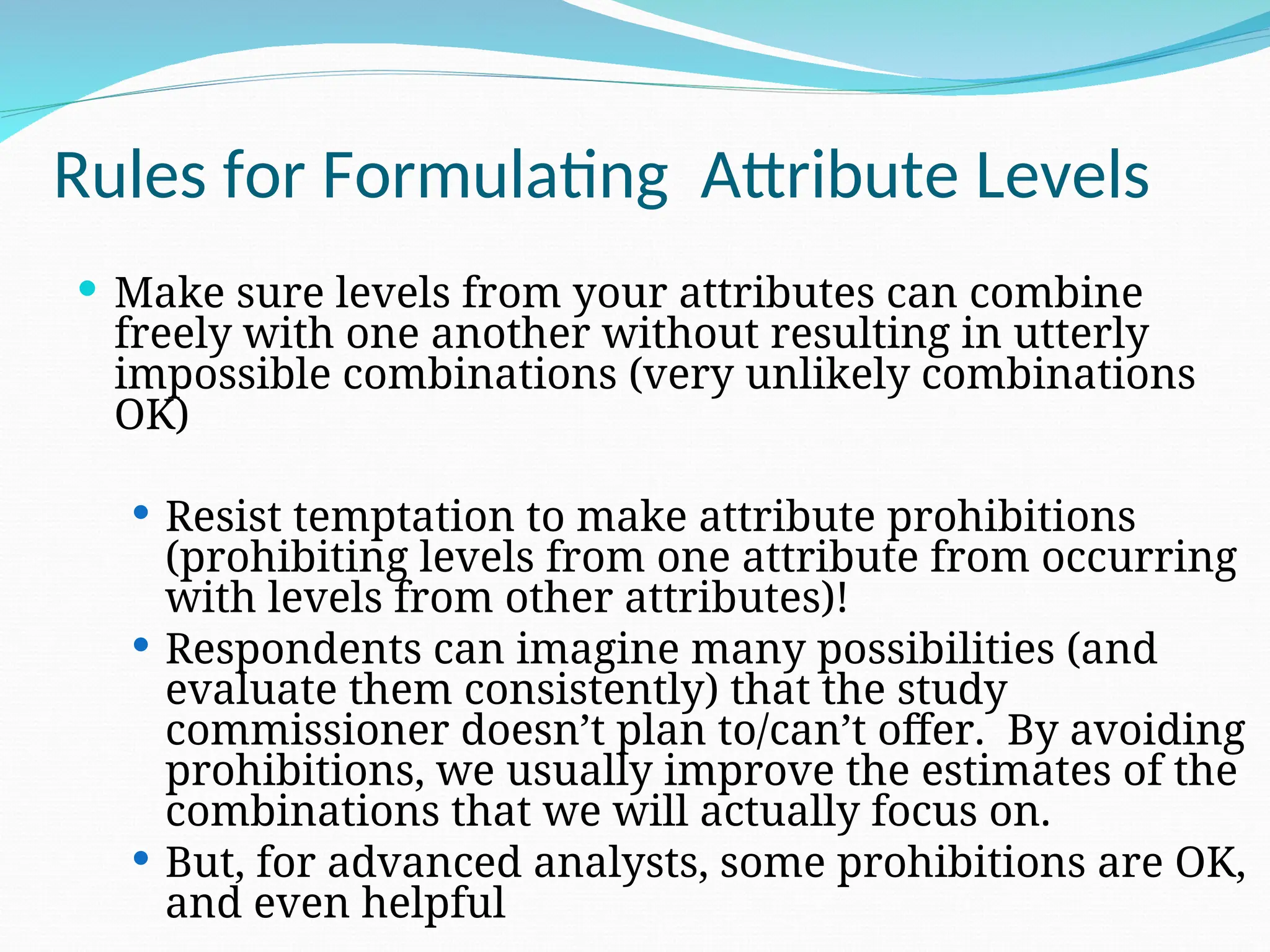
 Make sure levels from your attributes can combine
freely with one another without resulting in utterly
impossible combinations (very unlikely combinations
OK)
 Resist temptation to make attribute prohibitions
(prohibiting levels from one attribute from occurring
with levels from other attributes)!
 Respondents can imagine many possibilities (and
evaluate them consistently) that the study
commissioner doesn’t plan to/can’t offer. By avoiding
prohibitions, we usually improve the estimates of the
combinations that we will actually focus on.
 But, for advanced analysts, some prohibitions are OK,
and even helpful
Rules for Formulating Attribute Levels
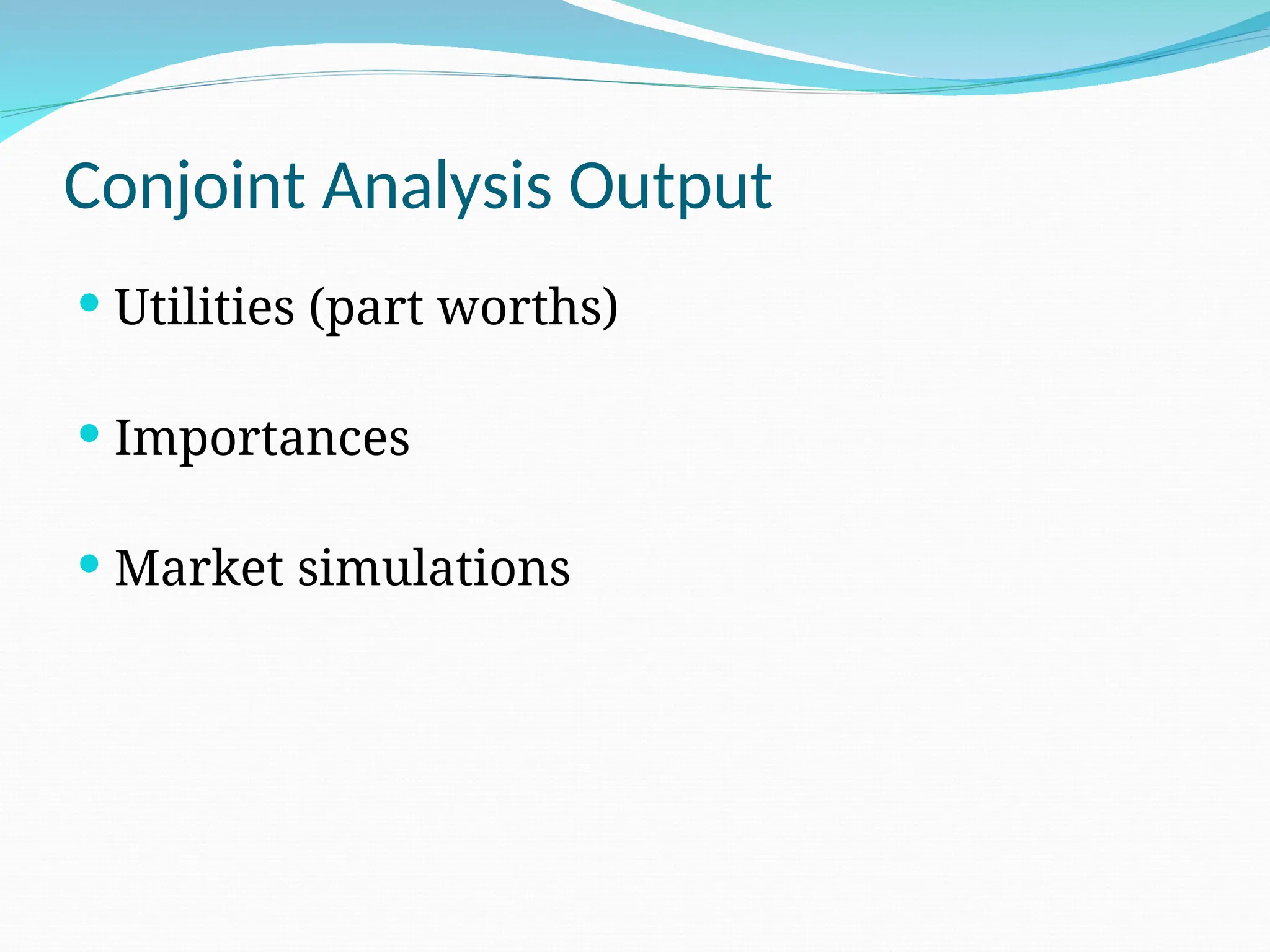
Conjoint Analysis Output
 Utilities (part worths)
 Importances
 Market simulations
Conjoint Utilities (Part Worths)
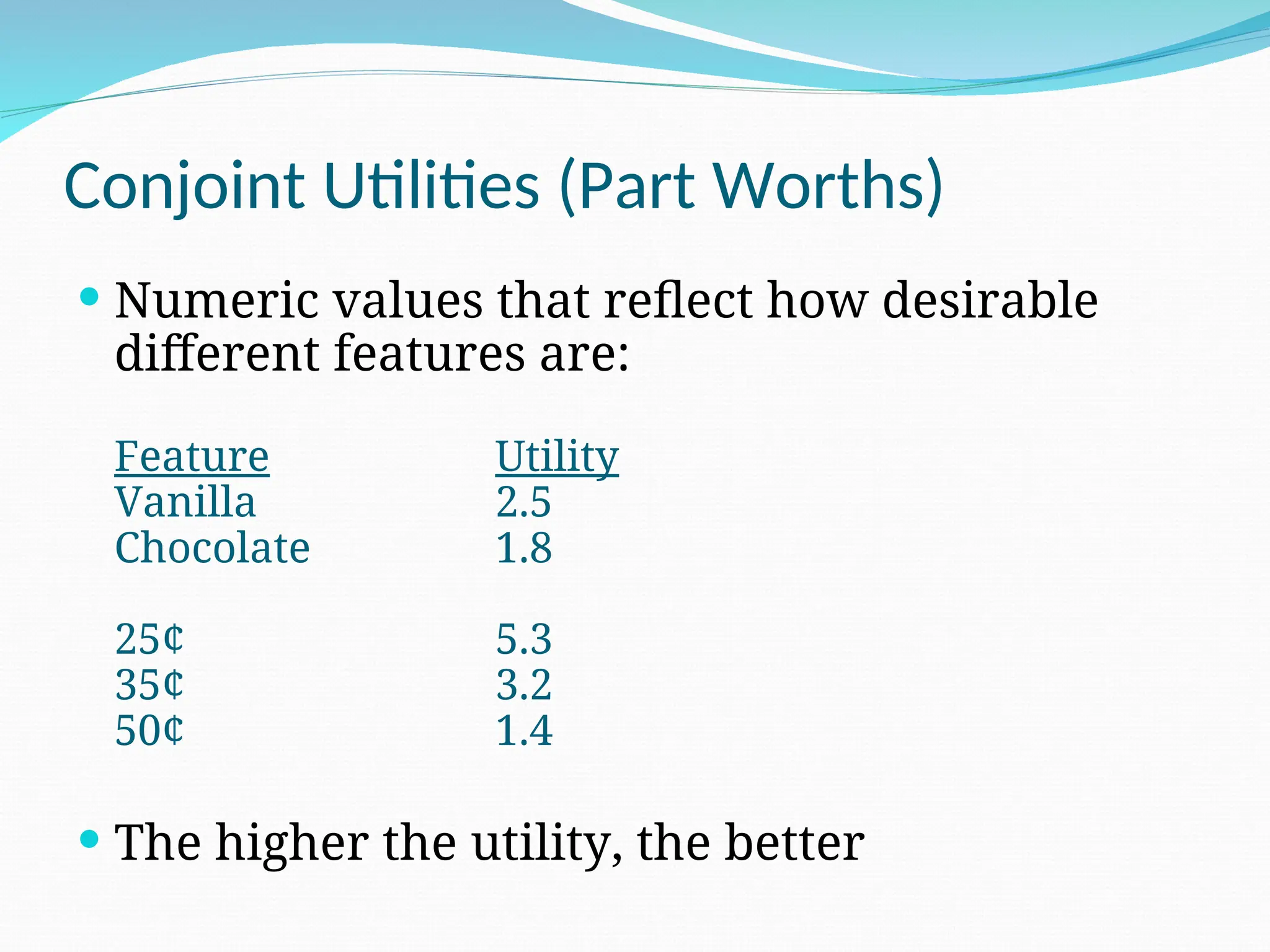
 Numeric values that reflect how desirable
different features are:
Feature Utility
Vanilla 2.5
Chocolate 1.8
25¢ 5.3
35¢ 3.2
50¢ 1.4
 The higher the utility, the better
Conjoint Importances
 Measure of how much influence each attribute has on
people’s choices
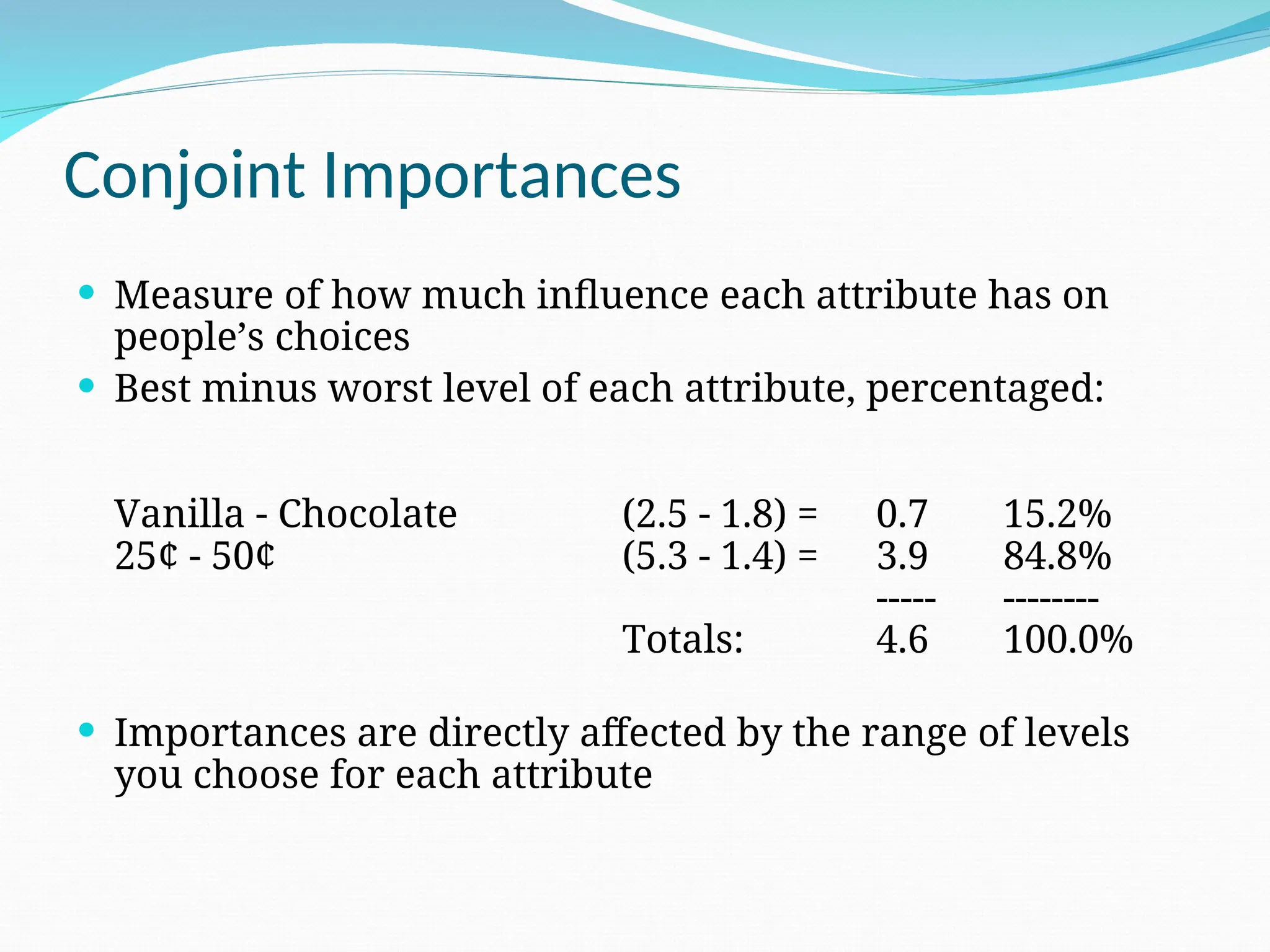
 Best minus worst level of each attribute, percentaged:
Vanilla - Chocolate (2.5 - 1.8) = 0.7 15.2%
25¢ - 50¢ (5.3 - 1.4) = 3.9 84.8%
----- --------
Totals: 4.6 100.0%
 Importances are directly affected by the range of levels
you choose for each attribute
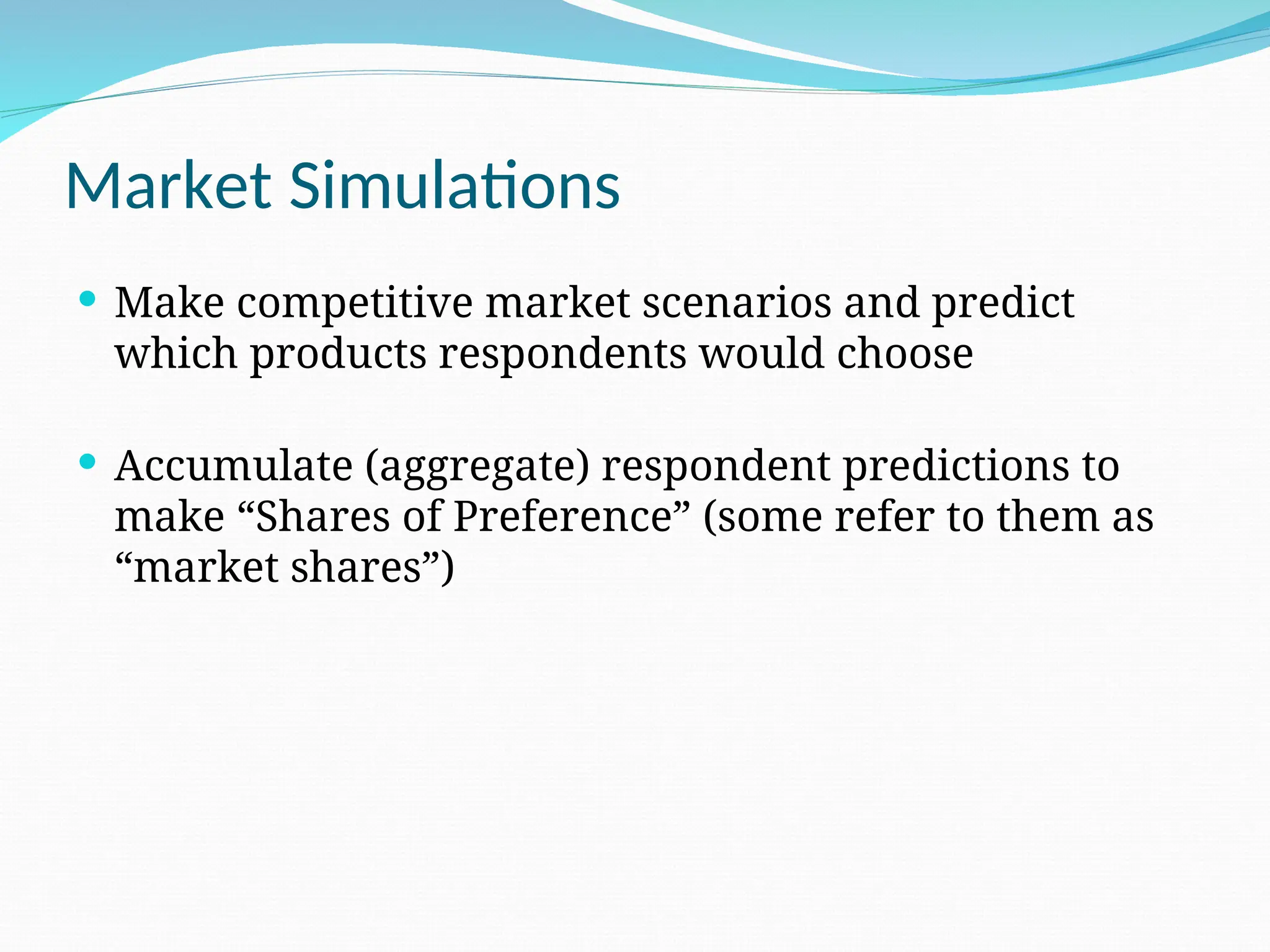
Market Simulations
 Make competitive market scenarios and predict
which products respondents would choose
 Accumulate (aggregate) respondent predictions to
make “Shares of Preference” (some refer to them as
“market shares”)
Market Simulation Example
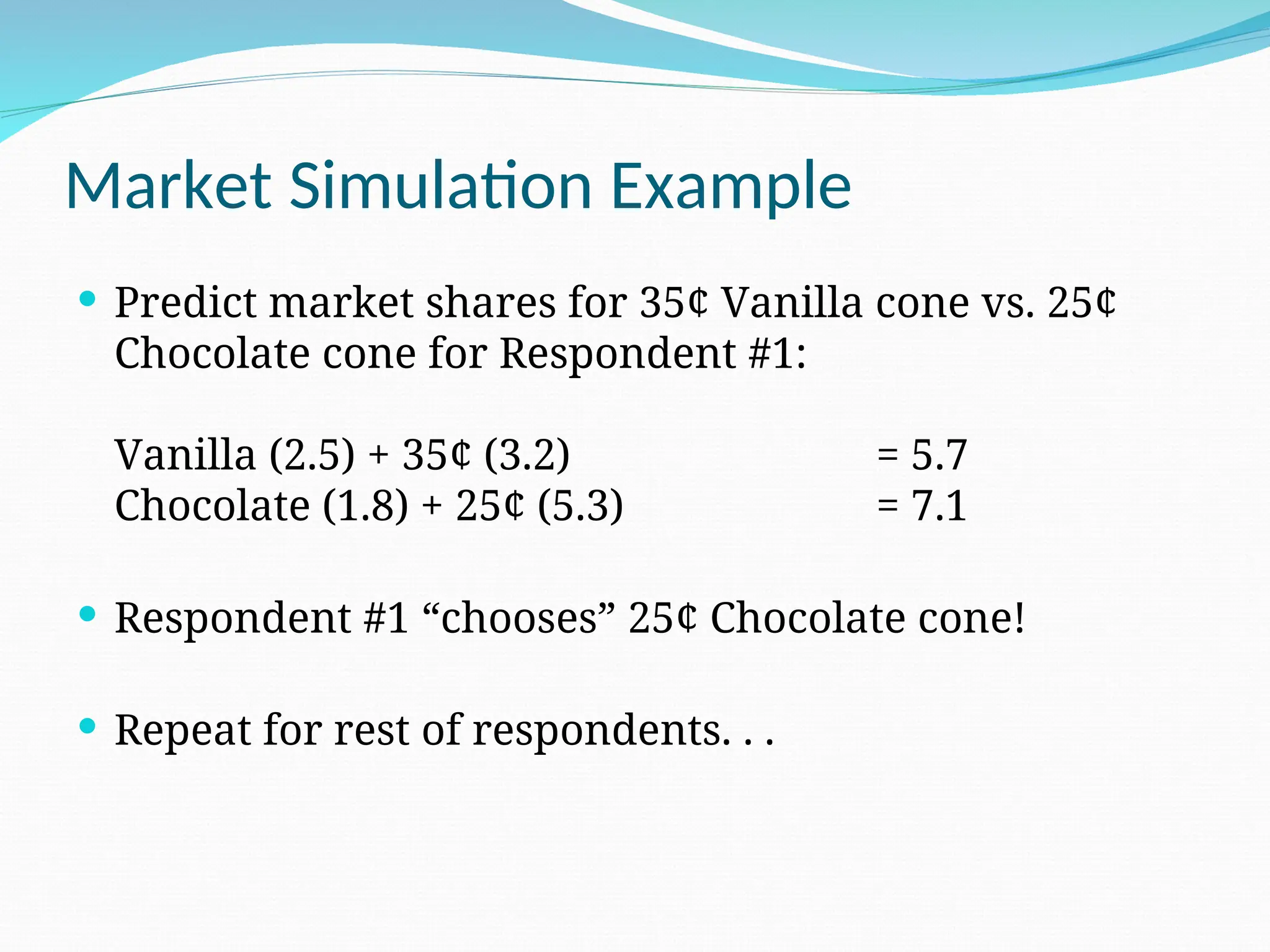
 Predict market shares for 35¢ Vanilla cone vs. 25¢
Chocolate cone for Respondent #1:
Vanilla (2.5) + 35¢ (3.2) = 5.7
Chocolate (1.8) + 25¢ (5.3) = 7.1
 Respondent #1 “chooses” 25¢ Chocolate cone!
 Repeat for rest of respondents. . .
Market Simulation Results
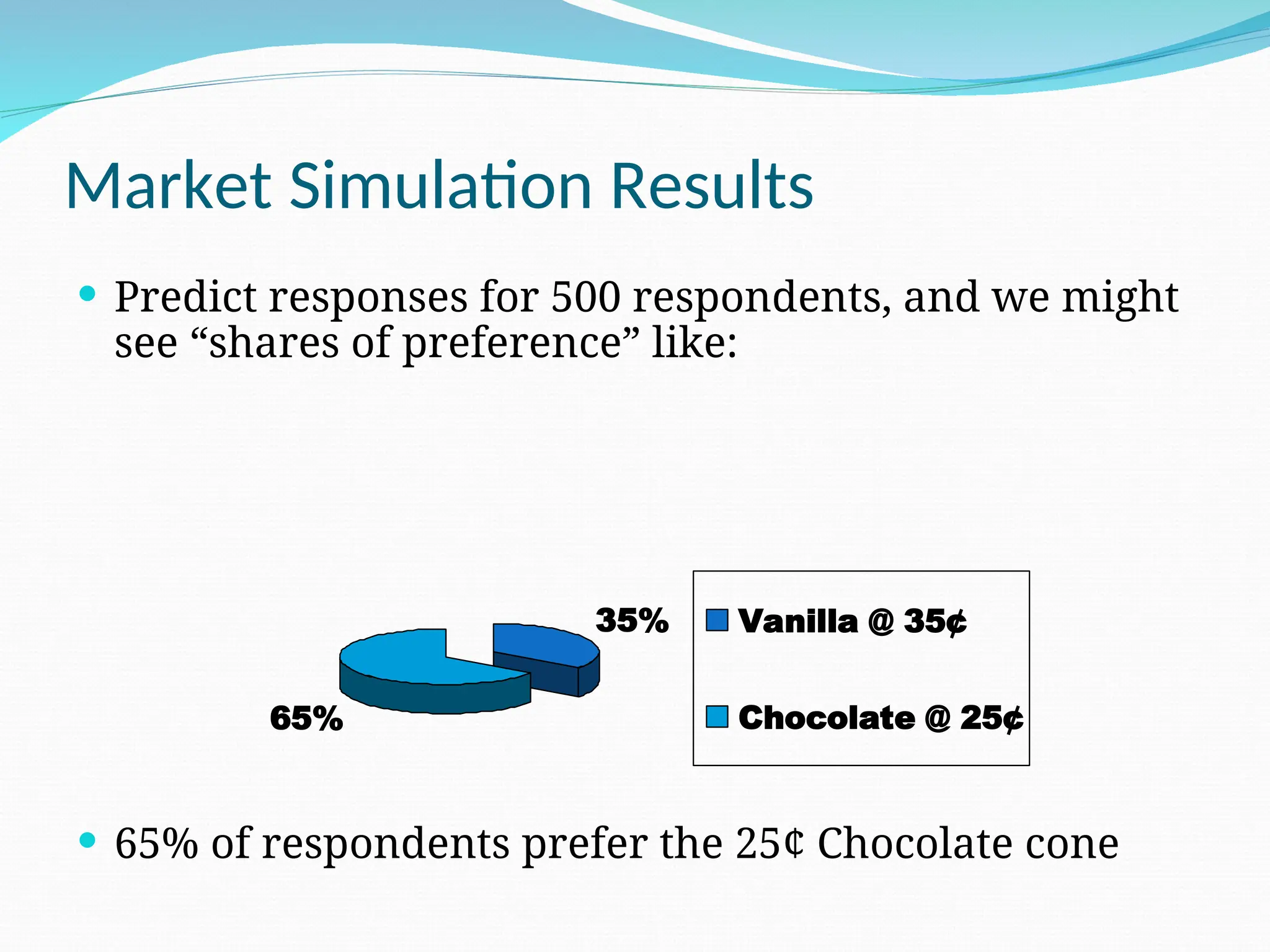
 Predict responses for 500 respondents, and we might
see “shares of preference” like:
 65% of respondents prefer the 25¢ Chocolate cone
35%
65%
Vanilla @ 35¢
Chocolate @ 25¢
Conjoint Market Simulation Assumptions
 All attributes that affect buyer choices in the real world
have been accounted for
 Equal availability (distribution)
 Respondents are aware of all products
 Long-range equilibrium (equal time on market)
 Equal effectiveness of sales force
 No out-of-stock conditions
Shares of Preference Don’t Always
Match Actual Market Shares
 Conjoint simulator assumptions usually don’t hold
true in the real world
 But this doesn’t mean that conjoint simulators are
not valuable!
 Simulators turn esoteric “utilities” into concrete
“shares”
 Conjoint simulators predict respondents’ interest in
products/services assuming a level playing field
Value of Conjoint Simulators…
Some Examples
 Lets you play “what-if” games to investigate value of
modifications to an existing product
 Lets you estimate how to design new product to
maximize buyer interest at low manufacturing cost
 Lets you investigate product line extensions: do we
cannibalize our own share or take mostly from
competitors?
 Lets you estimate demand curves, and cross-elasticity
curves
 Can provide an important input into demand
forecasting models
Three Main “Flavors” of Conjoint Analysis
 Traditional Full-Profile Conjoint
 Adaptive Conjoint Analysis (ACA)
 Choice-Based Conjoint (CBC), also known as
Discrete Choice Modeling (DCM)
Strengths of Traditional Conjoint
 Good for both product design and pricing
issues
 Can be administered on paper,
computer/internet
 Shows products in full-profile, which many
argue mimics real-world
 Can be used even with very small sample
sizes
Weaknesses of Traditional Full-Profile
Conjoint
 Limited ability to study many attributes
(more than about six)
 Limited ability to measure interactions and
other higher-order effects (cross-effects)
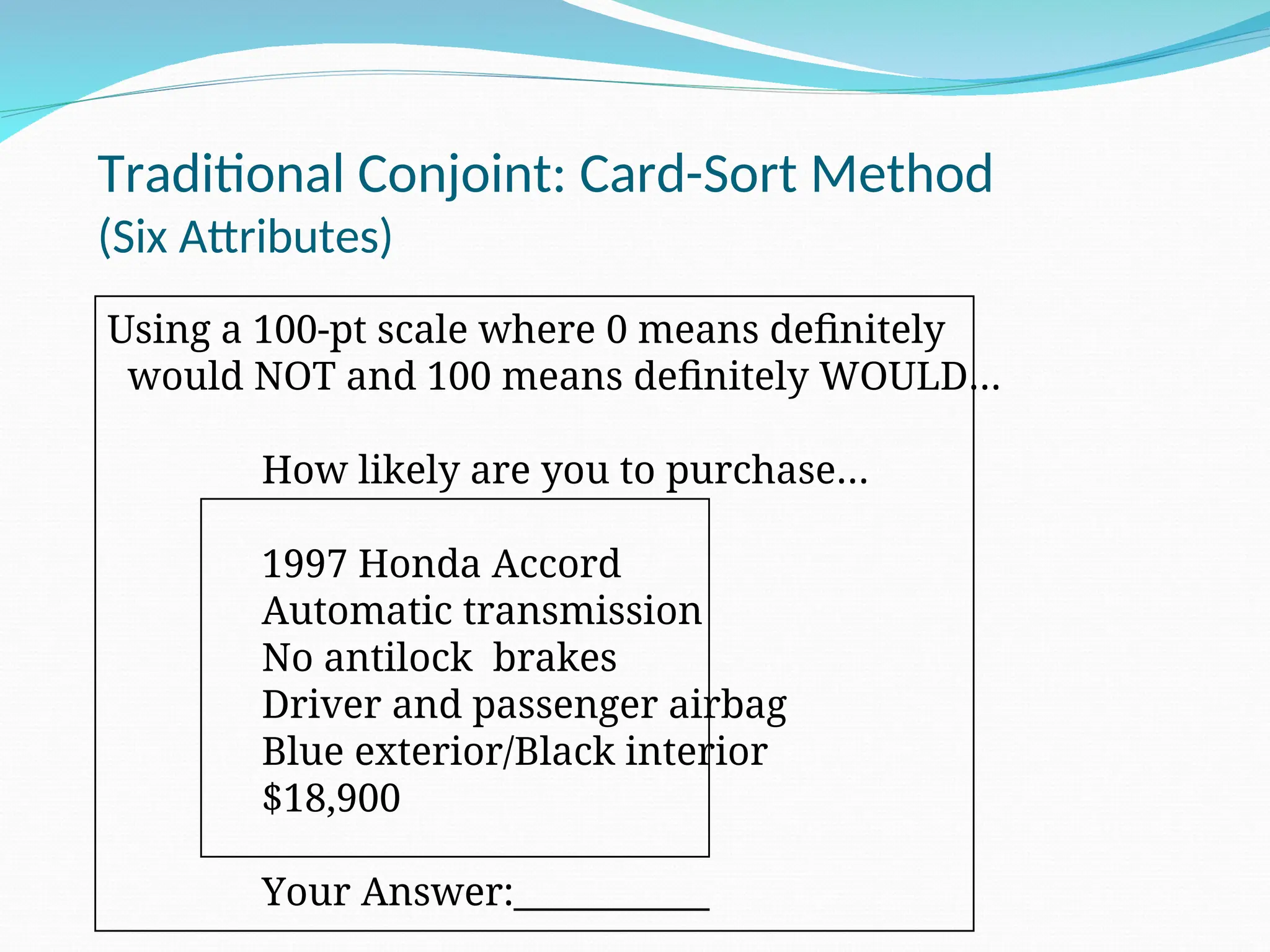
Traditional Conjoint: Card-Sort Method
(Six Attributes)
Using a 100-pt scale where 0 means definitely
would NOT and 100 means definitely WOULD…
How likely are you to purchase…
1997 Honda Accord
Automatic transmission
No antilock brakes
Driver and passenger airbag
Blue exterior/Black interior
$18,900
Your Answer:___________
Six Attributes: Challenging
 Respondents find six attributes in full-profile
challenging
 Need to read a lot of information to evaluate each
card
 Each respondent typically needs to evaluate
around 24-36 cards
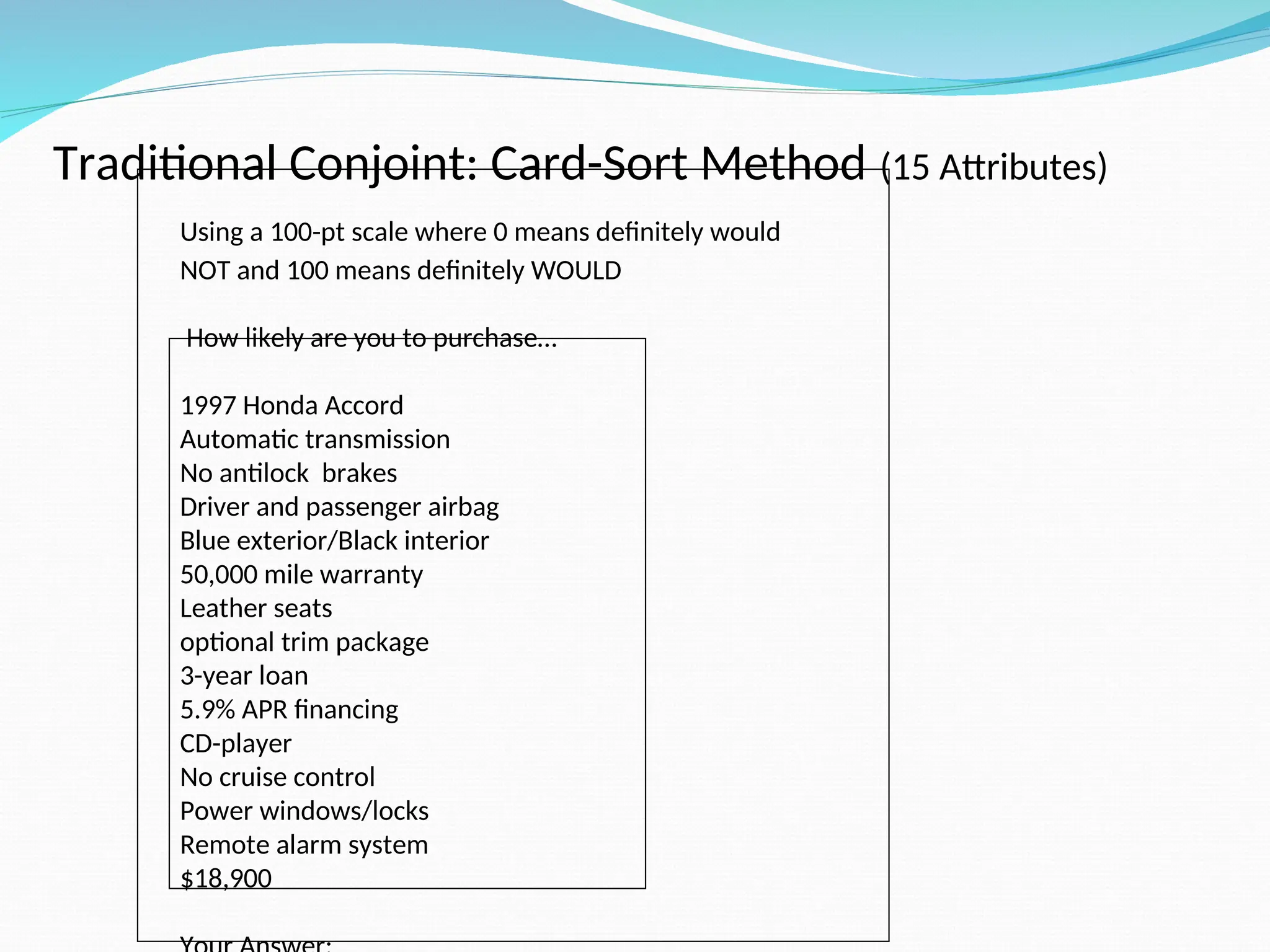
Traditional Conjoint: Card-Sort Method (15 Attributes)
Using a 100-pt scale where 0 means definitely would
NOT and 100 means definitely WOULD
How likely are you to purchase…
1997 Honda Accord
Automatic transmission
No antilock brakes
Driver and passenger airbag
Blue exterior/Black interior
50,000 mile warranty
Leather seats
optional trim package
3-year loan
5.9% APR financing
CD-player
No cruise control
Power windows/locks
Remote alarm system
$18,900
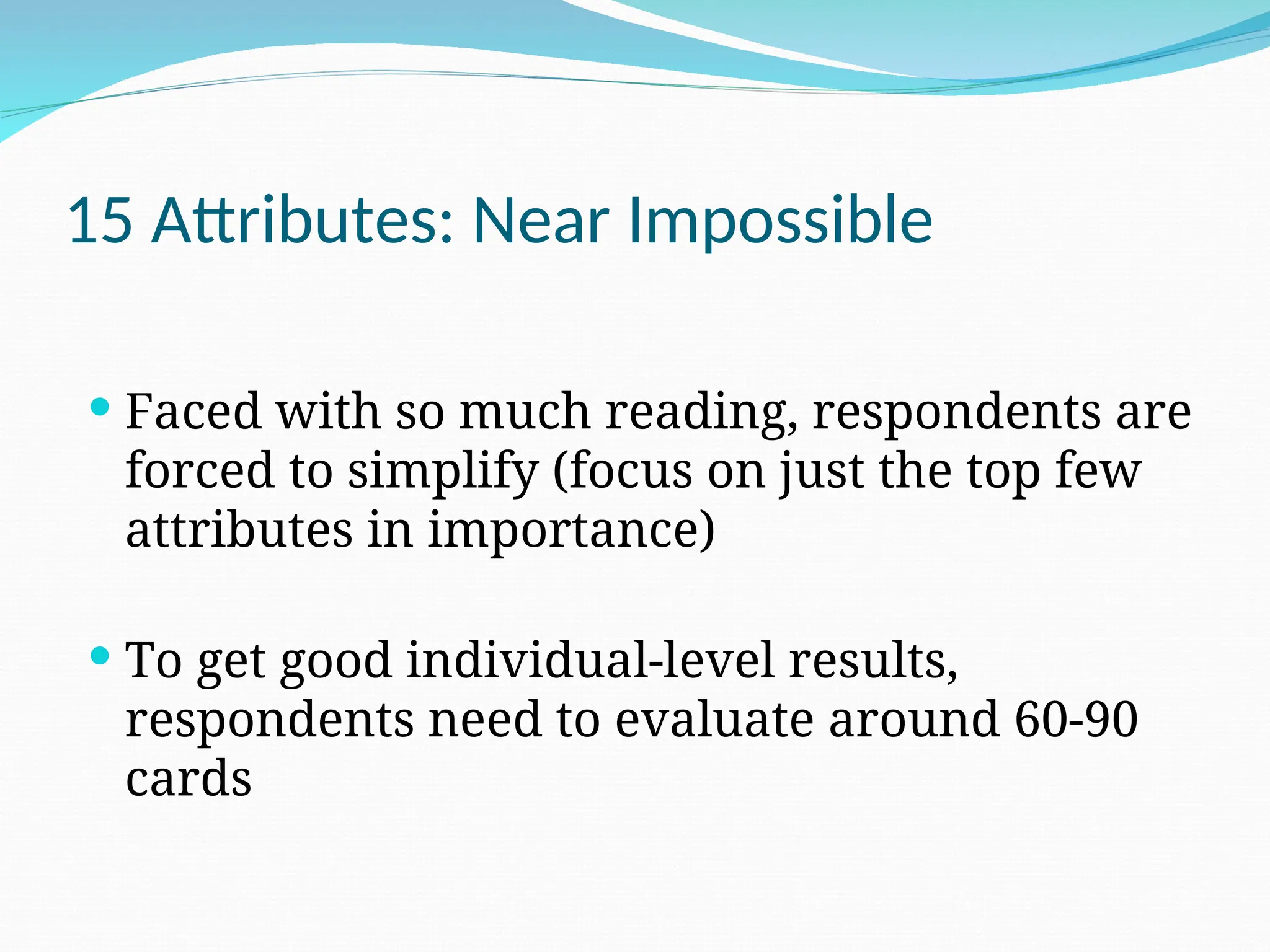
15 Attributes: Near Impossible
 Faced with so much reading, respondents are
forced to simplify (focus on just the top few
attributes in importance)
 To get good individual-level results,
respondents need to evaluate around 60-90
cards
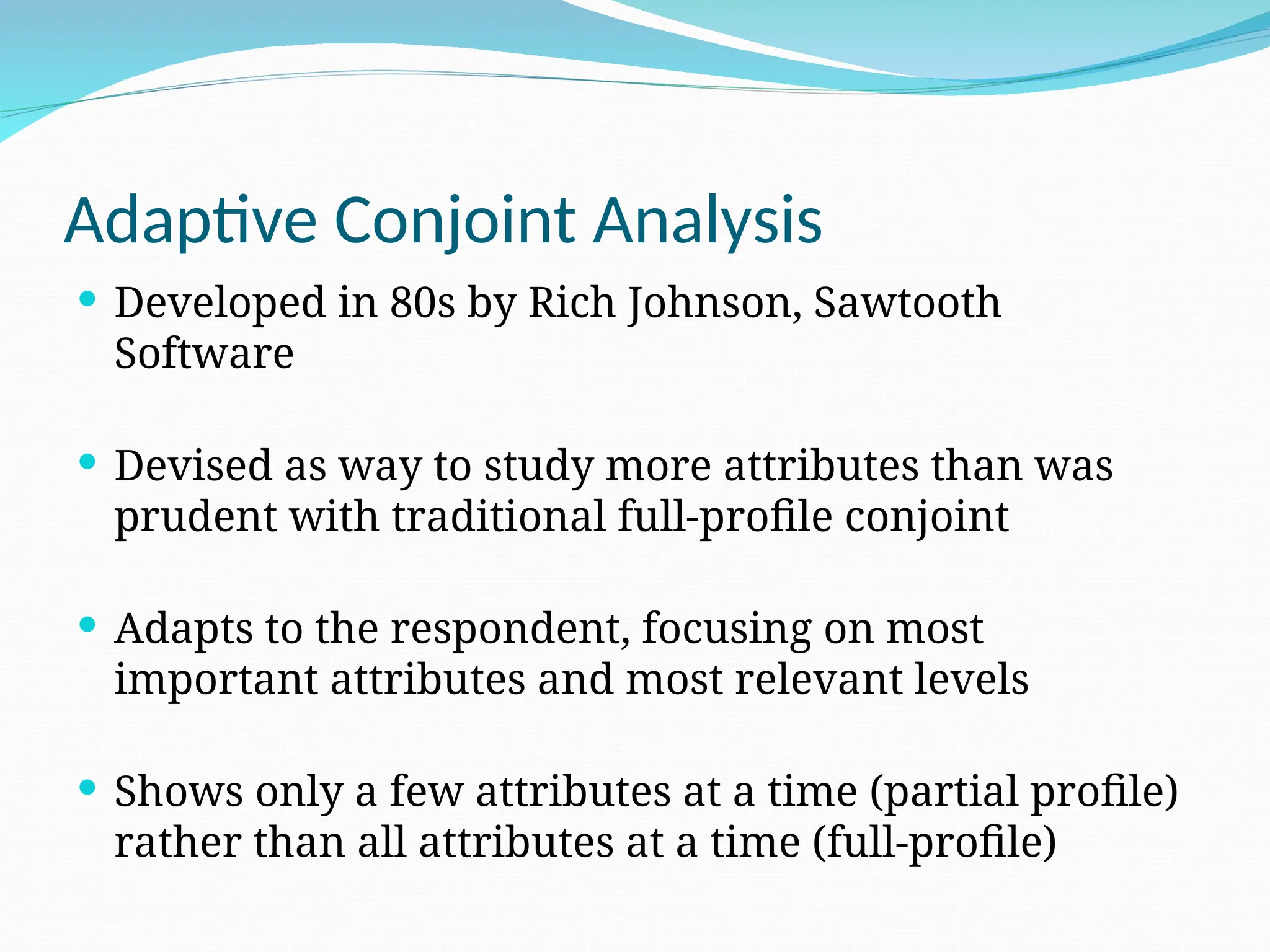
Adaptive Conjoint Analysis
 Developed in 80s by Rich Johnson, Sawtooth
Software
 Devised as way to study more attributes than was
prudent with traditional full-profile conjoint
 Adapts to the respondent, focusing on most
important attributes and most relevant levels
 Shows only a few attributes at a time (partial profile)
rather than all attributes at a time (full-profile)
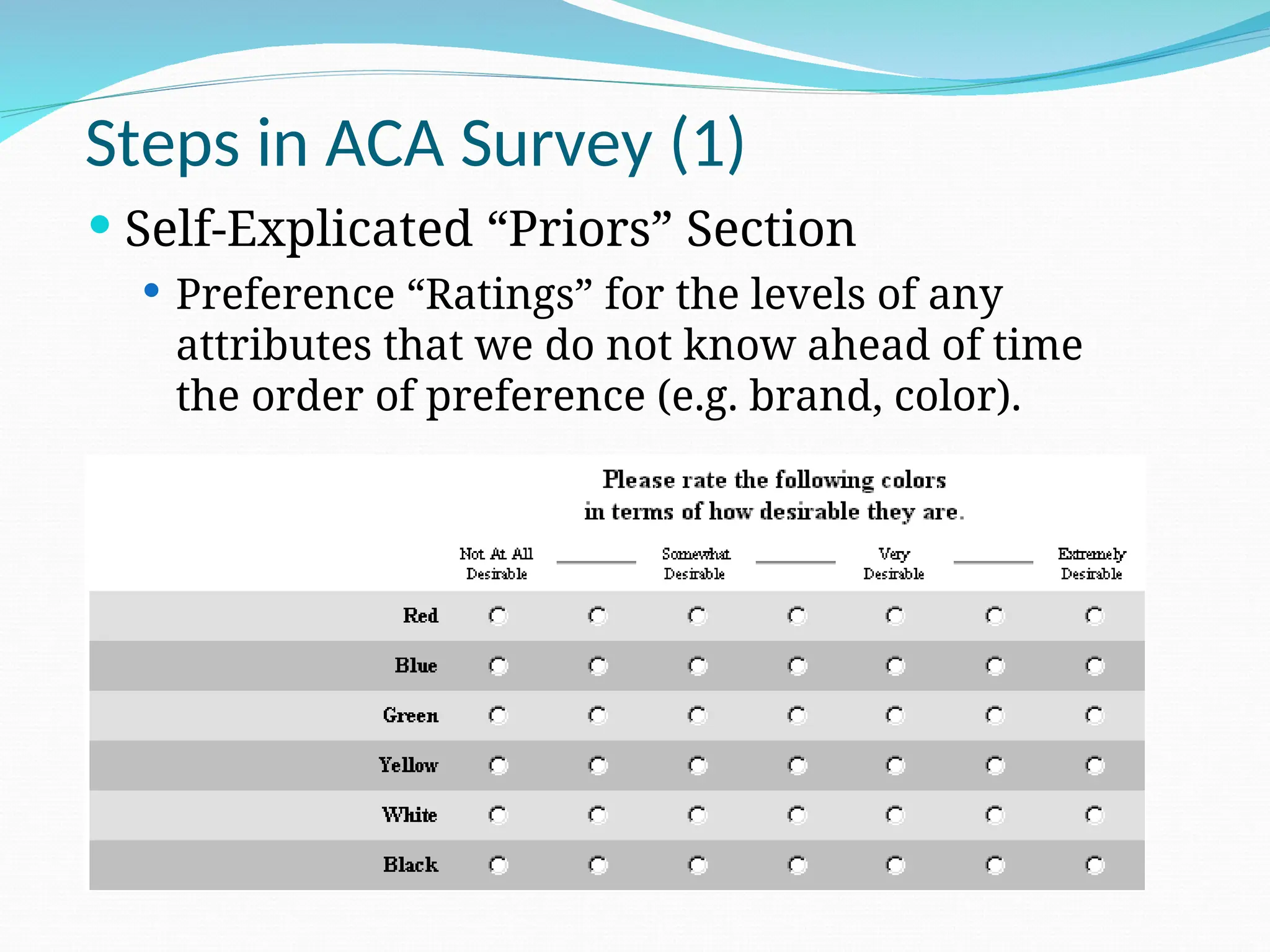
Steps in ACA Survey (1)
 Self-Explicated “Priors” Section
 Preference “Ratings” for the levels of any
attributes that we do not know ahead of time
the order of preference (e.g. brand, color).
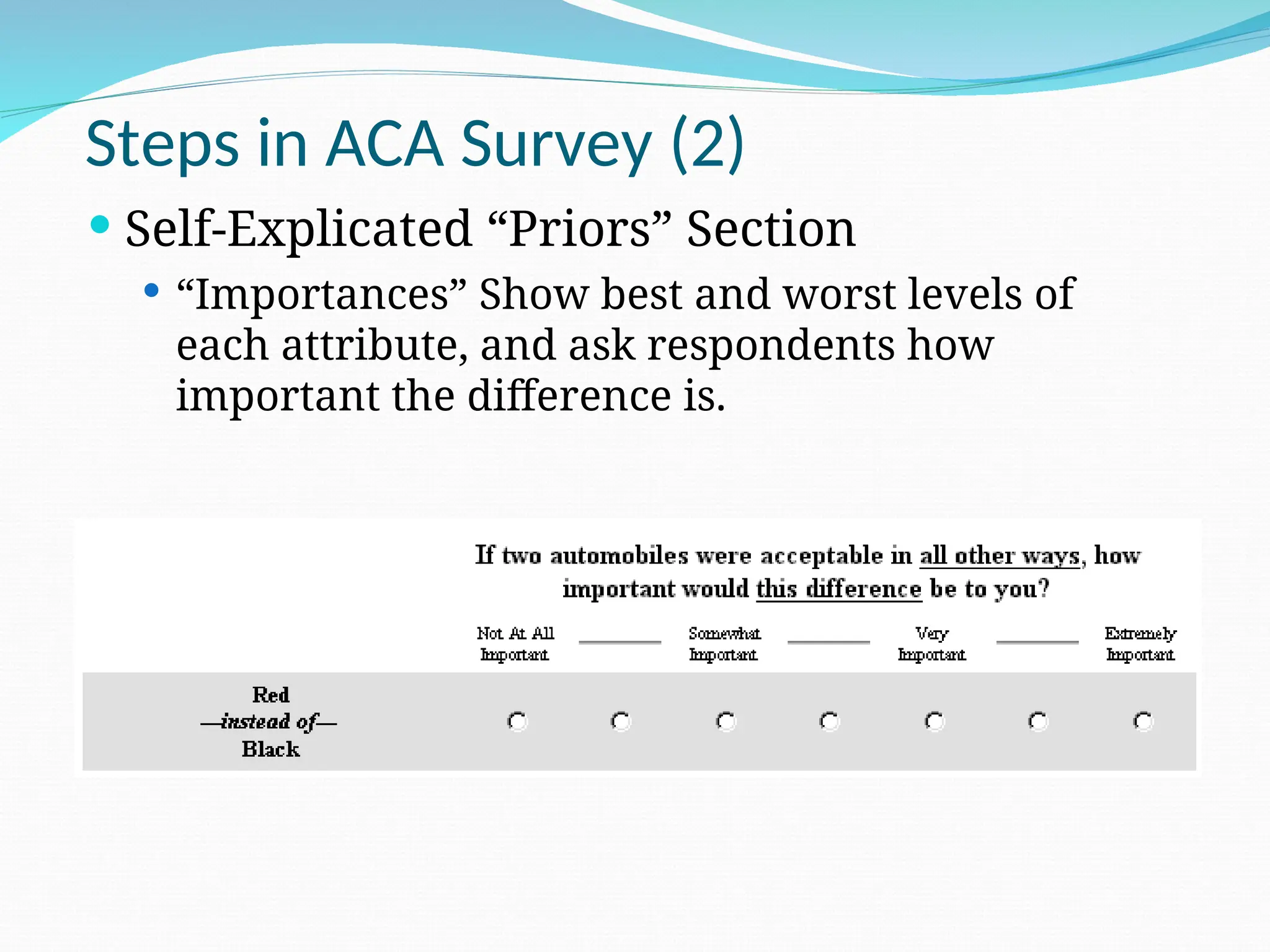
Steps in ACA Survey (2)
 Self-Explicated “Priors” Section
 “Importances” Show best and worst levels of
each attribute, and ask respondents how
important the difference is.
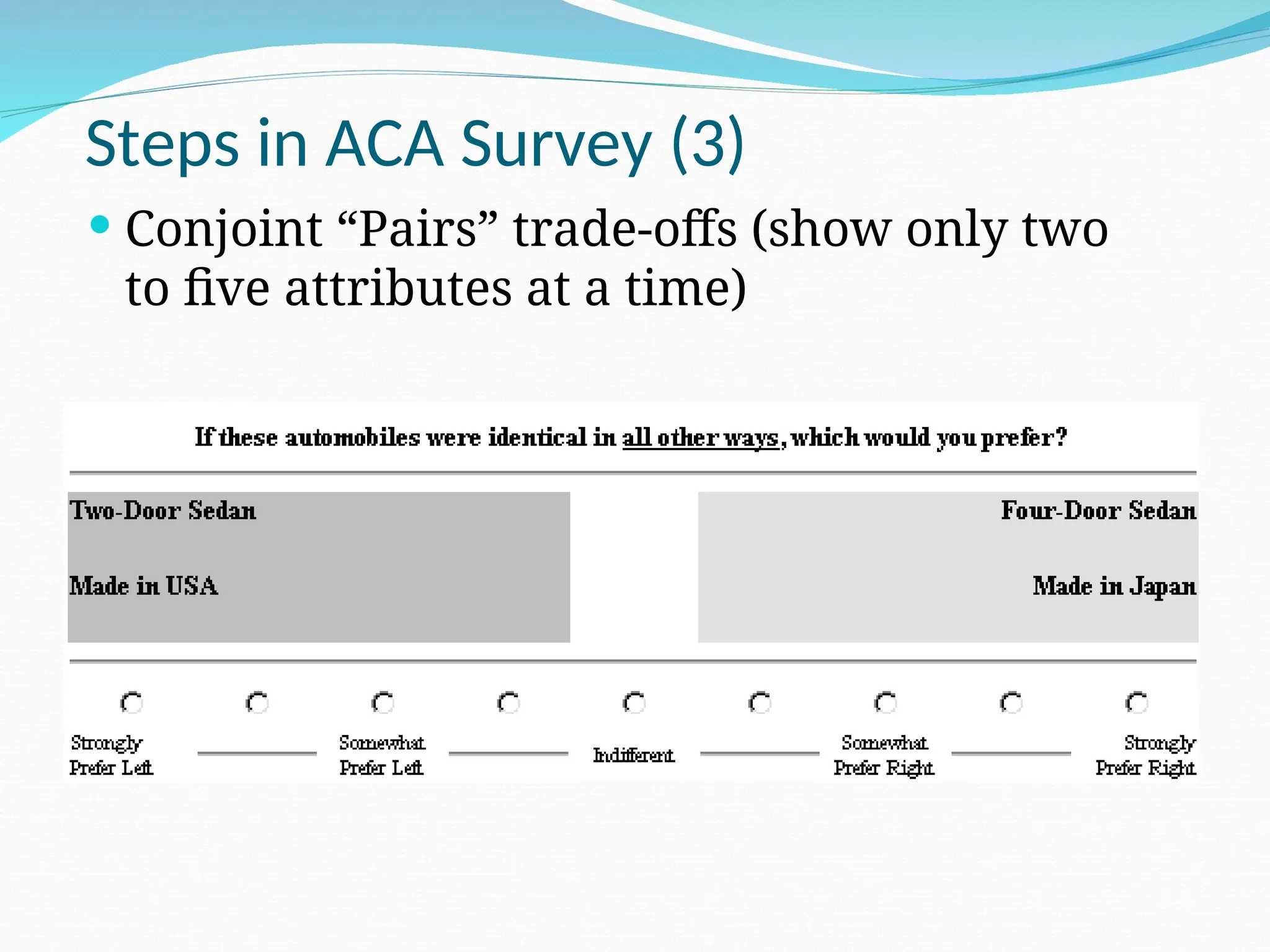
Steps in ACA Survey (3)
 Conjoint “Pairs” trade-offs (show only two
to five attributes at a time)
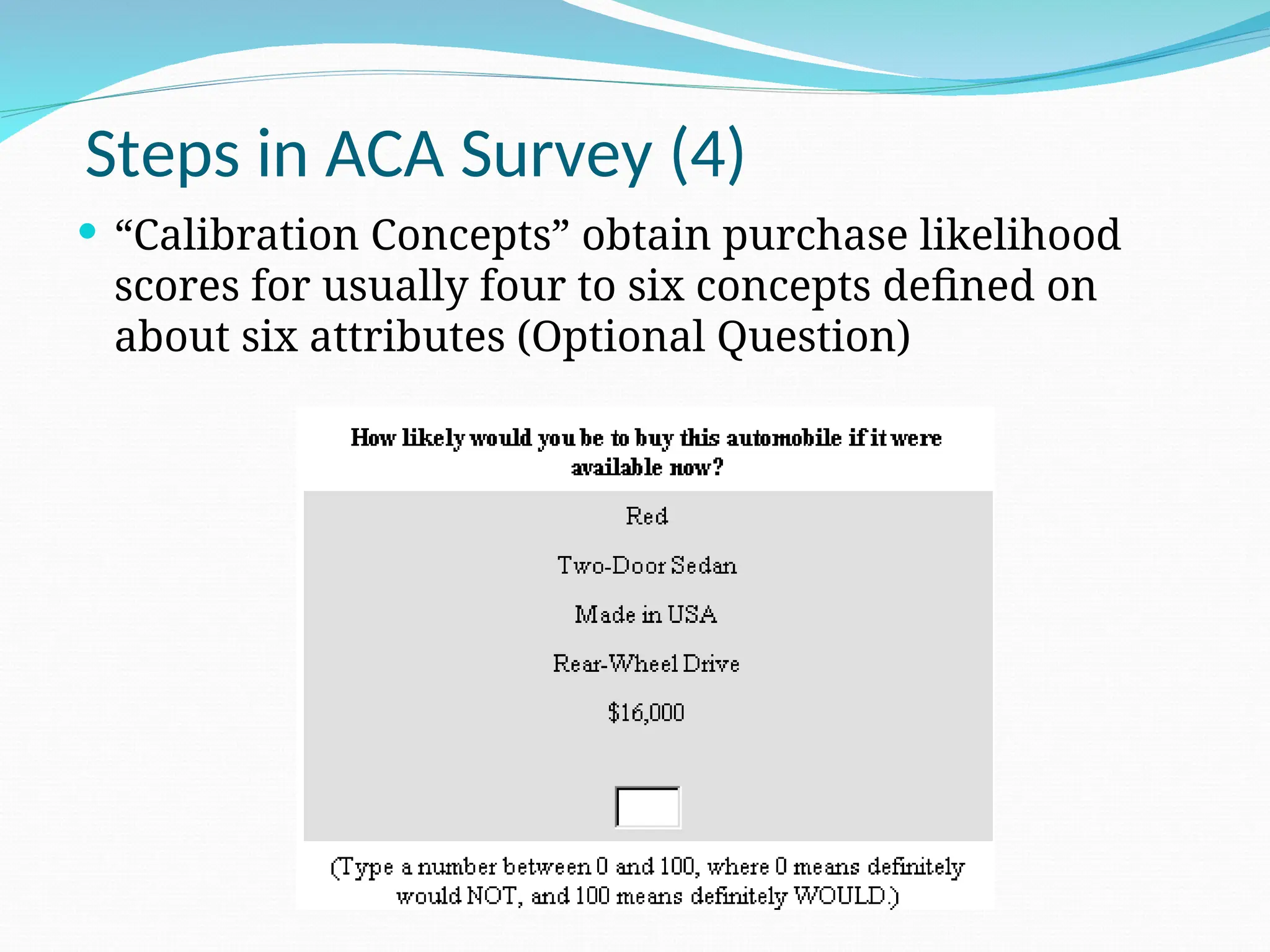
Steps in ACA Survey (4)
 “Calibration Concepts” obtain purchase likelihood
scores for usually four to six concepts defined on
about six attributes (Optional Question)
Adaptive Conjoint Analysis Example
 Sample ACA survey
Strengths of ACA
 Ability to measure many attributes, without
wearing out respondent
 Respondents find interview more interesting
and engaging
 Efficient interview: high ratio of information
gained per respondent effort
 Can be used even with very small sample sizes
ACA Best Practices
 Show only 2 or 3 attributes at a time in the pairs section. More than
that causes respondent fatigue, which outweighs the modest amount of
additional information.
 ACA can measure up to 30 attributes, but users should streamline
studies to have as few attributes as necessary for the business decision.
 Pretest the questionnaire to make sure it is not too long. If too long,
reduce number of attributes, levels, number of pairs questions, or
complexity of pairs questions.
 Examine pretest data to make sure results are logical and conform to
general expectations.
 Make sure respondents are engaged in the task: understanding the
attributes and levels and being in the market/having an interest in the
category.
Weaknesses of ACA
 Partial-profile presentation less realistic than
real world
 Respondents may not be able to assume attributes
not shown are “held constant”
 Often not good at pricing research
 Tends to understate importance of price, and
within each respondent assumes all brands have
equal price elasticities
 Must be computer-administered (PC or Web)
ACA Cons
 Must be a computerized survey.
 Potential double-counting of attributes that are not truly independent.
 Respondents may have difficulty keeping in mind that all other
attributes not involved in the current question are assumed to be equal.
 May “flatten” importances (particularly for low-involvement categories)
due to spreading respondents’ attention across individual attributes--but
the jury is still out.
 Can underestimate the importance of price (especially if many
attributes included). CBC and CVA considered better for pricing
research.
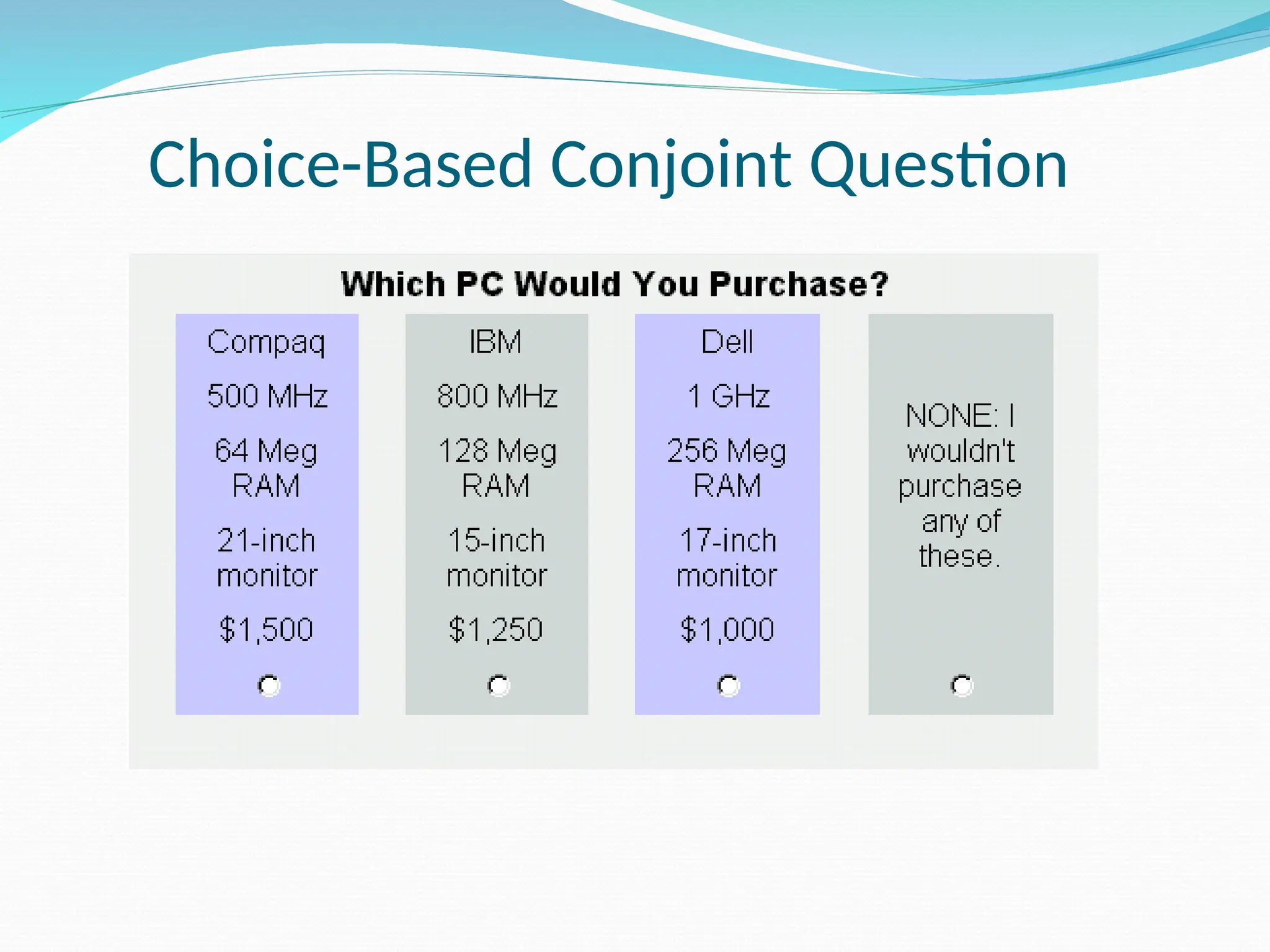
Choice-Based Conjoint (CBC)
 Became popular starting in early 90s
 Respondents are shown sets of cards and
asked to choose which one they would buy
 Can include “None of the above” response, or
multiple “held-constant alternatives”
Choice-Based Conjoint Question
Strengths of CBC
 Questions closely mimic what buyers do in real
world: choose from available products
 Can investigate interactions, alternative-specific
effects
 Can include “None” alternative, or multiple “constant
alternatives”
 Paper or Computer/Web based interviews possible
Weaknesses of CBC
• Usually requires larger sample sizes than with CVA
or ACA
• Tasks are more complex, so respondents can process
fewer attributes (CBC recommended <=6)
• Complex tasks may encourage response
simplification strategies
• Analysis more complex than with CVA or ACA

Innovation-Intro-to-Conjoint (Some methods for analysis)

  • 1.
    Introduction to Conjoint Analysis Adaptedfrom Sawtooth Software, Inc. materials
  • 2.
    Different Perspectives, DifferentGoals  Buyers want all of the most desirable features at lowest possible price  Sellers want to maximize profits by: 1) minimizing costs of providing features 2) providing products that offer greater overall value than the competition
  • 3.
    Demand Side ofEquation  Typical market research role is to focus first on demand side of the equation  After figuring out what buyers want, next assess whether it can be built/provided in a cost- effective manner
  • 4.
    Products/Services are Composedof Features/Attributes  Credit Card: Brand + Interest Rate + Annual Fee + Credit Limit  On-Line Brokerage: Brand + Fee + Speed of Transaction + Reliability of Transaction + Research/Charting Options
  • 5.
    Breaking the ProblemDown  If we learn how buyers value the components of a product, we are in a better position to design those that improve profitability
  • 6.
    How to LearnWhat Customers Want?  Ask Direct Questions about preference:  What brand do you prefer?  What Interest Rate would you like?  What Annual Fee would you like?  What Credit Limit would you like?  Answers often trivial and unenlightening (e.g. respondents prefer low fees to high fees, higher credit limits to low credit limits)
  • 7.
    How to LearnWhat Is Important?  Ask Direct Questions about importances  How important is it that you get the <<brand, interest rate, annual fee, credit limit>> that you want?
  • 8.
    Stated Importances  ImportanceRatings often have low discrimination: Average Importance Ratings 7.5 8.1 7.2 6.7 0 5 10 Credit Limit Annual Fee Interest Rate Brand
  • 9.
    Stated Importances  Answersoften have low discrimination, with most answers falling in “very important” categories  Answers sometimes useful for segmenting market, but still not as actionable as could be
  • 10.
    What is ConjointAnalysis?  Research technique developed in early 70s  Measures how buyers value components of a product/service bundle  Dictionary definition-- “Conjoint: Joined together, combined.”  Marketer’s catch-phrase-- “Features CONsidered JOINTly”
  • 11.
    Important Early Articles Luce, Duncan and John Tukey (1964), “Simultaneous Conjoint Measurement: A New Type of Fundamental Measurement,” Journal of Mathematical Psychology, 1, 1-27  Green, Paul and Vithala Rao (1971), “Conjoint Measurement for Quantifying Judgmental Data,” Journal of Marketing Research, 8 (Aug), 355-363  Johnson, Richard (1974), “Trade-off Analysis of Consumer Values,” Journal of Marketing Research, 11 (May), 121-127  Green, Paul and V. Srinivasan (1978), “Conjoint Analysis in Marketing: New Development with Implications for Research and Practice,” Journal of Marketing, 54 (Oct), 3-19  Louviere, Jordan and George Woodworth (1983), “Design and Analysis of Simulated Consumer Choice or Allocation Experiments,” Journal of Marketing Research, 20 (Nov), 350-367
  • 12.
    How Does ConjointAnalysis Work?  We vary the product features (independent variables) to build many (usually 12 or more) product concepts  We ask respondents to rate/rank those product concepts (dependent variable)  Based on the respondents’ evaluations of the product concepts, we figure out how much unique value (utility) each of the features added  (Regress dependent variable on independent variables; betas equal part worth utilities.)
  • 13.
    What’s So Goodabout Conjoint?  More realistic questions: Would you prefer . . . 210 Horsepower or 140 Horsepower 17 MPG 28 MPG  If choose left, you prefer Power. If choose right, you prefer Fuel Economy  Rather than ask directly whether you prefer Power over Fuel Economy, we present realistic tradeoff scenarios and infer preferences from your product choices
  • 14.
    What’s So Goodabout Conjoint?  When respondents are forced to make difficult tradeoffs, we learn what they truly value
  • 15.
    First Step: CreateAttribute List  Attributes assumed to be independent (Brand, Speed, Color, Price, etc.)  Each attribute has varying degrees, or “levels”  Brand: Coke, Pepsi, Sprite  Speed: 5 pages per minute, 10 pages per minute  Color: Red, Blue, Green, Black  Each level is assumed to be mutually exclusive of the others (a product has one and only one level level of that attribute)
  • 16.
    Rules for FormulatingAttribute Levels  Levels are assumed to be mutually exclusive Attribute: Add-on features level 1: Sunroof level 2: GPS System level 3: Video Screen  If define levels in this way, you cannot determine the value of providing two or three of these features at the same time
  • 17.
     Levels shouldhave concrete/unambiguous meaning “Very expensive” vs. “Costs $575” “Weight: 5 to 7 kilos” vs. “Weight 6 kilos”  One description leaves meaning up to individual interpretation, while the other does not Rules for Formulating Attribute Levels
  • 18.
     Don’t includetoo many levels for any one attribute  The usual number is about 3 to 5 levels per attribute  The temptation (for example) is to include many, many levels of price, so we can estimate people’s preferences for each  But, you spread your precious observations across more parameters to be estimated, resulting in noisier (less precise) measurement of ALL price levels  Better approach usually is to interpolate between fewer more precisely measured levels for “not asked about” prices Rules for Formulating Attribute Levels
  • 19.
     Whenever possible,try to balance the number of levels across attributes  There is a well-known bias in conjoint analysis called the “Number of Levels Effect”  Holding all else constant, attributes defined on more levels than others will be biased upwards in importance  For example, price defined as ($10, $12, $14, $16, $18, $20) will receive higher relative importance than when defined as ($10, $15, $20) even though the same range was measured  The Number of Levels effect holds for quantitative (e.g. price, speed) and categorical (e.g. brand, color) attributes Rules for Formulating Attribute Levels
  • 20.
     Make surelevels from your attributes can combine freely with one another without resulting in utterly impossible combinations (very unlikely combinations OK)  Resist temptation to make attribute prohibitions (prohibiting levels from one attribute from occurring with levels from other attributes)!  Respondents can imagine many possibilities (and evaluate them consistently) that the study commissioner doesn’t plan to/can’t offer. By avoiding prohibitions, we usually improve the estimates of the combinations that we will actually focus on.  But, for advanced analysts, some prohibitions are OK, and even helpful Rules for Formulating Attribute Levels
  • 21.
    Conjoint Analysis Output Utilities (part worths)  Importances  Market simulations
  • 22.
    Conjoint Utilities (PartWorths)  Numeric values that reflect how desirable different features are: Feature Utility Vanilla 2.5 Chocolate 1.8 25¢ 5.3 35¢ 3.2 50¢ 1.4  The higher the utility, the better
  • 23.
    Conjoint Importances  Measureof how much influence each attribute has on people’s choices  Best minus worst level of each attribute, percentaged: Vanilla - Chocolate (2.5 - 1.8) = 0.7 15.2% 25¢ - 50¢ (5.3 - 1.4) = 3.9 84.8% ----- -------- Totals: 4.6 100.0%  Importances are directly affected by the range of levels you choose for each attribute
  • 24.
    Market Simulations  Makecompetitive market scenarios and predict which products respondents would choose  Accumulate (aggregate) respondent predictions to make “Shares of Preference” (some refer to them as “market shares”)
  • 25.
    Market Simulation Example Predict market shares for 35¢ Vanilla cone vs. 25¢ Chocolate cone for Respondent #1: Vanilla (2.5) + 35¢ (3.2) = 5.7 Chocolate (1.8) + 25¢ (5.3) = 7.1  Respondent #1 “chooses” 25¢ Chocolate cone!  Repeat for rest of respondents. . .
  • 26.
    Market Simulation Results Predict responses for 500 respondents, and we might see “shares of preference” like:  65% of respondents prefer the 25¢ Chocolate cone 35% 65% Vanilla @ 35¢ Chocolate @ 25¢
  • 27.
    Conjoint Market SimulationAssumptions  All attributes that affect buyer choices in the real world have been accounted for  Equal availability (distribution)  Respondents are aware of all products  Long-range equilibrium (equal time on market)  Equal effectiveness of sales force  No out-of-stock conditions
  • 28.
    Shares of PreferenceDon’t Always Match Actual Market Shares  Conjoint simulator assumptions usually don’t hold true in the real world  But this doesn’t mean that conjoint simulators are not valuable!  Simulators turn esoteric “utilities” into concrete “shares”  Conjoint simulators predict respondents’ interest in products/services assuming a level playing field
  • 29.
    Value of ConjointSimulators… Some Examples  Lets you play “what-if” games to investigate value of modifications to an existing product  Lets you estimate how to design new product to maximize buyer interest at low manufacturing cost  Lets you investigate product line extensions: do we cannibalize our own share or take mostly from competitors?  Lets you estimate demand curves, and cross-elasticity curves  Can provide an important input into demand forecasting models
  • 30.
    Three Main “Flavors”of Conjoint Analysis  Traditional Full-Profile Conjoint  Adaptive Conjoint Analysis (ACA)  Choice-Based Conjoint (CBC), also known as Discrete Choice Modeling (DCM)
  • 31.
    Strengths of TraditionalConjoint  Good for both product design and pricing issues  Can be administered on paper, computer/internet  Shows products in full-profile, which many argue mimics real-world  Can be used even with very small sample sizes
  • 32.
    Weaknesses of TraditionalFull-Profile Conjoint  Limited ability to study many attributes (more than about six)  Limited ability to measure interactions and other higher-order effects (cross-effects)
  • 33.
    Traditional Conjoint: Card-SortMethod (Six Attributes) Using a 100-pt scale where 0 means definitely would NOT and 100 means definitely WOULD… How likely are you to purchase… 1997 Honda Accord Automatic transmission No antilock brakes Driver and passenger airbag Blue exterior/Black interior $18,900 Your Answer:___________
  • 34.
    Six Attributes: Challenging Respondents find six attributes in full-profile challenging  Need to read a lot of information to evaluate each card  Each respondent typically needs to evaluate around 24-36 cards
  • 35.
    Traditional Conjoint: Card-SortMethod (15 Attributes) Using a 100-pt scale where 0 means definitely would NOT and 100 means definitely WOULD How likely are you to purchase… 1997 Honda Accord Automatic transmission No antilock brakes Driver and passenger airbag Blue exterior/Black interior 50,000 mile warranty Leather seats optional trim package 3-year loan 5.9% APR financing CD-player No cruise control Power windows/locks Remote alarm system $18,900
  • 36.
    15 Attributes: NearImpossible  Faced with so much reading, respondents are forced to simplify (focus on just the top few attributes in importance)  To get good individual-level results, respondents need to evaluate around 60-90 cards
  • 37.
    Adaptive Conjoint Analysis Developed in 80s by Rich Johnson, Sawtooth Software  Devised as way to study more attributes than was prudent with traditional full-profile conjoint  Adapts to the respondent, focusing on most important attributes and most relevant levels  Shows only a few attributes at a time (partial profile) rather than all attributes at a time (full-profile)
  • 38.
    Steps in ACASurvey (1)  Self-Explicated “Priors” Section  Preference “Ratings” for the levels of any attributes that we do not know ahead of time the order of preference (e.g. brand, color).
  • 39.
    Steps in ACASurvey (2)  Self-Explicated “Priors” Section  “Importances” Show best and worst levels of each attribute, and ask respondents how important the difference is.
  • 40.
    Steps in ACASurvey (3)  Conjoint “Pairs” trade-offs (show only two to five attributes at a time)
  • 41.
    Steps in ACASurvey (4)  “Calibration Concepts” obtain purchase likelihood scores for usually four to six concepts defined on about six attributes (Optional Question)
  • 42.
    Adaptive Conjoint AnalysisExample  Sample ACA survey
  • 43.
    Strengths of ACA Ability to measure many attributes, without wearing out respondent  Respondents find interview more interesting and engaging  Efficient interview: high ratio of information gained per respondent effort  Can be used even with very small sample sizes
  • 44.
    ACA Best Practices Show only 2 or 3 attributes at a time in the pairs section. More than that causes respondent fatigue, which outweighs the modest amount of additional information.  ACA can measure up to 30 attributes, but users should streamline studies to have as few attributes as necessary for the business decision.  Pretest the questionnaire to make sure it is not too long. If too long, reduce number of attributes, levels, number of pairs questions, or complexity of pairs questions.  Examine pretest data to make sure results are logical and conform to general expectations.  Make sure respondents are engaged in the task: understanding the attributes and levels and being in the market/having an interest in the category.
  • 45.
    Weaknesses of ACA Partial-profile presentation less realistic than real world  Respondents may not be able to assume attributes not shown are “held constant”  Often not good at pricing research  Tends to understate importance of price, and within each respondent assumes all brands have equal price elasticities  Must be computer-administered (PC or Web)
  • 46.
    ACA Cons  Mustbe a computerized survey.  Potential double-counting of attributes that are not truly independent.  Respondents may have difficulty keeping in mind that all other attributes not involved in the current question are assumed to be equal.  May “flatten” importances (particularly for low-involvement categories) due to spreading respondents’ attention across individual attributes--but the jury is still out.  Can underestimate the importance of price (especially if many attributes included). CBC and CVA considered better for pricing research.
  • 47.
    Choice-Based Conjoint (CBC) Became popular starting in early 90s  Respondents are shown sets of cards and asked to choose which one they would buy  Can include “None of the above” response, or multiple “held-constant alternatives”
  • 48.
  • 49.
    Strengths of CBC Questions closely mimic what buyers do in real world: choose from available products  Can investigate interactions, alternative-specific effects  Can include “None” alternative, or multiple “constant alternatives”  Paper or Computer/Web based interviews possible
  • 50.
    Weaknesses of CBC •Usually requires larger sample sizes than with CVA or ACA • Tasks are more complex, so respondents can process fewer attributes (CBC recommended <=6) • Complex tasks may encourage response simplification strategies • Analysis more complex than with CVA or ACA