
© Absolutdata 2014 Proprietary and Confidential
Chicago New York London Dubai New Delhi Bangalore SingaporeSan Francisco
www.absolutdata.com
July 14, 2014
Incorporating Behavioral Economics in Decision
Making Through Conjoint Analysis
© Absolutdata 2014 Proprietary and Confidential 2
Agenda
2 Economics and Market Research
3 Introduction to Status Quo Bias (SQB)
4 Implication of SQB in Market Research
5
Incorporating SQB in Market Research
through Conjoint Analysis
6 Results, Findings and Impact
 Neoclassical Economics
 Behavioral Economics
1 Background
© Absolutdata 2014 Proprietary and Confidential 3
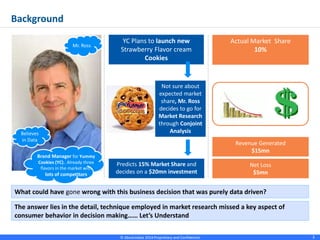
What could have gone wrong with this business decision that was purely data driven?
The answer lies in the detail, technique employed in market research missed a key aspect of
consumer behavior in decision making…… Let’s Understand
Believes
in Data
Brand Manager for Yummy
Cookies (YC).. Already three
flavors in the market with
lots of competitors
Background
Mr. Ross
YC Plans to launch new
Strawberry Flavor cream
Cookies
Not sure about
expected market
share, Mr. Ross
decides to go for
Market Research
through Conjoint
Analysis
Predicts 15% Market Share and
decides on a $20mn investment
Actual Market Share
10%
Revenue Generated
$15mn
Net Loss
$5mn
© Absolutdata 2014 Proprietary and Confidential 4
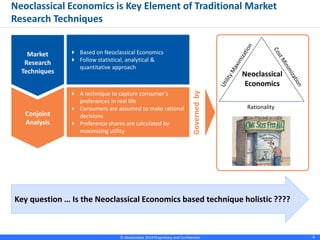
Key question … Is the Neoclassical Economics based technique holistic ????
Neoclassical Economics is Key Element of Traditional Market
Research Techniques
Market
Research
Techniques
Conjoint
Analysis
 Based on Neoclassical Economics
 Follow statistical, analytical &
quantitative approach
 A technique to capture consumer’s
preferences in real life
 Consumers are assumed to make rational
decisions
 Preference shares are calculated by
maximizing utility
Governedby
Neoclassical
Economics
Rationality
© Absolutdata 2014 Proprietary and Confidential 5
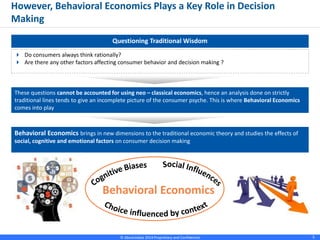
Questioning Traditional Wisdom
 Do consumers always think rationally?
 Are there any other factors affecting consumer behavior and decision making ?
However, Behavioral Economics Plays a Key Role in Decision
Making
These questions cannot be accounted for using neo – classical economics, hence an analysis done on strictly
traditional lines tends to give an incomplete picture of the consumer psyche. This is where Behavioral Economics
comes into play
Behavioral Economics brings in new dimensions to the traditional economic theory and studies the effects of
social, cognitive and emotional factors on consumer decision making
Behavioral Economics
© Absolutdata 2014 Proprietary and Confidential 6
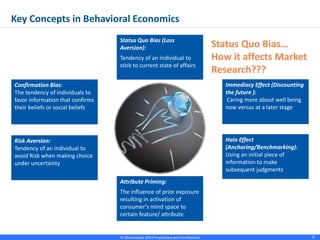
Immediacy Effect (Discounting
the future ):
Caring more about well being
now versus at a later stage
Halo Effect
(Anchoring/Benchmarking):
Using an initial piece of
information to make
subsequent judgments
Risk Aversion:
Tendency of an individual to
avoid Risk when making choice
under uncertainty
Confirmation Bias:
The tendency of individuals to
favor information that confirms
their beliefs or social beliefs
Status Quo Bias…
How it affects Market
Research???
Key Concepts in Behavioral Economics
Status Quo Bias (Loss
Aversion):
Tendency of an individual to
stick to current state of affairs
Attribute Priming:
The influence of prior exposure
resulting in activation of
consumer’s mind space to
certain feature/ attribute
© Absolutdata 2014 Proprietary and Confidential 7
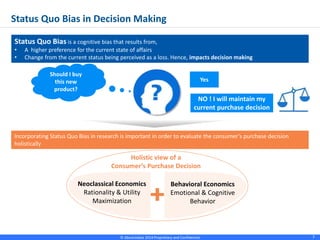
Status Quo Bias is a cognitive bias that results from,
• A higher preference for the current state of affairs
• Change from the current status being perceived as a loss. Hence, impacts decision making
Should I buy
this new
product?
NO ! I will maintain my
current purchase decision
Yes
Status Quo Bias in Decision Making
Holistic view of a
Consumer’s Purchase Decision
Behavioral Economics
Emotional & Cognitive
Behavior
Neoclassical Economics
Rationality & Utility
Maximization
Incorporating Status Quo Bias in research is important in order to evaluate the consumer’s purchase decision
holistically
© Absolutdata 2014 Proprietary and Confidential 8
BUT !
Accordingly…
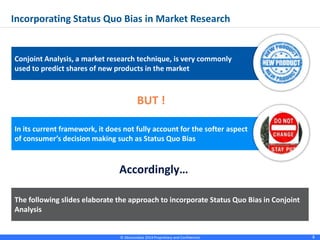
Conjoint Analysis, a market research technique, is very commonly
used to predict shares of new products in the market
Incorporating Status Quo Bias in Market Research
In its current framework, it does not fully account for the softer aspect
of consumer’s decision making such as Status Quo Bias
The following slides elaborate the approach to incorporate Status Quo Bias in Conjoint
Analysis
© Absolutdata 2014 Proprietary and Confidential 9
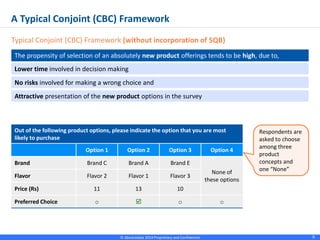
Typical Conjoint (CBC) Framework (without incorporation of SQB)
The propensity of selection of an absolutely new product offerings tends to be high, due to,
Out of the following product options, please indicate the option that you are most
likely to purchase
Option 1 Option 2 Option 3 Option 4
Brand Brand C Brand A Brand E
None of
these options
Flavor Flavor 2 Flavor 1 Flavor 3
Price (Rs) 11 13 10
Preferred Choice o  o o
Respondents are
asked to choose
among three
product
concepts and
one “None”
Lower time involved in decision making
No risks involved for making a wrong choice and
Attractive presentation of the new product options in the survey
A Typical Conjoint (CBC) Framework
© Absolutdata 2014 Proprietary and Confidential 10
Option 1 Option 2 Option 3
Brand Brand A Brand D Brand C
Flavor Flavor 1 Flavor 2 Flavor 3
Price (Rs) 11 13 8
Preferred Choice o  o
Incorporation of Status Quo Bias in Conjoint – Absolutdata’s Three
Step Approach
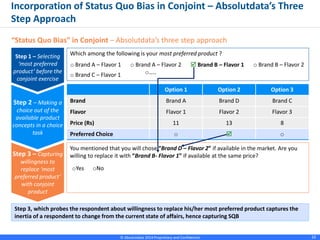
“Status Quo Bias” in Conjoint – Absolutdata’s three step approach
Which among the following is your most preferred product ?
o Brand A – Flavor 1 o Brand A – Flavor 2 o Brand B – Flavor 2
o Brand C – Flavor 1 o…..
 Brand B – Flavor 1
Step 1 – Selecting
‘most preferred
product’ before the
conjoint exercise
Step 2 – Making a
choice out of the
available product
concepts in a choice
task
You mentioned that you will chose “Brand D – Flavor 2” if available in the market. Are you
willing to replace it with “Brand B- Flavor 1” if available at the same price?
oYes oNo
Step 3 – Capturing
willingness to
replace ‘most
preferred product’
with conjoint
product
Step 3, which probes the respondent about willingness to replace his/her most preferred product captures the
inertia of a respondent to change from the current state of affairs, hence capturing SQB
© Absolutdata 2014 Proprietary and Confidential 11
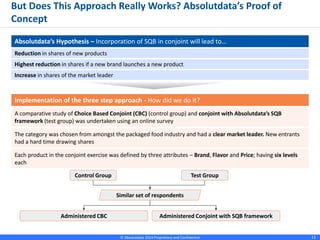
Absolutdata’s Hypothesis – Incorporation of SQB in conjoint will lead to…
Reduction in shares of new products
Highest reduction in shares if a new brand launches a new product
Increase in shares of the market leader
But Does This Approach Really Works? Absolutdata’s Proof of
Concept
Implementation of the three step approach - How did we do it?
A comparative study of Choice Based Conjoint (CBC) (control group) and conjoint with Absolutdata’s SQB
framework (test group) was undertaken using an online survey
The category was chosen from amongst the packaged food industry and had a clear market leader. New entrants
had a hard time drawing shares
Each product in the conjoint exercise was defined by three attributes – Brand, Flavor and Price; having six levels
each
Control Group Test Group
Similar set of respondents
Administered CBC Administered Conjoint with SQB framework
© Absolutdata 2014 Proprietary and Confidential 12
56%
18%
9%
3%
13%
1.26%
80%
2% 1% 0%
16%
0.04%
CBC Conjoint with SQB Framework
Product No. 1 2 3 4 5 6
Brand Brand A Brand A Brand B Brand B Brand C Brand F
Flavor Flavor 1 Flavor 2 Flavor 1 Flavor 2 Flavor 1 Flavor 6
Price ₹ 10 ₹ 12 ₹ 10 ₹ 12 ₹ 10 ₹ 10
Preference
Shares
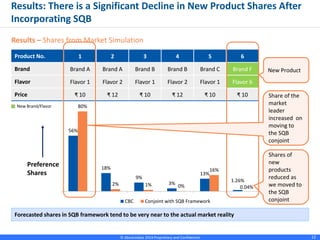
Shares of
new
products
reduced as
we moved to
the SQB
conjoint
Share of the
market
leader
increased on
moving to
the SQB
conjoint
New Brand/Flavor
New Product
Results: There is a Significant Decline in New Product Shares After
Incorporating SQB
Results – Shares from Market Simulation
Forecasted shares in SQB framework tend to be very near to the actual market reality
© Absolutdata 2014 Proprietary and Confidential 13
More Results: Other Hypothesis Also Proved Without Impacting
Key Consumer Behavior
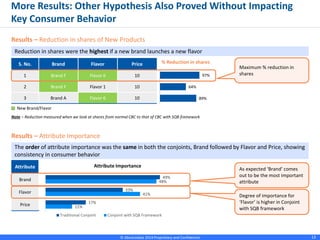
Results – Reduction in shares of New Products
Reduction in shares were the highest if a new brand launches a new flavor
S. No. Brand Flavor Price
1 Brand F Flavor 6 10
2 Brand F Flavor 1 10
3 Brand A Flavor 6 10 89%
64%
97%
% Reduction in shares
Note – Reduction measured when we look at shares from normal CBC to that of CBC with SQB framework
New Brand/Flavor
Maximum % reduction in
shares
Results – Attribute Importance
The order of attribute importance was the same in both the conjoints, Brand followed by Flavor and Price, showing
consistency in consumer behavior
Attribute
Brand
Flavor
Price 11%
41%
48%
17%
33%
49%
Traditional Conjoint Conjoint with SQB Framework
Attribute Importance
As expected ‘Brand’ comes
out to be the most important
attribute
Degree of importance for
‘Flavor’ is higher in Conjoint
with SQB framework
© Absolutdata 2014 Proprietary and Confidential 14
Hypothesis Verified
True False
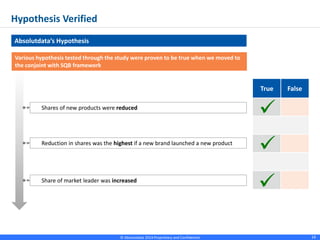
Shares of new products were reduced
Reduction in shares was the highest if a new brand launched a new product
Share of market leader was increased
Absolutdata’s Hypothesis



Various hypothesis tested through the study were proven to be true when we moved to
the conjoint with SQB framework
© Absolutdata 2014 Proprietary and Confidential 15
Impact of Absolutdata’s Conjoint with SQB Framework
Incorporated
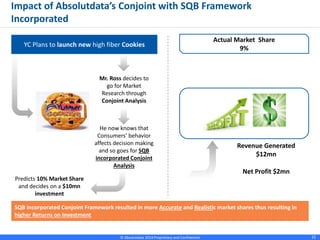
YC Plans to launch new high fiber Cookies
Mr. Ross decides to
go for Market
Research through
Conjoint Analysis
Predicts 10% Market Share
and decides on a $10mn
investment
Revenue Generated
$12mn
Net Profit $2mn
SQB incorporated Conjoint Framework resulted in more Accurate and Realistic market shares thus resulting in
higher Returns on Investment
He now knows that
Consumers’ behavior
affects decision making
and so goes for SQB
incorporated Conjoint
Analysis
Actual Market Share
9%
© Absolutdata 2014 Proprietary and Confidential 16
Applications in Industry
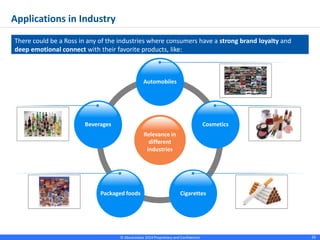
There could be a Ross in any of the industries where consumers have a strong brand loyalty and
deep emotional connect with their favorite products, like:
Automobiles
Cosmetics
CigarettesPackaged foods
Beverages
Relevance in
different
industries
Follow us on:

Decision Making Through Conjoint Analysis

  • 1.
    © Absolutdata 2014Proprietary and Confidential Chicago New York London Dubai New Delhi Bangalore SingaporeSan Francisco www.absolutdata.com July 14, 2014 Incorporating Behavioral Economics in Decision Making Through Conjoint Analysis
  • 2.
    © Absolutdata 2014Proprietary and Confidential 2 Agenda 2 Economics and Market Research 3 Introduction to Status Quo Bias (SQB) 4 Implication of SQB in Market Research 5 Incorporating SQB in Market Research through Conjoint Analysis 6 Results, Findings and Impact  Neoclassical Economics  Behavioral Economics 1 Background
  • 3.
    © Absolutdata 2014Proprietary and Confidential 3 What could have gone wrong with this business decision that was purely data driven? The answer lies in the detail, technique employed in market research missed a key aspect of consumer behavior in decision making…… Let’s Understand Believes in Data Brand Manager for Yummy Cookies (YC).. Already three flavors in the market with lots of competitors Background Mr. Ross YC Plans to launch new Strawberry Flavor cream Cookies Not sure about expected market share, Mr. Ross decides to go for Market Research through Conjoint Analysis Predicts 15% Market Share and decides on a $20mn investment Actual Market Share 10% Revenue Generated $15mn Net Loss $5mn
  • 4.
    © Absolutdata 2014Proprietary and Confidential 4 Key question … Is the Neoclassical Economics based technique holistic ???? Neoclassical Economics is Key Element of Traditional Market Research Techniques Market Research Techniques Conjoint Analysis  Based on Neoclassical Economics  Follow statistical, analytical & quantitative approach  A technique to capture consumer’s preferences in real life  Consumers are assumed to make rational decisions  Preference shares are calculated by maximizing utility Governedby Neoclassical Economics Rationality
  • 5.
    © Absolutdata 2014Proprietary and Confidential 5 Questioning Traditional Wisdom  Do consumers always think rationally?  Are there any other factors affecting consumer behavior and decision making ? However, Behavioral Economics Plays a Key Role in Decision Making These questions cannot be accounted for using neo – classical economics, hence an analysis done on strictly traditional lines tends to give an incomplete picture of the consumer psyche. This is where Behavioral Economics comes into play Behavioral Economics brings in new dimensions to the traditional economic theory and studies the effects of social, cognitive and emotional factors on consumer decision making Behavioral Economics
  • 6.
    © Absolutdata 2014Proprietary and Confidential 6 Immediacy Effect (Discounting the future ): Caring more about well being now versus at a later stage Halo Effect (Anchoring/Benchmarking): Using an initial piece of information to make subsequent judgments Risk Aversion: Tendency of an individual to avoid Risk when making choice under uncertainty Confirmation Bias: The tendency of individuals to favor information that confirms their beliefs or social beliefs Status Quo Bias… How it affects Market Research??? Key Concepts in Behavioral Economics Status Quo Bias (Loss Aversion): Tendency of an individual to stick to current state of affairs Attribute Priming: The influence of prior exposure resulting in activation of consumer’s mind space to certain feature/ attribute
  • 7.
    © Absolutdata 2014Proprietary and Confidential 7 Status Quo Bias is a cognitive bias that results from, • A higher preference for the current state of affairs • Change from the current status being perceived as a loss. Hence, impacts decision making Should I buy this new product? NO ! I will maintain my current purchase decision Yes Status Quo Bias in Decision Making Holistic view of a Consumer’s Purchase Decision Behavioral Economics Emotional & Cognitive Behavior Neoclassical Economics Rationality & Utility Maximization Incorporating Status Quo Bias in research is important in order to evaluate the consumer’s purchase decision holistically
  • 8.
    © Absolutdata 2014Proprietary and Confidential 8 BUT ! Accordingly… Conjoint Analysis, a market research technique, is very commonly used to predict shares of new products in the market Incorporating Status Quo Bias in Market Research In its current framework, it does not fully account for the softer aspect of consumer’s decision making such as Status Quo Bias The following slides elaborate the approach to incorporate Status Quo Bias in Conjoint Analysis
  • 9.
    © Absolutdata 2014Proprietary and Confidential 9 Typical Conjoint (CBC) Framework (without incorporation of SQB) The propensity of selection of an absolutely new product offerings tends to be high, due to, Out of the following product options, please indicate the option that you are most likely to purchase Option 1 Option 2 Option 3 Option 4 Brand Brand C Brand A Brand E None of these options Flavor Flavor 2 Flavor 1 Flavor 3 Price (Rs) 11 13 10 Preferred Choice o  o o Respondents are asked to choose among three product concepts and one “None” Lower time involved in decision making No risks involved for making a wrong choice and Attractive presentation of the new product options in the survey A Typical Conjoint (CBC) Framework
  • 10.
    © Absolutdata 2014Proprietary and Confidential 10 Option 1 Option 2 Option 3 Brand Brand A Brand D Brand C Flavor Flavor 1 Flavor 2 Flavor 3 Price (Rs) 11 13 8 Preferred Choice o  o Incorporation of Status Quo Bias in Conjoint – Absolutdata’s Three Step Approach “Status Quo Bias” in Conjoint – Absolutdata’s three step approach Which among the following is your most preferred product ? o Brand A – Flavor 1 o Brand A – Flavor 2 o Brand B – Flavor 2 o Brand C – Flavor 1 o…..  Brand B – Flavor 1 Step 1 – Selecting ‘most preferred product’ before the conjoint exercise Step 2 – Making a choice out of the available product concepts in a choice task You mentioned that you will chose “Brand D – Flavor 2” if available in the market. Are you willing to replace it with “Brand B- Flavor 1” if available at the same price? oYes oNo Step 3 – Capturing willingness to replace ‘most preferred product’ with conjoint product Step 3, which probes the respondent about willingness to replace his/her most preferred product captures the inertia of a respondent to change from the current state of affairs, hence capturing SQB
  • 11.
    © Absolutdata 2014Proprietary and Confidential 11 Absolutdata’s Hypothesis – Incorporation of SQB in conjoint will lead to… Reduction in shares of new products Highest reduction in shares if a new brand launches a new product Increase in shares of the market leader But Does This Approach Really Works? Absolutdata’s Proof of Concept Implementation of the three step approach - How did we do it? A comparative study of Choice Based Conjoint (CBC) (control group) and conjoint with Absolutdata’s SQB framework (test group) was undertaken using an online survey The category was chosen from amongst the packaged food industry and had a clear market leader. New entrants had a hard time drawing shares Each product in the conjoint exercise was defined by three attributes – Brand, Flavor and Price; having six levels each Control Group Test Group Similar set of respondents Administered CBC Administered Conjoint with SQB framework
  • 12.
    © Absolutdata 2014Proprietary and Confidential 12 56% 18% 9% 3% 13% 1.26% 80% 2% 1% 0% 16% 0.04% CBC Conjoint with SQB Framework Product No. 1 2 3 4 5 6 Brand Brand A Brand A Brand B Brand B Brand C Brand F Flavor Flavor 1 Flavor 2 Flavor 1 Flavor 2 Flavor 1 Flavor 6 Price ₹ 10 ₹ 12 ₹ 10 ₹ 12 ₹ 10 ₹ 10 Preference Shares Shares of new products reduced as we moved to the SQB conjoint Share of the market leader increased on moving to the SQB conjoint New Brand/Flavor New Product Results: There is a Significant Decline in New Product Shares After Incorporating SQB Results – Shares from Market Simulation Forecasted shares in SQB framework tend to be very near to the actual market reality
  • 13.
    © Absolutdata 2014Proprietary and Confidential 13 More Results: Other Hypothesis Also Proved Without Impacting Key Consumer Behavior Results – Reduction in shares of New Products Reduction in shares were the highest if a new brand launches a new flavor S. No. Brand Flavor Price 1 Brand F Flavor 6 10 2 Brand F Flavor 1 10 3 Brand A Flavor 6 10 89% 64% 97% % Reduction in shares Note – Reduction measured when we look at shares from normal CBC to that of CBC with SQB framework New Brand/Flavor Maximum % reduction in shares Results – Attribute Importance The order of attribute importance was the same in both the conjoints, Brand followed by Flavor and Price, showing consistency in consumer behavior Attribute Brand Flavor Price 11% 41% 48% 17% 33% 49% Traditional Conjoint Conjoint with SQB Framework Attribute Importance As expected ‘Brand’ comes out to be the most important attribute Degree of importance for ‘Flavor’ is higher in Conjoint with SQB framework
  • 14.
    © Absolutdata 2014Proprietary and Confidential 14 Hypothesis Verified True False Shares of new products were reduced Reduction in shares was the highest if a new brand launched a new product Share of market leader was increased Absolutdata’s Hypothesis    Various hypothesis tested through the study were proven to be true when we moved to the conjoint with SQB framework
  • 15.
    © Absolutdata 2014Proprietary and Confidential 15 Impact of Absolutdata’s Conjoint with SQB Framework Incorporated YC Plans to launch new high fiber Cookies Mr. Ross decides to go for Market Research through Conjoint Analysis Predicts 10% Market Share and decides on a $10mn investment Revenue Generated $12mn Net Profit $2mn SQB incorporated Conjoint Framework resulted in more Accurate and Realistic market shares thus resulting in higher Returns on Investment He now knows that Consumers’ behavior affects decision making and so goes for SQB incorporated Conjoint Analysis Actual Market Share 9%
  • 16.
    © Absolutdata 2014Proprietary and Confidential 16 Applications in Industry There could be a Ross in any of the industries where consumers have a strong brand loyalty and deep emotional connect with their favorite products, like: Automobiles Cosmetics CigarettesPackaged foods Beverages Relevance in different industries
  • 17.