Overview 
• Promotion Analytics: Intuition 
• Model Specification 
• Interpretation of Estimated Coefficients 
• Estimation 
• Limitation and Improvement
Scanner Data-Based Promotion Analytics: 
Key Idea 
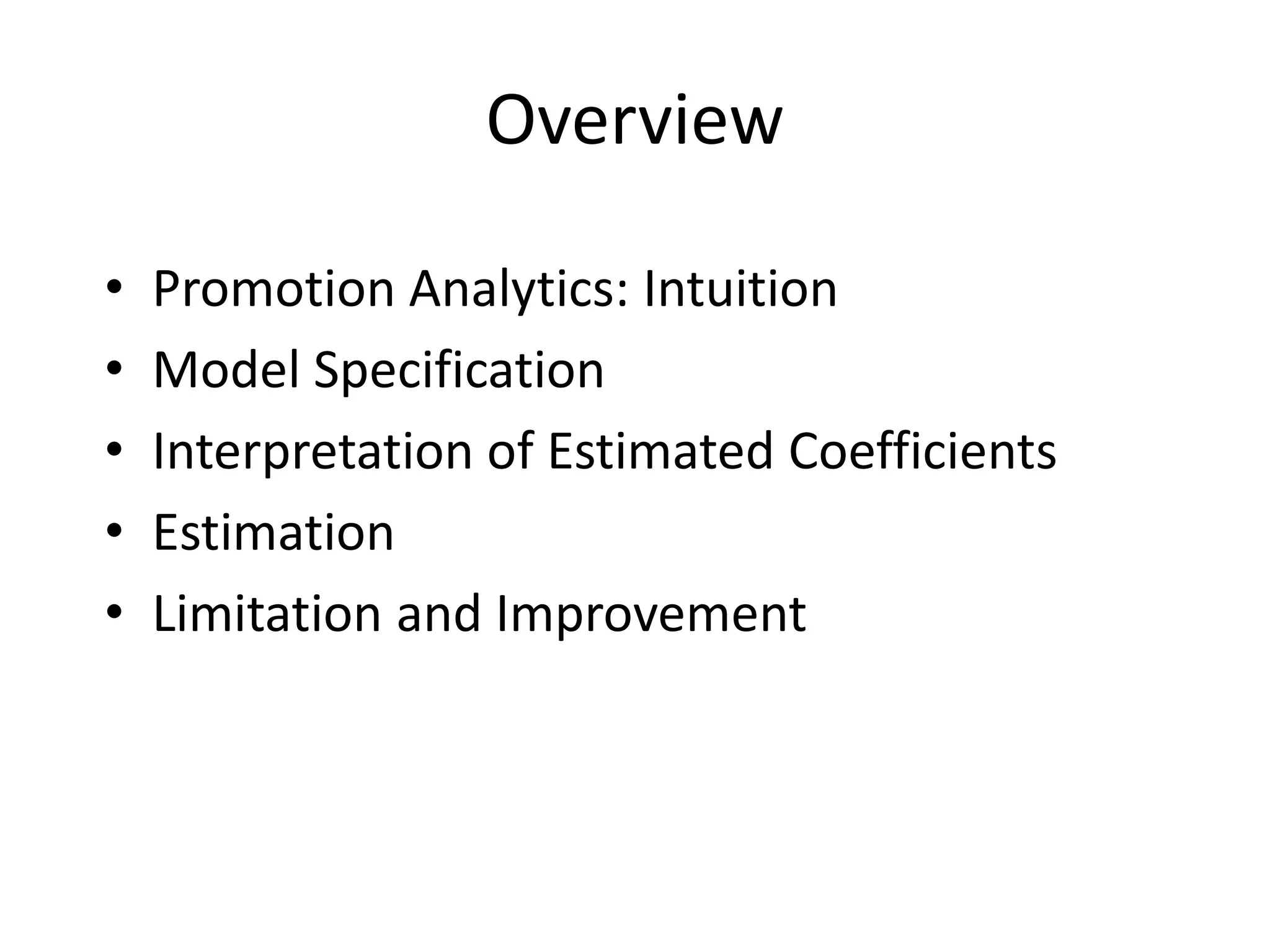
• Essentially “Counterfactual” analyses 
– Baseline sales: Normally expected volume for the product in 
absence of any store level promotional activity (estimated 
through econometric modeling) 
– Incremental sales: Additional volume due to in-store 
promotions 
• Incremental sales = Actual (Observed) – Baseline (Estimated) 
• Profitability of promotion can be assessed by combining costs of 
promotion with incremental revenue from promotion
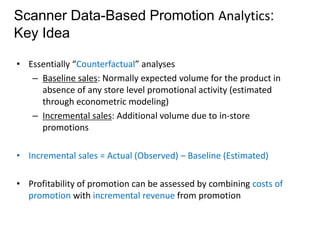
The Analytic Path 
Most issues can be addressed by drilling down this path 
Issue 
Base Volume Incremental Volume 
Distribution Velocity 
% ACV 
(Breadth) 
# of Items 
(Depth) 
Base Price 
Competitive 
Activity 
Other Factors 
Promotion 
Support 
(Quantity) 
Promotion 
Effectiveness 
(Quality) 
Level of 
Support 
Promo Mix 
Promo Price 
Price Discount 
Competitive Activity
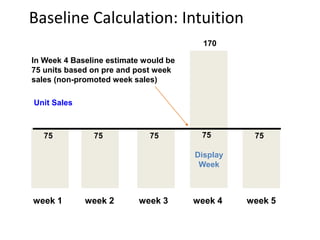
Baseline Calculation: Intuition 
170 
In Week 4 Baseline estimate would be 
75 units based on pre and post week 
sales (non-promoted week sales) 
Unit Sales 
75 
75 75 75 75 
Display 
Week 
week 1 week 2 week 3 week 4 week 5
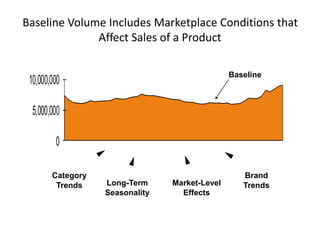
Baseline Volume Includes Marketplace Conditions that 
Affect Sales of a Product 
10,000,000 
5,000,000 
0 
Category 
Trends Long-Term 
Seasonality 
Market-Level 
Effects 
Baseline 
Brand 
Trends
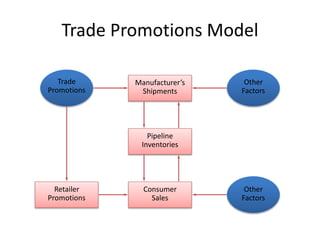
Trade Promotions Model 
Pipeline 
Inventories 
Trade 
Promotions 
Manufacturer’s 
Shipments 
Other 
Factors 
Consumer 
Sales 
Retailer 
Promotions 
Other 
Factors
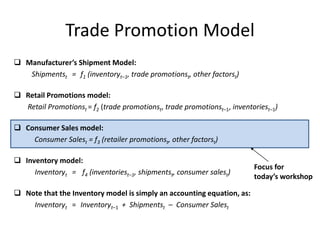
Trade Promotion Model 
 Manufacturer’s Shipment Model: 
Shipmentst = f1 (inventoryt–1, trade promotionst, other factorst) 
 Retail Promotions model: 
Retail Promotionst = f2 (trade promotionst, trade promotionst–1, inventoriest–1) 
 Consumer Sales model: 
Consumer Salest = f3 (retailer promotionst, other factorst) 
 Inventory model: 
Inventoryt = f4 (inventoriest–1, shipmentst, consumer salest) 
 Note that the Inventory model is simply an accounting equation, as: 
Inventoryt = Inventoryt–1 + Shipmentst – Consumer Salest 
Focus for 
today’s workshop
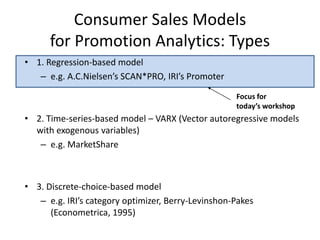
Consumer Sales Models 
for Promotion Analytics: Types 
Focus for 
today’s workshop 
• 1. Regression-based model 
– e.g. A.C.Nielsen’s SCAN*PRO, IRI’s Promoter 
• 2. Time-series-based model – VARX (Vector autoregressive models 
with exogenous variables) 
– e.g. MarketShare 
• 3. Discrete-choice-based model 
– e.g. IRI’s category optimizer, Berry-Levinshon-Pakes 
(Econometrica, 1995)
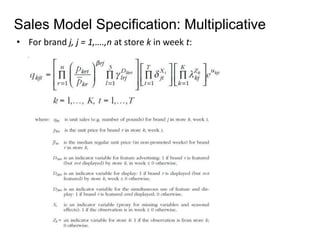
Sales Model Specification: Multiplicative 
• For brand j, j = 1,….,n at store k in week t:
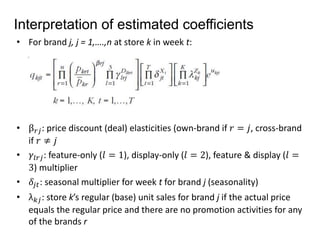
Interpretation of estimated coefficients 
• For brand j, j = 1,….,n at store k in week t: 
• β푟푗 : price discount (deal) elasticities (own-brand if 푟 = 푗, cross-brand 
if 푟 ≠ 푗 
• 훾푙푟푗: feature-only (푙 = 1), display-only (푙 = 2), feature & display (푙 = 
3) multiplier 
• 훿푗푡: seasonal multiplier for week t for brand j (seasonality) 
• λ푘푗 : store k’s regular (base) unit sales for brand j if the actual price 
equals the regular price and there are no promotion activities for any 
of the brands r
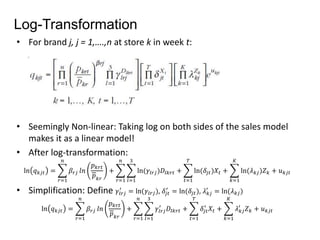
Log-Transformation 
• For brand j, j = 1,….,n at store k in week t: 
• Seemingly Non-linear: Taking log on both sides of the sales model 
makes it as a linear model! 
• After log-transformation: 
l푛 푞푘푗푡 = 
푛 
푟=1 
훽푟푗 푙푛 
푝푘푟푡 
푝푘푟 
+ 
푛 
푟=1 
3 
푙=1 
ln(훾푙푟푗 )퐷푙푘푟푡 + 
푇 
푡=1 
ln(훿푗푡 )푋푡 + 
퐾 
푘=1 
ln(휆푘푗 )푍푘 + 푢푘푗푡 
• Simplification: Define 훾푙푟푗 
′ = ln(훾푙푟푗 ), 훿푗푡 
′ = ln(훿푗푡 ), 휆푘푗 
′ = ln(휆푘푗 ) 
l푛 푞푘푗푡 = 
푛 
푟=1 
훽푟푗 푙푛 
푝푘푟푡 
푝푘푟 
+ 
푛 
푟=1 
3 
푙=1 
′ 퐷푙푘푟푡 + 
훾푙푟푗 
푇 
푡=1 
′ 푋푡 + 
훿푗푡 
퐾 
푘=1 
′ 푍푘 + 푢푘푗푡 
휆푘푗
Two Brand Example and Simplification 
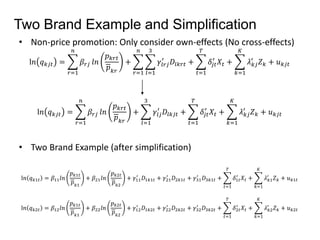
• Non-price promotion: Only consider own-effects (No cross-effects) 
l푛 푞푘푗푡 = 
푛 
푟=1 
훽푟푗 푙푛 
푝푘푟푡 
푝푘푟 
+ 
푛 
푟=1 
3 
푙=1 
′ 퐷푙푘푟푡 + 
훾푙푟푗 
푇 
푡=1 
′ 푋푡 + 
훿푗푡 
퐾 
푘=1 
′ 푍푘 + 푢푘푗푡 
휆푘푗 
l푛 푞푘푗푡 = 
푛 
푟=1 
훽푟푗 푙푛 
푝푘푟푡 
푝푘푟 
+ 
3 
푙=1 
′ 퐷푙푘푗푡 + 
훾푙푗 
푇 
푡=1 
′ 푋푡 + 
훿푗푡 
퐾 
푘=1 
′ 푍푘 + 푢푘푗푡 
휆푘푗 
• Two Brand Example (after simplification) 
l푛 푞푘1푡 = 훽11푙푛 
푝푘1푡 
푝푘1 
+ 훽21푙푛 
푝푘2푡 
푝푘2 
′ 퐷1푘1푡 + 훾21 
+ 훾11 
′ 퐷2푘1푡 + 훾31 
′ 퐷3푘1푡 + 
푇 
푡=1 
′ 푋푡 + 
훿1푡 
퐾 
푘=1 
′ 푍푘 + 푢푘1푡 
휆푘1 
l푛 푞푘2푡 = 훽12푙푛 
푝푘1푡 
푝푘1 
+ 훽22푙푛 
푝푘2푡 
푝푘2 
′ 퐷1푘2푡 + 훾22 
+ 훾12 
′ 퐷2푘2푡 + 훾32 
′ 퐷3푘2푡 + 
푇 
푡=1 
′ 푋푡 + 
훿2푡 
퐾 
푘=1 
′ 푍푘 + 푢푘2푡 
휆푘2
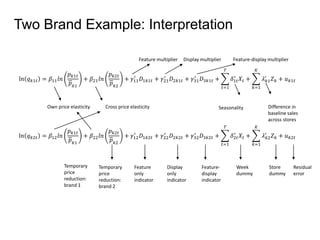
Two Brand Example: Interpretation 
l푛 푞푘1푡 = 훽11푙푛 
푝푘1푡 
푝푘1 
+ 훽21푙푛 
푝푘2푡 
푝푘2 
′ 퐷1푘1푡 + 훾21 
+ 훾11 
′ 퐷2푘1푡 + 훾31 
′ 퐷3푘1푡 + 
푇 
푡=1 
′ 푋푡 + 
훿1푡 
퐾 
푘=1 
′ 푍푘 + 푢푘1푡 
휆푘1 
Own price elasticity Cross price elasticity 
l푛 푞푘2푡 = 훽12푙푛 
푝푘1푡 
푝푘1 
+ 훽22푙푛 
푝푘2푡 
푝푘2 
′ 퐷1푘2푡 + 훾22 
+ 훾12 
′ 퐷2푘2푡 + 훾32 
′ 퐷3푘2푡 + 
푇 
푡=1 
′ 푋푡 + 
훿2푡 
퐾 
푘=1 
′ 푍푘 + 푢푘2푡 
휆푘2 
Week 
dummy 
Store 
dummy 
Residual 
error 
Feature 
only 
indicator 
Display 
only 
indicator 
Feature-display 
indicator 
Temporary 
price 
reduction: 
brand 1 
Temporary 
price 
reduction: 
brand 2 
Feature multiplier Display multiplier Feature-display multiplier 
Seasonality Difference in 
baseline sales 
across stores
Estimation 
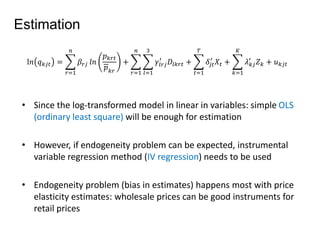
l푛 푞푘푗푡 = 
푛 
푟=1 
훽푟푗 푙푛 
푝푘푟푡 
푝푘푟 
+ 
푛 
푟=1 
3 
푙=1 
′ 퐷푙푘푟푡 + 
훾푙푟푗 
푇 
푡=1 
′ 푋푡 + 
훿푗푡 
퐾 
푘=1 
′ 푍푘 + 푢푘푗푡 
휆푘푗 
• Since the log-transformed model in linear in variables: simple OLS 
(ordinary least square) will be enough for estimation 
• However, if endogeneity problem can be expected, instrumental 
variable regression method (IV regression) needs to be used 
• Endogeneity problem (bias in estimates) happens most with price 
elasticity estimates: wholesale prices can be good instruments for 
retail prices
Calculating Baseline and Incremental Sales 
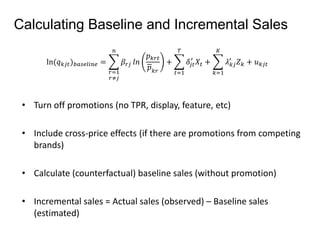
ln(푞푘푗푡)푏푎푠푒푙푖푛푒 = 
푛 
푟=1 
푟≠푗 
훽푟푗 푙푛 
푝푘푟푡 
푝푘푟 
+ 
푇 
푡=1 
′ 푋푡 + 
훿푗푡 
퐾 
푘=1 
′ 푍푘 + 푢푘푗푡 
휆푘푗 
• Turn off promotions (no TPR, display, feature, etc) 
• Include cross-price effects (if there are promotions from competing 
brands) 
• Calculate (counterfactual) baseline sales (without promotion) 
• Incremental sales = Actual sales (observed) – Baseline sales 
(estimated)
Limitation 
• Curse of dimensionality: Not very scalable in the case of categories with 
many SKUs -> J SKU’s: J x J parameters for each marketing mix 
• Homogeneity in response parameters: More flexible models allow 
heterogeneity in responses across chains/stores 
• No consideration of dynamics: lags and leads of prices can be included for 
dynamics 
• Log-linearity assumption on deal effect: More flexible (semi-parametric) 
models can be developed 
• Potential endogeneity (bias in estimated effects) if there are systematic 
allocation of promotion based on market/store conditions: instrumental 
variable regression can be considered
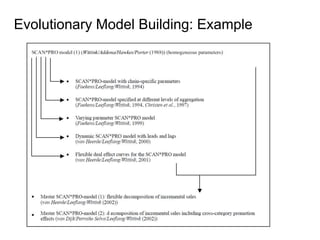
Evolutionary Model Building: Example

Promotion Analytics - Module 2: Model and Estimation

  • 1.
    Overview • PromotionAnalytics: Intuition • Model Specification • Interpretation of Estimated Coefficients • Estimation • Limitation and Improvement
  • 2.
    Scanner Data-Based PromotionAnalytics: Key Idea • Essentially “Counterfactual” analyses – Baseline sales: Normally expected volume for the product in absence of any store level promotional activity (estimated through econometric modeling) – Incremental sales: Additional volume due to in-store promotions • Incremental sales = Actual (Observed) – Baseline (Estimated) • Profitability of promotion can be assessed by combining costs of promotion with incremental revenue from promotion
  • 3.
    The Analytic Path Most issues can be addressed by drilling down this path Issue Base Volume Incremental Volume Distribution Velocity % ACV (Breadth) # of Items (Depth) Base Price Competitive Activity Other Factors Promotion Support (Quantity) Promotion Effectiveness (Quality) Level of Support Promo Mix Promo Price Price Discount Competitive Activity
  • 4.
    Baseline Calculation: Intuition 170 In Week 4 Baseline estimate would be 75 units based on pre and post week sales (non-promoted week sales) Unit Sales 75 75 75 75 75 Display Week week 1 week 2 week 3 week 4 week 5
  • 5.
    Baseline Volume IncludesMarketplace Conditions that Affect Sales of a Product 10,000,000 5,000,000 0 Category Trends Long-Term Seasonality Market-Level Effects Baseline Brand Trends
  • 6.
    Trade Promotions Model Pipeline Inventories Trade Promotions Manufacturer’s Shipments Other Factors Consumer Sales Retailer Promotions Other Factors
  • 7.
    Trade Promotion Model  Manufacturer’s Shipment Model: Shipmentst = f1 (inventoryt–1, trade promotionst, other factorst)  Retail Promotions model: Retail Promotionst = f2 (trade promotionst, trade promotionst–1, inventoriest–1)  Consumer Sales model: Consumer Salest = f3 (retailer promotionst, other factorst)  Inventory model: Inventoryt = f4 (inventoriest–1, shipmentst, consumer salest)  Note that the Inventory model is simply an accounting equation, as: Inventoryt = Inventoryt–1 + Shipmentst – Consumer Salest Focus for today’s workshop
  • 8.
    Consumer Sales Models for Promotion Analytics: Types Focus for today’s workshop • 1. Regression-based model – e.g. A.C.Nielsen’s SCAN*PRO, IRI’s Promoter • 2. Time-series-based model – VARX (Vector autoregressive models with exogenous variables) – e.g. MarketShare • 3. Discrete-choice-based model – e.g. IRI’s category optimizer, Berry-Levinshon-Pakes (Econometrica, 1995)
  • 9.
    Sales Model Specification:Multiplicative • For brand j, j = 1,….,n at store k in week t:
  • 10.
    Interpretation of estimatedcoefficients • For brand j, j = 1,….,n at store k in week t: • β푟푗 : price discount (deal) elasticities (own-brand if 푟 = 푗, cross-brand if 푟 ≠ 푗 • 훾푙푟푗: feature-only (푙 = 1), display-only (푙 = 2), feature & display (푙 = 3) multiplier • 훿푗푡: seasonal multiplier for week t for brand j (seasonality) • λ푘푗 : store k’s regular (base) unit sales for brand j if the actual price equals the regular price and there are no promotion activities for any of the brands r
  • 11.
    Log-Transformation • Forbrand j, j = 1,….,n at store k in week t: • Seemingly Non-linear: Taking log on both sides of the sales model makes it as a linear model! • After log-transformation: l푛 푞푘푗푡 = 푛 푟=1 훽푟푗 푙푛 푝푘푟푡 푝푘푟 + 푛 푟=1 3 푙=1 ln(훾푙푟푗 )퐷푙푘푟푡 + 푇 푡=1 ln(훿푗푡 )푋푡 + 퐾 푘=1 ln(휆푘푗 )푍푘 + 푢푘푗푡 • Simplification: Define 훾푙푟푗 ′ = ln(훾푙푟푗 ), 훿푗푡 ′ = ln(훿푗푡 ), 휆푘푗 ′ = ln(휆푘푗 ) l푛 푞푘푗푡 = 푛 푟=1 훽푟푗 푙푛 푝푘푟푡 푝푘푟 + 푛 푟=1 3 푙=1 ′ 퐷푙푘푟푡 + 훾푙푟푗 푇 푡=1 ′ 푋푡 + 훿푗푡 퐾 푘=1 ′ 푍푘 + 푢푘푗푡 휆푘푗
  • 12.
    Two Brand Exampleand Simplification • Non-price promotion: Only consider own-effects (No cross-effects) l푛 푞푘푗푡 = 푛 푟=1 훽푟푗 푙푛 푝푘푟푡 푝푘푟 + 푛 푟=1 3 푙=1 ′ 퐷푙푘푟푡 + 훾푙푟푗 푇 푡=1 ′ 푋푡 + 훿푗푡 퐾 푘=1 ′ 푍푘 + 푢푘푗푡 휆푘푗 l푛 푞푘푗푡 = 푛 푟=1 훽푟푗 푙푛 푝푘푟푡 푝푘푟 + 3 푙=1 ′ 퐷푙푘푗푡 + 훾푙푗 푇 푡=1 ′ 푋푡 + 훿푗푡 퐾 푘=1 ′ 푍푘 + 푢푘푗푡 휆푘푗 • Two Brand Example (after simplification) l푛 푞푘1푡 = 훽11푙푛 푝푘1푡 푝푘1 + 훽21푙푛 푝푘2푡 푝푘2 ′ 퐷1푘1푡 + 훾21 + 훾11 ′ 퐷2푘1푡 + 훾31 ′ 퐷3푘1푡 + 푇 푡=1 ′ 푋푡 + 훿1푡 퐾 푘=1 ′ 푍푘 + 푢푘1푡 휆푘1 l푛 푞푘2푡 = 훽12푙푛 푝푘1푡 푝푘1 + 훽22푙푛 푝푘2푡 푝푘2 ′ 퐷1푘2푡 + 훾22 + 훾12 ′ 퐷2푘2푡 + 훾32 ′ 퐷3푘2푡 + 푇 푡=1 ′ 푋푡 + 훿2푡 퐾 푘=1 ′ 푍푘 + 푢푘2푡 휆푘2
  • 13.
    Two Brand Example:Interpretation l푛 푞푘1푡 = 훽11푙푛 푝푘1푡 푝푘1 + 훽21푙푛 푝푘2푡 푝푘2 ′ 퐷1푘1푡 + 훾21 + 훾11 ′ 퐷2푘1푡 + 훾31 ′ 퐷3푘1푡 + 푇 푡=1 ′ 푋푡 + 훿1푡 퐾 푘=1 ′ 푍푘 + 푢푘1푡 휆푘1 Own price elasticity Cross price elasticity l푛 푞푘2푡 = 훽12푙푛 푝푘1푡 푝푘1 + 훽22푙푛 푝푘2푡 푝푘2 ′ 퐷1푘2푡 + 훾22 + 훾12 ′ 퐷2푘2푡 + 훾32 ′ 퐷3푘2푡 + 푇 푡=1 ′ 푋푡 + 훿2푡 퐾 푘=1 ′ 푍푘 + 푢푘2푡 휆푘2 Week dummy Store dummy Residual error Feature only indicator Display only indicator Feature-display indicator Temporary price reduction: brand 1 Temporary price reduction: brand 2 Feature multiplier Display multiplier Feature-display multiplier Seasonality Difference in baseline sales across stores
  • 14.
    Estimation l푛 푞푘푗푡= 푛 푟=1 훽푟푗 푙푛 푝푘푟푡 푝푘푟 + 푛 푟=1 3 푙=1 ′ 퐷푙푘푟푡 + 훾푙푟푗 푇 푡=1 ′ 푋푡 + 훿푗푡 퐾 푘=1 ′ 푍푘 + 푢푘푗푡 휆푘푗 • Since the log-transformed model in linear in variables: simple OLS (ordinary least square) will be enough for estimation • However, if endogeneity problem can be expected, instrumental variable regression method (IV regression) needs to be used • Endogeneity problem (bias in estimates) happens most with price elasticity estimates: wholesale prices can be good instruments for retail prices
  • 15.
    Calculating Baseline andIncremental Sales ln(푞푘푗푡)푏푎푠푒푙푖푛푒 = 푛 푟=1 푟≠푗 훽푟푗 푙푛 푝푘푟푡 푝푘푟 + 푇 푡=1 ′ 푋푡 + 훿푗푡 퐾 푘=1 ′ 푍푘 + 푢푘푗푡 휆푘푗 • Turn off promotions (no TPR, display, feature, etc) • Include cross-price effects (if there are promotions from competing brands) • Calculate (counterfactual) baseline sales (without promotion) • Incremental sales = Actual sales (observed) – Baseline sales (estimated)
  • 16.
    Limitation • Curseof dimensionality: Not very scalable in the case of categories with many SKUs -> J SKU’s: J x J parameters for each marketing mix • Homogeneity in response parameters: More flexible models allow heterogeneity in responses across chains/stores • No consideration of dynamics: lags and leads of prices can be included for dynamics • Log-linearity assumption on deal effect: More flexible (semi-parametric) models can be developed • Potential endogeneity (bias in estimated effects) if there are systematic allocation of promotion based on market/store conditions: instrumental variable regression can be considered
  • 17.

Editor's Notes

  • #4 A common business question involves understanding the drivers of changes in a brand’s volume, whether up or down. The biggest challenge in putting together a Category Overview is organizing the large amount of information to draw conclusions and recommendations. This diagram can be used to quickly highlight what is working or not working for a category, manufacturer or brand. Once you’ve identified the areas of focus, you can develop specific recommendations for marketing actions.
  • #5 The correct answer is 75 units. Even though 170 units were sold in week four, we can statistically derive that 75 of those units would have sold even if a promotion did not occur.
  • #6 Many marketplace conditions can impact the health of your base business. Various events can impact product sales and cause your base business to grow or decline over time. Examples include: General strength of the category Consumer trends such as low-carb diets Seasonality (inherent consumer interest at certain times of the year) FSIs TV, radio or internet advertising Competitive activity Distribution levels Base (everyday) pricing