


Thursday, May 28th, 2015
WE WILL BEGIN SHORTLY
questionpro.com | surveyanalytics.com
Learn How to Make Better Business Decisions
Conjoint Analysis Webinar : Will Begin Shortly….
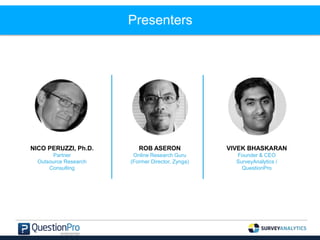
Presenters
VIVEK BHASKARAN
Founder & CEO
SurveyAnalytics /
QuestionPro
ROB ASERON
Online Research Guru
(Former Director, Zynga)
NICO PERUZZI, Ph.D.
Partner
Outsource Research
Consulting
AGENDA
 What is Conjoint Analysis?
 How Gaming Giant, Zynga, Won
 Introducing an All-in-One Solution
 Questions and Answer Session
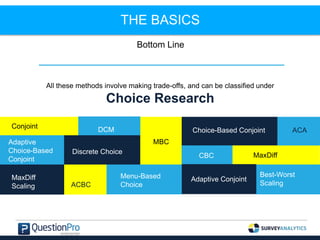
THE BASICS
Conjoint
Discrete Choice
Choice-Based ConjointDCM
CBC
Adaptive Conjoint
ACBC
ACA
Adaptive
Choice-Based
Conjoint
MaxDiff
MaxDiff
Scaling
MBC
Best-Worst
Scaling
Menu-Based
Choice
All these methods involve making trade-offs, and can be classified under
Choice Research
Bottom Line
THE BASICS
Bad news:
You just lost your job.
THE BASICS
Good news:
You have great skills
that give you options.
THE BASICS
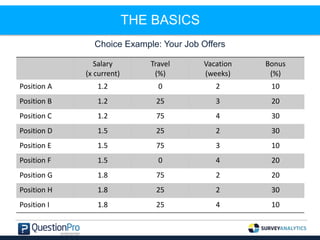
Choice Example: Your Job Offers
Salary
(x current)
Travel
(%)
Vacation
(weeks)
Bonus
(%)
Position A 1.2 0 2 10
Position B 1.2 25 3 20
Position C 1.2 75 4 30
Position D 1.5 25 2 30
Position E 1.5 75 3 10
Position F 1.5 0 4 20
Position G 1.8 75 2 20
Position H 1.8 25 2 30
Position I 1.8 25 4 10
Salary
(x current)
Travel
(%)
Vacation
(weeks)
Bonus
(%)
Position A 1.2 0 2 10
Position B 1.2 25 3 20
Position C 1.2 75 4 30
Position D 1.5 25 2 30
Position E 1.5 75 3 10
Position F 1.5 0 4 20
Position G 1.8 75 2 20
Position H 1.8 25 2 30
Position I 1.8 25 4 10
THE BASICS
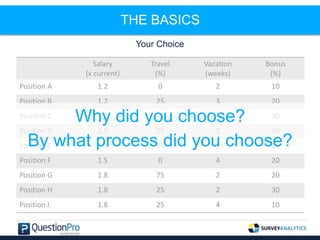
Your Choice
Why did you choose?
By what process did you choose?
THE BASICS
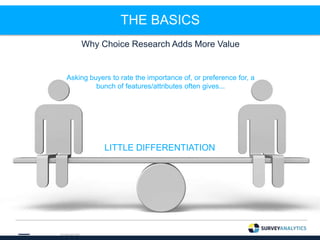
Why Choice Research Adds More Value
LITTLE DIFFERENTIATION
Asking buyers to rate the importance of, or preference for, a
bunch of features/attributes often gives...
THE BASICS
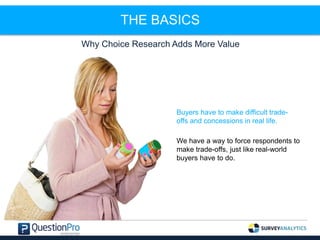
Why Choice Research Adds More Value
Buyers have to make difficult trade-
offs and concessions in real life.
We have a way to force respondents to
make trade-offs, just like real-world
buyers have to do.
THE BASICS
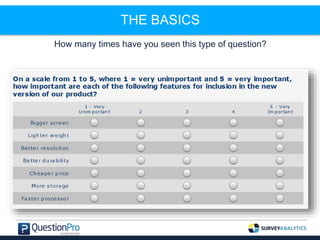
How many times have you seen this type of question?
THE BASICS
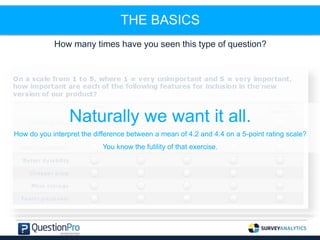
How many times have you seen this type of question?
Naturally we want it all.
How do you interpret the difference between a mean of 4.2 and 4.4 on a 5-point rating scale?
You know the futility of that exercise.
THE BASICS
…Or these types of questions?
 How much would you be willing to pay for this?
 At what price would you consider X “inexpensive,” “expensive,” “too expensive,”
and “too cheap?”
 But, these methods:
• Invite bargaining; can’t trust results; need to follow-up research
• Are overused and over-trusted; they feign precision
For a new product, with no idea of “what the market will bear,” this can get you near the ballpark.
THE BASICS
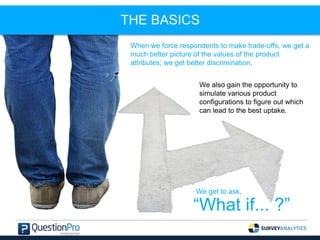
When we force respondents to make trade-offs, we get a
much better picture of the values of the product
attributes; we get better discrimination.
“What if... ?”
We also gain the opportunity to
simulate various product
configurations to figure out which
can lead to the best uptake.
We get to ask,
THE BASICS
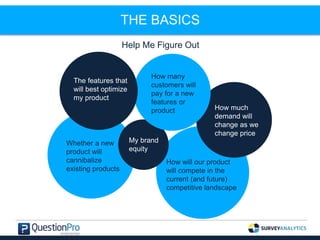
Help Me Figure Out
The features that
will best optimize
my product
How many
customers will
pay for a new
features or
product
My brand
equity
Whether a new
product will
cannibalize
existing products
How much
demand will
change as we
change price
How will our product
will compete in the
current (and future)
competitive landscape
THE BASICS
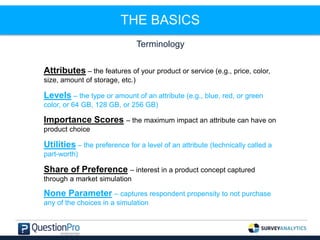
Terminology
Attributes – the features of your product or service (e.g., price, color,
size, amount of storage, etc.)
Levels – the type or amount of an attribute (e.g., blue, red, or green
color, or 64 GB, 128 GB, or 256 GB)
Importance Scores – the maximum impact an attribute can have on
product choice
Utilities – the preference for a level of an attribute (technically called a
part-worth)
Share of Preference – interest in a product concept captured
through a market simulation
None Parameter – captures respondent propensity to not purchase
any of the choices in a simulation
THE BASICS
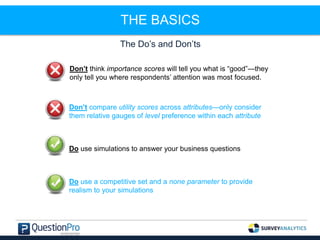
The Do’s and Don’ts
Don’t think importance scores will tell you what is “good”—they
only tell you where respondents’ attention was most focused.
Don’t compare utility scores across attributes—only consider
them relative gauges of level preference within each attribute
Do use simulations to answer your business questions
Do use a competitive set and a none parameter to provide
realism to your simulations
THE BASICS
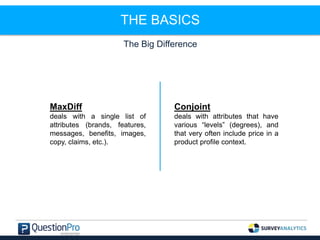
The Big Difference
MaxDiff
deals with a single list of
attributes (brands, features,
messages, benefits, images,
copy, claims, etc.).
Conjoint
deals with attributes that have
various “levels” (degrees), and
that very often include price in a
product profile context.
THE BASICS
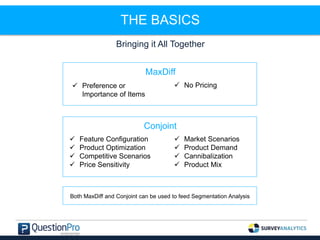
Bringing it All Together
MaxDiff
Conjoint
 Preference or
Importance of Items
 No Pricing
 Feature Configuration
 Product Optimization
 Competitive Scenarios
 Price Sensitivity
 Market Scenarios
 Product Demand
 Cannibalization
 Product Mix
Both MaxDiff and Conjoint can be used to feed Segmentation Analysis
CASE STUDY
How a Gaming Giant Won Using Max Diff & Conjoint
ROB ASERON
Online Research Guru
(Former Director, Zynga)
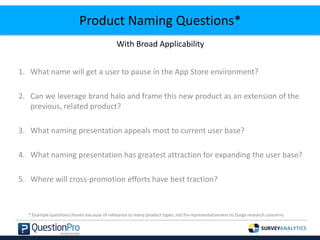
Product Naming Questions*
With Broad Applicability
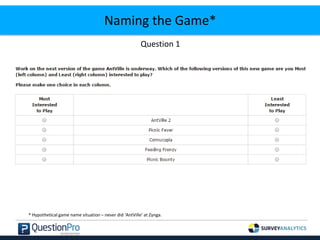
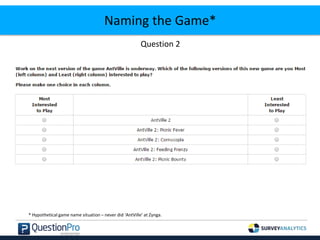
1. What name will get a user to pause in the App Store environment?
2. Can we leverage brand halo and frame this new product as an extension of the
previous, related product?
3. What naming presentation appeals most to current user base?
4. What naming presentation has greatest attraction for expanding the user base?
5. Where will cross-promotion efforts have best traction?
* Example questions chosen because of relevance to many product types, not for representativeness to Zynga research concerns.
Naming the Game*
Question 1
* Hypothetical game name situation – never did ‘AntVille’ at Zynga.
Naming the Game*
Question 2
* Hypothetical game name situation – never did ‘AntVille’ at Zynga.
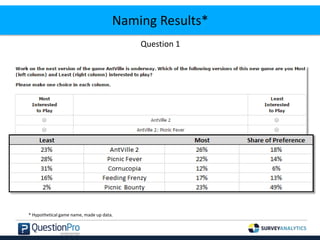
Naming Results*
Question 1
* Hypothetical game name, made up data.
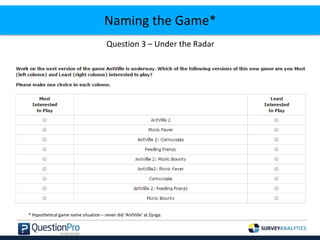
Naming the Game*
Question 3 – Under the Radar
* Hypothetical game name situation – never did ‘AntVille’ at Zynga.
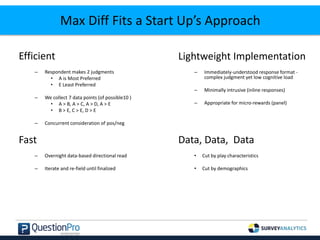
Max Diff Fits a Start Up’s Approach
Lightweight Implementation
– Immediately-understood response format -
complex judgment yet low cognitive load
– Minimally intrusive (inline responses)
– Appropriate for micro-rewards (panel)
Data, Data, Data
• Cut by play characteristics
• Cut by demographics
Efficient
– Respondent makes 2 judgments
• A is Most Preferred
• E Least Preferred
– We collect 7 data points (of possible10 )
• A > B, A > C, A > D, A > E
• B > E, C > E, D > E
– Concurrent consideration of pos/neg
Fast
– Overnight data-based directional read
– Iterate and re-field until finalized
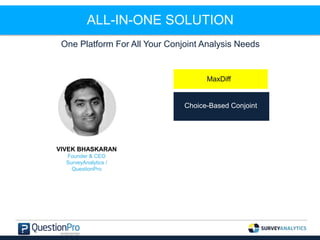
ALL-IN-ONE SOLUTION
One Platform For All Your Conjoint Analysis Needs
VIVEK BHASKARAN
Founder & CEO
SurveyAnalytics /
QuestionPro
Choice-Based Conjoint
MaxDiff
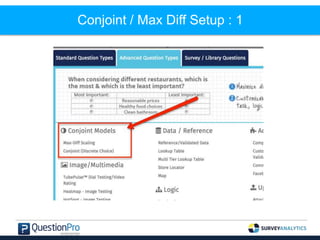
Conjoint / Max Diff Setup : 1
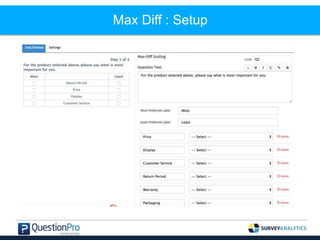
Max Diff : Setup
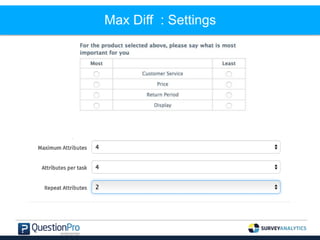
Max Diff : Settings
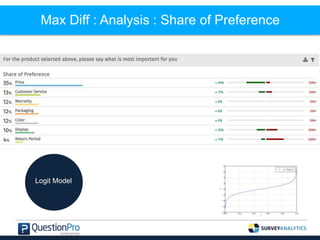
Max Diff : Analysis : Share of Preference
Logit Model
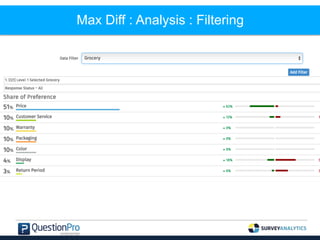
Max Diff : Analysis : Filtering
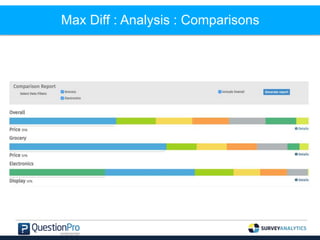
Max Diff : Analysis : Comparisons
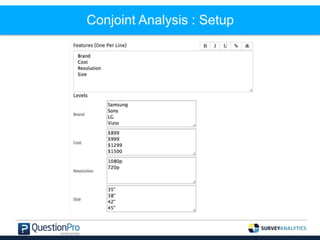
Conjoint Analysis : Setup
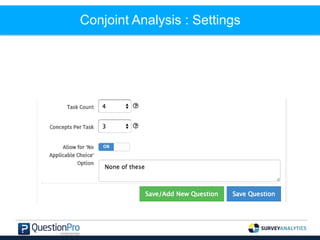
Conjoint Analysis : Settings
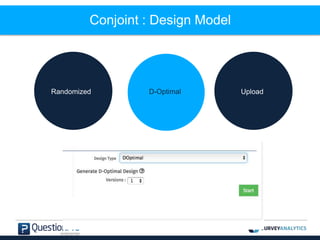
Conjoint : Design Model
Randomized D-Optimal Upload
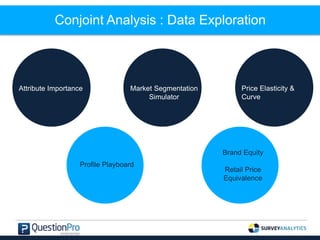
Conjoint Analysis : Data Exploration
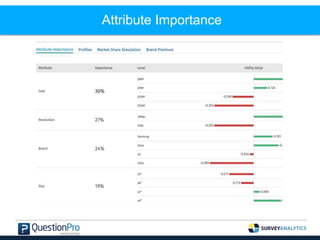
Attribute Importance
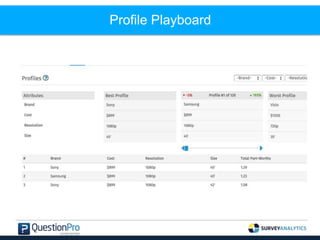
Profile Playboard
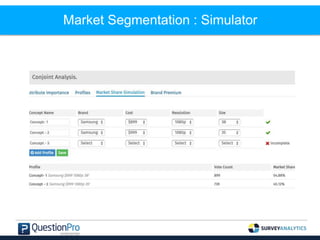
Market Segmentation
Simulator
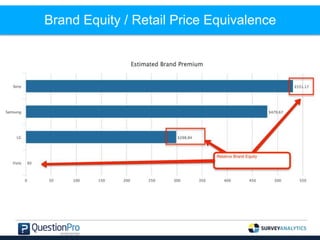
Brand Equity
Retail Price
Equivalence
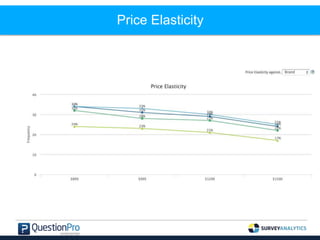
Price Elasticity &
Curve
Attribute Importance
Profile Playboard
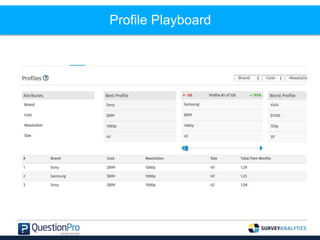
Profile Playboard
Market Segmentation : Simulator
Brand Equity / Retail Price Equivalence
Price Elasticity
QUESTIONS
1 (800) 326-5570
E-mail:
sales-team@surveyanalytics.com
Online Inquiries:
www.surveyanaltics.com/contact
Nico Peruzzi, Ph.D.
1 (408) 202-1521
E-mail:
nperuzzi@orconsulting.com
Rob Aseron
E-mail:
rob@onlineresearch.guru

How to Run Conjoint Analysis

  • 1.
    Thursday, May 28th,2015 WE WILL BEGIN SHORTLY questionpro.com | surveyanalytics.com Learn How to Make Better Business Decisions
  • 2.
    Conjoint Analysis Webinar: Will Begin Shortly….
  • 3.
    Presenters VIVEK BHASKARAN Founder &CEO SurveyAnalytics / QuestionPro ROB ASERON Online Research Guru (Former Director, Zynga) NICO PERUZZI, Ph.D. Partner Outsource Research Consulting
  • 4.
    AGENDA  What isConjoint Analysis?  How Gaming Giant, Zynga, Won  Introducing an All-in-One Solution  Questions and Answer Session
  • 5.
    THE BASICS Conjoint Discrete Choice Choice-BasedConjointDCM CBC Adaptive Conjoint ACBC ACA Adaptive Choice-Based Conjoint MaxDiff MaxDiff Scaling MBC Best-Worst Scaling Menu-Based Choice All these methods involve making trade-offs, and can be classified under Choice Research Bottom Line
  • 6.
    THE BASICS Bad news: Youjust lost your job.
  • 7.
    THE BASICS Good news: Youhave great skills that give you options.
  • 8.
    THE BASICS Choice Example:Your Job Offers Salary (x current) Travel (%) Vacation (weeks) Bonus (%) Position A 1.2 0 2 10 Position B 1.2 25 3 20 Position C 1.2 75 4 30 Position D 1.5 25 2 30 Position E 1.5 75 3 10 Position F 1.5 0 4 20 Position G 1.8 75 2 20 Position H 1.8 25 2 30 Position I 1.8 25 4 10
  • 9.
    Salary (x current) Travel (%) Vacation (weeks) Bonus (%) Position A1.2 0 2 10 Position B 1.2 25 3 20 Position C 1.2 75 4 30 Position D 1.5 25 2 30 Position E 1.5 75 3 10 Position F 1.5 0 4 20 Position G 1.8 75 2 20 Position H 1.8 25 2 30 Position I 1.8 25 4 10 THE BASICS Your Choice Why did you choose? By what process did you choose?
  • 10.
    THE BASICS Why ChoiceResearch Adds More Value LITTLE DIFFERENTIATION Asking buyers to rate the importance of, or preference for, a bunch of features/attributes often gives...
  • 11.
    THE BASICS Why ChoiceResearch Adds More Value Buyers have to make difficult trade- offs and concessions in real life. We have a way to force respondents to make trade-offs, just like real-world buyers have to do.
  • 12.
    THE BASICS How manytimes have you seen this type of question?
  • 13.
    THE BASICS How manytimes have you seen this type of question? Naturally we want it all. How do you interpret the difference between a mean of 4.2 and 4.4 on a 5-point rating scale? You know the futility of that exercise.
  • 14.
    THE BASICS …Or thesetypes of questions?  How much would you be willing to pay for this?  At what price would you consider X “inexpensive,” “expensive,” “too expensive,” and “too cheap?”  But, these methods: • Invite bargaining; can’t trust results; need to follow-up research • Are overused and over-trusted; they feign precision For a new product, with no idea of “what the market will bear,” this can get you near the ballpark.
  • 15.
    THE BASICS When weforce respondents to make trade-offs, we get a much better picture of the values of the product attributes; we get better discrimination. “What if... ?” We also gain the opportunity to simulate various product configurations to figure out which can lead to the best uptake. We get to ask,
  • 16.
    THE BASICS Help MeFigure Out The features that will best optimize my product How many customers will pay for a new features or product My brand equity Whether a new product will cannibalize existing products How much demand will change as we change price How will our product will compete in the current (and future) competitive landscape
  • 17.
    THE BASICS Terminology Attributes –the features of your product or service (e.g., price, color, size, amount of storage, etc.) Levels – the type or amount of an attribute (e.g., blue, red, or green color, or 64 GB, 128 GB, or 256 GB) Importance Scores – the maximum impact an attribute can have on product choice Utilities – the preference for a level of an attribute (technically called a part-worth) Share of Preference – interest in a product concept captured through a market simulation None Parameter – captures respondent propensity to not purchase any of the choices in a simulation
  • 18.
    THE BASICS The Do’sand Don’ts Don’t think importance scores will tell you what is “good”—they only tell you where respondents’ attention was most focused. Don’t compare utility scores across attributes—only consider them relative gauges of level preference within each attribute Do use simulations to answer your business questions Do use a competitive set and a none parameter to provide realism to your simulations
  • 19.
    THE BASICS The BigDifference MaxDiff deals with a single list of attributes (brands, features, messages, benefits, images, copy, claims, etc.). Conjoint deals with attributes that have various “levels” (degrees), and that very often include price in a product profile context.
  • 20.
    THE BASICS Bringing itAll Together MaxDiff Conjoint  Preference or Importance of Items  No Pricing  Feature Configuration  Product Optimization  Competitive Scenarios  Price Sensitivity  Market Scenarios  Product Demand  Cannibalization  Product Mix Both MaxDiff and Conjoint can be used to feed Segmentation Analysis
  • 21.
    CASE STUDY How aGaming Giant Won Using Max Diff & Conjoint ROB ASERON Online Research Guru (Former Director, Zynga)
  • 22.
    Product Naming Questions* WithBroad Applicability 1. What name will get a user to pause in the App Store environment? 2. Can we leverage brand halo and frame this new product as an extension of the previous, related product? 3. What naming presentation appeals most to current user base? 4. What naming presentation has greatest attraction for expanding the user base? 5. Where will cross-promotion efforts have best traction? * Example questions chosen because of relevance to many product types, not for representativeness to Zynga research concerns.
  • 23.
    Naming the Game* Question1 * Hypothetical game name situation – never did ‘AntVille’ at Zynga.
  • 24.
    Naming the Game* Question2 * Hypothetical game name situation – never did ‘AntVille’ at Zynga.
  • 25.
    Naming Results* Question 1 *Hypothetical game name, made up data.
  • 26.
    Naming the Game* Question3 – Under the Radar * Hypothetical game name situation – never did ‘AntVille’ at Zynga.
  • 27.
    Max Diff Fitsa Start Up’s Approach Lightweight Implementation – Immediately-understood response format - complex judgment yet low cognitive load – Minimally intrusive (inline responses) – Appropriate for micro-rewards (panel) Data, Data, Data • Cut by play characteristics • Cut by demographics Efficient – Respondent makes 2 judgments • A is Most Preferred • E Least Preferred – We collect 7 data points (of possible10 ) • A > B, A > C, A > D, A > E • B > E, C > E, D > E – Concurrent consideration of pos/neg Fast – Overnight data-based directional read – Iterate and re-field until finalized
  • 28.
    ALL-IN-ONE SOLUTION One PlatformFor All Your Conjoint Analysis Needs VIVEK BHASKARAN Founder & CEO SurveyAnalytics / QuestionPro Choice-Based Conjoint MaxDiff
  • 29.
    Conjoint / MaxDiff Setup : 1
  • 30.
  • 31.
    Max Diff :Settings
  • 32.
    Max Diff :Analysis : Share of Preference Logit Model
  • 33.
    Max Diff :Analysis : Filtering
  • 34.
    Max Diff :Analysis : Comparisons
  • 35.
  • 36.
  • 37.
    Conjoint : DesignModel Randomized D-Optimal Upload
  • 38.
    Conjoint Analysis :Data Exploration Attribute Importance Profile Playboard Market Segmentation Simulator Brand Equity Retail Price Equivalence Price Elasticity & Curve
  • 39.
  • 40.
  • 41.
  • 42.
  • 43.
    Brand Equity /Retail Price Equivalence
  • 44.
  • 45.
    QUESTIONS 1 (800) 326-5570 E-mail: sales-team@surveyanalytics.com OnlineInquiries: www.surveyanaltics.com/contact Nico Peruzzi, Ph.D. 1 (408) 202-1521 E-mail: nperuzzi@orconsulting.com Rob Aseron E-mail: rob@onlineresearch.guru

Editor's Notes

  • #46 Accuracy: Quality and accuracy is higher and more reliable.