CONGESTIVE HEART FAILURE
Presented by
Imran Ahammad Chowdhury
CONGESTIVE HEART FAILURE
It is a situation or condition of the heart
when heart fails to provide sufficient
cardiac output so that there will be
inadequate blood supply and oxygen
supply throughout the body.In CHF cardiac
muscle fails to contract sufficiently.
CARDIAC OUTPUT
• The cardiac output is the amount of blood ejected from
each ventricle every minute.The amount expelled by each
contraction is the stroke volume.Cardiac output is
expressed in litre per minute(l/min)and is calculated by
multiplying the stroke volume by the heart rate(masured in
beats per minute).
• CARDIAC OUTPUT=STROKE VOLUME * HEART RATE
• In a healthy adult at rest the stroke volume is
approximately 70ml and if the heart rate is 72 per
minute,the cardiac output is 5l/minute.
RISK FACTOR OF CHF
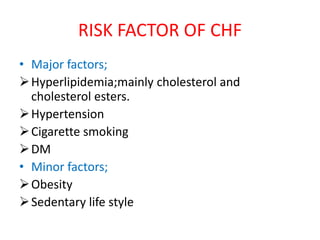
• Major factors;
Hyperlipidemia;mainly cholesterol and
cholesterol esters.
Hypertension
Cigarette smoking
DM
• Minor factors;
Obesity
Sedentary life style
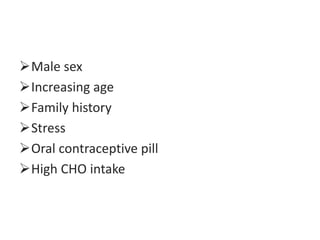
Male sex
Increasing age
Family history
Stress
Oral contraceptive pill
High CHO intake
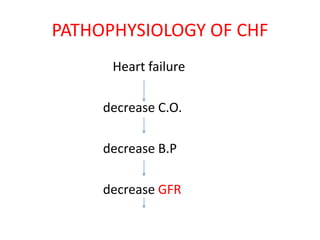
PATHOPHYSIOLOGY OF CHF
Heart failure
decrease C.O.
decrease B.P
decrease GFR
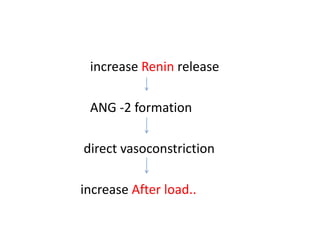
increase Renin release
ANG -2 formation
direct vasoconstriction
increase After load..
• ADH secretion increase contractility.
• ADH secretion causes salt & water
retention;which increase pre load..
DIAGNOSIS OF CHF
• Chest X-ray;this is very helpful in identifying
the buildup of fluid in the lungs.the heart is
usually enlarges in CHF,this may be visible in X-
ray film.
• Electrocardiogram(ECG);It is a painless test
that measures the electrical activity of the
heart(rhythm).
• Blood test;Low blood cell counts may cause
symptoms much like CHF
• MRI(Magnetic resonance imaging);It is used to
provide images of the heart and its ability to
pump bloob to the body.
• Cardiac catheterization(cath);In this case a
small tube is inserted into and artery in the leg
or arm.The catheter is moved to the heart to
measure pressures inside the heart and to put
contrast into the coronary arteries to look for
blockages.
DRUGS USED IN CHF
• Drugs that decrease preload
DIURETICS;Frusemide
NITRATE;Isosorbide mono nitrate
• Drugs that decrease afterload
VASODIALATORS;Hydralazine,Nitroprusside
• Drugs that decrease both preload & afterload
ACE inhibitors;Captopril,Lisinopril
• Drugs that increase
contractility(CARDIOTONICS)
CARDIAC GLYCOSIDE;Digoxin,Digitoxin
BETA AGONIST;Dopamine,Isoprenaline
PDE inhibitors(Phosphodiesterase
enzyme);Amrinone,Milrinone
AIM OF DRUGS
• The ultimate aim of drug is to increase force of
contraction Increase stroke volume
Increase cardiac output(C.O.)
• If C.O is increased,
1. Cardiomegaly will be corrected
2. Tachycardia will be corrected
3. Oedema will be corrected
4. Dyspnoea will be corrected
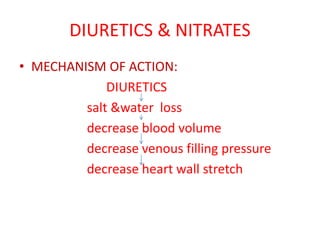
DIURETICS & NITRATES
• MECHANISM OF ACTION:
DIURETICS
salt &water loss
decrease blood volume
decrease venous filling pressure
decrease heart wall stretch
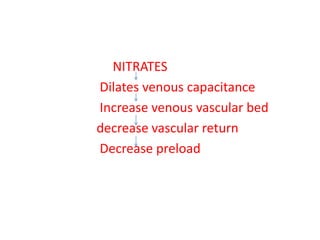
NITRATES
Dilates venous capacitance
Increase venous vascular bed
decrease vascular return
Decrease preload
CARDIOTONIC DRUGS
Cardiotonic drugs are the drugs which increase the
force of contraction of failing heart,either normal
or decrease heart rate and maintain effective
circulation.
Example:Digoxine,Dopamine,Atropine,Theophyline.
• Some new cardiotonics are;Nicorandil(potassium
channel activator),Xamoterol(Inotropic
drug),Pimobendan(Calcium channel sensitizer)
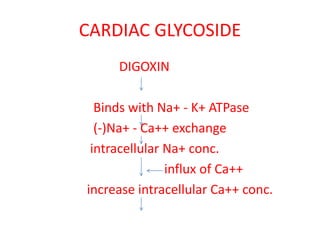
CARDIAC GLYCOSIDE
DIGOXIN
Binds with Na+ - K+ ATPase
(-)Na+ - Ca++ exchange
intracellular Na+ conc.
influx of Ca++
increase intracellular Ca++ conc.
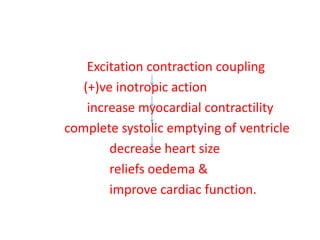
Excitation contraction coupling
(+)ve inotropic action
increase myocardial contractility
complete systolic emptying of ventricle
decrease heart size
reliefs oedema &
improve cardiac function.
Cardiotonics also decrease K+ conc. Which
results decrease H.R..
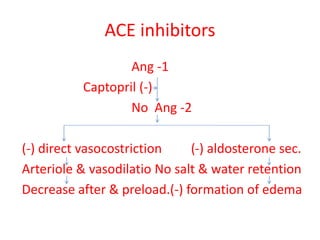
ACE inhibitors
Ang -1
Captopril (-)
No Ang -2
(-) direct vasocostriction (-) aldosterone sec.
Arteriole & vasodilatio No salt & water retention
Decrease after & preload.(-) formation of edema
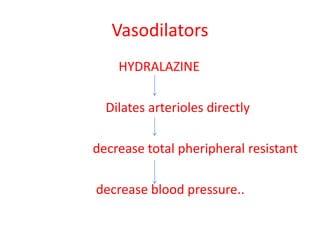
Vasodilators
HYDRALAZINE
Dilates arterioles directly
decrease total pheripheral resistant
decrease blood pressure..
Congestive heart failure

Congestive heart failure

  • 1.
    CONGESTIVE HEART FAILURE Presentedby Imran Ahammad Chowdhury
  • 2.
    CONGESTIVE HEART FAILURE Itis a situation or condition of the heart when heart fails to provide sufficient cardiac output so that there will be inadequate blood supply and oxygen supply throughout the body.In CHF cardiac muscle fails to contract sufficiently.
  • 3.
    CARDIAC OUTPUT • Thecardiac output is the amount of blood ejected from each ventricle every minute.The amount expelled by each contraction is the stroke volume.Cardiac output is expressed in litre per minute(l/min)and is calculated by multiplying the stroke volume by the heart rate(masured in beats per minute). • CARDIAC OUTPUT=STROKE VOLUME * HEART RATE • In a healthy adult at rest the stroke volume is approximately 70ml and if the heart rate is 72 per minute,the cardiac output is 5l/minute.
  • 4.
    RISK FACTOR OFCHF • Major factors; Hyperlipidemia;mainly cholesterol and cholesterol esters. Hypertension Cigarette smoking DM • Minor factors; Obesity Sedentary life style
  • 5.
    Male sex Increasing age Familyhistory Stress Oral contraceptive pill High CHO intake
  • 6.
    PATHOPHYSIOLOGY OF CHF Heartfailure decrease C.O. decrease B.P decrease GFR
  • 7.
    increase Renin release ANG-2 formation direct vasoconstriction increase After load..
  • 8.
    • ADH secretionincrease contractility. • ADH secretion causes salt & water retention;which increase pre load..
  • 9.
    DIAGNOSIS OF CHF •Chest X-ray;this is very helpful in identifying the buildup of fluid in the lungs.the heart is usually enlarges in CHF,this may be visible in X- ray film. • Electrocardiogram(ECG);It is a painless test that measures the electrical activity of the heart(rhythm). • Blood test;Low blood cell counts may cause symptoms much like CHF
  • 10.
    • MRI(Magnetic resonanceimaging);It is used to provide images of the heart and its ability to pump bloob to the body. • Cardiac catheterization(cath);In this case a small tube is inserted into and artery in the leg or arm.The catheter is moved to the heart to measure pressures inside the heart and to put contrast into the coronary arteries to look for blockages.
  • 11.
    DRUGS USED INCHF • Drugs that decrease preload DIURETICS;Frusemide NITRATE;Isosorbide mono nitrate • Drugs that decrease afterload VASODIALATORS;Hydralazine,Nitroprusside • Drugs that decrease both preload & afterload ACE inhibitors;Captopril,Lisinopril
  • 12.
    • Drugs thatincrease contractility(CARDIOTONICS) CARDIAC GLYCOSIDE;Digoxin,Digitoxin BETA AGONIST;Dopamine,Isoprenaline PDE inhibitors(Phosphodiesterase enzyme);Amrinone,Milrinone
  • 13.
    AIM OF DRUGS •The ultimate aim of drug is to increase force of contraction Increase stroke volume Increase cardiac output(C.O.) • If C.O is increased, 1. Cardiomegaly will be corrected 2. Tachycardia will be corrected 3. Oedema will be corrected 4. Dyspnoea will be corrected
  • 14.
    DIURETICS & NITRATES •MECHANISM OF ACTION: DIURETICS salt &water loss decrease blood volume decrease venous filling pressure decrease heart wall stretch
  • 15.
    NITRATES Dilates venous capacitance Increasevenous vascular bed decrease vascular return Decrease preload
  • 16.
    CARDIOTONIC DRUGS Cardiotonic drugsare the drugs which increase the force of contraction of failing heart,either normal or decrease heart rate and maintain effective circulation. Example:Digoxine,Dopamine,Atropine,Theophyline. • Some new cardiotonics are;Nicorandil(potassium channel activator),Xamoterol(Inotropic drug),Pimobendan(Calcium channel sensitizer)
  • 17.
    CARDIAC GLYCOSIDE DIGOXIN Binds withNa+ - K+ ATPase (-)Na+ - Ca++ exchange intracellular Na+ conc. influx of Ca++ increase intracellular Ca++ conc.
  • 18.
    Excitation contraction coupling (+)veinotropic action increase myocardial contractility complete systolic emptying of ventricle decrease heart size reliefs oedema & improve cardiac function.
  • 19.
    Cardiotonics also decreaseK+ conc. Which results decrease H.R..
  • 20.
    ACE inhibitors Ang -1 Captopril(-) No Ang -2 (-) direct vasocostriction (-) aldosterone sec. Arteriole & vasodilatio No salt & water retention Decrease after & preload.(-) formation of edema
  • 21.
    Vasodilators HYDRALAZINE Dilates arterioles directly decreasetotal pheripheral resistant decrease blood pressure..