Congestive Heart Failure
Definition
• Impaired cardiac pumping, heart is
unable to pump adequate amount of
blood to meet metabolic needs
• Associated with long-standing HTN and
CAD
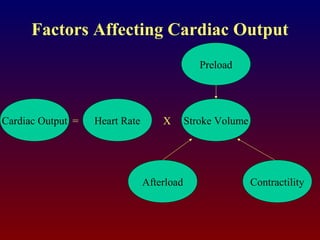
Factors Affecting Cardiac Output
Cardiac Output
Preload
Afterload Contractility
Heart Rate Stroke Volume= X
Factors Affecting Cardiac Output
• Preload
– The volume of blood/amount of fiber stretch
in the ventricles at the end of diastole (i.e.,
before the next contraction)
Factors Affecting Cardiac Output
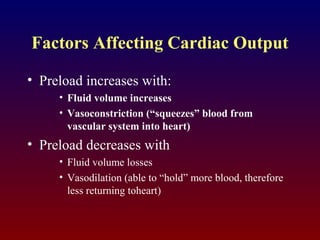
• Preload increases with:
• Fluid volume increases
• Vasoconstriction (“squeezes” blood from
vascular system into heart)
• Preload decreases with
• Fluid volume losses
• Vasodilation (able to “hold” more blood, therefore
less returning toheart)
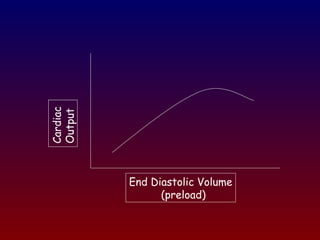
End Diastolic Volume
(preload)
Cardiac
Output
Factors Affecting Cardiac Output
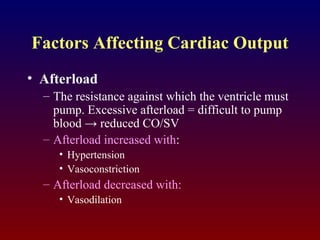
• Afterload
– The resistance against which the ventricle must
pump. Excessive afterload = difficult to pump
blood → reduced CO/SV
– Afterload increased with:
• Hypertension
• Vasoconstriction
– Afterload decreased with:
• Vasodilation
Factors Affecting Cardiac Output
• Contractility
– Ability of the heart muscle to contract; relates
to the strength of contraction.

Pathophysiology of CHF
• Vasoconstriction: ↑’s the resistance against
which heart has to pump (i.e., ↑’s afterload), and
may therefore ↓ CO
• Na and water retention: ↑’s fluid volume, which
↑’s preload. If too much “stretch” (d/t too much
fluid) → ↓ strength of contraction and ↓’s CO
• Excessive tachycardia → ↓’d diastolic filling
time → ↓’d ventricular filling → ↓’d CO
Congestive Heart Failure
Risk Factors
• CAD
• Age
• HTN
• Obesity
• Cigarette smoking
• Diabetes mellitus
• High cholesterol
Congestive Heart Failure
Etiology
• May be caused by any interference with
normal mechanisms regulating cardiac
output (CO)
• Common causes
– HTN
– Myocardial infarction
– Dysrhythmias
– Valvular disorders
2 Types of Heart Failure
Systolic Dysfunction
(Contraction) 2/3 of Patients
♥ The heart becomes weak
and enlarged
♥ The weakened heart
muscle can’t contract
♥ Not enough blood is
pumped from the
chambers
Diastolic Dysfunction
(Relaxation)
♥ Chambers don’t fill up so
less blood goes to the
lungs and body
♥ Stiff heart muscle can’t
relax
♥ Not enough blood fills the
chambers
What is an Ejection Fraction? (EF)
The amount of blood that pumps out of
the heart with each beat
♥ Normal EF = 50 – 65%
♥ Damaged Heart Muscle EF = 40%
♥ Potential Heart Transplant EF = 20%
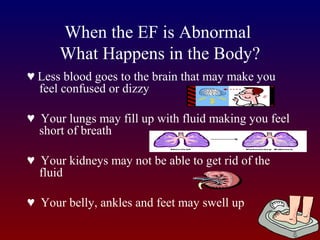
When the EF is Abnormal
What Happens in the Body?
♥ Less blood goes to the brain that may make you
feel confused or dizzy
♥ Your lungs may fill up with fluid making you feel
short of breath
♥ Your kidneys may not be able to get rid of the
fluid
♥ Your belly, ankles and feet may swell up
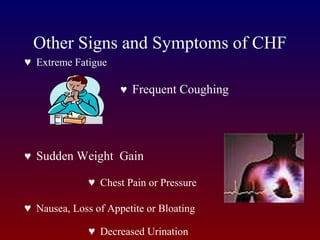
Other Signs and Symptoms of CHF
♥ Extreme Fatigue
♥ Frequent Coughing
♥ Sudden Weight Gain
♥ Chest Pain or Pressure
♥ Nausea, Loss of Appetite or Bloating
♥ Decreased Urination
Acute Congestive Heart Failure
Clinical Manifestations
• Pulmonary edema
– Agitation
– Pale or cyanotic
– Cold
– Severe dyspnea
– Tachypnea
– Pink, frothy sputum
Chronic Congestive Heart Failure
Clinical Manifestations
• Fatigue
• Dyspnea
– Paroxysmal nocturnal dyspnea (PND)
• Tachycardia
• Edema – (lung, liver, abdomen, legs)
• Nocturia
Chronic Congestive Heart Failure
Clinical Manifestations
• Behavioral changes
– Restlessness, confusion, ↓ attention
• Chest pain (d/t ↓ CO and ↑ myocardial work)
• Weight changes (r/t fluid retention)
• Skin changes
– Dusky appearance
New York Heart Association
Functional Classification
Class I
No symptoms with
ordinary activity
Class II
Slight limitation of
physical activity
results in fatigue,
shortness of breath,
chest pain or
irregular heart beat
Class III
Marked limitation of
physical activity.
Comfortable at rest, but
less than ordinary
physical activity results
in fatigue, irregular
heart beat, pain or
shortness of breath
Class IV
Unable to carry out any
physical activity without
discomfort
All symptoms in class III
even at rest
Congestive Heart Failure
Diagnostic Studies
• Primary goal is to determine underlying
cause
– Physical exam
– Chest x-ray
– ECG
– ECHO
Pharmacotherapy
• Reduction of volume overload (reduce preload)
– Diuretics
• Ventricular unloading (reduce afterload)
– Acute: nitroglycerin, sodium nitroprusside
– Chronic: inhibit renin-angiotensin-aldosterone system,
diuretics, ACE inhibitors, angiotensin antagonists
– Beta-blockers (also reduce sympathetic activation)
• Inotropic interventions
– Acute: dobutamine
– Chronic: phosphodiesterase inhibitors, digitalis
1. ACE inhibitors
2. Diuretics
3. Inotropic drugs
• Cardiac glycosides - Digitalis
• β-agonist (Dobutamine) &
• PDE inhibitors (Amirinone, milrinone)
4. Vasodilators
• Arteriolar-Hydralzine, minoxidil
• Ca blockers- Nifedipine
• K openers- Nicorandil
• Venous-GTN
5. β-Adrenergic blockers – carveidilol,
metoprolol
Cardiac Disorders
Cardiac Glycosides
• Digitalis - One of the oldest drugs
- Effective in treating congestive heart
failure (CHF)
- peripheral & lung tissues become
congested = CHF
• CHF can be left sided or right sided
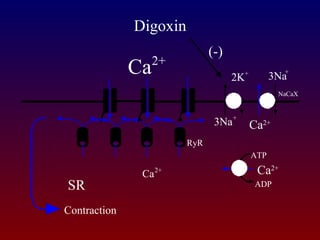
• Cardiac glycosides = digitalis glycosides
- inhibits the Na - K pump inc.
intracellular Ca
cardiac muscle fibers contract more
efficiently
- Digitalis = 3 effects on the heart 1) +
inotropic action (inc. myocard. contraction)
2) - chronotropic action (dec. HR) #) -
dromotropic action (dec. conduction of the
heart cells
SR
ATP
ADP
Ca2+
Ca2+
3Na
+
Contraction
NaCaX
ATPase
3Na+
ATPase
2K+
RyR
Digoxin
(-)
Ca2+
Ca2+
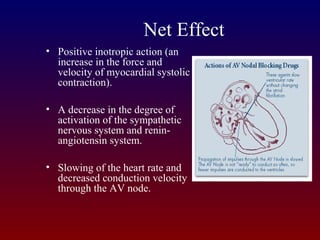
Net Effect
• Positive inotropic action (an
increase in the force and
velocity of myocardial systolic
contraction).
• A decrease in the degree of
activation of the sympathetic
nervous system and renin-
angiotensin system.
• Slowing of the heart rate and
decreased conduction velocity
through the AV node.
Pharmacokinetic Parameters• Absorption
– After oral dosing:
• Onset of action in 0.5 – 2 hours
• Peak effect reached in 2 – 6 hours
• Distribution
– Skeletal and heart muscle, but not into adipose tissue
– Up to 25-30% is bound to plasma proteins
• Metabolism
– Follows first-order kinetics
– Limited metabolism via sugar hydrolysis and lactone ring reduction
– Half-life = 1-2 days
• Excretion
– 60-80% excreted unchanged in urine
– Undergoes ACTIVE tubular secretion in the kidneys
• Action = inc. myocardial contraction (+
inotrophy),
and slows HR (- chronotropy), therefore regulating
the rate & rhythm of the heart
- Therapeutic serum levels = 0.5 - 2.0 ng/ml
• Use = moderate/severe systolic CHF, arrythmias
• SE = Dig. toxicity - bradycardia (pulse < 60),
anorexia, diarrhea, N&V, blurred vision, lethargy -
older adults more prone to toxicity
• DI - Other heart meds
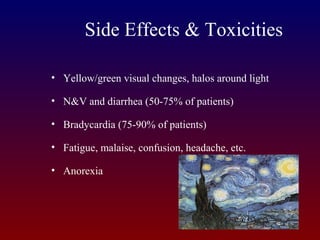
Side Effects & Toxicities
• Yellow/green visual changes, halos around light
• N&V and diarrhea (50-75% of patients)
• Bradycardia (75-90% of patients)
• Fatigue, malaise, confusion, headache, etc.
• Anorexia
Clinical Considerations
• Doses must be individualized and depends on the type & severity of the
disease, age & weight of the patient, renal function, and concomitant
disease states
• Normal dosage range is 125 – 500 mcg (50 – 200 mcg capsules) a day in
a single dose
• Contraindications: Patients w/ ventricular fibrillation, renal impairment,
hypokalemia, hypomagnesemia, hypercalcemia, and pulmonary disease
• Patient must be advised not to take nonprescription cough or cold
medications, antacids, laxatives, or antidiarrheals without consulting the
pharmacist or physician
• Pregnancy category C
Congestive heartfailure

Congestive heartfailure

  • 1.
  • 2.
    Congestive Heart Failure Definition •Impaired cardiac pumping, heart is unable to pump adequate amount of blood to meet metabolic needs • Associated with long-standing HTN and CAD
  • 3.
    Factors Affecting CardiacOutput Cardiac Output Preload Afterload Contractility Heart Rate Stroke Volume= X
  • 4.
    Factors Affecting CardiacOutput • Preload – The volume of blood/amount of fiber stretch in the ventricles at the end of diastole (i.e., before the next contraction)
  • 5.
    Factors Affecting CardiacOutput • Preload increases with: • Fluid volume increases • Vasoconstriction (“squeezes” blood from vascular system into heart) • Preload decreases with • Fluid volume losses • Vasodilation (able to “hold” more blood, therefore less returning toheart)
  • 6.
  • 7.
    Factors Affecting CardiacOutput • Afterload – The resistance against which the ventricle must pump. Excessive afterload = difficult to pump blood → reduced CO/SV – Afterload increased with: • Hypertension • Vasoconstriction – Afterload decreased with: • Vasodilation
  • 8.
    Factors Affecting CardiacOutput • Contractility – Ability of the heart muscle to contract; relates to the strength of contraction.
  • 9.
    Pathophysiology of CHF •Vasoconstriction: ↑’s the resistance against which heart has to pump (i.e., ↑’s afterload), and may therefore ↓ CO • Na and water retention: ↑’s fluid volume, which ↑’s preload. If too much “stretch” (d/t too much fluid) → ↓ strength of contraction and ↓’s CO • Excessive tachycardia → ↓’d diastolic filling time → ↓’d ventricular filling → ↓’d CO
  • 10.
    Congestive Heart Failure RiskFactors • CAD • Age • HTN • Obesity • Cigarette smoking • Diabetes mellitus • High cholesterol
  • 11.
    Congestive Heart Failure Etiology •May be caused by any interference with normal mechanisms regulating cardiac output (CO) • Common causes – HTN – Myocardial infarction – Dysrhythmias – Valvular disorders
  • 12.
    2 Types ofHeart Failure Systolic Dysfunction (Contraction) 2/3 of Patients ♥ The heart becomes weak and enlarged ♥ The weakened heart muscle can’t contract ♥ Not enough blood is pumped from the chambers Diastolic Dysfunction (Relaxation) ♥ Chambers don’t fill up so less blood goes to the lungs and body ♥ Stiff heart muscle can’t relax ♥ Not enough blood fills the chambers
  • 13.
    What is anEjection Fraction? (EF) The amount of blood that pumps out of the heart with each beat ♥ Normal EF = 50 – 65% ♥ Damaged Heart Muscle EF = 40% ♥ Potential Heart Transplant EF = 20%
  • 14.
    When the EFis Abnormal What Happens in the Body? ♥ Less blood goes to the brain that may make you feel confused or dizzy ♥ Your lungs may fill up with fluid making you feel short of breath ♥ Your kidneys may not be able to get rid of the fluid ♥ Your belly, ankles and feet may swell up
  • 15.
    Other Signs andSymptoms of CHF ♥ Extreme Fatigue ♥ Frequent Coughing ♥ Sudden Weight Gain ♥ Chest Pain or Pressure ♥ Nausea, Loss of Appetite or Bloating ♥ Decreased Urination
  • 16.
    Acute Congestive HeartFailure Clinical Manifestations • Pulmonary edema – Agitation – Pale or cyanotic – Cold – Severe dyspnea – Tachypnea – Pink, frothy sputum
  • 17.
    Chronic Congestive HeartFailure Clinical Manifestations • Fatigue • Dyspnea – Paroxysmal nocturnal dyspnea (PND) • Tachycardia • Edema – (lung, liver, abdomen, legs) • Nocturia
  • 18.
    Chronic Congestive HeartFailure Clinical Manifestations • Behavioral changes – Restlessness, confusion, ↓ attention • Chest pain (d/t ↓ CO and ↑ myocardial work) • Weight changes (r/t fluid retention) • Skin changes – Dusky appearance
  • 19.
    New York HeartAssociation Functional Classification Class I No symptoms with ordinary activity Class II Slight limitation of physical activity results in fatigue, shortness of breath, chest pain or irregular heart beat
  • 20.
    Class III Marked limitationof physical activity. Comfortable at rest, but less than ordinary physical activity results in fatigue, irregular heart beat, pain or shortness of breath Class IV Unable to carry out any physical activity without discomfort All symptoms in class III even at rest
  • 21.
    Congestive Heart Failure DiagnosticStudies • Primary goal is to determine underlying cause – Physical exam – Chest x-ray – ECG – ECHO
  • 22.
    Pharmacotherapy • Reduction ofvolume overload (reduce preload) – Diuretics • Ventricular unloading (reduce afterload) – Acute: nitroglycerin, sodium nitroprusside – Chronic: inhibit renin-angiotensin-aldosterone system, diuretics, ACE inhibitors, angiotensin antagonists – Beta-blockers (also reduce sympathetic activation) • Inotropic interventions – Acute: dobutamine – Chronic: phosphodiesterase inhibitors, digitalis
  • 23.
    1. ACE inhibitors 2.Diuretics 3. Inotropic drugs • Cardiac glycosides - Digitalis • β-agonist (Dobutamine) & • PDE inhibitors (Amirinone, milrinone)
  • 24.
    4. Vasodilators • Arteriolar-Hydralzine,minoxidil • Ca blockers- Nifedipine • K openers- Nicorandil • Venous-GTN 5. β-Adrenergic blockers – carveidilol, metoprolol
  • 25.
    Cardiac Disorders Cardiac Glycosides •Digitalis - One of the oldest drugs - Effective in treating congestive heart failure (CHF) - peripheral & lung tissues become congested = CHF
  • 26.
    • CHF canbe left sided or right sided • Cardiac glycosides = digitalis glycosides - inhibits the Na - K pump inc. intracellular Ca cardiac muscle fibers contract more efficiently - Digitalis = 3 effects on the heart 1) + inotropic action (inc. myocard. contraction) 2) - chronotropic action (dec. HR) #) - dromotropic action (dec. conduction of the heart cells
  • 27.
  • 28.
    Net Effect • Positiveinotropic action (an increase in the force and velocity of myocardial systolic contraction). • A decrease in the degree of activation of the sympathetic nervous system and renin- angiotensin system. • Slowing of the heart rate and decreased conduction velocity through the AV node.
  • 29.
    Pharmacokinetic Parameters• Absorption –After oral dosing: • Onset of action in 0.5 – 2 hours • Peak effect reached in 2 – 6 hours • Distribution – Skeletal and heart muscle, but not into adipose tissue – Up to 25-30% is bound to plasma proteins • Metabolism – Follows first-order kinetics – Limited metabolism via sugar hydrolysis and lactone ring reduction – Half-life = 1-2 days • Excretion – 60-80% excreted unchanged in urine – Undergoes ACTIVE tubular secretion in the kidneys
  • 30.
    • Action =inc. myocardial contraction (+ inotrophy), and slows HR (- chronotropy), therefore regulating the rate & rhythm of the heart - Therapeutic serum levels = 0.5 - 2.0 ng/ml • Use = moderate/severe systolic CHF, arrythmias • SE = Dig. toxicity - bradycardia (pulse < 60), anorexia, diarrhea, N&V, blurred vision, lethargy - older adults more prone to toxicity • DI - Other heart meds
  • 31.
    Side Effects &Toxicities • Yellow/green visual changes, halos around light • N&V and diarrhea (50-75% of patients) • Bradycardia (75-90% of patients) • Fatigue, malaise, confusion, headache, etc. • Anorexia
  • 32.
    Clinical Considerations • Dosesmust be individualized and depends on the type & severity of the disease, age & weight of the patient, renal function, and concomitant disease states • Normal dosage range is 125 – 500 mcg (50 – 200 mcg capsules) a day in a single dose • Contraindications: Patients w/ ventricular fibrillation, renal impairment, hypokalemia, hypomagnesemia, hypercalcemia, and pulmonary disease • Patient must be advised not to take nonprescription cough or cold medications, antacids, laxatives, or antidiarrheals without consulting the pharmacist or physician • Pregnancy category C

Editor's Notes

  • #13 2 Types of Heart Failure Systolic Dysfunction (Contraction) 2/3 of Patients ♥ The heart becomes weak and enlarged ♥ The weakened heart muscle can’t contract ♥ Not enough blood is pumped from the chambers Diastolic Dysfunction (Relaxation) ♥ Chambers don’t fill up so less blood goes to the lungs and body ♥ Stiff heart muscle can’t relax ♥ Not enough blood fills the chambers
  • #14 What is an Ejection Fraction? (EF) The amount of blood that pumps out of the heart with each beat ♥ Normal EF = 50 – 65% ♥ Damaged Heart Muscle EF = 40% ♥ Potential Heart Transplant EF = 20%
  • #15 When the EF is Abnormal What Happens in the Body? ♥ Less blood goes to the brain that may make you feel confused or dizzy ♥ Your lungs may fill up with fluid making you feel short of breath ♥ Your kidneys may not be able to get rid of the fluid ♥ Your belly, ankles and feet may swell up
  • #16 Other Signs and Symptoms of CHF ♥ Extreme Fatigue ♥ Frequent Coughing ♥ Sudden Weight Gain ♥ Chest Pain or Pressure ♥ Nausea, Loss of Appetite or Bloating ♥ Decreased Urination
  • #20 New York Heart Association Functional Classification Class I No symptoms with ordinary activity Class II Slight limitation of physical activity results in fatigue, shortness of breath, chest pain or irregular heart beat
  • #21 New York Heart Association Functional Classification Class III Marked limitation of physical activity. Comfortable at rest, but less than ordinary physical activity results in fatigue, irregular heart beat, pain or shortness of breath Class IV Unable to carry out any physical activity without discomfort All symptoms in class III even at rest