Pharmacotherapy: Cardiac
Arrhythmias
Dr. Pravin Prasad
MBBS, MD Clinical Pharmacology
Assistant Professor, Department of Clinical
Pharmacology
Maharajgunj Medical Campus, Kathmandu
15 June 2020 (1 Asar 2077), Monday
By the end of this class, B. Pharm 2nd
year students will be able to:
 Define the term arrhythmia
 Explain the basic mechanism of arrhythmias
 List the clinical presentation of arrhythmias
 Outline the therapeutic objective and treatment options of
arrhythmias
 Explain the pharmacotherapy of arrhythmia
 List the drugs used for treatment of different arrhythmias
Introduction
 Arrhythmia is loss of cardiac rhythm, especially irregularity of
heartbeat
Can be physiological as well as pathological
 Arrhythmias may require treatment if:
Rhythms that are too rapid, too slow, or asynchronous leading to
reduced cardiac output
Has potential to precipitate more serious or even lethal rhythm
disturbances
 Asymptomatic or minimally symptomatic arrhythmias should not be
treated with drugs
Anti-arrhythmic drugs can precipitate lethal arrhythmias
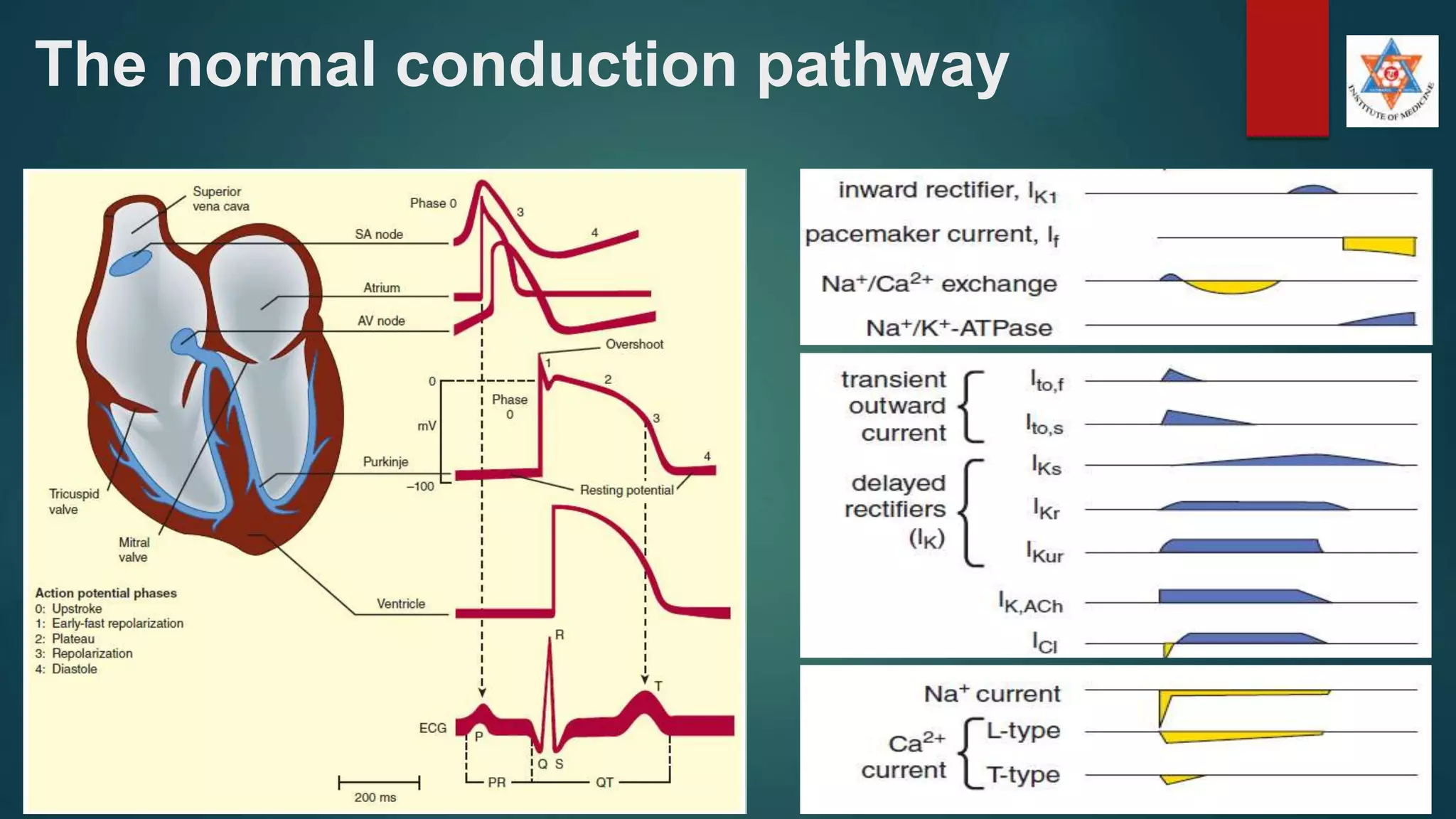
The normal conduction pathway
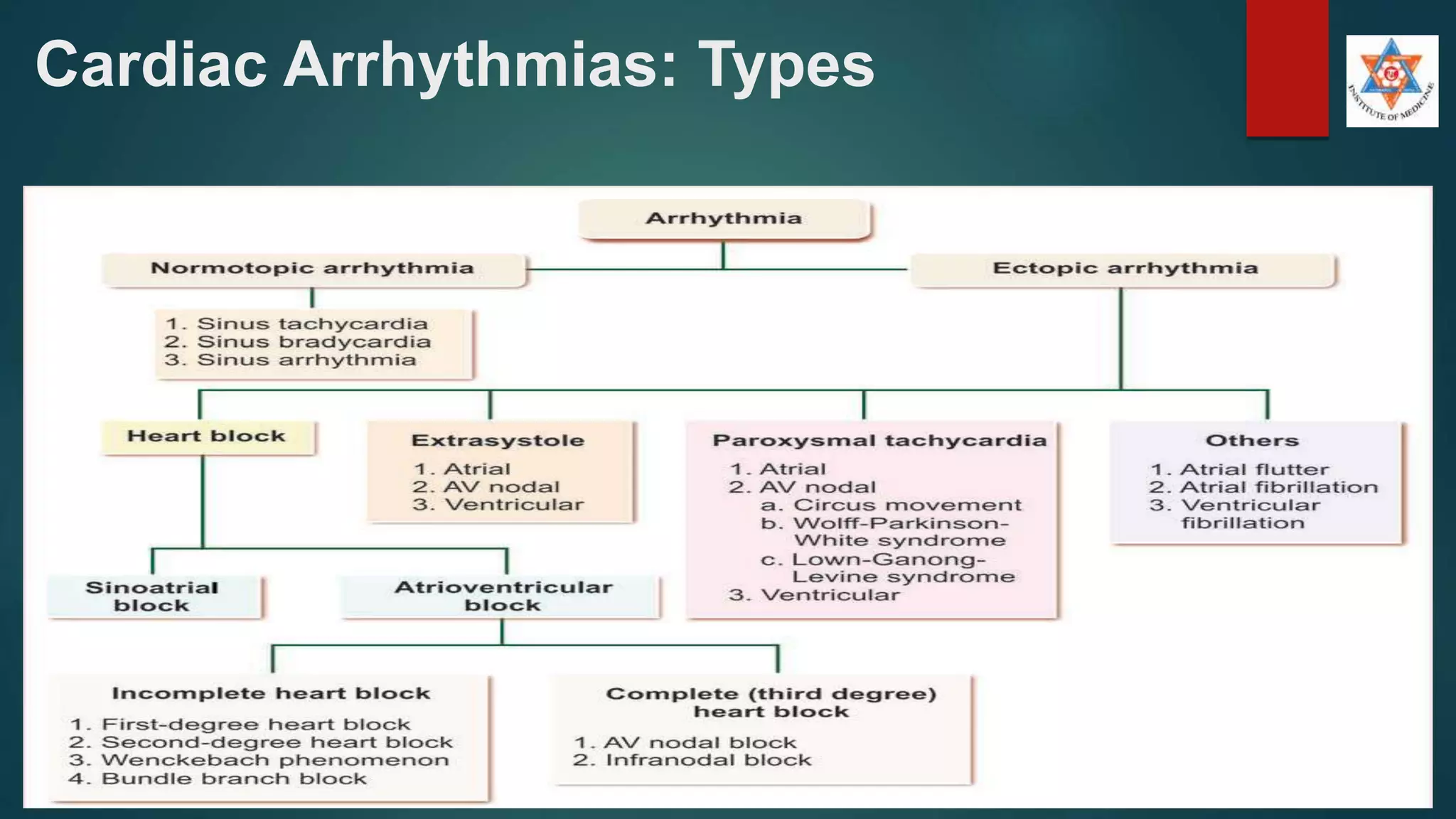
Cardiac Arrhythmias: Types
Arrhythmias: Mechanism
 Basic mechanism:
Disturbances in impulse formation
Disturbances in impulse conduction
 Precipitating factors:
Ischemia, hypoxia
Acidosis or alkalosis, electrolyte abnormalities
Excessive catecholamine exposure, autonomic influences
Drug toxicity (eg, digitalis or antiarrhythmic drugs)
Overstretching of cardiac fibers
Presence of scarred or otherwise diseased tissue
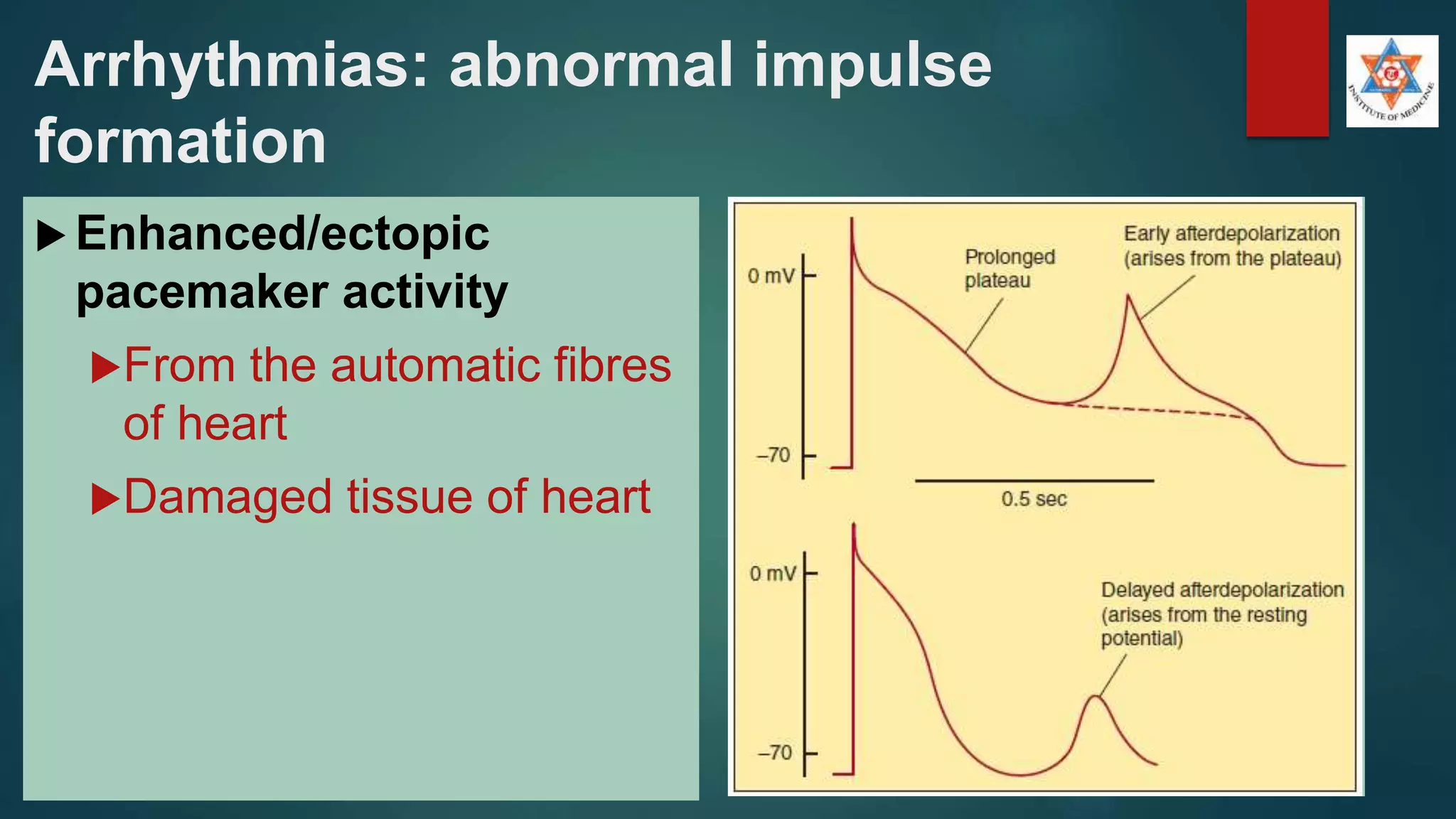
Arrhythmias: abnormal impulse
formation
 Enhanced/ectopic
pacemaker activity
From the automatic fibres
of heart
Damaged tissue of heart
Arrhythmias: abnormal impulse
formation
 After-depolarizations
Secondary depolarizations
accompanying a normal or
premature action potential
Early after-depolarization
(EAD)
Large impulse is
generated during
repolarization that gets
propagated
Arrhythmias: abnormal impulse
formation
 After-depolarizations
 Secondary depolarizations
accompanying a normal or
premature action potential
Delayed after-depolarization
(DAD):
Secondary deflection
after reaching RMP
Generally results from
Ca2+ overload (digitalis
toxicity, ischaemia-
reperfusion).
Arrhythmias: Abnormal impulse
transmission
 Reentry
Primarily due to abnormality
of conduction
Impulse recirculate and
cause repetitive activation
Are called reentrant
arrhythmias
Of several types:
Circus movement entry
Functional re-entry
Fractionation of impulse
Clinical Presentation
 Supraventricular tachycardias:
No symptoms to minor palpitations or irregular pulse to
severe and even life-threatening symptoms
Dizziness or acute syncopal episodes, symptoms of HF,
anginal chest pain, or a choking or pressure sensation
during the tachycardia episode
 AF or atrial flutter:
Similar to SVTs, but syncope is uncommon
Embolic stroke
Clinical Presentation
 Premature Ventricular Contractions:
Mild palpitations
 Ventricular tachycardia:
Totally asymptomatic to pulseless hemodynamic collapse
 Ventricular proarrhythmia:
No symptoms to worsening of symptoms to sudden death
 Ventricular Fibrillation:
Hemodynamic collapse, syncope, and cardiac arrest
Clinical Presentation
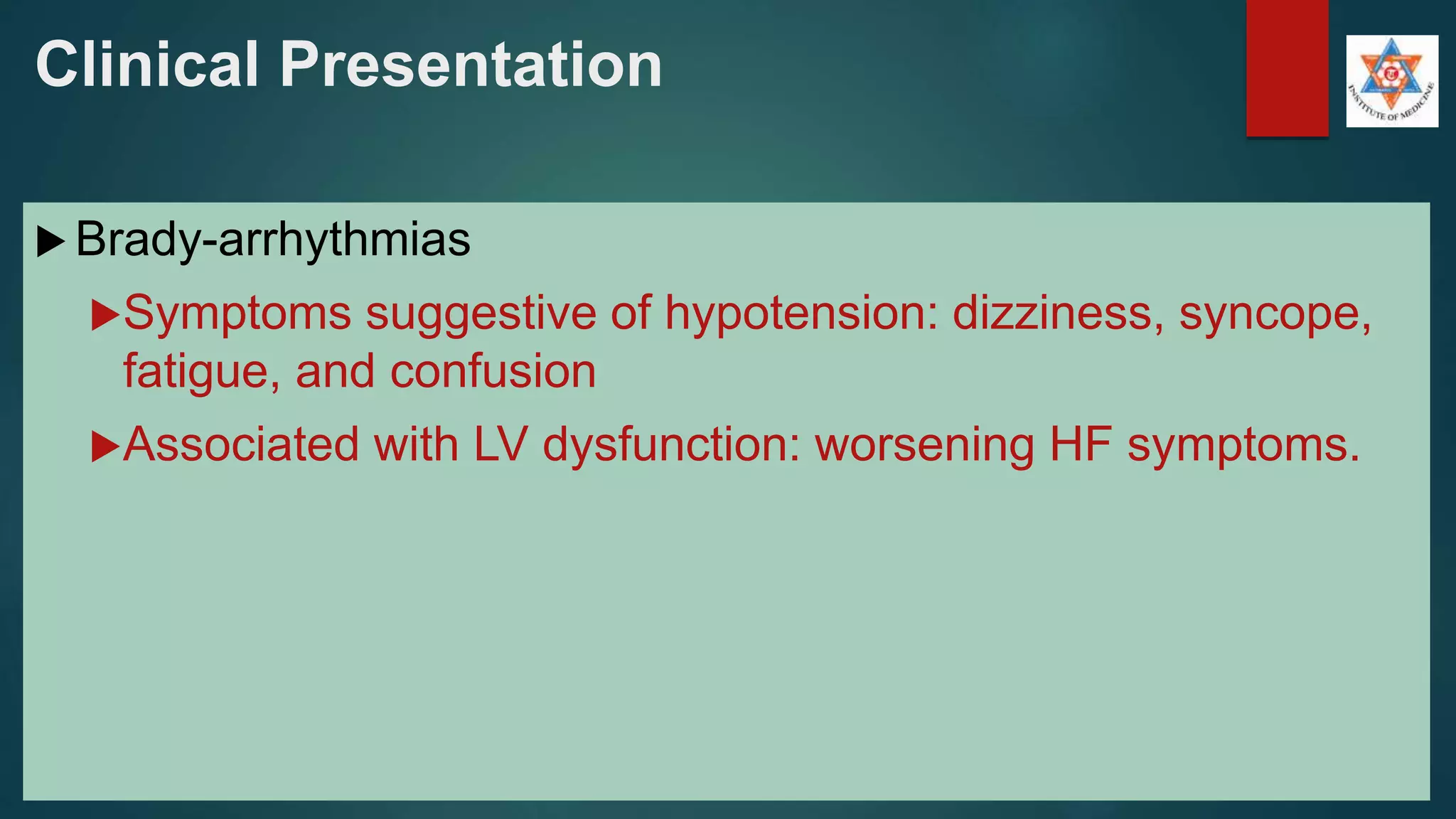
 Brady-arrhythmias
Symptoms suggestive of hypotension: dizziness, syncope,
fatigue, and confusion
Associated with LV dysfunction: worsening HF symptoms.
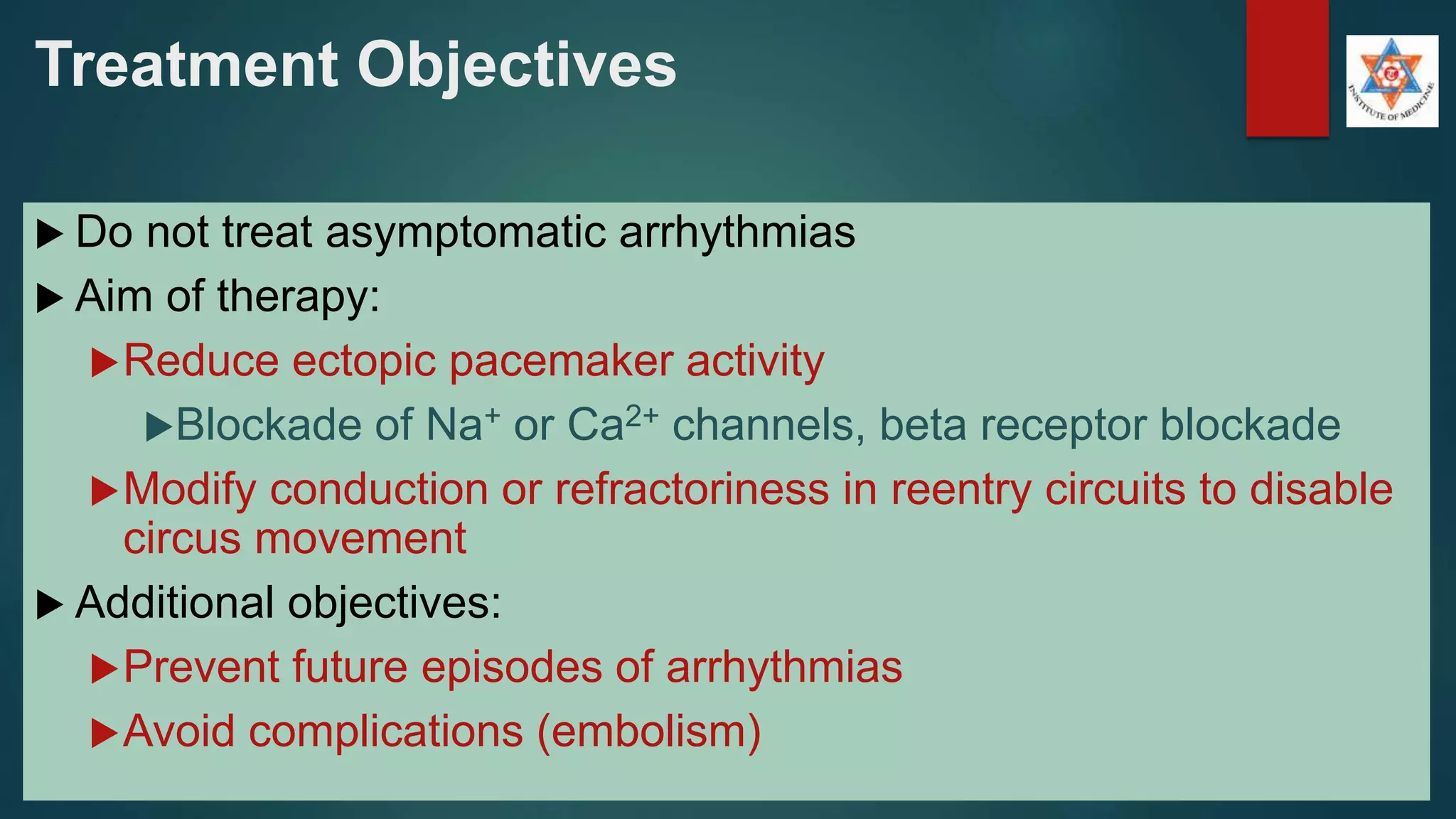
Treatment Objectives
 Do not treat asymptomatic arrhythmias
 Aim of therapy:
Reduce ectopic pacemaker activity
Blockade of Na+ or Ca2+ channels, beta receptor blockade
Modify conduction or refractoriness in reentry circuits to disable
circus movement
 Additional objectives:
Prevent future episodes of arrhythmias
Avoid complications (embolism)
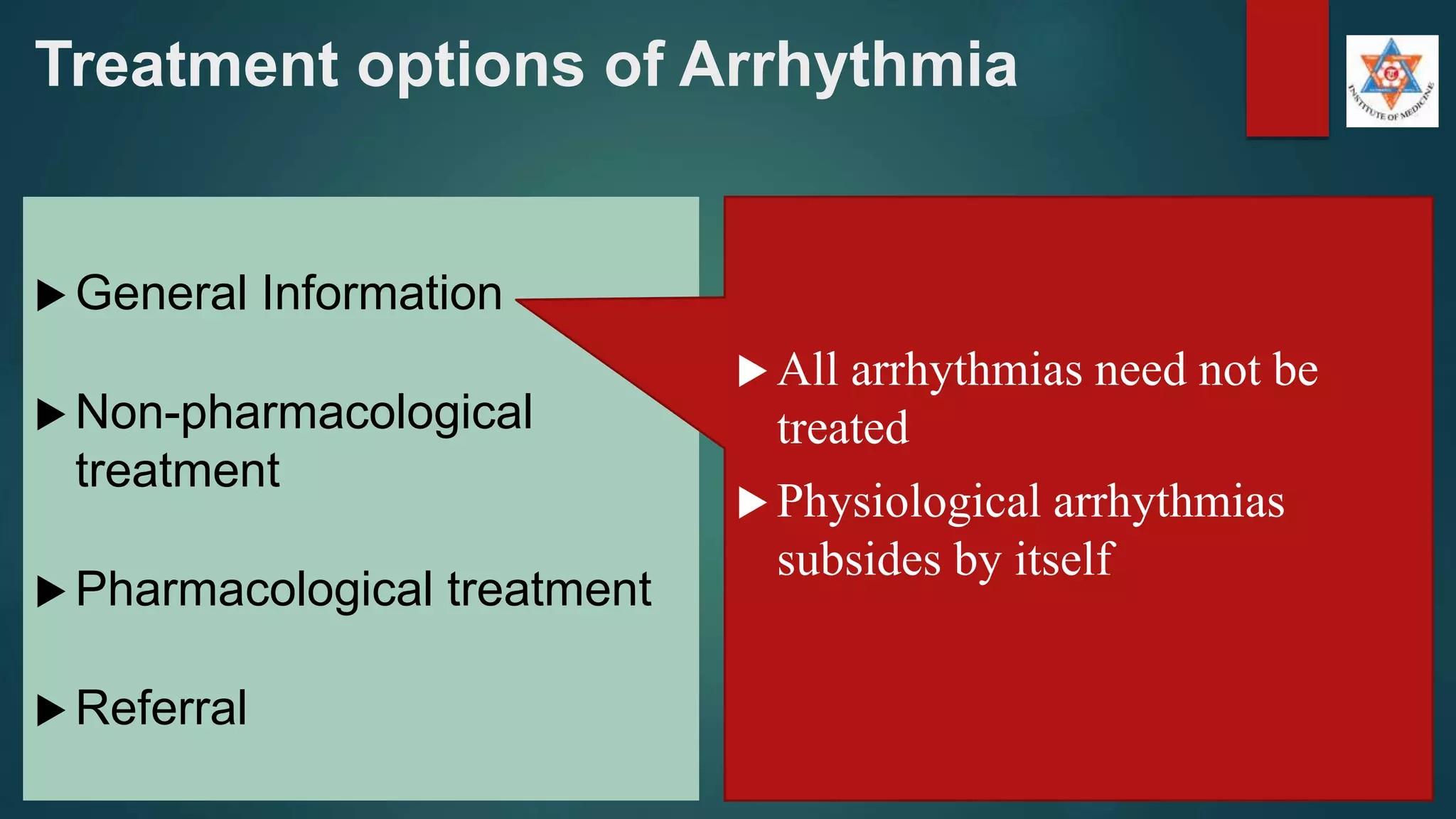
Treatment options of Arrhythmia
 General Information
 Non-pharmacological
treatment
 Pharmacological treatment
 Referral
 All arrhythmias need not be
treated
 Physiological arrhythmias
subsides by itself
Treatment options of Arrhythmia
 General Information
 Non-pharmacological
treatment
 Pharmacological treatment
 Referral
• Surgical Procedures:
• Radiofrequency catheter
ablation
• Cryoablation
• Permanent pacemaker
implantation
• Implantable cardio-defibrillator
• Carotid sinus massage
Treatment options of Arrhythmia
 General Information
 Non-pharmacological
treatment
 Pharmacological treatment
 Referral
• Drugs to terminate an episode of
arrhythmia
• Drugs to prevent future episodes
of arrhythmia
• Drug to prevent development of
complications
• Heart failure
• Haemodynamic collapse
• Anti-thrombotic
Classification of antiarrhythmic
agents
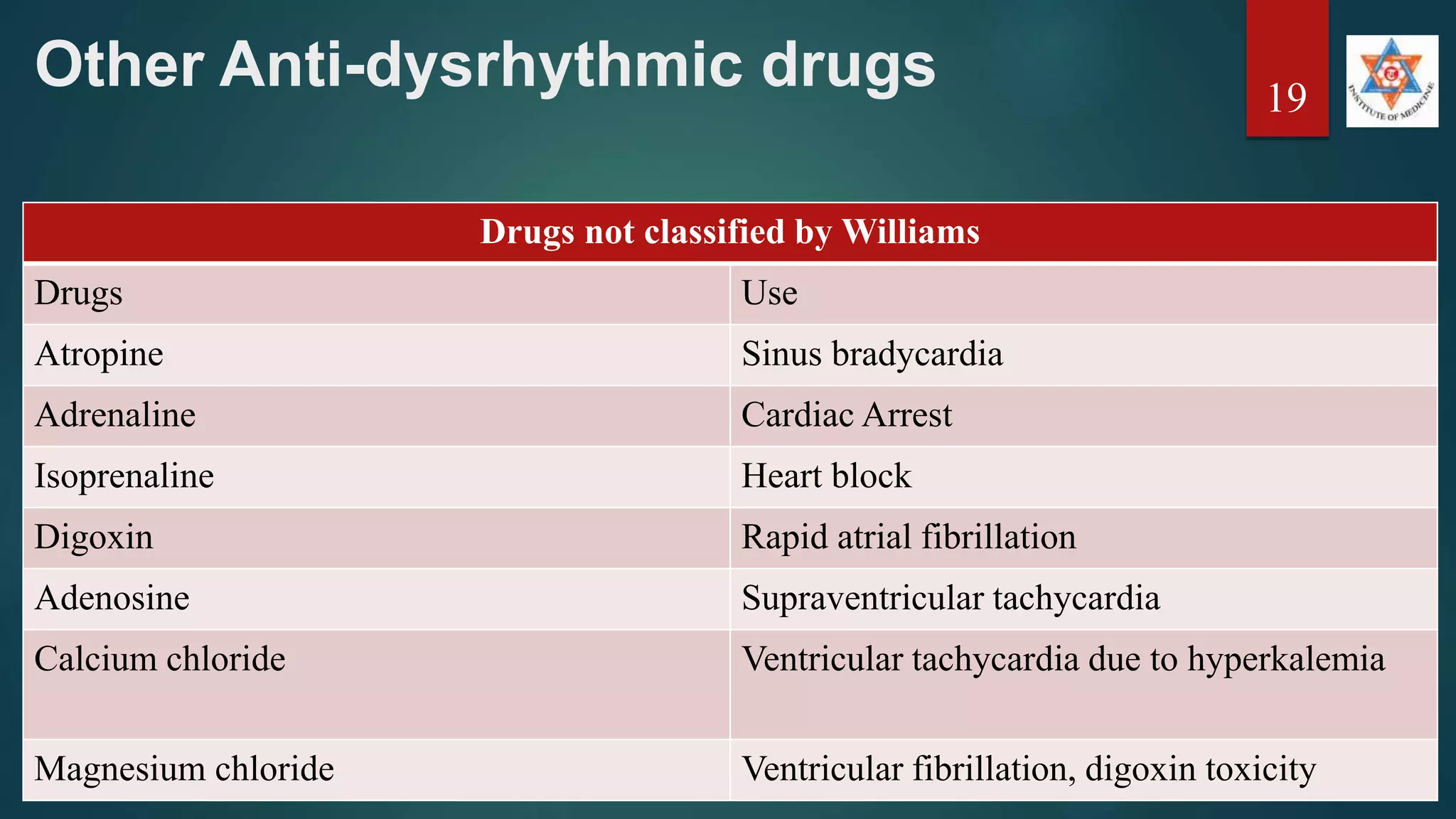
Other Anti-dysrhythmic drugs
Drugs not classified by Williams
Drugs Use
Atropine Sinus bradycardia
Adrenaline Cardiac Arrest
Isoprenaline Heart block
Digoxin Rapid atrial fibrillation
Adenosine Supraventricular tachycardia
Calcium chloride Ventricular tachycardia due to hyperkalemia
Magnesium chloride Ventricular fibrillation, digoxin toxicity
19
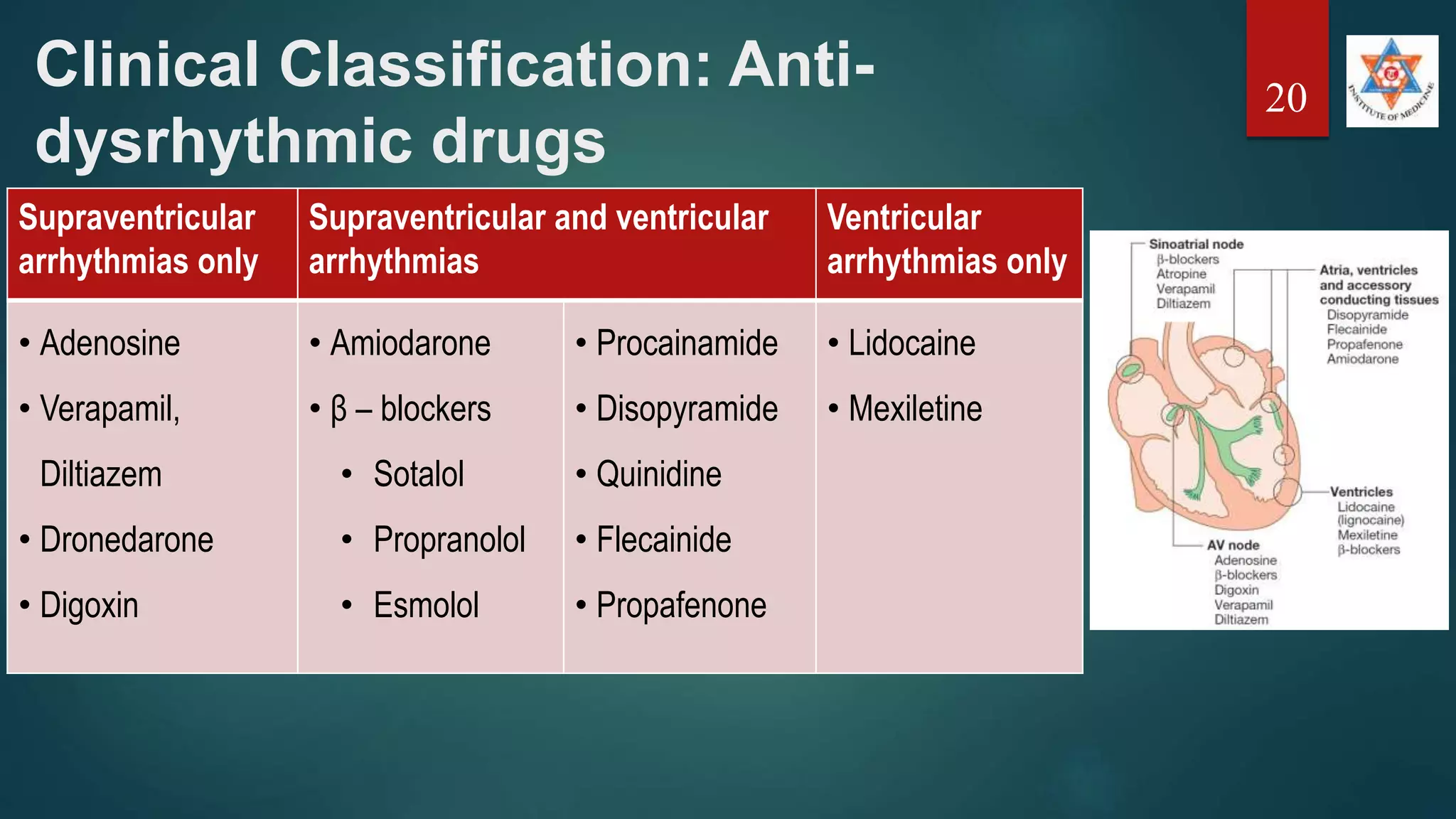
Clinical Classification: Anti-
dysrhythmic drugs
Supraventricular
arrhythmias only
Supraventricular and ventricular
arrhythmias
Ventricular
arrhythmias only
• Adenosine
• Verapamil,
Diltiazem
• Dronedarone
• Digoxin
• Amiodarone
• β – blockers
• Sotalol
• Propranolol
• Esmolol
• Procainamide
• Disopyramide
• Quinidine
• Flecainide
• Propafenone
• Lidocaine
• Mexiletine
20
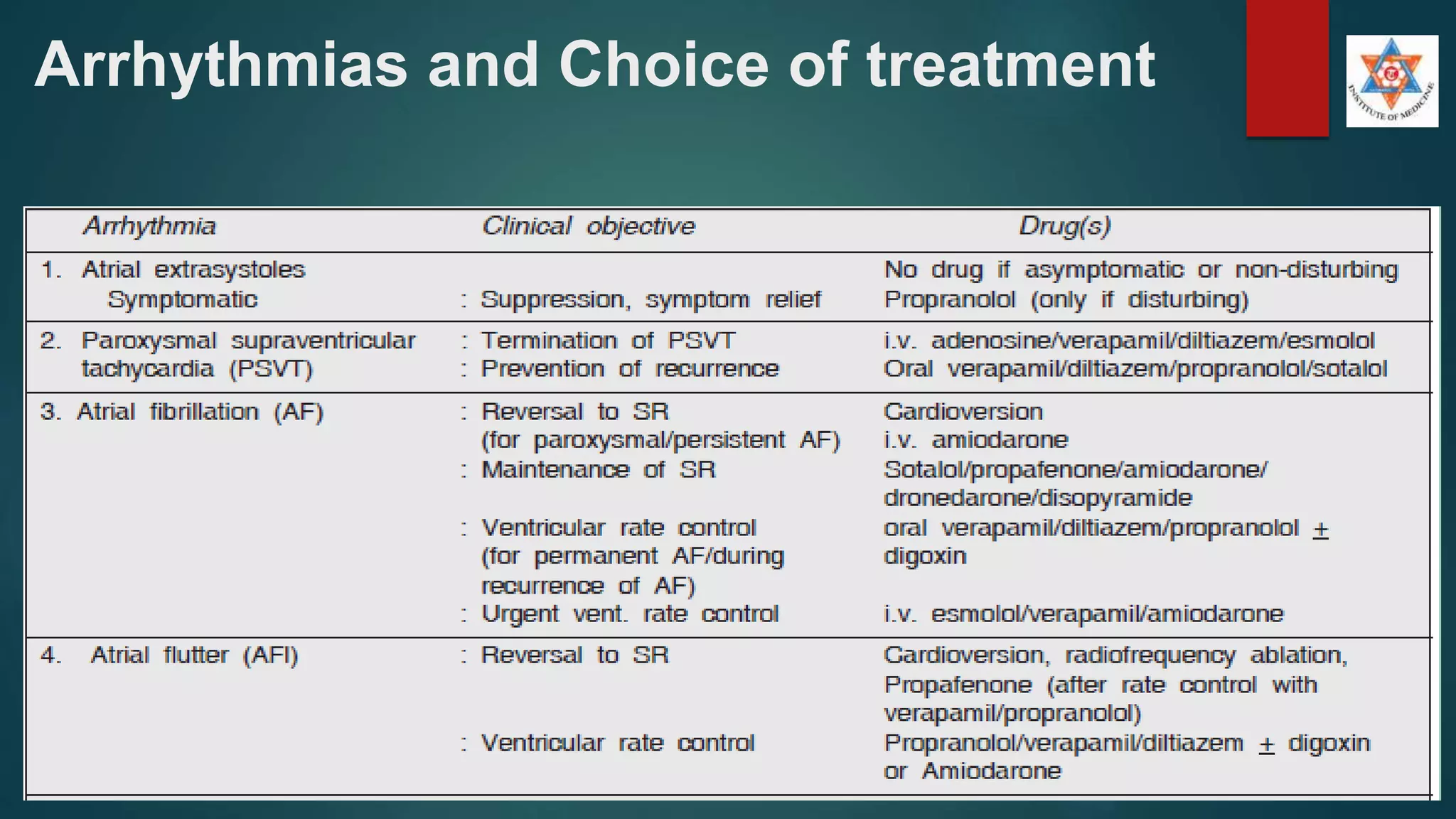
Arrhythmias and Choice of treatment
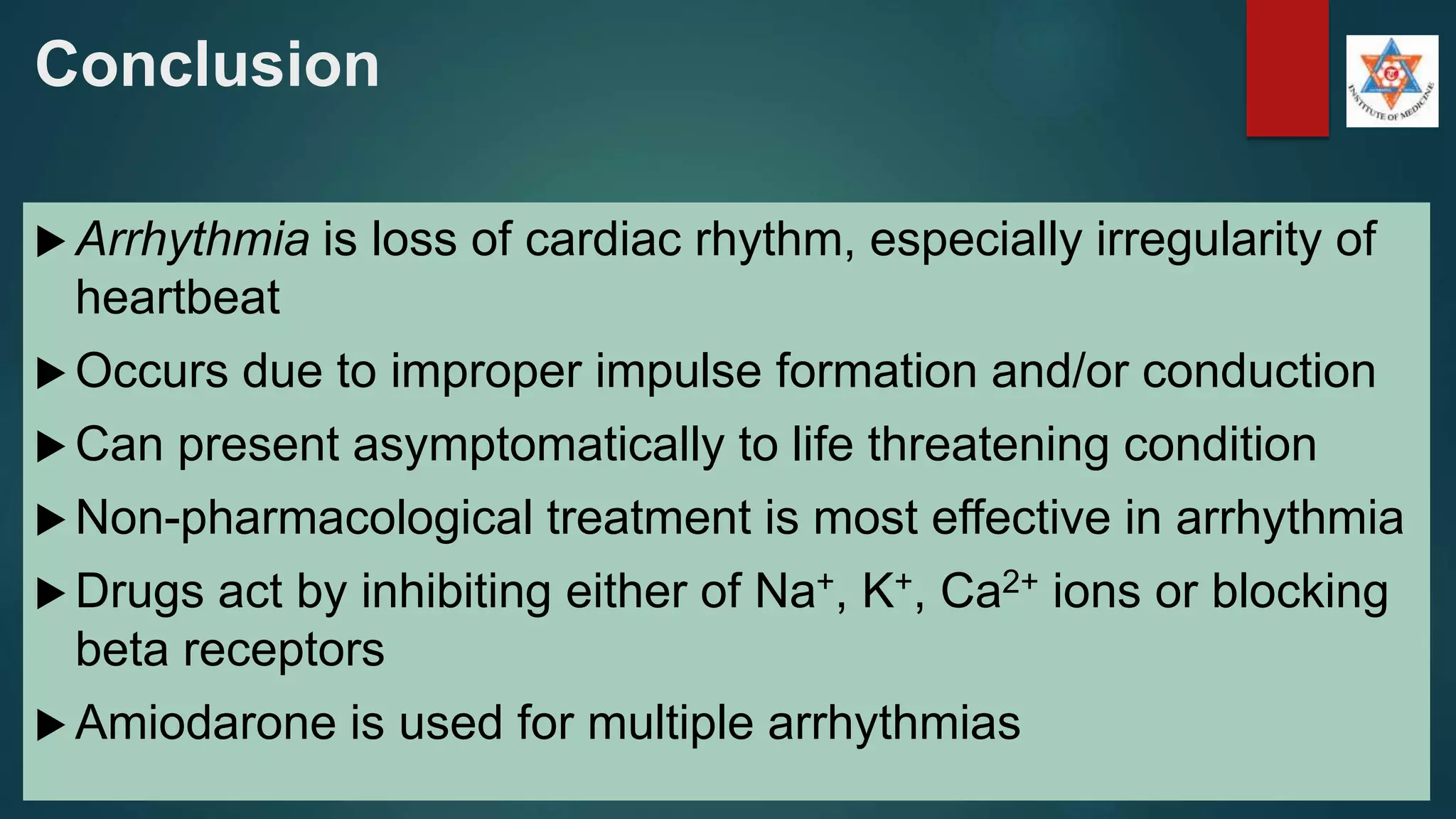
Conclusion
 Arrhythmia is loss of cardiac rhythm, especially irregularity of
heartbeat
 Occurs due to improper impulse formation and/or conduction
 Can present asymptomatically to life threatening condition
 Non-pharmacological treatment is most effective in arrhythmia
 Drugs act by inhibiting either of Na+, K+, Ca2+ ions or blocking
beta receptors
 Amiodarone is used for multiple arrhythmias

Pharmacotherapy of arrhythmia

  • 1.
    Pharmacotherapy: Cardiac Arrhythmias Dr. PravinPrasad MBBS, MD Clinical Pharmacology Assistant Professor, Department of Clinical Pharmacology Maharajgunj Medical Campus, Kathmandu 15 June 2020 (1 Asar 2077), Monday
  • 2.
    By the endof this class, B. Pharm 2nd year students will be able to:  Define the term arrhythmia  Explain the basic mechanism of arrhythmias  List the clinical presentation of arrhythmias  Outline the therapeutic objective and treatment options of arrhythmias  Explain the pharmacotherapy of arrhythmia  List the drugs used for treatment of different arrhythmias
  • 3.
    Introduction  Arrhythmia isloss of cardiac rhythm, especially irregularity of heartbeat Can be physiological as well as pathological  Arrhythmias may require treatment if: Rhythms that are too rapid, too slow, or asynchronous leading to reduced cardiac output Has potential to precipitate more serious or even lethal rhythm disturbances  Asymptomatic or minimally symptomatic arrhythmias should not be treated with drugs Anti-arrhythmic drugs can precipitate lethal arrhythmias
  • 4.
  • 5.
  • 6.
    Arrhythmias: Mechanism  Basicmechanism: Disturbances in impulse formation Disturbances in impulse conduction  Precipitating factors: Ischemia, hypoxia Acidosis or alkalosis, electrolyte abnormalities Excessive catecholamine exposure, autonomic influences Drug toxicity (eg, digitalis or antiarrhythmic drugs) Overstretching of cardiac fibers Presence of scarred or otherwise diseased tissue
  • 7.
    Arrhythmias: abnormal impulse formation Enhanced/ectopic pacemaker activity From the automatic fibres of heart Damaged tissue of heart
  • 8.
    Arrhythmias: abnormal impulse formation After-depolarizations Secondary depolarizations accompanying a normal or premature action potential Early after-depolarization (EAD) Large impulse is generated during repolarization that gets propagated
  • 9.
    Arrhythmias: abnormal impulse formation After-depolarizations  Secondary depolarizations accompanying a normal or premature action potential Delayed after-depolarization (DAD): Secondary deflection after reaching RMP Generally results from Ca2+ overload (digitalis toxicity, ischaemia- reperfusion).
  • 10.
    Arrhythmias: Abnormal impulse transmission Reentry Primarily due to abnormality of conduction Impulse recirculate and cause repetitive activation Are called reentrant arrhythmias Of several types: Circus movement entry Functional re-entry Fractionation of impulse
  • 11.
    Clinical Presentation  Supraventriculartachycardias: No symptoms to minor palpitations or irregular pulse to severe and even life-threatening symptoms Dizziness or acute syncopal episodes, symptoms of HF, anginal chest pain, or a choking or pressure sensation during the tachycardia episode  AF or atrial flutter: Similar to SVTs, but syncope is uncommon Embolic stroke
  • 12.
    Clinical Presentation  PrematureVentricular Contractions: Mild palpitations  Ventricular tachycardia: Totally asymptomatic to pulseless hemodynamic collapse  Ventricular proarrhythmia: No symptoms to worsening of symptoms to sudden death  Ventricular Fibrillation: Hemodynamic collapse, syncope, and cardiac arrest
  • 13.
    Clinical Presentation  Brady-arrhythmias Symptomssuggestive of hypotension: dizziness, syncope, fatigue, and confusion Associated with LV dysfunction: worsening HF symptoms.
  • 14.
    Treatment Objectives  Donot treat asymptomatic arrhythmias  Aim of therapy: Reduce ectopic pacemaker activity Blockade of Na+ or Ca2+ channels, beta receptor blockade Modify conduction or refractoriness in reentry circuits to disable circus movement  Additional objectives: Prevent future episodes of arrhythmias Avoid complications (embolism)
  • 15.
    Treatment options ofArrhythmia  General Information  Non-pharmacological treatment  Pharmacological treatment  Referral  All arrhythmias need not be treated  Physiological arrhythmias subsides by itself
  • 16.
    Treatment options ofArrhythmia  General Information  Non-pharmacological treatment  Pharmacological treatment  Referral • Surgical Procedures: • Radiofrequency catheter ablation • Cryoablation • Permanent pacemaker implantation • Implantable cardio-defibrillator • Carotid sinus massage
  • 17.
    Treatment options ofArrhythmia  General Information  Non-pharmacological treatment  Pharmacological treatment  Referral • Drugs to terminate an episode of arrhythmia • Drugs to prevent future episodes of arrhythmia • Drug to prevent development of complications • Heart failure • Haemodynamic collapse • Anti-thrombotic
  • 18.
  • 19.
    Other Anti-dysrhythmic drugs Drugsnot classified by Williams Drugs Use Atropine Sinus bradycardia Adrenaline Cardiac Arrest Isoprenaline Heart block Digoxin Rapid atrial fibrillation Adenosine Supraventricular tachycardia Calcium chloride Ventricular tachycardia due to hyperkalemia Magnesium chloride Ventricular fibrillation, digoxin toxicity 19
  • 20.
    Clinical Classification: Anti- dysrhythmicdrugs Supraventricular arrhythmias only Supraventricular and ventricular arrhythmias Ventricular arrhythmias only • Adenosine • Verapamil, Diltiazem • Dronedarone • Digoxin • Amiodarone • β – blockers • Sotalol • Propranolol • Esmolol • Procainamide • Disopyramide • Quinidine • Flecainide • Propafenone • Lidocaine • Mexiletine 20
  • 21.
  • 22.
  • 23.
    Conclusion  Arrhythmia isloss of cardiac rhythm, especially irregularity of heartbeat  Occurs due to improper impulse formation and/or conduction  Can present asymptomatically to life threatening condition  Non-pharmacological treatment is most effective in arrhythmia  Drugs act by inhibiting either of Na+, K+, Ca2+ ions or blocking beta receptors  Amiodarone is used for multiple arrhythmias

Editor's Notes

  • #4 Arrhythmias may require treatment because rhythms that are too rapid, too slow, or asynchronous can reduce cardiac output Some arrhythmias can precipitate more serious or even lethal rhythm disturbances; for example, early premature ventricular depolarizations can precipitate ventricular fibrillation. In such patients, antiarrhythmic drugs may be lifesaving. On the other hand, the hazards of antiarrhythmic drugs—and in particular the fact that they can precipitate lethal arrhythmias in some patients—have led to a reevaluation of their relative risks and benefits. In general, treatment of asymptomatic or minimally symptomatic arrhythmias should be avoided for this reason.
  • #8 Enhanced/ectopic pacemaker activity The slope of phase-4 depolarization may be increased pathologically in the automatic fibres or such activity may appear in ordinary fibres. Ectopic impulse may also result from current of injury. Myocardial cells damaged by ischaemia become partially depolarized: a current may flow between these and normally polarized fibres (injury current) and initiate an impulse.
  • #9 After-depolarizations These are secondary depolarizations accompanying a normal or premature action potential (AP), Fig. 38.1. Early after-depolarization (EAD): Repolarization during phase-3 is interrupted and membrane potential oscillates. If the amplitude of oscillations is sufficiently large, neighbouring tissue is activated and a series of impulses are propagated. EADs are frequently associated with long Q-T interval due to slow repolarization and markedly prolonged APs. They result from depression of delayed rectifier K+ current.
  • #10 After-depolarizations These are secondary depolarizations accompanying a normal or premature action potential (AP), Fig. 38.1. Delayed after-depolarization (DAD): After attaining resting membrane potential (RMP) a secondary deflection occurs which may reach threshold potential and initiate a single premature AP. This generally results from Ca2+ overload (digitalis toxicity, ischaemia-reperfusion).
  • #11 Circus movement entry: often responsible for PSVT, atrial flutter and atrioventricular reciprocal rhythm in WPW.
  • #12 Supraventricular tachycardias may cause clinical manifestations ranging from no symptoms to minor palpitations or irregular pulse to severe and even life-threatening symptoms. Patients may experience dizziness or acute syncopal episodes, symptoms of HF, anginal chest pain, or, more often, a choking or pressure sensation during the tachycardia episode. AF or atrial flutter may be manifested by the entire range of symptoms associated with other supraventricular tachycardias, but syncope is uncommon. Arterial embolization from atrial stasis and poorly adherent mural thrombi may result in embolic stroke.
  • #13 PVCs often cause no symptoms or only mild palpitations. The presentation of VT may vary from totally asymptomatic to pulseless hemodynamic collapse. Consequences of proarrhythmia range from no symptoms to worsening of symptoms to sudden death. VF results in hemodynamic collapse, syncope, and cardiac arrest.
  • #15 Modify conduction or refractoriness in reentry circuits to disable circus movement Decrease the number of available Na+ channels  decreased current Increased time to reach to resting state (prolonged refractory period)