Determination
of 𝒕 𝒎𝒂𝒙
Prepared by:
Imran Ahammad chowdhury
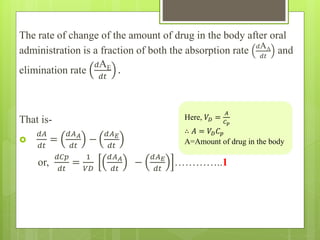
The rate of change of the amount of drug in the body after oral
administration is a fraction of both the absorption rate 𝑑AA
𝑑𝑡
and
elimination rate
𝑑AE
𝑑𝑡
.
That is-

𝑑𝐴
𝑑𝑡
=
𝑑𝐴 𝐴
𝑑𝑡
−
𝑑𝐴 𝐸
𝑑𝑡
or,
𝑑𝐶𝑝
𝑑𝑡
=
1
𝑉𝐷
𝑑𝐴 𝐴
𝑑𝑡
−
𝑑𝐴 𝐸
𝑑𝑡
…………..1
Here, 𝑉𝐷 =
𝐴
𝐶 𝑝
∴ 𝐴 = 𝑉𝐷 𝐶 𝑝
A=Amount of drug in the body
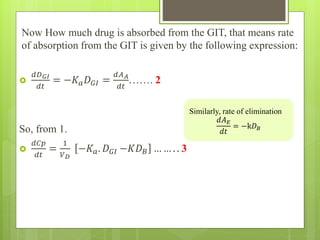
Now How much drug is absorbed from the GIT, that means rate
of absorption from the GIT is given by the following expression:

𝑑𝐷 𝐺𝐼
𝑑𝑡
= −𝐾 𝑎 𝐷 𝐺𝐼 =
𝑑𝐴 𝐴
𝑑𝑡
……. 2
So, from 1.

𝑑𝐶𝑝
𝑑𝑡
=
1
𝑉 𝐷
−𝐾 𝑎. 𝐷 𝐺𝐼 −𝐾𝐷 𝐵 … … . . 3
Similarly, rate of elimination
𝑑𝐴 𝐸
𝑑𝑡
= −k𝐷 𝐵
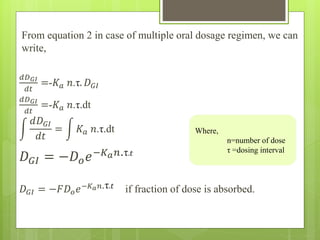
From equation 2 in case of multiple oral dosage regimen, we can
write,
𝑑𝐷 𝐺𝐼
𝑑𝑡
=-𝐾 𝑎 𝑛.τ. 𝐷 𝐺𝐼
𝑑𝐷 𝐺𝐼
𝑑𝑡
=-𝐾 𝑎 𝑛.τ.dt
𝑑𝐷 𝐺𝐼
𝑑𝑡
= 𝐾𝑎 𝑛.τ.dt
𝐷 𝐺𝐼 = −𝐷 𝑜 𝑒−𝐾 𝑎 𝑛.τ.𝑡
𝐷 𝐺𝐼 = −𝐹𝐷 𝑜 𝑒−𝐾 𝑎 𝑛.τ.𝑡
if fraction of dose is absorbed.
Where,
n=number of dose
τ =dosing interval
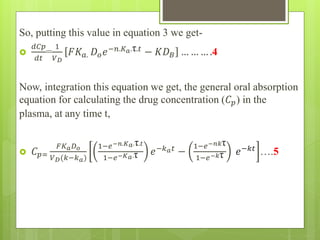
So, putting this value in equation 3 we get-

𝑑𝐶𝑝
𝑑𝑡
=
1
𝑉 𝐷
𝐹𝐾 𝑎. 𝐷 𝑜 𝑒−𝑛.𝐾 𝑎.τ.𝑡
− 𝐾𝐷 𝐵 … … … .4
Now, integration this equation we get, the general oral absorption
equation for calculating the drug concentration (𝐶 𝑝) in the
plasma, at any time t,
 𝐶 𝑝=
𝐹𝐾 𝑎 𝐷 𝑜
𝑉 𝐷(𝑘−𝑘 𝑎)
1−𝑒−𝑛.𝐾 𝑎.τ.𝑡
1−𝑒−𝐾 𝑎.τ 𝑒−𝑘 𝑎 𝑡 −
1−𝑒−𝑛𝑘τ
1−𝑒−𝑘τ 𝑒−𝑘𝑡 ….5
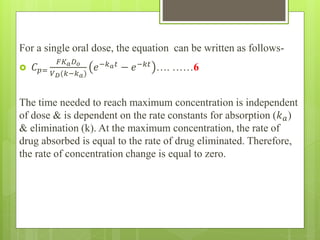
For a single oral dose, the equation can be written as follows-
 𝐶 𝑝=
𝐹𝐾 𝑎 𝐷 𝑜
𝑉 𝐷(𝑘−𝑘 𝑎)
𝑒−𝑘 𝑎 𝑡 − 𝑒−𝑘𝑡 …. ……6
The time needed to reach maximum concentration is independent
of dose & is dependent on the rate constants for absorption (𝑘 𝑎)
& elimination (k). At the maximum concentration, the rate of
drug absorbed is equal to the rate of drug eliminated. Therefore,
the rate of concentration change is equal to zero.
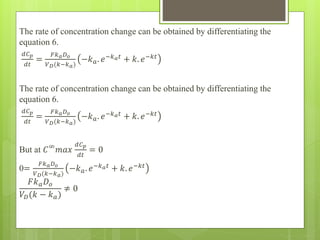
The rate of concentration change can be obtained by differentiating the
equation 6.
𝑑𝐶 𝑝
𝑑𝑡
=
𝐹𝑘 𝑎 𝐷 𝑜
𝑉 𝐷(𝑘−𝑘 𝑎)
−𝑘 𝑎. 𝑒−𝑘 𝑎 𝑡
+ 𝑘. 𝑒−𝑘𝑡
The rate of concentration change can be obtained by differentiating the
equation 6.
𝑑𝐶 𝑝
𝑑𝑡
=
𝐹𝑘 𝑎 𝐷 𝑜
𝑉 𝐷(𝑘−𝑘 𝑎)
−𝑘 𝑎. 𝑒−𝑘 𝑎 𝑡
+ 𝑘. 𝑒−𝑘𝑡
But at 𝐶∞
𝑚𝑎𝑥
𝑑𝐶 𝑝
𝑑𝑡
= 0
0=
𝐹𝑘 𝑎 𝐷 𝑜
𝑉 𝐷(𝑘−𝑘 𝑎)
−𝑘 𝑎. 𝑒−𝑘 𝑎 𝑡 + 𝑘. 𝑒−𝑘𝑡
𝐹𝑘 𝑎 𝐷 𝑜
𝑉𝐷(𝑘 − 𝑘 𝑎)
≠ 0
−𝑘 𝑎. 𝑒−𝑘 𝑎 𝑡 + 𝑘. 𝑒−𝑘𝑡 = 0
or, 𝑘 𝑎. 𝑒−𝑘 𝑎 𝑡 = 𝑘. 𝑒−𝑘𝑡
or, ln 𝑘 − 𝑘𝑡 = ln 𝑘 𝑎 − 𝑘 𝑎t
or, 𝑘 𝑎t − 𝑘𝑡 = ln 𝑘 𝑎 − ln 𝑘
or, t(𝑘 𝑎 − 𝑘)= ln 𝑘 𝑎 − ln 𝑘
or, 𝑡 𝑚𝑎𝑥 =
ln 𝑘 𝑎−𝑘
𝑘 𝑎−𝑘
=
2.303 log
𝑘 𝑎
𝑘
𝑘 𝑎−𝑘
Thank you

T max calculation[1]

  • 1.
  • 2.
    The rate ofchange of the amount of drug in the body after oral administration is a fraction of both the absorption rate 𝑑AA 𝑑𝑡 and elimination rate 𝑑AE 𝑑𝑡 . That is-  𝑑𝐴 𝑑𝑡 = 𝑑𝐴 𝐴 𝑑𝑡 − 𝑑𝐴 𝐸 𝑑𝑡 or, 𝑑𝐶𝑝 𝑑𝑡 = 1 𝑉𝐷 𝑑𝐴 𝐴 𝑑𝑡 − 𝑑𝐴 𝐸 𝑑𝑡 …………..1 Here, 𝑉𝐷 = 𝐴 𝐶 𝑝 ∴ 𝐴 = 𝑉𝐷 𝐶 𝑝 A=Amount of drug in the body
  • 3.
    Now How muchdrug is absorbed from the GIT, that means rate of absorption from the GIT is given by the following expression:  𝑑𝐷 𝐺𝐼 𝑑𝑡 = −𝐾 𝑎 𝐷 𝐺𝐼 = 𝑑𝐴 𝐴 𝑑𝑡 ……. 2 So, from 1.  𝑑𝐶𝑝 𝑑𝑡 = 1 𝑉 𝐷 −𝐾 𝑎. 𝐷 𝐺𝐼 −𝐾𝐷 𝐵 … … . . 3 Similarly, rate of elimination 𝑑𝐴 𝐸 𝑑𝑡 = −k𝐷 𝐵
  • 4.
    From equation 2in case of multiple oral dosage regimen, we can write, 𝑑𝐷 𝐺𝐼 𝑑𝑡 =-𝐾 𝑎 𝑛.τ. 𝐷 𝐺𝐼 𝑑𝐷 𝐺𝐼 𝑑𝑡 =-𝐾 𝑎 𝑛.τ.dt 𝑑𝐷 𝐺𝐼 𝑑𝑡 = 𝐾𝑎 𝑛.τ.dt 𝐷 𝐺𝐼 = −𝐷 𝑜 𝑒−𝐾 𝑎 𝑛.τ.𝑡 𝐷 𝐺𝐼 = −𝐹𝐷 𝑜 𝑒−𝐾 𝑎 𝑛.τ.𝑡 if fraction of dose is absorbed. Where, n=number of dose τ =dosing interval
  • 5.
    So, putting thisvalue in equation 3 we get-  𝑑𝐶𝑝 𝑑𝑡 = 1 𝑉 𝐷 𝐹𝐾 𝑎. 𝐷 𝑜 𝑒−𝑛.𝐾 𝑎.τ.𝑡 − 𝐾𝐷 𝐵 … … … .4 Now, integration this equation we get, the general oral absorption equation for calculating the drug concentration (𝐶 𝑝) in the plasma, at any time t,  𝐶 𝑝= 𝐹𝐾 𝑎 𝐷 𝑜 𝑉 𝐷(𝑘−𝑘 𝑎) 1−𝑒−𝑛.𝐾 𝑎.τ.𝑡 1−𝑒−𝐾 𝑎.τ 𝑒−𝑘 𝑎 𝑡 − 1−𝑒−𝑛𝑘τ 1−𝑒−𝑘τ 𝑒−𝑘𝑡 ….5
  • 6.
    For a singleoral dose, the equation can be written as follows-  𝐶 𝑝= 𝐹𝐾 𝑎 𝐷 𝑜 𝑉 𝐷(𝑘−𝑘 𝑎) 𝑒−𝑘 𝑎 𝑡 − 𝑒−𝑘𝑡 …. ……6 The time needed to reach maximum concentration is independent of dose & is dependent on the rate constants for absorption (𝑘 𝑎) & elimination (k). At the maximum concentration, the rate of drug absorbed is equal to the rate of drug eliminated. Therefore, the rate of concentration change is equal to zero.
  • 7.
    The rate ofconcentration change can be obtained by differentiating the equation 6. 𝑑𝐶 𝑝 𝑑𝑡 = 𝐹𝑘 𝑎 𝐷 𝑜 𝑉 𝐷(𝑘−𝑘 𝑎) −𝑘 𝑎. 𝑒−𝑘 𝑎 𝑡 + 𝑘. 𝑒−𝑘𝑡 The rate of concentration change can be obtained by differentiating the equation 6. 𝑑𝐶 𝑝 𝑑𝑡 = 𝐹𝑘 𝑎 𝐷 𝑜 𝑉 𝐷(𝑘−𝑘 𝑎) −𝑘 𝑎. 𝑒−𝑘 𝑎 𝑡 + 𝑘. 𝑒−𝑘𝑡 But at 𝐶∞ 𝑚𝑎𝑥 𝑑𝐶 𝑝 𝑑𝑡 = 0 0= 𝐹𝑘 𝑎 𝐷 𝑜 𝑉 𝐷(𝑘−𝑘 𝑎) −𝑘 𝑎. 𝑒−𝑘 𝑎 𝑡 + 𝑘. 𝑒−𝑘𝑡 𝐹𝑘 𝑎 𝐷 𝑜 𝑉𝐷(𝑘 − 𝑘 𝑎) ≠ 0
  • 8.
    −𝑘 𝑎. 𝑒−𝑘𝑎 𝑡 + 𝑘. 𝑒−𝑘𝑡 = 0 or, 𝑘 𝑎. 𝑒−𝑘 𝑎 𝑡 = 𝑘. 𝑒−𝑘𝑡 or, ln 𝑘 − 𝑘𝑡 = ln 𝑘 𝑎 − 𝑘 𝑎t or, 𝑘 𝑎t − 𝑘𝑡 = ln 𝑘 𝑎 − ln 𝑘 or, t(𝑘 𝑎 − 𝑘)= ln 𝑘 𝑎 − ln 𝑘 or, 𝑡 𝑚𝑎𝑥 = ln 𝑘 𝑎−𝑘 𝑘 𝑎−𝑘 = 2.303 log 𝑘 𝑎 𝑘 𝑘 𝑎−𝑘
  • 9.