EMILIO AGUINALDO COLLEGE
MEDICAL CENTER- CAVITE
DEPARTMENT OF INTERNAL
MEDICINE
Shumayla Aslam, MD
2nd year Resident1dr.shumaylaaslam@gmail.com
Case
• A 76/M known hypertensive and Diabetic
maintained on losartan and glimepride +
metformin respectively. Brought to the ER in
an unresponsive state. Vitals were BP 110/70,
HR 66, RR 18, CBG 35mg/dl. PE: cold clammy
extremities, coarse crackles left base of the
lung.
• Patient was given D50/50 1 vial, noted to be
awake responsive.
2dr.shumaylaaslam@gmail.com
Objectives
1. The causes of hypoglycemia
2. How to differentiate symtomatic and
asymtomatic hypoglycemia?
3. The management of hypoglycemia
4. How to prevent hypoglycemia?
3dr.shumaylaaslam@gmail.com
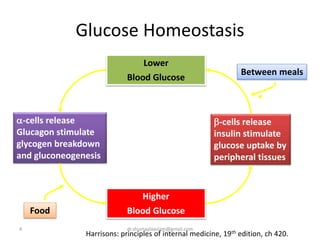
Glucose Homeostasis
-cells release
Glucagon stimulate
glycogen breakdown
and gluconeogenesis
-cells release
insulin stimulate
glucose uptake by
peripheral tissues
Lower
Blood Glucose
Higher
Blood GlucoseFood
Between meals
4
Harrisons: principles of internal medicine, 19th edition, ch 420.
dr.shumaylaaslam@gmail.com
Hypoglycemia Definition
• Whipple’s triad:
– (1) symptoms consistent with hypoglycemia,
– (2) a low plasma glucose concentration measured
with a precise method, and
– (3) relief of symptoms after the plasma glucose
level is raised.
Harrisons: principles of internal medicine, 19th edition, ch 420.
5dr.shumaylaaslam@gmail.com
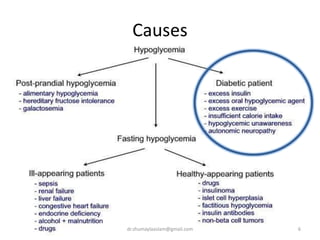
Causes
6dr.shumaylaaslam@gmail.com
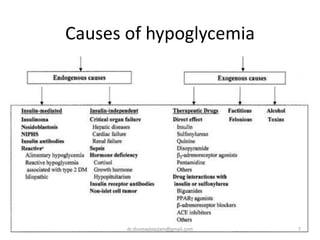
Causes of hypoglycemia
7dr.shumaylaaslam@gmail.com
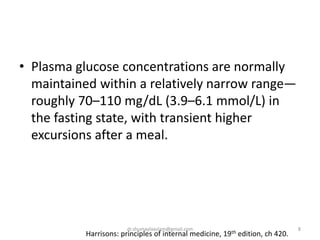
• Plasma glucose concentrations are normally
maintained within a relatively narrow range—
roughly 70–110 mg/dL (3.9–6.1 mmol/L) in
the fasting state, with transient higher
excursions after a meal.
8
Harrisons: principles of internal medicine, 19th edition, ch 420.
dr.shumaylaaslam@gmail.com
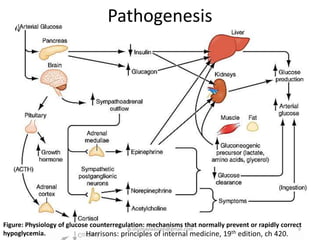
Pathogenesis
9
Figure: Physiology of glucose counterregulation: mechanisms that normally prevent or rapidly correct
hypoglycemia. Harrisons: principles of internal medicine, 19th edition, ch 420.
dr.shumaylaaslam@gmail.com
Clinical classification
The ADA and the Endocrine Society Workgroup on
Hypoglycemia recommends the following classification of
hypoglycemia in diabetes.
1. Severe hypoglycemia
– An event requiring the assistance of another person to
actively administer carbohydrate, glucagon, or other
resuscitative actions
– Plasma glucose measurements may not be available
during such an event, but neurologic recovery
attributable to restoration of plasma glucose to normal
is considered sufficient evidence that the event was
induced by a low plasma glucose concentration.
10dr.shumaylaaslam@gmail.com
2. Documented symptomatic hypoglycemia
‒ An event during which typical symptoms of hypoglycemia
‒ accompanied by a measured plasma glucose
concentration ≤70 mg/dL (3.9 mmol/L)
3. Asymptomatic hypoglycemia
– an event not accompanied by typical symptoms of
hypoglycemia
– measured plasma glucose concentration of
≤70 mg/dL (3.9 mmol/L).
11dr.shumaylaaslam@gmail.com
4. Probable symptomatic hypoglycemia
– typical symptoms of hypoglycemia are not
accompanied by a plasma glucose determination
(glucose concentration ≤70 mg/dL [3.9 mmol/L]).
5. Pseudohypoglycemia
– the person with diabetes reports typical symptoms
of hypoglycemia and interprets those as indicative of
hypoglycemia but with a measured plasma glucose
concentration >70 mg/dL (3.9 mmol/L).
– This category reflects the fact that patients with
chronically poor glycemic control.
12dr.shumaylaaslam@gmail.com
• It is recommended that people with diabetes
become concerned about the possibility of
hypoglycemia at a self-monitored blood glucose
(SMBG) level ≤70 mg/dL (3.9 mmol/L).
– it approximates the lower limit of the physiologic fasting
nondiabetic range,
– the normal glycemic threshold for glucose
counterregulatory hormone secretion, and
– the highest antecedent low glucose level reported to
reduce sympathoadrenal responses to subsequent
hypoglycemia
13dr.shumaylaaslam@gmail.com
MAGNITUDE OF THE PROBLEM
• Type 1 diabetes
– Hypoglycemia occurs frequently
– The average patient suffers countless numbers of
episodes of asymptomatic hypoglycemia, two
episodes of symptomatic hypoglycemia per week,
and one episode of temporarily disabling
hypoglycemia per year.
– not benign, because they impair defenses against
subsequent falling plasma glucose concentrations.
14dr.shumaylaaslam@gmail.com
• Type 2 diabetes
– less common
– severe hypoglycemia in insulin-treated type 2
diabetes is approximately 30 percent of that in
type 1 diabetes,
– events requiring medical treatment range from 40
to 100 percent.
– most often reported in patients taking long-acting
drugs, such as glyburide (glibenclamide).
– mild hypoglycemic symptoms –
• 16 to 20 percent in patients using sulfonylurea agents
• 30 to 50 percent in patients treated with insulin
15dr.shumaylaaslam@gmail.com
• agents that do not cause unregulated
hyperinsulinemia
– metformin, alpha-glucosidase inhibitors (acarbose, miglitol,
voglibose), thiazolidinediones (pioglitazone, rosiglitazone), glucagon-
like peptide-1 (GLP-1) receptor agonists
(exenatide, liraglutide, albiglutide, dulaglutide), dipeptidyl peptidase-4
(DPP-4) inhibitors (sitagliptin, vildagliptin, saxagliptin), and sodium-
glucose co-transporter 2 (SGLT2) inhibitors
(canagliflozin, empagliflozin, dapagliflozin) do not cause hypoglycemia.
– However, they increase the risk if used with insulin
or an insulin secretagogue
16dr.shumaylaaslam@gmail.com
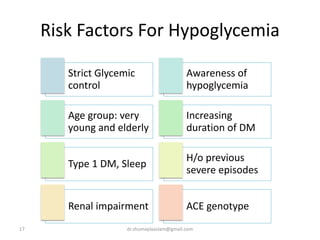
Risk Factors For Hypoglycemia
17
Strict Glycemic
control
Awareness of
hypoglycemia
Age group: very
young and elderly
Increasing
duration of DM
Type 1 DM, Sleep
H/o previous
severe episodes
Renal impairment ACE genotype
dr.shumaylaaslam@gmail.com
RISK FACTORS FOR HYPOGLYCEMIA
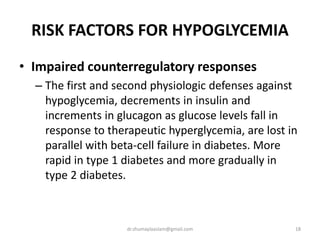
• Impaired counterregulatory responses
– The first and second physiologic defenses against
hypoglycemia, decrements in insulin and
increments in glucagon as glucose levels fall in
response to therapeutic hyperglycemia, are lost in
parallel with beta-cell failure in diabetes. More
rapid in type 1 diabetes and more gradually in
type 2 diabetes.
18dr.shumaylaaslam@gmail.com
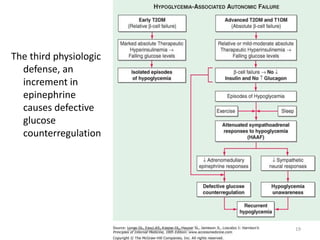
The third physiologic
defense, an
increment in
epinephrine
causes defective
glucose
counterregulation
19dr.shumaylaaslam@gmail.com
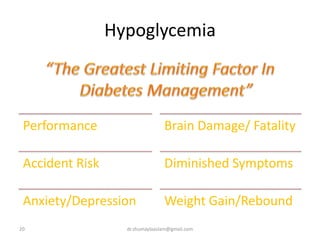
Hypoglycemia
Performance
Accident Risk
Anxiety/Depression
Brain Damage/ Fatality
Diminished Symptoms
Weight Gain/Rebound
20 dr.shumaylaaslam@gmail.com
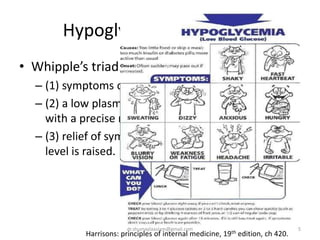
Symptoms of Hypoglycemia
• Autonomic
Sweating, hunger, paresthesias (Ach)
Palpitation, Tremor, Anxiety (NE/E)
• Neuroglycopenic
Confusion, Drowsiness, Speech difficulty, Anger
Inability to concentrate, Incoordination, Irritability
Visual disturbances, Ataxia, Seizures, Unconscious
• Non-specific
Nausea, Headache, Tiredness
21 dr.shumaylaaslam@gmail.com
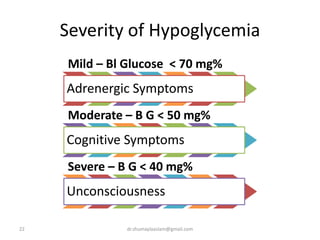
Severity of Hypoglycemia
Mild – Bl Glucose < 70 mg%
Adrenergic Symptoms
Moderate – B G < 50 mg%
Cognitive Symptoms
Severe – B G < 40 mg%
Unconsciousness
7 % of people arriving in to ED with  mental status
22 dr.shumaylaaslam@gmail.com
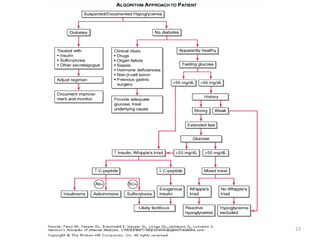
23dr.shumaylaaslam@gmail.com
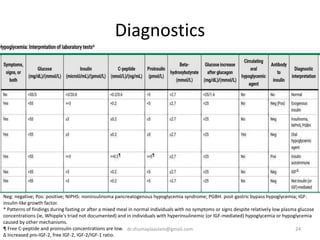
Diagnostics
24
Neg: negative; Pos: positive; NIPHS: noninsulinoma pancreatogenous hypoglycemia syndrome; PGBH: post-gastric bypass hypoglycemia; IGF:
insulin-like growth factor.
* Patterns of findings during fasting or after a mixed meal in normal individuals with no symptoms or signs despite relatively low plasma glucose
concentrations (ie, Whipple's triad not documented) and in individuals with hyperinsulinemic (or IGF-mediated) hypoglycemia or hypoglycemia
caused by other mechanisms.
¶ Free C-peptide and proinsulin concentrations are low.
Δ Increased pro-IGF-2, free IGF-2, IGF-2/IGF-1 ratio.
dr.shumaylaaslam@gmail.com
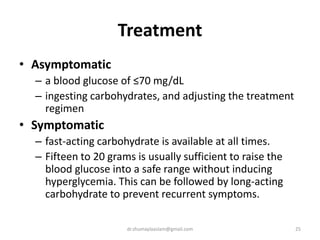
Treatment
• Asymptomatic
– a blood glucose of ≤70 mg/dL
– ingesting carbohydrates, and adjusting the treatment
regimen
• Symptomatic
– fast-acting carbohydrate is available at all times.
– Fifteen to 20 grams is usually sufficient to raise the
blood glucose into a safe range without inducing
hyperglycemia. This can be followed by long-acting
carbohydrate to prevent recurrent symptoms.
25dr.shumaylaaslam@gmail.com
• Severe
– A SQ or IM injection of 0.5 to 1.0 mg
of glucagon will usually lead to recovery of
consciousness within approximately 15 minutes.
– In hospital / ER 25 g of 50% glucose (dextrose) IV
– A subsequent glucose infusion is often needed,
depending upon the cause of the hypoglycemia.
– IV dextrose infusion should ensure delivery of 6 to
9 mg/kg per minute of glucose.
26dr.shumaylaaslam@gmail.com
– Measure a blood glucose 10 to 15 minutes after
the IV bolus.
– Readminister 12.5 to 25 grams of glucose as
needed to maintain the blood glucose above 80
mg/dL.
– monitor every 30 to 60 minutes thereafter until
stable (minimum of four hours).
– Admit patients with ingestion of a long-acting
hypoglycemic agent, recurrent hypoglycemia
during observation, and those unable to eat.
27dr.shumaylaaslam@gmail.com
IV
• 1 amp of D50 = 50% dextrose = 50g/100mL = 25g
x 4Kcal/g carbs = 100 calories bolus
• 1 L D5W at 100mL/hr = 5% Dextrose = 5g/100mL
x 1L = 50g x (4Kcal/g) = 200 cal infusion of 20
cal/hr
• 1 L D10W at 100mL/hr = 10%D= 10g/100mLx1L=
100g x (4Kcal/g)= 400 cal at infusion of 40 cal/hr
• 1 gram of glucose will raise your blood sugar
about 5 mg/dl
28dr.shumaylaaslam@gmail.com
Know Our Brain !!
• Brain is the major glucose consumer
• Consumes 120 to 150 g of glucose per day
• Glucose is virtually the sole fuel for brain
• Brain does not have any fuel stores like glycogen
• Can’t metabolize fatty acids as fuel
• Requires oxygen always to burn its glucose
• Can not live on anaerobic pathways
• One of most fastidious and voracious of all organs
• Oxygen and glucose supply can not be interrupted
29 dr.shumaylaaslam@gmail.com
THANK YOU
30dr.shumaylaaslam@gmail.com

Hypoglycemia in Adults

  • 1.
    EMILIO AGUINALDO COLLEGE MEDICALCENTER- CAVITE DEPARTMENT OF INTERNAL MEDICINE Shumayla Aslam, MD 2nd year Resident1dr.shumaylaaslam@gmail.com
  • 2.
    Case • A 76/Mknown hypertensive and Diabetic maintained on losartan and glimepride + metformin respectively. Brought to the ER in an unresponsive state. Vitals were BP 110/70, HR 66, RR 18, CBG 35mg/dl. PE: cold clammy extremities, coarse crackles left base of the lung. • Patient was given D50/50 1 vial, noted to be awake responsive. 2dr.shumaylaaslam@gmail.com
  • 3.
    Objectives 1. The causesof hypoglycemia 2. How to differentiate symtomatic and asymtomatic hypoglycemia? 3. The management of hypoglycemia 4. How to prevent hypoglycemia? 3dr.shumaylaaslam@gmail.com
  • 4.
    Glucose Homeostasis -cells release Glucagonstimulate glycogen breakdown and gluconeogenesis -cells release insulin stimulate glucose uptake by peripheral tissues Lower Blood Glucose Higher Blood GlucoseFood Between meals 4 Harrisons: principles of internal medicine, 19th edition, ch 420. dr.shumaylaaslam@gmail.com
  • 5.
    Hypoglycemia Definition • Whipple’striad: – (1) symptoms consistent with hypoglycemia, – (2) a low plasma glucose concentration measured with a precise method, and – (3) relief of symptoms after the plasma glucose level is raised. Harrisons: principles of internal medicine, 19th edition, ch 420. 5dr.shumaylaaslam@gmail.com
  • 6.
  • 7.
  • 8.
    • Plasma glucoseconcentrations are normally maintained within a relatively narrow range— roughly 70–110 mg/dL (3.9–6.1 mmol/L) in the fasting state, with transient higher excursions after a meal. 8 Harrisons: principles of internal medicine, 19th edition, ch 420. dr.shumaylaaslam@gmail.com
  • 9.
    Pathogenesis 9 Figure: Physiology ofglucose counterregulation: mechanisms that normally prevent or rapidly correct hypoglycemia. Harrisons: principles of internal medicine, 19th edition, ch 420. dr.shumaylaaslam@gmail.com
  • 10.
    Clinical classification The ADAand the Endocrine Society Workgroup on Hypoglycemia recommends the following classification of hypoglycemia in diabetes. 1. Severe hypoglycemia – An event requiring the assistance of another person to actively administer carbohydrate, glucagon, or other resuscitative actions – Plasma glucose measurements may not be available during such an event, but neurologic recovery attributable to restoration of plasma glucose to normal is considered sufficient evidence that the event was induced by a low plasma glucose concentration. 10dr.shumaylaaslam@gmail.com
  • 11.
    2. Documented symptomatichypoglycemia ‒ An event during which typical symptoms of hypoglycemia ‒ accompanied by a measured plasma glucose concentration ≤70 mg/dL (3.9 mmol/L) 3. Asymptomatic hypoglycemia – an event not accompanied by typical symptoms of hypoglycemia – measured plasma glucose concentration of ≤70 mg/dL (3.9 mmol/L). 11dr.shumaylaaslam@gmail.com
  • 12.
    4. Probable symptomatichypoglycemia – typical symptoms of hypoglycemia are not accompanied by a plasma glucose determination (glucose concentration ≤70 mg/dL [3.9 mmol/L]). 5. Pseudohypoglycemia – the person with diabetes reports typical symptoms of hypoglycemia and interprets those as indicative of hypoglycemia but with a measured plasma glucose concentration >70 mg/dL (3.9 mmol/L). – This category reflects the fact that patients with chronically poor glycemic control. 12dr.shumaylaaslam@gmail.com
  • 13.
    • It isrecommended that people with diabetes become concerned about the possibility of hypoglycemia at a self-monitored blood glucose (SMBG) level ≤70 mg/dL (3.9 mmol/L). – it approximates the lower limit of the physiologic fasting nondiabetic range, – the normal glycemic threshold for glucose counterregulatory hormone secretion, and – the highest antecedent low glucose level reported to reduce sympathoadrenal responses to subsequent hypoglycemia 13dr.shumaylaaslam@gmail.com
  • 14.
    MAGNITUDE OF THEPROBLEM • Type 1 diabetes – Hypoglycemia occurs frequently – The average patient suffers countless numbers of episodes of asymptomatic hypoglycemia, two episodes of symptomatic hypoglycemia per week, and one episode of temporarily disabling hypoglycemia per year. – not benign, because they impair defenses against subsequent falling plasma glucose concentrations. 14dr.shumaylaaslam@gmail.com
  • 15.
    • Type 2diabetes – less common – severe hypoglycemia in insulin-treated type 2 diabetes is approximately 30 percent of that in type 1 diabetes, – events requiring medical treatment range from 40 to 100 percent. – most often reported in patients taking long-acting drugs, such as glyburide (glibenclamide). – mild hypoglycemic symptoms – • 16 to 20 percent in patients using sulfonylurea agents • 30 to 50 percent in patients treated with insulin 15dr.shumaylaaslam@gmail.com
  • 16.
    • agents thatdo not cause unregulated hyperinsulinemia – metformin, alpha-glucosidase inhibitors (acarbose, miglitol, voglibose), thiazolidinediones (pioglitazone, rosiglitazone), glucagon- like peptide-1 (GLP-1) receptor agonists (exenatide, liraglutide, albiglutide, dulaglutide), dipeptidyl peptidase-4 (DPP-4) inhibitors (sitagliptin, vildagliptin, saxagliptin), and sodium- glucose co-transporter 2 (SGLT2) inhibitors (canagliflozin, empagliflozin, dapagliflozin) do not cause hypoglycemia. – However, they increase the risk if used with insulin or an insulin secretagogue 16dr.shumaylaaslam@gmail.com
  • 17.
    Risk Factors ForHypoglycemia 17 Strict Glycemic control Awareness of hypoglycemia Age group: very young and elderly Increasing duration of DM Type 1 DM, Sleep H/o previous severe episodes Renal impairment ACE genotype dr.shumaylaaslam@gmail.com
  • 18.
    RISK FACTORS FORHYPOGLYCEMIA • Impaired counterregulatory responses – The first and second physiologic defenses against hypoglycemia, decrements in insulin and increments in glucagon as glucose levels fall in response to therapeutic hyperglycemia, are lost in parallel with beta-cell failure in diabetes. More rapid in type 1 diabetes and more gradually in type 2 diabetes. 18dr.shumaylaaslam@gmail.com
  • 19.
    The third physiologic defense,an increment in epinephrine causes defective glucose counterregulation 19dr.shumaylaaslam@gmail.com
  • 20.
    Hypoglycemia Performance Accident Risk Anxiety/Depression Brain Damage/Fatality Diminished Symptoms Weight Gain/Rebound 20 dr.shumaylaaslam@gmail.com
  • 21.
    Symptoms of Hypoglycemia •Autonomic Sweating, hunger, paresthesias (Ach) Palpitation, Tremor, Anxiety (NE/E) • Neuroglycopenic Confusion, Drowsiness, Speech difficulty, Anger Inability to concentrate, Incoordination, Irritability Visual disturbances, Ataxia, Seizures, Unconscious • Non-specific Nausea, Headache, Tiredness 21 dr.shumaylaaslam@gmail.com
  • 22.
    Severity of Hypoglycemia Mild– Bl Glucose < 70 mg% Adrenergic Symptoms Moderate – B G < 50 mg% Cognitive Symptoms Severe – B G < 40 mg% Unconsciousness 7 % of people arriving in to ED with  mental status 22 dr.shumaylaaslam@gmail.com
  • 23.
  • 24.
    Diagnostics 24 Neg: negative; Pos:positive; NIPHS: noninsulinoma pancreatogenous hypoglycemia syndrome; PGBH: post-gastric bypass hypoglycemia; IGF: insulin-like growth factor. * Patterns of findings during fasting or after a mixed meal in normal individuals with no symptoms or signs despite relatively low plasma glucose concentrations (ie, Whipple's triad not documented) and in individuals with hyperinsulinemic (or IGF-mediated) hypoglycemia or hypoglycemia caused by other mechanisms. ¶ Free C-peptide and proinsulin concentrations are low. Δ Increased pro-IGF-2, free IGF-2, IGF-2/IGF-1 ratio. dr.shumaylaaslam@gmail.com
  • 25.
    Treatment • Asymptomatic – ablood glucose of ≤70 mg/dL – ingesting carbohydrates, and adjusting the treatment regimen • Symptomatic – fast-acting carbohydrate is available at all times. – Fifteen to 20 grams is usually sufficient to raise the blood glucose into a safe range without inducing hyperglycemia. This can be followed by long-acting carbohydrate to prevent recurrent symptoms. 25dr.shumaylaaslam@gmail.com
  • 26.
    • Severe – ASQ or IM injection of 0.5 to 1.0 mg of glucagon will usually lead to recovery of consciousness within approximately 15 minutes. – In hospital / ER 25 g of 50% glucose (dextrose) IV – A subsequent glucose infusion is often needed, depending upon the cause of the hypoglycemia. – IV dextrose infusion should ensure delivery of 6 to 9 mg/kg per minute of glucose. 26dr.shumaylaaslam@gmail.com
  • 27.
    – Measure ablood glucose 10 to 15 minutes after the IV bolus. – Readminister 12.5 to 25 grams of glucose as needed to maintain the blood glucose above 80 mg/dL. – monitor every 30 to 60 minutes thereafter until stable (minimum of four hours). – Admit patients with ingestion of a long-acting hypoglycemic agent, recurrent hypoglycemia during observation, and those unable to eat. 27dr.shumaylaaslam@gmail.com
  • 28.
    IV • 1 ampof D50 = 50% dextrose = 50g/100mL = 25g x 4Kcal/g carbs = 100 calories bolus • 1 L D5W at 100mL/hr = 5% Dextrose = 5g/100mL x 1L = 50g x (4Kcal/g) = 200 cal infusion of 20 cal/hr • 1 L D10W at 100mL/hr = 10%D= 10g/100mLx1L= 100g x (4Kcal/g)= 400 cal at infusion of 40 cal/hr • 1 gram of glucose will raise your blood sugar about 5 mg/dl 28dr.shumaylaaslam@gmail.com
  • 29.
    Know Our Brain!! • Brain is the major glucose consumer • Consumes 120 to 150 g of glucose per day • Glucose is virtually the sole fuel for brain • Brain does not have any fuel stores like glycogen • Can’t metabolize fatty acids as fuel • Requires oxygen always to burn its glucose • Can not live on anaerobic pathways • One of most fastidious and voracious of all organs • Oxygen and glucose supply can not be interrupted 29 dr.shumaylaaslam@gmail.com
  • 30.