Congenital Heart
Disease
By: Dr Ismah, Pediatric Department
1
OUTLINE
• Epidemiology
• Anatomy
• Types
• Clinical approach
- History, physical exams
- Investigation
- General management
2
EPIDEMIOLOGY
• CHDs affect nearly 1% of or about 40,000 births
per year in the United States
• The most common type of heart defect is a
ventricular septal defect (VSD)
• About 95% of babies born with a non-critical CHD
are expected to survive to 18 years of age [2012]
• About 69% of babies born with critical CHDs are
expected to survive to 18 years of age [2012]
http://www.cdc.gov
• A study on under five deaths in Malaysia in the
year 2006 showed that 10% of mortality was
directly related to CHD - http://mjpch.com
3
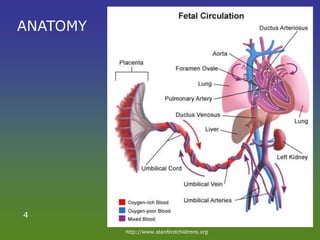
ANATOMY
http://www.stanfordchildrens.org
4
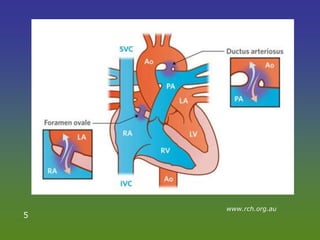
www.rch.org.au
5
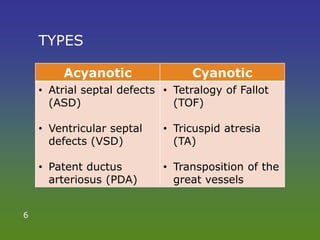
TYPES
Acyanotic Cyanotic
• Atrial septal defects
(ASD)
• Ventricular septal
defects (VSD)
• Patent ductus
arteriosus (PDA)
• Tetralogy of Fallot
(TOF)
• Tricuspid atresia
(TA)
• Transposition of the
great vessels
6
7
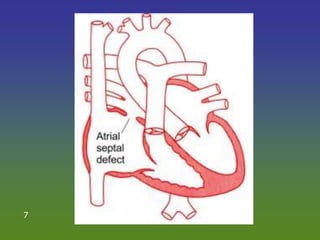
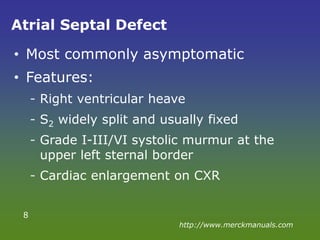
Atrial Septal Defect
• Most commonly asymptomatic
• Features:
- Right ventricular heave
- S2 widely split and usually fixed
- Grade I-III/VI systolic murmur at the
upper left sternal border
- Cardiac enlargement on CXR
8
http://www.merckmanuals.com
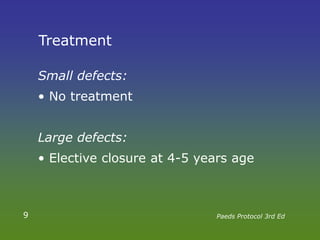
Treatment
Small defects:
• No treatment
Large defects:
• Elective closure at 4-5 years age
9 Paeds Protocol 3rd Ed
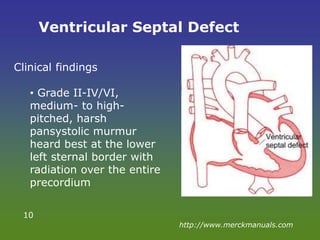
Ventricular Septal Defect
Clinical findings
• Grade II-IV/VI,
medium- to high-
pitched, harsh
pansystolic murmur
heard best at the lower
left sternal border with
radiation over the entire
precordium
10
http://www.merckmanuals.com
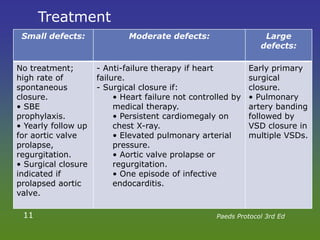
Treatment
Small defects: Moderate defects: Large
defects:
No treatment;
high rate of
spontaneous
closure.
• SBE
prophylaxis.
• Yearly follow up
for aortic valve
prolapse,
regurgitation.
• Surgical closure
indicated if
prolapsed aortic
valve.
- Anti-failure therapy if heart
failure.
- Surgical closure if:
• Heart failure not controlled by
medical therapy.
• Persistent cardiomegaly on
chest X-ray.
• Elevated pulmonary arterial
pressure.
• Aortic valve prolapse or
regurgitation.
• One episode of infective
endocarditis.
Early primary
surgical
closure.
• Pulmonary
artery banding
followed by
VSD closure in
multiple VSDs.
11 Paeds Protocol 3rd Ed
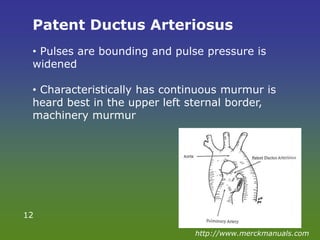
Patent Ductus Arteriosus
• Pulses are bounding and pulse pressure is
widened
• Characteristically has continuous murmur is
heard best in the upper left sternal border,
machinery murmur
12
http://www.merckmanuals.com
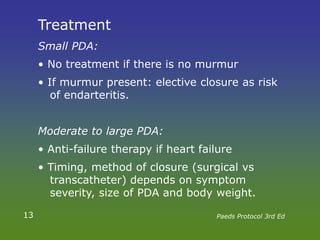
Treatment
Small PDA:
• No treatment if there is no murmur
• If murmur present: elective closure as risk
of endarteritis.
Moderate to large PDA:
• Anti-failure therapy if heart failure
• Timing, method of closure (surgical vs
transcatheter) depends on symptom
severity, size of PDA and body weight.
13 Paeds Protocol 3rd Ed
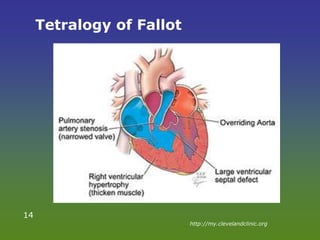
Tetralogy of Fallot
14
http://my.clevelandclinic.org
Typical features
• Symptoms include cyanosis, dyspnea with
feeding, poor growth, and
• Hypercyanotic "tet" spells (sudden, potentially
lethal episodes of severe cyanosis)
• A harsh systolic murmur at the left upper
sternal border with a single 2nd heart sound
(S2) is common
15
http://www.merckmanuals.com
Transposition of great arteries
16
http://mvpresource.com
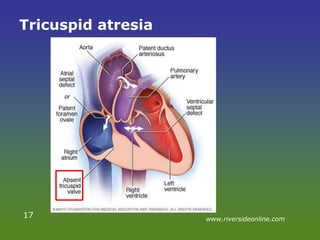
Tricuspid atresia
17 www.riversideonline.com
HISTORY
• Antenatal scans (cardiac malformation, fetal
arrhythmias, hydrops).
• Family history of congenital heart disease.
• Maternal illness: diabetes, rubella, teratogenic
medications.
• Perinatal problems: prematurity, meconium
aspiration, perinatal asphyxia.
18 Paeds Protocol 3rd Ed
PHYSICAL EXAMINATIONS
• Dysmorphism: Trisomy 21, 18, 13;
Turner syndrome
• Central cyanosis.
• Tachypnoea.
• Weak or unequal pulses.
• Heart murmur.
• Hepatomegaly.
19 Paeds Protocol 3rd Ed
INVESTIGATIONS
- CXR
- Hyperoxia test:
• Administer 100% oxygen via headbox at 15
L/min for 15 mins.
• ABG taken from right radial artery.
• Cyanotic heart diseases: pO₂ < 100 mmHg;
rise in pO₂ is < 20 mmHg.
- Echocardiography
20 Paeds Protocol 3rd Ed
GENERAL MANAGEMENT
• Correct metabolic acidosis, electrolyte
derangements, hypoglycaemia; prevent
hypothermia.
• Empirical treatment with IV antibiotics.
• Early cardiology consultation.
21 Paeds Protocol 3rd Ed
• IV Prostaglandin E infusion if duct-
dependent lesions suspected:
- Starting dose: 10 – 40 ng/kg/min;
maintenance: 2 – 10 ng/kg/min.
- Adverse effects: apnoea, fever,
hypotension.
22
• If unresponsive to IV prostaglandin E,
consider:
- Transposition of great arteries, obstructed
total anomalous pulmonary.
- Blocked IV line.
- Non-cardiac diagnosis.
• Arrangement to transfer to regional
cardiac center once stabilized.
23
THANK YOU
24

Congenital heart disease

  • 1.
    Congenital Heart Disease By: DrIsmah, Pediatric Department 1
  • 2.
    OUTLINE • Epidemiology • Anatomy •Types • Clinical approach - History, physical exams - Investigation - General management 2
  • 3.
    EPIDEMIOLOGY • CHDs affectnearly 1% of or about 40,000 births per year in the United States • The most common type of heart defect is a ventricular septal defect (VSD) • About 95% of babies born with a non-critical CHD are expected to survive to 18 years of age [2012] • About 69% of babies born with critical CHDs are expected to survive to 18 years of age [2012] http://www.cdc.gov • A study on under five deaths in Malaysia in the year 2006 showed that 10% of mortality was directly related to CHD - http://mjpch.com 3
  • 4.
  • 5.
  • 6.
    TYPES Acyanotic Cyanotic • Atrialseptal defects (ASD) • Ventricular septal defects (VSD) • Patent ductus arteriosus (PDA) • Tetralogy of Fallot (TOF) • Tricuspid atresia (TA) • Transposition of the great vessels 6
  • 7.
  • 8.
    Atrial Septal Defect •Most commonly asymptomatic • Features: - Right ventricular heave - S2 widely split and usually fixed - Grade I-III/VI systolic murmur at the upper left sternal border - Cardiac enlargement on CXR 8 http://www.merckmanuals.com
  • 9.
    Treatment Small defects: • Notreatment Large defects: • Elective closure at 4-5 years age 9 Paeds Protocol 3rd Ed
  • 10.
    Ventricular Septal Defect Clinicalfindings • Grade II-IV/VI, medium- to high- pitched, harsh pansystolic murmur heard best at the lower left sternal border with radiation over the entire precordium 10 http://www.merckmanuals.com
  • 11.
    Treatment Small defects: Moderatedefects: Large defects: No treatment; high rate of spontaneous closure. • SBE prophylaxis. • Yearly follow up for aortic valve prolapse, regurgitation. • Surgical closure indicated if prolapsed aortic valve. - Anti-failure therapy if heart failure. - Surgical closure if: • Heart failure not controlled by medical therapy. • Persistent cardiomegaly on chest X-ray. • Elevated pulmonary arterial pressure. • Aortic valve prolapse or regurgitation. • One episode of infective endocarditis. Early primary surgical closure. • Pulmonary artery banding followed by VSD closure in multiple VSDs. 11 Paeds Protocol 3rd Ed
  • 12.
    Patent Ductus Arteriosus •Pulses are bounding and pulse pressure is widened • Characteristically has continuous murmur is heard best in the upper left sternal border, machinery murmur 12 http://www.merckmanuals.com
  • 13.
    Treatment Small PDA: • Notreatment if there is no murmur • If murmur present: elective closure as risk of endarteritis. Moderate to large PDA: • Anti-failure therapy if heart failure • Timing, method of closure (surgical vs transcatheter) depends on symptom severity, size of PDA and body weight. 13 Paeds Protocol 3rd Ed
  • 14.
  • 15.
    Typical features • Symptomsinclude cyanosis, dyspnea with feeding, poor growth, and • Hypercyanotic "tet" spells (sudden, potentially lethal episodes of severe cyanosis) • A harsh systolic murmur at the left upper sternal border with a single 2nd heart sound (S2) is common 15 http://www.merckmanuals.com
  • 16.
    Transposition of greatarteries 16 http://mvpresource.com
  • 17.
  • 18.
    HISTORY • Antenatal scans(cardiac malformation, fetal arrhythmias, hydrops). • Family history of congenital heart disease. • Maternal illness: diabetes, rubella, teratogenic medications. • Perinatal problems: prematurity, meconium aspiration, perinatal asphyxia. 18 Paeds Protocol 3rd Ed
  • 19.
    PHYSICAL EXAMINATIONS • Dysmorphism:Trisomy 21, 18, 13; Turner syndrome • Central cyanosis. • Tachypnoea. • Weak or unequal pulses. • Heart murmur. • Hepatomegaly. 19 Paeds Protocol 3rd Ed
  • 20.
    INVESTIGATIONS - CXR - Hyperoxiatest: • Administer 100% oxygen via headbox at 15 L/min for 15 mins. • ABG taken from right radial artery. • Cyanotic heart diseases: pO₂ < 100 mmHg; rise in pO₂ is < 20 mmHg. - Echocardiography 20 Paeds Protocol 3rd Ed
  • 21.
    GENERAL MANAGEMENT • Correctmetabolic acidosis, electrolyte derangements, hypoglycaemia; prevent hypothermia. • Empirical treatment with IV antibiotics. • Early cardiology consultation. 21 Paeds Protocol 3rd Ed
  • 22.
    • IV ProstaglandinE infusion if duct- dependent lesions suspected: - Starting dose: 10 – 40 ng/kg/min; maintenance: 2 – 10 ng/kg/min. - Adverse effects: apnoea, fever, hypotension. 22
  • 23.
    • If unresponsiveto IV prostaglandin E, consider: - Transposition of great arteries, obstructed total anomalous pulmonary. - Blocked IV line. - Non-cardiac diagnosis. • Arrangement to transfer to regional cardiac center once stabilized. 23
  • 24.

Editor's Notes

  • #6 Closure in 24-48 hrs, permanent seal up to 3wks - http://circ.ahajournals.org/content/114/17/1873.long Closure upon cord clamp & infant take 1st breath
  • #12 Failures symptoms: Tachypnoea, Tachycardia, Hepatomegaly, Weak pulses
  • #16 Hypercyanotic spells – put on knee chest position/squat, 100% 02 and morphine
  • #20 Central cyanosis: bluish discoloration of mucus membrane, spo2 < 85% DDX: lung problems