ACYANOTIC HEART DISEASE

      Dr.B.BALAGOBI
ACYANOTIC HEART DISEASE
•   VSD:Commonest congenital heart disease
•   PDA
•   PS
•   ASD
•   Coarcation of aorta
•   AS
•   AVD
ATRIAL SEPTAL DEFECT.
• 2 common types
   – Ostium secundum defect:midseptum.(common,defect in foramen
     ovale);Usually   presents in adult life,Spontaneous closure is unlikely,Need Sx
   – Ostium primum defect:low in the septum.(Usually presents in first year)
     associated with other endocardial cushion defects (cleft AV valves, inlet type VSD
• Pathophysiology:
   – L-R shunt-increased flow across Rt heart-RV & PA enlargement.
• Clinical features:
   – Asymptomatic
   – slow wt gain(FTT)
   – frequent LRTI,No risk of infective endocarditis in ostium secondum ASD
• Diagnosis:
   – Right ventricular heave(Due to RVH)
   – Soft long ejection systolic murmur due to increased blood flow
     across the pulmonary valve at 3rd IC space
   – fixed wide split S2,large ASDincreased blood flow across
     tricupid valve  Mid diastolic murmur
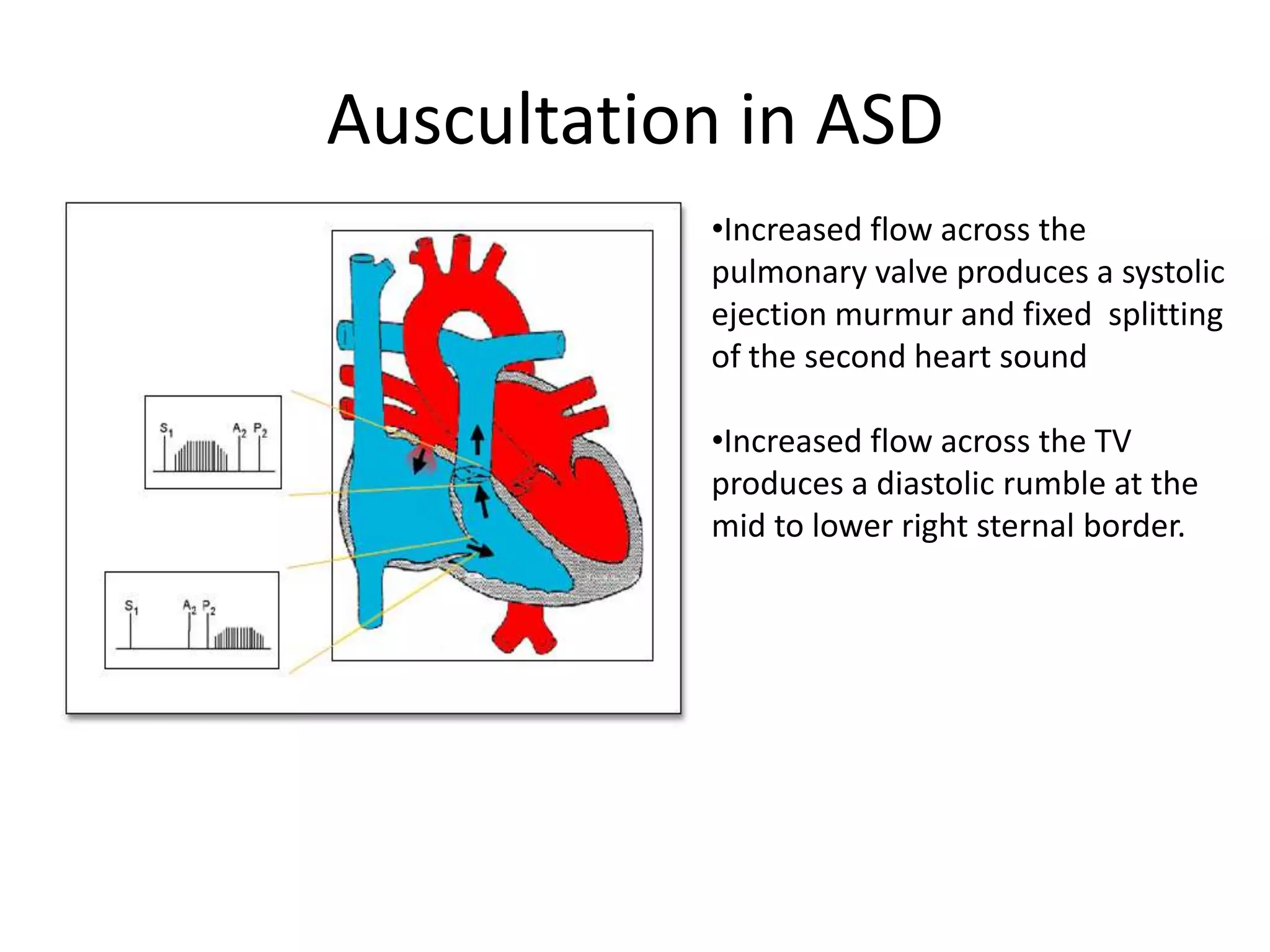
Auscultation in ASD
           •Increased flow across the
           pulmonary valve produces a systolic
           ejection murmur and fixed splitting
           of the second heart sound

           •Increased flow across the TV
           produces a diastolic rumble at the
           mid to lower right sternal border.
Investigations:
• CXR:
  – enlarged heart
  – Enlarged PA
  – increased pulmonary vascular markings,Central plethra
• ECG:
  – Right axis in secundum defect
  – hallmark of primum defect is extreme Left axis deviation
  – RVH,RBBB
• ECHO:RVH,valve anatomy,flow direction.
• Treatment:(indicated if symptoms+,RV overload)
  – Device closure during cardiac cathetrization
  – surgical closure.
ASD: Therapy
• Percutaneous Closure
  – only for secundum (contra in others)
  – adequate superior/inferior rim around ASD
  – no R-L shunting
• Surgical Closure
  – Good prognosis:
     • closure age < 25, PA pressure <40
     • If >25 or PA>40, decreased survival due to
       CHF, stroke, and afib
Atrial Septal Defect
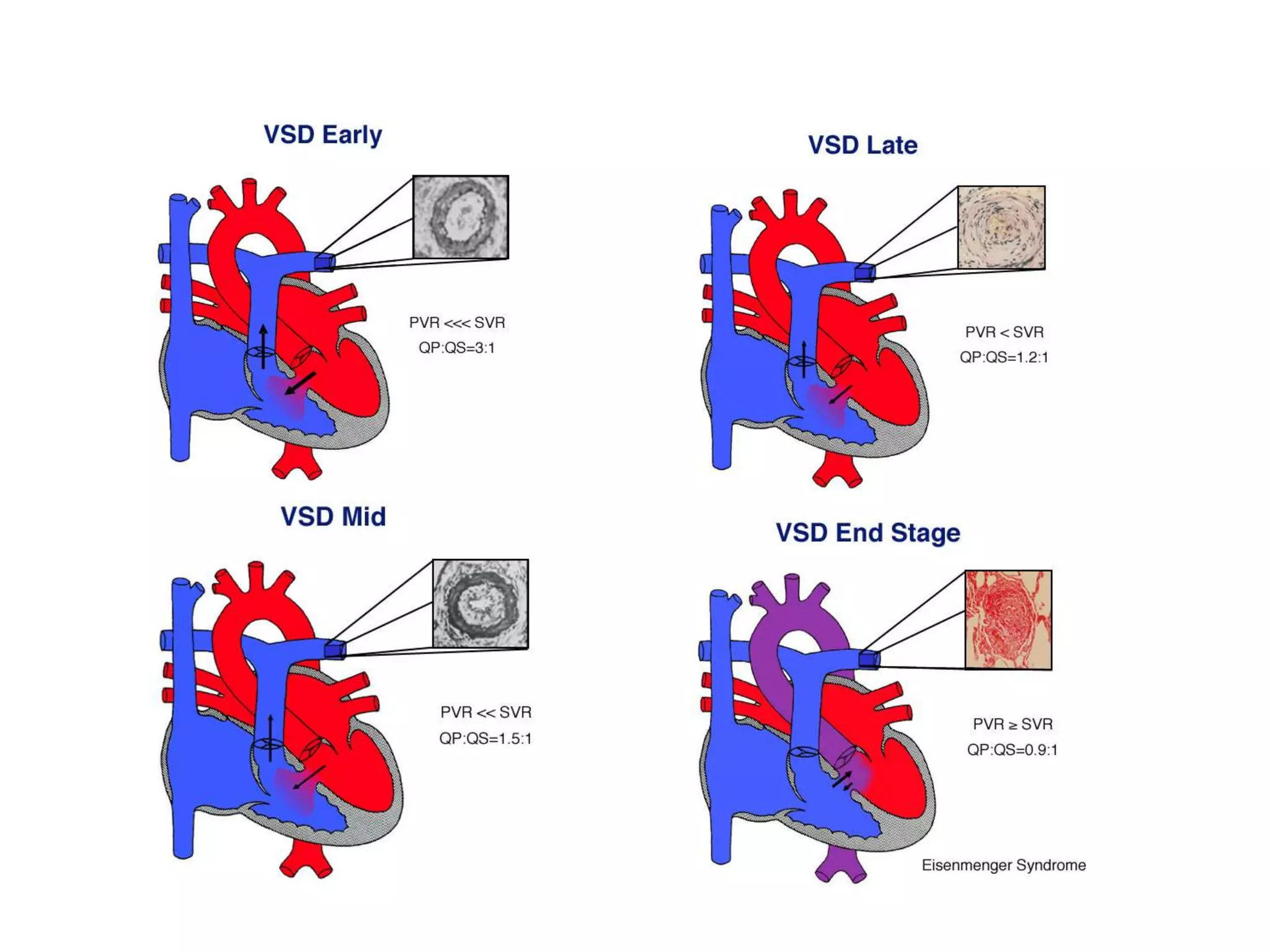
VENTRICULAR SEPTAL DEFECT.
• Most common CHD (32%),Often one component of another
  more complex congenital heart lesion.
• Pathophysiology:
   – Lt-Rt shunt as long as pulmonary vascular resistance is lower than
     systemic resistance,if reverse shunt reverses.
• Large defects lead to pul.hypertension-Eissenmenger syndrome.
• Clinical features: depend on size of the defect
   –    asymptomatic
   –   growth failure
   –   recurrent LRTI
   –   congestive heart failure
   –   SOB,cyanosis(Eissenmenger),Risk of infective endocarditis+
• Diagnosis:
   – parasternal thrill
   – pansystolic murmur at lower left sternal edge(Loud if small defect,if large VSD
      increase flow across pulmonary valve ejection systolic murmur
   – loud p2.(Pulmonary HT)
Ventricular Septal Defect
Investigations
• CXR:
   – cardiomegaly,enlarged LA&LV.
   – Enlarged PA,increased pulmonary vascular markings
   – Pulmonary oedema
• ECG:
   – extreme leftt axis is charecteristic,biventricular hypertrophy.
• ECHO:chamber size & pressures.
• Cardiac catheter:O2 content,PA pressure,size & no of
  defects.
MANGEMENT OF VSD
• Majority close spontaneously before 1 year of
  age;less than 10% require surgery.
• 2 types of VSD
  – Perimembranous(90%)
  – Muscular(More likely close spontaneously)
• Treatment:
  – Surgical closure before pulmonary vascular changes
    become irreversible.(if symptoms + like FTT,Features
    of Pul HT Loud P2,RVH)
  – Endocarditis prophylaxis
  – Heart failure Mx:ACEI,digoxin,diuretics.
Eisenmenger’s Syndrome
• Final common pathway for all significant LR
  shunting in which unrestricted pulmonary
  blood flow leads to pulmonary vaso-occlusive
  disease (PVOD); RL shunting/cyanosis
  devleops
• Generally need Qp:Qs >2:1
Eisenmenger: Treatment
• Sxs +polycythemia  phlebotomy
   – Careful if microcytosis, strongest predictor of
     cerebrovascular events
• RULE OUT CORRECTABLE DISEASE
• Once diagnosis established, avoid aggressive testing
  as many patients die during cardiovascular
  procedures
• Diuretics prn, oxygen
• Definitive: Heart Lung transplant
   – Prostacyclin therapy may delay, expensive
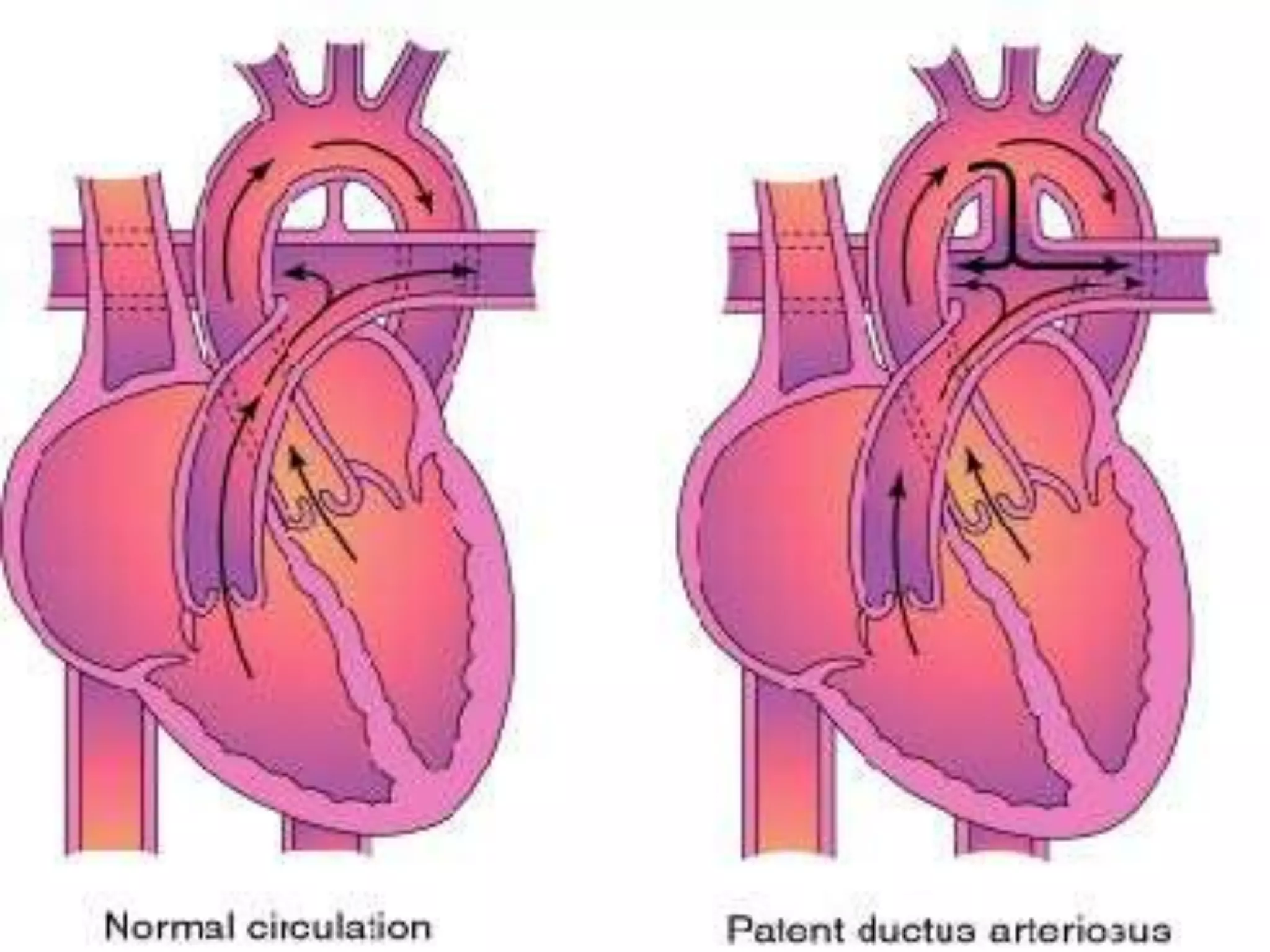
PATENT DUCTUS ARTERIOSUS.
• Connection between PA & descending aorta,Common in preterm
• Pathophysiology:
   – Lt-Rt shunt,reverses if pulmonary resistance increases-RV
     enlargement.If PDA is large Eissenmenger syndrome can develop.
• Clinical features:
   – depend on size & direction of flow
   – slow growth,LRTI,SOB,cyanosis.
• Diagnosis:
   – bounding pulse
   – continous murmur/Machinery murmur
   – loud S2.(Pul HT)
Investigations

•   CXR:cardiomegaly,increased pul vascularity.
•   ECG:Lt or biventricular hypertrophy.
•   ECHO:2D visualises PDA,doppler shows turbulance.
•   Cardiac catheter:PA pressures & O2 sats.

• Treatment:
    – Endocardial prophylaxis as long as patent
    – Indomethacin:a prostaglandin E1 inhibitor may close a PDA.
• Surgical:ligation /coil/clipping/division
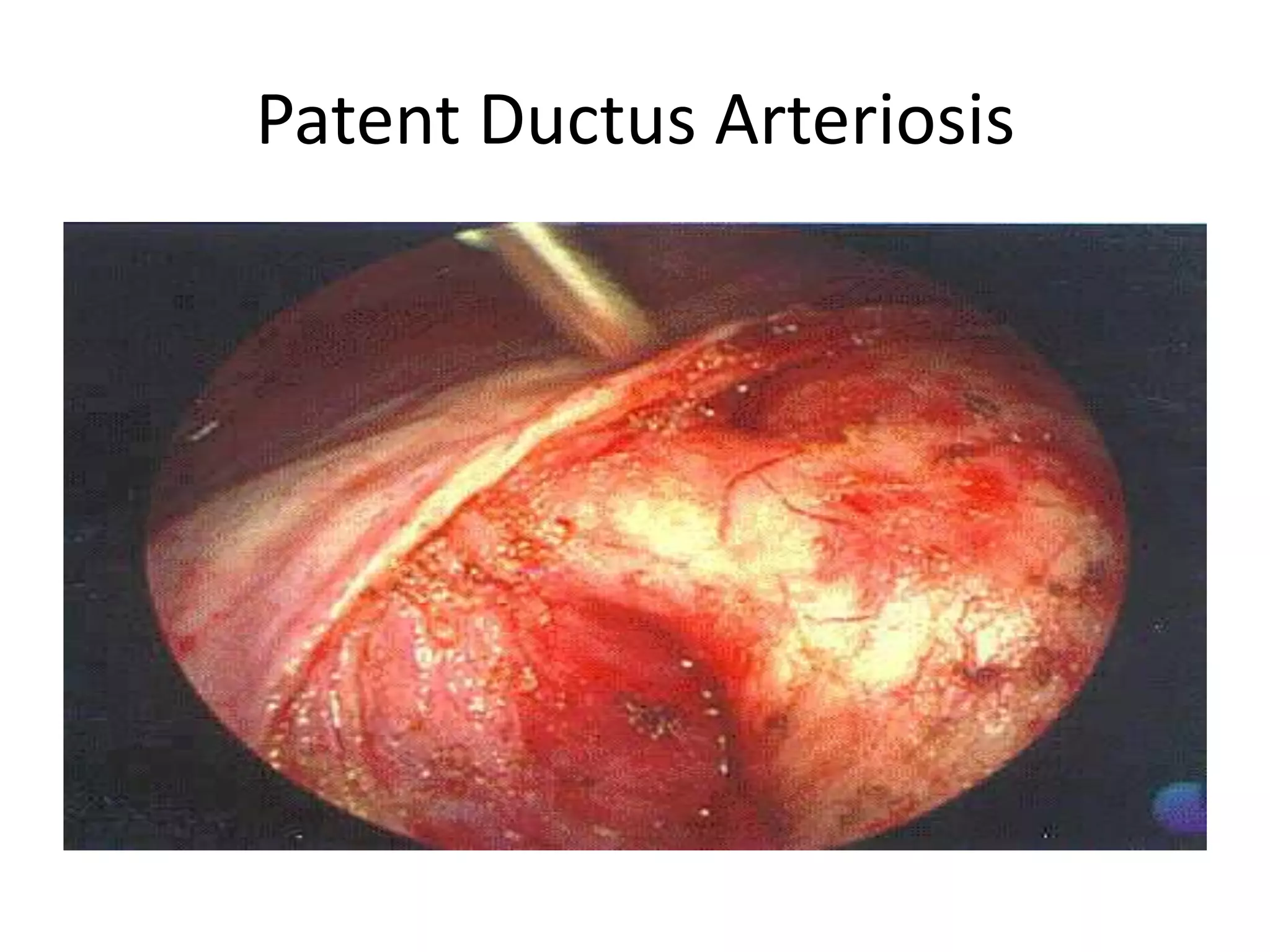
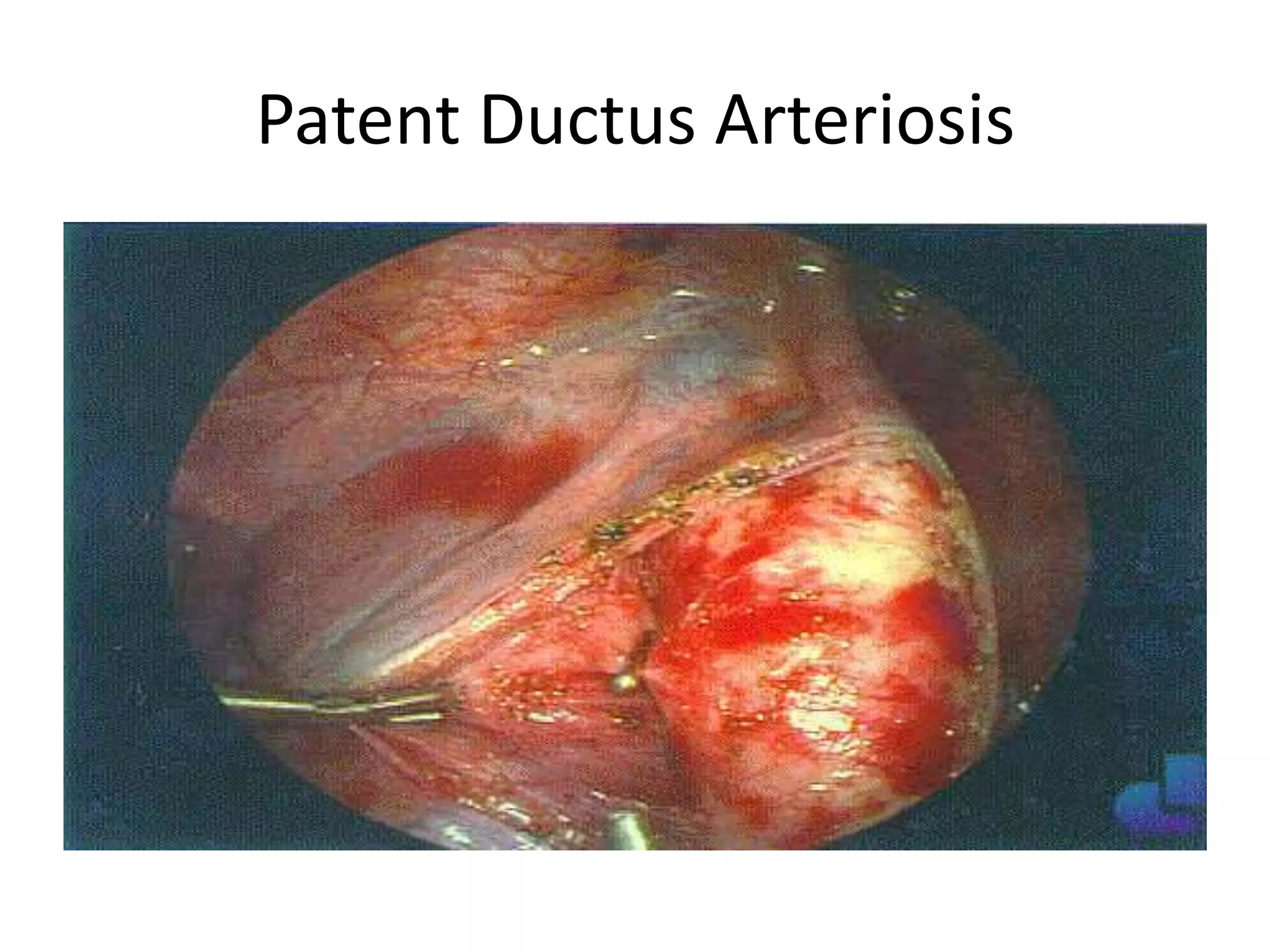
Patent Ductus Arteriosis
Coarctation of Aorta
• Narrowing in proximal descending aorta usually just beyond the
  origin of Left subclavian artery.
• May be long/tubular but most commonly discrete ridge
• Blood flow to the lower body maintained through collateral vessels
• 98% of all coarctations at segment of aorta adjacent to ductus arteriosus.
• Natural hx:
    – poor prognosis if unrepaired
    – High BP in UL & Low BP in LL
    – Systemic HypertensionLVF,Aortic Aneurysm/dissection,ICH
    – murmur (continuous or systolic murmur heard in back or SEM/ejection click of
      bicuspid AV)
    – weak/delayed LL pulses
    – Rib notching on CXR is pathognomonic
• Associated with
    – Turner’s syndrome
    – Subarachinoid haemorrhage
Rib notching
Coarctation Repair
•   Surgical correction
    1) Patch aortoplasty with
       removal of segment and
       end to end anastomosis
       or subclavian flap repair
    2) bypass tube grafting
       around segment
Pulmonary Stenosis
• No symptoms in mild or moderately severe
  lesions.
• Cyanosis and RVH, right-sided heart failure in
  patients with severe lesions.
• High pitched systolic ejection murmur maximal in
  second left interspace.
• Ejection click often present.
• Oligaemic lung fields(Reduced pulmonary
  vascular marking)
Pulmonary Stenosis
Valvular Aortic Stenosis
• Most common type, usually asymptomatic in
  children.
• May cause severe heart failure in infants.
• Prominent left ventricular impulse, narrow
  pulse pressure.
• Harsh systolic murmur and thrill along left
  sternal border, systolic ejection click.
Valvular Aortic Stenosis
Duct dependent Heart disease
• Some babies with CHD will depend on the
  circulation through PDA ,when duct close they
  become critically ill.
• Causes
  – R/S:TA,PA,Critical PS
  – L/S:COA,Critical AS,Hypoplastic left heart disease
  – TPGV
• Treatment
  – Prostaglandin infusion  keep the duct open.
Which of the following are non
        cyanotic heart disease?
A.   ASD
B.   Pulmonary atresia
C.   Large VSD
D.   Truncus arteriosis
E.   Aortic stenosis
T/F ASD?
A. Ostium Primum type is the commonest
B. Ostium secondum type gets infective
   endocarditis
C. Children are usually symptomatic during
   early childhood
D. Is most common congenital heart disease occurs in
   Rubella
E. Usually close spontaneously
F. Is the commonest acyanotic heart disease
T/F regarding ASD?
A. Associated with RBBB
B. Cause parasternal heave indicates pulmonary
   hypertension
C. Associated with recurrent respiratory tract
   infection
D. Murmur is due to left to right flow throw the
   defect
E. Cause variable split in second heart sound
F. Is rare in adults
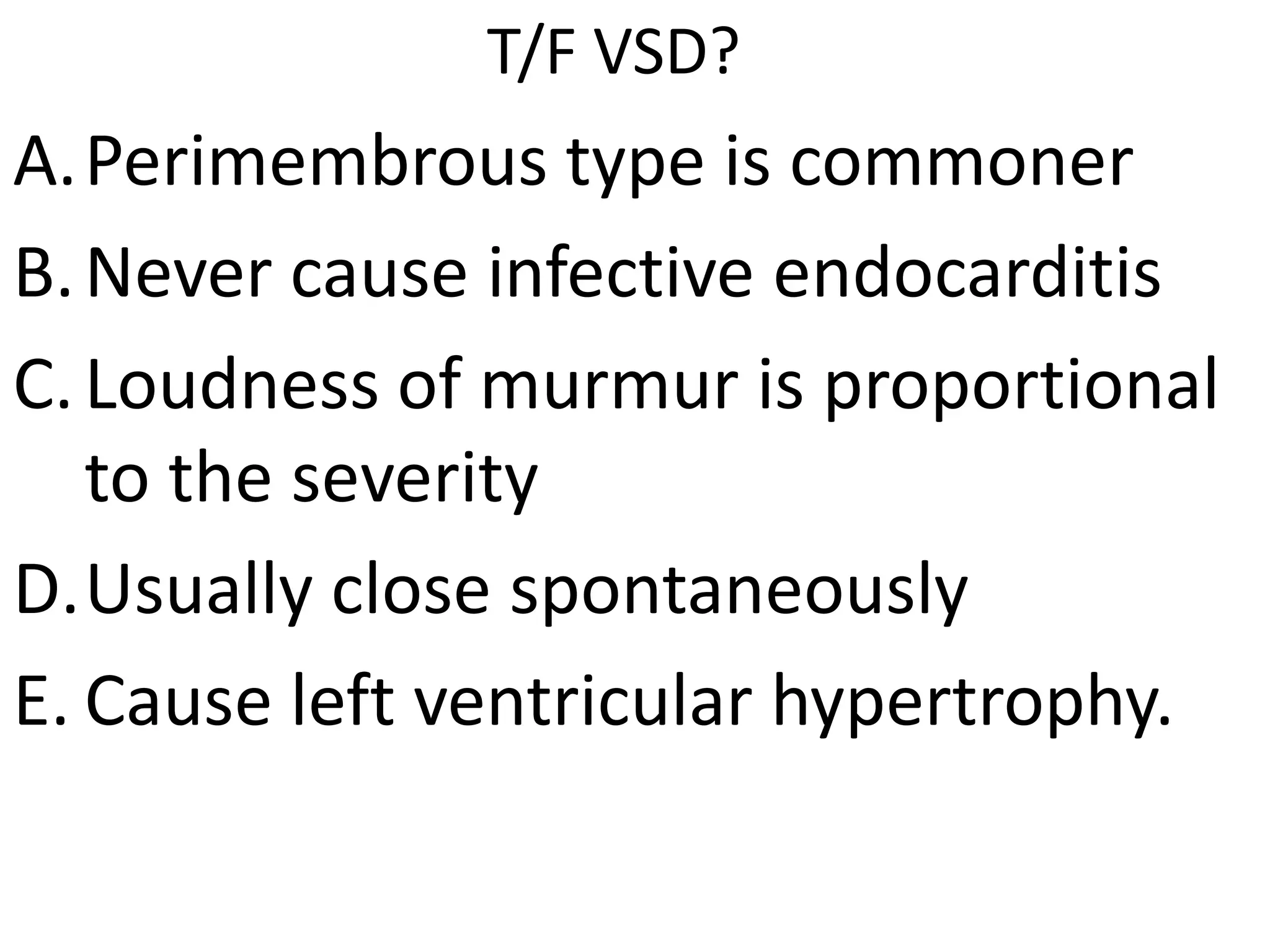
T/F VSD?
A.Perimembrous type is commoner
B. Never cause infective endocarditis
C. Loudness of murmur is proportional
   to the severity
D.Usually close spontaneously
E. Cause left ventricular hypertrophy.
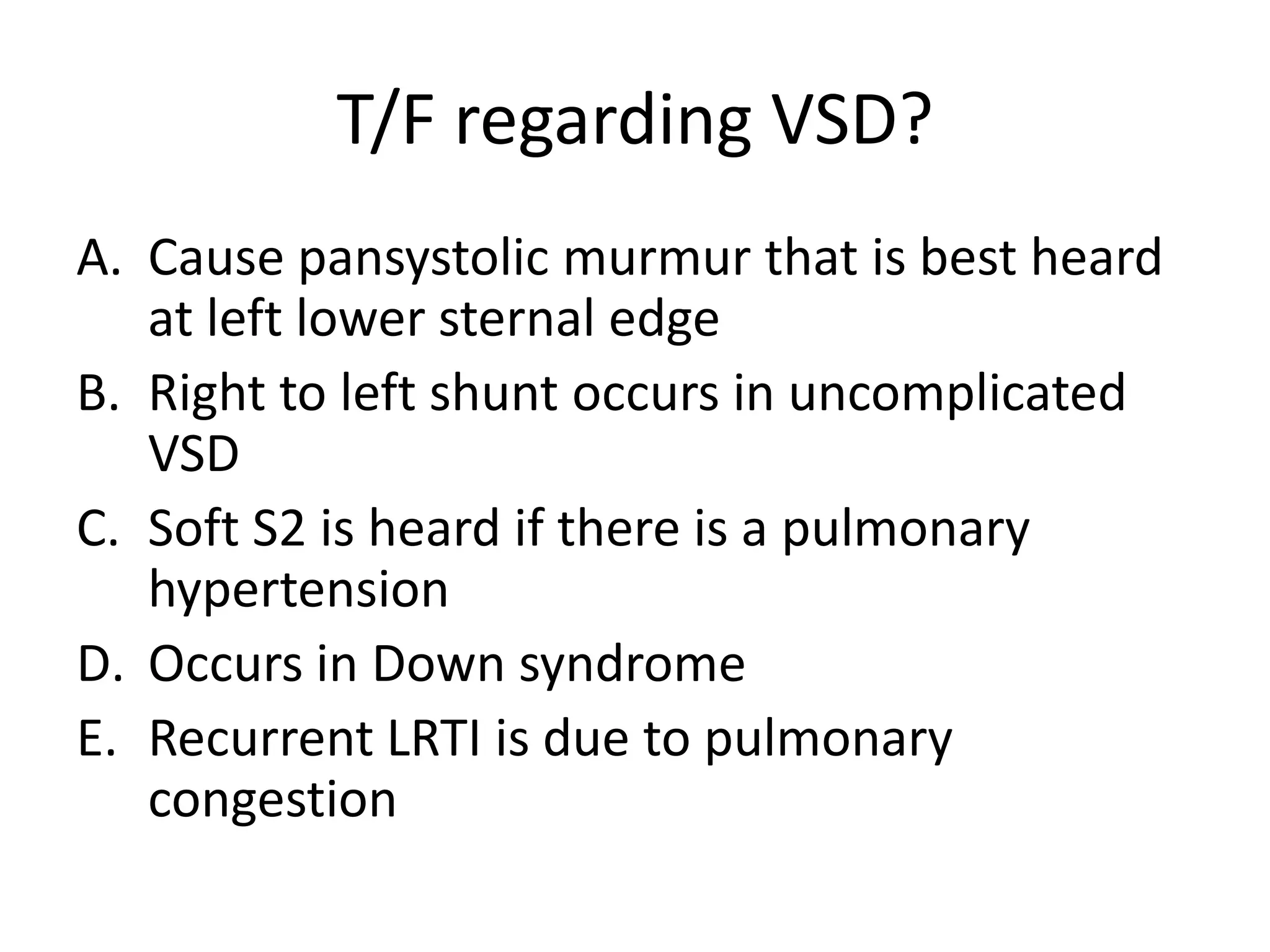
T/F regarding VSD?
A. Cause pansystolic murmur that is best heard
   at left lower sternal edge
B. Right to left shunt occurs in uncomplicated
   VSD
C. Soft S2 is heard if there is a pulmonary
   hypertension
D. Occurs in Down syndrome
E. Recurrent LRTI is due to pulmonary
   congestion
T/F PDA?
A. Associated with congenital rubella
B. Cause small volume pulse
C. Is an indication for the antibiotic
   prophylaxis against infective
   endocarditis
D. If left untreated cause pulmonary
   hypertension
E. In a full term baby is likely to close.
T/F regarding PDA?
A. Is a acyanotic heart disease
B. Cause plethoric lung field in CXR
C. Common in premature babies
D. May be seen in babies with cyanotic heart
   disease
E. May cause heart failure
T/F large uncomplicated PDA is
              associated with ?
A.   Cyanosis
B.   Clubbing
C.   Normal P2
D.   Wide pulse pressure
E.   Recurrent LRTI
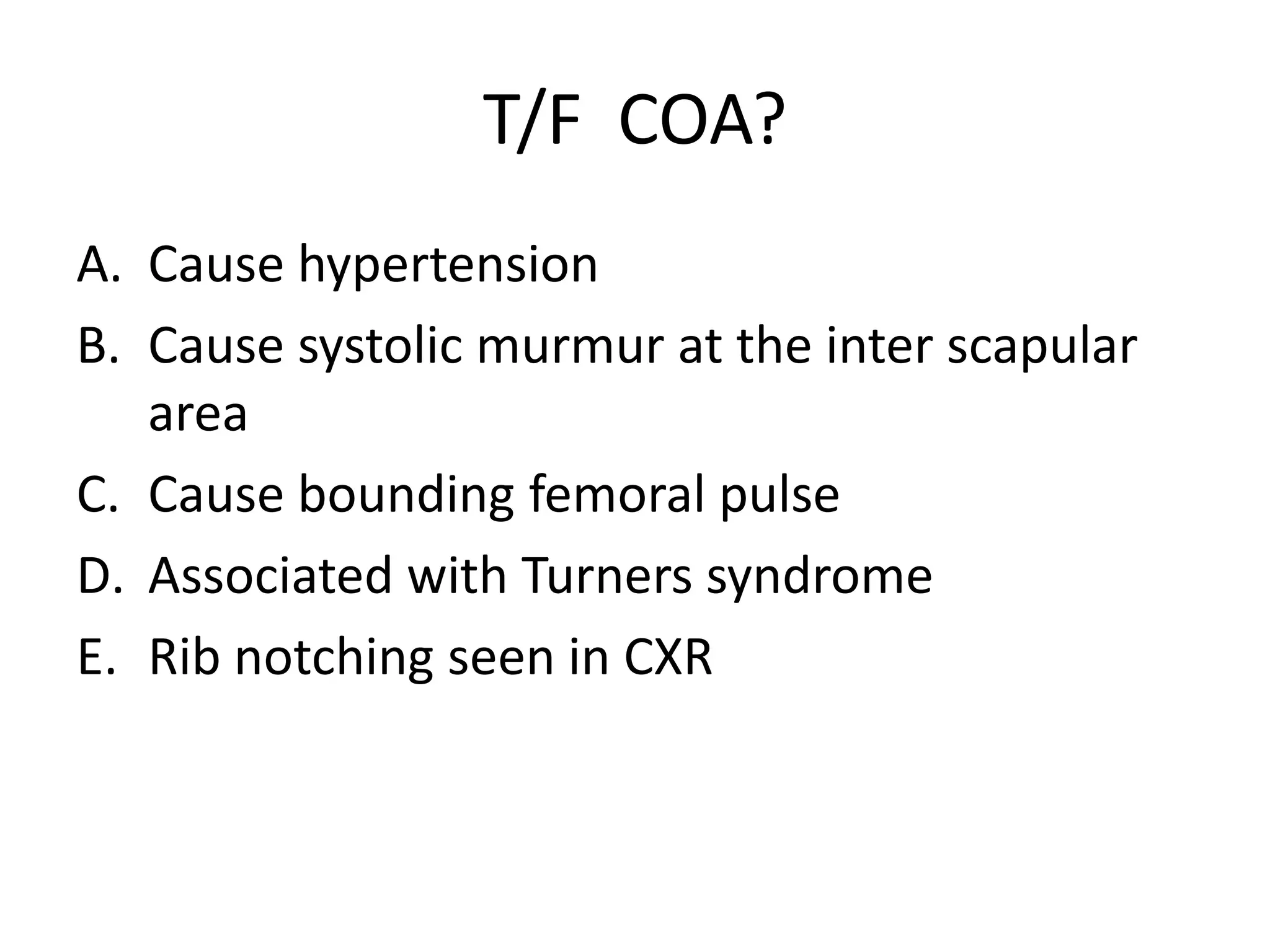
T/F COA?
A. Cause hypertension
B. Cause systolic murmur at the inter scapular
   area
C. Cause bounding femoral pulse
D. Associated with Turners syndrome
E. Rib notching seen in CXR
T/F Patent ductus arteriosus?

A. Is a feature of congenital rubella
B. In a full term ,baby is likely to close
   spontaneously
C. Associated with small volume pulse.
D. Is an indication for antibiotic prophylaxis against
   infective endocarditis
E. Loud P2 indicates pulmonary hypertension
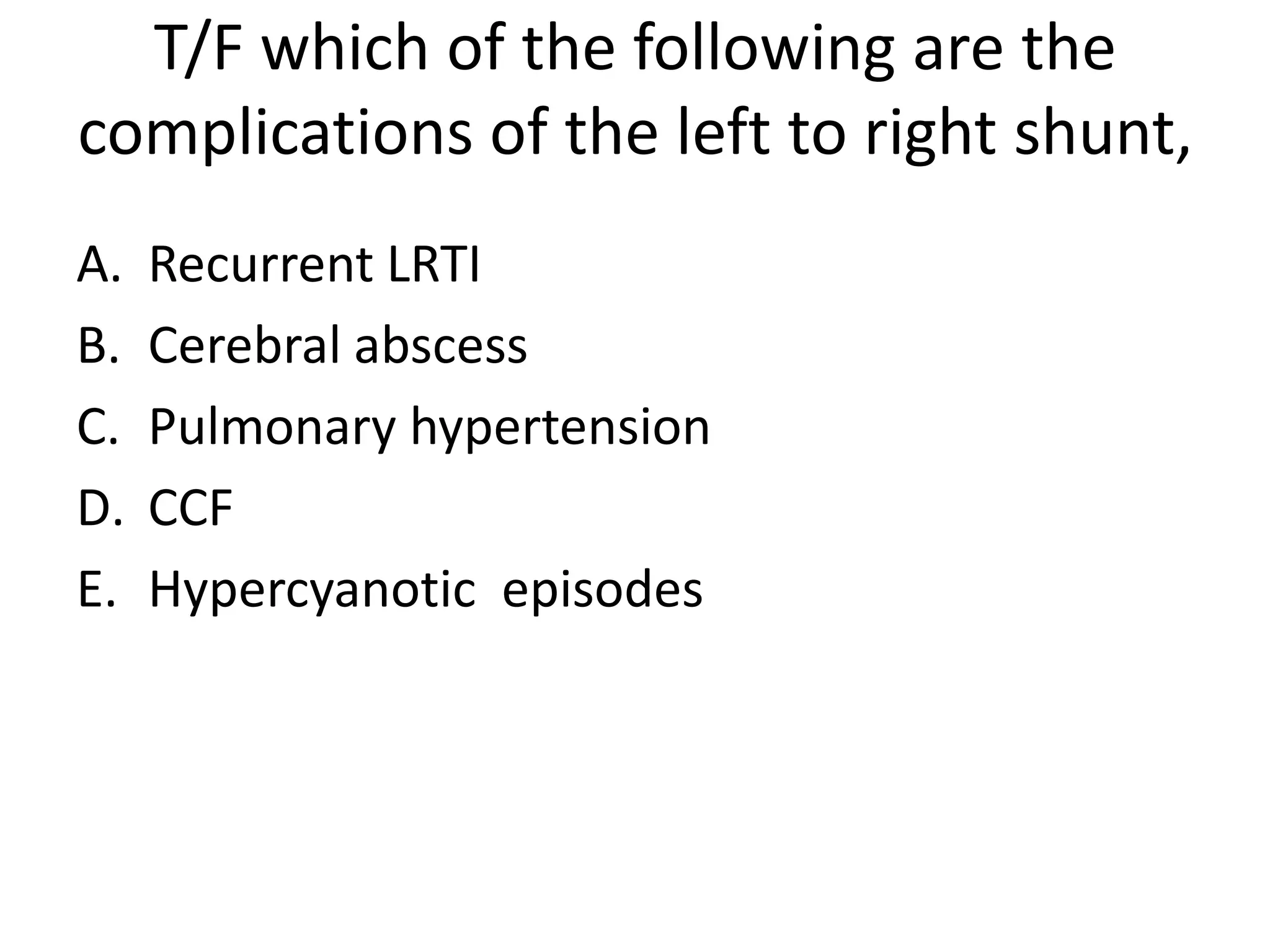
T/F which of the following are the
complications of the left to right shunt,
A.   Recurrent LRTI
B.   Cerebral abscess
C.   Pulmonary hypertension
D.   CCF
E.   Hypercyanotic episodes

Acyanotic heart disease

  • 1.
  • 2.
    ACYANOTIC HEART DISEASE • VSD:Commonest congenital heart disease • PDA • PS • ASD • Coarcation of aorta • AS • AVD
  • 3.
    ATRIAL SEPTAL DEFECT. •2 common types – Ostium secundum defect:midseptum.(common,defect in foramen ovale);Usually presents in adult life,Spontaneous closure is unlikely,Need Sx – Ostium primum defect:low in the septum.(Usually presents in first year) associated with other endocardial cushion defects (cleft AV valves, inlet type VSD • Pathophysiology: – L-R shunt-increased flow across Rt heart-RV & PA enlargement. • Clinical features: – Asymptomatic – slow wt gain(FTT) – frequent LRTI,No risk of infective endocarditis in ostium secondum ASD • Diagnosis: – Right ventricular heave(Due to RVH) – Soft long ejection systolic murmur due to increased blood flow across the pulmonary valve at 3rd IC space – fixed wide split S2,large ASDincreased blood flow across tricupid valve  Mid diastolic murmur
  • 4.
    Auscultation in ASD •Increased flow across the pulmonary valve produces a systolic ejection murmur and fixed splitting of the second heart sound •Increased flow across the TV produces a diastolic rumble at the mid to lower right sternal border.
  • 5.
    Investigations: • CXR: – enlarged heart – Enlarged PA – increased pulmonary vascular markings,Central plethra • ECG: – Right axis in secundum defect – hallmark of primum defect is extreme Left axis deviation – RVH,RBBB • ECHO:RVH,valve anatomy,flow direction. • Treatment:(indicated if symptoms+,RV overload) – Device closure during cardiac cathetrization – surgical closure.
  • 6.
    ASD: Therapy • PercutaneousClosure – only for secundum (contra in others) – adequate superior/inferior rim around ASD – no R-L shunting • Surgical Closure – Good prognosis: • closure age < 25, PA pressure <40 • If >25 or PA>40, decreased survival due to CHF, stroke, and afib
  • 7.
  • 8.
  • 9.
  • 10.
    VENTRICULAR SEPTAL DEFECT. •Most common CHD (32%),Often one component of another more complex congenital heart lesion. • Pathophysiology: – Lt-Rt shunt as long as pulmonary vascular resistance is lower than systemic resistance,if reverse shunt reverses. • Large defects lead to pul.hypertension-Eissenmenger syndrome. • Clinical features: depend on size of the defect – asymptomatic – growth failure – recurrent LRTI – congestive heart failure – SOB,cyanosis(Eissenmenger),Risk of infective endocarditis+ • Diagnosis: – parasternal thrill – pansystolic murmur at lower left sternal edge(Loud if small defect,if large VSD  increase flow across pulmonary valve ejection systolic murmur – loud p2.(Pulmonary HT)
  • 12.
  • 13.
    Investigations • CXR: – cardiomegaly,enlarged LA&LV. – Enlarged PA,increased pulmonary vascular markings – Pulmonary oedema • ECG: – extreme leftt axis is charecteristic,biventricular hypertrophy. • ECHO:chamber size & pressures. • Cardiac catheter:O2 content,PA pressure,size & no of defects.
  • 14.
    MANGEMENT OF VSD •Majority close spontaneously before 1 year of age;less than 10% require surgery. • 2 types of VSD – Perimembranous(90%) – Muscular(More likely close spontaneously) • Treatment: – Surgical closure before pulmonary vascular changes become irreversible.(if symptoms + like FTT,Features of Pul HT Loud P2,RVH) – Endocarditis prophylaxis – Heart failure Mx:ACEI,digoxin,diuretics.
  • 15.
    Eisenmenger’s Syndrome • Finalcommon pathway for all significant LR shunting in which unrestricted pulmonary blood flow leads to pulmonary vaso-occlusive disease (PVOD); RL shunting/cyanosis devleops • Generally need Qp:Qs >2:1
  • 17.
    Eisenmenger: Treatment • Sxs+polycythemia  phlebotomy – Careful if microcytosis, strongest predictor of cerebrovascular events • RULE OUT CORRECTABLE DISEASE • Once diagnosis established, avoid aggressive testing as many patients die during cardiovascular procedures • Diuretics prn, oxygen • Definitive: Heart Lung transplant – Prostacyclin therapy may delay, expensive
  • 18.
    PATENT DUCTUS ARTERIOSUS. •Connection between PA & descending aorta,Common in preterm • Pathophysiology: – Lt-Rt shunt,reverses if pulmonary resistance increases-RV enlargement.If PDA is large Eissenmenger syndrome can develop. • Clinical features: – depend on size & direction of flow – slow growth,LRTI,SOB,cyanosis. • Diagnosis: – bounding pulse – continous murmur/Machinery murmur – loud S2.(Pul HT)
  • 20.
    Investigations • CXR:cardiomegaly,increased pul vascularity. • ECG:Lt or biventricular hypertrophy. • ECHO:2D visualises PDA,doppler shows turbulance. • Cardiac catheter:PA pressures & O2 sats. • Treatment: – Endocardial prophylaxis as long as patent – Indomethacin:a prostaglandin E1 inhibitor may close a PDA. • Surgical:ligation /coil/clipping/division
  • 21.
  • 22.
  • 23.
    Coarctation of Aorta •Narrowing in proximal descending aorta usually just beyond the origin of Left subclavian artery. • May be long/tubular but most commonly discrete ridge • Blood flow to the lower body maintained through collateral vessels • 98% of all coarctations at segment of aorta adjacent to ductus arteriosus. • Natural hx: – poor prognosis if unrepaired – High BP in UL & Low BP in LL – Systemic HypertensionLVF,Aortic Aneurysm/dissection,ICH – murmur (continuous or systolic murmur heard in back or SEM/ejection click of bicuspid AV) – weak/delayed LL pulses – Rib notching on CXR is pathognomonic • Associated with – Turner’s syndrome – Subarachinoid haemorrhage
  • 25.
  • 26.
    Coarctation Repair • Surgical correction 1) Patch aortoplasty with removal of segment and end to end anastomosis or subclavian flap repair 2) bypass tube grafting around segment
  • 27.
    Pulmonary Stenosis • Nosymptoms in mild or moderately severe lesions. • Cyanosis and RVH, right-sided heart failure in patients with severe lesions. • High pitched systolic ejection murmur maximal in second left interspace. • Ejection click often present. • Oligaemic lung fields(Reduced pulmonary vascular marking)
  • 28.
  • 29.
    Valvular Aortic Stenosis •Most common type, usually asymptomatic in children. • May cause severe heart failure in infants. • Prominent left ventricular impulse, narrow pulse pressure. • Harsh systolic murmur and thrill along left sternal border, systolic ejection click.
  • 30.
  • 31.
    Duct dependent Heartdisease • Some babies with CHD will depend on the circulation through PDA ,when duct close they become critically ill. • Causes – R/S:TA,PA,Critical PS – L/S:COA,Critical AS,Hypoplastic left heart disease – TPGV • Treatment – Prostaglandin infusion  keep the duct open.
  • 32.
    Which of thefollowing are non cyanotic heart disease? A. ASD B. Pulmonary atresia C. Large VSD D. Truncus arteriosis E. Aortic stenosis
  • 33.
    T/F ASD? A. OstiumPrimum type is the commonest B. Ostium secondum type gets infective endocarditis C. Children are usually symptomatic during early childhood D. Is most common congenital heart disease occurs in Rubella E. Usually close spontaneously F. Is the commonest acyanotic heart disease
  • 34.
    T/F regarding ASD? A.Associated with RBBB B. Cause parasternal heave indicates pulmonary hypertension C. Associated with recurrent respiratory tract infection D. Murmur is due to left to right flow throw the defect E. Cause variable split in second heart sound F. Is rare in adults
  • 35.
    T/F VSD? A.Perimembrous typeis commoner B. Never cause infective endocarditis C. Loudness of murmur is proportional to the severity D.Usually close spontaneously E. Cause left ventricular hypertrophy.
  • 36.
    T/F regarding VSD? A.Cause pansystolic murmur that is best heard at left lower sternal edge B. Right to left shunt occurs in uncomplicated VSD C. Soft S2 is heard if there is a pulmonary hypertension D. Occurs in Down syndrome E. Recurrent LRTI is due to pulmonary congestion
  • 37.
    T/F PDA? A. Associatedwith congenital rubella B. Cause small volume pulse C. Is an indication for the antibiotic prophylaxis against infective endocarditis D. If left untreated cause pulmonary hypertension E. In a full term baby is likely to close.
  • 38.
    T/F regarding PDA? A.Is a acyanotic heart disease B. Cause plethoric lung field in CXR C. Common in premature babies D. May be seen in babies with cyanotic heart disease E. May cause heart failure
  • 39.
    T/F large uncomplicatedPDA is associated with ? A. Cyanosis B. Clubbing C. Normal P2 D. Wide pulse pressure E. Recurrent LRTI
  • 40.
    T/F COA? A. Causehypertension B. Cause systolic murmur at the inter scapular area C. Cause bounding femoral pulse D. Associated with Turners syndrome E. Rib notching seen in CXR
  • 41.
    T/F Patent ductusarteriosus? A. Is a feature of congenital rubella B. In a full term ,baby is likely to close spontaneously C. Associated with small volume pulse. D. Is an indication for antibiotic prophylaxis against infective endocarditis E. Loud P2 indicates pulmonary hypertension
  • 42.
    T/F which ofthe following are the complications of the left to right shunt, A. Recurrent LRTI B. Cerebral abscess C. Pulmonary hypertension D. CCF E. Hypercyanotic episodes