Benign Breast Diseases
By: Ismah Haron & Hamidah Aziz
1
Part 1: Outline
• Fibroadenosis/fibrocystic disease
• Fibroadenoma
• Giant fibroadenoma
• Phyllodes tumor
• Traumatic fat necrosis
2
Case 1
• Madam Z, 40 y/o presented with multiple lumps
at right breast that associated with cyclical pain.
PE revealed soft and fluctuated lumps.
• Fibroadenosis/fibrocystic disease
• Triple assessment
• Reassurance, cyst aspiration, hormone
manipulation e.g. COC pill
3
4
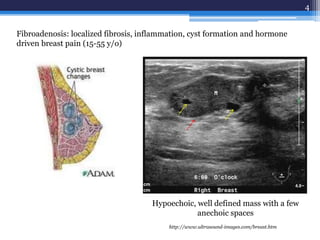
http://www.ultrasound-images.com/breast.htm
Hypoechoic, well defined mass with a few
anechoic spaces
Fibroadenosis: localized fibrosis, inflammation, cyst formation and hormone
driven breast pain (15-55 y/o)
• If aspirated fluid is blood stained or cyst recur
many times core biopsy or local excision
• Exclude cystadenocarcinoma
5
Case 2
• Miss Y, 22 y/o presented with a small painless
mobile lump at right breast that not increased in
size. She is otherwise well. PE revealed fixed, firm,
well defined margin, freely mobile breast lump.
• Fibroademona
• Triple assessment
• Treatment depends on its size
<3 cm: reassurance
>3 cm: excision
6
7
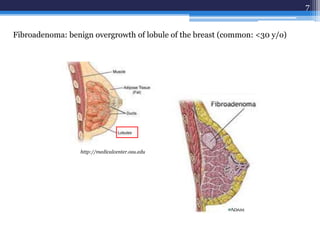
http://medicalcenter.osu.edu
Fibroadenoma: benign overgrowth of lobule of the breast (common: <30 y/o)
8
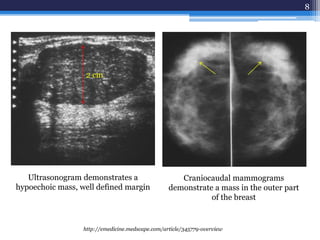
Ultrasonogram demonstrates a
hypoechoic mass, well defined margin
Craniocaudal mammograms
demonstrate a mass in the outer part
of the breast
http://emedicine.medscape.com/article/345779-overview
2 cm
Giant fibroadenoma
9
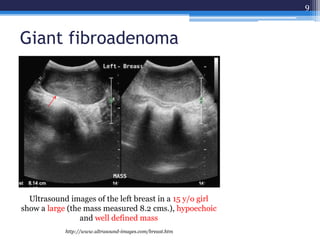
Ultrasound images of the left breast in a 15 y/o girl
show a large (the mass measured 8.2 cms.), hypoechoic
and well defined mass
http://www.ultrasound-images.com/breast.htm
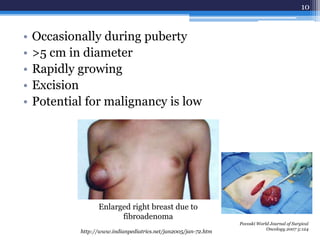
• Occasionally during puberty
• >5 cm in diameter
• Rapidly growing
• Excision
• Potential for malignancy is low
10
Povoski World Journal of Surgical
Oncology 2007 5:124
http://www.indianpediatrics.net/jan2005/jan-72.htm
Enlarged right breast due to
fibroadenoma
Case 3
• Miss X, 48 y/o admitted with small breast lump
had been present over many years and had
started to enlarge in the last 3 months. The lump
is mobile.
• She was single and nulliparous but without a
family history of breast cancer
11
12
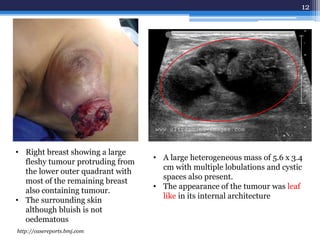
• Right breast showing a large
fleshy tumour protruding from
the lower outer quadrant with
most of the remaining breast
also containing tumour.
• The surrounding skin
although bluish is not
oedematous
• A large heterogeneous mass of 5.6 x 3.4
cm with multiple lobulations and cystic
spaces also present.
• The appearance of the tumour was leaf
like in its internal architecture
http://casereports.bmj.com
• Diagnosis:
Phyllodes tumor
▫ Rare breast tumor that forms from the connective
tissue of the breast.
▫ Benign, malignant or borderline by histological
▫ Surgical removal
 Benign:- removing the mass and a 2 cm area of
normal breast tissue from around the tumor.
 Malignant:- removed with a wider margin of breast
tissue or by total mastectomy if needed
13
Tumor
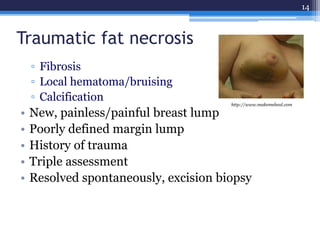
Traumatic fat necrosis
▫ Fibrosis
▫ Local hematoma/bruising
▫ Calcification
• New, painless/painful breast lump
• Poorly defined margin lump
• History of trauma
• Triple assessment
• Resolved spontaneously, excision biopsy
14
http://www.makemeheal.com
Summary
15
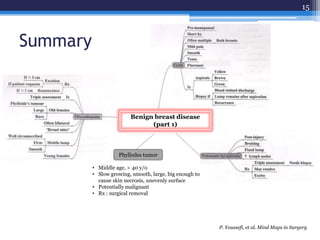
P. Youssefi, et al. Mind Maps in Surgery
Benign breast disease
(part 1)
• Middle age, > 40 y/o
• Slow growing, smooth, large, big enough to
cause skin necrosis, unevenly surface
• Potentially malignant
• Rx : surgical removal
Phyllodes tumor
Other references:
1. Bailey & Love’s Short Practice of Surgery 25th edition
2. Oxford Handbook of Clinical Surgery 3rd edition
16

benign breast disease

  • 1.
    Benign Breast Diseases By:Ismah Haron & Hamidah Aziz 1
  • 2.
    Part 1: Outline •Fibroadenosis/fibrocystic disease • Fibroadenoma • Giant fibroadenoma • Phyllodes tumor • Traumatic fat necrosis 2
  • 3.
    Case 1 • MadamZ, 40 y/o presented with multiple lumps at right breast that associated with cyclical pain. PE revealed soft and fluctuated lumps. • Fibroadenosis/fibrocystic disease • Triple assessment • Reassurance, cyst aspiration, hormone manipulation e.g. COC pill 3
  • 4.
    4 http://www.ultrasound-images.com/breast.htm Hypoechoic, well definedmass with a few anechoic spaces Fibroadenosis: localized fibrosis, inflammation, cyst formation and hormone driven breast pain (15-55 y/o)
  • 5.
    • If aspiratedfluid is blood stained or cyst recur many times core biopsy or local excision • Exclude cystadenocarcinoma 5
  • 6.
    Case 2 • MissY, 22 y/o presented with a small painless mobile lump at right breast that not increased in size. She is otherwise well. PE revealed fixed, firm, well defined margin, freely mobile breast lump. • Fibroademona • Triple assessment • Treatment depends on its size <3 cm: reassurance >3 cm: excision 6
  • 7.
    7 http://medicalcenter.osu.edu Fibroadenoma: benign overgrowthof lobule of the breast (common: <30 y/o)
  • 8.
    8 Ultrasonogram demonstrates a hypoechoicmass, well defined margin Craniocaudal mammograms demonstrate a mass in the outer part of the breast http://emedicine.medscape.com/article/345779-overview 2 cm
  • 9.
    Giant fibroadenoma 9 Ultrasound imagesof the left breast in a 15 y/o girl show a large (the mass measured 8.2 cms.), hypoechoic and well defined mass http://www.ultrasound-images.com/breast.htm
  • 10.
    • Occasionally duringpuberty • >5 cm in diameter • Rapidly growing • Excision • Potential for malignancy is low 10 Povoski World Journal of Surgical Oncology 2007 5:124 http://www.indianpediatrics.net/jan2005/jan-72.htm Enlarged right breast due to fibroadenoma
  • 11.
    Case 3 • MissX, 48 y/o admitted with small breast lump had been present over many years and had started to enlarge in the last 3 months. The lump is mobile. • She was single and nulliparous but without a family history of breast cancer 11
  • 12.
    12 • Right breastshowing a large fleshy tumour protruding from the lower outer quadrant with most of the remaining breast also containing tumour. • The surrounding skin although bluish is not oedematous • A large heterogeneous mass of 5.6 x 3.4 cm with multiple lobulations and cystic spaces also present. • The appearance of the tumour was leaf like in its internal architecture http://casereports.bmj.com
  • 13.
    • Diagnosis: Phyllodes tumor ▫Rare breast tumor that forms from the connective tissue of the breast. ▫ Benign, malignant or borderline by histological ▫ Surgical removal  Benign:- removing the mass and a 2 cm area of normal breast tissue from around the tumor.  Malignant:- removed with a wider margin of breast tissue or by total mastectomy if needed 13 Tumor
  • 14.
    Traumatic fat necrosis ▫Fibrosis ▫ Local hematoma/bruising ▫ Calcification • New, painless/painful breast lump • Poorly defined margin lump • History of trauma • Triple assessment • Resolved spontaneously, excision biopsy 14 http://www.makemeheal.com
  • 15.
    Summary 15 P. Youssefi, etal. Mind Maps in Surgery Benign breast disease (part 1) • Middle age, > 40 y/o • Slow growing, smooth, large, big enough to cause skin necrosis, unevenly surface • Potentially malignant • Rx : surgical removal Phyllodes tumor
  • 16.
    Other references: 1. Bailey& Love’s Short Practice of Surgery 25th edition 2. Oxford Handbook of Clinical Surgery 3rd edition 16

Editor's Notes

  • #4 Hx: size not change
  • #5 *more common in last decade of reproductive age Mammogram: generalized hyperintensity & maybe no lesion seen, http://radiopaedia.org/images/879835 Histopathology (not practice): there may be microcysts, fibrosis, adenosis of hyperplastic changes of the breast epithelial tissue
  • #9 Histology: well marked capsule, hyperplasia tissue
  • #12 *slowly growing
  • #13 Mammogram was performed on the patient and a large lobulated mass in was noted Histology with haematoxylin eosin stains revealed leaf-like architecture, long clefts with marked stromal overgrowth and hypercellularity.
  • #14 Locally invasive, recur or distant mets Not respond to hormonal, chemo/radiotherapy Ref: www.mypacs.net/cases/PHYLLODES-TUMOR-1512497.html