Confucianism
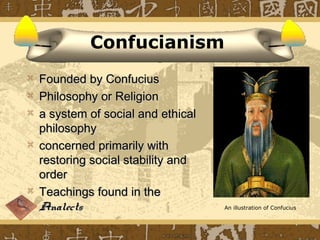
   Founded by Confucius
   Philosophy or Religion
   a system of social and ethical
    philosophy
   concerned primarily with
    restoring social stability and
    order
   Teachings found in the
    Analects                         An illustration of Confucius
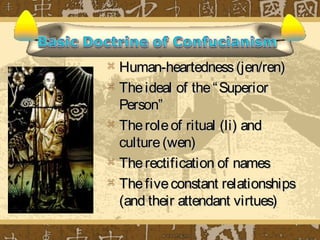
 Human-heartedness (jen/ren)
 The ideal of the “ Superior
  Person”
 The role of ritual (li) and
  culture (wen)
 The rectification of names

 The five constant relationships
  (and their attendant virtues)
   Jen (Ren) – character is combination of “two”
    and “human being”. Goodness; human-
    heartedness; benevolence; love.
   The basic virtue in Confucianism: “If a man sets
    his heart on benevolence [ren], he will be free
    from evil.” [Analects, 4.4]
   Entails a doctrine of reciprocity: “do not do unto
    others what you would not want others to do
    unto you” (“The Silver Rule”)
 A state of being; the sole focus for the
  superior person:
   The Master said, “Of neighborhoods
    benevolence [re n ] is the most
    beautiful. How can the man be
    considered wise who, when he has
    the choice, does not settle in
    benevolence?” (Analects, 4.1).
 Difficult to attain, but also the most
  natural:
   Has wisdom, compassion and courage:
      The Master said, “There are three things constantly on the lips of the gentleman none of which I have
         succeeded in following: “A man of benevolence never worries; a man of wisdom is never in two minds;
         a man of courage is never afraid.”
   Always strives for the good
      “Make it in your guiding principle to do your best for others and to be trustworthy in what you say.”
      The Master said, “A noble person covets the reputation of being slow in words but prompt in deed.”
   Thinks broadly
      The Master said, “A noble mind can see a question from all sides without bias. Small minds are biased and
         see a question only from one side.”
   Ritual: Li – also means propriety. There is a proper way to comport one’s self in all
    situations.
   Culture: Wen - “the arts of peace” – music, art, poetry.


   “If terms be no correct, language is not in accordance
    with the truth of things. If language is not in accordance
    with the truth of things, affairs cannot be carried out to
    success… Therefore a superior person considers it
    necessary that the names he uses be spoken
    appropriately. What the superior person requires is that
    in his words there be nothing that is incorrect” (Novak,
    126).
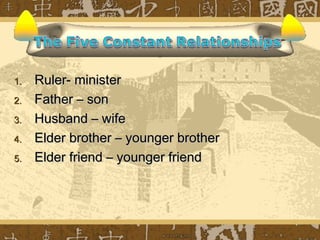
1.   Ruler- minister
2.   Father – son
3.   Husband – wife
4.   Elder brother – younger brother
5.   Elder friend – younger friend
 Loyalty
 Filial piety
The Master said, “The service which filial children do to their parents is as
   follows: In their general conduct to them, they manifest the utmost
   reverence; in their nourishing of them, their endeavor is to give them
   the utmost pleasure; when they are ill, they feel the greatest anxiety; in
   mourning for them, they exhibit every demonstration of grief; in
   sacrificing to them, they display the utmost solemnity. When children
   are complete in these five things (they may be pronounced) able to
   serve their parents.”
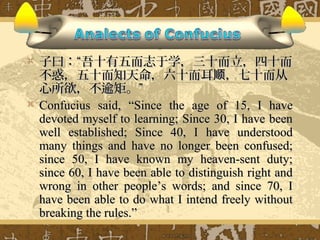
   子曰:“吾十有五而志于学,三十而立,四十而
    不惑,五十而知天命,六十而耳顺,七十而从
    心所欲,不逾矩。”
   Confucius said, “Since the age of 15, I have
    devoted myself to learning; Since 30, I have been
    well established; Since 40, I have understood
    many things and have no longer been confused;
    since 50, I have known my heaven-sent duty;
    since 60, I have been able to distinguish right and
    wrong in other people’s words; and since 70, I
    have been able to do what I intend freely without
    breaking the rules.”
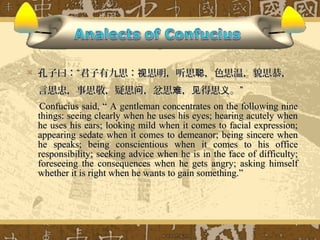
   孔子曰:“君子有九思:视思明,听思聪,色思温,貌思恭,
    言思忠,事思敬,疑思问,忿思难,见得思义。”
    Confucius said, “ A gentleman concentrates on the following nine
    things: seeing clearly when he uses his eyes; hearing acutely when
    he uses his ears; looking mild when it comes to facial expression;
    appearing sedate when it comes to demeanor; being sincere when
    he speaks; being conscientious when it comes to his office
    responsibility; seeking advice when he is in the face of difficulty;
    foreseeing the consequences when he gets angry; asking himself
    whether it is right when he wants to gain something.”
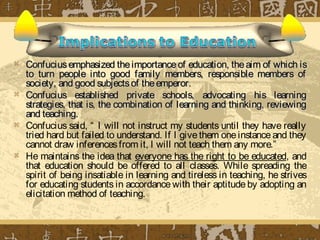
   Confucius emphasized the importance of education, the aim of which is
    to turn people into good family members, responsible members of
    society, and good subjects of the emperor.
   Confucius established private schools, advocating his learning
    strategies, that is, the combination of learning and thinking, reviewing
    and teaching.
   Confucius said, “ I will not instruct my students until they have really
    tried hard but failed to understand. If I give them one instance and they
    cannot draw inferences from it, I will not teach them any more.”
   He maintains the idea that everyone has the right to be educated, and
    that education should be offered to all classes. While spreading the
    spirit of being insatiable in learning and tireless in teaching, he strives
    for educating students in accordance with their aptitude by adopting an
    elicitation method of teaching.
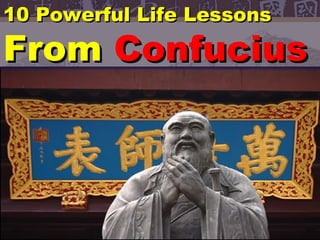
10 Powerful Life Lessons

From Confucius
Lesson # 1 : Just Keep Going


   “It does not matter how slowly
   you go as long as you do not
   stop.”
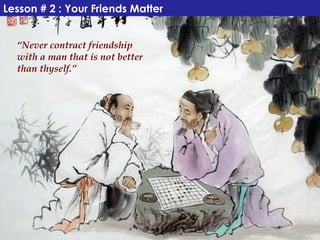
Lesson # 2 : Your Friends Matter


  “Never contract friendship
  with a man that is not better
  than thyself.”
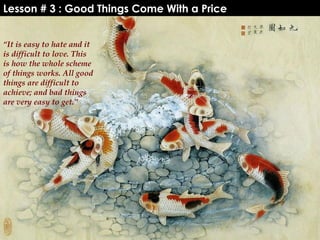
Lesson # 3 : Good Things Come With a Price


“It is easy to hate and it
is difficult to love. This
is how the whole scheme
of things works. All good
things are difficult to
achieve; and bad things
are very easy to get.”
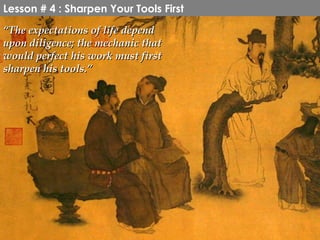
Lesson # 4 : Sharpen Your Tools First
“The expectations of life depend
upon diligence; the mechanic that
would perfect his work must first
sharpen his tools.”
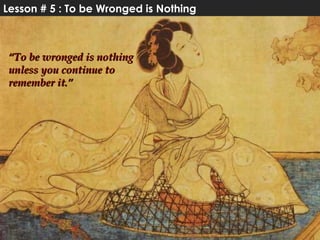
Lesson # 5 : To be Wronged is Nothing


 “To be wronged is nothing
 unless you continue to
 remember it.”
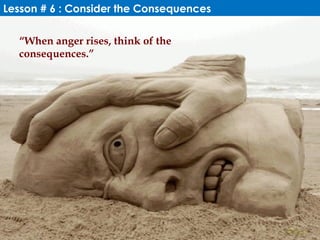
Lesson # 6 : Consider the Consequences

  “When anger rises, think of the
  consequences.”
Lesson # 7 : Make Adjustments

                          “When it is obvious that the
                          goals cannot be reached, don’t
                          adjust the goals, adjust the
                          action steps.”
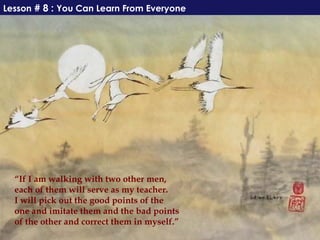
Lesson # 8 : You Can Learn From Everyone


  “If I am walking with two other men,
  each of them will serve as my teacher.
  I will pick out the good points of the
  one and imitate them and the bad points
  of the other and correct them in myself.”
Lesson # 9 : All or None
Lesson # 10 : Love whatever you do
"Life is really simple, but we insist on
making it complicated."
Confucianism

Confucianism

  • 2.
    Confucianism  Founded by Confucius  Philosophy or Religion  a system of social and ethical philosophy  concerned primarily with restoring social stability and order  Teachings found in the Analects An illustration of Confucius
  • 3.
     Human-heartedness (jen/ren) The ideal of the “ Superior Person”  The role of ritual (li) and culture (wen)  The rectification of names  The five constant relationships (and their attendant virtues)
  • 4.
    Jen (Ren) – character is combination of “two” and “human being”. Goodness; human- heartedness; benevolence; love.  The basic virtue in Confucianism: “If a man sets his heart on benevolence [ren], he will be free from evil.” [Analects, 4.4]  Entails a doctrine of reciprocity: “do not do unto others what you would not want others to do unto you” (“The Silver Rule”)
  • 5.
     A stateof being; the sole focus for the superior person: The Master said, “Of neighborhoods benevolence [re n ] is the most beautiful. How can the man be considered wise who, when he has the choice, does not settle in benevolence?” (Analects, 4.1).  Difficult to attain, but also the most natural:
  • 6.
    Has wisdom, compassion and courage: The Master said, “There are three things constantly on the lips of the gentleman none of which I have succeeded in following: “A man of benevolence never worries; a man of wisdom is never in two minds; a man of courage is never afraid.”  Always strives for the good “Make it in your guiding principle to do your best for others and to be trustworthy in what you say.” The Master said, “A noble person covets the reputation of being slow in words but prompt in deed.”  Thinks broadly The Master said, “A noble mind can see a question from all sides without bias. Small minds are biased and see a question only from one side.”
  • 7.
    Ritual: Li – also means propriety. There is a proper way to comport one’s self in all situations.  Culture: Wen - “the arts of peace” – music, art, poetry.  “If terms be no correct, language is not in accordance with the truth of things. If language is not in accordance with the truth of things, affairs cannot be carried out to success… Therefore a superior person considers it necessary that the names he uses be spoken appropriately. What the superior person requires is that in his words there be nothing that is incorrect” (Novak, 126).
  • 8.
    1. Ruler- minister 2. Father – son 3. Husband – wife 4. Elder brother – younger brother 5. Elder friend – younger friend
  • 9.
     Loyalty  Filialpiety The Master said, “The service which filial children do to their parents is as follows: In their general conduct to them, they manifest the utmost reverence; in their nourishing of them, their endeavor is to give them the utmost pleasure; when they are ill, they feel the greatest anxiety; in mourning for them, they exhibit every demonstration of grief; in sacrificing to them, they display the utmost solemnity. When children are complete in these five things (they may be pronounced) able to serve their parents.”
  • 10.
    子曰:“吾十有五而志于学,三十而立,四十而 不惑,五十而知天命,六十而耳顺,七十而从 心所欲,不逾矩。”  Confucius said, “Since the age of 15, I have devoted myself to learning; Since 30, I have been well established; Since 40, I have understood many things and have no longer been confused; since 50, I have known my heaven-sent duty; since 60, I have been able to distinguish right and wrong in other people’s words; and since 70, I have been able to do what I intend freely without breaking the rules.”
  • 11.
    孔子曰:“君子有九思:视思明,听思聪,色思温,貌思恭, 言思忠,事思敬,疑思问,忿思难,见得思义。” Confucius said, “ A gentleman concentrates on the following nine things: seeing clearly when he uses his eyes; hearing acutely when he uses his ears; looking mild when it comes to facial expression; appearing sedate when it comes to demeanor; being sincere when he speaks; being conscientious when it comes to his office responsibility; seeking advice when he is in the face of difficulty; foreseeing the consequences when he gets angry; asking himself whether it is right when he wants to gain something.”
  • 12.
    Confucius emphasized the importance of education, the aim of which is to turn people into good family members, responsible members of society, and good subjects of the emperor.  Confucius established private schools, advocating his learning strategies, that is, the combination of learning and thinking, reviewing and teaching.  Confucius said, “ I will not instruct my students until they have really tried hard but failed to understand. If I give them one instance and they cannot draw inferences from it, I will not teach them any more.”  He maintains the idea that everyone has the right to be educated, and that education should be offered to all classes. While spreading the spirit of being insatiable in learning and tireless in teaching, he strives for educating students in accordance with their aptitude by adopting an elicitation method of teaching.
  • 13.
    10 Powerful LifeLessons From Confucius
  • 14.
    Lesson # 1: Just Keep Going “It does not matter how slowly you go as long as you do not stop.”
  • 15.
    Lesson # 2: Your Friends Matter “Never contract friendship with a man that is not better than thyself.”
  • 16.
    Lesson # 3: Good Things Come With a Price “It is easy to hate and it is difficult to love. This is how the whole scheme of things works. All good things are difficult to achieve; and bad things are very easy to get.”
  • 17.
    Lesson # 4: Sharpen Your Tools First “The expectations of life depend upon diligence; the mechanic that would perfect his work must first sharpen his tools.”
  • 18.
    Lesson # 5: To be Wronged is Nothing “To be wronged is nothing unless you continue to remember it.”
  • 19.
    Lesson # 6: Consider the Consequences “When anger rises, think of the consequences.”
  • 20.
    Lesson # 7: Make Adjustments “When it is obvious that the goals cannot be reached, don’t adjust the goals, adjust the action steps.”
  • 21.
    Lesson # 8: You Can Learn From Everyone “If I am walking with two other men, each of them will serve as my teacher. I will pick out the good points of the one and imitate them and the bad points of the other and correct them in myself.”
  • 22.
    Lesson # 9: All or None
  • 23.
    Lesson # 10: Love whatever you do
  • 24.
    "Life is reallysimple, but we insist on making it complicated."

Editor's Notes

  • #4 http://www.physics-philosophy-metaphysics.com/images/Confucius-200.jpg
  • #5 http://www.physics-philosophy-metaphysics.com/images/Confucius-200.jpg
  • #6 http://www.physics-philosophy-metaphysics.com/images/Confucius-200.jpg
  • #7 http://www.physics-philosophy-metaphysics.com/images/Confucius-200.jpg
  • #8 http://www.physics-philosophy-metaphysics.com/images/Confucius-200.jpg
  • #9 http://www.physics-philosophy-metaphysics.com/images/Confucius-200.jpg
  • #10 http://www.physics-philosophy-metaphysics.com/images/Confucius-200.jpg
  • #13 http://www.physics-philosophy-metaphysics.com/images/Confucius-200.jpg