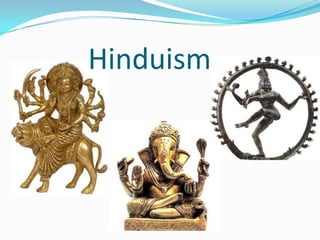
Hinduism
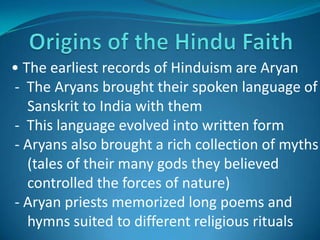
• The earliest records of Hinduism are Aryan
- The Aryans brought their spoken language of
   Sanskrit to India with them
- This language evolved into written form
- Aryans also brought a rich collection of myths
   (tales of their many gods they believed
   controlled the forces of nature)
- Aryan priests memorized long poems and
   hymns suited to different religious rituals
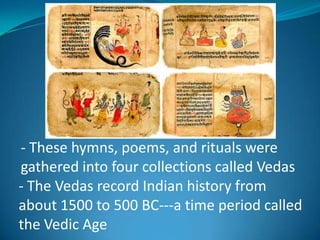
- These hymns, poems, and rituals were
gathered into four collections called Vedas
- The Vedas record Indian history from
about 1500 to 500 BC---a time period called
the Vedic Age
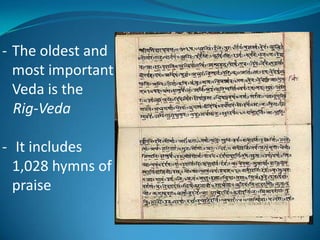
- The oldest and
  most important
  Veda is the
  Rig-Veda

- It includes
  1,028 hymns of
  praise
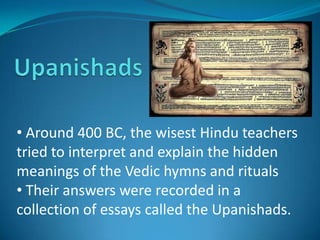
• Around 400 BC, the wisest Hindu teachers
tried to interpret and explain the hidden
meanings of the Vedic hymns and rituals
• Their answers were recorded in a
collection of essays called the Upanishads.
• A universal spirit is present within all living
  things—Brahman. This is thought to be the
  mighty spirit that creates and destroys life
   – The Brahman is One but expresses itself
     as Many
   – Everything in nature is tied together by
     Brahman
   – Because all living things are considered a
     part of Brahman, Hindus forbade the
     killing of animals
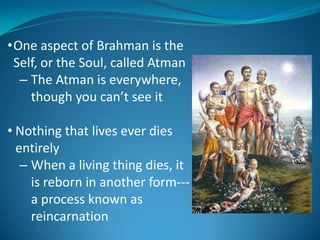
•One aspect of Brahman is the
 Self, or the Soul, called Atman
  – The Atman is everywhere,
    though you can’t see it

• Nothing that lives ever dies
  entirely
   – When a living thing dies, it
     is reborn in another form---
     a process known as
     reincarnation
• All wise Hindus must seek to reach a
  state of perfect understanding called
  moksha. At this point the self will
  disappear and merge with Brahman

• The authors of the Upanishads taught
  that forms of self denial—such as fasting,
  helped achieve union with Brahman.
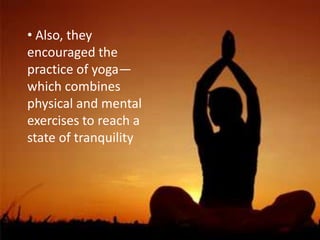
• Also, they
encouraged the
practice of yoga—
which combines
physical and mental
exercises to reach a
state of tranquility
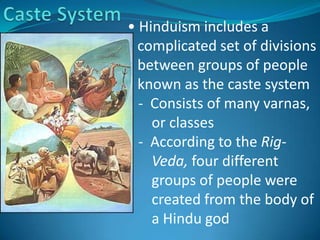
• Hinduism includes a
  complicated set of divisions
  between groups of people
  known as the caste system
  - Consists of many varnas,
    or classes
  - According to the Rig-
    Veda, four different
    groups of people were
    created from the body of
    a Hindu god
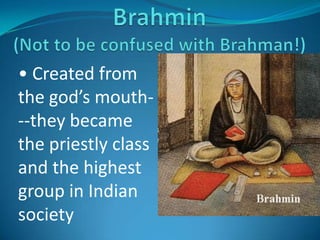
• Created from
the god’s mouth-
--they became
the priestly class
and the highest
group in Indian
society
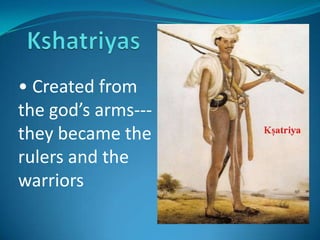
• Created from
the god’s arms---
they became the
rulers and the
warriors
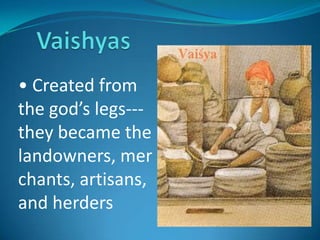
• Created from
the god’s legs---
they became the
landowners, mer
chants, artisans,
and herders
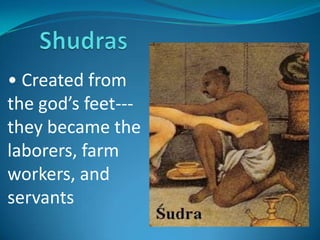
• Created from
the god’s feet---
they became the
laborers, farm
workers, and
servants
-The lowest
“caste” of
untouchables
- People who
performed jobs
considered
unclean
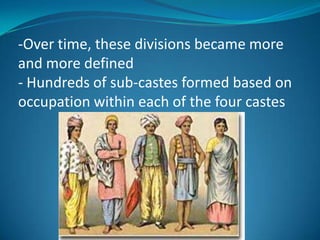
-Over time, these divisions became more
and more defined
- Hundreds of sub-castes formed based on
occupation within each of the four castes
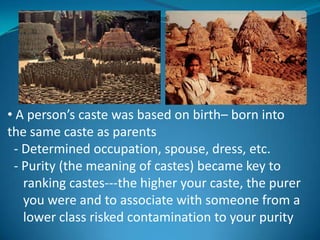
• A person’s caste was based on birth– born into
the same caste as parents
 - Determined occupation, spouse, dress, etc.
 - Purity (the meaning of castes) became key to
   ranking castes---the higher your caste, the purer
   you were and to associate with someone from a
   lower class risked contamination to your purity
• Is the caste system explicitly a religious part of
 the Hindu religion???? No!
• HOWEVER, Hinduism played a large part in
 maintaining the rigid structure
  - Cycle of birth and reincarnation
  - Actions in this life determines your fate when
     born again
  - If faithful and dutiful in this life, you will have
     a better fate in the next life
  - In a previous life, Brahmins had committed
     no bad deeds while untouchables had
• To earn good rebirth a person had
  to be a good member of his or
  her caste
   - Each caste had its particular
     duty or set of obligations called
     dharma
   - The individual’s wishes did not
   matter
   - It was better to do your duty
      badly than to do someone
      else’s duty well
• Hindus believed in an ethical law of cause
  and effect called karma
   - Moral behavior in one life guaranteed
     rebirth in a higher caste
   - Immoral behavior automatically dropped
     a reborn soul to a lower caste
• Hindus believed in an ethical law of cause
  and effect called karma
   - Moral behavior in one life guaranteed
     rebirth in a higher caste
   - Immoral behavior automatically dropped
     a reborn soul to a lower caste

Hinduism Presentation

  • 1.
  • 2.
    • The earliestrecords of Hinduism are Aryan - The Aryans brought their spoken language of Sanskrit to India with them - This language evolved into written form - Aryans also brought a rich collection of myths (tales of their many gods they believed controlled the forces of nature) - Aryan priests memorized long poems and hymns suited to different religious rituals
  • 3.
    - These hymns,poems, and rituals were gathered into four collections called Vedas - The Vedas record Indian history from about 1500 to 500 BC---a time period called the Vedic Age
  • 4.
    - The oldestand most important Veda is the Rig-Veda - It includes 1,028 hymns of praise
  • 5.
    • Around 400BC, the wisest Hindu teachers tried to interpret and explain the hidden meanings of the Vedic hymns and rituals • Their answers were recorded in a collection of essays called the Upanishads.
  • 6.
    • A universalspirit is present within all living things—Brahman. This is thought to be the mighty spirit that creates and destroys life – The Brahman is One but expresses itself as Many – Everything in nature is tied together by Brahman – Because all living things are considered a part of Brahman, Hindus forbade the killing of animals
  • 7.
    •One aspect ofBrahman is the Self, or the Soul, called Atman – The Atman is everywhere, though you can’t see it • Nothing that lives ever dies entirely – When a living thing dies, it is reborn in another form--- a process known as reincarnation
  • 8.
    • All wiseHindus must seek to reach a state of perfect understanding called moksha. At this point the self will disappear and merge with Brahman • The authors of the Upanishads taught that forms of self denial—such as fasting, helped achieve union with Brahman.
  • 9.
    • Also, they encouragedthe practice of yoga— which combines physical and mental exercises to reach a state of tranquility
  • 10.
    • Hinduism includesa complicated set of divisions between groups of people known as the caste system - Consists of many varnas, or classes - According to the Rig- Veda, four different groups of people were created from the body of a Hindu god
  • 11.
    • Created from thegod’s mouth- --they became the priestly class and the highest group in Indian society
  • 12.
    • Created from thegod’s arms--- they became the rulers and the warriors
  • 13.
    • Created from thegod’s legs--- they became the landowners, mer chants, artisans, and herders
  • 14.
    • Created from thegod’s feet--- they became the laborers, farm workers, and servants
  • 15.
    -The lowest “caste” of untouchables -People who performed jobs considered unclean
  • 16.
    -Over time, thesedivisions became more and more defined - Hundreds of sub-castes formed based on occupation within each of the four castes
  • 17.
    • A person’scaste was based on birth– born into the same caste as parents - Determined occupation, spouse, dress, etc. - Purity (the meaning of castes) became key to ranking castes---the higher your caste, the purer you were and to associate with someone from a lower class risked contamination to your purity
  • 18.
    • Is thecaste system explicitly a religious part of the Hindu religion???? No! • HOWEVER, Hinduism played a large part in maintaining the rigid structure - Cycle of birth and reincarnation - Actions in this life determines your fate when born again - If faithful and dutiful in this life, you will have a better fate in the next life - In a previous life, Brahmins had committed no bad deeds while untouchables had
  • 19.
    • To earngood rebirth a person had to be a good member of his or her caste - Each caste had its particular duty or set of obligations called dharma - The individual’s wishes did not matter - It was better to do your duty badly than to do someone else’s duty well
  • 20.
    • Hindus believedin an ethical law of cause and effect called karma - Moral behavior in one life guaranteed rebirth in a higher caste - Immoral behavior automatically dropped a reborn soul to a lower caste
  • 21.
    • Hindus believedin an ethical law of cause and effect called karma - Moral behavior in one life guaranteed rebirth in a higher caste - Immoral behavior automatically dropped a reborn soul to a lower caste