Confucianism
(khonghuchu)
Religious study
By:
Elvina mulac
Siti yaumilia salsa (13.036)
HISTORY
• Believing to god (ru jiao) was already available even before khonghucu
prophet appear.
• Khonghucu is a prophet that have a mission to make the ru jiao follower back
to the right place.
• After experienced many things in life confusius build a school dan have many
followers.
• It is a complete ideological system created by Confucius based on the
traditional culture of Xia, Shang and Zhou Dynasties
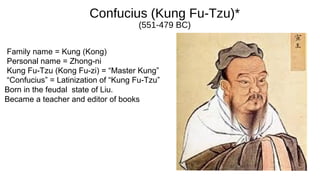
Confucius (Kung Fu-Tzu)*
(551-479 BC)
Family name = Kung (Kong)
Personal name = Zhong-ni
Kung Fu-Tzu (Kong Fu-zi) = “Master Kung”
“Confucius” = Latinization of “Kung Fu-Tzu”
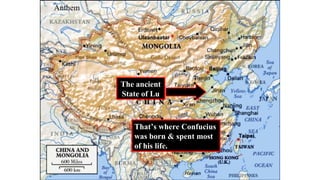
Born in the feudal state of Liu.
Became a teacher and editor of books
The ancient
State of Lu
That’s where Confucius
was born & spent most
of his life.
Anthem
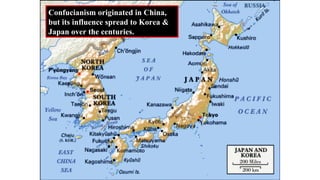
Confucianism originated in China,
but its influence spread to Korea &
Japan over the centuries.
6
Basic teaching
Eight recognition Faith(Ba Chen Gui)
• Cheng Xin Huang Tian: People of Confucian religion shall believe, satya, devoted, respectful, and
bow down to God Almighty or Huang Tian ( 皇 天 ).
• Juen Cheng Jie De: People of Confucian religion must uphold the virtues or De ( 德 ).
• Cheng Li Ming Ming: People of Confucian religion shall enforce the Word Gemilang or Ming Ming
( 明 命 ).
• Cheng Zhi Gui Shen: People of Confucian religion shall believe in the spirit and life or Gui Shen
( 鬼 神 ).
• Cheng Yang Xiao Shi: People of Confucian religion shall devote to the Old or Xiao Shi ( 孝 思 ).
• Mu Shun Cheng Duo: People Confucian shall recognize and follow the Prophet Kongzi as Genta
Spiritual or Duo Mu ( 木 铎 ).
• Qin Jing Cheng Shu: People of Confucian religion shall believe the truth of Scripture Wu Jing ( 五
经 ) and Si Shu ( 四 书 ).
• Cheng Xing Da Dao: mandatory life Confucian faiths take great Holy Way
Key Principles
7
Li: (morality) Following/respecting of etiquette and norms of daily life
Ren: (Love) stands for Kindness to the fellow man
Xin : (Trustable) stands for truthfulness, faithfulness and sincerity
Yi : (Truth) for righteousness or honesty, generosity of soul
Zhi : ( Thoughtful)Means wisdom, believed that wisdom didn’t just
concern the persons ability and aptitude, but also his moral
cultivation
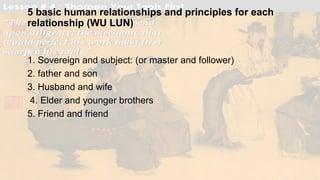
5 basic human relationships and principles for each
relationship (WU LUN)
1. Sovereign and subject: (or master and follower)
2. father and son
3. Husband and wife
4. Elder and younger brothers
5. Friend and friend
System of Beliefs
• The purpose of life is to follow an orderly and reverent existence in accord with Li
• Golden Rule: Never do to others what you would not like them to do to you
• Self(hood) – The selfhood in Confucianism is all about regarding our selves first and foremost
as a center of human relationship rather focusing in our individuality, and through that
relationship we determine our self-identity and therefore able to uniquely understand the
human condition.
• Family – It focuses in the primary virtue of being filial to one’s elder, or to act in a way suitable
for a son or daughter. That one’s relationship with family members is defined by respecting
and being patient towards each other. In other words it is about building a strong family bond.
• Nation – Confucianism also believes that government should offer their best in ensuring the
happiness of the people and the ongoing improvement of society. In short Intelligent
Government.
• Heaven – Confucianism also believes in heaven, Confucius himself believe heaven as a vital
fact of reality, and that at the age of fifty he had understood the mandate of heaven or the
Divine Rights of kings.
Philosoph
y
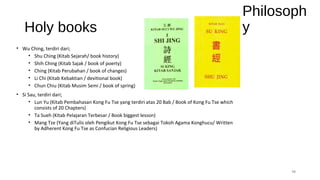
Holy books
• Wu Ching, terdiri dari;
• Shu Ching (Kitab Sejarah/ book history)
• Shih Ching (Kitab Sajak / book of poerty)
• Ching (Kitab Perubahan / book of changes)
• Li Chi (Kitab Kebaktian / devitional book)
• Chun Chiu (Kitab Musim Semi / book of spring)
• Si Sau, terdiri dari;
• Lun Yu (Kitab Pembahasan Kong Fu Tse yang terdiri atas 20 Bab / Book of Kong Fu Tse which
consists of 20 Chapters)
• Ta Sueh (Kitab Pelajaran Terbesar / Book biggest lesson)
• Mang Tze (Yang diTulis oleh Pengikut Kong Fu Tse sebagai Tokoh Agama Konghucu/ Written
by Adherent Kong Fu Tse as Confucian Religious Leaders)
11
Philosoph
y
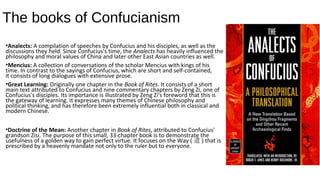
The books of Confucianism
•Analects: A compilation of speeches by Confucius and his disciples, as well as the
discussions they held. Since Confucius's time, the Analects has heavily influenced the
philosophy and moral values of China and later other East Asian countries as well.
•Mencius: A collection of conversations of the scholar Mencius with kings of his
time. In contrast to the sayings of Confucius, which are short and self-contained,
it consists of long dialogues with extensive prose.
•Great Learning: Originally one chapter in the Book of Rites. It consists of a short
main text attributed to Confucius and nine commentary chapters by Zeng Zi, one of
Confucius's disciples. Its importance is illustrated by Zeng Zi's foreword that this is
the gateway of learning. It expresses many themes of Chinese philosophy and
political thinking, and has therefore been extremely influential both in classical and
modern Chinese.
•Doctrine of the Mean: Another chapter in Book of Rites, attributed to Confucius'
grandson Zisi. The purpose of this small, 33-chapter book is to demonstrate the
usefulness of a golden way to gain perfect virtue. It focuses on the Way ( 道 ) that is
prescribed by a heavenly mandate not only to the ruler but to everyone.
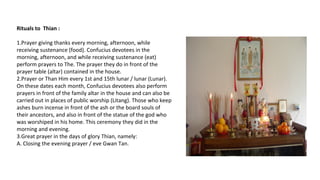
Rituals to Thian :
1.Prayer giving thanks every morning, afternoon, while
receiving sustenance (food). Confucius devotees in the
morning, afternoon, and while receiving sustenance (eat)
perform prayers to The. The prayer they do in front of the
prayer table (altar) contained in the house.
2.Prayer or Than Him every 1st and 15th lunar / lunar (Lunar).
On these dates each month, Confucius devotees also perform
prayers in front of the family altar in the house and can also be
carried out in places of public worship (Litang). Those who keep
ashes burn incense in front of the ash or the board souls of
their ancestors, and also in front of the statue of the god who
was worshiped in his home. This ceremony they did in the
morning and evening.
3.Great prayer in the days of glory Thian, namely:
A. Closing the evening prayer / eve Gwan Tan.
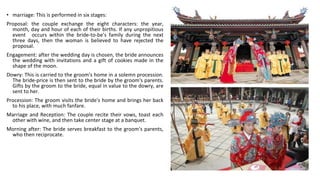
• marriage: This is performed in six stages:
Proposal: the couple exchange the eight characters: the year,
month, day and hour of each of their births. If any unpropitious
event occurs within the bride-to-be's family during the next
three days, then the woman is believed to have rejected the
proposal.
Engagement: after the wedding day is chosen, the bride announces
the wedding with invitations and a gift of cookies made in the
shape of the moon.
Dowry: This is carried to the groom's home in a solemn procession.
The bride-price is then sent to the bride by the groom's parents.
Gifts by the groom to the bride, equal in value to the dowry, are
sent to her.
Procession: The groom visits the bride's home and brings her back
to his place, with much fanfare.
Marriage and Reception: The couple recite their vows, toast each
other with wine, and then take center stage at a banquet.
Morning after: The bride serves breakfast to the groom's parents,
who then reciprocate.
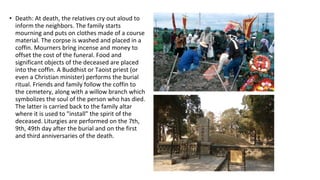
• Death: At death, the relatives cry out aloud to
inform the neighbors. The family starts
mourning and puts on clothes made of a course
material. The corpse is washed and placed in a
coffin. Mourners bring incense and money to
offset the cost of the funeral. Food and
significant objects of the deceased are placed
into the coffin. A Buddhist or Taoist priest (or
even a Christian minister) performs the burial
ritual. Friends and family follow the coffin to
the cemetery, along with a willow branch which
symbolizes the soul of the person who has died.
The latter is carried back to the family altar
where it is used to "install" the spirit of the
deceased. Liturgies are performed on the 7th,
9th, 49th day after the burial and on the first
and third anniversaries of the death.
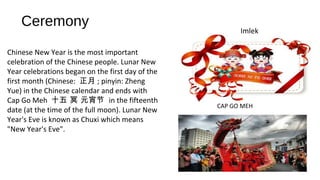
Ceremony
Imlek
CAP GO MEH
Chinese New Year is the most important
celebration of the Chinese people. Lunar New
Year celebrations began on the first day of the
first month (Chinese: 正月 ; pinyin: Zheng
Yue) in the Chinese calendar and ends with
Cap Go Meh 十五 冥 元宵节 in the fifteenth
date (at the time of the full moon). Lunar New
Year's Eve is known as Chuxi which means
"New Year's Eve".
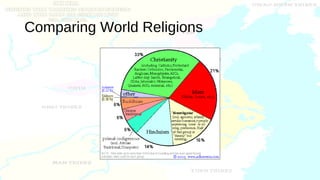
Comparing World Religions
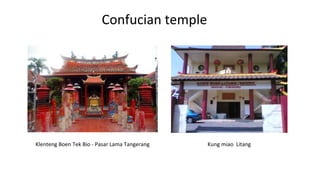
Klenteng Boen Tek Bio - Pasar Lama Tangerang Kung miao Litang
Confucian temple
What interest you the most /
what you most find interesting ?
Sources
• http://www.patheos.com/Library/Confucianism.html
• http://www.religionfacts.com/confucianism
• http://philosophy.lander.edu/oriental/main.html
• Www.slideshare.net

Confucianism (khonghuchu)

  • 1.
  • 2.
    HISTORY • Believing togod (ru jiao) was already available even before khonghucu prophet appear. • Khonghucu is a prophet that have a mission to make the ru jiao follower back to the right place. • After experienced many things in life confusius build a school dan have many followers. • It is a complete ideological system created by Confucius based on the traditional culture of Xia, Shang and Zhou Dynasties
  • 3.
    Confucius (Kung Fu-Tzu)* (551-479BC) Family name = Kung (Kong) Personal name = Zhong-ni Kung Fu-Tzu (Kong Fu-zi) = “Master Kung” “Confucius” = Latinization of “Kung Fu-Tzu” Born in the feudal state of Liu. Became a teacher and editor of books
  • 4.
    The ancient State ofLu That’s where Confucius was born & spent most of his life. Anthem
  • 5.
    Confucianism originated inChina, but its influence spread to Korea & Japan over the centuries.
  • 6.
    6 Basic teaching Eight recognitionFaith(Ba Chen Gui) • Cheng Xin Huang Tian: People of Confucian religion shall believe, satya, devoted, respectful, and bow down to God Almighty or Huang Tian ( 皇 天 ). • Juen Cheng Jie De: People of Confucian religion must uphold the virtues or De ( 德 ). • Cheng Li Ming Ming: People of Confucian religion shall enforce the Word Gemilang or Ming Ming ( 明 命 ). • Cheng Zhi Gui Shen: People of Confucian religion shall believe in the spirit and life or Gui Shen ( 鬼 神 ). • Cheng Yang Xiao Shi: People of Confucian religion shall devote to the Old or Xiao Shi ( 孝 思 ). • Mu Shun Cheng Duo: People Confucian shall recognize and follow the Prophet Kongzi as Genta Spiritual or Duo Mu ( 木 铎 ). • Qin Jing Cheng Shu: People of Confucian religion shall believe the truth of Scripture Wu Jing ( 五 经 ) and Si Shu ( 四 书 ). • Cheng Xing Da Dao: mandatory life Confucian faiths take great Holy Way
  • 7.
    Key Principles 7 Li: (morality)Following/respecting of etiquette and norms of daily life Ren: (Love) stands for Kindness to the fellow man Xin : (Trustable) stands for truthfulness, faithfulness and sincerity Yi : (Truth) for righteousness or honesty, generosity of soul Zhi : ( Thoughtful)Means wisdom, believed that wisdom didn’t just concern the persons ability and aptitude, but also his moral cultivation
  • 8.
    5 basic humanrelationships and principles for each relationship (WU LUN) 1. Sovereign and subject: (or master and follower) 2. father and son 3. Husband and wife 4. Elder and younger brothers 5. Friend and friend
  • 9.
    System of Beliefs •The purpose of life is to follow an orderly and reverent existence in accord with Li • Golden Rule: Never do to others what you would not like them to do to you • Self(hood) – The selfhood in Confucianism is all about regarding our selves first and foremost as a center of human relationship rather focusing in our individuality, and through that relationship we determine our self-identity and therefore able to uniquely understand the human condition. • Family – It focuses in the primary virtue of being filial to one’s elder, or to act in a way suitable for a son or daughter. That one’s relationship with family members is defined by respecting and being patient towards each other. In other words it is about building a strong family bond. • Nation – Confucianism also believes that government should offer their best in ensuring the happiness of the people and the ongoing improvement of society. In short Intelligent Government. • Heaven – Confucianism also believes in heaven, Confucius himself believe heaven as a vital fact of reality, and that at the age of fifty he had understood the mandate of heaven or the Divine Rights of kings.
  • 10.
  • 11.
    Holy books • WuChing, terdiri dari; • Shu Ching (Kitab Sejarah/ book history) • Shih Ching (Kitab Sajak / book of poerty) • Ching (Kitab Perubahan / book of changes) • Li Chi (Kitab Kebaktian / devitional book) • Chun Chiu (Kitab Musim Semi / book of spring) • Si Sau, terdiri dari; • Lun Yu (Kitab Pembahasan Kong Fu Tse yang terdiri atas 20 Bab / Book of Kong Fu Tse which consists of 20 Chapters) • Ta Sueh (Kitab Pelajaran Terbesar / Book biggest lesson) • Mang Tze (Yang diTulis oleh Pengikut Kong Fu Tse sebagai Tokoh Agama Konghucu/ Written by Adherent Kong Fu Tse as Confucian Religious Leaders) 11 Philosoph y
  • 12.
    The books ofConfucianism •Analects: A compilation of speeches by Confucius and his disciples, as well as the discussions they held. Since Confucius's time, the Analects has heavily influenced the philosophy and moral values of China and later other East Asian countries as well. •Mencius: A collection of conversations of the scholar Mencius with kings of his time. In contrast to the sayings of Confucius, which are short and self-contained, it consists of long dialogues with extensive prose. •Great Learning: Originally one chapter in the Book of Rites. It consists of a short main text attributed to Confucius and nine commentary chapters by Zeng Zi, one of Confucius's disciples. Its importance is illustrated by Zeng Zi's foreword that this is the gateway of learning. It expresses many themes of Chinese philosophy and political thinking, and has therefore been extremely influential both in classical and modern Chinese. •Doctrine of the Mean: Another chapter in Book of Rites, attributed to Confucius' grandson Zisi. The purpose of this small, 33-chapter book is to demonstrate the usefulness of a golden way to gain perfect virtue. It focuses on the Way ( 道 ) that is prescribed by a heavenly mandate not only to the ruler but to everyone.
  • 13.
    Rituals to Thian: 1.Prayer giving thanks every morning, afternoon, while receiving sustenance (food). Confucius devotees in the morning, afternoon, and while receiving sustenance (eat) perform prayers to The. The prayer they do in front of the prayer table (altar) contained in the house. 2.Prayer or Than Him every 1st and 15th lunar / lunar (Lunar). On these dates each month, Confucius devotees also perform prayers in front of the family altar in the house and can also be carried out in places of public worship (Litang). Those who keep ashes burn incense in front of the ash or the board souls of their ancestors, and also in front of the statue of the god who was worshiped in his home. This ceremony they did in the morning and evening. 3.Great prayer in the days of glory Thian, namely: A. Closing the evening prayer / eve Gwan Tan.
  • 14.
    • marriage: Thisis performed in six stages: Proposal: the couple exchange the eight characters: the year, month, day and hour of each of their births. If any unpropitious event occurs within the bride-to-be's family during the next three days, then the woman is believed to have rejected the proposal. Engagement: after the wedding day is chosen, the bride announces the wedding with invitations and a gift of cookies made in the shape of the moon. Dowry: This is carried to the groom's home in a solemn procession. The bride-price is then sent to the bride by the groom's parents. Gifts by the groom to the bride, equal in value to the dowry, are sent to her. Procession: The groom visits the bride's home and brings her back to his place, with much fanfare. Marriage and Reception: The couple recite their vows, toast each other with wine, and then take center stage at a banquet. Morning after: The bride serves breakfast to the groom's parents, who then reciprocate.
  • 15.
    • Death: Atdeath, the relatives cry out aloud to inform the neighbors. The family starts mourning and puts on clothes made of a course material. The corpse is washed and placed in a coffin. Mourners bring incense and money to offset the cost of the funeral. Food and significant objects of the deceased are placed into the coffin. A Buddhist or Taoist priest (or even a Christian minister) performs the burial ritual. Friends and family follow the coffin to the cemetery, along with a willow branch which symbolizes the soul of the person who has died. The latter is carried back to the family altar where it is used to "install" the spirit of the deceased. Liturgies are performed on the 7th, 9th, 49th day after the burial and on the first and third anniversaries of the death.
  • 16.
    Ceremony Imlek CAP GO MEH ChineseNew Year is the most important celebration of the Chinese people. Lunar New Year celebrations began on the first day of the first month (Chinese: 正月 ; pinyin: Zheng Yue) in the Chinese calendar and ends with Cap Go Meh 十五 冥 元宵节 in the fifteenth date (at the time of the full moon). Lunar New Year's Eve is known as Chuxi which means "New Year's Eve".
  • 17.
  • 18.
    Klenteng Boen TekBio - Pasar Lama Tangerang Kung miao Litang Confucian temple
  • 19.
    What interest youthe most / what you most find interesting ?
  • 20.