Confucianism
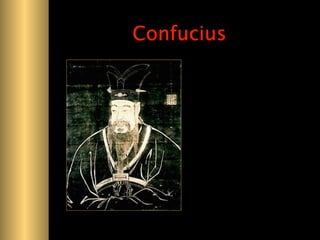
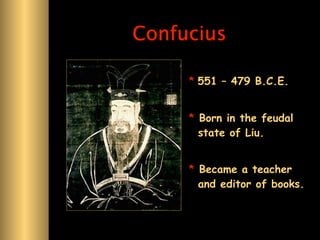
Confucius
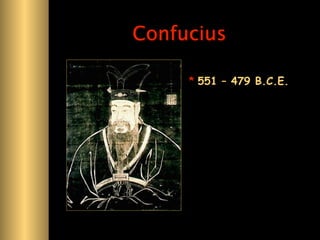
Confucius

     * 551 – 479 B.C.E.

Confucius

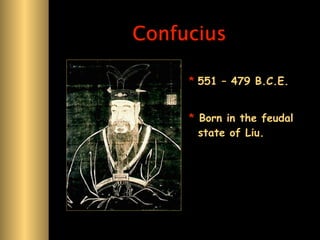
     * 551 – 479 B.C.E.


     * Born in the feudal
       state of Liu.
Confucius

     * 551 – 479 B.C.E.


     * Born in the feudal
       state of Liu.


     * Became a teacher
       and editor of books.
Major Confucian Principles

Li --> Rite, rules, ritual decorum (Binding
        force of an enduring stable society)
Major Confucian Principles

Li --> Rite, rules, ritual decorum (Binding
        force of an enduring stable society)

Ren --> humaneness, benevolence,
         humanity
Major Confucian Principles

Li --> Rite, rules, ritual decorum (Binding
        force of an enduring stable society)

Ren --> humaneness, benevolence,
         humanity

Shu --> Reciprocity, empathy
Major Confucian Principles

Li --> Rite, rules, ritual decorum (Binding
        force of an enduring stable society)

Ren --> humaneness, benevolence,
         humanity

Shu --> Reciprocity, empathy

     Do not do unto others what you would
     not want others to do unto you.
Major Confucian Principles

Li --> Rite, rules, ritual decorum (Binding
        force of an enduring stable society)

Ren --> humaneness, benevolence,
         humanity

Shu --> Reciprocity, empathy

     Do not do unto others what you would
     not want others to do unto you.

Yi --> Righteousness
Major Confucian Principles

Li --> Rite, rules, ritual decorum (Binding
        force of an enduring stable society)

Ren --> humaneness, benevolence,
         humanity

Shu --> Reciprocity, empathy

      Do not do unto others what you would
      not want others to do unto you.

Yi --> Righteousness

Xiao --> Filial Piety (Respect your elders!)
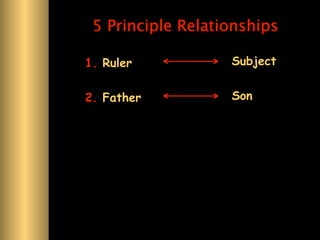
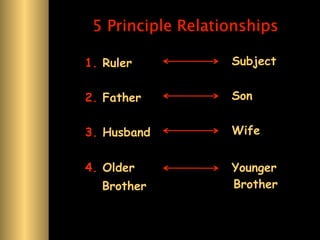
5 Principle Relationships

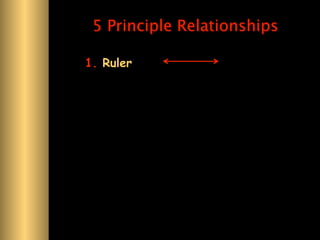
1. Ruler
5 Principle Relationships

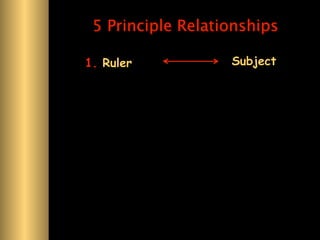
1. Ruler           Subject
5 Principle Relationships

1. Ruler           Subject


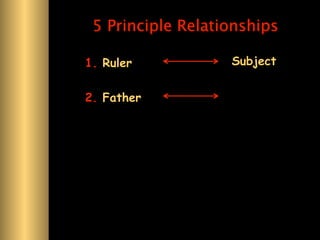
2. Father
5 Principle Relationships

1. Ruler           Subject


2. Father          Son
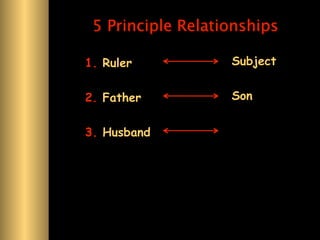
5 Principle Relationships

1. Ruler           Subject


2. Father          Son


3. Husband
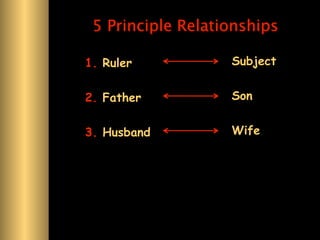
5 Principle Relationships

1. Ruler           Subject


2. Father          Son


3. Husband         Wife
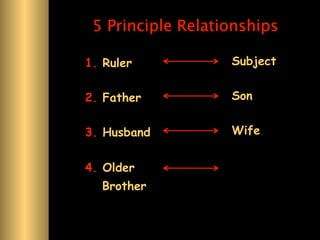
5 Principle Relationships

1. Ruler           Subject


2. Father          Son


3. Husband         Wife


4. Older
  Brother
5 Principle Relationships

1. Ruler           Subject


2. Father          Son


3. Husband         Wife


4. Older           Younger
  Brother          Brother
5 Principle Relationships

1. Ruler           Subject


2. Father          Son


3. Husband         Wife


4. Older           Younger
  Brother          Brother

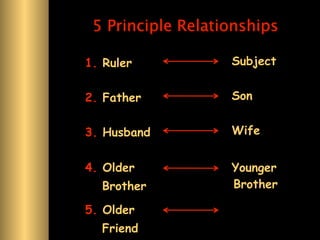
5. Older
  Friend
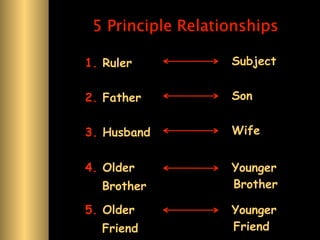
5 Principle Relationships

1. Ruler           Subject


2. Father          Son


3. Husband         Wife


4. Older           Younger
  Brother          Brother

5. Older           Younger
  Friend           Friend
Organizing Principles

     *   Status
Organizing Principles

     *   Status


     * Age
Organizing Principles

     *   Status


     * Age


     * Gender
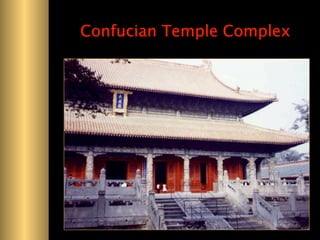
Confucian Temple Complex
The Analects
The Analects
* The single most important Confucian
 work.
The Analects
* The single most important Confucian
 work.


* In Chinese, it means “conversation.”
The Analects
* The single most important Confucian
 work.


* In Chinese, it means “conversation.”


* Focus on practicalities of interpersonal
  relationships and the relationship of
  the role of rulers and ministers to the
  conduct of government.
Sayings from The Analects

* Knowing what he knows and knowing what he
  doesn’t know, is characteristics of the person
  who knows.
Sayings from The Analects

* Knowing what he knows and knowing what he
  doesn’t know, is characteristics of the person
  who knows.


* Making a mistake and not correcting it, is
  making another mistake.
Sayings from The Analects

* Knowing what he knows and knowing what he
  doesn’t know, is characteristics of the person
  who knows.


* Making a mistake and not correcting it, is
  making another mistake.


* The superior man blames himself; the
  inferior man blames others.
Sayings from The Analects

* Knowing what he knows and knowing what he
  doesn’t know, is characteristics of the person
  who knows.


* Making a mistake and not correcting it, is
  making another mistake.


* The superior man blames himself; the
  inferior man blames others.
Stones Engraved with Confucius'
          Life Stories
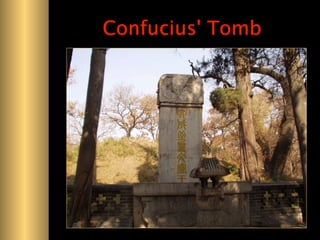
Confucius' Tomb
Mencius
Mencius
* 372 - 289 B.C.E.
Mencius
* 372 - 289 B.C.E.


* Disciple of Confucius.
Mencius
* 372 - 289 B.C.E.


* Disciple of Confucius.


* Starts off with the assumption that “people
  are basically good.”
Mencius
* 372 - 289 B.C.E.


* Disciple of Confucius.


* Starts off with the assumption that “people
  are basically good.”


* If someone does something bad, education,
  not punishment, is the answer.
Mencius
* 372 - 289 B.C.E.


* Disciple of Confucius.


* Starts off with the assumption that “people
  are basically good.”


* If someone does something bad, education,
  not punishment, is the answer.

   ä Good people will mend their ways in
      accordance to their inherent goodness.
Social Cohesion is Paramount!
* The emperor is the example of
  proper behavior --> “big daddy”
Social Cohesion is Paramount!
* The emperor is the example of
  proper behavior --> “big daddy”


* Social relationships are based on
  “rites” or “rituals.”
Social Cohesion is Paramount!
* The emperor is the example of
  proper behavior --> “big daddy”


* Social relationships are based on
  “rites” or “rituals.”


* Even religious rituals are
  important for SOCIAL, not
  religious reasons, acc. to Confucius.

Confucianism 2011

  • 2.
  • 3.
  • 4.
    Confucius * 551 – 479 B.C.E.
  • 5.
    Confucius * 551 – 479 B.C.E. * Born in the feudal state of Liu.
  • 6.
    Confucius * 551 – 479 B.C.E. * Born in the feudal state of Liu. * Became a teacher and editor of books.
  • 7.
  • 8.
    Major Confucian Principles Li--> Rite, rules, ritual decorum (Binding force of an enduring stable society)
  • 9.
    Major Confucian Principles Li--> Rite, rules, ritual decorum (Binding force of an enduring stable society) Ren --> humaneness, benevolence, humanity
  • 10.
    Major Confucian Principles Li--> Rite, rules, ritual decorum (Binding force of an enduring stable society) Ren --> humaneness, benevolence, humanity Shu --> Reciprocity, empathy
  • 11.
    Major Confucian Principles Li--> Rite, rules, ritual decorum (Binding force of an enduring stable society) Ren --> humaneness, benevolence, humanity Shu --> Reciprocity, empathy Do not do unto others what you would not want others to do unto you.
  • 12.
    Major Confucian Principles Li--> Rite, rules, ritual decorum (Binding force of an enduring stable society) Ren --> humaneness, benevolence, humanity Shu --> Reciprocity, empathy Do not do unto others what you would not want others to do unto you. Yi --> Righteousness
  • 13.
    Major Confucian Principles Li--> Rite, rules, ritual decorum (Binding force of an enduring stable society) Ren --> humaneness, benevolence, humanity Shu --> Reciprocity, empathy Do not do unto others what you would not want others to do unto you. Yi --> Righteousness Xiao --> Filial Piety (Respect your elders!)
  • 14.
  • 15.
  • 16.
  • 17.
    5 Principle Relationships 1.Ruler Subject 2. Father
  • 18.
    5 Principle Relationships 1.Ruler Subject 2. Father Son
  • 19.
    5 Principle Relationships 1.Ruler Subject 2. Father Son 3. Husband
  • 20.
    5 Principle Relationships 1.Ruler Subject 2. Father Son 3. Husband Wife
  • 21.
    5 Principle Relationships 1.Ruler Subject 2. Father Son 3. Husband Wife 4. Older Brother
  • 22.
    5 Principle Relationships 1.Ruler Subject 2. Father Son 3. Husband Wife 4. Older Younger Brother Brother
  • 23.
    5 Principle Relationships 1.Ruler Subject 2. Father Son 3. Husband Wife 4. Older Younger Brother Brother 5. Older Friend
  • 24.
    5 Principle Relationships 1.Ruler Subject 2. Father Son 3. Husband Wife 4. Older Younger Brother Brother 5. Older Younger Friend Friend
  • 25.
  • 26.
  • 27.
    Organizing Principles * Status * Age
  • 28.
    Organizing Principles * Status * Age * Gender
  • 29.
  • 30.
  • 31.
    The Analects * Thesingle most important Confucian work.
  • 32.
    The Analects * Thesingle most important Confucian work. * In Chinese, it means “conversation.”
  • 33.
    The Analects * Thesingle most important Confucian work. * In Chinese, it means “conversation.” * Focus on practicalities of interpersonal relationships and the relationship of the role of rulers and ministers to the conduct of government.
  • 34.
  • 35.
    Sayings from TheAnalects * Knowing what he knows and knowing what he doesn’t know, is characteristics of the person who knows.
  • 36.
    Sayings from TheAnalects * Knowing what he knows and knowing what he doesn’t know, is characteristics of the person who knows. * Making a mistake and not correcting it, is making another mistake.
  • 37.
    Sayings from TheAnalects * Knowing what he knows and knowing what he doesn’t know, is characteristics of the person who knows. * Making a mistake and not correcting it, is making another mistake. * The superior man blames himself; the inferior man blames others.
  • 38.
    Sayings from TheAnalects * Knowing what he knows and knowing what he doesn’t know, is characteristics of the person who knows. * Making a mistake and not correcting it, is making another mistake. * The superior man blames himself; the inferior man blames others.
  • 39.
    Stones Engraved withConfucius' Life Stories
  • 40.
  • 41.
  • 42.
    Mencius * 372 -289 B.C.E.
  • 43.
    Mencius * 372 -289 B.C.E. * Disciple of Confucius.
  • 44.
    Mencius * 372 -289 B.C.E. * Disciple of Confucius. * Starts off with the assumption that “people are basically good.”
  • 45.
    Mencius * 372 -289 B.C.E. * Disciple of Confucius. * Starts off with the assumption that “people are basically good.” * If someone does something bad, education, not punishment, is the answer.
  • 46.
    Mencius * 372 -289 B.C.E. * Disciple of Confucius. * Starts off with the assumption that “people are basically good.” * If someone does something bad, education, not punishment, is the answer. ä Good people will mend their ways in accordance to their inherent goodness.
  • 47.
  • 48.
    Social Cohesion isParamount! * The emperor is the example of proper behavior --> “big daddy”
  • 49.
    Social Cohesion isParamount! * The emperor is the example of proper behavior --> “big daddy” * Social relationships are based on “rites” or “rituals.”
  • 50.
    Social Cohesion isParamount! * The emperor is the example of proper behavior --> “big daddy” * Social relationships are based on “rites” or “rituals.” * Even religious rituals are important for SOCIAL, not religious reasons, acc. to Confucius.