TTaaooiissmm
Lao Tzu (604 BC - 531 BC) 
•ffaatthheerr ooff TTaaooiissmm 
•aattttrriibbuuttee wwiitthh tthhee wwrriittiinngg ooff TTaaoo-- 
ttee CChhiinngg 
–"tao" - the way or the path 
–"te" - virtue 
–"ching" - laws 
•HHee bbeelliieevveedd ““ssiimmpplliicciittyy”” ttoo bbee tthhee 
kkeeyy ttoo ttrruutthh aanndd ffrreeeeddoomm 
“The truth is not always beautiful, nor beautiful words the truth.” 
- LAO TZU
• In this way,Taoist philosophy reached out to 
council rulers and advise them of how to govern 
their domains. Thus Taoism, in a peculiar and 
roundabout way, became a political philosophy. 
The formulation follows these lines: 
The Tao ist sag e has no ambitio ns, the re fo re he can ne ve r 
fail. He who ne ve r fails always succe e ds. And he who 
always succe e ds is all- powe rful.
• When he was eighty years old he set out 
for the western border of China, toward 
what is now Tibet, saddened and 
disillusioned that men were unwilling to 
follow the path to natural goodness
Tao-te Ching 
• a series of poems that can be considered to be a 
work of philosophy, a treatise on how to run a 
government, a how-to book for achieving a 
balanced life, or a sage’s reflection of humanity 
and the universe
Chuang Tzu: The Next Voice 
• His style of writing with its 
parables and conversations both 
accessible while at the same time 
pointing to deeper issues 
• Chuang Tzu took the Taoist position 
of Lao Tzu and developed it further 
• he brought into Chinese philosophy 
is that of self-transformation as a 
central precept in the Taoist 
process
" Once I, Chuang Tzu, dre ame d I was a 
butte rfly and was happy as a butte rfly. I 
was co nscio us that I was quite ple ase d with 
myse lf, but I did no t know that I was Tzu. 
Sudde nly I awo ke , and the re was I, visibly 
Tzu. I do no t know whe the r it was Tzu 
dre aming that he was a butte rfly o r the 
butte rfly dre aming that he was Tzu. 
Be twe e n Tzu and the butte rfly the re must be 
some distinctio n. [But o ne may be the 
o the r. ] This is calle d the transfo rmatio n o f 
thing s. "
DDeevveellooppmmeenntt ooff 
TTaaooiissmm 
YYaanngg HHssiiuunngg 
WWaanngg CChh''uunngg 
HHuuaaii--NNaann TTzzuu 
LLiieehh TTzzuu && YYaanngg CChhuu
Yang Hsiung (53 B.C. to 18 A.D.) 
• was an exponent of what he called Tai 
Hsuan (Great Mystery) 
• This philosophy combined classical Taoism 
with elements of Confucian ethics 
• He is well known for his doctrine that 
human nature is a mixture of good and evil.
"...To make clear the achievement of nature and throw 
light on all things is called yang. To be hidden, 
without form, deep and unfathomable, is called yin. 
Yang knows yang but does not know yin. Yin knows 
yin but does not know yang. The Profound Principle 
alone knows both yin and yang, both going and 
stopping, and both darkness and light." 
--Tai Hsuan Ching
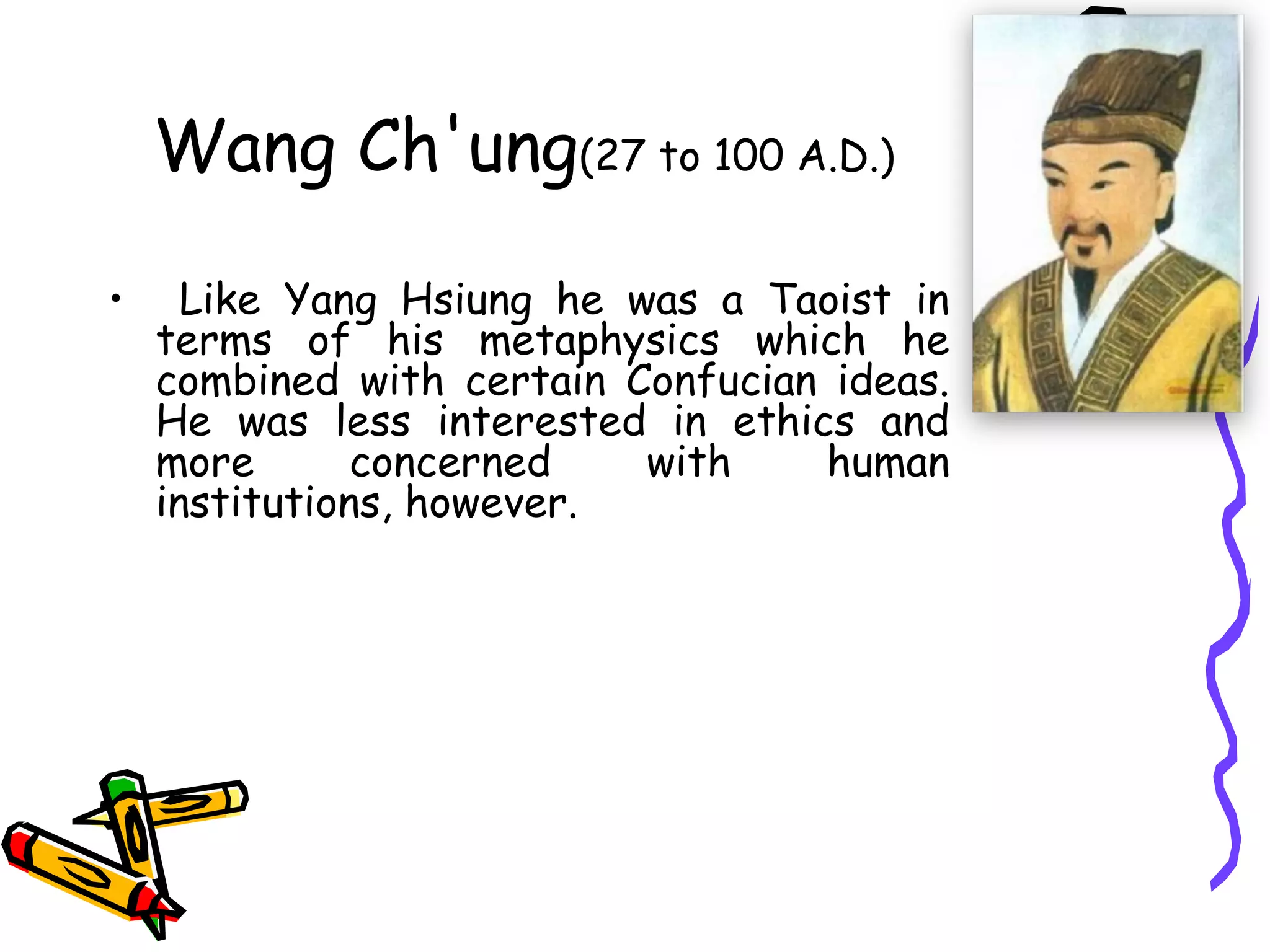
Wang Ch'ung(27 to 100 A.D.) 
• Like Yang Hsiung he was a Taoist in 
terms of his metaphysics which he 
combined with certain Confucian ideas. 
He was less interested in ethics and 
more concerned with human 
institutions, however.
•He declared that Heaven takes no direct action; 
that natural events occur spontaneously; that there 
is no such thing as teleology; that fortune and 
misfortune come by chance; and that man does not 
become a ghost at death. In all these beliefs is stood 
against a prevailing current of superstition and 
divination.
Huai-Nan Tzu 
(died 122 B.C.) [born Liu An] 
• was a prince of Huai-Nan and a 
fervent Taoist. 
• He was not original in his writings but 
gave Taoism further prominence. He 
came to a tragic end as he plotted a 
rebellion, failed and committed 
suicide
Lieh Tzu & Yang Chu 
• Taoism is the hedonism 
• Taoism is the pessimism
Yang Chu (440 to 360 B.C. ) 
• hedonism - school of thought that 
argues that pleasure is the only 
intrinsic good 
• intrinsic good
Lieh Tzu (5th century B.C.) 
• pessimism - it is a philosophy or 
worldview that directly challenges 
the notion of progress and what may 
be considered the faith-based claims 
of optimism 
• extensial value
RReelliiggiioouuss TTaaooiissmm 
TTaaooiisstt PPrraaccttiicceess aanndd BBeelliieeffss 
TTaaooiisstt SSeeccttss 
HHiissttoorryy ooff RReelliiggiioouuss TTaaooiissmm
Taoist Practices and Beliefs 
• This 'religious' Taoism had its own 
temples, priests, rites and symbolic 
images. Lao Tsu was venerated as a 'saint' 
and imperial sacrifices were made to him. 
It drew strongly upon the ideas of yin-yang 
and of the 'Five Agents' (metal, 
wood, water, fire & earth)
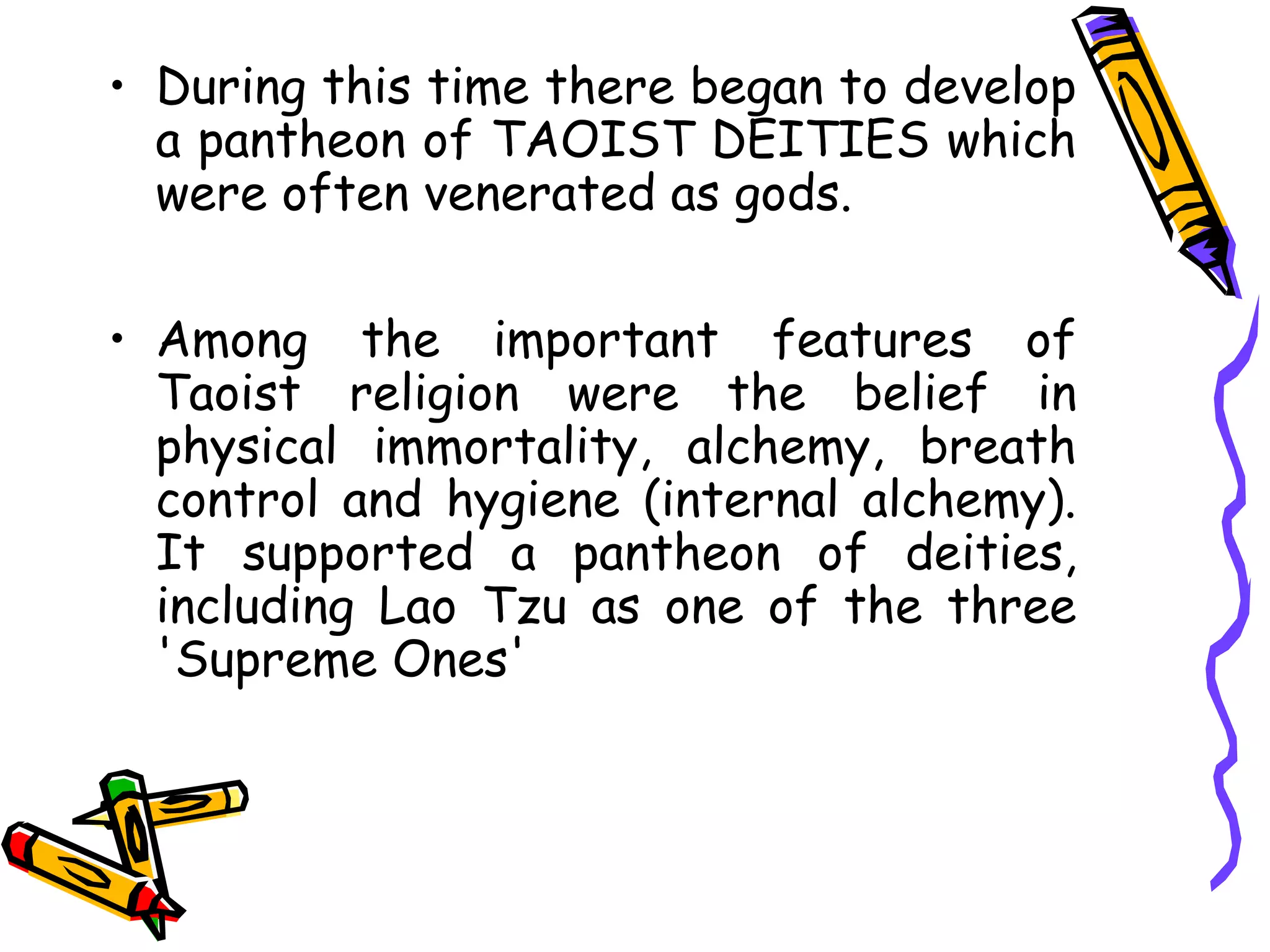
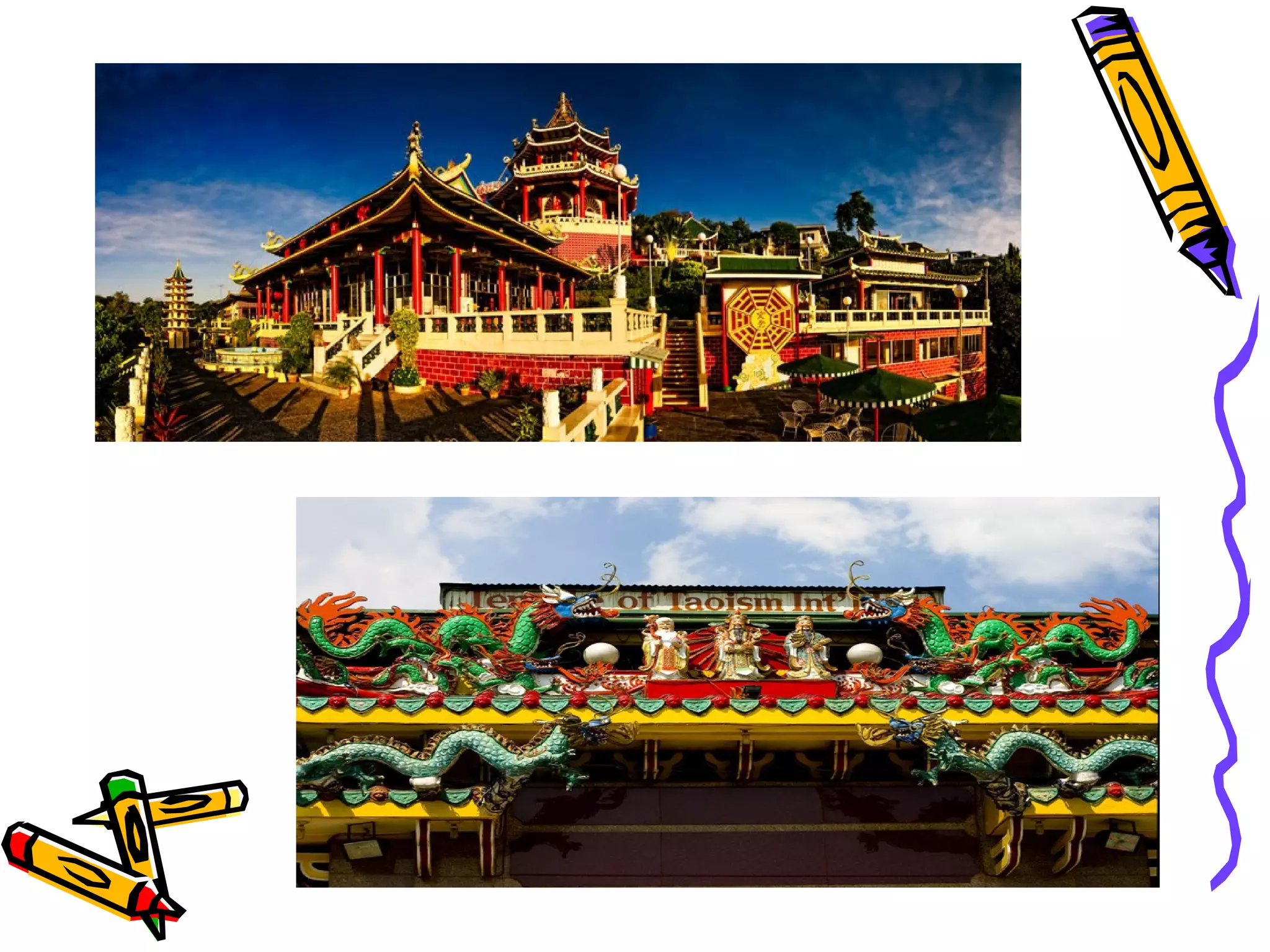
• During this time there began to develop 
a pantheon of TAOIST DEITIES which 
were often venerated as gods. 
• Among the important features of 
Taoist religion were the belief in 
physical immortality, alchemy, breath 
control and hygiene (internal alchemy). 
It supported a pantheon of deities, 
including Lao Tzu as one of the three 
'Supreme Ones'
• There is considerable evidence that this 
religious Taoism came to take on many 
'Tantric' elements, in which the worship 
of yin-yang takes on a distinctly sexual 
and erotic form. The interplay of yin 
and yang elements is represented, and 
celebrated, as a sexual union.
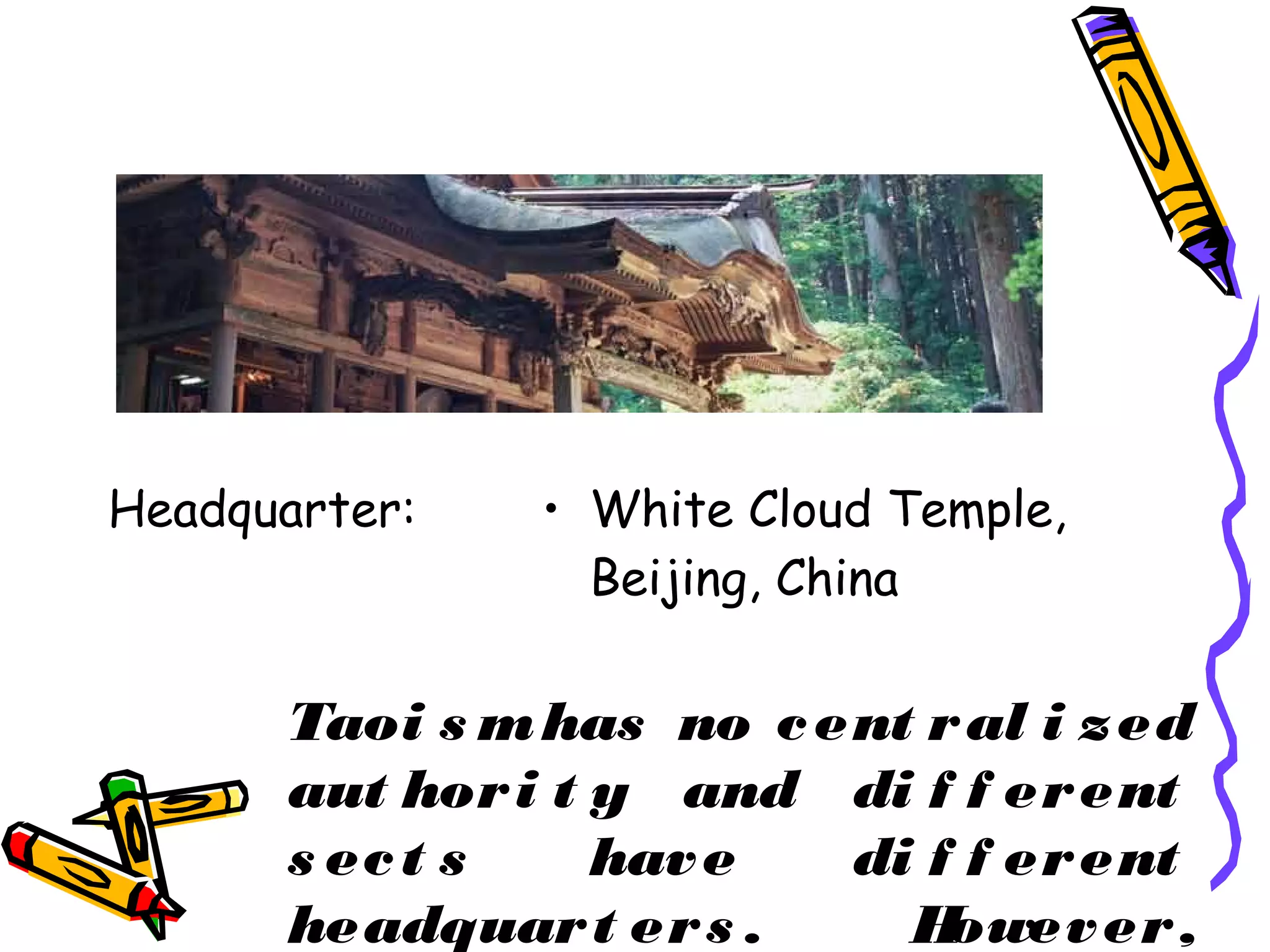
Headquarter: • White Cloud Temple, 
Beijing, China 
Taoi sm has no cent ral i zed 
aut hori t y and di f f erent 
s ec t s have di f f erent 
headquart ers . However,
Taoism did not exist as an organized 
religion until the Way of the Celestial 
Masters sect was founded in 142 C.E. by 
Zhang Daoling
Taoist Sects 
Among the principal Taoist sects to emerge 
were: 
• The Heavenly (or CCeelleessttiiaall)) MMaasstteerrss sseecctt, 
founded in West China in the second century A.D. 
It was founded by Chang Tao-ling (AD 34?-156?) 
who reputedly possessed remarkable healing 
powers. It advocated faith healing through the 
confession of sin and at one time recruited 
members as soldiers and engaged in war against 
the government.
In the 11th century, the sect obtained a large 
tract in Jiangxi province that remained an 
important Taoist center until 1927. The sect still 
flourishes in Taiwan and continues to pay homage 
to Zhang Daoling, who is regarded as immortal.
• TThhee SSuupprreemmee PPeeaaccee sseecctt, also founded in the 
second century A.D., adopted practices much 
like those of the Heavenly Master sect and 
launched a great rebellion that went on for 
several years before ending in 205 A.D. 
• TThhee MMaaoo--sshhaann ((MMoouunntt MMaaoo)) sseecctt, founded in 
the 4th century, introduced rituals involving 
both external and internal alchemies, 
mediumistic practice, and visionary 
communication with divinities.
• The Ling-pao (Marvelous TTrreeaassuurree)) sseecctt, also 
founded in the 4th century, introduced the 
worship of divinities called T'ien-tsun 
(Heavenly Lords). 
• TThhee CChh''uuaann--cchheenn ((CCoommpplleetteellyy RReeaall)) sseecctt was 
founded in the 12th century as a Taoist 
monastic movement. 
• EEvveennttuuaallllyy tthhee HHeeaavveennllyy MMaasstteerr sseecctt 
absorbed most of the beliefs and practices of 
the other sects and, in the 20th century, 
became the most popular Taoist group.
History of Religious Taoism
Lao Tzu - Quotes 
• Seek not happiness too greedily, and be not fearful of happiness. 
- Lao-tzu 
• A journey of a thousand miles begins with a single step. 
- Lao-tzu 
• He who knows does not speak. 
He who speaks does not know. 
- Lao-tzu 
• He who knows others is wise; 
He who know himself is enlightened. 
- Lao-tzu 
• He who loves the world as his body may be entrusted with the 
empire. 
- Lao-tzu
'doing nothing' one could 'accomplish everything.'

Taoism

  • 1.
  • 2.
    Lao Tzu (604BC - 531 BC) •ffaatthheerr ooff TTaaooiissmm •aattttrriibbuuttee wwiitthh tthhee wwrriittiinngg ooff TTaaoo-- ttee CChhiinngg –"tao" - the way or the path –"te" - virtue –"ching" - laws •HHee bbeelliieevveedd ““ssiimmpplliicciittyy”” ttoo bbee tthhee kkeeyy ttoo ttrruutthh aanndd ffrreeeeddoomm “The truth is not always beautiful, nor beautiful words the truth.” - LAO TZU
  • 3.
    • In thisway,Taoist philosophy reached out to council rulers and advise them of how to govern their domains. Thus Taoism, in a peculiar and roundabout way, became a political philosophy. The formulation follows these lines: The Tao ist sag e has no ambitio ns, the re fo re he can ne ve r fail. He who ne ve r fails always succe e ds. And he who always succe e ds is all- powe rful.
  • 4.
    • When hewas eighty years old he set out for the western border of China, toward what is now Tibet, saddened and disillusioned that men were unwilling to follow the path to natural goodness
  • 5.
    Tao-te Ching •a series of poems that can be considered to be a work of philosophy, a treatise on how to run a government, a how-to book for achieving a balanced life, or a sage’s reflection of humanity and the universe
  • 6.
    Chuang Tzu: TheNext Voice • His style of writing with its parables and conversations both accessible while at the same time pointing to deeper issues • Chuang Tzu took the Taoist position of Lao Tzu and developed it further • he brought into Chinese philosophy is that of self-transformation as a central precept in the Taoist process
  • 7.
    " Once I,Chuang Tzu, dre ame d I was a butte rfly and was happy as a butte rfly. I was co nscio us that I was quite ple ase d with myse lf, but I did no t know that I was Tzu. Sudde nly I awo ke , and the re was I, visibly Tzu. I do no t know whe the r it was Tzu dre aming that he was a butte rfly o r the butte rfly dre aming that he was Tzu. Be twe e n Tzu and the butte rfly the re must be some distinctio n. [But o ne may be the o the r. ] This is calle d the transfo rmatio n o f thing s. "
  • 8.
    DDeevveellooppmmeenntt ooff TTaaooiissmm YYaanngg HHssiiuunngg WWaanngg CChh''uunngg HHuuaaii--NNaann TTzzuu LLiieehh TTzzuu && YYaanngg CChhuu
  • 9.
    Yang Hsiung (53B.C. to 18 A.D.) • was an exponent of what he called Tai Hsuan (Great Mystery) • This philosophy combined classical Taoism with elements of Confucian ethics • He is well known for his doctrine that human nature is a mixture of good and evil.
  • 10.
    "...To make clearthe achievement of nature and throw light on all things is called yang. To be hidden, without form, deep and unfathomable, is called yin. Yang knows yang but does not know yin. Yin knows yin but does not know yang. The Profound Principle alone knows both yin and yang, both going and stopping, and both darkness and light." --Tai Hsuan Ching
  • 11.
    Wang Ch'ung(27 to100 A.D.) • Like Yang Hsiung he was a Taoist in terms of his metaphysics which he combined with certain Confucian ideas. He was less interested in ethics and more concerned with human institutions, however.
  • 12.
    •He declared thatHeaven takes no direct action; that natural events occur spontaneously; that there is no such thing as teleology; that fortune and misfortune come by chance; and that man does not become a ghost at death. In all these beliefs is stood against a prevailing current of superstition and divination.
  • 13.
    Huai-Nan Tzu (died122 B.C.) [born Liu An] • was a prince of Huai-Nan and a fervent Taoist. • He was not original in his writings but gave Taoism further prominence. He came to a tragic end as he plotted a rebellion, failed and committed suicide
  • 14.
    Lieh Tzu &Yang Chu • Taoism is the hedonism • Taoism is the pessimism
  • 15.
    Yang Chu (440to 360 B.C. ) • hedonism - school of thought that argues that pleasure is the only intrinsic good • intrinsic good
  • 16.
    Lieh Tzu (5thcentury B.C.) • pessimism - it is a philosophy or worldview that directly challenges the notion of progress and what may be considered the faith-based claims of optimism • extensial value
  • 17.
    RReelliiggiioouuss TTaaooiissmm TTaaooiissttPPrraaccttiicceess aanndd BBeelliieeffss TTaaooiisstt SSeeccttss HHiissttoorryy ooff RReelliiggiioouuss TTaaooiissmm
  • 18.
    Taoist Practices andBeliefs • This 'religious' Taoism had its own temples, priests, rites and symbolic images. Lao Tsu was venerated as a 'saint' and imperial sacrifices were made to him. It drew strongly upon the ideas of yin-yang and of the 'Five Agents' (metal, wood, water, fire & earth)
  • 19.
    • During thistime there began to develop a pantheon of TAOIST DEITIES which were often venerated as gods. • Among the important features of Taoist religion were the belief in physical immortality, alchemy, breath control and hygiene (internal alchemy). It supported a pantheon of deities, including Lao Tzu as one of the three 'Supreme Ones'
  • 20.
    • There isconsiderable evidence that this religious Taoism came to take on many 'Tantric' elements, in which the worship of yin-yang takes on a distinctly sexual and erotic form. The interplay of yin and yang elements is represented, and celebrated, as a sexual union.
  • 22.
    Headquarter: • WhiteCloud Temple, Beijing, China Taoi sm has no cent ral i zed aut hori t y and di f f erent s ec t s have di f f erent headquart ers . However,
  • 23.
    Taoism did notexist as an organized religion until the Way of the Celestial Masters sect was founded in 142 C.E. by Zhang Daoling
  • 24.
    Taoist Sects Amongthe principal Taoist sects to emerge were: • The Heavenly (or CCeelleessttiiaall)) MMaasstteerrss sseecctt, founded in West China in the second century A.D. It was founded by Chang Tao-ling (AD 34?-156?) who reputedly possessed remarkable healing powers. It advocated faith healing through the confession of sin and at one time recruited members as soldiers and engaged in war against the government.
  • 25.
    In the 11thcentury, the sect obtained a large tract in Jiangxi province that remained an important Taoist center until 1927. The sect still flourishes in Taiwan and continues to pay homage to Zhang Daoling, who is regarded as immortal.
  • 26.
    • TThhee SSuupprreemmeePPeeaaccee sseecctt, also founded in the second century A.D., adopted practices much like those of the Heavenly Master sect and launched a great rebellion that went on for several years before ending in 205 A.D. • TThhee MMaaoo--sshhaann ((MMoouunntt MMaaoo)) sseecctt, founded in the 4th century, introduced rituals involving both external and internal alchemies, mediumistic practice, and visionary communication with divinities.
  • 27.
    • The Ling-pao(Marvelous TTrreeaassuurree)) sseecctt, also founded in the 4th century, introduced the worship of divinities called T'ien-tsun (Heavenly Lords). • TThhee CChh''uuaann--cchheenn ((CCoommpplleetteellyy RReeaall)) sseecctt was founded in the 12th century as a Taoist monastic movement. • EEvveennttuuaallllyy tthhee HHeeaavveennllyy MMaasstteerr sseecctt absorbed most of the beliefs and practices of the other sects and, in the 20th century, became the most popular Taoist group.
  • 28.
  • 29.
    Lao Tzu -Quotes • Seek not happiness too greedily, and be not fearful of happiness. - Lao-tzu • A journey of a thousand miles begins with a single step. - Lao-tzu • He who knows does not speak. He who speaks does not know. - Lao-tzu • He who knows others is wise; He who know himself is enlightened. - Lao-tzu • He who loves the world as his body may be entrusted with the empire. - Lao-tzu
  • 30.
    'doing nothing' onecould 'accomplish everything.'