Confucia
nism
Blessie Joe Mugel
Baje
Confucianism
 “Confucianism for
thousands of years, has had
a major role in shaping the
culture and history of the
people who followed this
religion”
 “ Confucianism is more
Confucianism
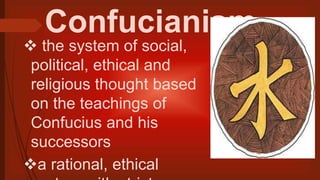
 the system of social,
political, ethical and
religious thought based
on the teachings of
Confucius and his
successors
a rational, ethical
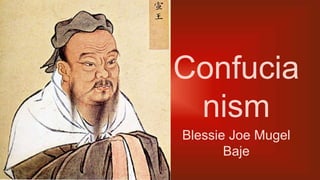
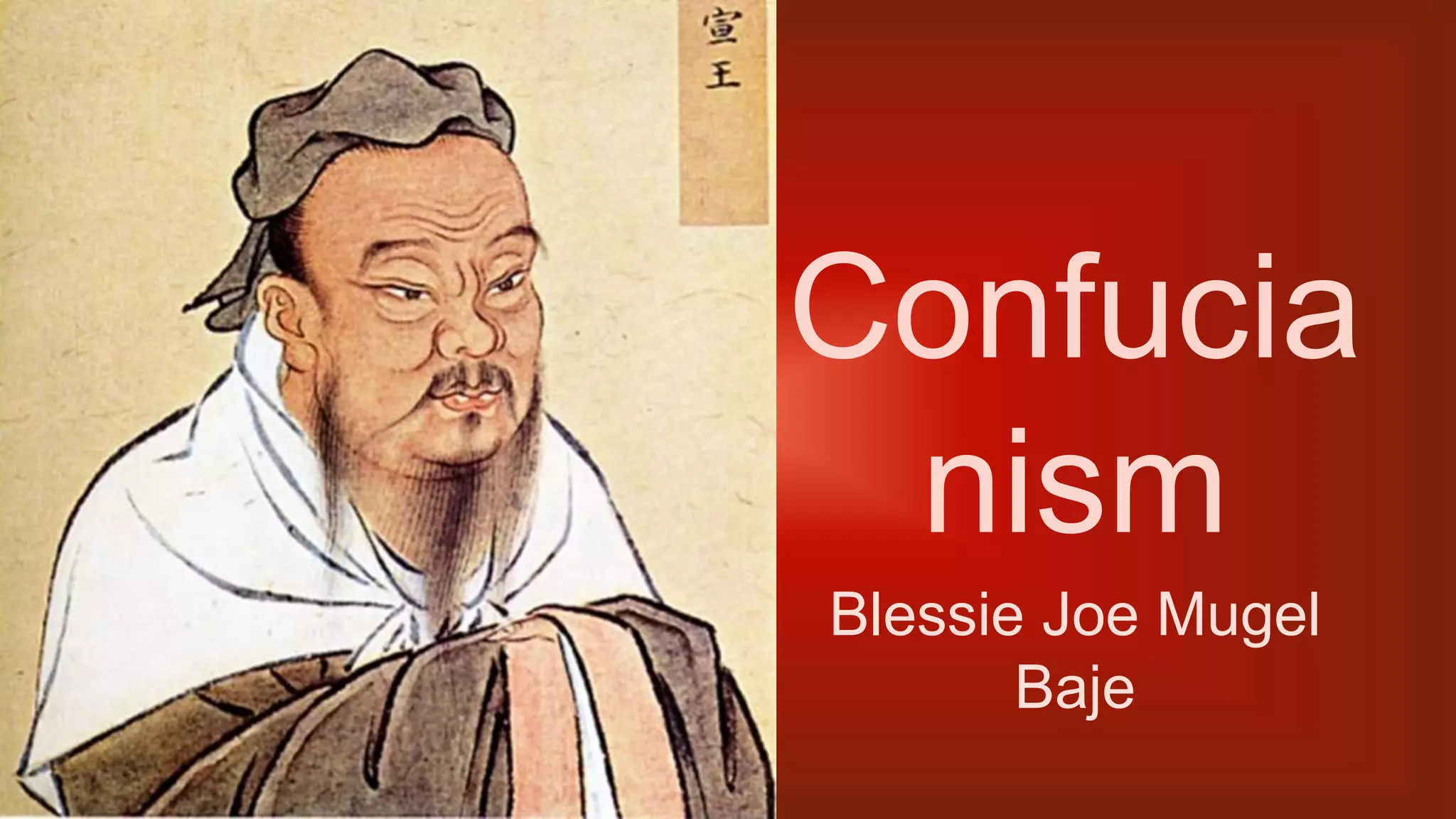
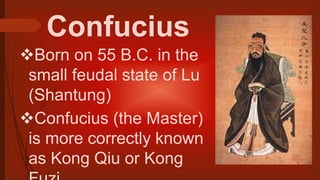
Confucius
Born on 55 B.C. in the
small feudal state of Lu
(Shantung)
Confucius (the Master)
is more correctly known
as Kong Qiu or Kong
Basic
Assumptions emphasizes the individual’s
social relations and social
responsibility over self-
consciousness
 a philosophy of human nature
that considers proper human
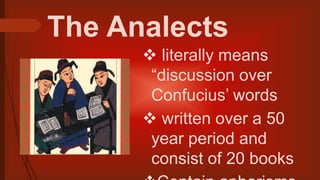
The Analects
 literally means
“discussion over
Confucius’ words
 written over a 50
year period and
consist of 20 books
tant
Teach
ings
Jen
(humanis
m)
 Confucianism’s Supreme
virtue
 often translated as goodness,
love or benevolence, human-
heartedness, humanity, virtue,
morality, etc.
Chun tzr (perfect
person) is a person with perfect moral
character, a “mature person” or
“gentlemen”.
It is reference to a person with such
abundant virtues that he is able to
contribute to the improvement of society.
The trait is often referred to as the
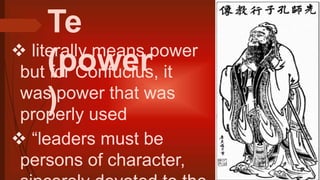
Te
(power
)
 literally means power
but for Confucius, it
was power that was
properly used
 “leaders must be
persons of character,
Li (rituals, rites,
properties,
conventions)
 outward expression of
good manners – the way
things should be done
 “Confucius believed that
there must be defined rules
that society will comply with
Sh
u
The Notion of Shu is
about empathy
towards others and
being able to
appreciate what the
other person in the
Wen (the arts)
 involves acquiring skills
of behavior which are
categorized as cultural
arts
 Confucius saw the “arts
as a means of peace and
and
Interperso
nal
Communic
ation
Confucianism and
Interpersonal
Communication
 teaches (directly and indirectly) the
notion of empathy
 status relationship
 concern for ritual and protocol
 interaction within the family is the
model for most social relationships
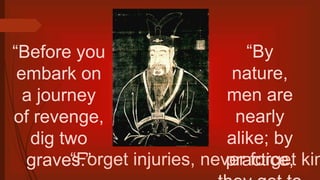
“Before you
embark on
a journey
of revenge,
dig two
graves.”“Forget injuries, never forget kin
“By
nature,
men are
nearly
alike; by
practice,

Confucianism

Editor's Notes

  • #2 Worldview is a culture’s orientation toward God, humanity, nature, the universe, life, death, sickness, and other philosophical, issues concerning existence Religion is the pre dominant element of a culture from which a worldview is derived
  • #3 Influences behavior in most Asian cultures and influences the behavior of Asians living in non Asian cultures -Confucius discouraged prayer. No revelatory sacred writings, no priesthood, no doctrine of anafterlife, and frowned on asceticism and monasticism Taught in Eastern Asian countries including China, Taiwan, Korea and Vietnam
  • #4 Has no priest, no temples, no religious rituals personal and governmental morality, correctness of social relationships, justice and sincerity.
  • #5 the center of the teachings of Confucianism, very influential Shantung province in China People were impressed by his integrity, honesty and pleasant personality His teachings grew from the observation of human condition in China during his lifetime He was witness to the political disintegration of the feudal order Founded by Supreme Sage K’ung-fu-tsu (Confucius) and Second Sage Meng-tzu (Mencius)
  • #6 People perceive themselves according to their social relationships and responsibilities as opposed to their individual being Deep commitment to social harmony In order to maintain order and peace, the people needed to respect and follow their superiors, but mutual respect was necessary at all times Self-cultivation is stressed in Confucianism. Great significance is placed on the ability of each individual to learn, to become educated, and to eventually become a moral and upstanding person. Self(hood) – The selfhood in Confucianism is all about regarding our selves first and foremost as a center of human relationship rather focusing in our individuality, and through that relationship we determine our self-identity and therefore able to uniquely understand the human condition.
  • #7 A compilation of speeches by Confucius and his disciples, as well as the discussions they held Were not written in a systematic and structured fashion These books continue to be a considerable influence on Chinese and Asian values and behavior
  • #9 Ultimate guide It is a perfect form of benevolence doings one’s best to treat others as one would wish to be treated. It is the central component of a perfect moral perspective. Regardless of one’s status or personality, conflicts can be avoided and harmony achieved if Jen was extended to others Capacity to measure the feelings of others by owns on
  • #10 A person who posseses this is thought to be the ideal person, in cultivated feeling has maximum development It can also be said to embody spiritual perfection in the Confucian sense. Self-cultivation is stressed in Confucianism. Great significance is placed on the ability of each individual to learn, to become educated, and to eventually become a moral and upstanding person.
  • #11 Te: refers to what might be called "moral power.“ what a true leader needs in order to be able to lead and to create a good and just society It is their ability to set a good example for the people and rule them in a proper way.
  • #12 Li: Behaving properly, even when performing apparently mundane routines, carries at all times the significance of a sacred ritual. In contemporary times (handshake or bow) as a correct greeting
  • #14 Confucius had great reverence for the arts
  • #16 Jen – empathy - Capacity to measure the feelings of others by owns on In communicating – make social relationships work without strife Social etiquette – attentive performance of social ritual and everyday etiquette shapes human character I accordance with archetypal patterns Filial relationship have well-defined hierarchical order concerning father & son, husband & wife, old and young members of the family In Chinese, requests are implied for the sake of relational harmony, indirect com helps prevent the embarrassment of rejection or disagreement among partners
  • #17 Primary goal: to create a true nobility through proper education and the indoctrination of all the virtues Tradition, obligation, sympathy, and respect Still relevant in some aspects: Advising people to create harmonious relationships Self-discipline Respect older people The philosophy of Confucius emphasized personal and governmental morality, correctness of social relationships, justice and sincerity. Confucianism is also known as Ruism Confucianism says little about divinity so it is often considered a philosophy instead of a religion. The core of Confucianism is humanistic. One of the main goals of Confucianism is to achieved a stable, lasting government by teaching people how to act Properly; Another is to attain inner harmony with nature. Today Confucianism has approximately 6 million followers worldwide Confucianism has also expanded to about 6 schools of thought, and one the most influential is Neo-Confucianism