Do Now
Answer the following question on a scrap
piece of paper:
What would you do: You know that you are
failing a class. You know you will be in
trouble when your parents find out. How
would you handle this situation?
Enduring Understanding
Analyze how philosophy, religion, and
technology molded Chinese society and
government
Describe how Buddhism, Confucianism,
Taoism (Daoism), and Legalism influenced
Chinese society
Philosophy






doctrine: a belief (or system of beliefs) accepted
as authoritative by some group or school
The rational investigation of questions about
existence and knowledge and ethics
Any personal belief about how to live or how to
deal with a situation; "self-indulgence was his
only philosophy"; "my father's philosophy of
child-rearing was to let mother do it"
Three Doctrine and Legalism


Philosophies which influenced the
development and execution of
government in China. Each dynasty used
a different philosophy to guide decision
making
Philosophy in Ancient Chinese
Government




When a dynasty came to power it’s first
priority was to establish a strong central
government
When the government was established
they relied on the guidance of a
philosophy or way of looking at the world
or thinking about knowledge, to guide
them in making laws and regulations
Chinese Governments…


Relied on several philosophies:









Confucianism – Most influential – based on
the teachings of Confucius
Buddhism – A religion NOT a philosophy –
based on the teachings of Buddha
Taoism – based on the teachings of Lao Tzu
Legalism – based on the teachings of Shang
Yang
Neo – Confucianism – Developed by Han Yu
and Li Ao
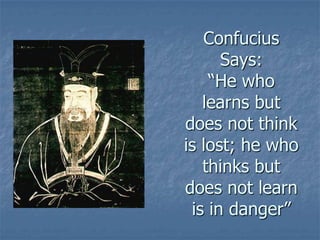
Confucius
Says:
“He who
learns but
does not think
is lost; he who
thinks but
does not learn
is in danger”
Confucianism vs. Buddhism:
Why Buddhism?


Confucianism is a belief system based on
the ideas of Confucius- A scholar who
taught moral virtues and ethics
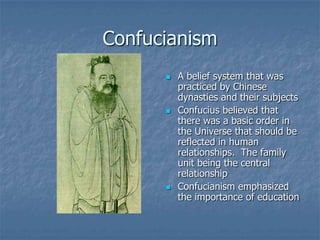
Confucianism






A belief system that was
practiced by Chinese
dynasties and their subjects
Confucius believed that
there was a basic order in
the Universe that should be
reflected in human
relationships. The family
unit being the central
relationship
Confucianism emphasized
the importance of education
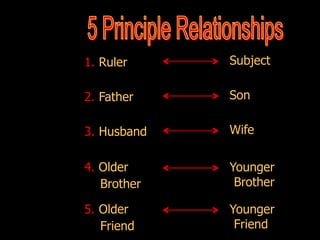
1. Ruler

Subject

2. Father

Son

3. Husband

Wife

4. Older
Brother

Younger
Brother

5. Older
Friend

Younger
Friend
Confucianism


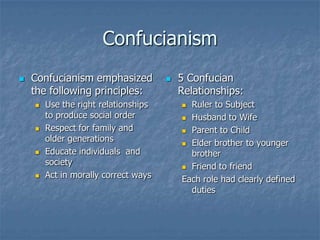
Confucianism emphasized
the following principles:








Use the right relationships
to produce social order
Respect for family and
older generations
Educate individuals and
society
Act in morally correct ways



5 Confucian
Relationships:
Ruler to Subject
 Husband to Wife
 Parent to Child
 Elder brother to younger
brother
 Friend to friend
Each role had clearly defined
duties

Confucianism in Government






Since the family unit is seen as the
primary social unit China’s government
would be a monarchy with it’s structure
based on the structure of the family
The ruler was seen to be the son of
heaven and the father of the people
The role of the government was as
protector of the people’s welfare
Confucianism in Government




Confucian political theory emphasized conflict
resolution through mediation rather than the
application of complex rules
Civil service in which all officials were to be
selected for their moral qualities that would
allow them to govern by example and their
status was measured by their scores on the civilservice examination
How did Confucianism influence
Chinese life?


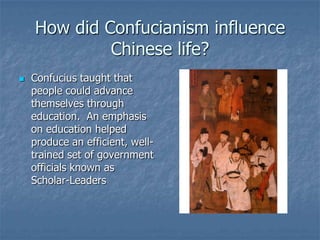
Confucius taught that
people could advance
themselves through
education. An emphasis
on education helped
produce an efficient, welltrained set of government
officials known as
Scholar-Leaders
Buddhism


Buddhism- A religion that started in India
in the 6th century by Siddhartha Gautama
also known as “The Buddha” or
“Enlightened One”
Buddhism


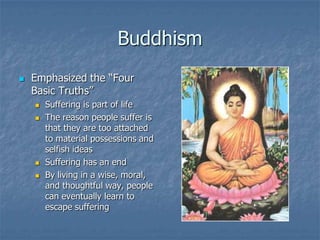
Emphasized the “Four
Basic Truths”






Suffering is part of life
The reason people suffer is
that they are too attached
to material possessions and
selfish ideas
Suffering has an end
By living in a wise, moral,
and thoughtful way, people
can eventually learn to
escape suffering
Buddhism in Government




Buddhism became popular in government
during the Tang Dynasty - Tang emperors
relied on Buddhist monks as counselors
regarding war, law, etc.
In 845 – The Tang Emperor Wu Tsang
destroyed Buddhist temples and
monasteries to replace belief in Buddhism
with Confucianism and Taoism
Not sure when he
died.
[604 B.C.E. - ?]
His name means
“Old Master”
Was he Confucius’
teacher?
The basic text of Daoism.
In Chinese, it means The Classic in
the Way and Its Power.

“Those who speak know nothing:
Those who know are silent.”
These words, I am told,
Were spoken by Laozi.
If we are to believe that Laozi,
Was himself one who knew,
How is it that he wrote a book,
Of five thousand words?
1. Dao [Tao] is the first-cause of the
universe. It is a force that flows through
all life.
2. A believer’s goal is to become one with
Dao; one with nature. [“The butterfly or
the man?” story.]
3. Wu wei --> “Let nature take its course.”
--> “The art of doing nothing.”
--> “Go with the flow!”
4. Man is unhappy because he lives acc. to
man-made laws, customs, & traditions that
are contrary to the ways of nature.
To escape the “social, political, & cultural

traps” of life, one must escape by:

1. Rejecting formal knowledge and
learning.
2. Relying on the senses and instincts.
3. Discovering the nature and
“rhythm” of the universe.
4. Ignoring political and social laws.
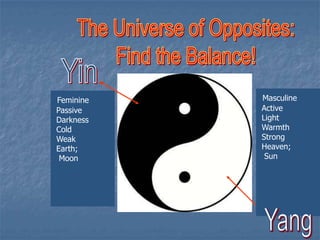
Feminine
Passive
Darkness
Cold
Weak
Earth;
Moon

Masculine
Active
Light
Warmth
Strong
Heaven;
Sun
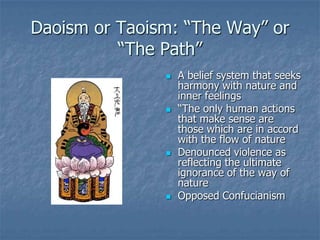
Daoism or Taoism: “The Way” or
“The Path”








A belief system that seeks
harmony with nature and
inner feelings
“The only human actions
that make sense are
those which are in accord
with the flow of nature
Denounced violence as
reflecting the ultimate
ignorance of the way of
nature
Opposed Confucianism
Taoism


Taoism rejects any human ideas or standards
which might lead to:








An overly assertive mode of behavior
Too strong a commitment to the achievement of
worldly goals
Denounce violence as reflecting the ultimate
ignorance of the way of nature
No one should have excessive desires
Wu-wei- “non-action”- does not mean doing
absolutely nothing, but don nothing unnatural
Taoism in Government


During the Tang dynasty the emperors
practiced Taoist beliefs and practiced


Focused on traditional beliefs and myths
How is a man to live in a world dominated
by chaos, suffering, and absurdity??
Confucianism --> Moral order in society.
Legalism --> Rule by harsh law & order.

Daoism --> Freedom for individuals and
less govt. to avoid
uniformity and conformity.
280? - 233 B.C.E.

Han Fe Zi.
Lived during the
late Warring States
period.
Legalism became
the political
philosophy of the
Qin [Ch’in] Dynasty.
Neo-Confucianism


When China unified once
again under the Song
Dynasty (960-1279 A.D.),
Confucian thinkers
blended Buddhism,
Daoism, and
Confucianism to create a
new form of
Confucianism


Concerned with human
behavior and a person’s
relationship with the
universe



Emphasized the following
principles:




Morality is the highest goal
a person can reach
The morality can be
reached through education
Education can occur
through books,
observation, or interaction
with others
Neo-Confucianism in
Government


Developed during the Tang dynasty, but
used in the Song dynasty




It was developed as a more rational form of
thinking
Confucianism had become bogged down with
mythical beliefs associated with Taosim and
Buddhism
Legalism


Believed in the following principals:







The law code must be clearly written and
made public – All people are equal under the
law – Laws should reward those who obey
them and punish those who dare to break
them
Law runs the state not the ruler
Special tactics and “secrets are to be
employed by the ruler to make sure others
don’t’ take control of the state
The position of the ruler holds the power not
the ruler
More to Know


Daoism





A clever mind is not a heart
There is more to knowing
than just being correct.
The wise know their
limitations; the foolish do not.



Buddhism “8 Fold
Path”












To know the truth
To intend to resist evil
To not say anything to hurt others
To respect life, property, and
morality
To work at a job that does not
injure others
To try to free one's mind from evil
To be in control of one's feelings
and thoughts
To practice appropriate forms of
concentration

Chinese philosophy

  • 1.
    Do Now Answer thefollowing question on a scrap piece of paper: What would you do: You know that you are failing a class. You know you will be in trouble when your parents find out. How would you handle this situation?
  • 2.
    Enduring Understanding Analyze howphilosophy, religion, and technology molded Chinese society and government Describe how Buddhism, Confucianism, Taoism (Daoism), and Legalism influenced Chinese society
  • 3.
    Philosophy    doctrine: a belief(or system of beliefs) accepted as authoritative by some group or school The rational investigation of questions about existence and knowledge and ethics Any personal belief about how to live or how to deal with a situation; "self-indulgence was his only philosophy"; "my father's philosophy of child-rearing was to let mother do it"
  • 4.
    Three Doctrine andLegalism  Philosophies which influenced the development and execution of government in China. Each dynasty used a different philosophy to guide decision making
  • 5.
    Philosophy in AncientChinese Government   When a dynasty came to power it’s first priority was to establish a strong central government When the government was established they relied on the guidance of a philosophy or way of looking at the world or thinking about knowledge, to guide them in making laws and regulations
  • 6.
    Chinese Governments…  Relied onseveral philosophies:      Confucianism – Most influential – based on the teachings of Confucius Buddhism – A religion NOT a philosophy – based on the teachings of Buddha Taoism – based on the teachings of Lao Tzu Legalism – based on the teachings of Shang Yang Neo – Confucianism – Developed by Han Yu and Li Ao
  • 7.
    Confucius Says: “He who learns but doesnot think is lost; he who thinks but does not learn is in danger”
  • 8.
    Confucianism vs. Buddhism: WhyBuddhism?  Confucianism is a belief system based on the ideas of Confucius- A scholar who taught moral virtues and ethics
  • 9.
    Confucianism    A belief systemthat was practiced by Chinese dynasties and their subjects Confucius believed that there was a basic order in the Universe that should be reflected in human relationships. The family unit being the central relationship Confucianism emphasized the importance of education
  • 10.
    1. Ruler Subject 2. Father Son 3.Husband Wife 4. Older Brother Younger Brother 5. Older Friend Younger Friend
  • 11.
    Confucianism  Confucianism emphasized the followingprinciples:     Use the right relationships to produce social order Respect for family and older generations Educate individuals and society Act in morally correct ways  5 Confucian Relationships: Ruler to Subject  Husband to Wife  Parent to Child  Elder brother to younger brother  Friend to friend Each role had clearly defined duties 
  • 12.
    Confucianism in Government    Sincethe family unit is seen as the primary social unit China’s government would be a monarchy with it’s structure based on the structure of the family The ruler was seen to be the son of heaven and the father of the people The role of the government was as protector of the people’s welfare
  • 13.
    Confucianism in Government   Confucianpolitical theory emphasized conflict resolution through mediation rather than the application of complex rules Civil service in which all officials were to be selected for their moral qualities that would allow them to govern by example and their status was measured by their scores on the civilservice examination
  • 14.
    How did Confucianisminfluence Chinese life?  Confucius taught that people could advance themselves through education. An emphasis on education helped produce an efficient, welltrained set of government officials known as Scholar-Leaders
  • 15.
    Buddhism  Buddhism- A religionthat started in India in the 6th century by Siddhartha Gautama also known as “The Buddha” or “Enlightened One”
  • 16.
    Buddhism  Emphasized the “Four BasicTruths”     Suffering is part of life The reason people suffer is that they are too attached to material possessions and selfish ideas Suffering has an end By living in a wise, moral, and thoughtful way, people can eventually learn to escape suffering
  • 17.
    Buddhism in Government   Buddhismbecame popular in government during the Tang Dynasty - Tang emperors relied on Buddhist monks as counselors regarding war, law, etc. In 845 – The Tang Emperor Wu Tsang destroyed Buddhist temples and monasteries to replace belief in Buddhism with Confucianism and Taoism
  • 18.
    Not sure whenhe died. [604 B.C.E. - ?] His name means “Old Master” Was he Confucius’ teacher?
  • 19.
    The basic textof Daoism. In Chinese, it means The Classic in the Way and Its Power. “Those who speak know nothing: Those who know are silent.” These words, I am told, Were spoken by Laozi. If we are to believe that Laozi, Was himself one who knew, How is it that he wrote a book, Of five thousand words?
  • 20.
    1. Dao [Tao]is the first-cause of the universe. It is a force that flows through all life. 2. A believer’s goal is to become one with Dao; one with nature. [“The butterfly or the man?” story.] 3. Wu wei --> “Let nature take its course.” --> “The art of doing nothing.” --> “Go with the flow!” 4. Man is unhappy because he lives acc. to man-made laws, customs, & traditions that are contrary to the ways of nature.
  • 21.
    To escape the“social, political, & cultural traps” of life, one must escape by: 1. Rejecting formal knowledge and learning. 2. Relying on the senses and instincts. 3. Discovering the nature and “rhythm” of the universe. 4. Ignoring political and social laws.
  • 22.
  • 23.
    Daoism or Taoism:“The Way” or “The Path”     A belief system that seeks harmony with nature and inner feelings “The only human actions that make sense are those which are in accord with the flow of nature Denounced violence as reflecting the ultimate ignorance of the way of nature Opposed Confucianism
  • 24.
    Taoism  Taoism rejects anyhuman ideas or standards which might lead to:      An overly assertive mode of behavior Too strong a commitment to the achievement of worldly goals Denounce violence as reflecting the ultimate ignorance of the way of nature No one should have excessive desires Wu-wei- “non-action”- does not mean doing absolutely nothing, but don nothing unnatural
  • 25.
    Taoism in Government  Duringthe Tang dynasty the emperors practiced Taoist beliefs and practiced  Focused on traditional beliefs and myths
  • 26.
    How is aman to live in a world dominated by chaos, suffering, and absurdity?? Confucianism --> Moral order in society. Legalism --> Rule by harsh law & order. Daoism --> Freedom for individuals and less govt. to avoid uniformity and conformity.
  • 27.
    280? - 233B.C.E. Han Fe Zi. Lived during the late Warring States period. Legalism became the political philosophy of the Qin [Ch’in] Dynasty.
  • 28.
    Neo-Confucianism  When China unifiedonce again under the Song Dynasty (960-1279 A.D.), Confucian thinkers blended Buddhism, Daoism, and Confucianism to create a new form of Confucianism  Concerned with human behavior and a person’s relationship with the universe  Emphasized the following principles:    Morality is the highest goal a person can reach The morality can be reached through education Education can occur through books, observation, or interaction with others
  • 29.
    Neo-Confucianism in Government  Developed duringthe Tang dynasty, but used in the Song dynasty   It was developed as a more rational form of thinking Confucianism had become bogged down with mythical beliefs associated with Taosim and Buddhism
  • 30.
    Legalism  Believed in thefollowing principals:     The law code must be clearly written and made public – All people are equal under the law – Laws should reward those who obey them and punish those who dare to break them Law runs the state not the ruler Special tactics and “secrets are to be employed by the ruler to make sure others don’t’ take control of the state The position of the ruler holds the power not the ruler
  • 31.
    More to Know  Daoism    Aclever mind is not a heart There is more to knowing than just being correct. The wise know their limitations; the foolish do not.  Buddhism “8 Fold Path”         To know the truth To intend to resist evil To not say anything to hurt others To respect life, property, and morality To work at a job that does not injure others To try to free one's mind from evil To be in control of one's feelings and thoughts To practice appropriate forms of concentration