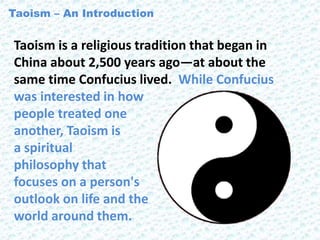
Taoism is a religious tradition that began in
China about 2,500 years ago—at about the
same time Confucius lived. While Confucius
was interested in how
people treated one
another, Taoism is
a spiritual
philosophy that
focuses on a person's
outlook on life and the
world around them.
Taoism – An Introduction
Taoism is a religious tradition that began in
China about 2,500 years ago—at about the
same time Confucius lived. While Confucius
was interested in how
people treated one
another, Taoism is
a spiritual
philosophy that
focuses on a person's
outlook on life and the
world around them.
Taoism – An Introduction
Taoism is practiced
today in China, Taiwan,
Hong King, Singapore,
Japan, and Thailand,
but there are Taoists
throughout the world.
Taoism – An Introduction
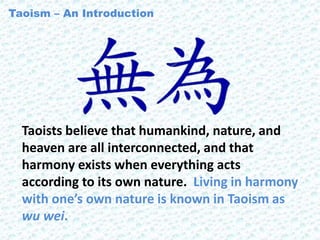
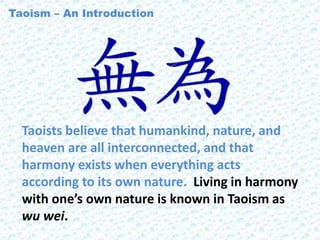
Taoists believe that humankind, nature, and
heaven are all interconnected, and that
harmony exists when everything acts
according to its own nature. Living in harmony
with one’s own nature is known in Taoism as
wu wei.
Taoism – An Introduction
Taoists believe that humankind, nature, and
heaven are all interconnected, and that
harmony exists when everything acts
according to its own nature. Living in harmony
with one’s own nature is known in Taoism as
wu wei.
Taoism – An Introduction
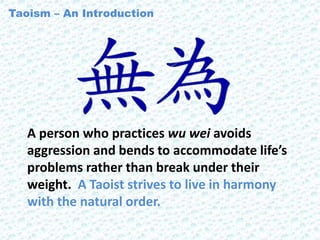
A person who practices wu wei avoids
aggression and bends to accommodate life’s
problems rather than break under their
weight. A Taoist strives to live in harmony
with the natural order.
Taoism – An Introduction
A person who practices wu wei avoids
aggression and bends to accommodate life’s
problems rather than break under their
weight. A Taoist strives to live in harmony
with the natural order.
Taoism – An Introduction
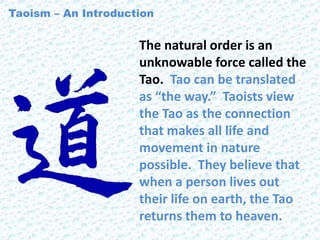
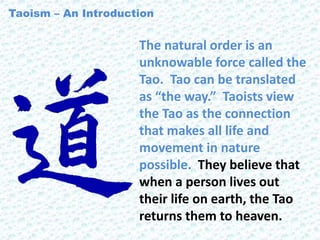
The natural order is an
unknowable force called the
Tao. Tao can be translated
as “the way.” Taoists view
the Tao as the connection
that makes all life and
movement in nature
possible. They believe that
when a person lives out
their life on earth, the Tao
returns them to heaven.
Taoism – An Introduction
The natural order is an
unknowable force called the
Tao. Tao can be translated
as “the way.” Taoists view
the Tao as the connection
that makes all life and
movement in nature
possible. They believe that
when a person lives out
their life on earth, the Tao
returns them to heaven.
Taoism – An Introduction
The natural order is an
unknowable force called the
Tao. Tao can be translated
as “the way.” Taoists view
the Tao as the connection
that makes all life and
movement in nature
possible. They believe that
when a person lives out
their life on earth, the Tao
returns them to heaven.
Taoism – An Introduction
The natural order is an
unknowable force called the
Tao. Tao can be translated
as “the way.” Taoists view
the Tao as the connection
that makes all life and
movement in nature
possible. They believe that
when a person lives out
their life on earth, the Tao
returns them to heaven.
Taoism – An Introduction
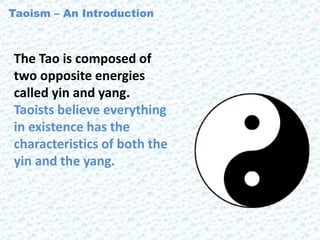
The Tao is composed of
two opposite energies
called yin and yang.
Taoists believe everything
in existence has the
characteristics of both the
yin and the yang.
Taoism – An Introduction
The Tao is composed of
two opposite energies
called yin and yang.
Taoists believe everything
in existence has the
characteristics of both the
yin and the yang.
Taoism – An Introduction
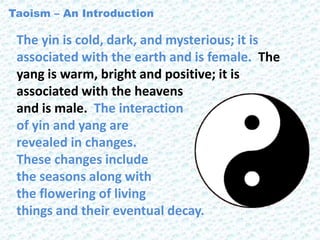
The yin is cold, dark, and mysterious; it is
associated with the earth and is female. The
yang is warm, bright and positive; it is
associated with the heavens
and is male. The interaction
of yin and yang are
revealed in changes.
These changes include
the seasons along with
the flowering of living
things and their eventual decay.
Taoism – An Introduction
The yin is cold, dark, and mysterious; it is
associated with the earth and is female. The
yang is warm, bright and positive; it is
associated with the heavens
and is male. The interaction
of yin and yang are
revealed in changes.
These changes include
the seasons along with
the flowering of living
things and their eventual decay.
Taoism – An Introduction
The yin is cold, dark, and mysterious; it is
associated with the earth and is female. The
yang is warm, bright and positive; it is
associated with the heavens
and is male. The interaction
of yin and yang are
revealed in changes.
These changes include
the seasons along with
the flowering of living
things and their eventual decay.
Taoism – An Introduction
The yin is cold, dark, and mysterious; it is
associated with the earth and is female. The
yang is warm, bright and positive; it is
associated with the heavens
and is male. The interaction
of yin and yang are
revealed in changes.
These changes include
the seasons along with
the flowering of living
things and their eventual decay.
Taoism – An Introduction
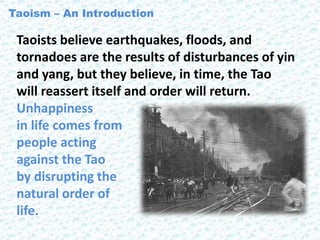
Taoists believe earthquakes, floods, and
tornadoes are the results of disturbances of yin
and yang, but they believe, in time, the Tao
will reassert itself and order will return.
Unhappiness
in life comes from
people acting
against the Tao
by disrupting the
natural order of
life.
Taoism – An Introduction
Taoists believe earthquakes, floods, and
tornadoes are the results of disturbances of yin
and yang, but they believe, in time, the Tao
will reassert itself and order will return.
Unhappiness
in life comes from
people acting
against the Tao
by disrupting the
natural order of
life.
Taoism – An Introduction
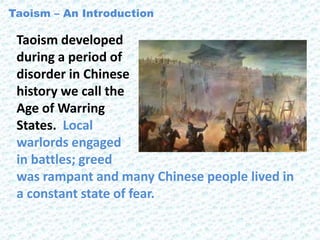
Taoism developed
during a period of
disorder in Chinese
history we call the
Age of Warring
States. Local
warlords engaged
in battles; greed
was rampant and many Chinese people lived in
a constant state of fear.
Taoism – An Introduction
Taoism developed
during a period of
disorder in Chinese
history we call the
Age of Warring
States. Local
warlords engaged
in battles; greed
was rampant and many Chinese people lived in
a constant state of fear.
Taoism – An Introduction
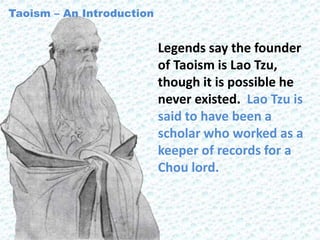
Legends say the founder
of Taoism is Lao Tzu,
though it is possible he
never existed. Lao Tzu is
said to have been a
scholar who worked as a
keeper of records for a
Chou lord.
Taoism – An Introduction
Legends say the founder
of Taoism is Lao Tzu,
though it is possible he
never existed. Lao Tzu is
said to have been a
scholar who worked as a
keeper of records for a
Chou lord.
Taoism – An Introduction
Lao Tzu was unhappy
with moral decay of his
time, so he withdrew to
his home to think about
the meaning of life. Lao
Tzu’s meditation made
him a very wise man.
Taoism – An Introduction
Lao Tzu was unhappy
with moral decay of his
time, so he withdrew to
his home to think about
the meaning of life. Lao
Tzu’s meditation made
him a very wise man.
Taoism – An Introduction
Once, while traveling, a
gatekeeper recognized
Lao Tzu and asked him to
write down his wisdom.
According to legend, Lao
Tzu wrote the Tao Te
Ching, then rode through
the gate, never to be
seen again.
Taoism – An Introduction
Once, while traveling, a
gatekeeper recognized
Lao Tzu and asked him to
write down his wisdom.
According to legend, Lao
Tzu wrote the Tao Te
Ching, then rode through
the gate, never to be
seen again.
Taoism – An Introduction
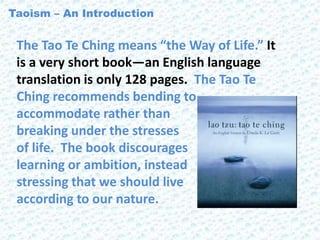
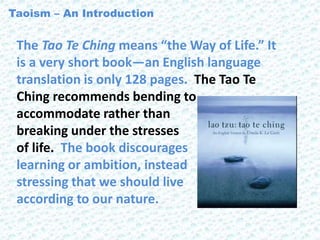
The Tao Te Ching means “the Way of Life.” It
is a very short book—an English language
translation is only 128 pages. The Tao Te
Ching recommends bending to
accommodate rather than
breaking under the stresses
of life. The book discourages
learning or ambition, instead
stressing that we should live
according to our nature.
Taoism – An Introduction
The Tao Te Ching means “the Way of Life.” It
is a very short book—an English language
translation is only 128 pages. The Tao Te
Ching recommends bending to
accommodate rather than
breaking under the stresses
of life. The book discourages
learning or ambition, instead
stressing that we should live
according to our nature.
Taoism – An Introduction
The Tao Te Ching means “the Way of Life.” It
is a very short book—an English language
translation is only 128 pages. The Tao Te
Ching recommends bending to
accommodate rather than
breaking under the stresses
of life. The book discourages
learning or ambition, instead
stressing that we should live
according to our nature.
Taoism – An Introduction
The Tao Te Ching means “the Way of Life.” It
is a very short book—an English language
translation is only 128 pages. The Tao Te
Ching recommends bending to
accommodate rather than
breaking under the stresses
of life. The book discourages
learning or ambition, instead
stressing that we should live
according to our nature.
Taoism – An Introduction
It places nature above
culture, and a solitary
individual above society.
According to the Tao Te
Ching, inaction is better
than action. By not
allowing events to unfold
according to their nature,
a person has challenged
the Tao.
Taoism – An Introduction
It places nature above
culture, and a solitary
individual above society.
According to the Tao Te
Ching, inaction is better
than action. By not
allowing events to unfold
according to their nature,
a person has challenged
the Tao.
Taoism – An Introduction
It places nature above
culture, and a solitary
individual above society.
According to the Tao Te
Ching, inaction is better
than action. By not
allowing events to unfold
according to their nature,
a person has challenged
the Tao.
Taoism – An Introduction
Many Taoists compare the Tao to water. When it
is restricted, water seeks the weakest spot of any
obstruction and applies constant force until it is
free.
Taoism – An Introduction
Many Taoists compare the Tao to water. When it
is restricted, water seeks the weakest spot of any
obstruction and applies constant force until it is
free.
Taoism – An Introduction
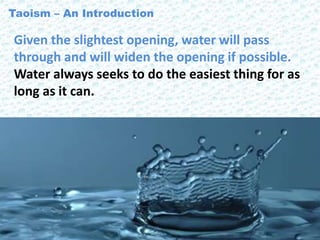
Given the slightest opening, water will pass
through and will widen the opening if possible.
Water always seeks to do the easiest thing for as
long as it can.
Taoism – An Introduction
Given the slightest opening, water will pass
through and will widen the opening if possible.
Water always seeks to do the easiest thing for as
long as it can.
Taoism – An Introduction
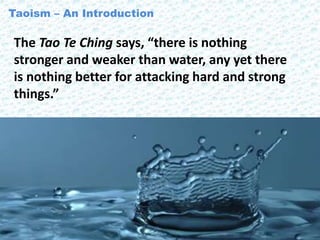
The Tao Te Ching says, “there is nothing
stronger and weaker than water, any yet there
is nothing better for attacking hard and strong
things.”
Taoism – An Introduction

Taoism

  • 1.
    Taoism is areligious tradition that began in China about 2,500 years ago—at about the same time Confucius lived. While Confucius was interested in how people treated one another, Taoism is a spiritual philosophy that focuses on a person's outlook on life and the world around them. Taoism – An Introduction
  • 2.
    Taoism is areligious tradition that began in China about 2,500 years ago—at about the same time Confucius lived. While Confucius was interested in how people treated one another, Taoism is a spiritual philosophy that focuses on a person's outlook on life and the world around them. Taoism – An Introduction
  • 3.
    Taoism is practiced todayin China, Taiwan, Hong King, Singapore, Japan, and Thailand, but there are Taoists throughout the world. Taoism – An Introduction
  • 4.
    Taoists believe thathumankind, nature, and heaven are all interconnected, and that harmony exists when everything acts according to its own nature. Living in harmony with one’s own nature is known in Taoism as wu wei. Taoism – An Introduction
  • 5.
    Taoists believe thathumankind, nature, and heaven are all interconnected, and that harmony exists when everything acts according to its own nature. Living in harmony with one’s own nature is known in Taoism as wu wei. Taoism – An Introduction
  • 6.
    A person whopractices wu wei avoids aggression and bends to accommodate life’s problems rather than break under their weight. A Taoist strives to live in harmony with the natural order. Taoism – An Introduction
  • 7.
    A person whopractices wu wei avoids aggression and bends to accommodate life’s problems rather than break under their weight. A Taoist strives to live in harmony with the natural order. Taoism – An Introduction
  • 8.
    The natural orderis an unknowable force called the Tao. Tao can be translated as “the way.” Taoists view the Tao as the connection that makes all life and movement in nature possible. They believe that when a person lives out their life on earth, the Tao returns them to heaven. Taoism – An Introduction
  • 9.
    The natural orderis an unknowable force called the Tao. Tao can be translated as “the way.” Taoists view the Tao as the connection that makes all life and movement in nature possible. They believe that when a person lives out their life on earth, the Tao returns them to heaven. Taoism – An Introduction
  • 10.
    The natural orderis an unknowable force called the Tao. Tao can be translated as “the way.” Taoists view the Tao as the connection that makes all life and movement in nature possible. They believe that when a person lives out their life on earth, the Tao returns them to heaven. Taoism – An Introduction
  • 11.
    The natural orderis an unknowable force called the Tao. Tao can be translated as “the way.” Taoists view the Tao as the connection that makes all life and movement in nature possible. They believe that when a person lives out their life on earth, the Tao returns them to heaven. Taoism – An Introduction
  • 12.
    The Tao iscomposed of two opposite energies called yin and yang. Taoists believe everything in existence has the characteristics of both the yin and the yang. Taoism – An Introduction
  • 13.
    The Tao iscomposed of two opposite energies called yin and yang. Taoists believe everything in existence has the characteristics of both the yin and the yang. Taoism – An Introduction
  • 14.
    The yin iscold, dark, and mysterious; it is associated with the earth and is female. The yang is warm, bright and positive; it is associated with the heavens and is male. The interaction of yin and yang are revealed in changes. These changes include the seasons along with the flowering of living things and their eventual decay. Taoism – An Introduction
  • 15.
    The yin iscold, dark, and mysterious; it is associated with the earth and is female. The yang is warm, bright and positive; it is associated with the heavens and is male. The interaction of yin and yang are revealed in changes. These changes include the seasons along with the flowering of living things and their eventual decay. Taoism – An Introduction
  • 16.
    The yin iscold, dark, and mysterious; it is associated with the earth and is female. The yang is warm, bright and positive; it is associated with the heavens and is male. The interaction of yin and yang are revealed in changes. These changes include the seasons along with the flowering of living things and their eventual decay. Taoism – An Introduction
  • 17.
    The yin iscold, dark, and mysterious; it is associated with the earth and is female. The yang is warm, bright and positive; it is associated with the heavens and is male. The interaction of yin and yang are revealed in changes. These changes include the seasons along with the flowering of living things and their eventual decay. Taoism – An Introduction
  • 18.
    Taoists believe earthquakes,floods, and tornadoes are the results of disturbances of yin and yang, but they believe, in time, the Tao will reassert itself and order will return. Unhappiness in life comes from people acting against the Tao by disrupting the natural order of life. Taoism – An Introduction
  • 19.
    Taoists believe earthquakes,floods, and tornadoes are the results of disturbances of yin and yang, but they believe, in time, the Tao will reassert itself and order will return. Unhappiness in life comes from people acting against the Tao by disrupting the natural order of life. Taoism – An Introduction
  • 20.
    Taoism developed during aperiod of disorder in Chinese history we call the Age of Warring States. Local warlords engaged in battles; greed was rampant and many Chinese people lived in a constant state of fear. Taoism – An Introduction
  • 21.
    Taoism developed during aperiod of disorder in Chinese history we call the Age of Warring States. Local warlords engaged in battles; greed was rampant and many Chinese people lived in a constant state of fear. Taoism – An Introduction
  • 22.
    Legends say thefounder of Taoism is Lao Tzu, though it is possible he never existed. Lao Tzu is said to have been a scholar who worked as a keeper of records for a Chou lord. Taoism – An Introduction
  • 23.
    Legends say thefounder of Taoism is Lao Tzu, though it is possible he never existed. Lao Tzu is said to have been a scholar who worked as a keeper of records for a Chou lord. Taoism – An Introduction
  • 24.
    Lao Tzu wasunhappy with moral decay of his time, so he withdrew to his home to think about the meaning of life. Lao Tzu’s meditation made him a very wise man. Taoism – An Introduction
  • 25.
    Lao Tzu wasunhappy with moral decay of his time, so he withdrew to his home to think about the meaning of life. Lao Tzu’s meditation made him a very wise man. Taoism – An Introduction
  • 26.
    Once, while traveling,a gatekeeper recognized Lao Tzu and asked him to write down his wisdom. According to legend, Lao Tzu wrote the Tao Te Ching, then rode through the gate, never to be seen again. Taoism – An Introduction
  • 27.
    Once, while traveling,a gatekeeper recognized Lao Tzu and asked him to write down his wisdom. According to legend, Lao Tzu wrote the Tao Te Ching, then rode through the gate, never to be seen again. Taoism – An Introduction
  • 28.
    The Tao TeChing means “the Way of Life.” It is a very short book—an English language translation is only 128 pages. The Tao Te Ching recommends bending to accommodate rather than breaking under the stresses of life. The book discourages learning or ambition, instead stressing that we should live according to our nature. Taoism – An Introduction
  • 29.
    The Tao TeChing means “the Way of Life.” It is a very short book—an English language translation is only 128 pages. The Tao Te Ching recommends bending to accommodate rather than breaking under the stresses of life. The book discourages learning or ambition, instead stressing that we should live according to our nature. Taoism – An Introduction
  • 30.
    The Tao TeChing means “the Way of Life.” It is a very short book—an English language translation is only 128 pages. The Tao Te Ching recommends bending to accommodate rather than breaking under the stresses of life. The book discourages learning or ambition, instead stressing that we should live according to our nature. Taoism – An Introduction
  • 31.
    The Tao TeChing means “the Way of Life.” It is a very short book—an English language translation is only 128 pages. The Tao Te Ching recommends bending to accommodate rather than breaking under the stresses of life. The book discourages learning or ambition, instead stressing that we should live according to our nature. Taoism – An Introduction
  • 32.
    It places natureabove culture, and a solitary individual above society. According to the Tao Te Ching, inaction is better than action. By not allowing events to unfold according to their nature, a person has challenged the Tao. Taoism – An Introduction
  • 33.
    It places natureabove culture, and a solitary individual above society. According to the Tao Te Ching, inaction is better than action. By not allowing events to unfold according to their nature, a person has challenged the Tao. Taoism – An Introduction
  • 34.
    It places natureabove culture, and a solitary individual above society. According to the Tao Te Ching, inaction is better than action. By not allowing events to unfold according to their nature, a person has challenged the Tao. Taoism – An Introduction
  • 35.
    Many Taoists comparethe Tao to water. When it is restricted, water seeks the weakest spot of any obstruction and applies constant force until it is free. Taoism – An Introduction
  • 36.
    Many Taoists comparethe Tao to water. When it is restricted, water seeks the weakest spot of any obstruction and applies constant force until it is free. Taoism – An Introduction
  • 37.
    Given the slightestopening, water will pass through and will widen the opening if possible. Water always seeks to do the easiest thing for as long as it can. Taoism – An Introduction
  • 38.
    Given the slightestopening, water will pass through and will widen the opening if possible. Water always seeks to do the easiest thing for as long as it can. Taoism – An Introduction
  • 39.
    The Tao TeChing says, “there is nothing stronger and weaker than water, any yet there is nothing better for attacking hard and strong things.” Taoism – An Introduction