
Conflict/Functionalist Theories
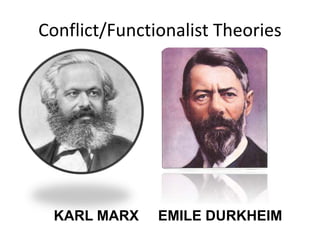
KARL MARX EMILE DURKHEIM
CONFLICT THEORY
• Begins with Marx and his analysis of history
• Thesis/antithesis = struggle (conflict)
• Synthesis = a new order is produced because
of the struggle between the classes
• Three stages of history: feudalism, capitalism &
socialism (it was an inevitable destination!)
(Many call it communism)
Always a struggle
The materialist view of history = the most
important determinant of social life is the work
people are doing, especially work that results in
provision of the basic necessities of life, food,
clothing and shelter.
Power=ownership
• He maintained that everything of value in society
results from human labour. Thus, Marx saw
working men and women as engaged in making
society, in creating the conditions for their own
existence.
• Every part of human history and existence must
be understood through the lens of
social/economic theory
• All relationships are based on conflict/struggle
• Who has the power? Who wants it? Who owns
the resources?
Only 1 institution: private property
• The central institution of capitalist society
is private property, the system by
which capital (that is, money, machines, tools,
factories, and other material objects used in
production) is controlled by a small minority of
the population.
• This leads to two opposed classes, the owners of
capital (called the bourgeoisie) and the workers
(called the proletariat), whose only property is
their own labour time, which they have to sell to
the capitalists.
• Economic exploitation leads directly to
political oppression, as owners make use of
their economic power to gain control of the
state and turn it into a servant of bourgeois
economic interests.
• Police power, for instance, is used to enforce
property rights and guarantee unfair contracts
between capitalist and worker.
Oppression is everywhere!
• The economic structure of society moulds
the superstructure, including ideas (e.g.,
morality, ideologies, art, and literature) and
the social institutions that support the class
structure of society (e.g., the state, the
educational system, the family, and religious
institutions).
• What do you think? Is school oppressive?
Functionalist theory / Durkheim
• First theory in sociology
• Two fundamentals:
• 1- application of scientific
method (sociologists
must be objective &
without bias)
• 2- institutions fulfill basic
human needs and all
groups play a role in
achieving equilibrium
Balance, equilibrium, stability
• Key words for functionalism
• Think of any system that must co-ordinate its
parts for survival (body & organs)
• A social system with needs that must be met
• When change in one group happens, other
groups must adjust, adapt, respond...to
accommodate for the change, finding the
equilibrium again - Homeostasis
• HOMOEOSTASIS IS THE KEY WORD HERE
A society is
• A system of inter-related “parts”
• A change in one affects the others
• Most changes are the result of “evolution” or
natural progression of ideas and social
change
• Durkheim was influenced by Darwin`s work
• Functionalism focuses on the individual and
how social forces influence him (Macro
perspective)
The social self
• Functionalism understands the individual to
be a product of social forces in the
environment
• Almost puppet-like (has been the criticism)
• The individual`s place in the social structure
will determine their actions
• Functionalist want to PREDICT behavior
• This explains the emphasis on the scientific
method
• Shared values (solidarity) is key to group
cohesiveness
• Example: laws, rules, constitutions are an
explicit expression of supreme values
(justice, freedom) that are held in common
by a group/society
• Functionalism is
a macro approach to studying
society; it defines society as
a system of interrelated parts.
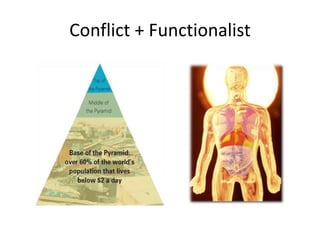
• A good metaphor is the body
with its interrelated organs
that all work together to
produce the state of health of
the person. It has built in
mechanisms that maintain
stasis or balance. (Sweating,
shivering, etc.)
In society, when things
happen to provoke change
or throw it off kilter, other
mechanisms come into play
to help bring back to a
balance. Sometimes this
new balance is slow change,
in the case of people`s
values changing faster than
the laws or the other way
around. What examples
can you think of to prove
this theory?
Capitalism and the Economy
Conflict + Functionalist
What Is Media?
• Media are any formats or vehicles that carry, present, or
communicate information – books, posters, Web pages,
clay tablets, and radio.
• Mass media refers to any form of media that reaches the
mass of the people.
22
Political Economy of the Media
• Media ownership in the United States is in
the hands of six companies.
• Those companies affect the information
and messages communicated to the
public.
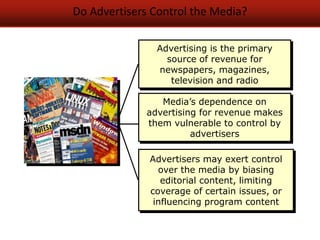
Do Advertisers Control the Media?
Advertising is the primary
source of revenue for
newspapers, magazines,
television and radio
Advertisers may exert control
over the media by biasing
editorial content, limiting
coverage of certain issues, or
influencing program content
Media’s dependence on
advertising for revenue makes
them vulnerable to control by
advertisers
Do Advertisers Control the Media?
They must report the news
fairly and accurately to retain
public confidence
Advertisers need the media
more than the media need
any one advertiser
Media maintain separation
between news and business
departments “The Wall”
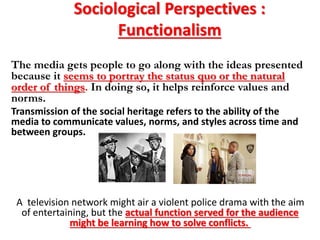
Sociological Perspectives :
Functionalism
The media gets people to go along with the ideas presented
because it seems to portray the status quo or the natural
order of things. In doing so, it helps reinforce values and
norms.
Transmission of the social heritage refers to the ability of the
media to communicate values, norms, and styles across time and
between groups.
A television network might air a violent police drama with the aim
of entertaining, but the actual function served for the audience
might be learning how to solve conflicts.
Sociological Perspectives:
Conflict
From a Marxist viewpoint, status-symbol
chocolate advertising exemplifies how
“commodity fetishism” helps maintain capitalism.
Such advertising legitimizes the elite class by
reinforcing the image of upper-class superiority
and by presenting the luxurious lifestyle as
something to aspire to.
Can you give me some other examples?
27
Godiva promotes the idea that consumers of their chocolates are somehow “higher class”
and more “tasteful” than people who do not consume them. As a result, their chocolates
have a higher exchange value than the everyday, $1 chocolates meant for middle and
lower-class consumers. Can you say “Starbucks?”
Sociological Perspectives:
Symbolic Interactionism
• The media uses symbols of happiness and success to
attempt to affect an abstract social structure. For
instance, companies no longer try to sell their
products – they instead try to sell a lifestyle.
• Customers believe that if they acquire the product,
their lifestyle will change. Examples?
28
Social and Cultural Consequences
Does advertising
encourage materialism?
Does advertising make people
buy things they don’t need?
Is advertising just
a reflection of society?
Advertising and Stereotyping
Portrayal of women to
reflect their changing role
in society
Portrayal of
women as
sex objects
Ethnic
stereotyping/
representation
Gender
stereotyping
Sexual
orientation
Criticisms of
Advertising
With Regard to
Stereotyping
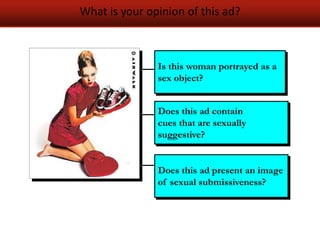
What is your opinion of this ad?
Is this woman portrayed as a
sex object?
Does this ad contain
cues that are sexually
suggestive?
Does this ad present an image
of sexual submissiveness?
Working in America
• Workers are more productive than ever, yet job
insecurity is high.
• As a result, many people are working longer hours,
especially people at higher income levels, in order
to prove loyalty or achieve marginal benefits.
Theorizing the Transition to Capitalism
• Karl Marx
– stated that capitalism created alienation in workers—
including alienation from the products they produced,
from the production process, from other workers, and
from themselves and their creative tendencies
– predicted both that capitalism would ultimately destroy
itself and that the working class would rise against the
capitalist class, leading to a period first of socialism and
then of communism
Figure 14.4 Champagne-Glass Distribution
You May Ask Yourself, 2nd Edition
Copyright © 2011 W.W. Norton & Company
Recent Changes in Capitalism
• In society today, people actually earn less money
(relative to the cost of living) compared to the early
1900s. This is because:
– Only men were “supposed to” work.
– Men were paid enough to provide for the whole
family.
– Unfortunately, the higher wage was at the cost of
women’s freedom and autonomy.
40% Of Americans Now Make Less
Than 1968 Minimum Wage
Recent Changes in Capitalism
• Compared to other industrialized countries and some
developing countries, Americans work longer hours and
have fewer vacation benefits and less generous family leave
policies.
• Even when generous benefits are available, workers often
do not take advantage of them, which suggests that work is
central in the lives of Americans.
Figure 14.3 Annual Vacation Days and Holidays Worldwide
You May Ask Yourself, 2nd Edition
Copyright © 2011 W.W. Norton & Company
Recent Changes in Capitalism
Conflict – Functionalist –
Symbolic Interaction perspectives
Globalization refers to the processes that create and
intensify worldwide social exchanges and
interdependencies.
– creates an increase in trade and economic exchanges
– magnifies the division between the world’s rich and poor
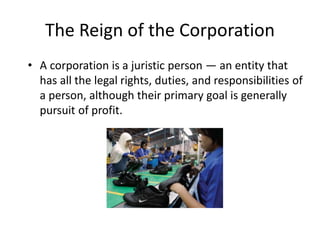
The Reign of the Corporation
• A corporation is a juristic person — an entity that
has all the legal rights, duties, and responsibilities of
a person, although their primary goal is generally
pursuit of profit.
The Reign of the Corporation
This model raises concerns about
– corporate ethics
– environmental responsibility
– fair wages
The Reign of the Corporation
To fight for workers’ rights, workers sometimes form a union -
a collective organization that unites for the purpose of
collective bargaining.

Sociological Perspective part two

  • 1.
  • 2.
    CONFLICT THEORY • Beginswith Marx and his analysis of history • Thesis/antithesis = struggle (conflict)
  • 3.
    • Synthesis =a new order is produced because of the struggle between the classes • Three stages of history: feudalism, capitalism & socialism (it was an inevitable destination!) (Many call it communism)
  • 4.
    Always a struggle Thematerialist view of history = the most important determinant of social life is the work people are doing, especially work that results in provision of the basic necessities of life, food, clothing and shelter.
  • 5.
    Power=ownership • He maintainedthat everything of value in society results from human labour. Thus, Marx saw working men and women as engaged in making society, in creating the conditions for their own existence. • Every part of human history and existence must be understood through the lens of social/economic theory • All relationships are based on conflict/struggle • Who has the power? Who wants it? Who owns the resources?
  • 6.
    Only 1 institution:private property • The central institution of capitalist society is private property, the system by which capital (that is, money, machines, tools, factories, and other material objects used in production) is controlled by a small minority of the population. • This leads to two opposed classes, the owners of capital (called the bourgeoisie) and the workers (called the proletariat), whose only property is their own labour time, which they have to sell to the capitalists.
  • 7.
    • Economic exploitationleads directly to political oppression, as owners make use of their economic power to gain control of the state and turn it into a servant of bourgeois economic interests. • Police power, for instance, is used to enforce property rights and guarantee unfair contracts between capitalist and worker.
  • 8.
    Oppression is everywhere! •The economic structure of society moulds the superstructure, including ideas (e.g., morality, ideologies, art, and literature) and the social institutions that support the class structure of society (e.g., the state, the educational system, the family, and religious institutions). • What do you think? Is school oppressive?
  • 9.
    Functionalist theory /Durkheim • First theory in sociology • Two fundamentals: • 1- application of scientific method (sociologists must be objective & without bias) • 2- institutions fulfill basic human needs and all groups play a role in achieving equilibrium
  • 10.
    Balance, equilibrium, stability •Key words for functionalism • Think of any system that must co-ordinate its parts for survival (body & organs) • A social system with needs that must be met • When change in one group happens, other groups must adjust, adapt, respond...to accommodate for the change, finding the equilibrium again - Homeostasis • HOMOEOSTASIS IS THE KEY WORD HERE
  • 11.
    A society is •A system of inter-related “parts” • A change in one affects the others • Most changes are the result of “evolution” or natural progression of ideas and social change • Durkheim was influenced by Darwin`s work • Functionalism focuses on the individual and how social forces influence him (Macro perspective)
  • 12.
    The social self •Functionalism understands the individual to be a product of social forces in the environment • Almost puppet-like (has been the criticism) • The individual`s place in the social structure will determine their actions
  • 16.
    • Functionalist wantto PREDICT behavior • This explains the emphasis on the scientific method • Shared values (solidarity) is key to group cohesiveness • Example: laws, rules, constitutions are an explicit expression of supreme values (justice, freedom) that are held in common by a group/society
  • 18.
    • Functionalism is amacro approach to studying society; it defines society as a system of interrelated parts. • A good metaphor is the body with its interrelated organs that all work together to produce the state of health of the person. It has built in mechanisms that maintain stasis or balance. (Sweating, shivering, etc.)
  • 19.
    In society, whenthings happen to provoke change or throw it off kilter, other mechanisms come into play to help bring back to a balance. Sometimes this new balance is slow change, in the case of people`s values changing faster than the laws or the other way around. What examples can you think of to prove this theory?
  • 20.
  • 21.
  • 22.
    What Is Media? •Media are any formats or vehicles that carry, present, or communicate information – books, posters, Web pages, clay tablets, and radio. • Mass media refers to any form of media that reaches the mass of the people. 22
  • 23.
    Political Economy ofthe Media • Media ownership in the United States is in the hands of six companies. • Those companies affect the information and messages communicated to the public.
  • 24.
    Do Advertisers Controlthe Media? Advertising is the primary source of revenue for newspapers, magazines, television and radio Advertisers may exert control over the media by biasing editorial content, limiting coverage of certain issues, or influencing program content Media’s dependence on advertising for revenue makes them vulnerable to control by advertisers
  • 25.
    Do Advertisers Controlthe Media? They must report the news fairly and accurately to retain public confidence Advertisers need the media more than the media need any one advertiser Media maintain separation between news and business departments “The Wall”
  • 26.
    Sociological Perspectives : Functionalism Themedia gets people to go along with the ideas presented because it seems to portray the status quo or the natural order of things. In doing so, it helps reinforce values and norms. Transmission of the social heritage refers to the ability of the media to communicate values, norms, and styles across time and between groups. A television network might air a violent police drama with the aim of entertaining, but the actual function served for the audience might be learning how to solve conflicts.
  • 27.
    Sociological Perspectives: Conflict From aMarxist viewpoint, status-symbol chocolate advertising exemplifies how “commodity fetishism” helps maintain capitalism. Such advertising legitimizes the elite class by reinforcing the image of upper-class superiority and by presenting the luxurious lifestyle as something to aspire to. Can you give me some other examples? 27 Godiva promotes the idea that consumers of their chocolates are somehow “higher class” and more “tasteful” than people who do not consume them. As a result, their chocolates have a higher exchange value than the everyday, $1 chocolates meant for middle and lower-class consumers. Can you say “Starbucks?”
  • 28.
    Sociological Perspectives: Symbolic Interactionism •The media uses symbols of happiness and success to attempt to affect an abstract social structure. For instance, companies no longer try to sell their products – they instead try to sell a lifestyle. • Customers believe that if they acquire the product, their lifestyle will change. Examples? 28
  • 29.
    Social and CulturalConsequences Does advertising encourage materialism? Does advertising make people buy things they don’t need? Is advertising just a reflection of society?
  • 30.
    Advertising and Stereotyping Portrayalof women to reflect their changing role in society Portrayal of women as sex objects Ethnic stereotyping/ representation Gender stereotyping Sexual orientation Criticisms of Advertising With Regard to Stereotyping
  • 31.
    What is youropinion of this ad? Is this woman portrayed as a sex object? Does this ad contain cues that are sexually suggestive? Does this ad present an image of sexual submissiveness?
  • 32.
    Working in America •Workers are more productive than ever, yet job insecurity is high. • As a result, many people are working longer hours, especially people at higher income levels, in order to prove loyalty or achieve marginal benefits.
  • 33.
    Theorizing the Transitionto Capitalism • Karl Marx – stated that capitalism created alienation in workers— including alienation from the products they produced, from the production process, from other workers, and from themselves and their creative tendencies – predicted both that capitalism would ultimately destroy itself and that the working class would rise against the capitalist class, leading to a period first of socialism and then of communism
  • 35.
    Figure 14.4 Champagne-GlassDistribution You May Ask Yourself, 2nd Edition Copyright © 2011 W.W. Norton & Company
  • 36.
    Recent Changes inCapitalism • In society today, people actually earn less money (relative to the cost of living) compared to the early 1900s. This is because: – Only men were “supposed to” work. – Men were paid enough to provide for the whole family. – Unfortunately, the higher wage was at the cost of women’s freedom and autonomy.
  • 37.
    40% Of AmericansNow Make Less Than 1968 Minimum Wage
  • 38.
    Recent Changes inCapitalism • Compared to other industrialized countries and some developing countries, Americans work longer hours and have fewer vacation benefits and less generous family leave policies. • Even when generous benefits are available, workers often do not take advantage of them, which suggests that work is central in the lives of Americans.
  • 39.
    Figure 14.3 AnnualVacation Days and Holidays Worldwide You May Ask Yourself, 2nd Edition Copyright © 2011 W.W. Norton & Company
  • 40.
    Recent Changes inCapitalism Conflict – Functionalist – Symbolic Interaction perspectives Globalization refers to the processes that create and intensify worldwide social exchanges and interdependencies. – creates an increase in trade and economic exchanges – magnifies the division between the world’s rich and poor
  • 41.
    The Reign ofthe Corporation • A corporation is a juristic person — an entity that has all the legal rights, duties, and responsibilities of a person, although their primary goal is generally pursuit of profit.
  • 42.
    The Reign ofthe Corporation This model raises concerns about – corporate ethics – environmental responsibility – fair wages
  • 43.
    The Reign ofthe Corporation To fight for workers’ rights, workers sometimes form a union - a collective organization that unites for the purpose of collective bargaining.