SYA 3010 Sociological
 Theory:


 Karl Mannheim

                              © 1998-2006 by Ronald Keith
Thursday, February 28, 2013            Bolender             1
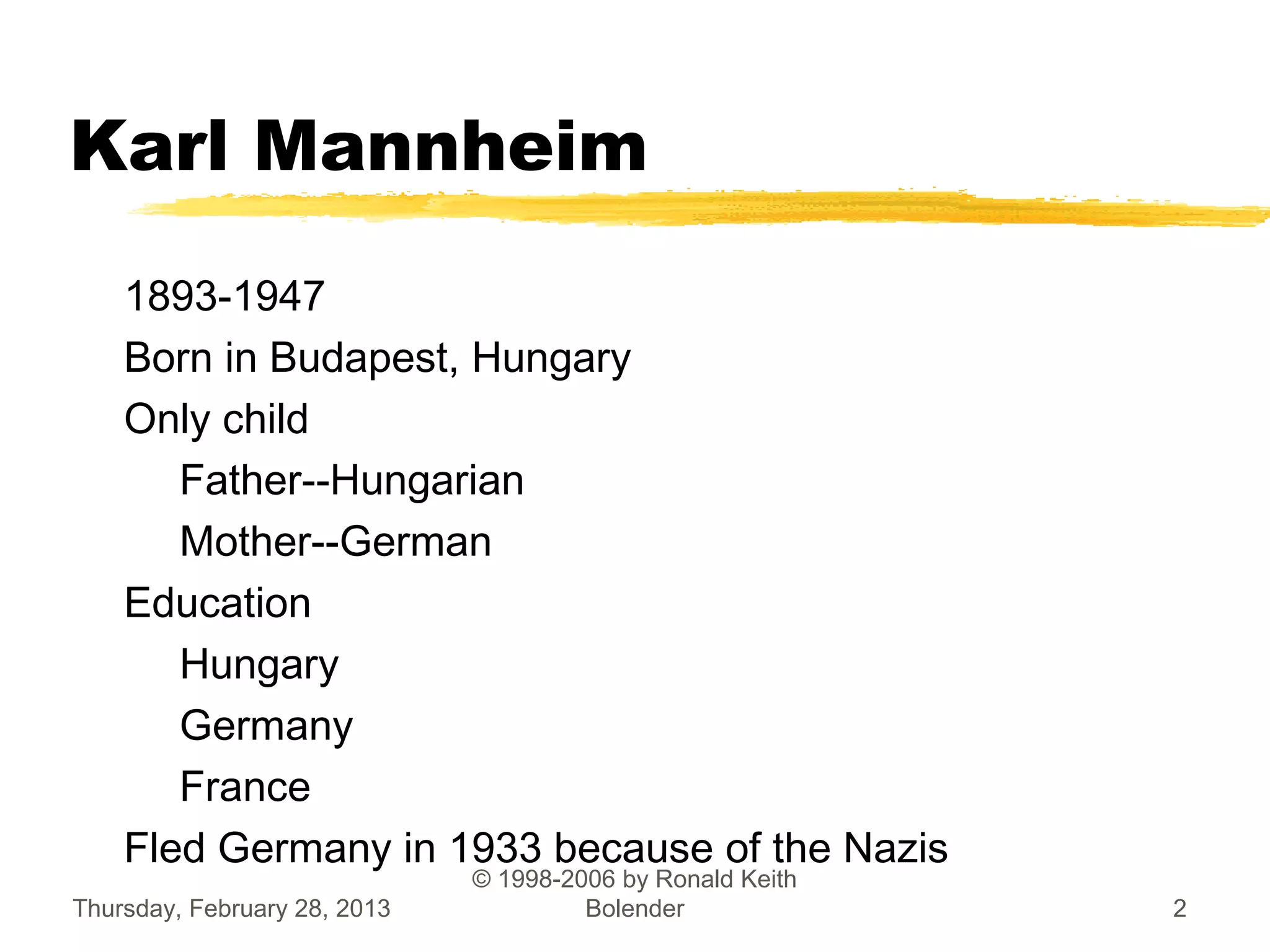
Karl Mannheim
    1893-1947
    Born in Budapest, Hungary
    Only child
       Father--Hungarian
       Mother--German
    Education
       Hungary
       Germany
       France
    Fled Germany in 1933 because of the Nazis
                              © 1998-2006 by Ronald Keith
Thursday, February 28, 2013            Bolender             2
Karl Mannheim:
Sociology of Knowledge

        Sociology of Knowledge
This branch of sociology studies the relation
 between thought and society and is
 concerned with the social or existential
 conditions of knowledge (Coser
 1971:429).
Coser, Lewis A. 1971. Masters of Sociological Thought: Ideas in
  Historical and Social Context. New York: Harcourt Brace
  Jovanovich.
                              © 1998-2006 by Ronald Keith
Thursday, February 28, 2013            Bolender                   3
Karl Mannheim:
Sociology of Knowledge

existential : 1 Of, relating to, or affirming
 existence 2 a: grounded in existence or
 the experience of existence: EMPIRICAL
 b: having being in time and space


                              © 1998-2006 by Ronald Keith
Thursday, February 28, 2013            Bolender             4
Karl Mannheim:
Sociology of Knowledge

Thinking is an activity that must be related
 to other social activity within a structural
 frame. To Mannheim, the sociological
 viewpoint seeks from the very beginning
 to interpret individual activity in all spheres
 within the context of group experience
 (Mannheim 1936:27).
Mannheim, Karl. 1936. Ideology and Utopia. New York: Harcourt Brace
  Jovanovich.
                              © 1998-2006 by Ronald Keith
Thursday, February 28, 2013            Bolender                   5
Karl Mannheim:
Sociology of Knowledge

Thinking is never a privileged activity free
 from the effects of group life; therefore, it
 must be understood and interpreted within
 its construct.


                              © 1998-2006 by Ronald Keith
Thursday, February 28, 2013            Bolender             6
Karl Mannheim:
Sociology of Knowledge

No given individual confronts the world and, in
 striving for the truth, constructs a world view out
 of the data of his experience. . . . It is much
 more correct that knowledge is from the very
 beginning a co-operative process of group life,
 in which everyone unfolds his knowledge within
 a framework of a common fate, a common
 activity, and the overcoming of common
 difficulties (Mannheim 1936:26).
                              © 1998-2006 by Ronald Keith
Thursday, February 28, 2013            Bolender             7
Karl Mannheim:
Sociology of Knowledge
            Ideology and Utopia
    Ideology
         Those total systems of thought held by society's ruling groups
         that obscure the real conditions and thereby preserve the status
         quo.

    Utopia
         Total systems of thought are forged by oppressed groups
         interested in the transformation of society. From the utopian
         side, the purpose of social thought is not to diagnose the
         present reality but to provide a rationally justifiable system of
         ideas to legitimate and direct change. 
                    Mannheim was a Conflict Theorist.
                              © 1998-2006 by Ronald Keith
Thursday, February 28, 2013            Bolender                              8
Karl Mannheim:
Sociology of Knowledge

       Relativism and Relationalism
    Relativism
         More on a psychological/individual level…
         knowledge/truth is subjective per the
         individual
    Relationalism
         Takes into account the influence of social
         factors, status, class, sociohistorical position
                              © 1998-2006 by Ronald Keith
Thursday, February 28, 2013            Bolender             9
Karl Mannheim:
Sociology of Knowledge

    Methods of Dealing with Cultural Objects
    or Intellectual Phenomena
         “From the inside”
             So that their immanent meanings are disclosed to
             the investigator
         “From the outside”
             As a reflection of the societal process in which the
             thinker is inevitably enmeshed
                • Knowledge is conceived as existentially determined

                              © 1998-2006 by Ronald Keith
Thursday, February 28, 2013            Bolender                        10
Karl Mannheim:
Sociology of Knowledge

Mannheim undertook to generalize Marx’s
 programmatic orientation to inquire into the
 connection of . . . philosophy with . . . reality
 (Marx and Engles 1939:6), and to analyze the
 ways in which systems of ideas depend on the
 social position--particularly the class positions--
 of their proponents.

Marx, Karl and Friedrich Engles. 1939. The German Ideology. New
  York: International Publishers.
                              © 1998-2006 by Ronald Keith
Thursday, February 28, 2013            Bolender                   11
Karl Mannheim:
Sociology of Knowledge
In the Marxian formulation, attention was called to the
   functions of ideology for the defense of class privileges,
   and to the distortion and falsification of ideas that
   derived from the privileged positions of bourgeois
   thinkers. In contrast to this interpretation of bourgeois
   ideology, Marx’s own ideals were held by the Marxists to
   be true and unbiased by virtue of their being an
   expression of a class--the proletariat--that had no
   privileged interests to defend.


                              © 1998-2006 by Ronald Keith
Thursday, February 28, 2013            Bolender             12
Karl Mannheim:
Sociology of Knowledge
Mannheim did not make this distinction between
 various systems of ideas. He allowed for the
 probability that all ideas, even “truths,” were
 related to, and hence influenced by, the social
 and historical situation from which they
 emerged. The very fact that each thinker is
 affiliated with particular groups in society--that
 he occupies a certain status and enacts certain
 social roles--colors his intellectual outlook.
VERY IMPORTANT STATEMENT…THINK ABOUT
                         IT!
             © 1998-2006 by Ronald Keith
Thursday, February 28, 2013   Bolender                13
Karl Mannheim:
Sociology of Knowledge

Men do not confront the objects of the world
 from the abstract levels of a
 contemplating mind as such, nor do they
 do so exclusively as solitary beings. On
 the contrary, they act with and against
 one another in diversely organized
 groups, and while doing so they think with
 and against each other (Mannheim
 1936:3).       © 1998-2006 by Ronald Keith
Thursday, February 28, 2013   Bolender     14
Karl Mannheim:
Sociology of Knowledge
Mannheim defined the sociology of knowledge as a theory
  of the social or existential conditioning of thought. To
  him all knowledge and all ideas are “bound to a
  location,” though to different degrees, within the social
  structure and the historical process. At times a particular
  group can have fuller access to the understanding of a
  social phenomenon than other groups, but no group can
  have total access to it. Ideas are rooted in the differential
  location in historical time and social structure of their
  proponents so that thought is inevitably perspectivistic.
VERY IMPORTANT STATEMENT…THINK ABOUT
                  IT!
                              © 1998-2006 by Ronald Keith
Thursday, February 28, 2013            Bolender              15
Karl Mannheim:
Sociology of Knowledge
. . . Perspective . . . is something more than a merely
    formal determination of thinking. [It] signifies the manner
    in which one views an object, what one perceives in it,
    and how one construes it in his thinking. [Perspective]
    also refers to qualitative elements in the structure of
    thought, elements which must necessarily be overlooked
    by a purely formal logic. It is precisely these factors
    which are responsible for the fact that two persons, even
    if they apply the same formal-logical rules, may judge
    the same object very differently (Mannheim 1936:244).

                              © 1998-2006 by Ronald Keith
Thursday, February 28, 2013            Bolender              16
Karl Mannheim:
Sociology of Knowledge

Like the proverbial seven blind men trying to
  describe the properties of an elephant,
  persons viewing a common object from
  dissimilar angles of vision rooted in their
  different social location are apt to arrive at
  different cognitive conclusions and
  different value judgements. Human
  thought is “situationally relative.”
                              © 1998-2006 by Ronald Keith
Thursday, February 28, 2013            Bolender             17
Karl Mannheim:
Sociology of Knowledge
            Problem of Generations Zeitlin (1997:381-383)
    New participants in the cultural process are emerging
    Former participants in that process are continually
    disappearing
    Members of any one generation can participate only in a
    temporally limited section of the historical process
    It is therefore necessary continually to transmit the
    accumulated cultural heritage
    The transition from generation to generation is a
    continuous process
Zeitlin, Irving M. 1997. Ideology and the Development of Sociological
   Theory. 6th ed. Upper © 1998-2006 by Ronald Keith
                            Saddle River, NJ: Prentice Hall.
Thursday, February 28, 2013     Bolender                                18
Karl Mannheim:
Sociology of Knowledge

       Remember Comte’s Law of Human
     Progress and the sociological assumption
     of progressive change?----The sociology
      of knowledge (especially the problem of
        generations) follows the logic of this
                   assumption.


                              © 1998-2006 by Ronald Keith
Thursday, February 28, 2013            Bolender             19
Karl Mannheim:
Sociology of Knowledge
  A good example of this idea is a review of the
    concept (definition) of Nazarene membership
   from the 1st generation to the 5th generation.
    How has the definition and related cultural
  expectations changed? (Think in terms of rules,
       standards, and definition of the “holiness
                       lifestyle.”)
 How has the “knowledge” of the culture changed?
     Is different? What has been lost? What has
                     been added?
                              © 1998-2006 by Ronald Keith
Thursday, February 28, 2013            Bolender             20
Karl Mannheim:
Sociology of Knowledge

  How do the “Problem of Generations” and
   “relationalism” impact the analysis of the
       situation between the 1st and 5th
             generation members?


                              © 1998-2006 by Ronald Keith
Thursday, February 28, 2013            Bolender             21

Karl Mannheim

  • 1.
    SYA 3010 Sociological Theory: Karl Mannheim © 1998-2006 by Ronald Keith Thursday, February 28, 2013 Bolender 1
  • 2.
    Karl Mannheim 1893-1947 Born in Budapest, Hungary Only child Father--Hungarian Mother--German Education Hungary Germany France Fled Germany in 1933 because of the Nazis © 1998-2006 by Ronald Keith Thursday, February 28, 2013 Bolender 2
  • 3.
    Karl Mannheim: Sociology ofKnowledge Sociology of Knowledge This branch of sociology studies the relation between thought and society and is concerned with the social or existential conditions of knowledge (Coser 1971:429). Coser, Lewis A. 1971. Masters of Sociological Thought: Ideas in Historical and Social Context. New York: Harcourt Brace Jovanovich. © 1998-2006 by Ronald Keith Thursday, February 28, 2013 Bolender 3
  • 4.
    Karl Mannheim: Sociology ofKnowledge existential : 1 Of, relating to, or affirming existence 2 a: grounded in existence or the experience of existence: EMPIRICAL b: having being in time and space © 1998-2006 by Ronald Keith Thursday, February 28, 2013 Bolender 4
  • 5.
    Karl Mannheim: Sociology ofKnowledge Thinking is an activity that must be related to other social activity within a structural frame. To Mannheim, the sociological viewpoint seeks from the very beginning to interpret individual activity in all spheres within the context of group experience (Mannheim 1936:27). Mannheim, Karl. 1936. Ideology and Utopia. New York: Harcourt Brace Jovanovich. © 1998-2006 by Ronald Keith Thursday, February 28, 2013 Bolender 5
  • 6.
    Karl Mannheim: Sociology ofKnowledge Thinking is never a privileged activity free from the effects of group life; therefore, it must be understood and interpreted within its construct. © 1998-2006 by Ronald Keith Thursday, February 28, 2013 Bolender 6
  • 7.
    Karl Mannheim: Sociology ofKnowledge No given individual confronts the world and, in striving for the truth, constructs a world view out of the data of his experience. . . . It is much more correct that knowledge is from the very beginning a co-operative process of group life, in which everyone unfolds his knowledge within a framework of a common fate, a common activity, and the overcoming of common difficulties (Mannheim 1936:26). © 1998-2006 by Ronald Keith Thursday, February 28, 2013 Bolender 7
  • 8.
    Karl Mannheim: Sociology ofKnowledge Ideology and Utopia Ideology Those total systems of thought held by society's ruling groups that obscure the real conditions and thereby preserve the status quo. Utopia Total systems of thought are forged by oppressed groups interested in the transformation of society. From the utopian side, the purpose of social thought is not to diagnose the present reality but to provide a rationally justifiable system of ideas to legitimate and direct change.  Mannheim was a Conflict Theorist. © 1998-2006 by Ronald Keith Thursday, February 28, 2013 Bolender 8
  • 9.
    Karl Mannheim: Sociology ofKnowledge Relativism and Relationalism Relativism More on a psychological/individual level… knowledge/truth is subjective per the individual Relationalism Takes into account the influence of social factors, status, class, sociohistorical position © 1998-2006 by Ronald Keith Thursday, February 28, 2013 Bolender 9
  • 10.
    Karl Mannheim: Sociology ofKnowledge Methods of Dealing with Cultural Objects or Intellectual Phenomena “From the inside” So that their immanent meanings are disclosed to the investigator “From the outside” As a reflection of the societal process in which the thinker is inevitably enmeshed • Knowledge is conceived as existentially determined © 1998-2006 by Ronald Keith Thursday, February 28, 2013 Bolender 10
  • 11.
    Karl Mannheim: Sociology ofKnowledge Mannheim undertook to generalize Marx’s programmatic orientation to inquire into the connection of . . . philosophy with . . . reality (Marx and Engles 1939:6), and to analyze the ways in which systems of ideas depend on the social position--particularly the class positions-- of their proponents. Marx, Karl and Friedrich Engles. 1939. The German Ideology. New York: International Publishers. © 1998-2006 by Ronald Keith Thursday, February 28, 2013 Bolender 11
  • 12.
    Karl Mannheim: Sociology ofKnowledge In the Marxian formulation, attention was called to the functions of ideology for the defense of class privileges, and to the distortion and falsification of ideas that derived from the privileged positions of bourgeois thinkers. In contrast to this interpretation of bourgeois ideology, Marx’s own ideals were held by the Marxists to be true and unbiased by virtue of their being an expression of a class--the proletariat--that had no privileged interests to defend. © 1998-2006 by Ronald Keith Thursday, February 28, 2013 Bolender 12
  • 13.
    Karl Mannheim: Sociology ofKnowledge Mannheim did not make this distinction between various systems of ideas. He allowed for the probability that all ideas, even “truths,” were related to, and hence influenced by, the social and historical situation from which they emerged. The very fact that each thinker is affiliated with particular groups in society--that he occupies a certain status and enacts certain social roles--colors his intellectual outlook. VERY IMPORTANT STATEMENT…THINK ABOUT IT! © 1998-2006 by Ronald Keith Thursday, February 28, 2013 Bolender 13
  • 14.
    Karl Mannheim: Sociology ofKnowledge Men do not confront the objects of the world from the abstract levels of a contemplating mind as such, nor do they do so exclusively as solitary beings. On the contrary, they act with and against one another in diversely organized groups, and while doing so they think with and against each other (Mannheim 1936:3). © 1998-2006 by Ronald Keith Thursday, February 28, 2013 Bolender 14
  • 15.
    Karl Mannheim: Sociology ofKnowledge Mannheim defined the sociology of knowledge as a theory of the social or existential conditioning of thought. To him all knowledge and all ideas are “bound to a location,” though to different degrees, within the social structure and the historical process. At times a particular group can have fuller access to the understanding of a social phenomenon than other groups, but no group can have total access to it. Ideas are rooted in the differential location in historical time and social structure of their proponents so that thought is inevitably perspectivistic. VERY IMPORTANT STATEMENT…THINK ABOUT IT! © 1998-2006 by Ronald Keith Thursday, February 28, 2013 Bolender 15
  • 16.
    Karl Mannheim: Sociology ofKnowledge . . . Perspective . . . is something more than a merely formal determination of thinking. [It] signifies the manner in which one views an object, what one perceives in it, and how one construes it in his thinking. [Perspective] also refers to qualitative elements in the structure of thought, elements which must necessarily be overlooked by a purely formal logic. It is precisely these factors which are responsible for the fact that two persons, even if they apply the same formal-logical rules, may judge the same object very differently (Mannheim 1936:244). © 1998-2006 by Ronald Keith Thursday, February 28, 2013 Bolender 16
  • 17.
    Karl Mannheim: Sociology ofKnowledge Like the proverbial seven blind men trying to describe the properties of an elephant, persons viewing a common object from dissimilar angles of vision rooted in their different social location are apt to arrive at different cognitive conclusions and different value judgements. Human thought is “situationally relative.” © 1998-2006 by Ronald Keith Thursday, February 28, 2013 Bolender 17
  • 18.
    Karl Mannheim: Sociology ofKnowledge Problem of Generations Zeitlin (1997:381-383) New participants in the cultural process are emerging Former participants in that process are continually disappearing Members of any one generation can participate only in a temporally limited section of the historical process It is therefore necessary continually to transmit the accumulated cultural heritage The transition from generation to generation is a continuous process Zeitlin, Irving M. 1997. Ideology and the Development of Sociological Theory. 6th ed. Upper © 1998-2006 by Ronald Keith Saddle River, NJ: Prentice Hall. Thursday, February 28, 2013 Bolender 18
  • 19.
    Karl Mannheim: Sociology ofKnowledge Remember Comte’s Law of Human Progress and the sociological assumption of progressive change?----The sociology of knowledge (especially the problem of generations) follows the logic of this assumption. © 1998-2006 by Ronald Keith Thursday, February 28, 2013 Bolender 19
  • 20.
    Karl Mannheim: Sociology ofKnowledge A good example of this idea is a review of the concept (definition) of Nazarene membership from the 1st generation to the 5th generation. How has the definition and related cultural expectations changed? (Think in terms of rules, standards, and definition of the “holiness lifestyle.”) How has the “knowledge” of the culture changed? Is different? What has been lost? What has been added? © 1998-2006 by Ronald Keith Thursday, February 28, 2013 Bolender 20
  • 21.
    Karl Mannheim: Sociology ofKnowledge How do the “Problem of Generations” and “relationalism” impact the analysis of the situation between the 1st and 5th generation members? © 1998-2006 by Ronald Keith Thursday, February 28, 2013 Bolender 21

Editor's Notes

  • #2 SOC4044 Sociological Theory Thursday, February 28, 2013 © 1998-2006 by Ronald Keith Bolender
  • #3 SOC4044 Sociological Theory Thursday, February 28, 2013 © 1998-2006 by Ronald Keith Bolender
  • #4 SOC4044 Sociological Theory Thursday, February 28, 2013 © 1998-2006 by Ronald Keith Bolender Coser (1971:429-463) existential : 1 Of, relating to, or affirming existence 2 a: grounded in existence or the experience of existence: EMPIRICAL b: having being in time and space
  • #5 SOC4044 Sociological Theory Thursday, February 28, 2013 © 1998-2006 by Ronald Keith Bolender
  • #6 SOC4044 Sociological Theory Thursday, February 28, 2013 © 1998-2006 by Ronald Keith Bolender
  • #7 SOC4044 Sociological Theory Thursday, February 28, 2013 © 1998-2006 by Ronald Keith Bolender
  • #8 SOC4044 Sociological Theory Thursday, February 28, 2013 © 1998-2006 by Ronald Keith Bolender
  • #9 SOC4044 Sociological Theory Thursday, February 28, 2013 © 1998-2006 by Ronald Keith Bolender
  • #10 SOC4044 Sociological Theory Thursday, February 28, 2013 © 1998-2006 by Ronald Keith Bolender
  • #11 SOC4044 Sociological Theory Thursday, February 28, 2013 © 1998-2006 by Ronald Keith Bolender
  • #12 SOC4044 Sociological Theory Thursday, February 28, 2013 © 1998-2006 by Ronald Keith Bolender
  • #13 SOC4044 Sociological Theory Thursday, February 28, 2013 © 1998-2006 by Ronald Keith Bolender
  • #14 SOC4044 Sociological Theory Thursday, February 28, 2013 © 1998-2006 by Ronald Keith Bolender
  • #15 SOC4044 Sociological Theory Thursday, February 28, 2013 © 1998-2006 by Ronald Keith Bolender
  • #16 SOC4044 Sociological Theory Thursday, February 28, 2013 © 1998-2006 by Ronald Keith Bolender
  • #17 SOC4044 Sociological Theory Thursday, February 28, 2013 © 1998-2006 by Ronald Keith Bolender
  • #18 SOC4044 Sociological Theory Thursday, February 28, 2013 © 1998-2006 by Ronald Keith Bolender
  • #19 SOC4044 Sociological Theory Thursday, February 28, 2013 © 1998-2006 by Ronald Keith Bolender Zeitlin, Irving M. 1997. Ideology and the Development of Sociological Theory . 6th ed. Upper Saddle River, NJ: Prentice Hall. Zeitlin (1997:381-383)
  • #20 SOC4044 Sociological Theory Thursday, February 28, 2013 © 1998-2006 by Ronald Keith Bolender
  • #21 SOC4044 Sociological Theory Thursday, February 28, 2013 © 1998-2006 by Ronald Keith Bolender
  • #22 SOC4044 Sociological Theory Thursday, February 28, 2013 © 1998-2006 by Ronald Keith Bolender