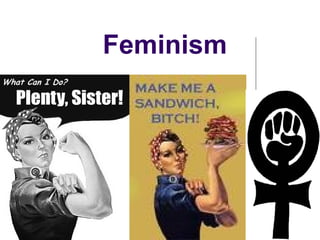
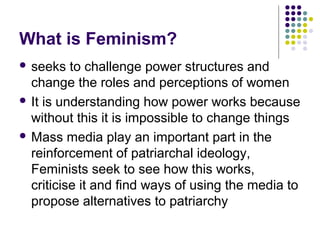
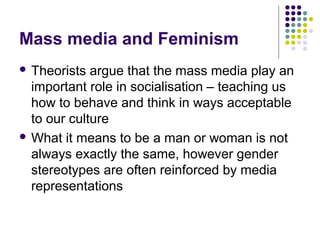
Feminism
What is Feminism?
 seeks

to challenge power structures and
change the roles and perceptions of women
 It is understanding how power works because
without this it is impossible to change things
 Mass media play an important part in the
reinforcement of patriarchal ideology,
Feminists seek to see how this works,
criticise it and find ways of using the media to
propose alternatives to patriarchy
 Feminists

are interested in the contribution
made by the media to society’s dominant
ideas about gender roles
 Sex is a matter of biological differences,
whereas
 Gender is about the cultural distinctions
which we learn to make between masculinity
and femininity
 Our sex is determined at birth but we still
have to learn how to think and behave as a
boy or a girl, according to the expectations of
our culture
Mass media and Feminism
 Theorists

argue that the mass media play an
important role in socialisation – teaching us
how to behave and think in ways acceptable
to our culture
 What it means to be a man or woman is not
always exactly the same, however gender
stereotypes are often reinforced by media
representations
Stereotyped gendered roles










Femininity
Caring
Nurturing
Emotional
Domestic
Sensitive
Passive
Gentle
Soft

Masculinity
Tough
Providing
Rational
Public, work-orientated
Thick-skinned
Active
Rough
Hard
 These

stereotypes can be embarrassing
and old fashioned – but they still describe
familiar versions of masculinity and
femininity
 Also they are the qualities associated
with power – linked to influential roles,
leadership and well paid jobs
 The stereotypical feminine qualities are
associated with lower status and poorly
paid jobs
Gender changes over time
 Gender

roles and representations have
changed over the years – mostly because
feminists have made a good deal of progress
in eroding the stereotypes
 However they have been replaced with
different yet equally disempowering
stereotypes
 Feminists are now concerned not with the
stereotypes of low value but with the visual
presentation of the body
Naomi Wolf: ‘The Beauty Myth’
 “Beauty

is a currency like the gold standard.
Like any economy, it is determined by politics
and in the modern age in the West, it is the
last, best belief system that keeps male
domination intact”.
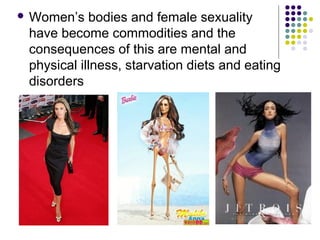
 She argues that images of ultra-thin
supermodels and the ‘perfect body’
glamorised by advertising, fashion and the
media are indications of a patriarchal attack
on women’s bodies.
 Women’s

bodies and female sexuality
have become commodities and the
consequences of this are mental and
physical illness, starvation diets and eating
disorders
Laura Mulvey – ‘Visual
pleasure and narrative cinema’






‘The male Gaze’ so much of media output assumes
that the spectator is male or constructs reality from a
male point of view
Her idea was that the darkened cinema offered the
perfect opportunity for the male viewer to drool over
the erotic exhibition of women’s bodies.
Because female characters are usually irrelevant to
the plot, female viewers also identify with the male
character, enjoying the spectical of women through
his eyes
Angela McRobbie
 Angela

also developed the idea that the
media encourage women to see through
men’s eyes in relation to girls’ magazines
 Jackie magazine in 1979 worked alongside
other socialising influences to reinforce an
obsession with romance rather than sexual
pleasure
 Both Mulvey and McRobbie have found good
reasons to modify their views in recent years
– mainly because of the array of media
representations available today
Gauntlett (2002)
“men and women are seen working side by
side as equals, in hospitals, schools and police
stations of TV land.
Movie produces are wary of having women as
screaming victims, and have realised the kickass heroines do better business.
Advertisers have now realised that audiences
will laugh at images of the pretty housewife,
and have reacted by showing women to be
sexy at work instead.”
The waves of Feminism
 First

wave: from the mid 19th to early 20th C
feminist activism was focused on the fight for
social and political equality. (The Suffragettes)
 Second Wave: the liberation movement of the
1960’s and 70’s – the struggles for equal pay
and rights at work
 Third wave: more emphasis on the positive
nature of ambiguity and difference (not all
women are the same). They also have links
with postmodernism and question the nature of
gender difference
Post feminism
 sometimes

been seen as anti-feminism, a rejection
of the values and sacrifices made by the first and
second wave feminists – however this is not the
case
 Post feminists have a different view of media
representations.
 If women know that femininity is a construct then
they can play with its signs, symbols and identities
from a position of power (semiotic guerrilla warfare
– where the meanings of signifiers such as
highheels and lipstick can be shifted from
powerless to powerful.

Feminism

  • 1.
  • 2.
    What is Feminism? seeks to challenge power structures and change the roles and perceptions of women  It is understanding how power works because without this it is impossible to change things  Mass media play an important part in the reinforcement of patriarchal ideology, Feminists seek to see how this works, criticise it and find ways of using the media to propose alternatives to patriarchy
  • 3.
     Feminists are interestedin the contribution made by the media to society’s dominant ideas about gender roles  Sex is a matter of biological differences, whereas  Gender is about the cultural distinctions which we learn to make between masculinity and femininity  Our sex is determined at birth but we still have to learn how to think and behave as a boy or a girl, according to the expectations of our culture
  • 4.
    Mass media andFeminism  Theorists argue that the mass media play an important role in socialisation – teaching us how to behave and think in ways acceptable to our culture  What it means to be a man or woman is not always exactly the same, however gender stereotypes are often reinforced by media representations
  • 5.
  • 6.
     These stereotypes canbe embarrassing and old fashioned – but they still describe familiar versions of masculinity and femininity  Also they are the qualities associated with power – linked to influential roles, leadership and well paid jobs  The stereotypical feminine qualities are associated with lower status and poorly paid jobs
  • 7.
    Gender changes overtime  Gender roles and representations have changed over the years – mostly because feminists have made a good deal of progress in eroding the stereotypes  However they have been replaced with different yet equally disempowering stereotypes  Feminists are now concerned not with the stereotypes of low value but with the visual presentation of the body
  • 8.
    Naomi Wolf: ‘TheBeauty Myth’  “Beauty is a currency like the gold standard. Like any economy, it is determined by politics and in the modern age in the West, it is the last, best belief system that keeps male domination intact”.  She argues that images of ultra-thin supermodels and the ‘perfect body’ glamorised by advertising, fashion and the media are indications of a patriarchal attack on women’s bodies.
  • 9.
     Women’s bodies andfemale sexuality have become commodities and the consequences of this are mental and physical illness, starvation diets and eating disorders
  • 10.
    Laura Mulvey –‘Visual pleasure and narrative cinema’    ‘The male Gaze’ so much of media output assumes that the spectator is male or constructs reality from a male point of view Her idea was that the darkened cinema offered the perfect opportunity for the male viewer to drool over the erotic exhibition of women’s bodies. Because female characters are usually irrelevant to the plot, female viewers also identify with the male character, enjoying the spectical of women through his eyes
  • 11.
    Angela McRobbie  Angela alsodeveloped the idea that the media encourage women to see through men’s eyes in relation to girls’ magazines  Jackie magazine in 1979 worked alongside other socialising influences to reinforce an obsession with romance rather than sexual pleasure  Both Mulvey and McRobbie have found good reasons to modify their views in recent years – mainly because of the array of media representations available today
  • 12.
    Gauntlett (2002) “men andwomen are seen working side by side as equals, in hospitals, schools and police stations of TV land. Movie produces are wary of having women as screaming victims, and have realised the kickass heroines do better business. Advertisers have now realised that audiences will laugh at images of the pretty housewife, and have reacted by showing women to be sexy at work instead.”
  • 13.
    The waves ofFeminism  First wave: from the mid 19th to early 20th C feminist activism was focused on the fight for social and political equality. (The Suffragettes)  Second Wave: the liberation movement of the 1960’s and 70’s – the struggles for equal pay and rights at work  Third wave: more emphasis on the positive nature of ambiguity and difference (not all women are the same). They also have links with postmodernism and question the nature of gender difference
  • 14.
    Post feminism  sometimes beenseen as anti-feminism, a rejection of the values and sacrifices made by the first and second wave feminists – however this is not the case  Post feminists have a different view of media representations.  If women know that femininity is a construct then they can play with its signs, symbols and identities from a position of power (semiotic guerrilla warfare – where the meanings of signifiers such as highheels and lipstick can be shifted from powerless to powerful.