Reading Assignment
 The Sociological Perspective pg.14-17
 Origins of Sociology pg.18-26
 Theoretical Perspectives in Sociology
pg. 34-40
Chapter Review Questions
1. Define Sociology
2. Define Society
3. What is Social Location?
4. Describe the Sociological Perspective.
5. How does the sociological perspective and social location shape personal
worldview
6. Who is the father of Sociology?
7. What is Positivism?
8. What are the three major social changes that led to the development of
Sociology as a discipline?
9. Why is the industrial revolution so pivotal in the development of
Sociology?
10. Differentiate between the macro and micro levels of sociological analysis
11. Who is Karl Marx and why is he relevant to Sociology
12. Differentiate between social conflict theory, functionalism and symbolic
interaction theory.
Theoretical Perspectives
A theory is a general statement about how
some parts of the world fit together and how
they work. It is an explanation of how two or
more facts are related. By providing a
framework in which to fit observations, each
theory interprets reality in a unique way.
What is a Sociological Perspective?
 Tool for analyzing social life.
 Level of analysis
• Macro
• Micro
 Three major perspectives in Sociology
• Functionalist Perspective
• Conflict Perspective
• Symbolic Interaction Perspective
Macro vs. Micro
 Macro – functionalists & conflict
theorists focus on large scale
patterns
 Micro – symbolic interactionist
focus on what people do in each
other’s presence
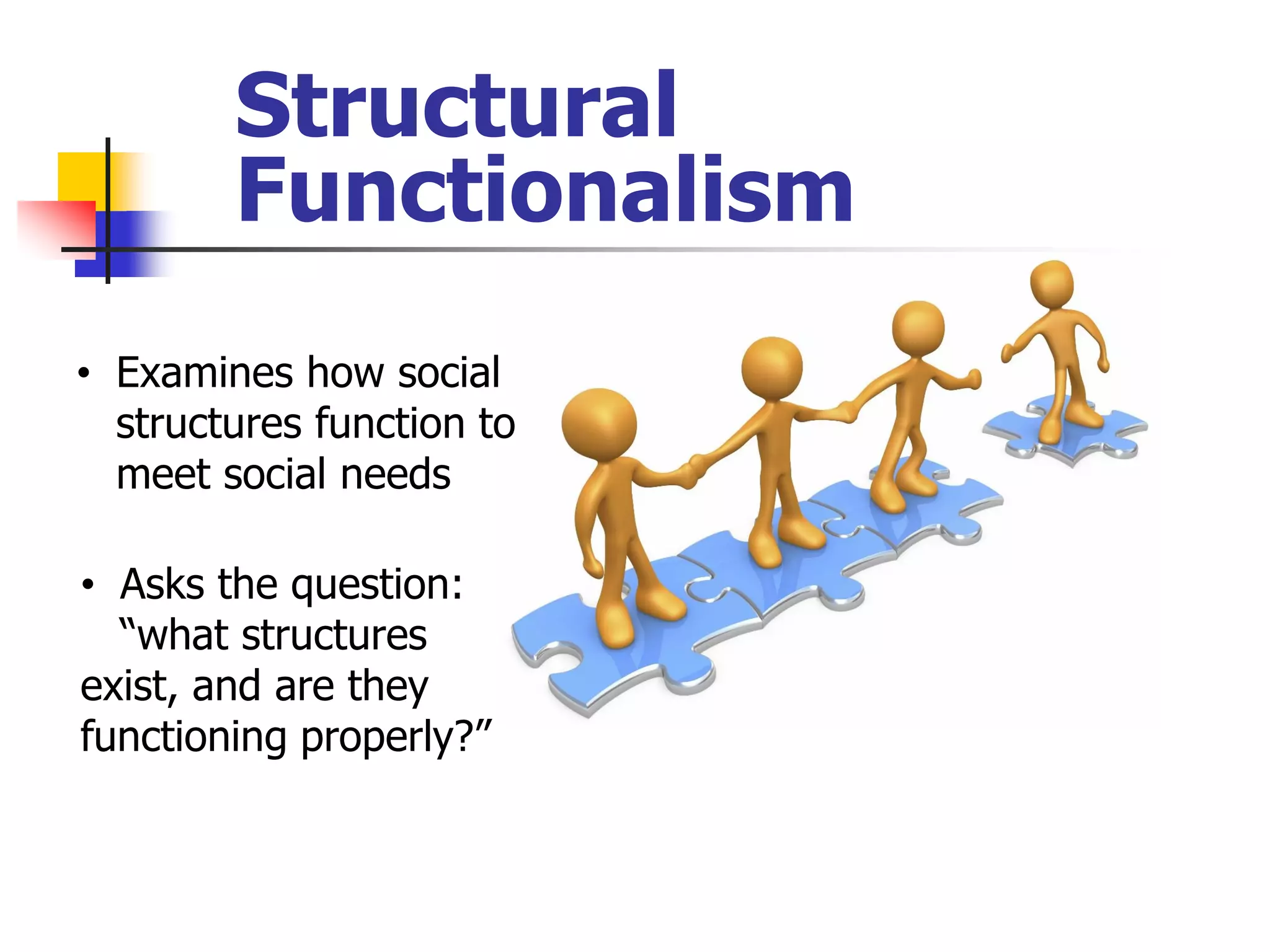
Structural
Functionalism
• Examines how social
structures function to
meet social needs
• Asks the question:
“what structures
exist, and are they
functioning properly?”
Functionalist Perspective
 Vision of Society
• A system of interrelated parts that function
or operate together harmoniously.
• Organism
• Social System
 Society is viewed as
very similar to the
human body.
• Each part meets a
need in order to
maintain a normal
state of balance.
• Organs are viewed as
similar to social
systems.
Organism
Social Systems
 Interdependent
network of social
institutions (family,
school, business,
religion, etc.) that
shape our lives.
 Social systems
contribute to the
stability of society.
 Equilibrium
 Disequilibrium
HERBERT SPENCER (1820-1903)
 Contributed an evolutionary perspective on
social order and social change.
 Social Darwinism
 The belief that the human beings best
adapted to their environment survive and
prosper, whereas those poorly adapted die
out.
 Coined the term “survival of the fittest.”
EMILE DURKHEIM (1858-1917)
 Believed the limits of human potential
are socially based.
 One of his most important contributions
was the concept of social facts.
 Social facts are patterned ways of acting,
thinking, and feeling that exist outside any
one individual but exert social control over
each person.
█ Emphasizes the way parts of a society are
structured to maintain its stability
TALCOTT PARSONS (1902-1972)
– Viewed society as vast network of
connected parts
– Each helps maintain the system as a whole
Module 3
ROBERT K. MERTON (1910–2003)
 Manifest Functions
 The recognized and intended consequences of
any social pattern
 Latent Functions
 The unrecognized and unintended
consequences of any social pattern
 Social Dysfunction
 Any social pattern that might disrupt the
operation of society
STRUCTURAL FUNCTIONALIST
PERSPECTIVE
 Social life depends on
consensus and
cooperation. Conflict
is socially destructive.
 Changes tend to
disrupt social life,
setting things off
balance.
▪ CRITICAL REVIEW
▪ Main idea of the structural-functional
approach is its vision of society as stable
and orderly
▪ Main goal of sociologists who use this
approach is to figure out “what makes
society tick”
17
Various
groups are in
conflict to
compete
for
limited
resources,
control, or
authority.
Dominate
Groups
Subordinate
Groups
Wealth, Power, Prestige
Resources, Control, Authority
Power Struggle
What is Conflict Theory?
 Conflict theory generally surrounds the idea
that most struggles in society happen
because of conflicts between different social
classes or groups
 Each group struggles to attain more
resources and because resources are scarce,
they must struggle with other groups
 Groups try to protect their own interests,
therefore blocking the progress of other
groups
Major Proposition of Conflict
Theories
 Society is not a system in equilibrium but a nebulous structure
of imperfectly coordinated elements
 Every society experiences at every moment social conflict
 Every element in a society contributes to its change
 Every society rests on constrain of some of its members by
others
 Social universe is the setting within which the conflict of life are
acted out
Karl Marx (1818-1883)
“There must be something
rotten in the very core of a
social system which increases
in wealth without diminishing
its misery, and increases in
crime even more than its
numbers.”
Marx, K. (1859). Population,
crime and pauperism.Collected
Works, (16).
 Society
 Is composed of have and have-nots, rulers
and ruled.
 Laws
 Reflect the interests of the dominant class.
 Capitalism
 Encourages egoism and criminality by
equating status with property.
Karl Marx (1818-1883)
 Means of production
Everything, except human labor, that is used
to produce wealth.
 Bourgeoisie
Marx’s name for the class made up of those
who own the means of production; the
employer or owner class.
Karl Marx (1818-1883)
 Proletariat
The name that Marx applied to the class
made up of those who do not own the means
of production; the employee or working class.
Karl Marx (1818-1883)
 Class consciousness
The concept Marx used to identify the
awareness of members of a class of their
class interests and enemies.
 False consciousness (ideological control)
where the masses, or proletariat are deluded
into thinking that everything is fine and that
the appalling in which they live and work are
inevitable.
Karl Marx (1818-1883)
 Punishment
 Only crimes of the poor are punished.
 Economic inequality
 Intensifies personal problems and crime.
 Crime
 Will virtually disappear with equal
distribution of property.
Karl Marx (1818-1883)
 The justice system operates to
protect the rich and powerful by:
 how crimes are defined.
 how laws are enforced.
 how law-breakers are punished.
Karl Marx (1818-1883)
 Power relations
 Conflict is rooted in the
competition for power.
 Power provides the means to
influence public opinion for
private gain.
 Those in power use the law
to criminalize those without
power (e.g. minority groups).
Karl Marx (1818-1883)
Conclusion
 A major change in course in sociology
 From consensus to conflict
 Away from functional thought
 But perhaps too much emphasis on
conflict
Conflict as a Binding
Element
 We often mistake conflict as always being a dividing
factor, it can instead have quite the opposite reaction
 When two groups are pitted against one another, the
bonds between members of each group within itself
become much closer
 Violence can also point out problems that might not
be obvious
Violence can bring about public activism and force change
through public attitudes
▪ CRITICAL REVIEW
▪ Ignores how shared values and
interdependence can unify members of a
society
▪ Politically, social-conflict cannot claim
scientific objectivity
▪ Both the functional and conflict approaches
paint society in broad strokes

03 Functionalist & Conflict Perspectives SOC1014.pdf

  • 1.
    Reading Assignment  TheSociological Perspective pg.14-17  Origins of Sociology pg.18-26  Theoretical Perspectives in Sociology pg. 34-40
  • 2.
    Chapter Review Questions 1.Define Sociology 2. Define Society 3. What is Social Location? 4. Describe the Sociological Perspective. 5. How does the sociological perspective and social location shape personal worldview 6. Who is the father of Sociology? 7. What is Positivism? 8. What are the three major social changes that led to the development of Sociology as a discipline? 9. Why is the industrial revolution so pivotal in the development of Sociology? 10. Differentiate between the macro and micro levels of sociological analysis 11. Who is Karl Marx and why is he relevant to Sociology 12. Differentiate between social conflict theory, functionalism and symbolic interaction theory.
  • 3.
    Theoretical Perspectives A theoryis a general statement about how some parts of the world fit together and how they work. It is an explanation of how two or more facts are related. By providing a framework in which to fit observations, each theory interprets reality in a unique way.
  • 4.
    What is aSociological Perspective?  Tool for analyzing social life.  Level of analysis • Macro • Micro  Three major perspectives in Sociology • Functionalist Perspective • Conflict Perspective • Symbolic Interaction Perspective
  • 5.
    Macro vs. Micro Macro – functionalists & conflict theorists focus on large scale patterns  Micro – symbolic interactionist focus on what people do in each other’s presence
  • 6.
    Structural Functionalism • Examines howsocial structures function to meet social needs • Asks the question: “what structures exist, and are they functioning properly?”
  • 7.
    Functionalist Perspective  Visionof Society • A system of interrelated parts that function or operate together harmoniously. • Organism • Social System
  • 8.
     Society isviewed as very similar to the human body. • Each part meets a need in order to maintain a normal state of balance. • Organs are viewed as similar to social systems. Organism
  • 9.
    Social Systems  Interdependent networkof social institutions (family, school, business, religion, etc.) that shape our lives.  Social systems contribute to the stability of society.  Equilibrium  Disequilibrium
  • 10.
    HERBERT SPENCER (1820-1903) Contributed an evolutionary perspective on social order and social change.  Social Darwinism  The belief that the human beings best adapted to their environment survive and prosper, whereas those poorly adapted die out.  Coined the term “survival of the fittest.”
  • 11.
    EMILE DURKHEIM (1858-1917) Believed the limits of human potential are socially based.  One of his most important contributions was the concept of social facts.  Social facts are patterned ways of acting, thinking, and feeling that exist outside any one individual but exert social control over each person.
  • 13.
    █ Emphasizes theway parts of a society are structured to maintain its stability TALCOTT PARSONS (1902-1972) – Viewed society as vast network of connected parts – Each helps maintain the system as a whole Module 3
  • 14.
    ROBERT K. MERTON(1910–2003)  Manifest Functions  The recognized and intended consequences of any social pattern  Latent Functions  The unrecognized and unintended consequences of any social pattern  Social Dysfunction  Any social pattern that might disrupt the operation of society
  • 15.
    STRUCTURAL FUNCTIONALIST PERSPECTIVE  Sociallife depends on consensus and cooperation. Conflict is socially destructive.  Changes tend to disrupt social life, setting things off balance.
  • 16.
    ▪ CRITICAL REVIEW ▪Main idea of the structural-functional approach is its vision of society as stable and orderly ▪ Main goal of sociologists who use this approach is to figure out “what makes society tick”
  • 17.
    17 Various groups are in conflictto compete for limited resources, control, or authority. Dominate Groups Subordinate Groups Wealth, Power, Prestige Resources, Control, Authority Power Struggle What is Conflict Theory?
  • 18.
    What is ConflictTheory?  Conflict theory generally surrounds the idea that most struggles in society happen because of conflicts between different social classes or groups  Each group struggles to attain more resources and because resources are scarce, they must struggle with other groups  Groups try to protect their own interests, therefore blocking the progress of other groups
  • 19.
    Major Proposition ofConflict Theories  Society is not a system in equilibrium but a nebulous structure of imperfectly coordinated elements  Every society experiences at every moment social conflict  Every element in a society contributes to its change  Every society rests on constrain of some of its members by others  Social universe is the setting within which the conflict of life are acted out
  • 20.
    Karl Marx (1818-1883) “Theremust be something rotten in the very core of a social system which increases in wealth without diminishing its misery, and increases in crime even more than its numbers.” Marx, K. (1859). Population, crime and pauperism.Collected Works, (16).
  • 21.
     Society  Iscomposed of have and have-nots, rulers and ruled.  Laws  Reflect the interests of the dominant class.  Capitalism  Encourages egoism and criminality by equating status with property. Karl Marx (1818-1883)
  • 22.
     Means ofproduction Everything, except human labor, that is used to produce wealth.  Bourgeoisie Marx’s name for the class made up of those who own the means of production; the employer or owner class. Karl Marx (1818-1883)
  • 23.
     Proletariat The namethat Marx applied to the class made up of those who do not own the means of production; the employee or working class. Karl Marx (1818-1883)
  • 24.
     Class consciousness Theconcept Marx used to identify the awareness of members of a class of their class interests and enemies.  False consciousness (ideological control) where the masses, or proletariat are deluded into thinking that everything is fine and that the appalling in which they live and work are inevitable. Karl Marx (1818-1883)
  • 25.
     Punishment  Onlycrimes of the poor are punished.  Economic inequality  Intensifies personal problems and crime.  Crime  Will virtually disappear with equal distribution of property. Karl Marx (1818-1883)
  • 26.
     The justicesystem operates to protect the rich and powerful by:  how crimes are defined.  how laws are enforced.  how law-breakers are punished. Karl Marx (1818-1883)
  • 27.
     Power relations Conflict is rooted in the competition for power.  Power provides the means to influence public opinion for private gain.  Those in power use the law to criminalize those without power (e.g. minority groups). Karl Marx (1818-1883)
  • 28.
    Conclusion  A majorchange in course in sociology  From consensus to conflict  Away from functional thought  But perhaps too much emphasis on conflict
  • 29.
    Conflict as aBinding Element  We often mistake conflict as always being a dividing factor, it can instead have quite the opposite reaction  When two groups are pitted against one another, the bonds between members of each group within itself become much closer  Violence can also point out problems that might not be obvious Violence can bring about public activism and force change through public attitudes
  • 30.
    ▪ CRITICAL REVIEW ▪Ignores how shared values and interdependence can unify members of a society ▪ Politically, social-conflict cannot claim scientific objectivity ▪ Both the functional and conflict approaches paint society in broad strokes