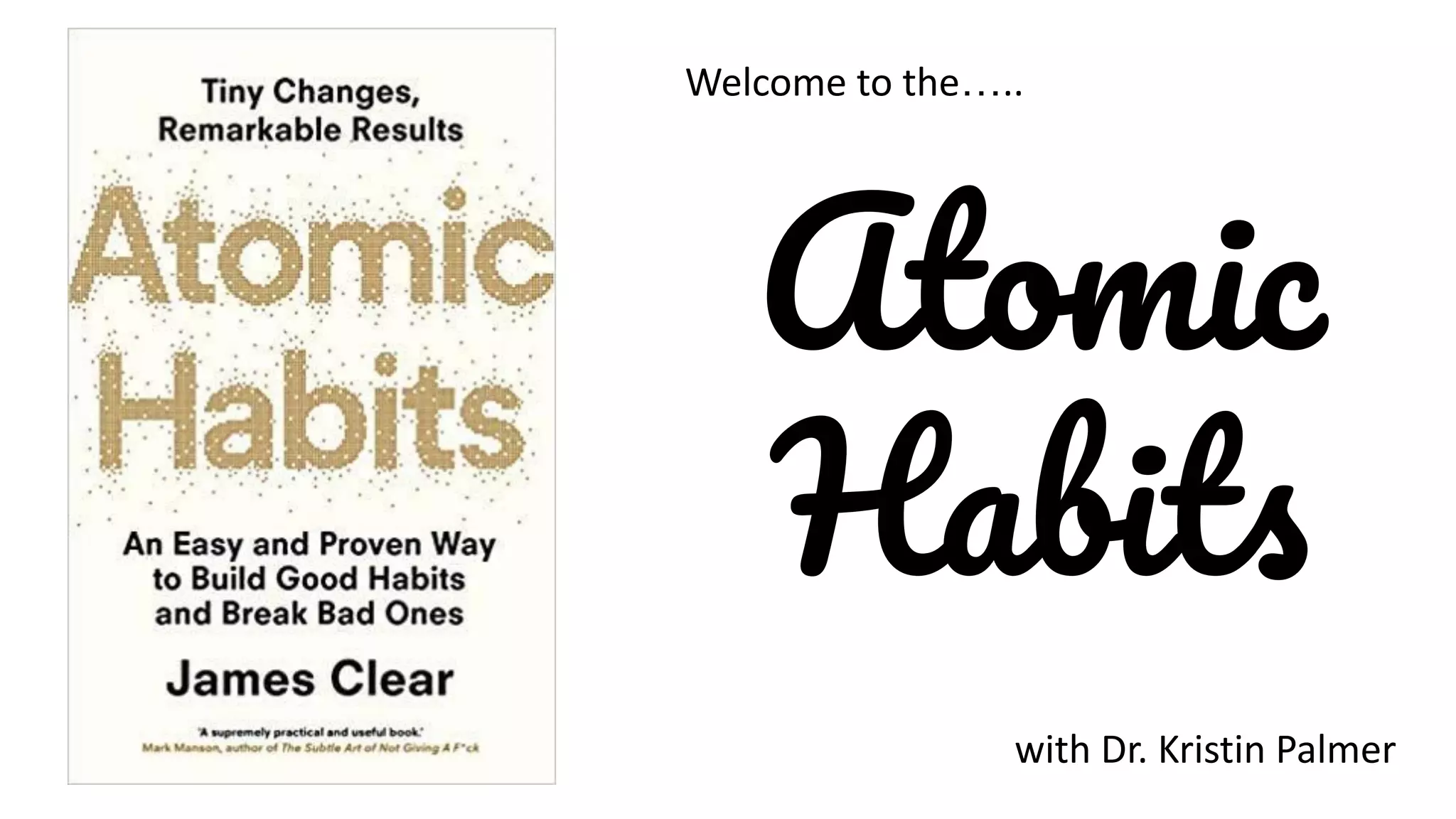
Atomic
Habits
Welcome to the…..
with Dr. Kristin Palmer
Format for today’s workshop
● Housekeeping
● Introductions
● High-level takeaways on the book
● Tools and templates from the book
● Active discussion and engagement
● Follow up email with slides and survey
HOUSEKEEPING
You’ll get the
slides via email
Please provide
feedback in the
survey
Please mute
when not
speaking
On or off
camera is
a-ok
This is a safe place
Dr. Kristin Palmer
CEO, Life Coach, Builder, Woman who gets stuff done, Crusader for Improving the World through Education.
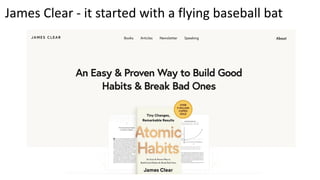
James Clear - it started with a flying baseball bat
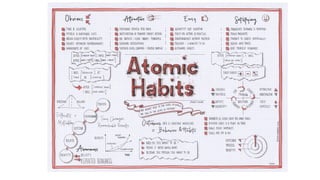
“Success is the product of daily habits, not once
in a lifetime transformations.” - James Clear
Are your habits putting you on the path to success?
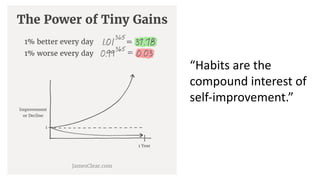
“Habits are the
compound interest of
self-improvement.”
1% Better
Tiny Daily Changes = Outstanding Results
Goals vs. Systems
Create a system (and environment) to support you.
Goals are momentary.
Systems sustain who you want to be over time.
Environment
Pack your gym bag.
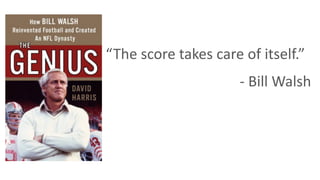
“The score takes care of itself.”
- Bill Walsh
Identity
Be who you want and the your choices will follow.
Latin root for Identity is:
essentitas = being
and
identidem=repeatedly
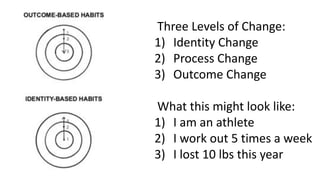
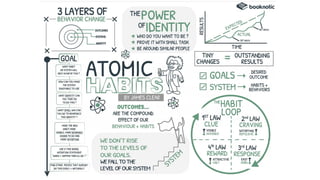
Three Levels of Change:
1) Identity Change
2) Process Change
3) Outcome Change
What this might look like:
1) I am an athlete
2) I work out 5 times a week
3) I lost 10 lbs this year
Habits matter because they can change your
beliefs about yourself.
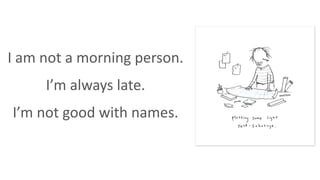
I am not a morning person.
I’m always late.
I’m not good with names.
1. Decide the type of person you want to be.
2. Prove it to yourself with small wins.
I’m not a smoker.
I’m a healthy person.
I’m a supportive mom.
Your identity emerges out of your habits.
Every action you take is a vote for the type of
person you wish to become.
The most effective way to change your habits
is to focus not on what you want to achieve,
but on who you wish to become.
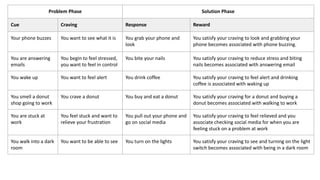
Problem Phase Solution Phase
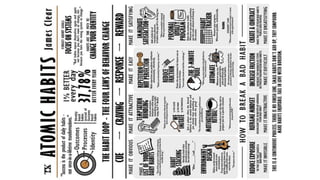
Cue Craving Response Reward
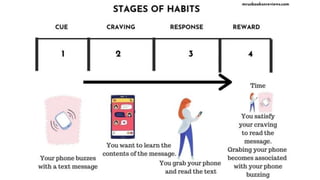
Your phone buzzes You want to see what it is You grab your phone and
look
You satisfy your craving to look and grabbing your
phone becomes associated with phone buzzing.
You are answering
emails
You begin to feel stressed,
you want to feel in control
You bite your nails You satisfy your craving to reduce stress and biting
nails becomes associated with answering email
You wake up You want to feel alert You drink coffee You satisfy your craving to feel alert and drinking
coffee is associated with waking up
You smell a donut
shop going to work
You crave a donut You buy and eat a donut You satisfy your craving for a donut and buying a
donut becomes associated with walking to work
You are stuck at
work
You feel stuck and want to
relieve your frustration
You pull out your phone and
go on social media
You satisfy your craving to feel relieved and you
associate checking social media for when you are
feeling stuck on a problem at work
You walk into a dark
room
You want to be able to see You turn on the lights You satisfy your craving to see and turning on the light
switch becomes associated with being in a dark room
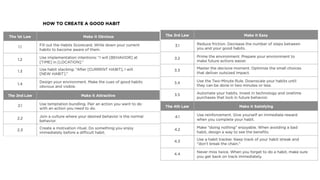
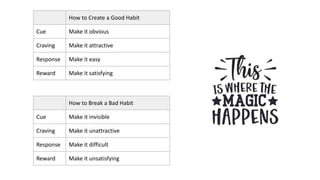
How to Create a Good Habit
Cue Make it obvious
Craving Make it attractive
Response Make it easy
Reward Make it satisfying
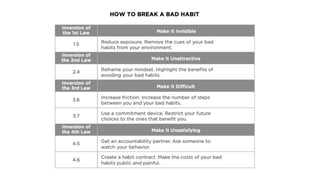
How to Break a Bad Habit
Cue Make it invisible
Craving Make it unattractive
Response Make it difficult
Reward Make it unsatisfying
Whenever you want to change behavior, ask yourself:
1) How can I make it obvious?
2) How can I make it attractive?
3) How can I make it easy?
4) How can I make it satisfying?
Law #1: Make it obvious
The trick here is we tend to do things on autopilot
and not realize what we are doing unconsciously.
We have behavior patterns, but we need
to make ourselves aware of them.
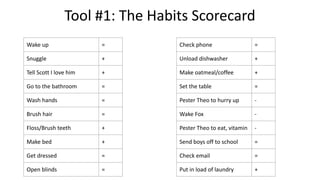
Tool #1: The Habits Scorecard
Wake up =
Snuggle +
Tell Scott I love him +
Go to the bathroom =
Wash hands =
Brush hair =
Floss/Brush teeth +
Make bed +
Get dressed =
Open blinds =
Check phone =
Unload dishwasher +
Make oatmeal/coffee +
Set the table =
Pester Theo to hurry up -
Wake Fox -
Pester Theo to eat, vitamin -
Send boys off to school =
Check email =
Put in load of laundry +
Tool #2: Implementation Intentions
People who make a specific plan for when they will
perform a new habit are more likely to follow through (vs
waiting for inspiration to strike).
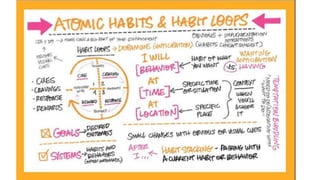
I will do (Activity) on (Day)
at (Time) in (Place).
This might look like…..
Meditations. I will meditate for one minute at 7AM in my kitchen.
Studying. I will study Spanish for 20 minutes at 6PM in my bedroom.
Exercise. I will exercise for one hour at 5PM in my local gym.
Marriage. I will make my partner a cup of tea at 8AM in the kitchen.
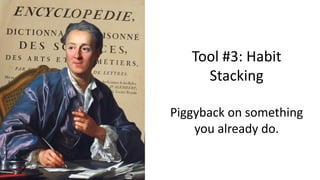
Tool #3: Habit
Stacking
Piggyback on something
you already do.
It started with flooding….
Everything you do is a cue for
the next thing you do.
You go to the bathroom which leads to washing and
drying your hands. Then you see the towel is dirty so
you add it to the laundry. Then you see you are out of
dryer sheets so you add that to the shopping list, etc…
After I (current habit),
I will (new habit).
Look at your habit
scorecard and decide
what new habit to
piggyback where.
After I pour my coffee, I will meditate for one minute.
When I decide I want to buy something, I will wait 3 days.
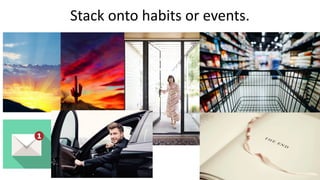
Stack onto habits or events.
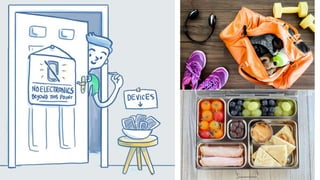
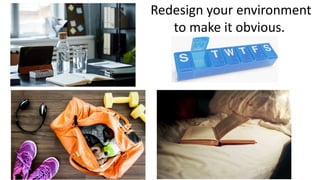
Redesign your environment
to make it obvious.
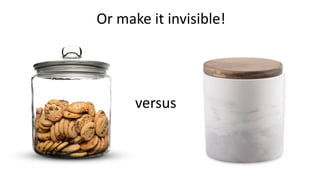
Or make it invisible!
versus
To stop a bad habit, change the environment
If you can’t get your work done, leave your phone in another room.
If you are wasting too much time watching TV, move the TV to another room.
If you buy junk food at the grocery store, change the store you shop at.
If you are playing too many video games, unplug the console and store in a closet.
Motivation is overrated.
Self-control is a short term strategy.
Law #2: Make it attractive
We want/anticipate rewards more than we like rewards.
Thinking about vacation vs. being on vacation.
Thinking about presents on Christmas morning vs. playing with presents.
Tool #4: Temptation Bundling
what you want to do + what you need to do
After I (current habit), I will (habit I need).
After (habit I need), I will (habit I want).
After I get my morning coffee, I will say something I am grateful for (need), then I can read the news (want).
After I pull out my phone, I will do 10 push-ups (need), then I will check Facebook (want).
After I get back from lunch, I will call three clients (need), then I can check ESPN (want).
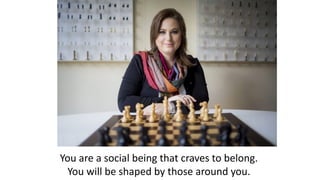
You are a social being that craves to belong.
You will be shaped by those around you.
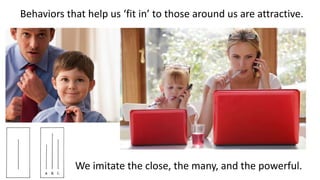
Behaviors that help us ‘fit in’ to those around us are attractive.
We imitate the close, the many, and the powerful.
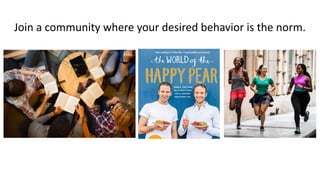
Join a community where your desired behavior is the norm.
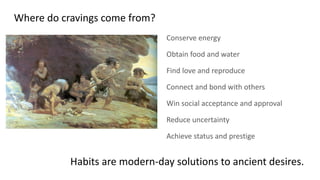
Where do cravings come from?
Conserve energy
Obtain food and water
Find love and reproduce
Connect and bond with others
Win social acceptance and approval
Reduce uncertainty
Achieve status and prestige
Habits are modern-day solutions to ancient desires.
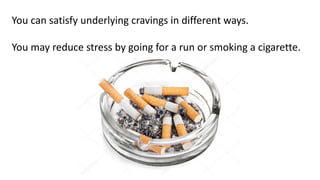
You can satisfy underlying cravings in different ways.
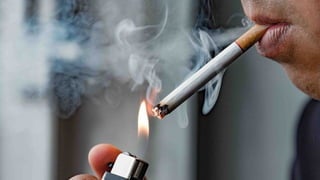
You may reduce stress by going for a run or smoking a cigarette.
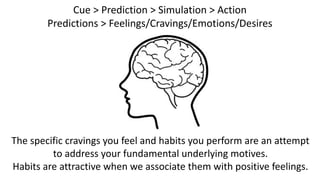
Cue > Prediction > Simulation > Action
Predictions > Feelings/Cravings/Emotions/Desires
The specific cravings you feel and habits you perform are an attempt
to address your fundamental underlying motives.
Habits are attractive when we associate them with positive feelings.
I have to cook dinner for my family.
I get to make dinner for my family.
I need to go for a run.
It’s time to build endurance and get fast.
I have to quit smoking.
I want to lead a long and healthy life.
Law #3: Make it easy
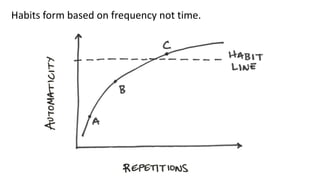
To make something automatic, you need to do it a lot.
Repetition not Perfection
JUST DO
Be in Motion vs. Taking Action
I brainstormed a list of possible topics.
I wrote a draft of an article.
Motion feels like you are getting something done but
it’s really it is just preparing to get something done.
Habits form based on frequency not time.
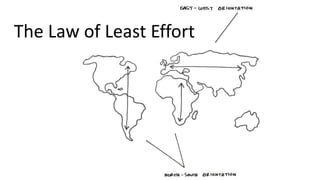
The Law of Least Effort
The truth is our real
motivation is to be lazy and to
do what is convenient.
The greater the obstacle, the
more difficult the habit, the more
friction there is between you and
your desired end state.
Make the habits you don’t want
hard.
Unplug the TV. Uninstall the app.
Change the password.
Make the habits you want easy.
Two minute rule. Healthy Treats
Ready. Gym bag packed.
Addition by Subtraction = Maximize Efficiencies
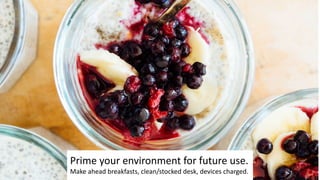
Prime your environment for future use.
Make ahead breakfasts, clean/stocked desk, devices charged.
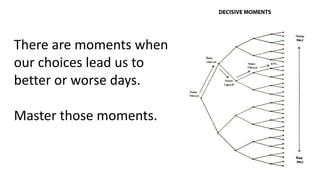
There are moments when
our choices lead us to
better or worse days.
Master those moments.
Even when you know
you should start small,
it’s easy to start too big.
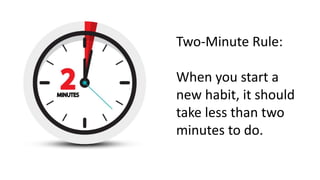
Two-Minute Rule:
When you start a
new habit, it should
take less than two
minutes to do.
Make it super easy.
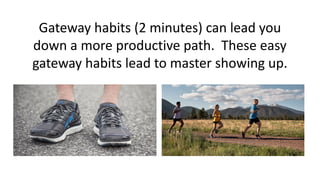
Gateway habits (2 minutes) can lead you
down a more productive path. These easy
gateway habits lead to master showing up.
Establish the habit,
then make it
harder.
You can’t improve a
habit that doesn’t exist.
Habit Shaping =
Moving from easy to harder in phases.
If you create a ritual at the
beginning of a process, it is more
likely you can slip into a deep focus
to do great things faster.
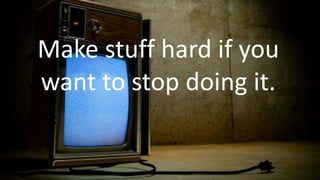
Make stuff hard if you
want to stop doing it.
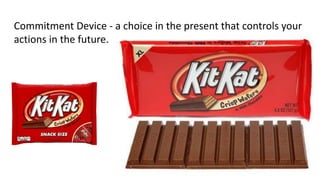
Commitment Device - a choice in the present that controls your
actions in the future.
The ultimate way to lock
in future behavior is to
automate your habits.
Make it automatic to do ‘the right thing’
Medicine. Prescriptions on auto-refill.
Personal finance. Auto-deduct from your paycheck to your retirement savings.
Cooking. Meal-delivery services can do your grocery shopping and portion control.
Productivity. Social media browsing can be cut off with a website blocker.
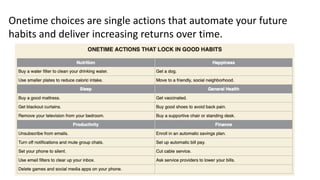
Onetime choices are single actions that automate your future
habits and deliver increasing returns over time.
Law #4: Make it satisfying
What is rewarded is repeated. What is punished is avoided.
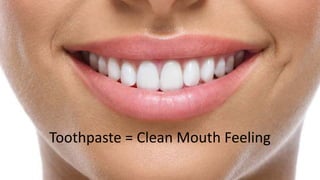
Toothpaste = Clean Mouth Feeling
Love that luxurious lather = clean hands
Immediate.
Not delayed.
“It almost always happens that when the
immediate consequence is favorable, the
later consequences are disastrous, and vice
versa…Often, the sweeter the first fruit of
a habit, the more bitter are it’s later fruits.”
- Frederic Bastiat
The cost of good habits are in
the present. The cost of bad
habits are in the future.
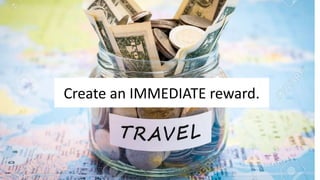
Create an IMMEDIATE reward.
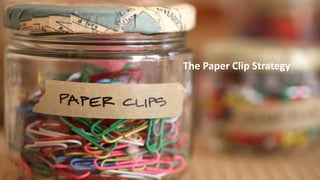
The Paper Clip Strategy
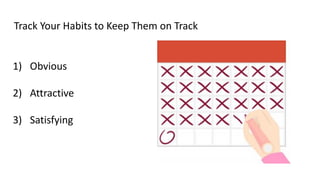
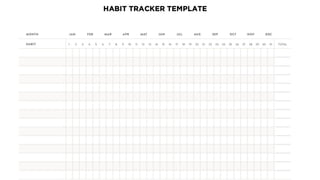
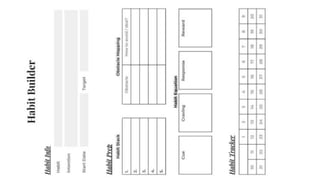
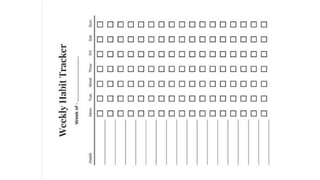
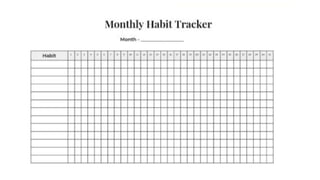
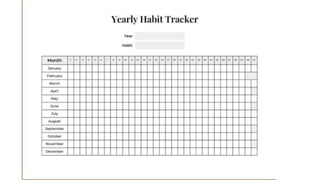
Track Your Habits to Keep Them on Track
1) Obvious
2) Attractive
3) Satisfying
After I (current habit), I
will (track my habit).
You will miss a day.
Start again the next day.
Never miss twice.
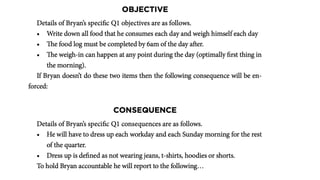
Habit Contracts can give you an accountability
partner and create immediate consequences.
You are less likely to repeat
a bad habit if it is painful or
unsatisfying.
Bonus Stuff / Endnotes
Habits are easier to perform and
more satisfying to stick with
when they align with your
natural inclinations and abilities.
The secret to maximizing your
odds of success is to choose the
right field of competition.
Big Five Personality Traits
Openness to experience: from curious and inventive to cautious and consistent.
Conscientiousness: organized and efficient to easygoing and spontaneous.
Extroversion: outgoing and energetic to solitary and reserved.
Agreeableness: friendly and compassionate to challenging and detached.
Neuroticism: anxious and sensitive to confident, calm, and stable.
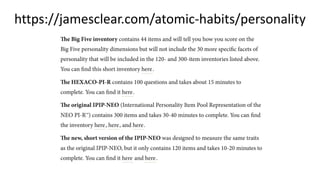
https://jamesclear.com/atomic-habits/personality
Explore, explore, explore….
What feels like fun to me but work to others?
What makes me lose track of time?
Where do I get greater returns than the average person?
What comes naturally to me?
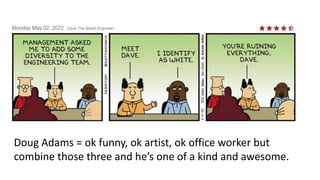
Doug Adams = ok funny, ok artist, ok office worker but
combine those three and he’s one of a kind and awesome.
Play a game that favors
your strengths. If you can’t
find one, create one.
Work. Hard.
“Optimal Zone of Difficulty”
Goldilocks Rule: Humans experience peak
motivation when working on tasks that are
right on the edge of their current abilities.
Not too hard. Not too easy. Just right.
When starting a habit, make it easy.
Once established, add small challenges.
The greatest threat to success
is not failure but boredom.
Do it even when it’s boring.
Keep doing the reps.
Cutting up the crudites.
Down dog after down dog.
Habits + Deliberate Practice = Mastery
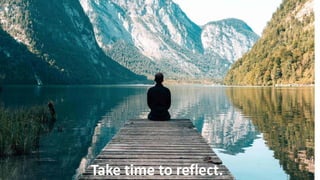
Take time to reflect.
Lessons from the Four Laws
Awareness comes before desire.
Happiness is simply the absence of desire.
It is the idea of pleasure that we chase.
Peace occurs when you don’t turn your observations into problems.
With a big enough why you can overcome any how.
Being curious is better than being smart.
Emotions drive behavior.
We can only be rational and logical after we have been emotional.
Your response tends to follow your emotions.
Lessons continued
Suffering drives progress.
Your actions reveal how badly you want something.
Reward is on the other side of sacrifice.
Self-control is difficult because it is not satisfying.
Our expectations determine our satisfaction.
The main of failure correlates to the height of expectation.
Feels come both before and after the behavior.
Desire initiates. Pleasure sustains.
Hope declines with experience and is replaced by acceptance.
Lessons continued
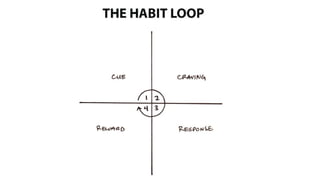
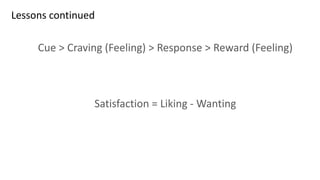
Cue > Craving (Feeling) > Response > Reward (Feeling)
Satisfaction = Liking - Wanting
Additional Resources from Workshop Discussion
TBD
Thank you!
Dr. Kristin Palmer
http://www.CentralOregonLifeCoach.com

Atomic Habits Virtual Workshop - Whole Book Summary

  • 1.
  • 2.
    Format for today’sworkshop ● Housekeeping ● Introductions ● High-level takeaways on the book ● Tools and templates from the book ● Active discussion and engagement ● Follow up email with slides and survey
  • 3.
    HOUSEKEEPING You’ll get the slidesvia email Please provide feedback in the survey Please mute when not speaking On or off camera is a-ok This is a safe place
  • 4.
    Dr. Kristin Palmer CEO,Life Coach, Builder, Woman who gets stuff done, Crusader for Improving the World through Education.
  • 6.
    James Clear -it started with a flying baseball bat
  • 9.
    “Success is theproduct of daily habits, not once in a lifetime transformations.” - James Clear Are your habits putting you on the path to success?
  • 10.
    “Habits are the compoundinterest of self-improvement.”
  • 12.
    1% Better Tiny DailyChanges = Outstanding Results
  • 13.
    Goals vs. Systems Createa system (and environment) to support you. Goals are momentary. Systems sustain who you want to be over time.
  • 15.
  • 16.
    “The score takescare of itself.” - Bill Walsh
  • 17.
    Identity Be who youwant and the your choices will follow.
  • 19.
    Latin root forIdentity is: essentitas = being and identidem=repeatedly
  • 20.
    Three Levels ofChange: 1) Identity Change 2) Process Change 3) Outcome Change What this might look like: 1) I am an athlete 2) I work out 5 times a week 3) I lost 10 lbs this year
  • 21.
    Habits matter becausethey can change your beliefs about yourself.
  • 22.
    I am nota morning person. I’m always late. I’m not good with names.
  • 23.
    1. Decide thetype of person you want to be. 2. Prove it to yourself with small wins.
  • 24.
    I’m not asmoker. I’m a healthy person. I’m a supportive mom.
  • 27.
    Your identity emergesout of your habits. Every action you take is a vote for the type of person you wish to become.
  • 30.
    The most effectiveway to change your habits is to focus not on what you want to achieve, but on who you wish to become.
  • 33.
    Problem Phase SolutionPhase Cue Craving Response Reward Your phone buzzes You want to see what it is You grab your phone and look You satisfy your craving to look and grabbing your phone becomes associated with phone buzzing. You are answering emails You begin to feel stressed, you want to feel in control You bite your nails You satisfy your craving to reduce stress and biting nails becomes associated with answering email You wake up You want to feel alert You drink coffee You satisfy your craving to feel alert and drinking coffee is associated with waking up You smell a donut shop going to work You crave a donut You buy and eat a donut You satisfy your craving for a donut and buying a donut becomes associated with walking to work You are stuck at work You feel stuck and want to relieve your frustration You pull out your phone and go on social media You satisfy your craving to feel relieved and you associate checking social media for when you are feeling stuck on a problem at work You walk into a dark room You want to be able to see You turn on the lights You satisfy your craving to see and turning on the light switch becomes associated with being in a dark room
  • 34.
    How to Createa Good Habit Cue Make it obvious Craving Make it attractive Response Make it easy Reward Make it satisfying How to Break a Bad Habit Cue Make it invisible Craving Make it unattractive Response Make it difficult Reward Make it unsatisfying
  • 35.
    Whenever you wantto change behavior, ask yourself: 1) How can I make it obvious? 2) How can I make it attractive? 3) How can I make it easy? 4) How can I make it satisfying?
  • 36.
    Law #1: Makeit obvious The trick here is we tend to do things on autopilot and not realize what we are doing unconsciously. We have behavior patterns, but we need to make ourselves aware of them.
  • 40.
    Tool #1: TheHabits Scorecard Wake up = Snuggle + Tell Scott I love him + Go to the bathroom = Wash hands = Brush hair = Floss/Brush teeth + Make bed + Get dressed = Open blinds = Check phone = Unload dishwasher + Make oatmeal/coffee + Set the table = Pester Theo to hurry up - Wake Fox - Pester Theo to eat, vitamin - Send boys off to school = Check email = Put in load of laundry +
  • 42.
    Tool #2: ImplementationIntentions People who make a specific plan for when they will perform a new habit are more likely to follow through (vs waiting for inspiration to strike).
  • 43.
    I will do(Activity) on (Day) at (Time) in (Place).
  • 44.
    This might looklike….. Meditations. I will meditate for one minute at 7AM in my kitchen. Studying. I will study Spanish for 20 minutes at 6PM in my bedroom. Exercise. I will exercise for one hour at 5PM in my local gym. Marriage. I will make my partner a cup of tea at 8AM in the kitchen.
  • 45.
    Tool #3: Habit Stacking Piggybackon something you already do.
  • 46.
    It started withflooding….
  • 47.
    Everything you dois a cue for the next thing you do. You go to the bathroom which leads to washing and drying your hands. Then you see the towel is dirty so you add it to the laundry. Then you see you are out of dryer sheets so you add that to the shopping list, etc…
  • 48.
    After I (currenthabit), I will (new habit).
  • 49.
    Look at yourhabit scorecard and decide what new habit to piggyback where. After I pour my coffee, I will meditate for one minute. When I decide I want to buy something, I will wait 3 days.
  • 50.
  • 51.
  • 52.
    Or make itinvisible! versus
  • 53.
    To stop abad habit, change the environment If you can’t get your work done, leave your phone in another room. If you are wasting too much time watching TV, move the TV to another room. If you buy junk food at the grocery store, change the store you shop at. If you are playing too many video games, unplug the console and store in a closet.
  • 54.
    Motivation is overrated. Self-controlis a short term strategy.
  • 55.
    Law #2: Makeit attractive We want/anticipate rewards more than we like rewards. Thinking about vacation vs. being on vacation. Thinking about presents on Christmas morning vs. playing with presents.
  • 56.
    Tool #4: TemptationBundling what you want to do + what you need to do
  • 58.
    After I (currenthabit), I will (habit I need). After (habit I need), I will (habit I want). After I get my morning coffee, I will say something I am grateful for (need), then I can read the news (want). After I pull out my phone, I will do 10 push-ups (need), then I will check Facebook (want). After I get back from lunch, I will call three clients (need), then I can check ESPN (want).
  • 59.
    You are asocial being that craves to belong. You will be shaped by those around you.
  • 60.
    Behaviors that helpus ‘fit in’ to those around us are attractive. We imitate the close, the many, and the powerful.
  • 61.
    Join a communitywhere your desired behavior is the norm.
  • 62.
    Where do cravingscome from? Conserve energy Obtain food and water Find love and reproduce Connect and bond with others Win social acceptance and approval Reduce uncertainty Achieve status and prestige Habits are modern-day solutions to ancient desires.
  • 63.
    You can satisfyunderlying cravings in different ways. You may reduce stress by going for a run or smoking a cigarette.
  • 64.
    Cue > Prediction> Simulation > Action Predictions > Feelings/Cravings/Emotions/Desires The specific cravings you feel and habits you perform are an attempt to address your fundamental underlying motives. Habits are attractive when we associate them with positive feelings.
  • 65.
    I have tocook dinner for my family. I get to make dinner for my family. I need to go for a run. It’s time to build endurance and get fast. I have to quit smoking. I want to lead a long and healthy life.
  • 66.
    Law #3: Makeit easy To make something automatic, you need to do it a lot.
  • 67.
  • 68.
    Be in Motionvs. Taking Action I brainstormed a list of possible topics. I wrote a draft of an article. Motion feels like you are getting something done but it’s really it is just preparing to get something done.
  • 69.
    Habits form basedon frequency not time.
  • 70.
    The Law ofLeast Effort
  • 71.
    The truth isour real motivation is to be lazy and to do what is convenient.
  • 72.
    The greater theobstacle, the more difficult the habit, the more friction there is between you and your desired end state.
  • 73.
    Make the habitsyou don’t want hard. Unplug the TV. Uninstall the app. Change the password.
  • 74.
    Make the habitsyou want easy. Two minute rule. Healthy Treats Ready. Gym bag packed.
  • 75.
    Addition by Subtraction= Maximize Efficiencies
  • 76.
    Prime your environmentfor future use. Make ahead breakfasts, clean/stocked desk, devices charged.
  • 77.
    There are momentswhen our choices lead us to better or worse days. Master those moments.
  • 78.
    Even when youknow you should start small, it’s easy to start too big.
  • 79.
    Two-Minute Rule: When youstart a new habit, it should take less than two minutes to do.
  • 80.
  • 81.
    Gateway habits (2minutes) can lead you down a more productive path. These easy gateway habits lead to master showing up.
  • 82.
  • 83.
    You can’t improvea habit that doesn’t exist.
  • 84.
    Habit Shaping = Movingfrom easy to harder in phases.
  • 85.
    If you createa ritual at the beginning of a process, it is more likely you can slip into a deep focus to do great things faster.
  • 86.
    Make stuff hardif you want to stop doing it.
  • 87.
    Commitment Device -a choice in the present that controls your actions in the future.
  • 88.
    The ultimate wayto lock in future behavior is to automate your habits.
  • 89.
    Make it automaticto do ‘the right thing’ Medicine. Prescriptions on auto-refill. Personal finance. Auto-deduct from your paycheck to your retirement savings. Cooking. Meal-delivery services can do your grocery shopping and portion control. Productivity. Social media browsing can be cut off with a website blocker.
  • 90.
    Onetime choices aresingle actions that automate your future habits and deliver increasing returns over time.
  • 91.
    Law #4: Makeit satisfying What is rewarded is repeated. What is punished is avoided.
  • 92.
    Toothpaste = CleanMouth Feeling
  • 93.
    Love that luxuriouslather = clean hands
  • 94.
  • 95.
    “It almost alwayshappens that when the immediate consequence is favorable, the later consequences are disastrous, and vice versa…Often, the sweeter the first fruit of a habit, the more bitter are it’s later fruits.” - Frederic Bastiat
  • 98.
    The cost ofgood habits are in the present. The cost of bad habits are in the future.
  • 99.
  • 105.
  • 106.
    Track Your Habitsto Keep Them on Track 1) Obvious 2) Attractive 3) Satisfying
  • 108.
    After I (currenthabit), I will (track my habit).
  • 109.
    You will missa day. Start again the next day. Never miss twice.
  • 110.
    Habit Contracts cangive you an accountability partner and create immediate consequences.
  • 112.
    You are lesslikely to repeat a bad habit if it is painful or unsatisfying.
  • 114.
    Bonus Stuff /Endnotes
  • 115.
    Habits are easierto perform and more satisfying to stick with when they align with your natural inclinations and abilities.
  • 117.
    The secret tomaximizing your odds of success is to choose the right field of competition.
  • 118.
    Big Five PersonalityTraits Openness to experience: from curious and inventive to cautious and consistent. Conscientiousness: organized and efficient to easygoing and spontaneous. Extroversion: outgoing and energetic to solitary and reserved. Agreeableness: friendly and compassionate to challenging and detached. Neuroticism: anxious and sensitive to confident, calm, and stable.
  • 119.
  • 120.
    Explore, explore, explore…. Whatfeels like fun to me but work to others? What makes me lose track of time? Where do I get greater returns than the average person? What comes naturally to me?
  • 121.
    Doug Adams =ok funny, ok artist, ok office worker but combine those three and he’s one of a kind and awesome.
  • 122.
    Play a gamethat favors your strengths. If you can’t find one, create one.
  • 123.
  • 124.
    “Optimal Zone ofDifficulty” Goldilocks Rule: Humans experience peak motivation when working on tasks that are right on the edge of their current abilities. Not too hard. Not too easy. Just right.
  • 125.
    When starting ahabit, make it easy. Once established, add small challenges.
  • 126.
    The greatest threatto success is not failure but boredom.
  • 127.
    Do it evenwhen it’s boring. Keep doing the reps. Cutting up the crudites. Down dog after down dog.
  • 128.
    Habits + DeliberatePractice = Mastery
  • 129.
    Take time toreflect.
  • 132.
    Lessons from theFour Laws Awareness comes before desire. Happiness is simply the absence of desire. It is the idea of pleasure that we chase. Peace occurs when you don’t turn your observations into problems. With a big enough why you can overcome any how. Being curious is better than being smart. Emotions drive behavior. We can only be rational and logical after we have been emotional. Your response tends to follow your emotions.
  • 133.
    Lessons continued Suffering drivesprogress. Your actions reveal how badly you want something. Reward is on the other side of sacrifice. Self-control is difficult because it is not satisfying. Our expectations determine our satisfaction. The main of failure correlates to the height of expectation. Feels come both before and after the behavior. Desire initiates. Pleasure sustains. Hope declines with experience and is replaced by acceptance.
  • 134.
    Lessons continued Cue >Craving (Feeling) > Response > Reward (Feeling) Satisfaction = Liking - Wanting
  • 145.
    Additional Resources fromWorkshop Discussion TBD
  • 146.
    Thank you! Dr. KristinPalmer http://www.CentralOregonLifeCoach.com