 
Project Team 1
Carol Antonelli & Mica Werner
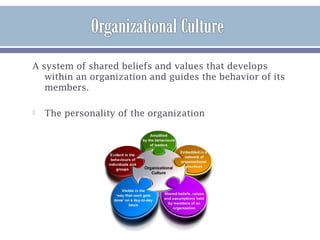
A system of shared beliefs and values that develops
within an organization and guides the behavior of its
members.
 The personality of the organization
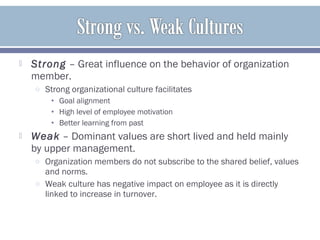
 Strong – Great influence on the behavior of organization
member.
o Strong organizational culture facilitates
• Goal alignment
• High level of employee motivation
• Better learning from past
 Weak – Dominant values are short lived and held mainly
by upper management.
o Organization members do not subscribe to the shared belief, values
and norms.
o Weak culture has negative impact on employee as it is directly
linked to increase in turnover.
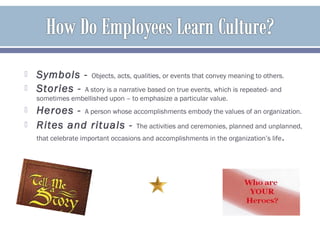
 Symbols - Objects, acts, qualities, or events that convey meaning to others.
 Stories - A story is a narrative based on true events, which is repeated- and
sometimes embellished upon – to emphasize a particular value.
 Heroes - A person whose accomplishments embody the values of an organization.
 Rites and rituals - The activities and ceremonies, planned and unplanned,
that celebrate important occasions and accomplishments in the organization’s life.
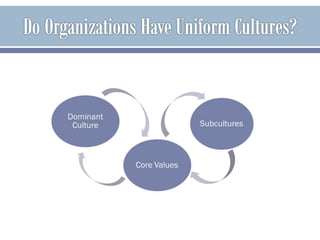
Dominant Culture:
Expresses the core values that are shared by a majority of the
organization.
Subculture:
Tend to develop in large organizations to reflect common
problems, situations, or experiences.
 Clan
 Entrepreneurial
 Market
 Bureaucratic
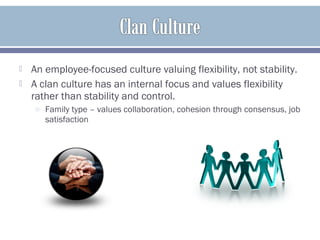
 An employee-focused culture valuing flexibility, not stability.
 A clan culture has an internal focus and values flexibility
rather than stability and control.
o Family type – values collaboration, cohesion through consensus, job
satisfaction
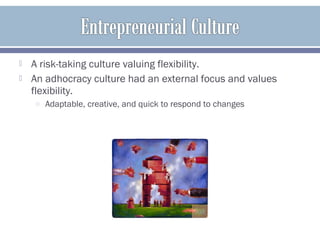
 A risk-taking culture valuing flexibility.
 An adhocracy culture had an external focus and values
flexibility.
o Adaptable, creative, and quick to respond to changes
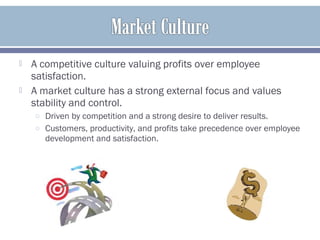
 A competitive culture valuing profits over employee
satisfaction.
 A market culture has a strong external focus and values
stability and control.
o Driven by competition and a strong desire to deliver results.
o Customers, productivity, and profits take precedence over employee
development and satisfaction.
 A structured culture that has an internal focus and values
stability and control over flexibility.
 Formalized, structured work environment aimed at
achieving effectiveness through a variety of control
mechanisms that measure efficiency, timeliness, and
reliability in the creation and delivery of products.
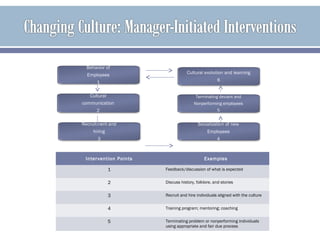
Behavior of
Employees
1
Cultural evolution and learning
6
Terminating deviant and
Nonperforming employees
5
Socialization of new
Employees
4
Recruitment and
hiring
3
Cultural
communication
2
Intervention Points Examples
1 Feedback/discussion of what is expected
2 Discuss history, folklore, and stories
3 Recruit and hire individuals aligned with the culture
4 Training program; mentoring; coaching
5 Terminating problem or nonperforming individuals
using appropriate and fair due process
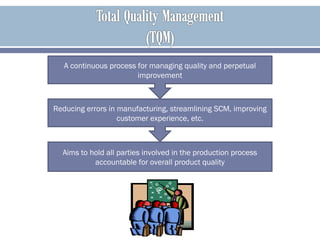
A continuous process for managing quality and perpetual
improvement
Reducing errors in manufacturing, streamlining SCM, improving
customer experience, etc.
Aims to hold all parties involved in the production process
accountable for overall product quality
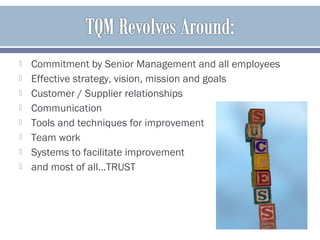
 Commitment by Senior Management and all employees
 Effective strategy, vision, mission and goals
 Customer / Supplier relationships
 Communication
 Tools and techniques for improvement
 Team work
 Systems to facilitate improvement
 and most of all…TRUST
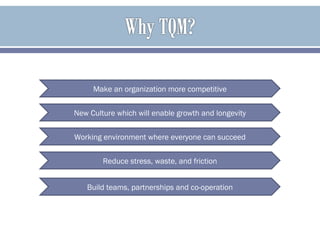
Make an organization more competitive
New Culture which will enable growth and longevity
Working environment where everyone can succeed
Build teams, partnerships and co-operation
Reduce stress, waste, and friction
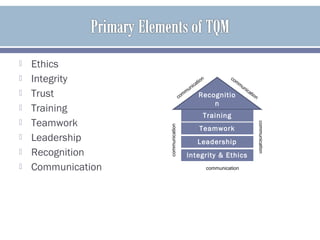
 Ethics
 Integrity
 Trust
 Training
 Teamwork
 Leadership
 Recognition
 Communication
Recognitio
n
Training
Teamwork
Leadership
Integrity & Ethics
com
m
unication com
m
unication
communication
communication
communication
 Quality Improvement Teams – Small groups of employees,
working on solving specific problems related to quality and
productivity.
 Benchmarking – Process of identifying the best practices and
approaches by comparing productivity in specific areas within
ones’ own company to other organizations both within and
outside the industry.
 Statistical process control - Statistical technique that uses
periodic random samples taken during actual production to
determine whether acceptable quality levels are being met.
 Commitment – In order for the ‘Future Model’ to be a success,
each member of the organization must be committed to the
change process.
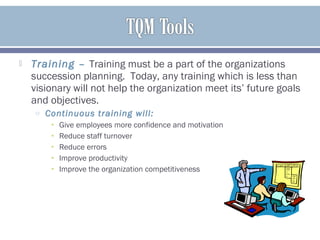
 Training – Training must be a part of the organizations
succession planning. Today, any training which is less than
visionary will not help the organization meet its’ future goals
and objectives.
o Continuous training will:
• Give employees more confidence and motivation
• Reduce staff turnover
• Reduce errors
• Improve productivity
• Improve the organization competitiveness
David Hudson, Jaguar, Land Rover Director of Manufacturing
Operations
Transforming Halewood into the world’s best Ford assembly plant:
o In 1998, Ford Motor Company elected to risk building the new ‘Baby
Jag' X-Type Jaguar at an old Ford plant in Liverpool, England. This was a
place that had been described as one of Ford's worst manufacturing
plants and where the workforce struggled to build an adequate Ford
Escort.
The Halewood Difference culture transformation program provided the
foundation from which we could develop a completely new way of
working. We have been able to harness the wealth and diversity of
talent of our employees and together transform Halewood into ‘the best
Ford assembly plant in the world'.
 Leadership and teamwork go hand in hand.
 Lack of communication between departments, supervisors
and employees create a barrier for successful change.
 Lead by example, train employees to provide quality
product, create an environment where there is no fear to
share knowledge, give credit where credit is due.
 Gibson, JL., et al. Organizations - Behavior, Structure,
Processes. 14th
Edition. Chapter 2 (pg. 29-53).
 Mishra, Pratibha. Organizational Culture. Ashapura
Garments, Ltd. Dec. 16, 2009 (Slideshare).
 Wilson, SC. Organizational Culture in Organization. Future
Group. June 01, 2013 (Slideshare).
 Nanak, G. Total Quality Management. Institute of
Management. May 02, 2014 (Slideshare).
 ASQ. Total Quality Management.
http://asq.org/learn-about-quality/total-quality-management/overview/overview.html

Organizational Culture, Structure and Design

  • 1.
      Project Team1 Carol Antonelli & Mica Werner
  • 2.
    A system ofshared beliefs and values that develops within an organization and guides the behavior of its members.  The personality of the organization
  • 3.
     Strong –Great influence on the behavior of organization member. o Strong organizational culture facilitates • Goal alignment • High level of employee motivation • Better learning from past  Weak – Dominant values are short lived and held mainly by upper management. o Organization members do not subscribe to the shared belief, values and norms. o Weak culture has negative impact on employee as it is directly linked to increase in turnover.
  • 4.
     Symbols -Objects, acts, qualities, or events that convey meaning to others.  Stories - A story is a narrative based on true events, which is repeated- and sometimes embellished upon – to emphasize a particular value.  Heroes - A person whose accomplishments embody the values of an organization.  Rites and rituals - The activities and ceremonies, planned and unplanned, that celebrate important occasions and accomplishments in the organization’s life.
  • 6.
    Dominant Culture: Expresses thecore values that are shared by a majority of the organization. Subculture: Tend to develop in large organizations to reflect common problems, situations, or experiences.
  • 7.
     Clan  Entrepreneurial Market  Bureaucratic
  • 8.
     An employee-focusedculture valuing flexibility, not stability.  A clan culture has an internal focus and values flexibility rather than stability and control. o Family type – values collaboration, cohesion through consensus, job satisfaction
  • 9.
     A risk-takingculture valuing flexibility.  An adhocracy culture had an external focus and values flexibility. o Adaptable, creative, and quick to respond to changes
  • 10.
     A competitiveculture valuing profits over employee satisfaction.  A market culture has a strong external focus and values stability and control. o Driven by competition and a strong desire to deliver results. o Customers, productivity, and profits take precedence over employee development and satisfaction.
  • 11.
     A structuredculture that has an internal focus and values stability and control over flexibility.  Formalized, structured work environment aimed at achieving effectiveness through a variety of control mechanisms that measure efficiency, timeliness, and reliability in the creation and delivery of products.
  • 12.
    Behavior of Employees 1 Cultural evolutionand learning 6 Terminating deviant and Nonperforming employees 5 Socialization of new Employees 4 Recruitment and hiring 3 Cultural communication 2 Intervention Points Examples 1 Feedback/discussion of what is expected 2 Discuss history, folklore, and stories 3 Recruit and hire individuals aligned with the culture 4 Training program; mentoring; coaching 5 Terminating problem or nonperforming individuals using appropriate and fair due process
  • 13.
    A continuous processfor managing quality and perpetual improvement Reducing errors in manufacturing, streamlining SCM, improving customer experience, etc. Aims to hold all parties involved in the production process accountable for overall product quality
  • 14.
     Commitment bySenior Management and all employees  Effective strategy, vision, mission and goals  Customer / Supplier relationships  Communication  Tools and techniques for improvement  Team work  Systems to facilitate improvement  and most of all…TRUST
  • 15.
    Make an organizationmore competitive New Culture which will enable growth and longevity Working environment where everyone can succeed Build teams, partnerships and co-operation Reduce stress, waste, and friction
  • 16.
     Ethics  Integrity Trust  Training  Teamwork  Leadership  Recognition  Communication Recognitio n Training Teamwork Leadership Integrity & Ethics com m unication com m unication communication communication communication
  • 17.
     Quality ImprovementTeams – Small groups of employees, working on solving specific problems related to quality and productivity.  Benchmarking – Process of identifying the best practices and approaches by comparing productivity in specific areas within ones’ own company to other organizations both within and outside the industry.  Statistical process control - Statistical technique that uses periodic random samples taken during actual production to determine whether acceptable quality levels are being met.  Commitment – In order for the ‘Future Model’ to be a success, each member of the organization must be committed to the change process.
  • 18.
     Training –Training must be a part of the organizations succession planning. Today, any training which is less than visionary will not help the organization meet its’ future goals and objectives. o Continuous training will: • Give employees more confidence and motivation • Reduce staff turnover • Reduce errors • Improve productivity • Improve the organization competitiveness
  • 19.
    David Hudson, Jaguar,Land Rover Director of Manufacturing Operations Transforming Halewood into the world’s best Ford assembly plant: o In 1998, Ford Motor Company elected to risk building the new ‘Baby Jag' X-Type Jaguar at an old Ford plant in Liverpool, England. This was a place that had been described as one of Ford's worst manufacturing plants and where the workforce struggled to build an adequate Ford Escort. The Halewood Difference culture transformation program provided the foundation from which we could develop a completely new way of working. We have been able to harness the wealth and diversity of talent of our employees and together transform Halewood into ‘the best Ford assembly plant in the world'.
  • 20.
     Leadership andteamwork go hand in hand.  Lack of communication between departments, supervisors and employees create a barrier for successful change.  Lead by example, train employees to provide quality product, create an environment where there is no fear to share knowledge, give credit where credit is due.
  • 21.
     Gibson, JL.,et al. Organizations - Behavior, Structure, Processes. 14th Edition. Chapter 2 (pg. 29-53).  Mishra, Pratibha. Organizational Culture. Ashapura Garments, Ltd. Dec. 16, 2009 (Slideshare).  Wilson, SC. Organizational Culture in Organization. Future Group. June 01, 2013 (Slideshare).  Nanak, G. Total Quality Management. Institute of Management. May 02, 2014 (Slideshare).  ASQ. Total Quality Management. http://asq.org/learn-about-quality/total-quality-management/overview/overview.html