Slide 1
Organizational Conflict
Slide 2
Conflict
• Conflicts: there are at least two independent groups, the groups
perceive some incompatibility between themselves, and the groups
interact with each other in some way. Two example definitions are,
"process in which one party perceives that its interests are being
opposed or negatively affected by another party"
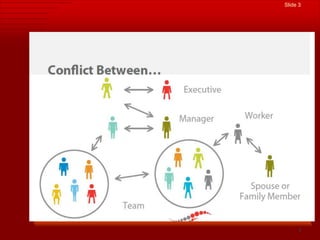
Slide 3
3
Slide 4
Causes of Conflict in Organizations
• Misunderstanding
• Personality clashes
• Competition for resources
• Authority issues
• Lack of cooperation
• Differences over methods or style
• Low performance
• Value or goal differences
Slide 5
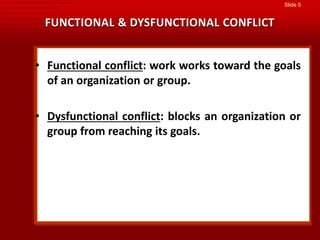
FUNCTIONAL & DYSFUNCTIONAL CONFLICT
• Functional conflict: work works toward the goals
of an organization or group.
• Dysfunctional conflict: blocks an organization or
group from reaching its goals.
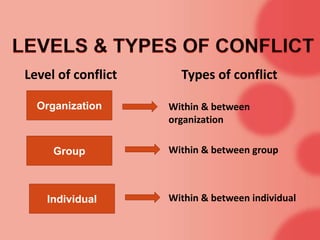
Level of conflict Types of conflict
Organization
Group
Individual
Within & between
organization
Within & between group
Within & between individual
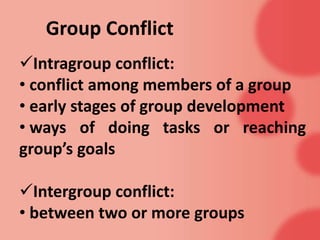
Group Conflict
Intragroup conflict:
• conflict among members of a group
• early stages of group development
• ways of doing tasks or reaching
group’s goals
Intergroup conflict:
• between two or more groups
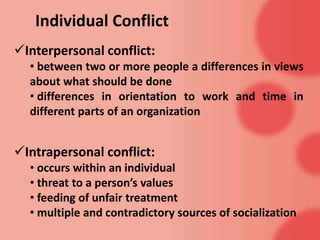
Individual Conflict
Interpersonal conflict:
• between two or more people a differences in views
about what should be done
• differences in orientation to work and time in
different parts of an organization
Intrapersonal conflict:
• occurs within an individual
• threat to a person’s values
• feeding of unfair treatment
• multiple and contradictory sources of socialization
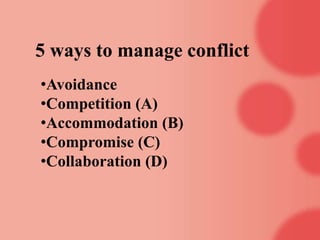
5 ways to manage conflict
•Avoidance
•Competition (A)
•Accommodation (B)
•Compromise (C)
•Collaboration (D)
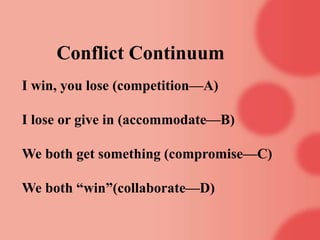
Conflict Continuum
I win, you lose (competition—A)
I lose or give in (accommodate—B)
We both get something (compromise—C)
We both “win”(collaborate—D)
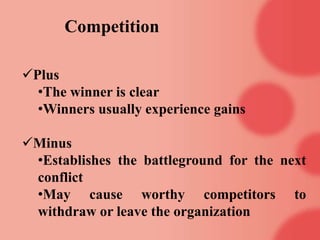
Competition
Plus
•The winner is clear
•Winners usually experience gains
Minus
•Establishes the battleground for the next
conflict
•May cause worthy competitors to
withdraw or leave the organization
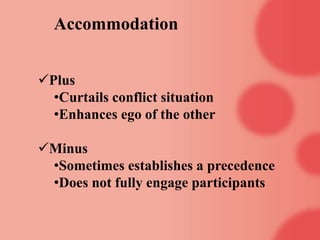
Accommodation
Plus
•Curtails conflict situation
•Enhances ego of the other
Minus
•Sometimes establishes a precedence
•Does not fully engage participants
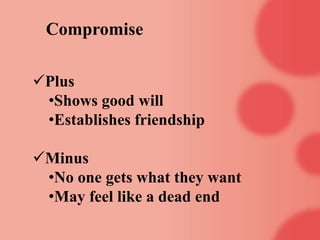
Compromise
Plus
•Shows good will
•Establishes friendship
Minus
•No one gets what they want
•May feel like a dead end
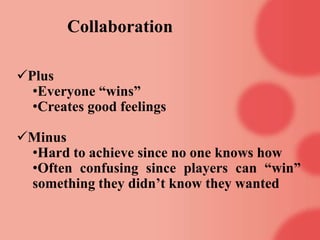
Collaboration
Plus
•Everyone “wins”
•Creates good feelings
Minus
•Hard to achieve since no one knows how
•Often confusing since players can “win”
something they didn’t know they wanted

conflict management.ppt

  • 1.
  • 2.
    Slide 2 Conflict • Conflicts:there are at least two independent groups, the groups perceive some incompatibility between themselves, and the groups interact with each other in some way. Two example definitions are, "process in which one party perceives that its interests are being opposed or negatively affected by another party"
  • 3.
  • 4.
    Slide 4 Causes ofConflict in Organizations • Misunderstanding • Personality clashes • Competition for resources • Authority issues • Lack of cooperation • Differences over methods or style • Low performance • Value or goal differences
  • 5.
    Slide 5 FUNCTIONAL &DYSFUNCTIONAL CONFLICT • Functional conflict: work works toward the goals of an organization or group. • Dysfunctional conflict: blocks an organization or group from reaching its goals.
  • 6.
    Level of conflictTypes of conflict Organization Group Individual Within & between organization Within & between group Within & between individual
  • 7.
    Group Conflict Intragroup conflict: •conflict among members of a group • early stages of group development • ways of doing tasks or reaching group’s goals Intergroup conflict: • between two or more groups
  • 8.
    Individual Conflict Interpersonal conflict: •between two or more people a differences in views about what should be done • differences in orientation to work and time in different parts of an organization Intrapersonal conflict: • occurs within an individual • threat to a person’s values • feeding of unfair treatment • multiple and contradictory sources of socialization
  • 9.
    5 ways tomanage conflict •Avoidance •Competition (A) •Accommodation (B) •Compromise (C) •Collaboration (D)
  • 10.
    Conflict Continuum I win,you lose (competition—A) I lose or give in (accommodate—B) We both get something (compromise—C) We both “win”(collaborate—D)
  • 11.
    Competition Plus •The winner isclear •Winners usually experience gains Minus •Establishes the battleground for the next conflict •May cause worthy competitors to withdraw or leave the organization
  • 12.
    Accommodation Plus •Curtails conflict situation •Enhancesego of the other Minus •Sometimes establishes a precedence •Does not fully engage participants
  • 13.
    Compromise Plus •Shows good will •Establishesfriendship Minus •No one gets what they want •May feel like a dead end
  • 14.
    Collaboration Plus •Everyone “wins” •Creates goodfeelings Minus •Hard to achieve since no one knows how •Often confusing since players can “win” something they didn’t know they wanted