
Conductors
Charging
Charging an object consists in
creating an imbalance on the
electrical charge of that object.

What are some examples?
Electrolytic Solutions pg 142
Conductors
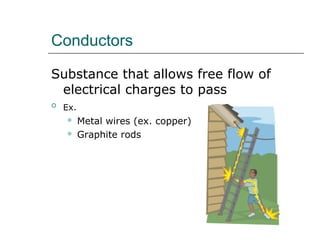
Substance that allows free flow of
electrical charges to pass


Ex.



Metal wires (ex. copper)
Graphite rods
Semi-conductors
Substance that has an electrical
conductivity between that of a
conductor and insulator.
This allows it to control the amount
and direction of the flow.
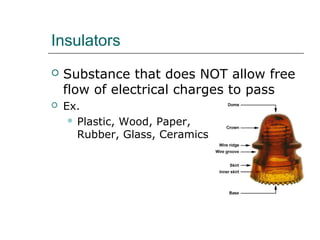
Insulators


Substance that does NOT allow free
flow of electrical charges to pass



Ex.
 Plastic, Wood, Paper,
Rubber, Glass, Ceramics
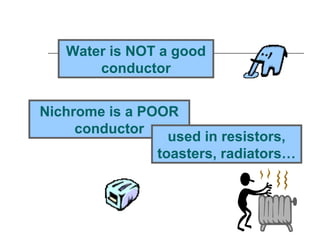
Water is NOT a good
conductor
Nichrome is a POOR
conductor
used in resistors,
toasters, radiators…
Conductance (G):


Is a number that tells you how
well electrical current flows



Characteristic property



Measured in Seimens “S”



Conductors have HIGH
conductance



Insulator have LOW conductance
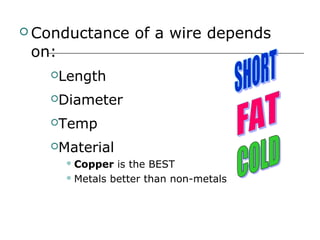
 Conductance

of a wire depends

on:
Length
Diameter
Temp
Material
 Copper

is the BEST
 Metals better than non-metals
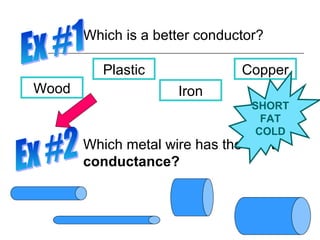
Which is a better conductor?
Plastic
Wood

Copper
Iron
SHORT
FAT
COLD

Which metal wire has the best
conductance?
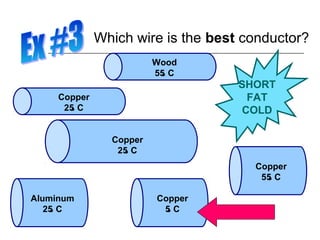
Which wire is the best conductor?
Wood
55 C
o

SHORT
FAT
COLD

Copper
25 C
o
Copper
25 C
o

Copper
55 C
o
Aluminum
25 C
o

Copper
5C
o


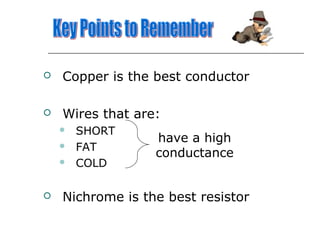
Copper is the best conductor



Wires that are:






SHORT
FAT
COLD

have a high
conductance

Nichrome is the best resistor
Activities:
Page

479, Q. 8-10.
Worksheet #8
Alternative Educational Experiences
through e-Learning

AST 406 Conductors