CONDUCTORS
• A conductor is an object or type of material that allows the flow
of charge (electrical current) in one or more directions.
• Materials made of metal are common electrical conductors.
• Electrical current is generated by the flow of negatively charged
electrons, positively charged holes, and positive or negative ions
in some cases.
• Conduction materials
include metals, electrolytes, superconductors, semiconductors, plas
mas and some nonmetallic conductors such
as graphite and Conductive polymers.
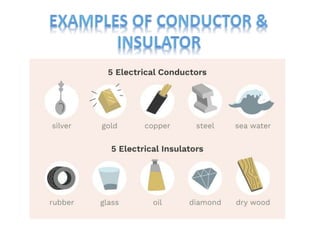
• Copper has a high conductivity. Copper, Silver, Gold, Aluminum are
the examples of good conductor.
INSULATORS
• An electrical insulator is a material whose internal electric
charges do not flow freely; very little electric current will flow
through it under the influence of an electric field.
• This contrasts with other materials, semiconductors and conductors,
which conduct electric current more easily.
• The property that distinguishes an insulator is its resistivity;
insulators have higher resistivity than semiconductors or conductors.
• Electrical insulation is the absence of electrical conduction.
• Wood, Plastic, Rubber, Wool, Paper, Wax, Glass, Ebonite are the
examples of insulators.
Conductor-Insulator-ppt.pptx

Conductor-Insulator-ppt.pptx

  • 2.
    CONDUCTORS • A conductoris an object or type of material that allows the flow of charge (electrical current) in one or more directions. • Materials made of metal are common electrical conductors. • Electrical current is generated by the flow of negatively charged electrons, positively charged holes, and positive or negative ions in some cases. • Conduction materials include metals, electrolytes, superconductors, semiconductors, plas mas and some nonmetallic conductors such as graphite and Conductive polymers. • Copper has a high conductivity. Copper, Silver, Gold, Aluminum are the examples of good conductor.
  • 3.
    INSULATORS • An electricalinsulator is a material whose internal electric charges do not flow freely; very little electric current will flow through it under the influence of an electric field. • This contrasts with other materials, semiconductors and conductors, which conduct electric current more easily. • The property that distinguishes an insulator is its resistivity; insulators have higher resistivity than semiconductors or conductors. • Electrical insulation is the absence of electrical conduction. • Wood, Plastic, Rubber, Wool, Paper, Wax, Glass, Ebonite are the examples of insulators.