
CONDITIONAL
SENTENCES:
VARIATIONS IN TENSES
By Ade Sudirman, S.Pd
Grammar
4th Semester
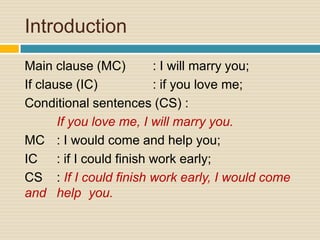
Introduction
Main clause (MC) : I will marry you;
If clause (IC) : if you love me;
Conditional sentences (CS) :
If you love me, I will marry you.
MC : I would come and help you;
IC : if I could finish work early;
CS : If I could finish work early, I would come
and help you.
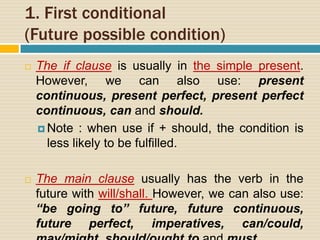
1. First conditional
(Future possible condition)
 The if clause is usually in the simple present.
However, we can also use: present
continuous, present perfect, present perfect
continuous, can and should.
 Note : when use if + should, the condition is
less likely to be fulfilled.
 The main clause usually has the verb in the
future with will/shall. However, we can also use:
“be going to” future, future continuous,
future perfect, imperatives, can/could,
Examples of1st conditional
 If I can finish work early, I will come
and help you;
 If they go there, I will follow them;
 If should see him, I will tell him the
good news;
 If you phone me after 12 o’clock, I
might be in bed;
 If you need me, call me;
 We’re going to buy her a big present if
Helen passes all her exams.
Saya akan marah jika kamu tidak
datang ke pesta pernikahanku.
Jika mereka telah menerima
nasihatmu, saya yakin,mereka akan
mengubah pola fikir mereka saat ini.
Jika dia masih sedang
menunggumu, dia akan sangat
kecewa.
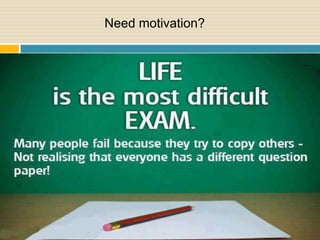
Need motivation?
I will be angry if you do not
come to my wedding party.
If they have accepted your
advice, I am sure, they will
change their mindset this time.
If he is still waiting for you, he
will be very disappointed.
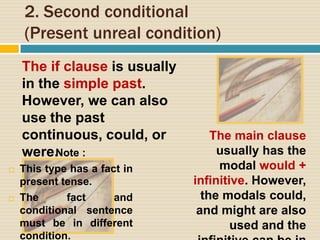
2. Second conditional
(Present unreal condition)
The if clause is usually
in the simple past.
However, we can also
use the past
continuous, could, or
were.
The main clause
usually has the
modal would +
infinitive. However,
the modals could,
and might are also
used and the
Note :
 This type has a fact in
present tense.
 The fact and
conditional sentence
must be in different
condition.
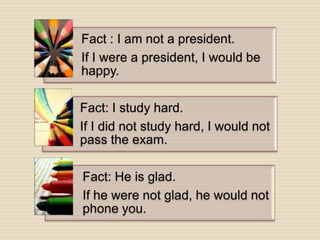
Fact : I am not a president.
If I were a president, I would be
happy.
Fact: I study hard.
If I did not study hard, I would not
pass the exam.
Fact: He is glad.
If he were not glad, he would not
phone you.
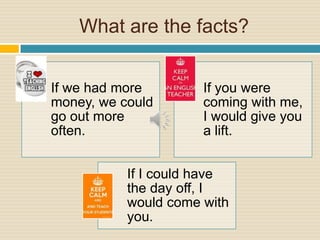
What are the facts?
If we had more
money, we could
go out more
often.
If you were
coming with me,
I would give you
a lift.
If I could have
the day off, I
would come with
you.
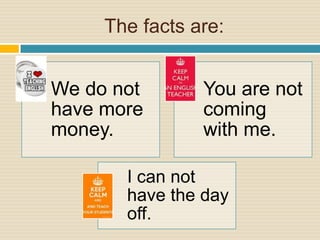
The facts are:
We do not
have more
money.
You are not
coming
with me.
I can not
have the day
off.
3. Third conditional
(Past unreal condition)
The if clause
is usually in
the past
perfect.
However, we
can also use
the past
perfect
continuous
or could +
perfect
infinitive:
The main
clause usually
has the modal
would +
perfect
infinitive.
However, we
can also use
the modals
could and
might before
the perfect
infinitive.
Note :
This type has
a fact in past
tense.
The fact and
conditional
sentence
must be in
different
condition.
What are the facts?
If we had not
had more money,
we could not
have gone out
more often.
If you had been
glad with me, I
would have given
you a gift.
If the ambulance
had come
sooner, he might
have been saved
The facts are:
We had
more money.
You were not
glad with
me.
The ambulance
did not come
sooner.
4. Zero conditional
If I stay out late,
I always get a
taxi home.
Each time I
stay out late, I
get a taxi
home.
To describe
something that
is generally
true.
The use of IF
here is very
similar to when.
Being proud of ourselves
The end
Thank
you

Conditional sentences (AdeS)

  • 1.
    CONDITIONAL SENTENCES: VARIATIONS IN TENSES ByAde Sudirman, S.Pd Grammar 4th Semester
  • 2.
    Introduction Main clause (MC): I will marry you; If clause (IC) : if you love me; Conditional sentences (CS) : If you love me, I will marry you. MC : I would come and help you; IC : if I could finish work early; CS : If I could finish work early, I would come and help you.
  • 3.
    1. First conditional (Futurepossible condition)  The if clause is usually in the simple present. However, we can also use: present continuous, present perfect, present perfect continuous, can and should.  Note : when use if + should, the condition is less likely to be fulfilled.  The main clause usually has the verb in the future with will/shall. However, we can also use: “be going to” future, future continuous, future perfect, imperatives, can/could,
  • 4.
    Examples of1st conditional If I can finish work early, I will come and help you;  If they go there, I will follow them;  If should see him, I will tell him the good news;  If you phone me after 12 o’clock, I might be in bed;  If you need me, call me;  We’re going to buy her a big present if Helen passes all her exams.
  • 5.
    Saya akan marahjika kamu tidak datang ke pesta pernikahanku. Jika mereka telah menerima nasihatmu, saya yakin,mereka akan mengubah pola fikir mereka saat ini. Jika dia masih sedang menunggumu, dia akan sangat kecewa.
  • 6.
  • 7.
    I will beangry if you do not come to my wedding party. If they have accepted your advice, I am sure, they will change their mindset this time. If he is still waiting for you, he will be very disappointed.
  • 8.
    2. Second conditional (Presentunreal condition) The if clause is usually in the simple past. However, we can also use the past continuous, could, or were. The main clause usually has the modal would + infinitive. However, the modals could, and might are also used and the Note :  This type has a fact in present tense.  The fact and conditional sentence must be in different condition.
  • 9.
    Fact : Iam not a president. If I were a president, I would be happy. Fact: I study hard. If I did not study hard, I would not pass the exam. Fact: He is glad. If he were not glad, he would not phone you.
  • 10.
    What are thefacts? If we had more money, we could go out more often. If you were coming with me, I would give you a lift. If I could have the day off, I would come with you.
  • 11.
    The facts are: Wedo not have more money. You are not coming with me. I can not have the day off.
  • 12.
    3. Third conditional (Pastunreal condition) The if clause is usually in the past perfect. However, we can also use the past perfect continuous or could + perfect infinitive: The main clause usually has the modal would + perfect infinitive. However, we can also use the modals could and might before the perfect infinitive. Note : This type has a fact in past tense. The fact and conditional sentence must be in different condition.
  • 13.
    What are thefacts? If we had not had more money, we could not have gone out more often. If you had been glad with me, I would have given you a gift. If the ambulance had come sooner, he might have been saved
  • 14.
    The facts are: Wehad more money. You were not glad with me. The ambulance did not come sooner.
  • 15.
    4. Zero conditional IfI stay out late, I always get a taxi home. Each time I stay out late, I get a taxi home. To describe something that is generally true. The use of IF here is very similar to when.
  • 16.
    Being proud ofourselves
  • 17.

Editor's Notes

  • #5 Introductory notes.
  • #9 A list of procedures and steps, or a lecture slide with media.
  • #17 An opportunity for questions and discussions.