CONDITIONAL SENTENCES

          Zero
          First
          Second
          Third
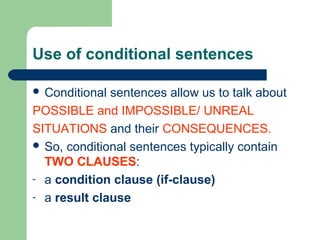
Use of conditional sentences

 Conditional sentences allow us to talk about
POSSIBLE and IMPOSSIBLE/ UNREAL
SITUATIONS and their CONSEQUENCES.
 So, conditional sentences typically contain
  TWO CLAUSES:
- a condition clause (if-clause)
- a result clause
ZERO CONDITIONAL
if+ present simple, / present simple
Present simple / if+present simple

 To  describe A STRAIGHTFORWARD
   CAUSE AND EFFECT
If you press that button, the engine starts

 To  write a SCIENTIFIC TRUTH
If you mix oil and water, the oil floats
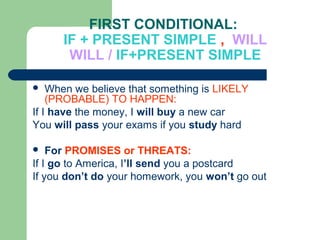
FIRST CONDITIONAL:
      IF + PRESENT SIMPLE , WILL
       WILL / IF+PRESENT SIMPLE

   When we believe that something is LIKELY
    (PROBABLE) TO HAPPEN:
If I have the money, I will buy a new car
You will pass your exams if you study hard

   For PROMISES or THREATS:
If I go to America, I’ll send you a postcard
If you don’t do your homework, you won’t go out
POSSIBLE VARIATIONS OF THE MAIN
 FORM:

1)   Instead of WILL, we may have other MODAL VERBS
If you keep on behaving like that, you may/might have
     problems.
If you finish your work in time, you can/may go home.
If you want to lose weight, you must/should eat less bread.
If you see Tom, could you ask him to ring me?.

2) Instead of WILL, we may have an IMPERATIVE
If you are hungry, make yourself a sandwich.
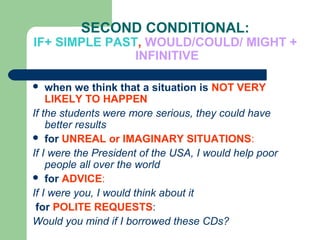
SECOND CONDITIONAL:
IF+ SIMPLE PAST, WOULD/COULD/ MIGHT +
               INFINITIVE

   when we think that a situation is NOT VERY
    LIKELY TO HAPPEN
If the students were more serious, they could have
    better results
 for UNREAL or IMAGINARY SITUATIONS:

If I were the President of the USA, I would help poor
    people all over the world
 for ADVICE:

If I were you, I would think about it
 for POLITE REQUESTS:
Would you mind if I borrowed these CDs?
EXAMPLE OF POSSIBLE VARIATIONS

 If you tried again, you might succeed.
 If I knew her number, I could ring her up.
 If I were on holiday, I might be touring Italy.
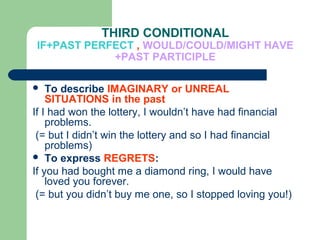
THIRD CONDITIONAL
IF+PAST PERFECT , WOULD/COULD/MIGHT HAVE
            +PAST PARTICIPLE

   To describe IMAGINARY or UNREAL
    SITUATIONS in the past
If I had won the lottery, I wouldn’t have had financial
    problems.
 (= but I didn’t win the lottery and so I had financial
    problems)
 To express REGRETS:
If you had bought me a diamond ring, I would have
    loved you forever.
 (= but you didn’t buy me one, so I stopped loving you!)
Examples of possible variations:

- If I had know you were coming, I could have
   met you at the airport.
(I didn’t know you were coming, so I didn’t meet
   you there)
- We might have passed if we had studied
   harder.
(We didn’t study hard, so we didn’t pass)
ALTERNATIVES TO ‘IF’...

 UNLESS (= if not)
You won’t lose weight, unless you stop eating chocolate.
Unless you hurry you’ll miss the train.
 OTHERWISE (= if it doesn’t happen/ if it didn’t
  happen/ it it hadn’t happen)
Stop eating chocolate, otherwise you won’t lose weight.
Her father pays her fees, otherwise she wouldn’t be
  here.
He studied very hard, otherwise he wouldn’t have had
  such good marks.
ALTERNATIVES TO ‘IF’...

 ASLONG AS / PROVIDED (THAT) / ON
  CONDITION THAT....
I’ll lend you my books as long as / provided that / on
     condition that you promise to bring them back.
 INVERSIONS
Had I known that he was upset, I wouldn’t have said
  anything.
 EVEN    IF...
Even if I were a millionaire, I wouldn’t give him
  any money.
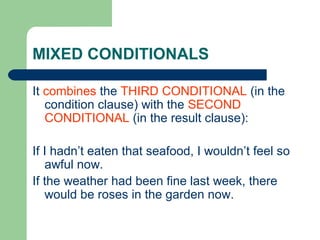
MIXED CONDITIONALS

It combines the THIRD CONDITIONAL (in the
   condition clause) with the SECOND
   CONDITIONAL (in the result clause):

If I hadn’t eaten that seafood, I wouldn’t feel so
   awful now.
If the weather had been fine last week, there
   would be roses in the garden now.
MIXED CONDITIONALS

 Or   the SECOND CONDITIONAL (in the if-
   clause) with the THIRD CONDITIONAL (in
   the main clause)
If he weren’t so shy, he would have asked her
   to marry him.
If Emma weren’t so lazy, she would have
   studied harder.
* It happens when the time reference in the if-
   clause is different from the main clause.
I wish / If only

We use I wish/ If only + past simple to talk
   about a desire for the present.
I’m not very tall. I wish/If only I were taller.

I haven’t got a house at the beach. I wish/ If
   only I had a house at the beach.
I wish / If only

We use I wish/If only + past participle to talk
 about a regret about something in the past.

I didn’t study very hard. I wish/ If only I had
   studied harder.
I ate a lot; I’m so full. I wish/ If only I hadn’t
   eaten so much.
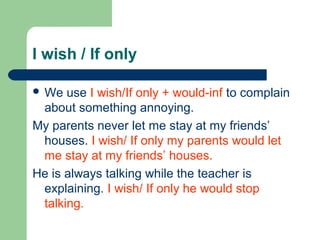
I wish / If only

 We  use I wish/If only + would-inf to complain
 about something annoying.
My parents never let me stay at my friends’
 houses. I wish/ If only my parents would let
 me stay at my friends’ houses.
He is always talking while the teacher is
 explaining. I wish/ If only he would stop
 talking.

Conditionals

  • 1.
    CONDITIONAL SENTENCES Zero First Second Third
  • 2.
    Use of conditionalsentences  Conditional sentences allow us to talk about POSSIBLE and IMPOSSIBLE/ UNREAL SITUATIONS and their CONSEQUENCES.  So, conditional sentences typically contain TWO CLAUSES: - a condition clause (if-clause) - a result clause
  • 3.
    ZERO CONDITIONAL if+ presentsimple, / present simple Present simple / if+present simple  To describe A STRAIGHTFORWARD CAUSE AND EFFECT If you press that button, the engine starts  To write a SCIENTIFIC TRUTH If you mix oil and water, the oil floats
  • 4.
    FIRST CONDITIONAL: IF + PRESENT SIMPLE , WILL WILL / IF+PRESENT SIMPLE  When we believe that something is LIKELY (PROBABLE) TO HAPPEN: If I have the money, I will buy a new car You will pass your exams if you study hard  For PROMISES or THREATS: If I go to America, I’ll send you a postcard If you don’t do your homework, you won’t go out
  • 5.
    POSSIBLE VARIATIONS OFTHE MAIN FORM: 1) Instead of WILL, we may have other MODAL VERBS If you keep on behaving like that, you may/might have problems. If you finish your work in time, you can/may go home. If you want to lose weight, you must/should eat less bread. If you see Tom, could you ask him to ring me?. 2) Instead of WILL, we may have an IMPERATIVE If you are hungry, make yourself a sandwich.
  • 6.
    SECOND CONDITIONAL: IF+ SIMPLEPAST, WOULD/COULD/ MIGHT + INFINITIVE  when we think that a situation is NOT VERY LIKELY TO HAPPEN If the students were more serious, they could have better results  for UNREAL or IMAGINARY SITUATIONS: If I were the President of the USA, I would help poor people all over the world  for ADVICE: If I were you, I would think about it for POLITE REQUESTS: Would you mind if I borrowed these CDs?
  • 7.
    EXAMPLE OF POSSIBLEVARIATIONS  If you tried again, you might succeed.  If I knew her number, I could ring her up.  If I were on holiday, I might be touring Italy.
  • 8.
    THIRD CONDITIONAL IF+PAST PERFECT, WOULD/COULD/MIGHT HAVE +PAST PARTICIPLE  To describe IMAGINARY or UNREAL SITUATIONS in the past If I had won the lottery, I wouldn’t have had financial problems. (= but I didn’t win the lottery and so I had financial problems)  To express REGRETS: If you had bought me a diamond ring, I would have loved you forever. (= but you didn’t buy me one, so I stopped loving you!)
  • 9.
    Examples of possiblevariations: - If I had know you were coming, I could have met you at the airport. (I didn’t know you were coming, so I didn’t meet you there) - We might have passed if we had studied harder. (We didn’t study hard, so we didn’t pass)
  • 10.
    ALTERNATIVES TO ‘IF’... UNLESS (= if not) You won’t lose weight, unless you stop eating chocolate. Unless you hurry you’ll miss the train.  OTHERWISE (= if it doesn’t happen/ if it didn’t happen/ it it hadn’t happen) Stop eating chocolate, otherwise you won’t lose weight. Her father pays her fees, otherwise she wouldn’t be here. He studied very hard, otherwise he wouldn’t have had such good marks.
  • 11.
    ALTERNATIVES TO ‘IF’... ASLONG AS / PROVIDED (THAT) / ON CONDITION THAT.... I’ll lend you my books as long as / provided that / on condition that you promise to bring them back.  INVERSIONS Had I known that he was upset, I wouldn’t have said anything.  EVEN IF... Even if I were a millionaire, I wouldn’t give him any money.
  • 12.
    MIXED CONDITIONALS It combinesthe THIRD CONDITIONAL (in the condition clause) with the SECOND CONDITIONAL (in the result clause): If I hadn’t eaten that seafood, I wouldn’t feel so awful now. If the weather had been fine last week, there would be roses in the garden now.
  • 13.
    MIXED CONDITIONALS  Or the SECOND CONDITIONAL (in the if- clause) with the THIRD CONDITIONAL (in the main clause) If he weren’t so shy, he would have asked her to marry him. If Emma weren’t so lazy, she would have studied harder. * It happens when the time reference in the if- clause is different from the main clause.
  • 14.
    I wish /If only We use I wish/ If only + past simple to talk about a desire for the present. I’m not very tall. I wish/If only I were taller. I haven’t got a house at the beach. I wish/ If only I had a house at the beach.
  • 15.
    I wish /If only We use I wish/If only + past participle to talk about a regret about something in the past. I didn’t study very hard. I wish/ If only I had studied harder. I ate a lot; I’m so full. I wish/ If only I hadn’t eaten so much.
  • 16.
    I wish /If only  We use I wish/If only + would-inf to complain about something annoying. My parents never let me stay at my friends’ houses. I wish/ If only my parents would let me stay at my friends’ houses. He is always talking while the teacher is explaining. I wish/ If only he would stop talking.