CONCEPTS OF RPI
INDIAN DENTAL ACADEMY
Leader in continuing Dental Education
www.indiandentalacademy.com
CONTENTS
 Introduction
 IBar philosophy
 RPI system
 RPA system
 Conclusion
 Bibliography
www.indiandentalacademy.com
Terminology
• REST :
a projection or attachment, usually on
the side of an object
• REST SEAT :
the prepared recess in a tooth or
restoration created to receive the occlusal,
incisal, cingulum, or lingual rest
www.indiandentalacademy.com
• I-bar clasp:
the component of the clasp assembly
that engages a portion of the tooth surface
and either enters an undercut for retention
or remains entirely above the height of
contour to act as a reciprocating element.
Generally it is used to stabilize and retain
a removable dental prosthesis
www.indiandentalacademy.com
INTRODUCTION
www.indiandentalacademy.com
• In contrast with the Kratochvil’s basic
design, which necessitates heavy
preparation, Krol developed a modification
that avoids tooth preparation.
www.indiandentalacademy.com
• The state emphasis in Krol’s system is
stress control with minimal tooth coverage
and minimal gingival coverage.
www.indiandentalacademy.com
• The clasp system includes the three
elements of Kratochvil’s system: -
mesial rest,
proximal plate
and I-bar.
• Each element, however, has undergone
significant change to meet Krol’s criteria.
www.indiandentalacademy.com
• In RPI system:
R = Rest
P = Proximal plate
I = I-bar
www.indiandentalacademy.com
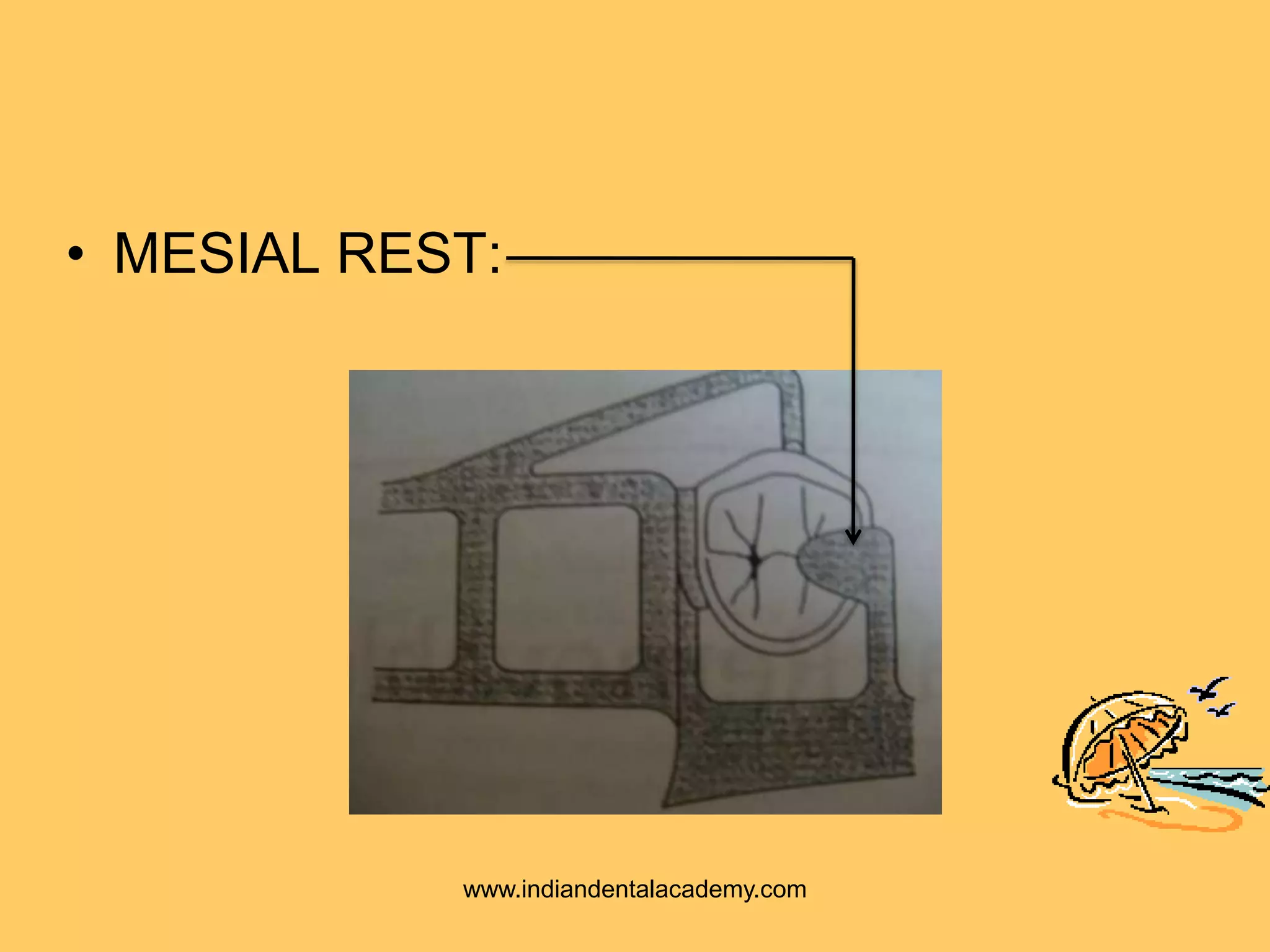
• MESIAL REST:
www.indiandentalacademy.com
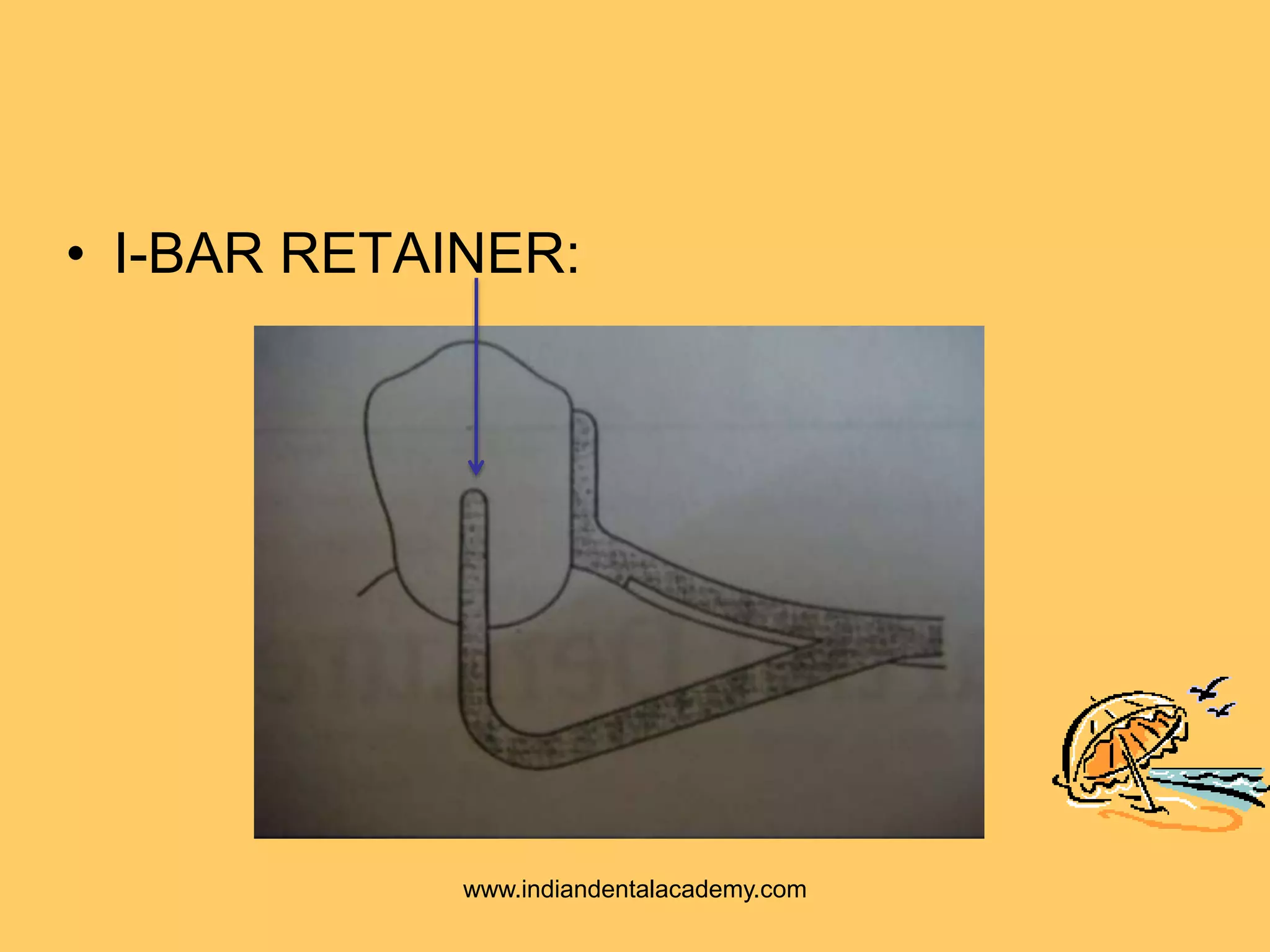
• I-BAR RETAINER:
www.indiandentalacademy.com
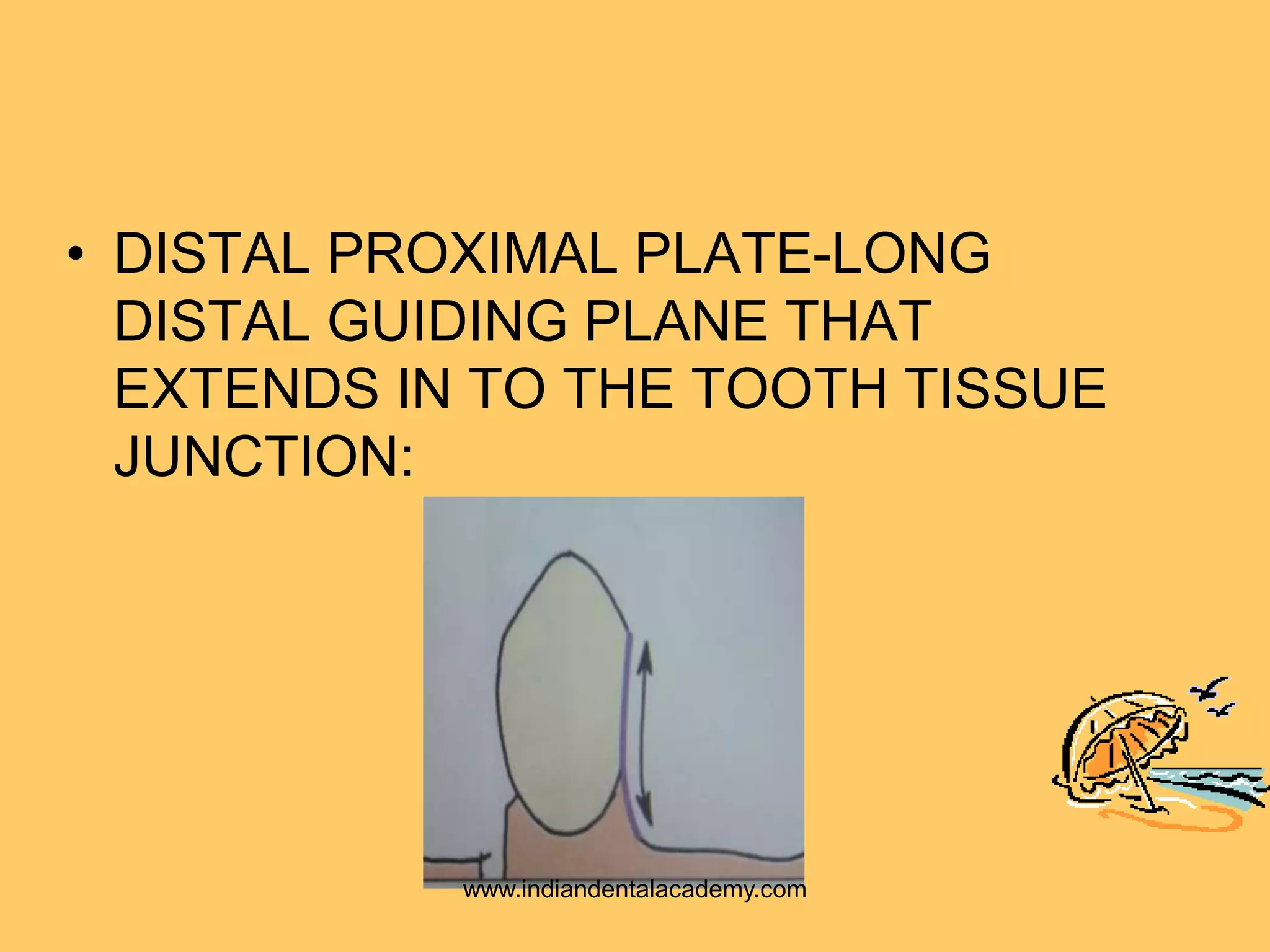
• DISTAL PROXIMAL PLATE-LONG
DISTAL GUIDING PLANE THAT
EXTENDS IN TO THE TOOTH TISSUE
JUNCTION:
www.indiandentalacademy.com
REST
• Rest preparations are less extensive in the
RPI system.
• The mesial rest extends only into the
triangular fossa, even in molar
preparations, and canine rests are often
circular concave depressions prepared in
the mesial marginal ridge
www.indiandentalacademy.com
• When aesthetics permits incisal rests can
be used in mandibular anteriors
• And they can be used to splint the
periodontally weakened teeth
www.indiandentalacademy.com
features
• Mesial rest.
• It provides Vertical support
• Good adaptation to transfer forces
principally
• Sufficient bulk to with stand fources
www.indiandentalacademy.com
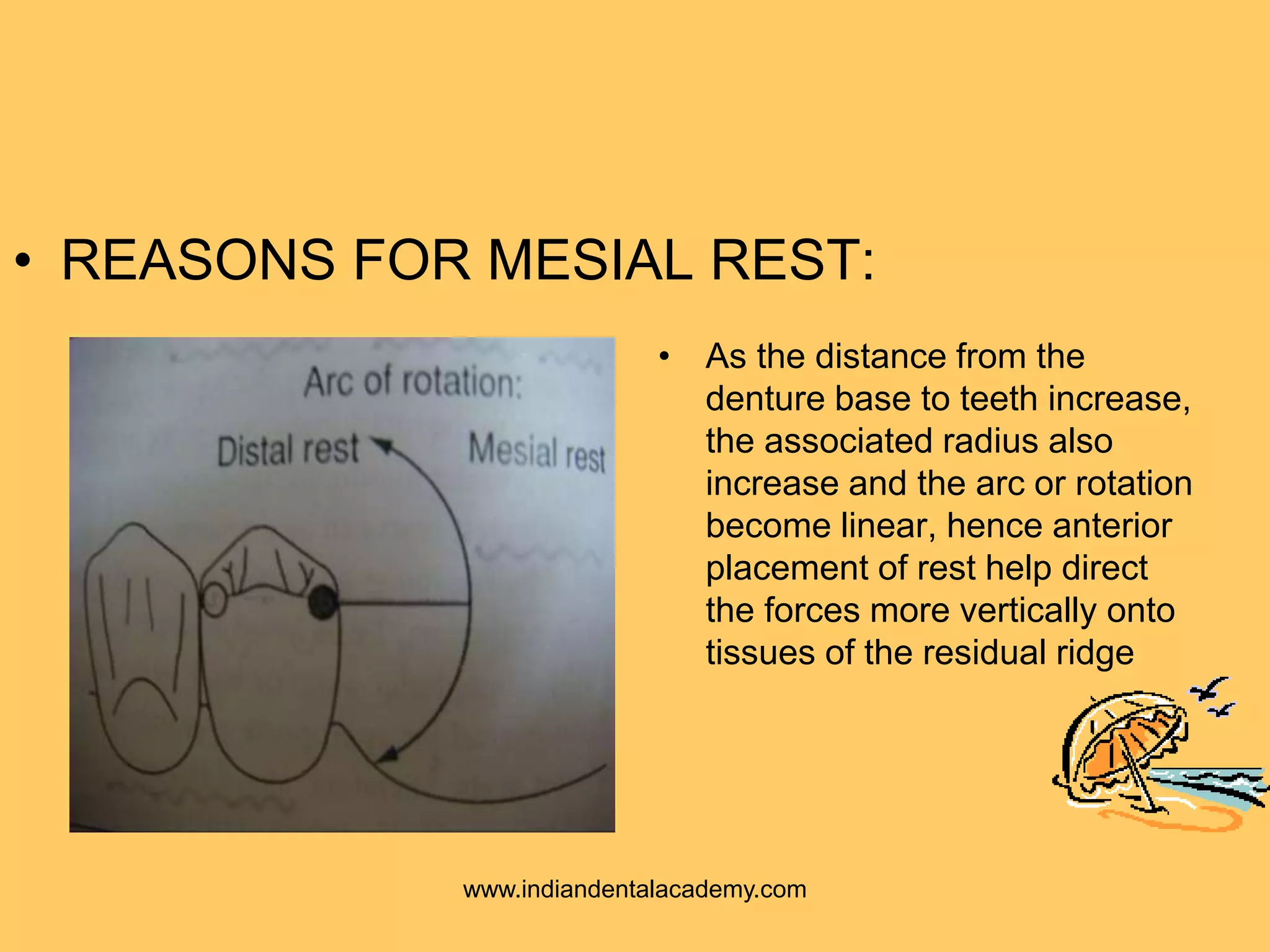
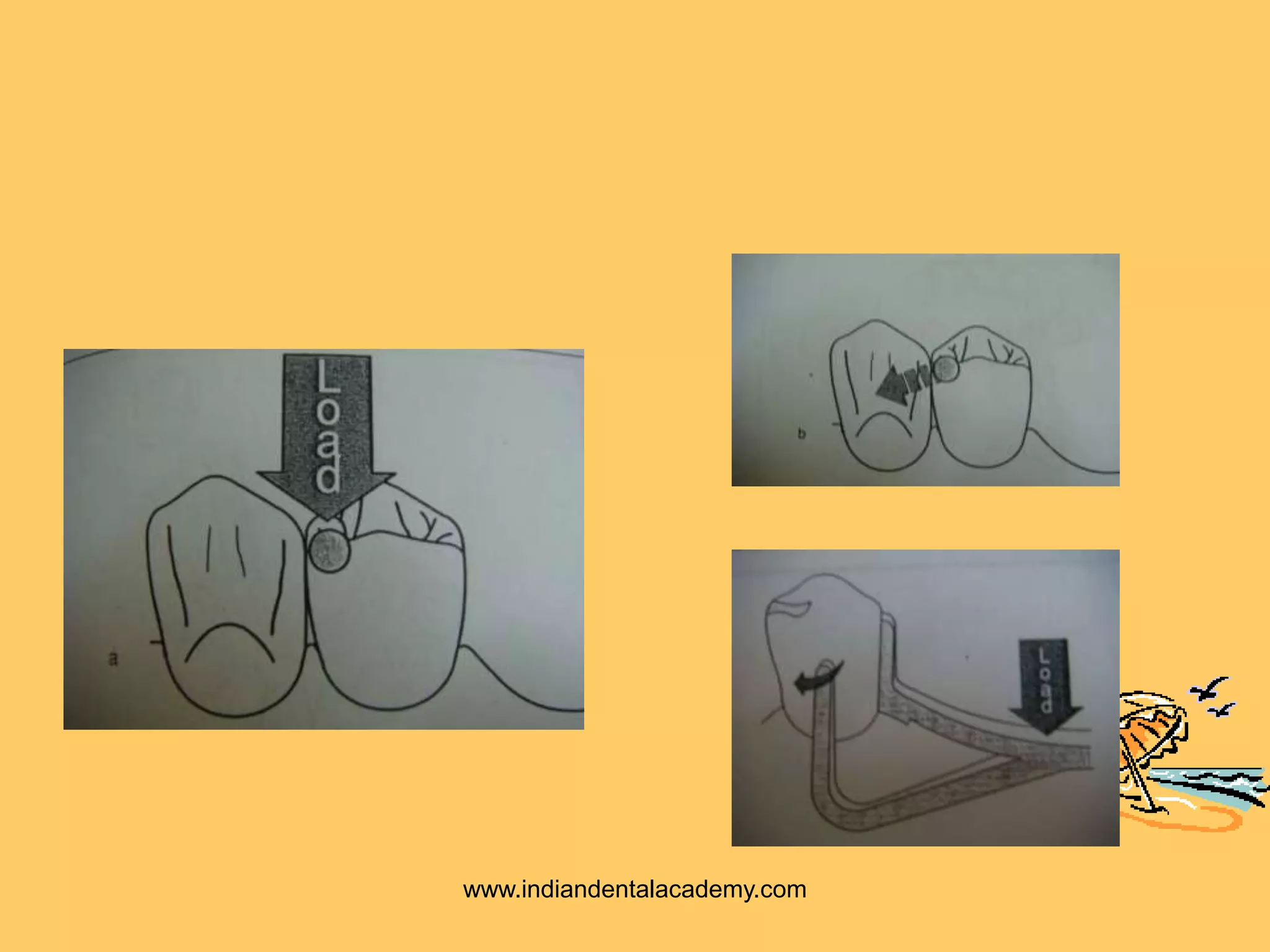
• As the distance from the
denture base to teeth increase,
the associated radius also
increase and the arc or rotation
become linear, hence anterior
placement of rest help direct
the forces more vertically onto
tissues of the residual ridge
• REASONS FOR MESIAL REST:
www.indiandentalacademy.com
PROXIMAL PLATE:
• The proximal plate makes greatest
departure from Kratochvil’s design.
• The prepared guide plane is 2 to 3 mm
high occlusogingivally and the proximal
plate contacts only 1 mm of the gingival
portion of the guide plane
www.indiandentalacademy.com
• . Relief is provided at the tooth – tissue
junction to allow the proximal plate to
disengage into the proximal undercut
under occlusal loading.
www.indiandentalacademy.com
• This proximal plate, in conjunction with the
minor connector supporting the rest,
provides the stabilizing and reciprocal
aspects of the clasp assembly.
www.indiandentalacademy.com
advantages
• Improved stabilisation
• Reunites and stabilizes remaining teeth with the
dental arch
• Retention Improves by limiting the paths of
removal and insertion
• Reduces food impaction between teeth and
proximal plate and protects teeth tissue junction
• Provides reciprocation during insertion and
removal
• Distributed forces through out the arch
www.indiandentalacademy.com
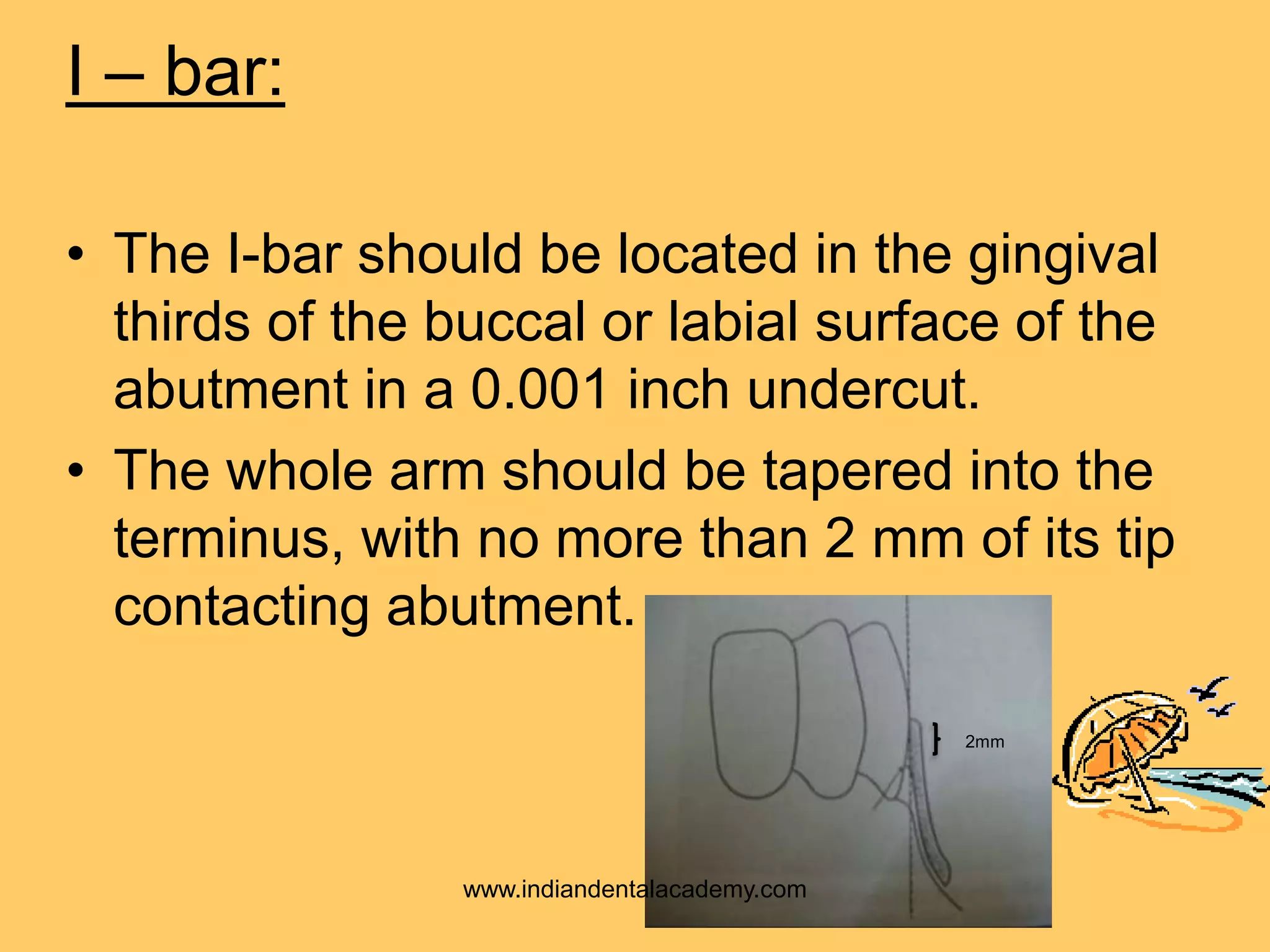
I – bar:
• The I-bar should be located in the gingival
thirds of the buccal or labial surface of the
abutment in a 0.001 inch undercut.
• The whole arm should be tapered into the
terminus, with no more than 2 mm of its tip
contacting abutment.
2mm
www.indiandentalacademy.com
• The retentive tip contacts the tooth from
the undercut to the height of contour.
• This area of contact along with the rest
and proximal plate contact provides
stabilization through encirclement.
www.indiandentalacademy.com
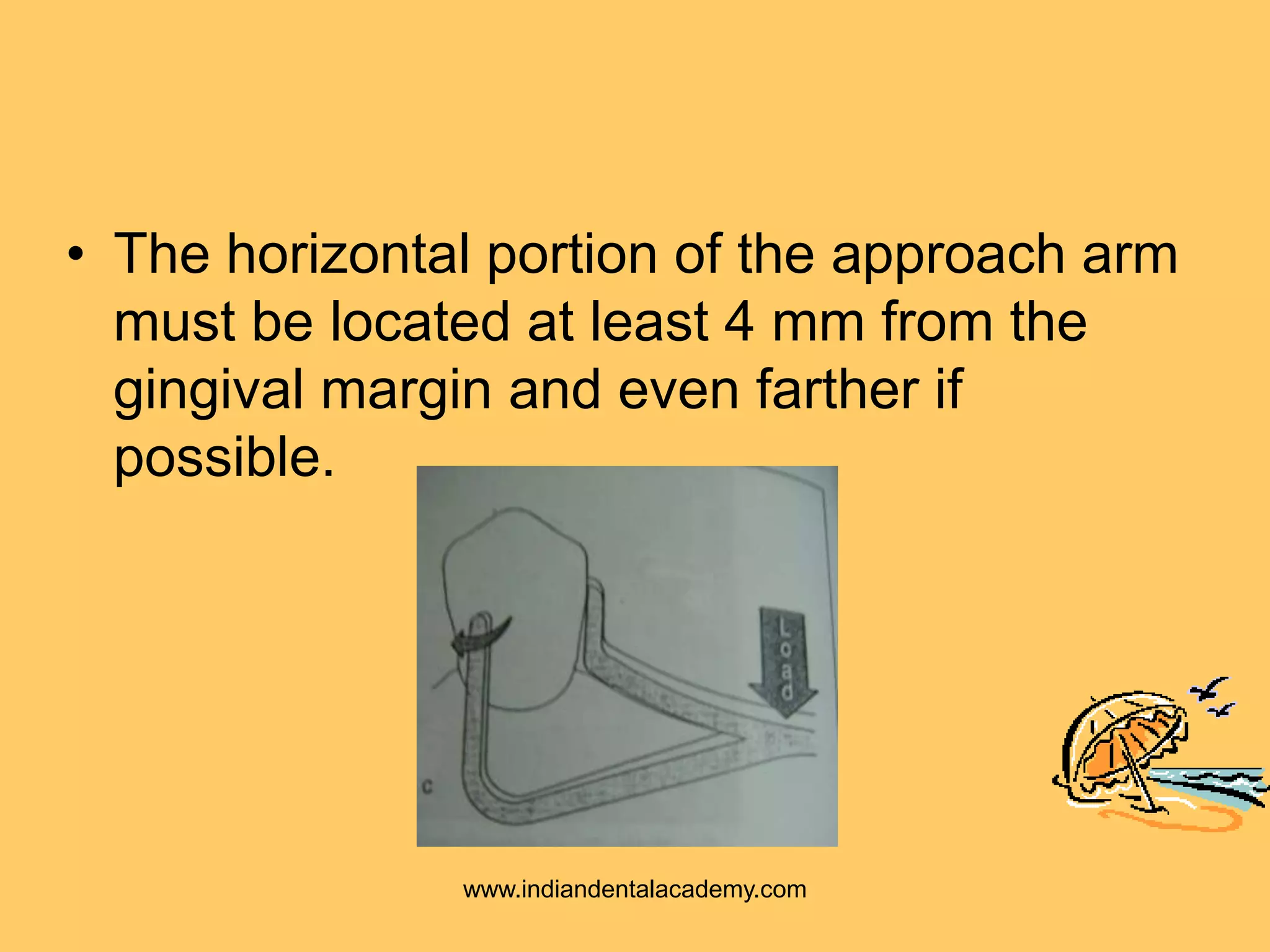
• The horizontal portion of the approach arm
must be located at least 4 mm from the
gingival margin and even farther if
possible.
www.indiandentalacademy.com
• ADVANTAGES:
• Food accumulation minimized
• Approach arm does not contact abutment
teeth so lateral forcers are minimized.
www.indiandentalacademy.com
• DISADVANTAGES:
• Less horizontal stabilization
• Less retention.
www.indiandentalacademy.com
• There are three basic approaches to the
application of the RPI system.
• The location of the rest, the design of the
minor connector (proximal plate) as it
relates to the guiding plane, and the
location of the retentive arm are factors
that influence how this clasp system
functions.
www.indiandentalacademy.com
• All advocate the use of a rest located
mesially on the primary abutment tooth
adjacent to the extension base area.
www.indiandentalacademy.com
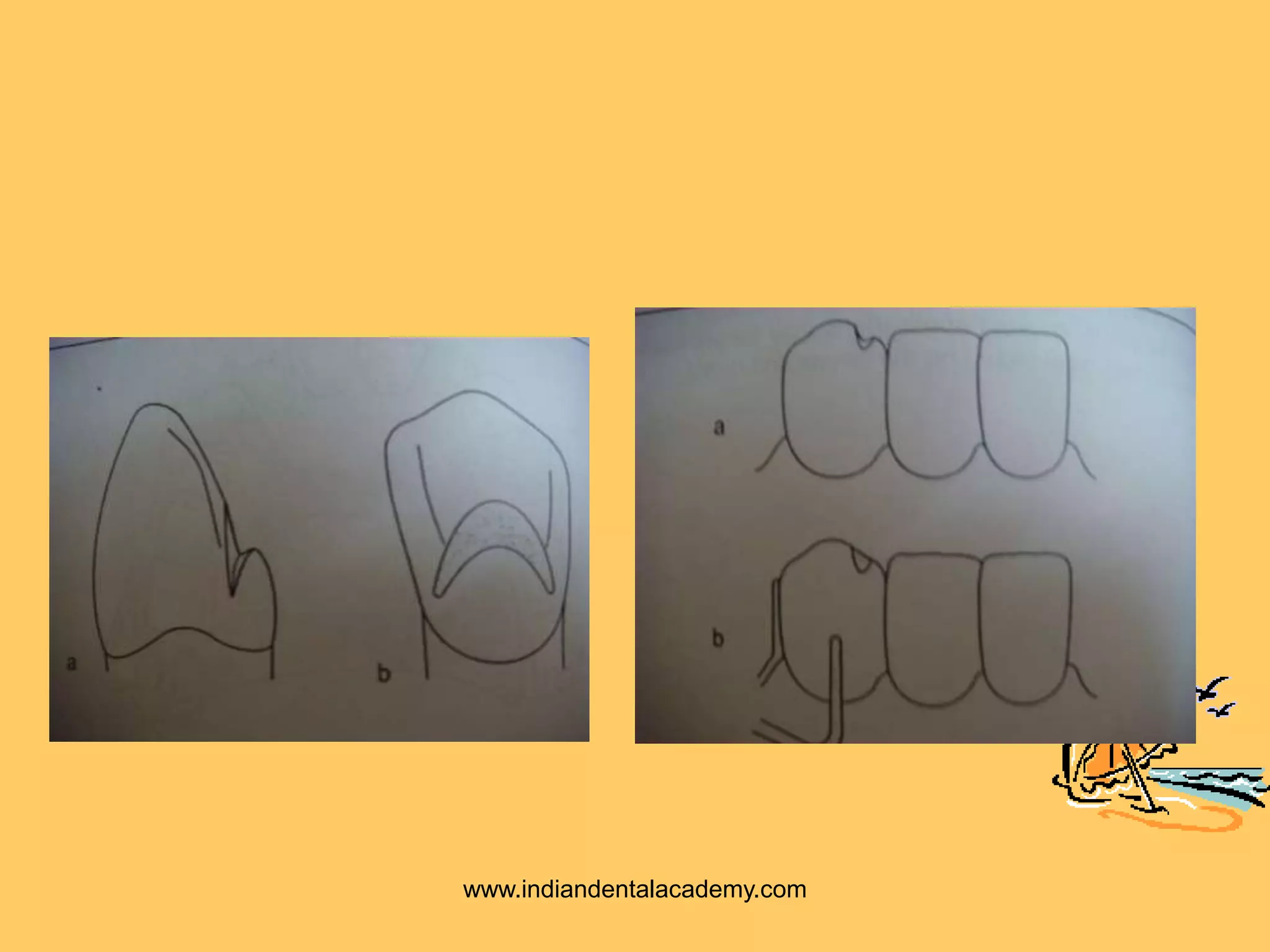
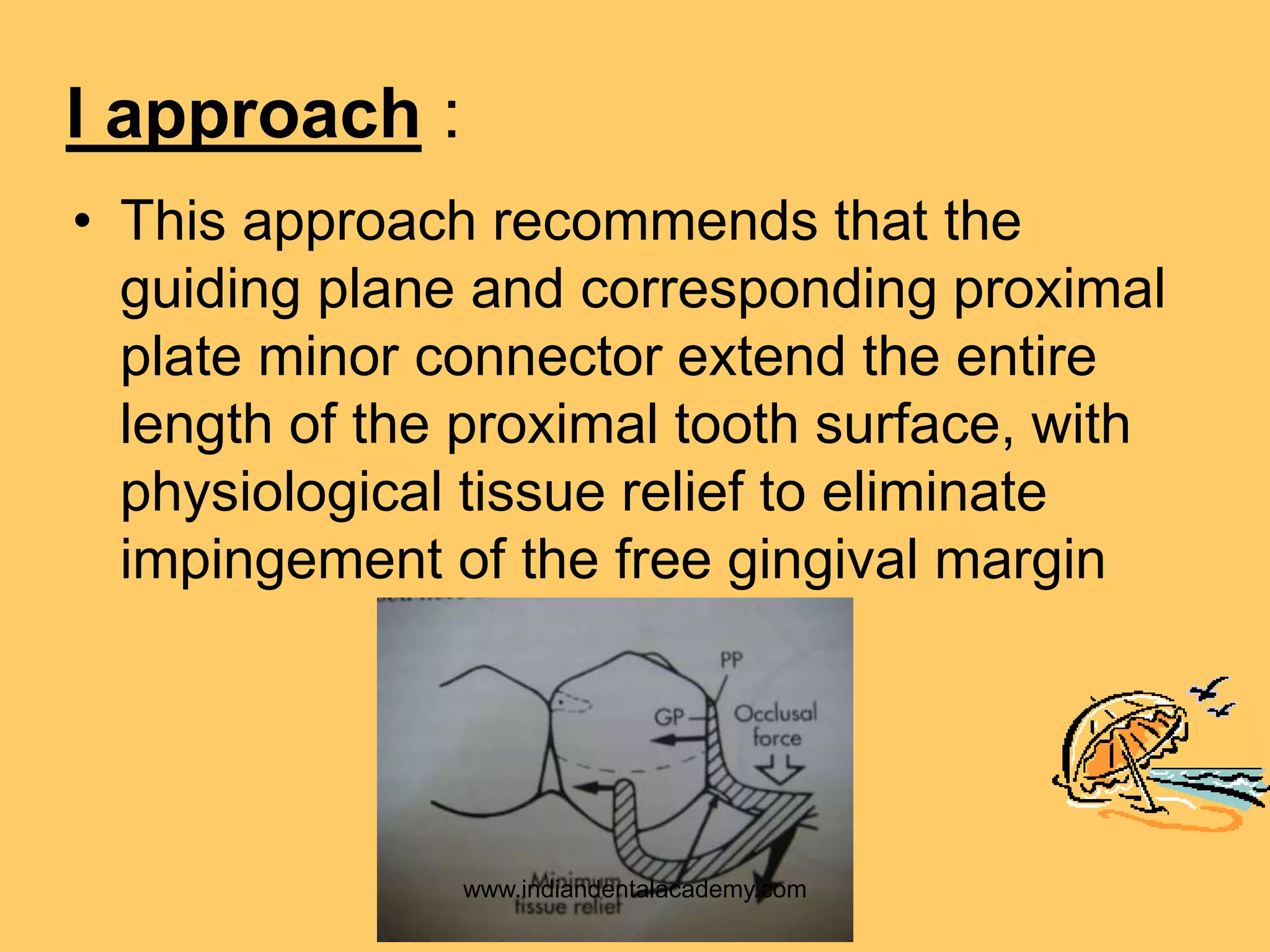
I approach :
• This approach recommends that the
guiding plane and corresponding proximal
plate minor connector extend the entire
length of the proximal tooth surface, with
physiological tissue relief to eliminate
impingement of the free gingival margin
www.indiandentalacademy.com
• Bar clasp assembly in which guiding plane
(GP) and corresponding proximal plate
(PP) extend entire length of proximal tooth
surface to contact greater surface area of
guide plane which directs functional forces
in horizontal direction , thus tooth {teeth}
are loaded more than edentulous ridge.
www.indiandentalacademy.com
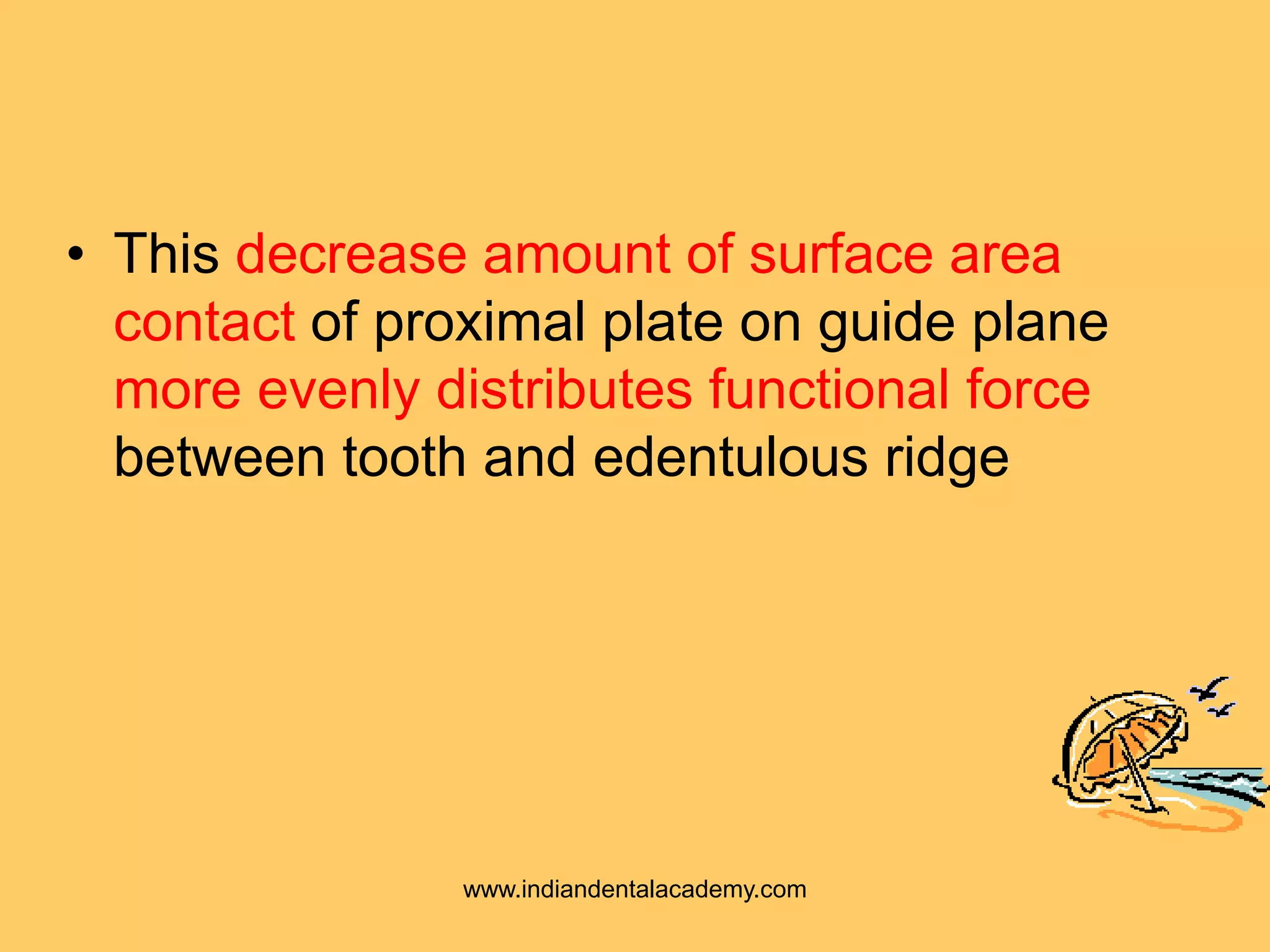
II approach:
• This approach suggests that the guiding
plane and corresponding proximal plate
minor connector extend from the marginal
ridge to the junction of the middle and
gingival thirds of the proximal tooth
surface
www.indiandentalacademy.com
• Both approaches recommend that the
retaining clasp arm be located in the
gingival third of the buccal or labial surface
of the abutment in a 0.001 inch undercut
www.indiandentalacademy.com
• This decrease amount of surface area
contact of proximal plate on guide plane
more evenly distributes functional force
between tooth and edentulous ridge
www.indiandentalacademy.com
III approach:
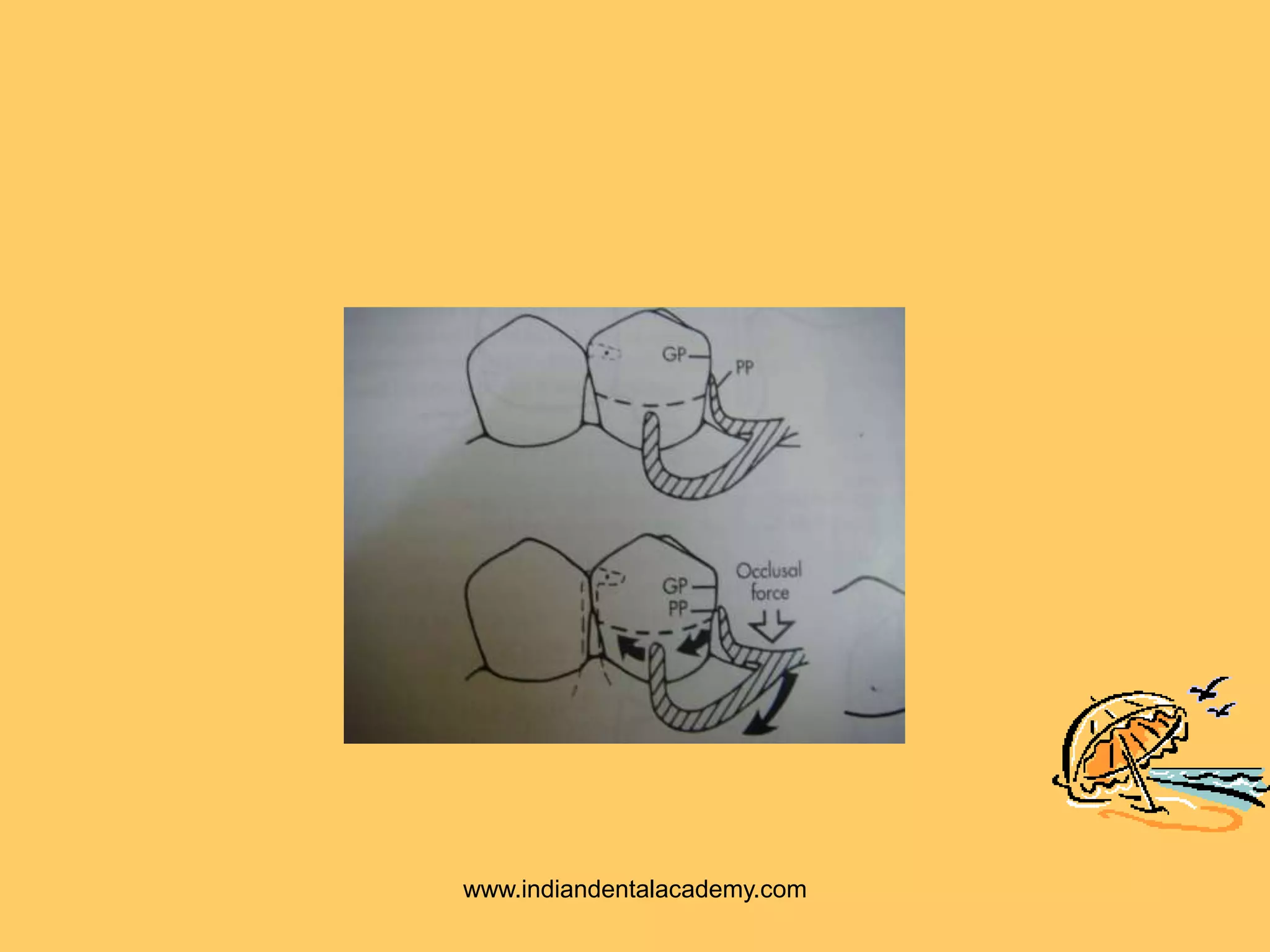
• This approach favours a proximal plate
minor connector that contacts
approximately 1mm of the gingival portion
of the guiding plane and retentive clasp
arm located in a 0.001 inch undercut in the
gingival third of the tooth at the greatest
prominence or to the mesial away from the
edentulous area
www.indiandentalacademy.com
• During function, proximal plate and I-bar
clasp arm are designed to move in
mesiogingival direction, disengaging tooth.
Lack of sustained contact between
proximal plate and guide plane distributes
more functional force to edentulous ridge.
•
www.indiandentalacademy.com
• Application of each approach is predicated
on the distribution of load to be applied to
the tooth and edentulous ridge.
www.indiandentalacademy.com
• The stated purpose of reducing the
proximal plate is to improve gingival health
by opening up embrasure spaces as much
as possible.
www.indiandentalacademy.com
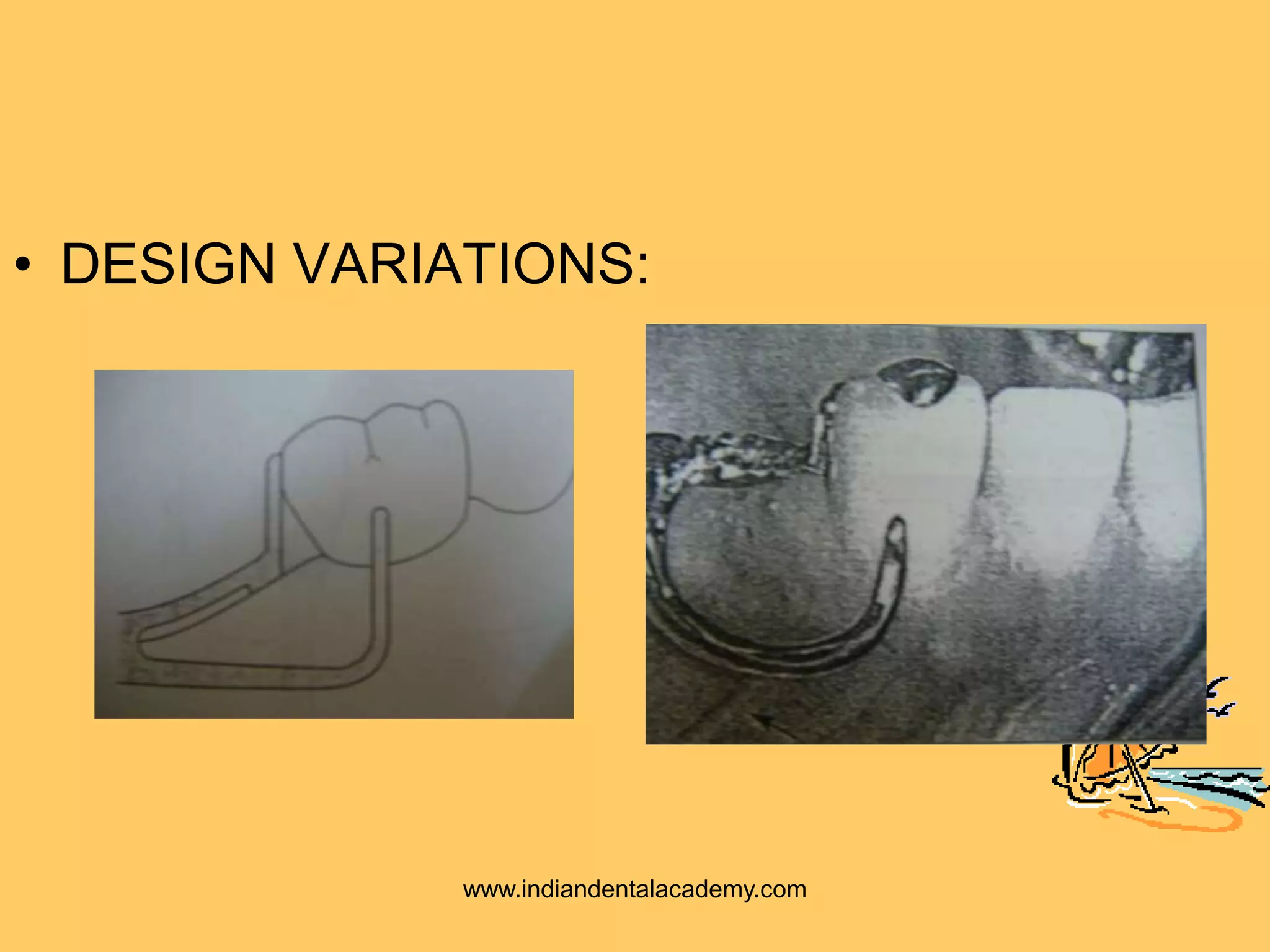
• DESIGN VARIATIONS:
www.indiandentalacademy.com
1. MAJOR CONNECTORS IN MANDIBLE
AND MAXILLA
2. MINOR CONNECTORS
3. DENTURE BASE CONNECTORS
www.indiandentalacademy.com
MODIFICATION TO RPI
SYSTEM:
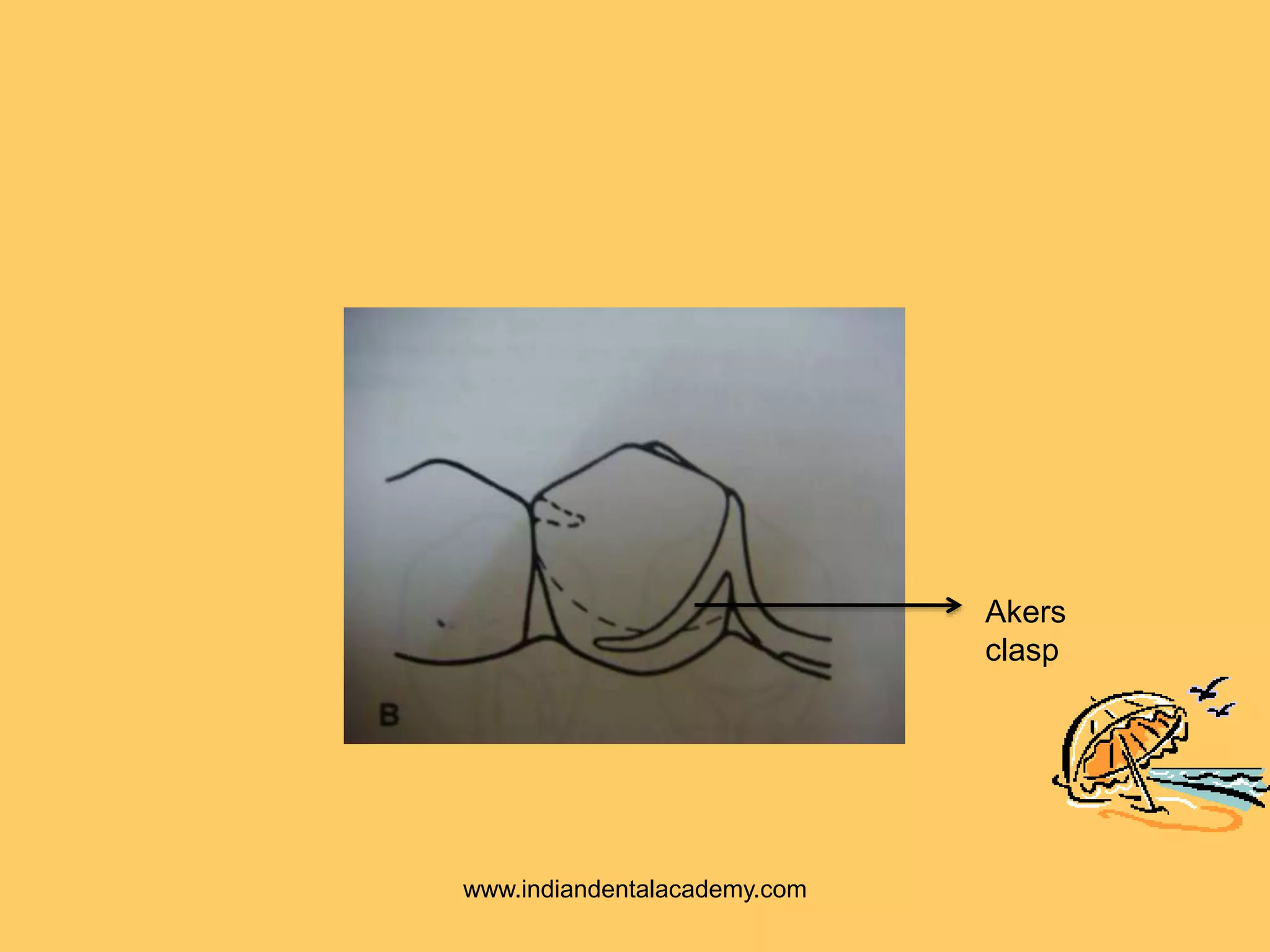
• Kroll in 1976 has given modification to RPI
system. That is
• RPA in which
R = rest
P = proximal plate
A = Akers clasp
www.indiandentalacademy.com
Akers
clasp
www.indiandentalacademy.com
contraindications for a bar- type
clasp
 exaggerated buccal or lingual tilts,
 severe tissue undercut
 or a shallow buccal vestibule
 and the desirable undercut is located in the
gingival third of the tooth away from the
extension base area,
• this modification to RPI i.e., RPA should
be considered.
www.indiandentalacademy.com
Tipped abutments
and tissue impingements are
• treated with RPA clasp.
• When Akers clasp arm is used, careful
attention is paid to relieve all undercuts
except at the retentive tip
www.indiandentalacademy.com
The removable partial denture design:
british dental journal: vol-189; n0-7 pg-
414
• In the study they concluded that there a plaque
accumulation in terms of quality and quantity on
alloplastic materials and there is some
components are leached into oral cavity from this
alloplastic material
• And this will cause tissue injury
• This can be prevented with the equillibrium in 3
components
• 1- operator
• 2- patient
• 3- laboratory perosenell
www.indiandentalacademy.com
10yr old evaluation of r.p.d’s ,survival
rates based in re treatment
j.p.d- vol-76: no-1, 1996
• In this survey 784 patients were given with
metal dentures and their feed back was
taken
• In the survey it was found that
88% - with 96% of success
10 people died that is 8%
Remaining people didnt wear the r.p.d
www.indiandentalacademy.com
A randomised clinical trial of 2 basic r.p.d’s-
comparision of masticatory efficiency-
j.p.d- 1997: 78; 15-21
• Statement of problem: there is no clinical
data about the functional efficiency of
different r.p.d designs.
• For this 118 patients were selected with
unilateral or bi lateral r.p.d’s
• Conclusion: despite some performance
difference at entry the mean performance
scores for the 2 different groups became
similar
www.indiandentalacademy.com
conclusion
• Successful use of the system requires
careful analysis of each component for the
function that it provides and thoughtful
execution of the system in the abutment
preparation and precise fitting of
framework
www.indiandentalacademy.com
• The i-bar design meets all of the
requirements of partial denture clasp
system, horizontal stabilization, retention,
reciprocation, and passivity.
• Successful use of i-bar system requires
careful analysis and planning of each
component, skillful abutment preparation,
and precise fitting of the frame work
www.indiandentalacademy.com
• Bibliography
• 1.MC CRACKEN’S REMOVABLE PARTIAL PROSTHODONTICS
11TH EDITION.
• 2.STEWART’S CLINICAL REMOVABLE PARTIAL
PROSTHODONTICS
3RD EDITION.
• 3.REMOVABLE DENTURE PROSTHODONTICS –A.A GRANT
/W.JOHNSON 2ND EDITION.
• 4.A COLOUR ATLAS OF REMOVABLE PARTIAL DENTURES
J.C.DAVENPORT,R.M.BASKER
• 5.REMOVABLE PARTIAL PROSTHODONTICS-DR SYBILLE K
LECHNER,PROFESSOR A ROY MAC GREGOR.
REFERENCES
www.indiandentalacademy.com

Concepts of rpi /prosthodontic courses

  • 1.
    CONCEPTS OF RPI INDIANDENTAL ACADEMY Leader in continuing Dental Education www.indiandentalacademy.com
  • 2.
    CONTENTS  Introduction  IBarphilosophy  RPI system  RPA system  Conclusion  Bibliography www.indiandentalacademy.com
  • 3.
    Terminology • REST : aprojection or attachment, usually on the side of an object • REST SEAT : the prepared recess in a tooth or restoration created to receive the occlusal, incisal, cingulum, or lingual rest www.indiandentalacademy.com
  • 4.
    • I-bar clasp: thecomponent of the clasp assembly that engages a portion of the tooth surface and either enters an undercut for retention or remains entirely above the height of contour to act as a reciprocating element. Generally it is used to stabilize and retain a removable dental prosthesis www.indiandentalacademy.com
  • 5.
  • 6.
    • In contrastwith the Kratochvil’s basic design, which necessitates heavy preparation, Krol developed a modification that avoids tooth preparation. www.indiandentalacademy.com
  • 7.
    • The stateemphasis in Krol’s system is stress control with minimal tooth coverage and minimal gingival coverage. www.indiandentalacademy.com
  • 8.
    • The claspsystem includes the three elements of Kratochvil’s system: - mesial rest, proximal plate and I-bar. • Each element, however, has undergone significant change to meet Krol’s criteria. www.indiandentalacademy.com
  • 9.
    • In RPIsystem: R = Rest P = Proximal plate I = I-bar www.indiandentalacademy.com
  • 10.
  • 11.
  • 12.
    • DISTAL PROXIMALPLATE-LONG DISTAL GUIDING PLANE THAT EXTENDS IN TO THE TOOTH TISSUE JUNCTION: www.indiandentalacademy.com
  • 13.
    REST • Rest preparationsare less extensive in the RPI system. • The mesial rest extends only into the triangular fossa, even in molar preparations, and canine rests are often circular concave depressions prepared in the mesial marginal ridge www.indiandentalacademy.com
  • 14.
  • 15.
    • When aestheticspermits incisal rests can be used in mandibular anteriors • And they can be used to splint the periodontally weakened teeth www.indiandentalacademy.com
  • 16.
    features • Mesial rest. •It provides Vertical support • Good adaptation to transfer forces principally • Sufficient bulk to with stand fources www.indiandentalacademy.com
  • 17.
    • As thedistance from the denture base to teeth increase, the associated radius also increase and the arc or rotation become linear, hence anterior placement of rest help direct the forces more vertically onto tissues of the residual ridge • REASONS FOR MESIAL REST: www.indiandentalacademy.com
  • 18.
  • 19.
    PROXIMAL PLATE: • Theproximal plate makes greatest departure from Kratochvil’s design. • The prepared guide plane is 2 to 3 mm high occlusogingivally and the proximal plate contacts only 1 mm of the gingival portion of the guide plane www.indiandentalacademy.com
  • 20.
    • . Reliefis provided at the tooth – tissue junction to allow the proximal plate to disengage into the proximal undercut under occlusal loading. www.indiandentalacademy.com
  • 21.
    • This proximalplate, in conjunction with the minor connector supporting the rest, provides the stabilizing and reciprocal aspects of the clasp assembly. www.indiandentalacademy.com
  • 22.
    advantages • Improved stabilisation •Reunites and stabilizes remaining teeth with the dental arch • Retention Improves by limiting the paths of removal and insertion • Reduces food impaction between teeth and proximal plate and protects teeth tissue junction • Provides reciprocation during insertion and removal • Distributed forces through out the arch www.indiandentalacademy.com
  • 23.
    I – bar: •The I-bar should be located in the gingival thirds of the buccal or labial surface of the abutment in a 0.001 inch undercut. • The whole arm should be tapered into the terminus, with no more than 2 mm of its tip contacting abutment. 2mm www.indiandentalacademy.com
  • 24.
    • The retentivetip contacts the tooth from the undercut to the height of contour. • This area of contact along with the rest and proximal plate contact provides stabilization through encirclement. www.indiandentalacademy.com
  • 25.
    • The horizontalportion of the approach arm must be located at least 4 mm from the gingival margin and even farther if possible. www.indiandentalacademy.com
  • 26.
    • ADVANTAGES: • Foodaccumulation minimized • Approach arm does not contact abutment teeth so lateral forcers are minimized. www.indiandentalacademy.com
  • 27.
    • DISADVANTAGES: • Lesshorizontal stabilization • Less retention. www.indiandentalacademy.com
  • 28.
    • There arethree basic approaches to the application of the RPI system. • The location of the rest, the design of the minor connector (proximal plate) as it relates to the guiding plane, and the location of the retentive arm are factors that influence how this clasp system functions. www.indiandentalacademy.com
  • 29.
    • All advocatethe use of a rest located mesially on the primary abutment tooth adjacent to the extension base area. www.indiandentalacademy.com
  • 30.
    I approach : •This approach recommends that the guiding plane and corresponding proximal plate minor connector extend the entire length of the proximal tooth surface, with physiological tissue relief to eliminate impingement of the free gingival margin www.indiandentalacademy.com
  • 31.
    • Bar claspassembly in which guiding plane (GP) and corresponding proximal plate (PP) extend entire length of proximal tooth surface to contact greater surface area of guide plane which directs functional forces in horizontal direction , thus tooth {teeth} are loaded more than edentulous ridge. www.indiandentalacademy.com
  • 32.
    II approach: • Thisapproach suggests that the guiding plane and corresponding proximal plate minor connector extend from the marginal ridge to the junction of the middle and gingival thirds of the proximal tooth surface www.indiandentalacademy.com
  • 33.
    • Both approachesrecommend that the retaining clasp arm be located in the gingival third of the buccal or labial surface of the abutment in a 0.001 inch undercut www.indiandentalacademy.com
  • 34.
    • This decreaseamount of surface area contact of proximal plate on guide plane more evenly distributes functional force between tooth and edentulous ridge www.indiandentalacademy.com
  • 35.
    III approach: • Thisapproach favours a proximal plate minor connector that contacts approximately 1mm of the gingival portion of the guiding plane and retentive clasp arm located in a 0.001 inch undercut in the gingival third of the tooth at the greatest prominence or to the mesial away from the edentulous area www.indiandentalacademy.com
  • 36.
  • 37.
    • During function,proximal plate and I-bar clasp arm are designed to move in mesiogingival direction, disengaging tooth. Lack of sustained contact between proximal plate and guide plane distributes more functional force to edentulous ridge. • www.indiandentalacademy.com
  • 38.
    • Application ofeach approach is predicated on the distribution of load to be applied to the tooth and edentulous ridge. www.indiandentalacademy.com
  • 39.
    • The statedpurpose of reducing the proximal plate is to improve gingival health by opening up embrasure spaces as much as possible. www.indiandentalacademy.com
  • 40.
  • 41.
    1. MAJOR CONNECTORSIN MANDIBLE AND MAXILLA 2. MINOR CONNECTORS 3. DENTURE BASE CONNECTORS www.indiandentalacademy.com
  • 42.
    MODIFICATION TO RPI SYSTEM: •Kroll in 1976 has given modification to RPI system. That is • RPA in which R = rest P = proximal plate A = Akers clasp www.indiandentalacademy.com
  • 43.
  • 44.
    contraindications for abar- type clasp  exaggerated buccal or lingual tilts,  severe tissue undercut  or a shallow buccal vestibule  and the desirable undercut is located in the gingival third of the tooth away from the extension base area, • this modification to RPI i.e., RPA should be considered. www.indiandentalacademy.com
  • 45.
    Tipped abutments and tissueimpingements are • treated with RPA clasp. • When Akers clasp arm is used, careful attention is paid to relieve all undercuts except at the retentive tip www.indiandentalacademy.com
  • 46.
    The removable partialdenture design: british dental journal: vol-189; n0-7 pg- 414 • In the study they concluded that there a plaque accumulation in terms of quality and quantity on alloplastic materials and there is some components are leached into oral cavity from this alloplastic material • And this will cause tissue injury • This can be prevented with the equillibrium in 3 components • 1- operator • 2- patient • 3- laboratory perosenell www.indiandentalacademy.com
  • 47.
    10yr old evaluationof r.p.d’s ,survival rates based in re treatment j.p.d- vol-76: no-1, 1996 • In this survey 784 patients were given with metal dentures and their feed back was taken • In the survey it was found that 88% - with 96% of success 10 people died that is 8% Remaining people didnt wear the r.p.d www.indiandentalacademy.com
  • 48.
    A randomised clinicaltrial of 2 basic r.p.d’s- comparision of masticatory efficiency- j.p.d- 1997: 78; 15-21 • Statement of problem: there is no clinical data about the functional efficiency of different r.p.d designs. • For this 118 patients were selected with unilateral or bi lateral r.p.d’s • Conclusion: despite some performance difference at entry the mean performance scores for the 2 different groups became similar www.indiandentalacademy.com
  • 49.
    conclusion • Successful useof the system requires careful analysis of each component for the function that it provides and thoughtful execution of the system in the abutment preparation and precise fitting of framework www.indiandentalacademy.com
  • 50.
    • The i-bardesign meets all of the requirements of partial denture clasp system, horizontal stabilization, retention, reciprocation, and passivity. • Successful use of i-bar system requires careful analysis and planning of each component, skillful abutment preparation, and precise fitting of the frame work www.indiandentalacademy.com
  • 51.
    • Bibliography • 1.MCCRACKEN’S REMOVABLE PARTIAL PROSTHODONTICS 11TH EDITION. • 2.STEWART’S CLINICAL REMOVABLE PARTIAL PROSTHODONTICS 3RD EDITION. • 3.REMOVABLE DENTURE PROSTHODONTICS –A.A GRANT /W.JOHNSON 2ND EDITION. • 4.A COLOUR ATLAS OF REMOVABLE PARTIAL DENTURES J.C.DAVENPORT,R.M.BASKER • 5.REMOVABLE PARTIAL PROSTHODONTICS-DR SYBILLE K LECHNER,PROFESSOR A ROY MAC GREGOR. REFERENCES www.indiandentalacademy.com
  • 52.