Introduction
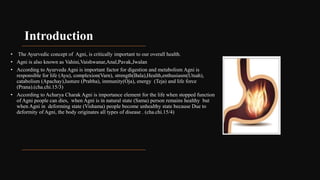
• The Ayurvedic concept of Agni, is critically important to our overall health.
• Agni is also known as Vahini,Vaishwanar,Anal,Pavak,Jwalan
• According to Ayurveda Agni is important factor for digestion and metabolism Agni is
responsible for life (Ayu), complexion(Varn), strength(Bala),Health,enthusiasm(Utsah),
catabolism (Apachay),lusture (Prabha), immunity(Oja), energy (Teja) and life force
(Prana).(cha.chi.15/3)
• According to Acharya Charak Agni is importance element for the life when stopped function
of Agni people can dies, when Agni is in natural state (Sama) person remains healthy but
when Agni in deforming state (Vishama) people become unhealthy state because Due to
deformity of Agni, the body originates all types of disease . (cha.chi.15/4)
Types of Agni
Agni is innumerable because of its presence in each dhatu paramanu (cell) of the body. But, enumeration of the number of Agnis varies in various
classical Ayurvedic texts, as shown below.
 Charaka mentioned about 13 Agnis. Jatharagni – 1, Bhutagni – 5, Dhatvagni – 7 (Ch.Chi.15/38).
 According to Acharya Sushruta, five types of Agnis are illustrated, viz . Pachakagni, Ranjakagni , Alochakagni, Sadhakagni and
Bhrajakagni. However, there is an indirect reference of five Bhutagnis underlying in the brief description made to the transformation of
food stuff. (Sh.Su.21/10.)

Vagbhata has described different types Agni, viz. – Bhutagnis – 5,– Dhatvagnis – 7, –Dhoshagni – 3 and– Malagni – 3.

Sharangadhara has recognized five pittas only (Pachak, Bhrajak, Ranjak, Alochaka and Sadhak) (Sha.Sa.Pu. Kh.-5/32).
 Bhavamishra has followed Acharya Charaka and Vagbhata (Bh. Pu.Kh.-3/169,180).
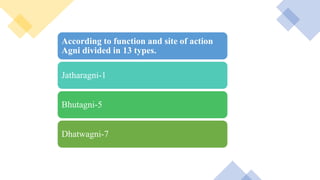
According to function and site of action
Agni divided in 13 types.
Jatharagni-1
Bhutagni-5
Dhatwagni-7
Jatharagni
 Jathragni is the Agni present in jathara . jathara stands for the between the stomach and duodenum.
 Responsible to digests all the types of food (Ashit,Khadit,Pitta,Leha).(su.su.2/10)
 These three Saman Vayu,Pachak Pitta and Kledaka Kapha are also necessary to maintain the function of Jatharagni.
 According to modern science function of jathragni is like Trypsin, chymotrypsin, carboxypeptidase, pancreatic lipase,
phospholipase,colipase,pancreatic amylase.
According to performance of digestion in human being Jatharagni is also classified in to four categories.
(cha.chi.15/51)
a) Samagni –The person who has Samagni has good digestion, due to which his health remains healthy .because in
Samagni Tridodsha is in balanced condition
b) Vishmagni- There is an excess of Vata in it, due to which digestion is sometimes done properly, sometimes not.
c) Tikshnagni- Tiksha means fast digestion due to excess of pitta dosha.
d) Mandagni- Manda means slow due to kapha dosha aggravation
Bhutagni - Bhutagni is present in five basic elements (panchmaha bhuta). There are five Agni in
each of the five basic elements,
Dhatwagni - Dhatwagni present in Saptdhatu all dhatu contain their own Agni to metabolize the
nutrient materials supplied to them though their own srotas.
Rasagni present in the Rasa Dhatu.
Raktagni present in the Rakta Dhatu.
Mamsagni present in the Mamsa Dhatu.
Medagni present in the Meda Dhatu.
Asthyagni present in the Asthi Dhatu.
Majjagni present in the Majja Dhatu.
Shukragni present in the Shukra Dhatu.
Physiological significance
 Majority of the disease are outcome of malfunctioning of the Agni which rightly has called as central to health.
 Agni plays not only plays vital role in absorption of macro as well as micronutrients but is destructive to pathogens
also.
 The food that in not properly digested is refereed as “ Ama” in ayurveda and it nothing but a toxin or pathogen
responsible for array of disease.
 Proper functioning of digestive fire is evident from normal tone of the digestive system circulatory-system, strong
immunity or resistance against diseases, Proper tissue growth.
Pathological significance
If digestive fire is not functioning of properly, one has poor digestion, languid blood circulation, poor complexion, low
energy Level, flatulence and poor immunity against disease. Thus, promoting proper functioning of digestive fire is
treating the root cause of of all diseases, according to ayurvedic principle
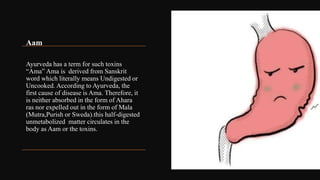
Ayurveda has a term for such toxins
“Ama” Ama is derived from Sanskrit
word which literally means Undigested or
Uncooked. According to Ayurveda, the
first cause of disease is Ama. Therefore, it
is neither absorbed in the form of Ahara
ras nor expelled out in the form of Mala
(Mutra,Purish or Sweda).this half-digested
unmetabolized matter circulates in the
body as Aam or the toxins.
Aam
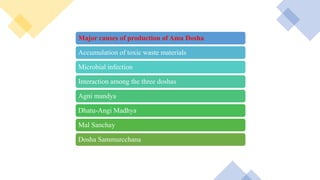
Major causes of production of Ama Dosha
Accumulation of toxic waste materials
Microbial infection
Interaction among the three doshas
Agni mandya
Dhatu-Angi Madhya
Mal Sanchay
Dosha Sammurcchana
Signs to identify Aam build-up and why you should care
Aam has all the properties different and opposite of that of Agni, so if
optimum Agni makes you feel stronger, healthy, and active. Aam
buildup on the other hand will make you feel weaker, unhealthy, and
lethargic.
• A thick white coating, covering the tongue, when you wake up in
the morning, is a clear indication of Aam accumulation.
Other than that,
• Disturbed digestion.
• Frequent digestive issues.
• Acid refluxes.
• Constipation.
• Feeling of heaviness and weight gain.
• Hair fall, Skin issues, and other similar complaints.
• Excessive laziness and inactiveness.
• Lack of motivation.
• Constant and frequent episodes of anxiety, depression, and bouts
of anger.
All these factors collectively and independently suggest the collection
and accumulation of Aam in the body.
•
Management
These are some basic important steps to avoid Aam build-up in the body.
• Not eating before the previous meal is digested.
• Eating only when hungry.
• Avoiding afternoon naps.
• Having meals after showers and not before.
• Working out at half of one’s capacity.
• Resting and getting enough sleep.
• Keeping a positive attitude at things, practicing empathy.
• Meditation and mindfulness.
Shunthi ( Dried Ginger ), Pimpali ( Long pepper ) and Marich ( Pepper ) are somesimple single-use household medicines
that can be consumed for supporting Agni.
Yogic management
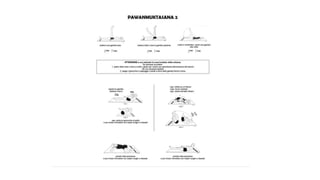
• Pawanmuktasan part 1,2,3
• Vajrasan
• Bhujangasan
• Dhanurasan
• Shalbhasan
• Paschimottanasan
• Sarvangasan
• Halasan
• Matsyasan
• Padmasan
• Udarakarshanasan
• Shankhprakshalana
• Vaman kriya
• Pranayam
Bhujangasana
Ardhmatsyendrasana
Dhanurasana
Paschimottanasana
Conclusion
 Agni is an important integral part of body. Responsible for good digestion
 Ama is formed due to Mandagni, it may impair the mechanism of the gastrointestinal system.
 Also hampers the homeostasis of Dosha ,Dhatu ,Mala.
 Severity of disease is understood through the theory of free radicals in the contemporary science, while in ayurveda
It is understood by the concept of Aam
References
https://www.banyanbotanicals.com/info/ayurvedic-living/living-ayurveda/health-guides/understanding-agni/ama-
the-antithesis-of-agni/
https://ourayurinfo.blogspot.com/2011/12/agni-and-aam.html
https://www.planetayurveda.com/agni-versus-
ama/#:~:text=Agni%20is%20among%20the%20critical%20factors%20in%20determining,impairment%20of%20
Agni%2C%20which%20in%20turn%2C%20destroys%20Agni.
https://www.slideshare.net/SoniyaVetal/concept-of-agni
https://www.slideshare.net/ThejaswiniRamachandra1/concept-of-Agni-amp-ama-seminar
https://sarveda.com/aama-in-ayurveda-an-introduction/
https://www.mowglinatural.com/serie-di-pawanmuktasana/
Saraswati,k.s.( 2013 ) . Yogic management of common diseases. Munger bihar : yoga publications trust.
THANKYOU

Agni and Aam pptx.pptx

  • 2.
    Introduction • The Ayurvedicconcept of Agni, is critically important to our overall health. • Agni is also known as Vahini,Vaishwanar,Anal,Pavak,Jwalan • According to Ayurveda Agni is important factor for digestion and metabolism Agni is responsible for life (Ayu), complexion(Varn), strength(Bala),Health,enthusiasm(Utsah), catabolism (Apachay),lusture (Prabha), immunity(Oja), energy (Teja) and life force (Prana).(cha.chi.15/3) • According to Acharya Charak Agni is importance element for the life when stopped function of Agni people can dies, when Agni is in natural state (Sama) person remains healthy but when Agni in deforming state (Vishama) people become unhealthy state because Due to deformity of Agni, the body originates all types of disease . (cha.chi.15/4)
  • 3.
    Types of Agni Agniis innumerable because of its presence in each dhatu paramanu (cell) of the body. But, enumeration of the number of Agnis varies in various classical Ayurvedic texts, as shown below.  Charaka mentioned about 13 Agnis. Jatharagni – 1, Bhutagni – 5, Dhatvagni – 7 (Ch.Chi.15/38).  According to Acharya Sushruta, five types of Agnis are illustrated, viz . Pachakagni, Ranjakagni , Alochakagni, Sadhakagni and Bhrajakagni. However, there is an indirect reference of five Bhutagnis underlying in the brief description made to the transformation of food stuff. (Sh.Su.21/10.)  Vagbhata has described different types Agni, viz. – Bhutagnis – 5,– Dhatvagnis – 7, –Dhoshagni – 3 and– Malagni – 3.  Sharangadhara has recognized five pittas only (Pachak, Bhrajak, Ranjak, Alochaka and Sadhak) (Sha.Sa.Pu. Kh.-5/32).  Bhavamishra has followed Acharya Charaka and Vagbhata (Bh. Pu.Kh.-3/169,180).
  • 4.
    According to functionand site of action Agni divided in 13 types. Jatharagni-1 Bhutagni-5 Dhatwagni-7
  • 5.
    Jatharagni  Jathragni isthe Agni present in jathara . jathara stands for the between the stomach and duodenum.  Responsible to digests all the types of food (Ashit,Khadit,Pitta,Leha).(su.su.2/10)  These three Saman Vayu,Pachak Pitta and Kledaka Kapha are also necessary to maintain the function of Jatharagni.  According to modern science function of jathragni is like Trypsin, chymotrypsin, carboxypeptidase, pancreatic lipase, phospholipase,colipase,pancreatic amylase. According to performance of digestion in human being Jatharagni is also classified in to four categories. (cha.chi.15/51) a) Samagni –The person who has Samagni has good digestion, due to which his health remains healthy .because in Samagni Tridodsha is in balanced condition b) Vishmagni- There is an excess of Vata in it, due to which digestion is sometimes done properly, sometimes not. c) Tikshnagni- Tiksha means fast digestion due to excess of pitta dosha. d) Mandagni- Manda means slow due to kapha dosha aggravation
  • 6.
    Bhutagni - Bhutagniis present in five basic elements (panchmaha bhuta). There are five Agni in each of the five basic elements, Dhatwagni - Dhatwagni present in Saptdhatu all dhatu contain their own Agni to metabolize the nutrient materials supplied to them though their own srotas. Rasagni present in the Rasa Dhatu. Raktagni present in the Rakta Dhatu. Mamsagni present in the Mamsa Dhatu. Medagni present in the Meda Dhatu. Asthyagni present in the Asthi Dhatu. Majjagni present in the Majja Dhatu. Shukragni present in the Shukra Dhatu.
  • 7.
    Physiological significance  Majorityof the disease are outcome of malfunctioning of the Agni which rightly has called as central to health.  Agni plays not only plays vital role in absorption of macro as well as micronutrients but is destructive to pathogens also.  The food that in not properly digested is refereed as “ Ama” in ayurveda and it nothing but a toxin or pathogen responsible for array of disease.  Proper functioning of digestive fire is evident from normal tone of the digestive system circulatory-system, strong immunity or resistance against diseases, Proper tissue growth. Pathological significance If digestive fire is not functioning of properly, one has poor digestion, languid blood circulation, poor complexion, low energy Level, flatulence and poor immunity against disease. Thus, promoting proper functioning of digestive fire is treating the root cause of of all diseases, according to ayurvedic principle
  • 8.
    Ayurveda has aterm for such toxins “Ama” Ama is derived from Sanskrit word which literally means Undigested or Uncooked. According to Ayurveda, the first cause of disease is Ama. Therefore, it is neither absorbed in the form of Ahara ras nor expelled out in the form of Mala (Mutra,Purish or Sweda).this half-digested unmetabolized matter circulates in the body as Aam or the toxins. Aam
  • 9.
    Major causes ofproduction of Ama Dosha Accumulation of toxic waste materials Microbial infection Interaction among the three doshas Agni mandya Dhatu-Angi Madhya Mal Sanchay Dosha Sammurcchana
  • 10.
    Signs to identifyAam build-up and why you should care Aam has all the properties different and opposite of that of Agni, so if optimum Agni makes you feel stronger, healthy, and active. Aam buildup on the other hand will make you feel weaker, unhealthy, and lethargic. • A thick white coating, covering the tongue, when you wake up in the morning, is a clear indication of Aam accumulation. Other than that, • Disturbed digestion. • Frequent digestive issues. • Acid refluxes. • Constipation. • Feeling of heaviness and weight gain. • Hair fall, Skin issues, and other similar complaints. • Excessive laziness and inactiveness. • Lack of motivation. • Constant and frequent episodes of anxiety, depression, and bouts of anger. All these factors collectively and independently suggest the collection and accumulation of Aam in the body. •
  • 11.
    Management These are somebasic important steps to avoid Aam build-up in the body. • Not eating before the previous meal is digested. • Eating only when hungry. • Avoiding afternoon naps. • Having meals after showers and not before. • Working out at half of one’s capacity. • Resting and getting enough sleep. • Keeping a positive attitude at things, practicing empathy. • Meditation and mindfulness. Shunthi ( Dried Ginger ), Pimpali ( Long pepper ) and Marich ( Pepper ) are somesimple single-use household medicines that can be consumed for supporting Agni.
  • 12.
    Yogic management • Pawanmuktasanpart 1,2,3 • Vajrasan • Bhujangasan • Dhanurasan • Shalbhasan • Paschimottanasan • Sarvangasan • Halasan • Matsyasan • Padmasan • Udarakarshanasan • Shankhprakshalana • Vaman kriya • Pranayam
  • 17.
  • 18.
  • 19.
  • 20.
  • 21.
    Conclusion  Agni isan important integral part of body. Responsible for good digestion  Ama is formed due to Mandagni, it may impair the mechanism of the gastrointestinal system.  Also hampers the homeostasis of Dosha ,Dhatu ,Mala.  Severity of disease is understood through the theory of free radicals in the contemporary science, while in ayurveda It is understood by the concept of Aam
  • 22.
  • 23.