Mechanical
Maintenance
Submitted to:
Anshu Kumar Sinha
Asst. Professor
SHRI VAISHNAV
Institute of Technology and Science, Indore
Submitted by:
AshutoshTomar
0802ME141018
Contents:
 Maintenance and terms
 Preventive Maintenance
 Corrective Maintenance
 Operational Maintenance
 Lubrication
 Advantages
What is
Maintenance?
&Why?
 Maintenance involves keeping the workplace, its structures,
equipment, machines, furniture and facilities in good repair and
operating efficiently and safely.
 It includes repairing, replacing, servicing, inspecting and testing.
 To keep premises, equipment, machines and the work environment
safe and reliable.
 Lack of maintenance or inadequate maintenance can lead to
dangerous situations, accidents and health problems.
 The actual cost for a breakdown is between four to fifteen times the
maintenance costs. When the breakdown causes production to stop,
the costs are very high because no parts are being produced.
Mech
Maintenance
Terms &
Definitions:
Mechanical MaintenanceTypes:
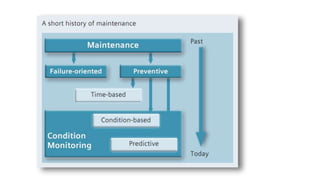
 Preventive maintenance:
It is to maximize equipment availability and minimize product
defects by taking care of the equipment before the problems
arise. Repair costs are often, but not always, higher than the cost
of preventive maintenance.
Failure Oriented Maintenance:
 Corrective maintenance: It is unscheduled maintenance to return
equipment to working state and carried out because maintenance
perceived deficiencies or failures.
Terms &
Definitions:
 Predictive maintenance:The use of modern measurement and
signal processing methods to accurately diagnose equipment
condition during operation.
 Maintenance concept: A statement of the overall concept of the
product specification that controls the type of maintenance action
to be employed for the item under consideration.
 Maintenance plan:A document that outlines the management
and technical procedure to be employed to maintain an item;
usually describes facilities, tools, schedules, and resources.
 Reliability:The probability that an item will perform its stated
function satisfactorily for the desired period when used per the
specified conditions.
Terms &
Definitions:
 Maintainability:The probability that a failed item will be restored
to adequately working condition.
 Active repair time:The component of downtime when repair
persons are active to effect a repair.
 Mean time to repair (MTTR):A figure of merit depending on item
maintainability equal to the mean item repair time. In the case of
exponentially distributed times to repair, MTTR is the reciprocal of
the repair rate.
Terms &
Definitions:
 Quality:The degree to which an item, function, or process
satisfies requirements of customer and user.
 Maintenance person:An individual who conducts preventive
maintenance and responds to a user’s service call to a repair
facility, and performs corrective maintenance on an item. Also
called custom engineer, service person, technician, field engineer,
mechanic, repair person, etc.
 Inspection:The qualitative observation of an item’s performance
or condition.
Preventive
Maintenance:
The costs of preventive maintenance include:
 Labour costs to plan and manage the schedule
 Labour costs to perform the maintenance
 Machine downtime while maintenance is performed: loss of
production and idled workers
 Cost of materials or supplies to perform the maintenance
The benefits of preventive maintenance include:
 Fewer unexpected outages caused by machine breakdown
 Avoiding high costs for repair
 Fewer defective products, leading to lower cost for rework
 Continued high standards for safety
Operational
Maintenance:
 It consists of inspecting, cleaning, servicing, preserving, lubricating,
and adjusting, as required.
 Its purpose is threefold:
 (1) to make the operator aware of the state of readiness of the
equipment;
 (2) to reduce the delays that would occur if a qualified technician had
to be called every time a simple adjustment were needed;
 (3) to release technicians for more complicated work
 Replacing worn out filters or cartridges, or removing and replacing a
worn belt, cutting tool, or grinding stone.
Corrective
Maintenance:
Activities undertaken to detect, isolate, and rectify a fault so that the
failed equipment, machine, or system can be restored to its normal
operable state.
 The main objective is to maximize the effectiveness of all critical plant
system, the elimination of breakdowns, unnecessary repair, & the
reduction of the deviations from optimum operating conditions.
 Performed after failure detection
 Its activities are planned & regularly taken out to keep plant's m/c &
equipment in optimum operating condition.
Zero Hours
Maintenance
(Overhaul):
Zero Hours Maintenance (Overhaul):The set of tasks whose goal is
to review the equipment at scheduled intervals before appearing
any failure, either when the reliability of the equipment has
decreased considerably so it is risky to make forecasts of
production capacity .This review is based on leaving the
equipment to zero hours of operation, that is, as if the equipment
were new.These reviews will replace or repair all items subject to
wear.The aim is to ensure, with high probability, a good working
time fixed in advance.
Periodic
maintenance
(Time Based
Maintenance
TBM):
Periodic maintenance (Time Based MaintenanceTBM): the basic
maintenance of equipment made by the users of it. It consists of a
series of elementary tasks (data collections, visual inspections,
cleaning, lubrication, retightening screws,…) for which no
extensive training is necessary, but perhaps only a brief training.
This type of maintenance is the based onTPM (Total Productive
Maintenance).
Maintenance
models
A. CORRECTIVE MODEL
This is the most basic model, and includes, in addition to visual
inspections and lubrication, the arising breakdowns repair. It is
applied, as we will see, to equipments with the lowest level of
criticality, whose faults are not a problem, economically or
technically. In this type of equipment is not profitable to devote
more resources and efforts.
B. CONDITIONAL MODEL
It includes the activities of the previous model, and also this
model carries out a series of tests that will determine a
subsequent action. If after testing we discovered an anomaly,
we will schedule an intervention; on the contrary, if everything
is correct, we will not act on the equipment.
This maintenance model is valid in equipment not to very used,
or for equipment that despite being important in the
production system the probability of failure is low.
Maintenance
Models
C. SYSTEMATIC MODELS:
 This model includes a set of tasks we will perform no matter what
is the condition of the equipment , also we will perform some
measurements and tests to decide whether to carry out other
tasks of greater magnitude, and finally, we will repair faults that
arise.
Examples:
1.The landing gear of an aircraft
2.The engine of an aircraft
High
Availability
Maintenance
Models:
 It is applied to that equipment that under no circumstances may
suffer a breakdown or malfunction.These are equipments to
whom are also required very high levels of availability, above 90%.
Examples of this model of maintenance may be:
 Rotating equipment working continuously
 Turbine of power production
 high temperature furnaces, where an intervention means cooling
and re-heating the furnace, resulting in energy expense and
production losses associated with it.
 Reactor deposits or reaction tanks not duplicated that are the
basis of production and to be kept in operation as many hours as
possible.
Legal
Maintenance:
Some of the equipment subjected to this type of maintenance are:
 Equipment and devices under pressure
 Installation of High and MediumVoltage
 CoolingTowers
 Certain lifts: service or people
 Vehicles
 Fire Prevention Facilities
 Storage tanks of certain chemicals
Lubricate
Bearing:
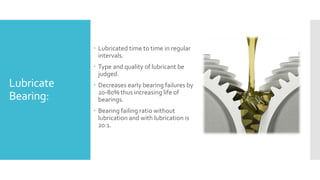
 Lubricated time to time in regular
intervals.
 Type and quality of lubricant be
judged.
 Decreases early bearing failures by
20-80% thus increasing life of
bearings.
 Bearing failing ratio without
lubrication and with lubrication is
20:1.
Thank You.

Mechanical Maintenance

  • 1.
    Mechanical Maintenance Submitted to: Anshu KumarSinha Asst. Professor SHRI VAISHNAV Institute of Technology and Science, Indore Submitted by: AshutoshTomar 0802ME141018
  • 3.
    Contents:  Maintenance andterms  Preventive Maintenance  Corrective Maintenance  Operational Maintenance  Lubrication  Advantages
  • 4.
    What is Maintenance? &Why?  Maintenanceinvolves keeping the workplace, its structures, equipment, machines, furniture and facilities in good repair and operating efficiently and safely.  It includes repairing, replacing, servicing, inspecting and testing.  To keep premises, equipment, machines and the work environment safe and reliable.  Lack of maintenance or inadequate maintenance can lead to dangerous situations, accidents and health problems.  The actual cost for a breakdown is between four to fifteen times the maintenance costs. When the breakdown causes production to stop, the costs are very high because no parts are being produced.
  • 5.
    Mech Maintenance Terms & Definitions: Mechanical MaintenanceTypes: Preventive maintenance: It is to maximize equipment availability and minimize product defects by taking care of the equipment before the problems arise. Repair costs are often, but not always, higher than the cost of preventive maintenance. Failure Oriented Maintenance:  Corrective maintenance: It is unscheduled maintenance to return equipment to working state and carried out because maintenance perceived deficiencies or failures.
  • 6.
    Terms & Definitions:  Predictivemaintenance:The use of modern measurement and signal processing methods to accurately diagnose equipment condition during operation.  Maintenance concept: A statement of the overall concept of the product specification that controls the type of maintenance action to be employed for the item under consideration.  Maintenance plan:A document that outlines the management and technical procedure to be employed to maintain an item; usually describes facilities, tools, schedules, and resources.  Reliability:The probability that an item will perform its stated function satisfactorily for the desired period when used per the specified conditions.
  • 7.
    Terms & Definitions:  Maintainability:Theprobability that a failed item will be restored to adequately working condition.  Active repair time:The component of downtime when repair persons are active to effect a repair.  Mean time to repair (MTTR):A figure of merit depending on item maintainability equal to the mean item repair time. In the case of exponentially distributed times to repair, MTTR is the reciprocal of the repair rate.
  • 8.
    Terms & Definitions:  Quality:Thedegree to which an item, function, or process satisfies requirements of customer and user.  Maintenance person:An individual who conducts preventive maintenance and responds to a user’s service call to a repair facility, and performs corrective maintenance on an item. Also called custom engineer, service person, technician, field engineer, mechanic, repair person, etc.  Inspection:The qualitative observation of an item’s performance or condition.
  • 9.
    Preventive Maintenance: The costs ofpreventive maintenance include:  Labour costs to plan and manage the schedule  Labour costs to perform the maintenance  Machine downtime while maintenance is performed: loss of production and idled workers  Cost of materials or supplies to perform the maintenance The benefits of preventive maintenance include:  Fewer unexpected outages caused by machine breakdown  Avoiding high costs for repair  Fewer defective products, leading to lower cost for rework  Continued high standards for safety
  • 10.
    Operational Maintenance:  It consistsof inspecting, cleaning, servicing, preserving, lubricating, and adjusting, as required.  Its purpose is threefold:  (1) to make the operator aware of the state of readiness of the equipment;  (2) to reduce the delays that would occur if a qualified technician had to be called every time a simple adjustment were needed;  (3) to release technicians for more complicated work  Replacing worn out filters or cartridges, or removing and replacing a worn belt, cutting tool, or grinding stone.
  • 11.
    Corrective Maintenance: Activities undertaken todetect, isolate, and rectify a fault so that the failed equipment, machine, or system can be restored to its normal operable state.  The main objective is to maximize the effectiveness of all critical plant system, the elimination of breakdowns, unnecessary repair, & the reduction of the deviations from optimum operating conditions.  Performed after failure detection  Its activities are planned & regularly taken out to keep plant's m/c & equipment in optimum operating condition.
  • 12.
    Zero Hours Maintenance (Overhaul): Zero HoursMaintenance (Overhaul):The set of tasks whose goal is to review the equipment at scheduled intervals before appearing any failure, either when the reliability of the equipment has decreased considerably so it is risky to make forecasts of production capacity .This review is based on leaving the equipment to zero hours of operation, that is, as if the equipment were new.These reviews will replace or repair all items subject to wear.The aim is to ensure, with high probability, a good working time fixed in advance.
  • 13.
    Periodic maintenance (Time Based Maintenance TBM): Periodic maintenance(Time Based MaintenanceTBM): the basic maintenance of equipment made by the users of it. It consists of a series of elementary tasks (data collections, visual inspections, cleaning, lubrication, retightening screws,…) for which no extensive training is necessary, but perhaps only a brief training. This type of maintenance is the based onTPM (Total Productive Maintenance).
  • 14.
    Maintenance models A. CORRECTIVE MODEL Thisis the most basic model, and includes, in addition to visual inspections and lubrication, the arising breakdowns repair. It is applied, as we will see, to equipments with the lowest level of criticality, whose faults are not a problem, economically or technically. In this type of equipment is not profitable to devote more resources and efforts. B. CONDITIONAL MODEL It includes the activities of the previous model, and also this model carries out a series of tests that will determine a subsequent action. If after testing we discovered an anomaly, we will schedule an intervention; on the contrary, if everything is correct, we will not act on the equipment. This maintenance model is valid in equipment not to very used, or for equipment that despite being important in the production system the probability of failure is low.
  • 15.
    Maintenance Models C. SYSTEMATIC MODELS: This model includes a set of tasks we will perform no matter what is the condition of the equipment , also we will perform some measurements and tests to decide whether to carry out other tasks of greater magnitude, and finally, we will repair faults that arise. Examples: 1.The landing gear of an aircraft 2.The engine of an aircraft
  • 16.
    High Availability Maintenance Models:  It isapplied to that equipment that under no circumstances may suffer a breakdown or malfunction.These are equipments to whom are also required very high levels of availability, above 90%. Examples of this model of maintenance may be:  Rotating equipment working continuously  Turbine of power production  high temperature furnaces, where an intervention means cooling and re-heating the furnace, resulting in energy expense and production losses associated with it.  Reactor deposits or reaction tanks not duplicated that are the basis of production and to be kept in operation as many hours as possible.
  • 17.
    Legal Maintenance: Some of theequipment subjected to this type of maintenance are:  Equipment and devices under pressure  Installation of High and MediumVoltage  CoolingTowers  Certain lifts: service or people  Vehicles  Fire Prevention Facilities  Storage tanks of certain chemicals
  • 18.
    Lubricate Bearing:  Lubricated timeto time in regular intervals.  Type and quality of lubricant be judged.  Decreases early bearing failures by 20-80% thus increasing life of bearings.  Bearing failing ratio without lubrication and with lubrication is 20:1.
  • 19.