1
2
3
4
5
6
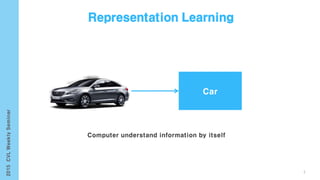
Car
7
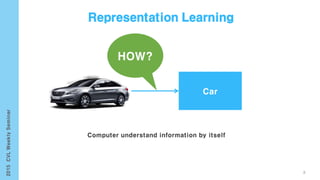
Car
HOW?
8
H
V
9
All
10
V
All
H
11
All
HV
12
All
HV
HVV
13
All
HV
HVV
14
H VV
V VV
15
H VV
V VV
16
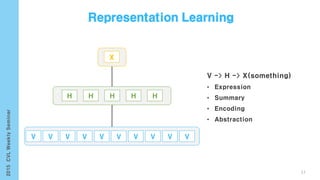
V V V V V V V V V V
H H H H H
X
17
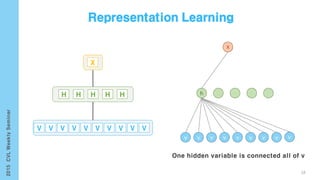
V V V V V V V V V V
H H H H H
X
v v vv v v v
X
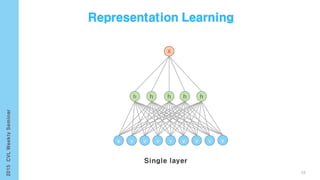
18
X
h h h h
v v vv v v v
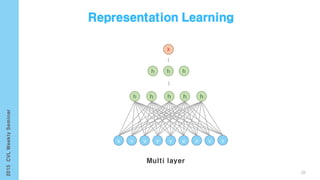
19
X
v v vv v v v
h h h h
20
X
v v vv v v v
h h h h
21
X
v v vv v v v
h h h h
abstraction
abstraction
22
X
v v vv v v v
h h h h
abstraction
abstraction
23
24
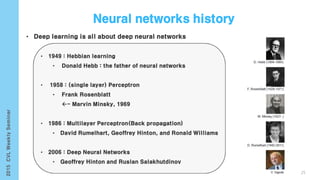
• Deep learning is all about deep neural networks
• 1949 : Hebbian learning
• Donald Hebb : the father of neural networks
• 1958 : (single layer) Perceptron
• Frank Rosenblatt
- Marvin Minsky, 1969
• 1986 : Multilayer Perceptron(Back propagation)
• David Rumelhart, Geoffrey Hinton, and Ronald Williams
• 2006 : Deep Neural Networks
• Geoffrey Hinton and Ruslan Salakhutdinov
25
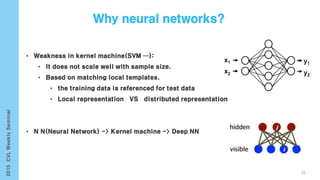
• Weakness in kernel machine(SVM …):
• It does not scale well with sample size.
• Based on matching local templates.
• the training data is referenced for test data
• Local representation VS distributed representation
• N N(Neural Network) -> Kernel machine -> Deep NN
26
27
28
29
30
31
32
33
34
35
36
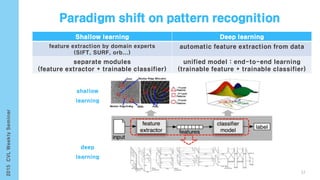
Shallow learning Deep learning
feature extraction by domain experts
(SIFT, SURF, orb...)
automatic feature extraction from data
separate modules
(feature extractor + trainable classifier)
unified model : end-to-end learning
(trainable feature + trainable classifier)
37
38
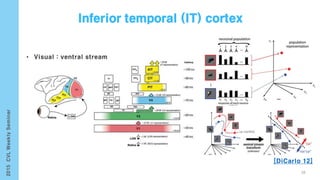
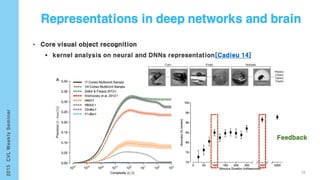
• Core visual object recognition
Feedback
39
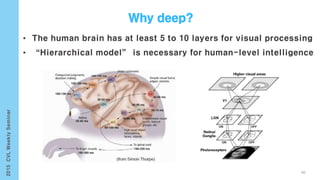
40
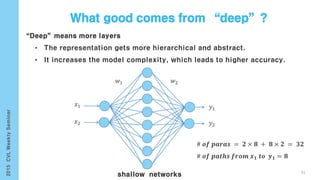
41
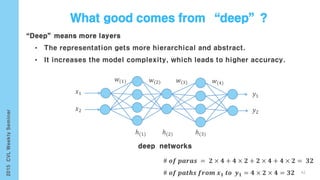
42
43
44
45
46
47
48
49
50
51
52
𝑥 𝑡
ℎ 𝑡
=
𝑥0
ℎ0
𝑥2
ℎ2
𝑥1
ℎ1
𝑥 𝑡
ℎ 𝑡
…
[http://karpathy.github.io/2015/05/21/rnn-effectiveness]53
• Bidirection Neural Network utilize in the past and future context for
every point in the sequence
• Two Hidden Layer(Forwards and Backwards) shared same output layer
Visualized of the amount of input information for prediction by different network structures
[Schuster 97]
54
55
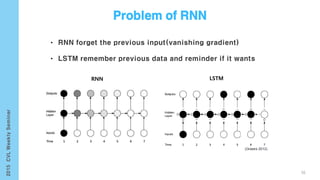
RNN LSTM
• RNN forget the previous input(vanishing gradient)
• LSTM remember previous data and reminder if it wants
56
ℎ 𝑡−1(𝑝𝑟𝑒𝑣 𝑟𝑒𝑠𝑢𝑙𝑡)
𝜎
𝑥 𝑡(𝑐𝑢𝑟𝑟𝑒𝑛𝑡 𝑑𝑎𝑡𝑎)
𝐶𝑡−1 𝐶𝑡
𝑓𝑡 = 𝜎(𝑊𝑓 ∙ ℎ 𝑡−1, 𝑥 𝑡 + 𝑏𝑓)
𝑓𝑡
[http://colah.github.io/posts/2015-08-Understanding-LSTMs]
57
ℎ 𝑡−1(𝑝𝑟𝑒𝑣 𝑟𝑒𝑠𝑢𝑙𝑡)
𝜎
𝑥 𝑡(𝑐𝑢𝑟𝑟𝑒𝑛𝑡 𝑑𝑎𝑡𝑎)
𝐶𝑡−1 𝐶𝑡
𝑖 𝑡 = 𝜎(𝑊𝑖 ∙ ℎ 𝑡−1, 𝑥 𝑡 + 𝑏𝑖)
𝜎
𝑓𝑡
𝑖 𝑡
𝑡𝑎𝑛ℎ
𝐶𝑡
𝐶𝑡 = 𝑡𝑎𝑛ℎ(𝑊𝑐 ∙ ℎ 𝑡−1, 𝑥 𝑡 + 𝑏 𝑐)
58
[http://colah.github.io/posts/2015-08-Understanding-LSTMs]
ℎ 𝑡−1(𝑝𝑟𝑒𝑣 𝑟𝑒𝑠𝑢𝑙𝑡)
𝜎
𝑥 𝑡(𝑐𝑢𝑟𝑟𝑒𝑛𝑡 𝑑𝑎𝑡𝑎)
𝐶𝑡−1 𝐶𝑡
𝐶𝑡 = 𝑓𝑡 ∗ 𝐶𝑡−1 + 𝑖 𝑡 ∗ 𝐶𝑡
𝜎
𝑓𝑡
𝑖 𝑡
𝑡𝑎𝑛ℎ
𝐶𝑡
ⅹ
+ⅹ
59
[http://colah.github.io/posts/2015-08-Understanding-LSTMs]
ℎ 𝑡−1(𝑝𝑟𝑒𝑣 𝑟𝑒𝑠𝑢𝑙𝑡)
𝜎
𝑥 𝑡(𝑐𝑢𝑟𝑟𝑒𝑛𝑡 𝑑𝑎𝑡𝑎)
𝐶𝑡−1 𝐶𝑡
𝑂𝑡 = 𝜎(𝑊𝑜 ∙ ℎ 𝑡−1, 𝑥 𝑡 + 𝑏 𝑜)
𝜎
𝑓𝑡
𝑖 𝑡
𝑡𝑎𝑛ℎ
𝐶𝑡
ⅹ
+ⅹ
𝜎
ⅹ
𝑡𝑎𝑛ℎ
ℎ 𝑡
ℎ 𝑡
ℎ 𝑡 = 𝑂𝑡 ∗ 𝑡𝑎nh(𝐶𝑡)
60
[http://colah.github.io/posts/2015-08-Understanding-LSTMs]
61
• Dropout operator only to non-recurrent connections
[Zaremba14]
Arrow dash applied dropout otherwise solid line is not applied
ℎ 𝑡
𝑙
: hidden state in layer 𝑙 in timestep 𝑡.
dropout operator
Frame-level speech recognition accuracy
decode
encode
V1
W1
X2
X1
X1
V1
W1
X2
X1
X1
X2
V2
W2
X3
• Regress from observation to itself (input X1 -> output X1)
• ex : data compression(JPEG etc..)
[Lemme 10]
62
output
hidden
input
0 1 0 0…
0.05 0.7 0.5 0.01…
0.9 0.1 10−8…10−4
cow dog cat bus
original target
output of ensemble
[Hinton 14]
Softened outputs reveal the dark knowledge in the ensemble
dog
dog
training result
cat buscow
dog cat buscow
63
• Distribution of the top layer has more information.
• Model size in DNN can increase up to tens of GB
input
target
input
output
Training a DNN
Training a shallow network
64
[Hinton 14]
65
0 1 0 0 0 0 0 0 0 0dog
0 0 1 0 0 0 0 0 0 0cat
• Word embedding 𝑊: 𝑤𝑜𝑟𝑑𝑠 → ℝ 𝑛 function mapping to high-dimensional vectors
0.3 0.2 0.1 0.5 0.7dog
0.2 0.8 0.3 0.1 0.9cat
one hot vector representation
[Vinyals 14]
Nearest neighbors a few words
Word Embedding
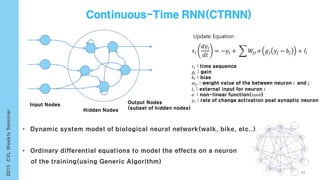
𝜏𝑖 : time sequence
𝑔𝑖 : gain
𝑏𝑖 : bias
𝑤𝑗𝑖 : weight value of the between neuron 𝑖 and 𝑗
𝐼𝑖 : external input for neuron 𝑖
𝜎 : non-linear function(𝑡𝑎𝑛ℎ)
𝑦𝑖 : rate of change activation post synaptic neuron
Input Nodes
Hidden Nodes
Output Nodes
(subset of hidden nodes)
𝜏𝑖
𝑑𝑦𝑖
𝑑𝑡
= −𝑦𝑖 + 𝑊𝑗𝑖 𝜎 𝑔𝑗 𝑦𝑗 − 𝑏𝑗 + 𝐼𝑖
Update Equation
66
• Dynamic system model of biological neural network(walk, bike, etc..)
• Ordinary differential equations to model the effects on a neuron
of the training(using Generic Algorithm)
67
68
69
70
71
72
73
74
75
76
77
78
79
80
81
82
83
84
85
86
87
88
89
90
91
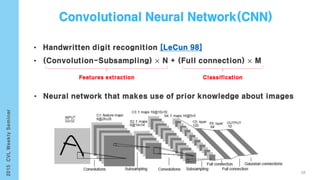
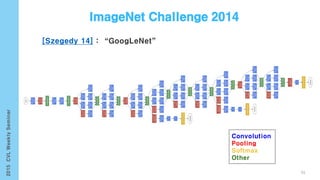
Convolution
Pooling
Softmax
Other
92
93
94
95
96
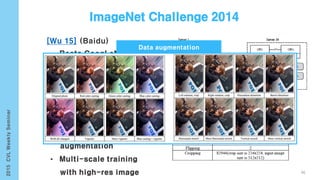
Data augmentation
97
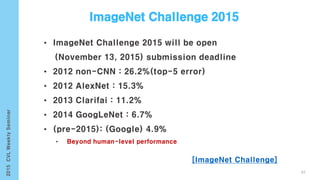
November 13, 2015) submission deadline
• (pre-2015): (Google) 4.9%
• Beyond human-level performance
98
99
100
[Karpathy 14]
[Girshick 13]
• Generate dense, free-from descriptions of images
Infer region word alignments use to R-CNN + BRNN + MRF
101
Image Segmentation(Graph Cut + Disjoint union)
[Karpathy 14]
Infer region word alignments use to R-CNN + BRNN + MRF
102
𝑆 𝑘𝑙 =
𝑡∈𝑔 𝑙 𝑖∈𝑔 𝑘
𝑚𝑎𝑥(0, 𝑣𝑖
𝑇
𝑆𝑡)
Result BRNN
Result RNN
𝑔𝑙
𝑔 𝑘
• 𝑆𝑡 and 𝑣𝑖 with their additional
Multiple Instance Learning
hⅹ4096 maxrix(h is 1000~1600)
t-dimensional word dictionary
[Karpathy 14]
103
𝐸 𝑎1, . . , 𝑎 𝑛 = 𝑎 𝑗=𝑡
−𝑠𝑖𝑚𝑖𝑙𝑎𝑟𝑖𝑡𝑦(𝑤𝑗, 𝑟𝑡) + 𝑗=1..𝑁−1 𝛽[𝑎𝑗 = 𝑎𝑗+1]
Smoothing with an MRF
• Best region independently align each other
• Similarity regions are arrangement nearby
• Argmin can found dynamic programming
(word, region)
104
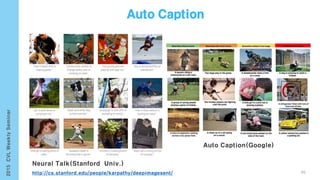
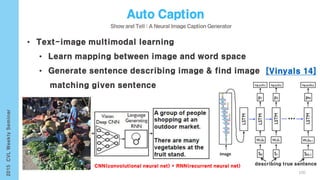
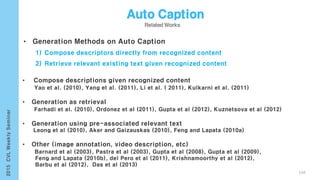
• Generation Methods on Auto Caption
1) Compose descriptors directly from recognized content
2) Retrieve relevant existing text given recognized content
• Compose descriptions given recognized content
Yao et al. (2010), Yang et al. (2011), Li et al. ( 2011), Kulkarni et al. (2011)
• Generation as retrieval
Farhadi et al. (2010), Ordonez et al (2011), Gupta et al (2012), Kuznetsova et al (2012)
• Generation using pre-associated relevant text
Leong et al (2010), Aker and Gaizauskas (2010), Feng and Lapata (2010a)
• Other (image annotation, video description, etc)
Barnard et al (2003), Pastra et al (2003), Gupta et al (2008), Gupta et al (2009),
Feng and Lapata (2010b), del Pero et al (2011), Krishnamoorthy et al (2012),
Barbu et al (2012), Das et al (2013)
105
106
107
• Divided to five part of human body(two arms, two legs, trunk)
• Modeling movements of these individual part and layer composed of 9
layers(BRNN, fusion layer, fully connection layer)
[Yong 15]
108
109
110
• “Maching Learning to Deep Learning by 곽동민
• http://www.cs.toronto.edu/~hinton/MatlabForSciencePaper.html
• convolutional neural networks : LeCun
• Alex Krizhevsky: Hinton (python, C++)
• https://code.google.com/p/cuda-convnet/
• Caffe: UC Berkeley (C++)
• http://caffe.berkeleyvision.org/
111
112

Computer vision lab seminar(deep learning) yong hoon

  • 1.
  • 2.
  • 3.
  • 4.
  • 5.
  • 6.
  • 7.
  • 8.
  • 9.
  • 10.
  • 11.
  • 12.
  • 13.
  • 14.
  • 15.
  • 16.
  • 17.
    V V VV V V V V V V H H H H H X 17
  • 18.
    V V VV V V V V V V H H H H H X v v vv v v v X 18
  • 19.
    X h h hh v v vv v v v 19
  • 20.
    X v v vvv v v h h h h 20
  • 21.
    X v v vvv v v h h h h 21
  • 22.
    X v v vvv v v h h h h abstraction abstraction 22
  • 23.
    X v v vvv v v h h h h abstraction abstraction 23
  • 24.
  • 25.
    • Deep learningis all about deep neural networks • 1949 : Hebbian learning • Donald Hebb : the father of neural networks • 1958 : (single layer) Perceptron • Frank Rosenblatt - Marvin Minsky, 1969 • 1986 : Multilayer Perceptron(Back propagation) • David Rumelhart, Geoffrey Hinton, and Ronald Williams • 2006 : Deep Neural Networks • Geoffrey Hinton and Ruslan Salakhutdinov 25
  • 26.
    • Weakness inkernel machine(SVM …): • It does not scale well with sample size. • Based on matching local templates. • the training data is referenced for test data • Local representation VS distributed representation • N N(Neural Network) -> Kernel machine -> Deep NN 26
  • 27.
  • 28.
  • 29.
  • 30.
  • 31.
  • 32.
  • 33.
  • 34.
  • 35.
  • 36.
  • 37.
    Shallow learning Deeplearning feature extraction by domain experts (SIFT, SURF, orb...) automatic feature extraction from data separate modules (feature extractor + trainable classifier) unified model : end-to-end learning (trainable feature + trainable classifier) 37
  • 38.
  • 39.
    • Core visualobject recognition Feedback 39
  • 40.
  • 41.
  • 42.
  • 43.
  • 44.
  • 45.
  • 46.
  • 47.
  • 48.
  • 49.
  • 50.
  • 51.
  • 52.
  • 53.
    𝑥 𝑡 ℎ 𝑡 = 𝑥0 ℎ0 𝑥2 ℎ2 𝑥1 ℎ1 𝑥𝑡 ℎ 𝑡 … [http://karpathy.github.io/2015/05/21/rnn-effectiveness]53
  • 54.
    • Bidirection NeuralNetwork utilize in the past and future context for every point in the sequence • Two Hidden Layer(Forwards and Backwards) shared same output layer Visualized of the amount of input information for prediction by different network structures [Schuster 97] 54
  • 55.
  • 56.
    RNN LSTM • RNNforget the previous input(vanishing gradient) • LSTM remember previous data and reminder if it wants 56
  • 57.
    ℎ 𝑡−1(𝑝𝑟𝑒𝑣 𝑟𝑒𝑠𝑢𝑙𝑡) 𝜎 𝑥𝑡(𝑐𝑢𝑟𝑟𝑒𝑛𝑡 𝑑𝑎𝑡𝑎) 𝐶𝑡−1 𝐶𝑡 𝑓𝑡 = 𝜎(𝑊𝑓 ∙ ℎ 𝑡−1, 𝑥 𝑡 + 𝑏𝑓) 𝑓𝑡 [http://colah.github.io/posts/2015-08-Understanding-LSTMs] 57
  • 58.
    ℎ 𝑡−1(𝑝𝑟𝑒𝑣 𝑟𝑒𝑠𝑢𝑙𝑡) 𝜎 𝑥𝑡(𝑐𝑢𝑟𝑟𝑒𝑛𝑡 𝑑𝑎𝑡𝑎) 𝐶𝑡−1 𝐶𝑡 𝑖 𝑡 = 𝜎(𝑊𝑖 ∙ ℎ 𝑡−1, 𝑥 𝑡 + 𝑏𝑖) 𝜎 𝑓𝑡 𝑖 𝑡 𝑡𝑎𝑛ℎ 𝐶𝑡 𝐶𝑡 = 𝑡𝑎𝑛ℎ(𝑊𝑐 ∙ ℎ 𝑡−1, 𝑥 𝑡 + 𝑏 𝑐) 58 [http://colah.github.io/posts/2015-08-Understanding-LSTMs]
  • 59.
    ℎ 𝑡−1(𝑝𝑟𝑒𝑣 𝑟𝑒𝑠𝑢𝑙𝑡) 𝜎 𝑥𝑡(𝑐𝑢𝑟𝑟𝑒𝑛𝑡 𝑑𝑎𝑡𝑎) 𝐶𝑡−1 𝐶𝑡 𝐶𝑡 = 𝑓𝑡 ∗ 𝐶𝑡−1 + 𝑖 𝑡 ∗ 𝐶𝑡 𝜎 𝑓𝑡 𝑖 𝑡 𝑡𝑎𝑛ℎ 𝐶𝑡 ⅹ +ⅹ 59 [http://colah.github.io/posts/2015-08-Understanding-LSTMs]
  • 60.
    ℎ 𝑡−1(𝑝𝑟𝑒𝑣 𝑟𝑒𝑠𝑢𝑙𝑡) 𝜎 𝑥𝑡(𝑐𝑢𝑟𝑟𝑒𝑛𝑡 𝑑𝑎𝑡𝑎) 𝐶𝑡−1 𝐶𝑡 𝑂𝑡 = 𝜎(𝑊𝑜 ∙ ℎ 𝑡−1, 𝑥 𝑡 + 𝑏 𝑜) 𝜎 𝑓𝑡 𝑖 𝑡 𝑡𝑎𝑛ℎ 𝐶𝑡 ⅹ +ⅹ 𝜎 ⅹ 𝑡𝑎𝑛ℎ ℎ 𝑡 ℎ 𝑡 ℎ 𝑡 = 𝑂𝑡 ∗ 𝑡𝑎nh(𝐶𝑡) 60 [http://colah.github.io/posts/2015-08-Understanding-LSTMs]
  • 61.
    61 • Dropout operatoronly to non-recurrent connections [Zaremba14] Arrow dash applied dropout otherwise solid line is not applied ℎ 𝑡 𝑙 : hidden state in layer 𝑙 in timestep 𝑡. dropout operator Frame-level speech recognition accuracy
  • 62.
    decode encode V1 W1 X2 X1 X1 V1 W1 X2 X1 X1 X2 V2 W2 X3 • Regress fromobservation to itself (input X1 -> output X1) • ex : data compression(JPEG etc..) [Lemme 10] 62 output hidden input
  • 63.
    0 1 00… 0.05 0.7 0.5 0.01… 0.9 0.1 10−8…10−4 cow dog cat bus original target output of ensemble [Hinton 14] Softened outputs reveal the dark knowledge in the ensemble dog dog training result cat buscow dog cat buscow 63
  • 64.
    • Distribution ofthe top layer has more information. • Model size in DNN can increase up to tens of GB input target input output Training a DNN Training a shallow network 64 [Hinton 14]
  • 65.
    65 0 1 00 0 0 0 0 0 0dog 0 0 1 0 0 0 0 0 0 0cat • Word embedding 𝑊: 𝑤𝑜𝑟𝑑𝑠 → ℝ 𝑛 function mapping to high-dimensional vectors 0.3 0.2 0.1 0.5 0.7dog 0.2 0.8 0.3 0.1 0.9cat one hot vector representation [Vinyals 14] Nearest neighbors a few words Word Embedding
  • 66.
    𝜏𝑖 : timesequence 𝑔𝑖 : gain 𝑏𝑖 : bias 𝑤𝑗𝑖 : weight value of the between neuron 𝑖 and 𝑗 𝐼𝑖 : external input for neuron 𝑖 𝜎 : non-linear function(𝑡𝑎𝑛ℎ) 𝑦𝑖 : rate of change activation post synaptic neuron Input Nodes Hidden Nodes Output Nodes (subset of hidden nodes) 𝜏𝑖 𝑑𝑦𝑖 𝑑𝑡 = −𝑦𝑖 + 𝑊𝑗𝑖 𝜎 𝑔𝑗 𝑦𝑗 − 𝑏𝑗 + 𝐼𝑖 Update Equation 66 • Dynamic system model of biological neural network(walk, bike, etc..) • Ordinary differential equations to model the effects on a neuron of the training(using Generic Algorithm)
  • 67.
  • 68.
  • 69.
  • 70.
  • 71.
  • 72.
  • 73.
  • 74.
  • 75.
  • 76.
  • 77.
  • 78.
  • 79.
  • 80.
  • 81.
  • 82.
  • 83.
  • 84.
  • 85.
  • 86.
  • 87.
  • 88.
  • 89.
  • 90.
  • 91.
  • 92.
  • 93.
  • 94.
  • 95.
  • 96.
  • 97.
    97 November 13, 2015)submission deadline • (pre-2015): (Google) 4.9% • Beyond human-level performance
  • 98.
  • 99.
  • 100.
  • 101.
    [Karpathy 14] [Girshick 13] •Generate dense, free-from descriptions of images Infer region word alignments use to R-CNN + BRNN + MRF 101 Image Segmentation(Graph Cut + Disjoint union)
  • 102.
    [Karpathy 14] Infer regionword alignments use to R-CNN + BRNN + MRF 102 𝑆 𝑘𝑙 = 𝑡∈𝑔 𝑙 𝑖∈𝑔 𝑘 𝑚𝑎𝑥(0, 𝑣𝑖 𝑇 𝑆𝑡) Result BRNN Result RNN 𝑔𝑙 𝑔 𝑘 • 𝑆𝑡 and 𝑣𝑖 with their additional Multiple Instance Learning hⅹ4096 maxrix(h is 1000~1600) t-dimensional word dictionary
  • 103.
    [Karpathy 14] 103 𝐸 𝑎1,. . , 𝑎 𝑛 = 𝑎 𝑗=𝑡 −𝑠𝑖𝑚𝑖𝑙𝑎𝑟𝑖𝑡𝑦(𝑤𝑗, 𝑟𝑡) + 𝑗=1..𝑁−1 𝛽[𝑎𝑗 = 𝑎𝑗+1] Smoothing with an MRF • Best region independently align each other • Similarity regions are arrangement nearby • Argmin can found dynamic programming (word, region)
  • 104.
    104 • Generation Methodson Auto Caption 1) Compose descriptors directly from recognized content 2) Retrieve relevant existing text given recognized content • Compose descriptions given recognized content Yao et al. (2010), Yang et al. (2011), Li et al. ( 2011), Kulkarni et al. (2011) • Generation as retrieval Farhadi et al. (2010), Ordonez et al (2011), Gupta et al (2012), Kuznetsova et al (2012) • Generation using pre-associated relevant text Leong et al (2010), Aker and Gaizauskas (2010), Feng and Lapata (2010a) • Other (image annotation, video description, etc) Barnard et al (2003), Pastra et al (2003), Gupta et al (2008), Gupta et al (2009), Feng and Lapata (2010b), del Pero et al (2011), Krishnamoorthy et al (2012), Barbu et al (2012), Das et al (2013)
  • 105.
  • 106.
  • 107.
  • 108.
    • Divided tofive part of human body(two arms, two legs, trunk) • Modeling movements of these individual part and layer composed of 9 layers(BRNN, fusion layer, fully connection layer) [Yong 15] 108
  • 109.
  • 110.
  • 111.
    • “Maching Learningto Deep Learning by 곽동민 • http://www.cs.toronto.edu/~hinton/MatlabForSciencePaper.html • convolutional neural networks : LeCun • Alex Krizhevsky: Hinton (python, C++) • https://code.google.com/p/cuda-convnet/ • Caffe: UC Berkeley (C++) • http://caffe.berkeleyvision.org/ 111
  • 112.

Editor's Notes

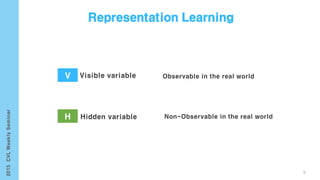
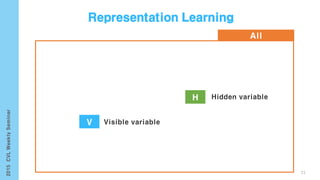
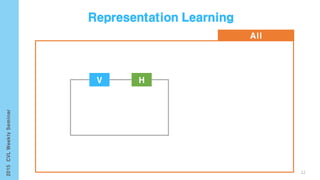
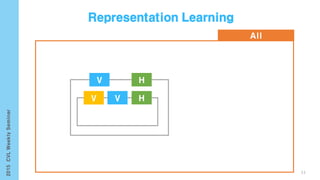
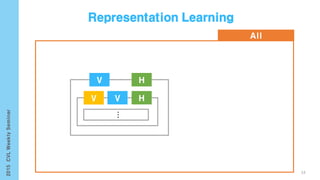
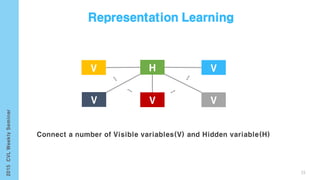
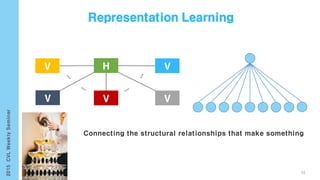
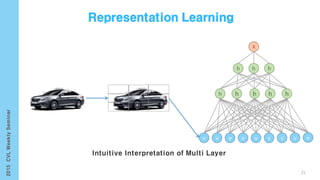
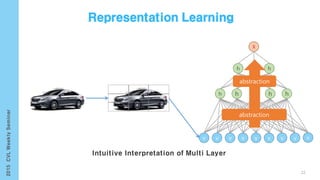
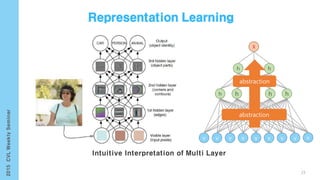
  • #10 Deep Learning의 핵심인 Hidden Variable(Latent Variable) 로 object의 representation을 표현함
  • #110 이홍락 : m.s ph.d stanford, michigan univ. 조교수