Evolution of Deep Learning:
New Methods and Applications
Chitta Ranjan, Ph.D.
Pandora Media.
Feb 15, 2018
nk.chitta.ranjan@gmail.com
1
Evolution of Deep Learning
Outline
• Background
• Challenges
• Solutions
2
Evolution of Deep Learning
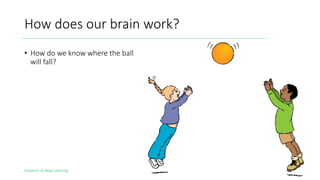
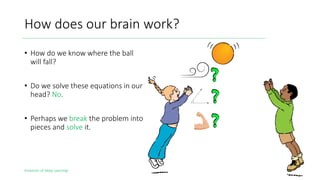
How does our brain work?
• How do we know where the ball
will fall?
3
Evolution of Deep Learning
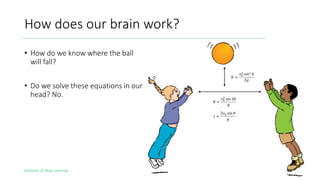
How does our brain work?
• How do we know where the ball
will fall?
• Do we solve these equations in our
head? No.
4
! =
#$
%
sin% )
2+
, =
#$
%
sin 2)
+
- =
2#$ sin )
+
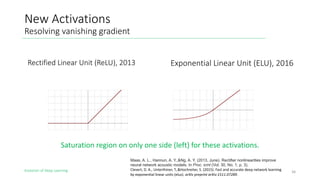
Evolution of Deep Learning
How does our brain work?
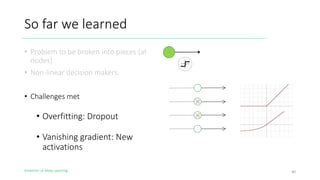
• How do we know where the ball
will fall?
• Do we solve these equations in our
head? No.
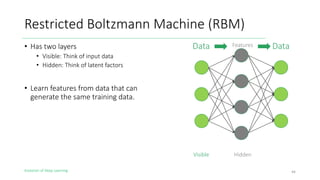
• Perhaps we break the problem into
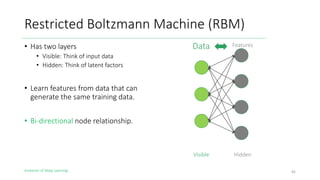
pieces and solve it.
5
Evolution of Deep Learning
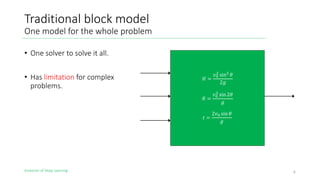
Traditional block model
One model for the whole problem
6
• One solver to solve it all.
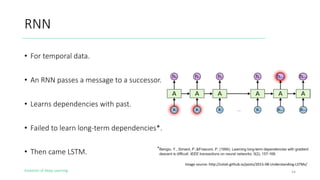
• Has limitation for complex
problems.
! =
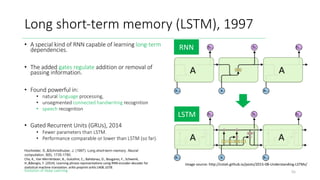
#$
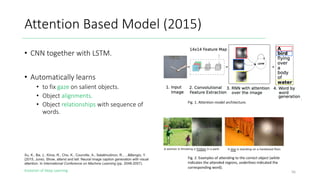
% sin% )
2+
, =
#$
% sin 2)
+
- =
2#$ sin )
+
Evolution of Deep Learning
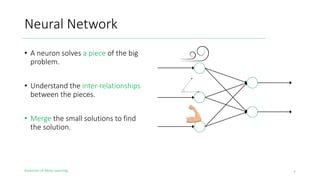
Neural Network
7
• A neuron solves a piece of the big
problem.
• Understand the inter-relationships
between the pieces.
• Merge the small solutions to find
the solution.
Evolution of Deep Learning
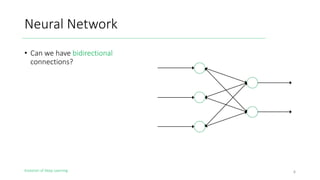
Neural Network
8
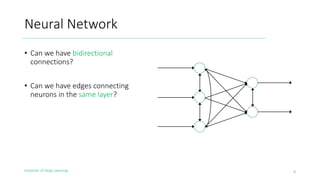
• Can we have bidirectional
connections?
Evolution of Deep Learning
Neural Network
9
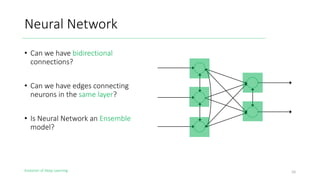
• Can we have bidirectional
connections?
• Can we have edges connecting
neurons in the same layer?
Evolution of Deep Learning
Neural Network
10
• Can we have bidirectional
connections?
• Can we have edges connecting
neurons in the same layer?
• Is Neural Network an Ensemble
model?
Evolution of Deep Learning
Birth of Neural Network
11
Evolution of Deep Learning
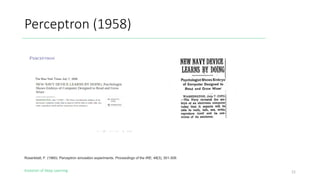
Perceptron (1958)
12
Rosenblatt, F. (1960). Perceptron simulation experiments. Proceedings of the IRE, 48(3), 301-309.
Evolution of Deep Learning
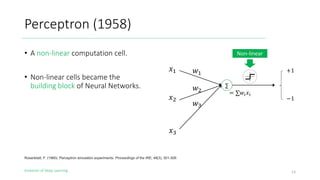
Perceptron (1958)
∑
!"
!#
!$
%"
%#
%$
= ∑%(!(
+1
−1
Non-linear
13
• A non-linear computation cell.
• Non-linear cells became the
building block of Neural Networks.
Rosenblatt, F. (1960). Perceptron simulation experiments. Proceedings of the IRE, 48(3), 301-309.
Evolution of Deep Learning
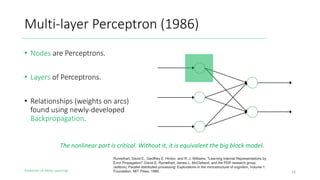
Multi-layer Perceptron (1986)
14
• Nodes are Perceptrons.
• Layers of Perceptrons.
• Relationships (weights on arcs)
found using newly-developed
Backpropagation.
The nonlinear part is critical. Without it, it is equivalent the big block model.
Rumelhart, David E., Geoffrey E. Hinton, and R. J. Williams. "Learning Internal Representations by
Error Propagation". David E. Rumelhart, James L. McClelland, and the PDP research group.
(editors), Parallel distributed processing: Explorations in the microstructure of cognition, Volume 1:
Foundation. MIT Press, 1986.
Evolution of Deep Learning
Multi-layer Perceptron (1986)
15
• Nodes are Perceptrons.
• Layers of Perceptrons.
• Relationships (weights on arcs)
found using newly-developed
Backpropagation.
The nonlinear part is critical. Without it, it is equivalent the big block model.
Evolution of Deep Learning
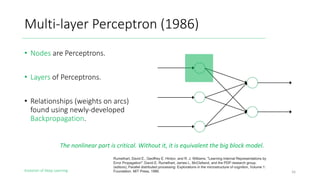
Multi-layer Perceptron (1986)
16
• Nodes are Perceptrons.
• Layers of Perceptrons.
• Relationships (weights on arcs)
found using newly-developed
Backpropagation.
The nonlinear part is critical. Without it, it is equivalent the big block model.
Rumelhart, David E., Geoffrey E. Hinton, and R. J. Williams. "Learning Internal Representations by
Error Propagation". David E. Rumelhart, James L. McClelland, and the PDP research group.
(editors), Parallel distributed processing: Explorations in the microstructure of cognition, Volume 1:
Foundation. MIT Press, 1986.
Evolution of Deep Learning
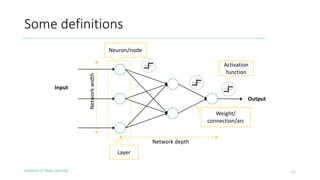
Some definitions
17
Activation
function
Neuron/node
Layer
Network depth
Networkwidth
Weight/
connection/arc
Input
Output
Evolution of Deep Learning
We learned..
18
Evolution of Deep Learning
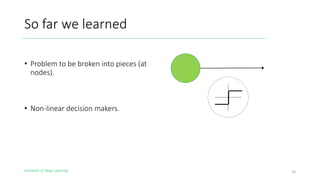
So far we learned
• Problem to be broken into pieces (at
nodes).
• Non-linear decision makers.
19
Evolution of Deep Learning
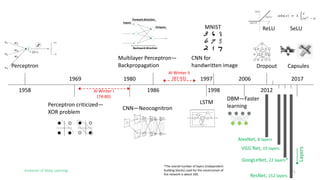
Timeline
20
Evolution of Deep Learning
1980
Capsules
SeLU
2017
Dropout
2012
ReLU
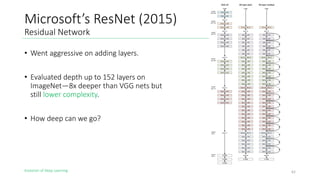
ResNet, 152 layers
GoogLeNet, 22 layers*
VGG Net, 19 layers
AlexNet, 8 layers
Layers
Perceptron
1958
1969
Perceptron criticized—
XOR problem
∑
!"
!#
!$
%"
%#
%$
= ∑%(!(
+1
−1
1987
1986
Multilayer Perceptron—
Backpropagation
Inputs
Outputs
Forward direction
Backward direction
AI Winter I
(74-80)
2006
CNN for
handwritten image
1998
CNN—Neocognitron
AI Winter II
(87-93) 1997
LSTM
DBM—Faster
learning
*The overall number of layers (independent
building blocks) used for the construction of
the network is about 100.
21
MNIST
Evolution of Deep Learning
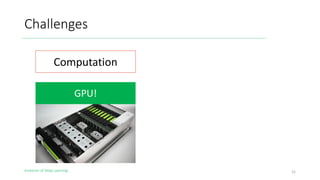
Challenges
Computation
GPU!
22
Evolution of Deep Learning
Challenges
Computation
GPU!
23
Evolution of Deep Learning
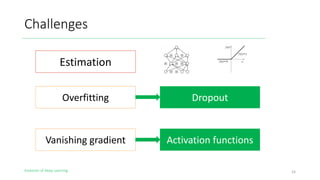
Challenges
Estimation
Overfitting
Vanishing gradient
Dropout
Activation functions
24
Evolution of Deep Learning
Dropout
25
Evolution of Deep Learning
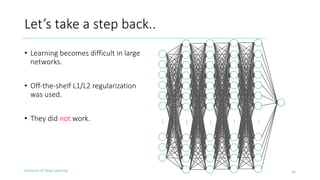
Let’s take a step back..
26
⋮ ⋮ ⋮ ⋮ ⋮
• Learning becomes difficult in large
networks.
• Off-the-shelf L1/L2 regularization
was used.
• They did not work.
Evolution of Deep Learning
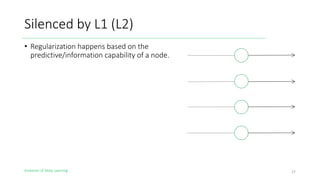
Silenced by L1 (L2)
• Regularization happens based on the
predictive/information capability of a node.
27
Evolution of Deep Learning
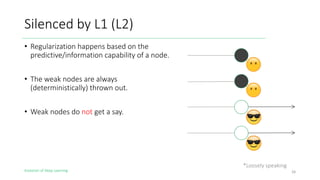
Silenced by L1 (L2)
• Regularization happens based on the
predictive/information capability of a node.
• The weak nodes are always
(deterministically) thrown out.
• Weak nodes do not get a say.
28
*Loosely speaking
Evolution of Deep Learning
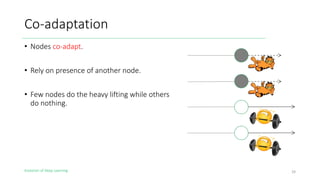
Co-adaptation
• Nodes co-adapt.
• Rely on presence of another node.
• Few nodes do the heavy lifting while others
do nothing.
29
Evolution of Deep Learning 30
Wide networks doesn’t really help.
Evolution of Deep Learning
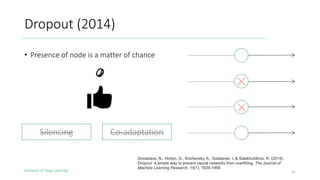
Dropout (2014)
• Presence of node is a matter of chance
31
Silencing Co-adaptation
Srivastava, N., Hinton, G., Krizhevsky, A., Sutskever, I.,& Salakhutdinov, R. (2014).
Dropout: A simple way to prevent neural networks from overfitting. The Journal of
Machine Learning Research, 15(1), 1929-1958.
Evolution of Deep Learning
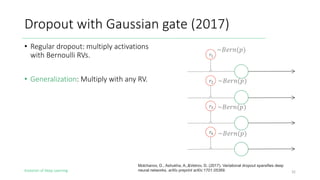
Dropout with Gaussian gate (2017)
• Regular dropout: multiply activations
with Bernoulli RVs.
• Generalization: Multiply with any RV.
32
!"
!#
!$
!%
~'(!)(+)
~'(!)(+)
~'(!)(+)
~'(!)(+)
Molchanov, D., Ashukha, A.,&Vetrov, D. (2017). Variational dropout sparsifies deep
neural networks. arXiv preprint arXiv:1701.05369.
Evolution of Deep Learning
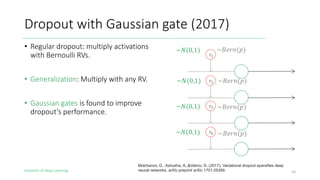
Dropout with Gaussian gate (2017)
• Regular dropout: multiply activations
with Bernoulli RVs.
• Generalization: Multiply with any RV.
• Gaussian gates is found to improve
dropout’s performance.
33
!"
!#
!$
!%
~'(!)(+)
~'(!)(+)
~'(!)(+)
~'(!)(+)
~-(0,1)
~-(0,1)
~-(0,1)
~-(0,1)
Molchanov, D., Ashukha, A.,&Vetrov, D. (2017). Variational dropout sparsifies deep
neural networks. arXiv preprint arXiv:1701.05369.
Evolution of Deep Learning
Activation functions
34
Evolution of Deep Learning
Vanishing Gradient in Deep Networks
35
⋮ ⋮ ⋮ ⋮ ⋮
""""
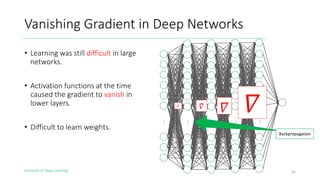
• Learning was still difficult in large
networks.
• Activation functions at the time
caused the gradient to vanish in
lower layers.
• Difficult to learn weights.
Backpropagation
Evolution of Deep Learning 36
Deep networks doesn’t really help.
Evolution of Deep Learning
Vanishing gradient
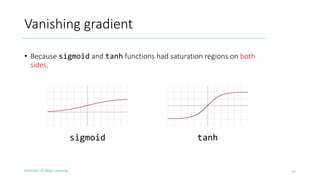
• Because sigmoid and tanh functions had saturation regions on both
sides.
37
sigmoid tanh
Evolution of Deep Learning
New Activations
Resolving vanishing gradient
Rectified Linear Unit (ReLU), 2013
38
Maas, A. L., Hannun, A. Y.,&Ng, A. Y. (2013, June). Rectifier nonlinearities improve
neural network acoustic models. In Proc. icml (Vol. 30, No. 1, p. 3).
Clevert, D. A., Unterthiner, T.,&Hochreiter, S. (2015). Fast and accurate deep network learning
by exponential linear units (elus). arXiv preprint arXiv:1511.07289.
Exponential Linear Unit (ELU), 2016
Saturation region on only one side (left) for these activations.
Evolution of Deep Learning
We learned..
39
Evolution of Deep Learning
So far we learned
• Problem to be broken into pieces (at
nodes).
• Non-linear decision makers.
• Challenges met
• Overfitting: Dropout
• Vanishing gradient: New
activations
40
Evolution of Deep Learning
Model types
41
Evolution of Deep Learning
Types of Models
• Unsupervised
• Deep Belief Networks (DBN)
• Supervised
• Feed-forward Neural Network (FNN)
• Recurrent Neural Network (RNN)
• Convolutional Neural Network (CNN)
42
Evolution of Deep Learning
Deep Belief Networks (DBN)
43
Evolution of Deep Learning
Restricted Boltzmann Machine (RBM)
• Has two layers
• Visible: Think of input data
• Hidden: Think of latent factors
• Learn features from data that can
generate the same training data.
44
HiddenVisible
FeaturesData Data
Evolution of Deep Learning
Restricted Boltzmann Machine (RBM)
• Has two layers
• Visible: Think of input data
• Hidden: Think of latent factors
• Learn features from data that can
generate the same training data.
• Bi-directional node relationship.
45
HiddenVisible
FeaturesData
Evolution of Deep Learning
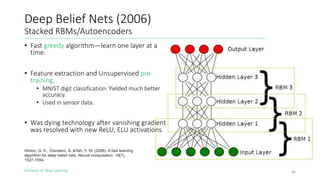
Deep Belief Nets (2006)
Stacked RBMs/Autoencoders
46
• Fast greedy algorithm—learn one layer at a
time.
• Feature extraction and Unsupervised pre-
training.
• MNIST digit classification: Yielded much better
accuracy.
• Used in sensor data.
• Was dying technology after vanishing gradient
was resolved with new ReLU, ELU activations.
Hinton, G. E., Osindero, S.,&Teh, Y. W. (2006). A fast learning
algorithm for deep belief nets. Neural computation, 18(7),
1527-1554.
Evolution of Deep Learning
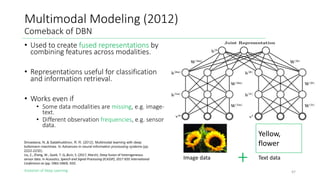
Multimodal Modeling (2012)
Comeback of DBN
Image data Text data
47
Yellow,
flower
+
• Used to create fused representations by
combining features across modalities.
• Representations useful for classification
and information retrieval.
• Works even if
• Some data modalities are missing, e.g. image-
text.
• Different observation frequencies, e.g. sensor
data.
Srivastava, N.,& Salakhutdinov, R. R. (2012). Multimodal learning with deep
boltzmann machines. In Advances in neural information processing systems (pp.
2222-2230).
Liu, Z., Zhang, W., Quek, T. Q.,&Lin, S. (2017, March). Deep fusion of heterogeneous
sensor data. In Acoustics, Speech and Signal Processing (ICASSP), 2017 IEEE International
Conference on (pp. 5965-5969). IEEE.
Evolution of Deep Learning
Feed-forward Neural Network (FNN)
48
Evolution of Deep Learning
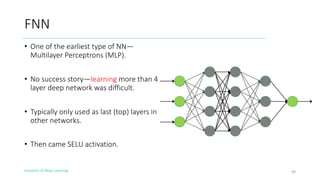
FNN
49
• One of the earliest type of NN—
Multilayer Perceptrons (MLP).
• No success story—learning more than 4
layer deep network was difficult.
• Typically only used as last (top) layers in
other networks.
• Then came SELU activation.
Evolution of Deep Learning
Scaled Exponential Linear Units (SELU), 2017
Self-normalizing Neural Networks. New life for FNNs.
50
Klambauer, G., Unterthiner, T., Mayr, A.,&Hochreiter, S. (2017). Self-normalizing neural networks.
In Advances in Neural Information Processing Systems (pp. 972-981).
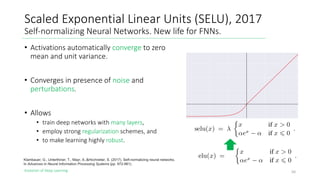
• Activations automatically converge to zero
mean and unit variance.
• Converges in presence of noise and
perturbations.
• Allows
• train deep networks with many layers,
• employ strong regularization schemes, and
• to make learning highly robust.
Evolution of Deep Learning
Recurrent Neural Network (RNN)
51
Evolution of Deep Learning
RNN
Image source: http://colah.github.io/posts/2015-08-Understanding-LSTMs/
52
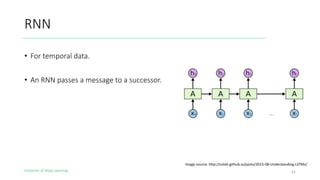
• For temporal data.
• An RNN passes a message to a successor.
Evolution of Deep Learning
RNN
Image source: http://colah.github.io/posts/2015-08-Understanding-LSTMs/
53
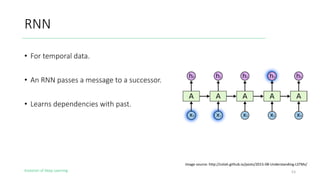
• For temporal data.
• An RNN passes a message to a successor.
• Learns dependencies with past.
Evolution of Deep Learning
RNN
Image source: http://colah.github.io/posts/2015-08-Understanding-LSTMs/
54
*Bengio, Y., Simard, P.,&Frasconi, P. (1994). Learning long-term dependencies with gradient
descent is difficult. IEEE transactions on neural networks, 5(2), 157-166.
• For temporal data.
• An RNN passes a message to a successor.
• Learns dependencies with past.
• Failed to learn long-term dependencies*.
• Then came LSTM.
Evolution of Deep Learning
Long short-term memory (LSTM), 1997
55
Image source: http://colah.github.io/posts/2015-08-Understanding-LSTMs/
RNN
LSTM
Hochreiter, S.,&Schmidhuber, J. (1997). Long short-term memory. Neural
computation, 9(8), 1735-1780.
Cho, K., Van Merriënboer, B., Gulcehre, C., Bahdanau, D., Bougares, F., Schwenk,
H.,&Bengio, Y. (2014). Learning phrase representations using RNN encoder-decoder for
statistical machine translation. arXiv preprint arXiv:1406.1078.
• A special kind of RNN capable of learning long-term
dependencies.
• The added gates regulate addition or removal of
passing information.
• Found powerful in:
• natural language processing,
• unsegmented connected handwriting recognition
• speech recognition
• Gated Recurrent Units (GRUs), 2014
• Fewer parameters than LSTM.
• Performance comparable or lower than LSTM (so far).
Evolution of Deep Learning
Attention Based Model (2015)
• CNN together with LSTM.
• Automatically learns
• to fix gaze on salient objects.
• Object alignments.
• Object relationships with sequence of
words.
56
Xu, K., Ba, J., Kiros, R., Cho, K., Courville, A., Salakhudinov, R., ...&Bengio, Y.
(2015, June). Show, attend and tell: Neural image caption generation with visual
attention. In International Conference on Machine Learning (pp. 2048-2057).
Fig. 1. Attention model architecture.
Fig. 2. Examples of attending to the correct object (white
indicates the attended regions, underlines indicated the
corresponding word).
Evolution of Deep Learning
Convolutional Neural Network (CNN)
57
Evolution of Deep Learning
CNN
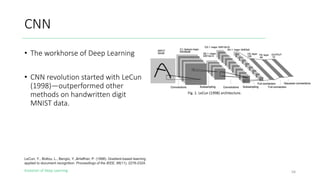
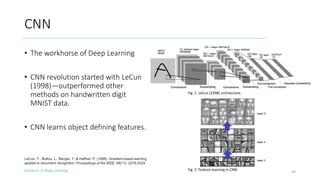
• The workhorse of Deep Learning
• CNN revolution started with LeCun
(1998)—outperformed other
methods on handwritten digit
MNIST data.
58
LeCun, Y., Bottou, L., Bengio, Y.,&Haffner, P. (1998). Gradient-based learning
applied to document recognition. Proceedings of the IEEE, 86(11), 2278-2324.
Fig. 1. LeCun (1998) architecture.
Evolution of Deep Learning
CNN
• The workhorse of Deep Learning
• CNN revolution started with LeCun
(1998)—outperformed other
methods on handwritten digit
MNIST data.
• CNN learns object defining features.
59
LeCun, Y., Bottou, L., Bengio, Y.,& Haffner, P. (1998). Gradient-based learning
applied to document recognition. Proceedings of the IEEE, 86(11), 2278-2324.
Fig. 1. LeCun (1998) architecture.
Fig. 2. Feature learning in CNN.
Evolution of Deep Learning
AlexNet (2012)
New estimation techniques
60
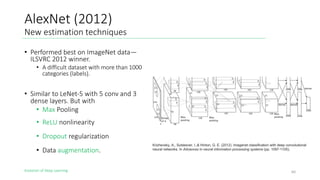
• Performed best on ImageNet data—
ILSVRC 2012 winner.
• A difficult dataset with more than 1000
categories (labels).
• Similar to LeNet-5 with 5 conv and 3
dense layers. But with
• Max Pooling
• ReLU nonlinearity
• Dropout regularization
• Data augmentation.
Krizhevsky, A., Sutskever, I.,& Hinton, G. E. (2012). Imagenet classification with deep convolutional
neural networks. In Advances in neural information processing systems (pp. 1097-1105).
Evolution of Deep Learning
GoogLeNet (2014)
Inception module
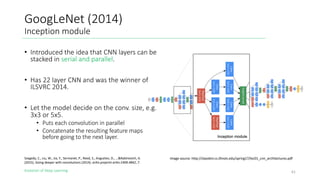
• Introduced the idea that CNN layers can be
stacked in serial and parallel.
• Has 22 layer CNN and was the winner of
ILSVRC 2014.
• Let the model decide on the conv. size, e.g.
3x3 or 5x5.
• Puts each convolution in parallel
• Concatenate the resulting feature maps
before going to the next layer.
61
Image source: http://slazebni.cs.illinois.edu/spring17/lec01_cnn_architectures.pdfSzegedy, C., Liu, W., Jia, Y., Sermanet, P., Reed, S., Anguelov, D., ...&Rabinovich, A.
(2015). Going deeper with convolutions (2014). arXiv preprint arXiv:1409.4842, 7.
Evolution of Deep Learning
Microsoft’s ResNet (2015)
Residual Network
• Went aggressive on adding layers.
• Evaluated depth up to 152 layers on
ImageNet—8x deeper than VGG nets but
still lower complexity.
• How deep can we go?
62
Evolution of Deep Learning
Microsoft’s ResNet (2015)
Residual Network
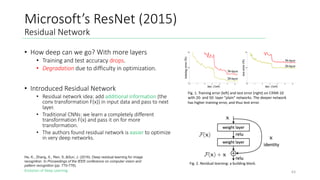
• How deep can we go? With more layers
• Training and test accuracy drops.
• Degradation due to difficulty in optimization.
• Introduced Residual Network
• Residual network idea: add additional information (the
conv transformation F(x)) in input data and pass to next
layer.
• Traditional CNNs: we learn a completely different
transformation F(x) and pass it on for more
transformation.
• The authors found residual network is easier to optimize
in very deep networks.
63
Fig. 1. Training error (left) and test error (right) on CIFAR-10
with 20- and 50- layer ”plain” networks. The deeper network
has higher training error, and thus test error.
Fig. 2. Residual learning: a building block.
He, K., Zhang, X., Ren, S.,&Sun, J. (2016). Deep residual learning for image
recognition. In Proceedings of the IEEE conference on computer vision and
pattern recognition (pp. 770-778).
Evolution of Deep Learning
Capsules (2017)
Going to the next level
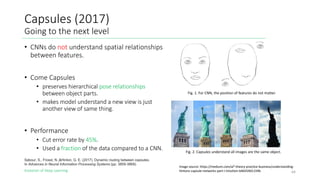
• CNNs do not understand spatial relationships
between features.
• Come Capsules
• preserves hierarchical pose relationships
between object parts.
• makes model understand a new view is just
another view of same thing.
• Performance
• Cut error rate by 45%.
• Used a fraction of the data compared to a CNN.
64
Fig. 1. For CNN, the position of features do not matter.
Image source: https://medium.com/ai³-theory-practice-business/understanding-
hintons-capsule-networks-part-i-intuition-b4b559d1159b
Sabour, S., Frosst, N.,&Hinton, G. E. (2017). Dynamic routing between capsules.
In Advances in Neural Information Processing Systems (pp. 3859-3869).
Fig. 2. Capsules understand all images are the same object.
Evolution of Deep Learning
We learned..
65
Evolution of Deep Learning
In summary, we learned
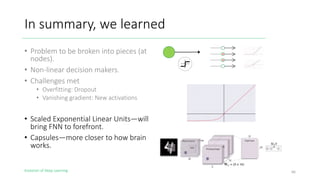
• Problem to be broken into pieces (at
nodes).
• Non-linear decision makers.
• Challenges met
• Overfitting: Dropout
• Vanishing gradient: New activations
• Scaled Exponential Linear Units—will
bring FNN to forefront.
• Capsules—more closer to how brain
works.
66
Evolution of Deep Learning
In summary, we learned
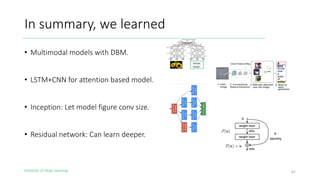
• Multimodal models with DBM.
• LSTM+CNN for attention based model.
• Inception: Let model figure conv size.
• Residual network: Can learn deeper.
67
Yellow,
flower
Evolution of Deep Learning
Thank you!
68
Evolution of Deep Learning
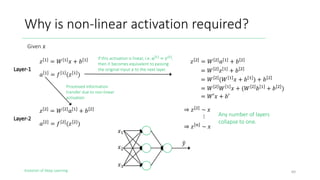
Why is non-linear activation required?
69
!"
!#
!$
%&
Given !
' " = ) " ! + + "
, " = - " (' " )
' #
= ) #
, "
+ + #
, #
= - #
(' #
)
Layer-1
Layer-2
' # = ) # , " + + #
= ) # ' " + + #
= ) #
() "
! + + "
) + + #
= ) #
) "
! + () #
+ "
+ + #
)
= )′! + +′
⇒ ' #
~	!
⇒ ' 4 ~	!
⋮ Any number of layers
collapse to one.
Processed information
transfer due to non-linear
activation
If this activation is linear, i.e. , "
= ' "
,
then it becomes equivalent to passing
the original input ! to the next layer.

Evolution of Deep Learning and new advancements

  • 1.
    Evolution of DeepLearning: New Methods and Applications Chitta Ranjan, Ph.D. Pandora Media. Feb 15, 2018 nk.chitta.ranjan@gmail.com 1
  • 2.
    Evolution of DeepLearning Outline • Background • Challenges • Solutions 2
  • 3.
    Evolution of DeepLearning How does our brain work? • How do we know where the ball will fall? 3
  • 4.
    Evolution of DeepLearning How does our brain work? • How do we know where the ball will fall? • Do we solve these equations in our head? No. 4 ! = #$ % sin% ) 2+ , = #$ % sin 2) + - = 2#$ sin ) +
  • 5.
    Evolution of DeepLearning How does our brain work? • How do we know where the ball will fall? • Do we solve these equations in our head? No. • Perhaps we break the problem into pieces and solve it. 5
  • 6.
    Evolution of DeepLearning Traditional block model One model for the whole problem 6 • One solver to solve it all. • Has limitation for complex problems. ! = #$ % sin% ) 2+ , = #$ % sin 2) + - = 2#$ sin ) +
  • 7.
    Evolution of DeepLearning Neural Network 7 • A neuron solves a piece of the big problem. • Understand the inter-relationships between the pieces. • Merge the small solutions to find the solution.
  • 8.
    Evolution of DeepLearning Neural Network 8 • Can we have bidirectional connections?
  • 9.
    Evolution of DeepLearning Neural Network 9 • Can we have bidirectional connections? • Can we have edges connecting neurons in the same layer?
  • 10.
    Evolution of DeepLearning Neural Network 10 • Can we have bidirectional connections? • Can we have edges connecting neurons in the same layer? • Is Neural Network an Ensemble model?
  • 11.
    Evolution of DeepLearning Birth of Neural Network 11
  • 12.
    Evolution of DeepLearning Perceptron (1958) 12 Rosenblatt, F. (1960). Perceptron simulation experiments. Proceedings of the IRE, 48(3), 301-309.
  • 13.
    Evolution of DeepLearning Perceptron (1958) ∑ !" !# !$ %" %# %$ = ∑%(!( +1 −1 Non-linear 13 • A non-linear computation cell. • Non-linear cells became the building block of Neural Networks. Rosenblatt, F. (1960). Perceptron simulation experiments. Proceedings of the IRE, 48(3), 301-309.
  • 14.
    Evolution of DeepLearning Multi-layer Perceptron (1986) 14 • Nodes are Perceptrons. • Layers of Perceptrons. • Relationships (weights on arcs) found using newly-developed Backpropagation. The nonlinear part is critical. Without it, it is equivalent the big block model. Rumelhart, David E., Geoffrey E. Hinton, and R. J. Williams. "Learning Internal Representations by Error Propagation". David E. Rumelhart, James L. McClelland, and the PDP research group. (editors), Parallel distributed processing: Explorations in the microstructure of cognition, Volume 1: Foundation. MIT Press, 1986.
  • 15.
    Evolution of DeepLearning Multi-layer Perceptron (1986) 15 • Nodes are Perceptrons. • Layers of Perceptrons. • Relationships (weights on arcs) found using newly-developed Backpropagation. The nonlinear part is critical. Without it, it is equivalent the big block model.
  • 16.
    Evolution of DeepLearning Multi-layer Perceptron (1986) 16 • Nodes are Perceptrons. • Layers of Perceptrons. • Relationships (weights on arcs) found using newly-developed Backpropagation. The nonlinear part is critical. Without it, it is equivalent the big block model. Rumelhart, David E., Geoffrey E. Hinton, and R. J. Williams. "Learning Internal Representations by Error Propagation". David E. Rumelhart, James L. McClelland, and the PDP research group. (editors), Parallel distributed processing: Explorations in the microstructure of cognition, Volume 1: Foundation. MIT Press, 1986.
  • 17.
    Evolution of DeepLearning Some definitions 17 Activation function Neuron/node Layer Network depth Networkwidth Weight/ connection/arc Input Output
  • 18.
    Evolution of DeepLearning We learned.. 18
  • 19.
    Evolution of DeepLearning So far we learned • Problem to be broken into pieces (at nodes). • Non-linear decision makers. 19
  • 20.
    Evolution of DeepLearning Timeline 20
  • 21.
    Evolution of DeepLearning 1980 Capsules SeLU 2017 Dropout 2012 ReLU ResNet, 152 layers GoogLeNet, 22 layers* VGG Net, 19 layers AlexNet, 8 layers Layers Perceptron 1958 1969 Perceptron criticized— XOR problem ∑ !" !# !$ %" %# %$ = ∑%(!( +1 −1 1987 1986 Multilayer Perceptron— Backpropagation Inputs Outputs Forward direction Backward direction AI Winter I (74-80) 2006 CNN for handwritten image 1998 CNN—Neocognitron AI Winter II (87-93) 1997 LSTM DBM—Faster learning *The overall number of layers (independent building blocks) used for the construction of the network is about 100. 21 MNIST
  • 22.
    Evolution of DeepLearning Challenges Computation GPU! 22
  • 23.
    Evolution of DeepLearning Challenges Computation GPU! 23
  • 24.
    Evolution of DeepLearning Challenges Estimation Overfitting Vanishing gradient Dropout Activation functions 24
  • 25.
    Evolution of DeepLearning Dropout 25
  • 26.
    Evolution of DeepLearning Let’s take a step back.. 26 ⋮ ⋮ ⋮ ⋮ ⋮ • Learning becomes difficult in large networks. • Off-the-shelf L1/L2 regularization was used. • They did not work.
  • 27.
    Evolution of DeepLearning Silenced by L1 (L2) • Regularization happens based on the predictive/information capability of a node. 27
  • 28.
    Evolution of DeepLearning Silenced by L1 (L2) • Regularization happens based on the predictive/information capability of a node. • The weak nodes are always (deterministically) thrown out. • Weak nodes do not get a say. 28 *Loosely speaking
  • 29.
    Evolution of DeepLearning Co-adaptation • Nodes co-adapt. • Rely on presence of another node. • Few nodes do the heavy lifting while others do nothing. 29
  • 30.
    Evolution of DeepLearning 30 Wide networks doesn’t really help.
  • 31.
    Evolution of DeepLearning Dropout (2014) • Presence of node is a matter of chance 31 Silencing Co-adaptation Srivastava, N., Hinton, G., Krizhevsky, A., Sutskever, I.,& Salakhutdinov, R. (2014). Dropout: A simple way to prevent neural networks from overfitting. The Journal of Machine Learning Research, 15(1), 1929-1958.
  • 32.
    Evolution of DeepLearning Dropout with Gaussian gate (2017) • Regular dropout: multiply activations with Bernoulli RVs. • Generalization: Multiply with any RV. 32 !" !# !$ !% ~'(!)(+) ~'(!)(+) ~'(!)(+) ~'(!)(+) Molchanov, D., Ashukha, A.,&Vetrov, D. (2017). Variational dropout sparsifies deep neural networks. arXiv preprint arXiv:1701.05369.
  • 33.
    Evolution of DeepLearning Dropout with Gaussian gate (2017) • Regular dropout: multiply activations with Bernoulli RVs. • Generalization: Multiply with any RV. • Gaussian gates is found to improve dropout’s performance. 33 !" !# !$ !% ~'(!)(+) ~'(!)(+) ~'(!)(+) ~'(!)(+) ~-(0,1) ~-(0,1) ~-(0,1) ~-(0,1) Molchanov, D., Ashukha, A.,&Vetrov, D. (2017). Variational dropout sparsifies deep neural networks. arXiv preprint arXiv:1701.05369.
  • 34.
    Evolution of DeepLearning Activation functions 34
  • 35.
    Evolution of DeepLearning Vanishing Gradient in Deep Networks 35 ⋮ ⋮ ⋮ ⋮ ⋮ """" • Learning was still difficult in large networks. • Activation functions at the time caused the gradient to vanish in lower layers. • Difficult to learn weights. Backpropagation
  • 36.
    Evolution of DeepLearning 36 Deep networks doesn’t really help.
  • 37.
    Evolution of DeepLearning Vanishing gradient • Because sigmoid and tanh functions had saturation regions on both sides. 37 sigmoid tanh
  • 38.
    Evolution of DeepLearning New Activations Resolving vanishing gradient Rectified Linear Unit (ReLU), 2013 38 Maas, A. L., Hannun, A. Y.,&Ng, A. Y. (2013, June). Rectifier nonlinearities improve neural network acoustic models. In Proc. icml (Vol. 30, No. 1, p. 3). Clevert, D. A., Unterthiner, T.,&Hochreiter, S. (2015). Fast and accurate deep network learning by exponential linear units (elus). arXiv preprint arXiv:1511.07289. Exponential Linear Unit (ELU), 2016 Saturation region on only one side (left) for these activations.
  • 39.
    Evolution of DeepLearning We learned.. 39
  • 40.
    Evolution of DeepLearning So far we learned • Problem to be broken into pieces (at nodes). • Non-linear decision makers. • Challenges met • Overfitting: Dropout • Vanishing gradient: New activations 40
  • 41.
    Evolution of DeepLearning Model types 41
  • 42.
    Evolution of DeepLearning Types of Models • Unsupervised • Deep Belief Networks (DBN) • Supervised • Feed-forward Neural Network (FNN) • Recurrent Neural Network (RNN) • Convolutional Neural Network (CNN) 42
  • 43.
    Evolution of DeepLearning Deep Belief Networks (DBN) 43
  • 44.
    Evolution of DeepLearning Restricted Boltzmann Machine (RBM) • Has two layers • Visible: Think of input data • Hidden: Think of latent factors • Learn features from data that can generate the same training data. 44 HiddenVisible FeaturesData Data
  • 45.
    Evolution of DeepLearning Restricted Boltzmann Machine (RBM) • Has two layers • Visible: Think of input data • Hidden: Think of latent factors • Learn features from data that can generate the same training data. • Bi-directional node relationship. 45 HiddenVisible FeaturesData
  • 46.
    Evolution of DeepLearning Deep Belief Nets (2006) Stacked RBMs/Autoencoders 46 • Fast greedy algorithm—learn one layer at a time. • Feature extraction and Unsupervised pre- training. • MNIST digit classification: Yielded much better accuracy. • Used in sensor data. • Was dying technology after vanishing gradient was resolved with new ReLU, ELU activations. Hinton, G. E., Osindero, S.,&Teh, Y. W. (2006). A fast learning algorithm for deep belief nets. Neural computation, 18(7), 1527-1554.
  • 47.
    Evolution of DeepLearning Multimodal Modeling (2012) Comeback of DBN Image data Text data 47 Yellow, flower + • Used to create fused representations by combining features across modalities. • Representations useful for classification and information retrieval. • Works even if • Some data modalities are missing, e.g. image- text. • Different observation frequencies, e.g. sensor data. Srivastava, N.,& Salakhutdinov, R. R. (2012). Multimodal learning with deep boltzmann machines. In Advances in neural information processing systems (pp. 2222-2230). Liu, Z., Zhang, W., Quek, T. Q.,&Lin, S. (2017, March). Deep fusion of heterogeneous sensor data. In Acoustics, Speech and Signal Processing (ICASSP), 2017 IEEE International Conference on (pp. 5965-5969). IEEE.
  • 48.
    Evolution of DeepLearning Feed-forward Neural Network (FNN) 48
  • 49.
    Evolution of DeepLearning FNN 49 • One of the earliest type of NN— Multilayer Perceptrons (MLP). • No success story—learning more than 4 layer deep network was difficult. • Typically only used as last (top) layers in other networks. • Then came SELU activation.
  • 50.
    Evolution of DeepLearning Scaled Exponential Linear Units (SELU), 2017 Self-normalizing Neural Networks. New life for FNNs. 50 Klambauer, G., Unterthiner, T., Mayr, A.,&Hochreiter, S. (2017). Self-normalizing neural networks. In Advances in Neural Information Processing Systems (pp. 972-981). • Activations automatically converge to zero mean and unit variance. • Converges in presence of noise and perturbations. • Allows • train deep networks with many layers, • employ strong regularization schemes, and • to make learning highly robust.
  • 51.
    Evolution of DeepLearning Recurrent Neural Network (RNN) 51
  • 52.
    Evolution of DeepLearning RNN Image source: http://colah.github.io/posts/2015-08-Understanding-LSTMs/ 52 • For temporal data. • An RNN passes a message to a successor.
  • 53.
    Evolution of DeepLearning RNN Image source: http://colah.github.io/posts/2015-08-Understanding-LSTMs/ 53 • For temporal data. • An RNN passes a message to a successor. • Learns dependencies with past.
  • 54.
    Evolution of DeepLearning RNN Image source: http://colah.github.io/posts/2015-08-Understanding-LSTMs/ 54 *Bengio, Y., Simard, P.,&Frasconi, P. (1994). Learning long-term dependencies with gradient descent is difficult. IEEE transactions on neural networks, 5(2), 157-166. • For temporal data. • An RNN passes a message to a successor. • Learns dependencies with past. • Failed to learn long-term dependencies*. • Then came LSTM.
  • 55.
    Evolution of DeepLearning Long short-term memory (LSTM), 1997 55 Image source: http://colah.github.io/posts/2015-08-Understanding-LSTMs/ RNN LSTM Hochreiter, S.,&Schmidhuber, J. (1997). Long short-term memory. Neural computation, 9(8), 1735-1780. Cho, K., Van Merriënboer, B., Gulcehre, C., Bahdanau, D., Bougares, F., Schwenk, H.,&Bengio, Y. (2014). Learning phrase representations using RNN encoder-decoder for statistical machine translation. arXiv preprint arXiv:1406.1078. • A special kind of RNN capable of learning long-term dependencies. • The added gates regulate addition or removal of passing information. • Found powerful in: • natural language processing, • unsegmented connected handwriting recognition • speech recognition • Gated Recurrent Units (GRUs), 2014 • Fewer parameters than LSTM. • Performance comparable or lower than LSTM (so far).
  • 56.
    Evolution of DeepLearning Attention Based Model (2015) • CNN together with LSTM. • Automatically learns • to fix gaze on salient objects. • Object alignments. • Object relationships with sequence of words. 56 Xu, K., Ba, J., Kiros, R., Cho, K., Courville, A., Salakhudinov, R., ...&Bengio, Y. (2015, June). Show, attend and tell: Neural image caption generation with visual attention. In International Conference on Machine Learning (pp. 2048-2057). Fig. 1. Attention model architecture. Fig. 2. Examples of attending to the correct object (white indicates the attended regions, underlines indicated the corresponding word).
  • 57.
    Evolution of DeepLearning Convolutional Neural Network (CNN) 57
  • 58.
    Evolution of DeepLearning CNN • The workhorse of Deep Learning • CNN revolution started with LeCun (1998)—outperformed other methods on handwritten digit MNIST data. 58 LeCun, Y., Bottou, L., Bengio, Y.,&Haffner, P. (1998). Gradient-based learning applied to document recognition. Proceedings of the IEEE, 86(11), 2278-2324. Fig. 1. LeCun (1998) architecture.
  • 59.
    Evolution of DeepLearning CNN • The workhorse of Deep Learning • CNN revolution started with LeCun (1998)—outperformed other methods on handwritten digit MNIST data. • CNN learns object defining features. 59 LeCun, Y., Bottou, L., Bengio, Y.,& Haffner, P. (1998). Gradient-based learning applied to document recognition. Proceedings of the IEEE, 86(11), 2278-2324. Fig. 1. LeCun (1998) architecture. Fig. 2. Feature learning in CNN.
  • 60.
    Evolution of DeepLearning AlexNet (2012) New estimation techniques 60 • Performed best on ImageNet data— ILSVRC 2012 winner. • A difficult dataset with more than 1000 categories (labels). • Similar to LeNet-5 with 5 conv and 3 dense layers. But with • Max Pooling • ReLU nonlinearity • Dropout regularization • Data augmentation. Krizhevsky, A., Sutskever, I.,& Hinton, G. E. (2012). Imagenet classification with deep convolutional neural networks. In Advances in neural information processing systems (pp. 1097-1105).
  • 61.
    Evolution of DeepLearning GoogLeNet (2014) Inception module • Introduced the idea that CNN layers can be stacked in serial and parallel. • Has 22 layer CNN and was the winner of ILSVRC 2014. • Let the model decide on the conv. size, e.g. 3x3 or 5x5. • Puts each convolution in parallel • Concatenate the resulting feature maps before going to the next layer. 61 Image source: http://slazebni.cs.illinois.edu/spring17/lec01_cnn_architectures.pdfSzegedy, C., Liu, W., Jia, Y., Sermanet, P., Reed, S., Anguelov, D., ...&Rabinovich, A. (2015). Going deeper with convolutions (2014). arXiv preprint arXiv:1409.4842, 7.
  • 62.
    Evolution of DeepLearning Microsoft’s ResNet (2015) Residual Network • Went aggressive on adding layers. • Evaluated depth up to 152 layers on ImageNet—8x deeper than VGG nets but still lower complexity. • How deep can we go? 62
  • 63.
    Evolution of DeepLearning Microsoft’s ResNet (2015) Residual Network • How deep can we go? With more layers • Training and test accuracy drops. • Degradation due to difficulty in optimization. • Introduced Residual Network • Residual network idea: add additional information (the conv transformation F(x)) in input data and pass to next layer. • Traditional CNNs: we learn a completely different transformation F(x) and pass it on for more transformation. • The authors found residual network is easier to optimize in very deep networks. 63 Fig. 1. Training error (left) and test error (right) on CIFAR-10 with 20- and 50- layer ”plain” networks. The deeper network has higher training error, and thus test error. Fig. 2. Residual learning: a building block. He, K., Zhang, X., Ren, S.,&Sun, J. (2016). Deep residual learning for image recognition. In Proceedings of the IEEE conference on computer vision and pattern recognition (pp. 770-778).
  • 64.
    Evolution of DeepLearning Capsules (2017) Going to the next level • CNNs do not understand spatial relationships between features. • Come Capsules • preserves hierarchical pose relationships between object parts. • makes model understand a new view is just another view of same thing. • Performance • Cut error rate by 45%. • Used a fraction of the data compared to a CNN. 64 Fig. 1. For CNN, the position of features do not matter. Image source: https://medium.com/ai³-theory-practice-business/understanding- hintons-capsule-networks-part-i-intuition-b4b559d1159b Sabour, S., Frosst, N.,&Hinton, G. E. (2017). Dynamic routing between capsules. In Advances in Neural Information Processing Systems (pp. 3859-3869). Fig. 2. Capsules understand all images are the same object.
  • 65.
    Evolution of DeepLearning We learned.. 65
  • 66.
    Evolution of DeepLearning In summary, we learned • Problem to be broken into pieces (at nodes). • Non-linear decision makers. • Challenges met • Overfitting: Dropout • Vanishing gradient: New activations • Scaled Exponential Linear Units—will bring FNN to forefront. • Capsules—more closer to how brain works. 66
  • 67.
    Evolution of DeepLearning In summary, we learned • Multimodal models with DBM. • LSTM+CNN for attention based model. • Inception: Let model figure conv size. • Residual network: Can learn deeper. 67 Yellow, flower
  • 68.
    Evolution of DeepLearning Thank you! 68
  • 69.
    Evolution of DeepLearning Why is non-linear activation required? 69 !" !# !$ %& Given ! ' " = ) " ! + + " , " = - " (' " ) ' # = ) # , " + + # , # = - # (' # ) Layer-1 Layer-2 ' # = ) # , " + + # = ) # ' " + + # = ) # () " ! + + " ) + + # = ) # ) " ! + () # + " + + # ) = )′! + +′ ⇒ ' # ~ ! ⇒ ' 4 ~ ! ⋮ Any number of layers collapse to one. Processed information transfer due to non-linear activation If this activation is linear, i.e. , " = ' " , then it becomes equivalent to passing the original input ! to the next layer.