Suren Kumar Noida Centre
Computer vision and machine vision differ in how images are created and processed Computer vision is done with everyday real world video and photography. Machine vision is done in oversimplified situations as to significantly increase reliability while decreasing cost of equipment and complexity of algorithms
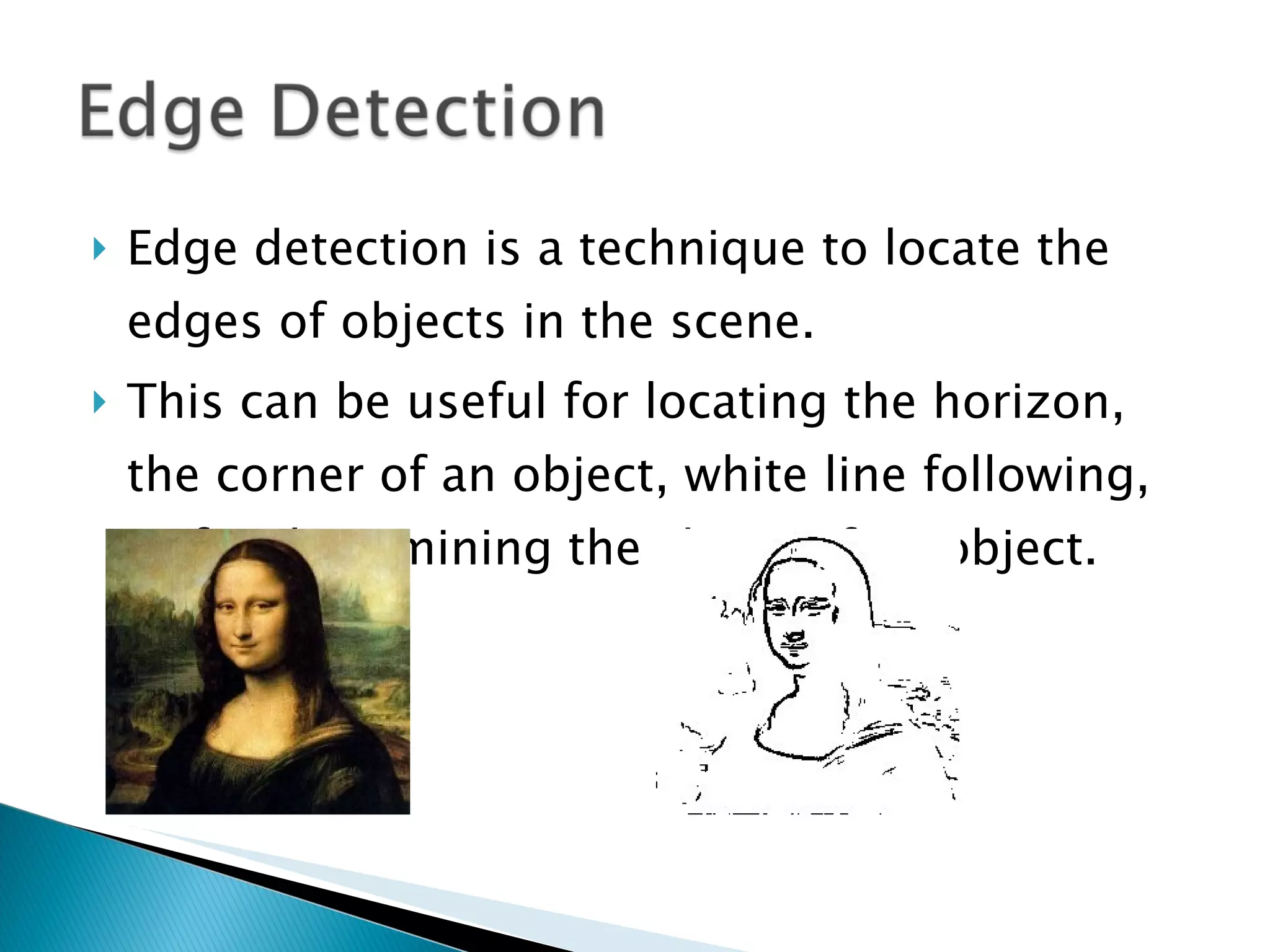
Edge detection is a technique to locate the edges of objects in the scene. This can be useful for locating the horizon, the corner of an object, white line following, or for determining the shape of an object.
sort through the image matrix pixel by pixel for each pixel, analyze each of the 8 pixels surrounding it  record the value of the darkest pixel, and the lightest pixel  if (darkest_pixel_value - lightest_pixel_value) > threshold)      then rewrite that pixel as 1;  else rewrite that pixel as 0;
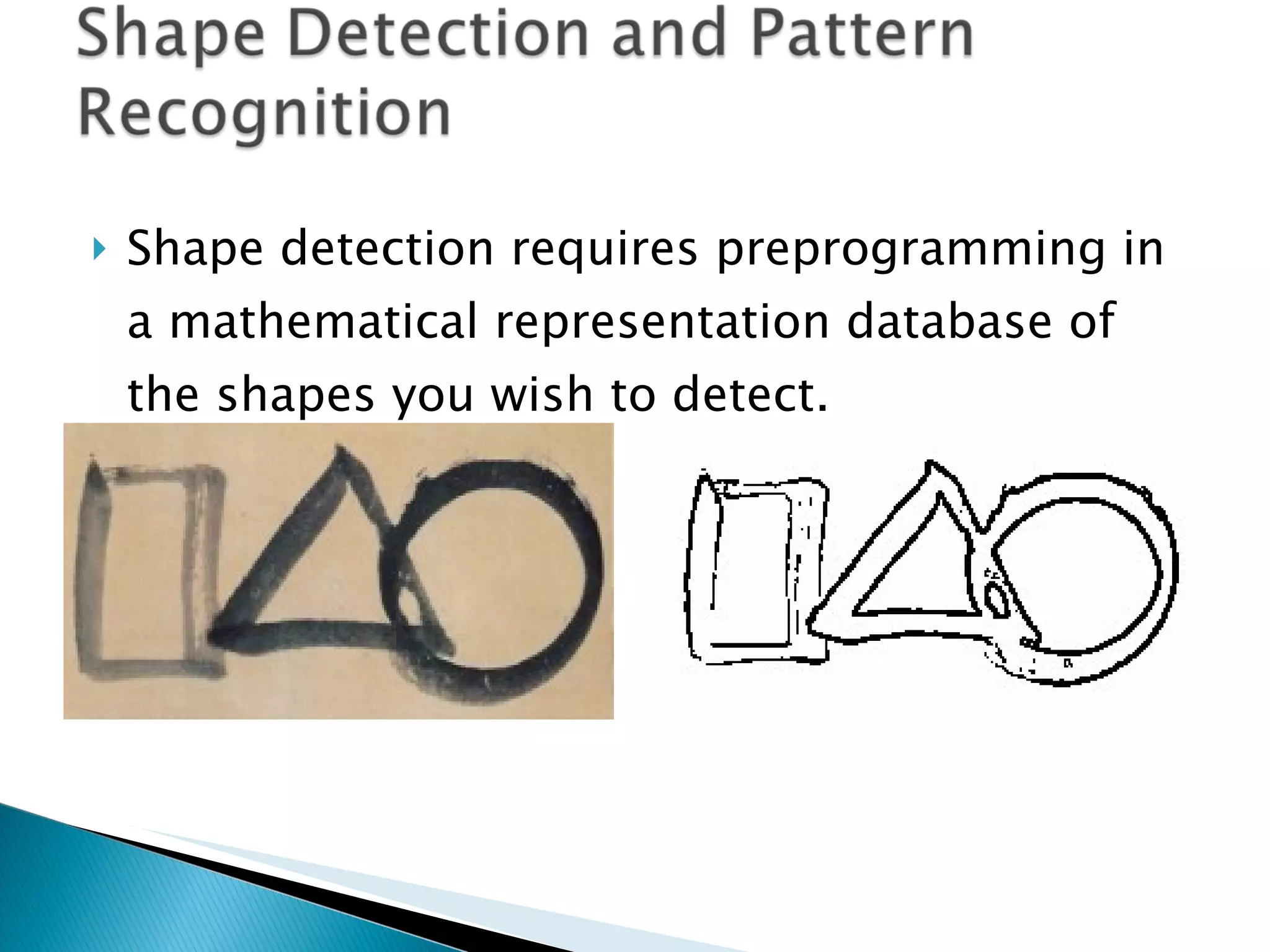
Shape detection requires preprogramming in a mathematical representation database of the shapes you wish to detect.
run edge detection to find the border line of each shape count the number of continuous edges  a sharp change in line direction signifies a different line  do this by determining the average vector between adjacent pixels  if three lines detected, then its a triangle  if four lines, then a square  if one line, then its a circle  by measure angles between lines you can determine more info (rhomboid, equilateral triangle, etc.)
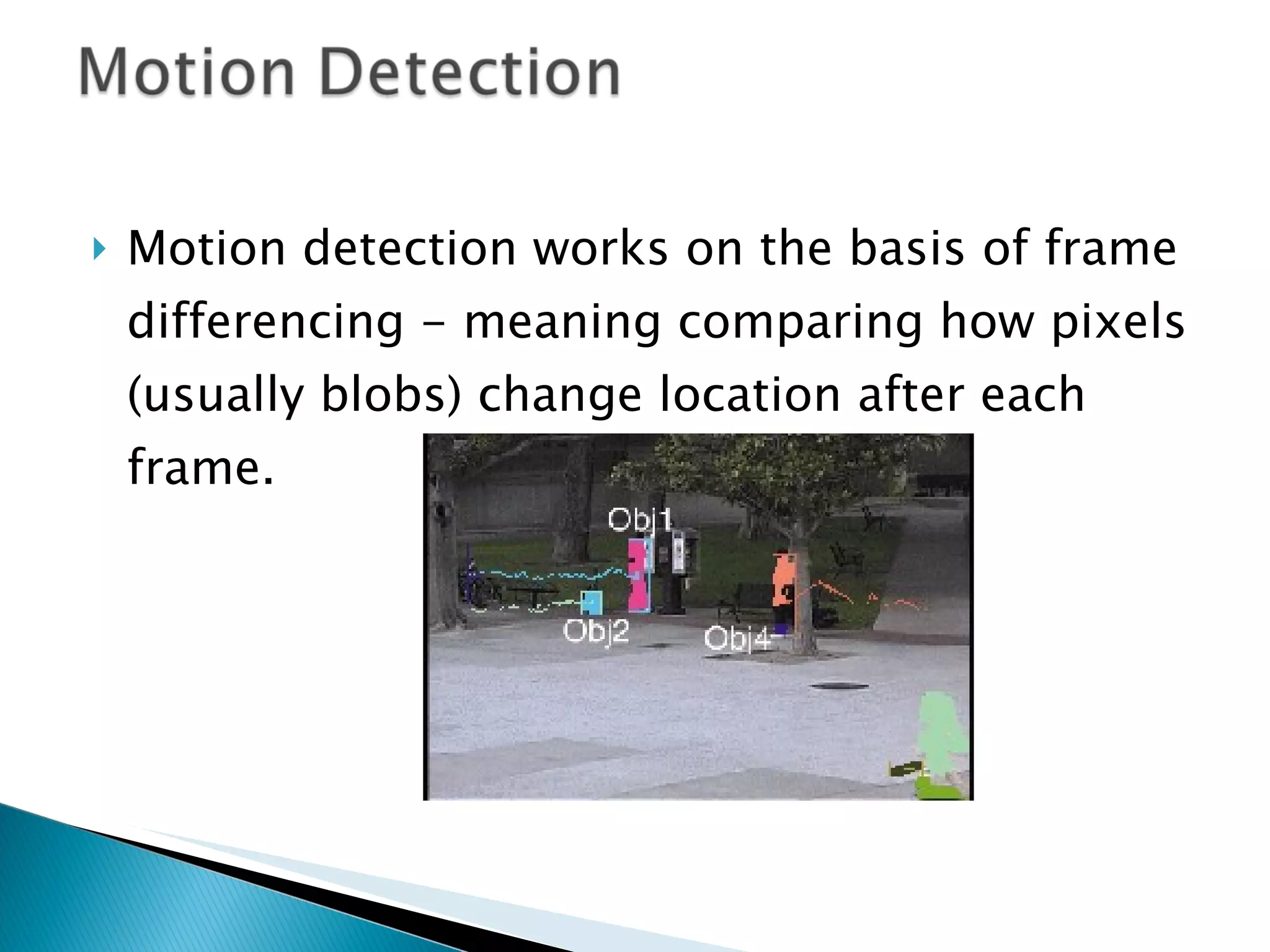
Motion detection works on the basis of frame differencing - meaning comparing how pixels (usually blobs) change location after each frame.
calculate the middle mass in frame 1 wait X seconds  calculate the middle mass in frame 2  if (mm_frame_1 - mm_frame_2) > threshold)       then motion detected
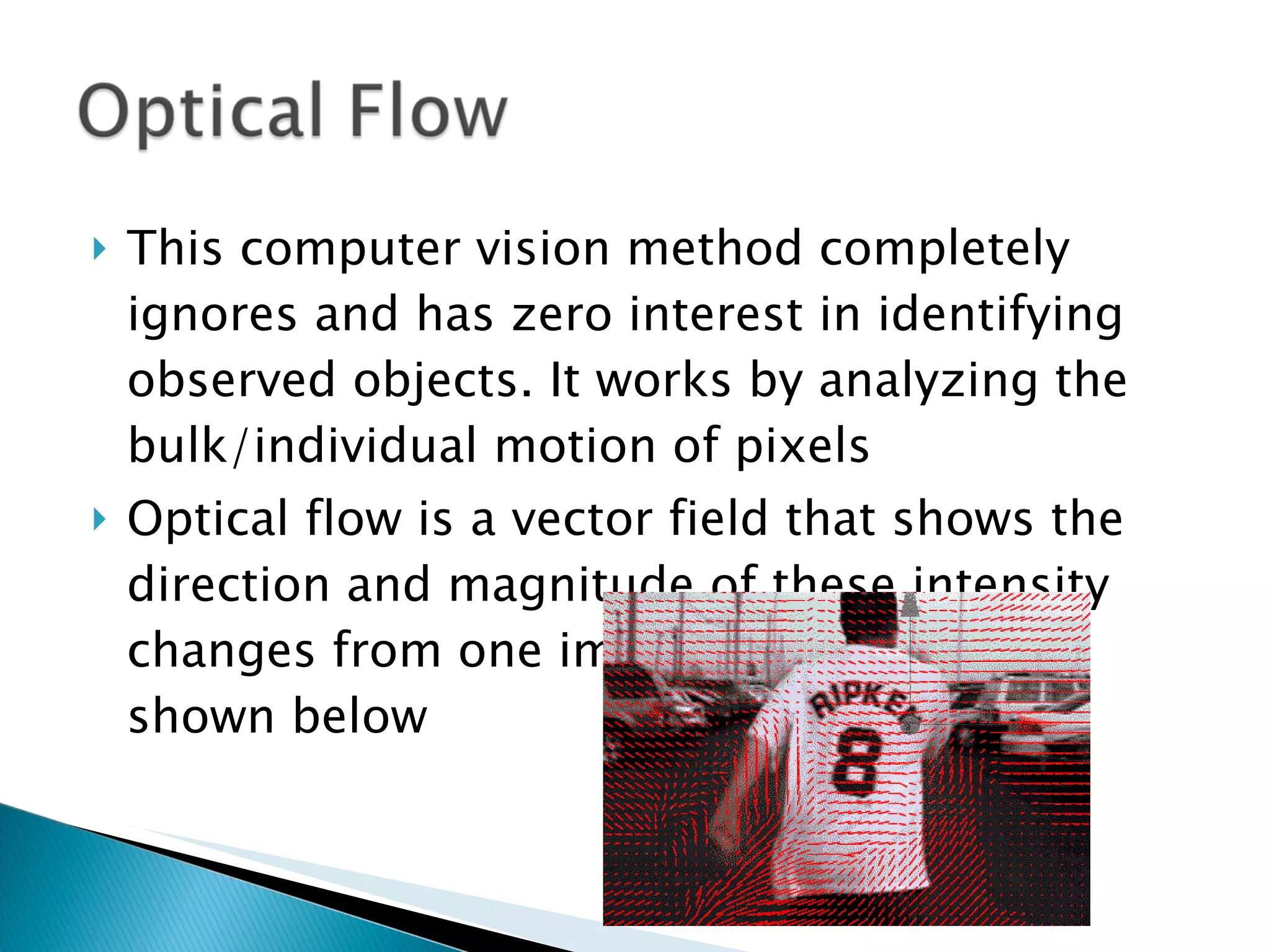
This computer vision method completely ignores and has zero interest in identifying observed objects. It works by analyzing the bulk/individual motion of pixels Optical flow is a vector field that shows the direction and magnitude of these intensity changes from one image to the other, as shown below
Ever notice when traveling by plane, the higher you are the slower the ground below you seems to move?  For aerial robots that have a known constant speed, by analyzing pixel velocity from a downward facing camera the altitude can be calculated.

Computer Vision Basics

  • 1.
  • 2.
    Computer vision andmachine vision differ in how images are created and processed Computer vision is done with everyday real world video and photography. Machine vision is done in oversimplified situations as to significantly increase reliability while decreasing cost of equipment and complexity of algorithms
  • 3.
    Edge detection isa technique to locate the edges of objects in the scene. This can be useful for locating the horizon, the corner of an object, white line following, or for determining the shape of an object.
  • 4.
    sort through theimage matrix pixel by pixel for each pixel, analyze each of the 8 pixels surrounding it record the value of the darkest pixel, and the lightest pixel if (darkest_pixel_value - lightest_pixel_value) > threshold)     then rewrite that pixel as 1; else rewrite that pixel as 0;
  • 5.
    Shape detection requirespreprogramming in a mathematical representation database of the shapes you wish to detect.
  • 6.
    run edge detectionto find the border line of each shape count the number of continuous edges a sharp change in line direction signifies a different line do this by determining the average vector between adjacent pixels if three lines detected, then its a triangle if four lines, then a square if one line, then its a circle by measure angles between lines you can determine more info (rhomboid, equilateral triangle, etc.)
  • 7.
    Motion detection workson the basis of frame differencing - meaning comparing how pixels (usually blobs) change location after each frame.
  • 8.
    calculate the middlemass in frame 1 wait X seconds calculate the middle mass in frame 2 if (mm_frame_1 - mm_frame_2) > threshold)      then motion detected
  • 9.
    This computer visionmethod completely ignores and has zero interest in identifying observed objects. It works by analyzing the bulk/individual motion of pixels Optical flow is a vector field that shows the direction and magnitude of these intensity changes from one image to the other, as shown below
  • 10.
    Ever notice whentraveling by plane, the higher you are the slower the ground below you seems to move? For aerial robots that have a known constant speed, by analyzing pixel velocity from a downward facing camera the altitude can be calculated.