COMPUTER VISION, MACHINE, AND DEEP
LEARNING WITH PYTHON
Dr.Eng. Igi Ardiyanto
PROFILE
Igi Ardiyanto
Field of Interest :
Robotics
Computer Vision
Intelligent Transportation System
Embedded System
Parallel Computing
Deep Learning
More Information ??
http://te.ugm.ac.id/~igi
What is Computer
Vision?
Computer Vision, Machine, and Deep Learning with Python
COMPUTER VISION
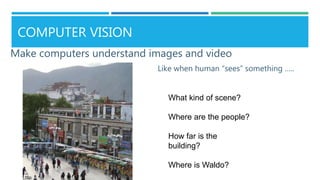
Make computers understand images and video
What kind of scene?
Where are the people?
How far is the
building?
Where is Waldo?
Like when human “sees” something …..
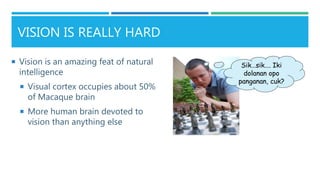
VISION IS REALLY HARD
 Vision is an amazing feat of natural
intelligence
 Visual cortex occupies about 50%
of Macaque brain
 More human brain devoted to
vision than anything else
Sik…sik…. Iki
dolanan opo
panganan, cuk?
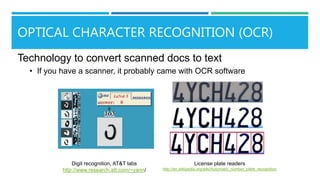
OPTICAL CHARACTER RECOGNITION (OCR)
Digit recognition, AT&T labs
http://www.research.att.com/~yann/
Technology to convert scanned docs to text
• If you have a scanner, it probably came with OCR software
License plate readers
http://en.wikipedia.org/wiki/Automatic_number_plate_recognition
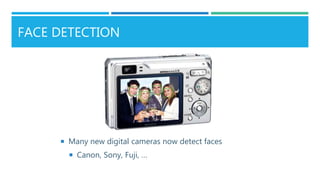
FACE DETECTION
 Many new digital cameras now detect faces
 Canon, Sony, Fuji, …
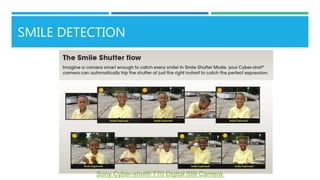
SMILE DETECTION
Sony Cyber-shot® T70 Digital Still Camera
What is Machine
Learning?
Computer Vision, Machine, and Deep Learning with Python
MACHINE LEARNING
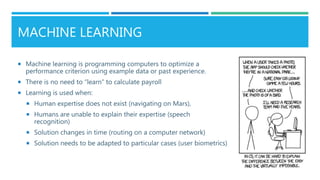
 Machine learning is programming computers to optimize a
performance criterion using example data or past experience.
 There is no need to “learn” to calculate payroll
 Learning is used when:
 Human expertise does not exist (navigating on Mars),
 Humans are unable to explain their expertise (speech
recognition)
 Solution changes in time (routing on a computer network)
 Solution needs to be adapted to particular cases (user biometrics)
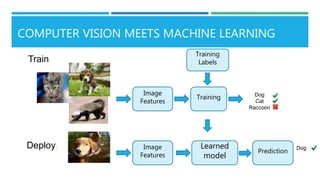
COMPUTER VISION MEETS MACHINE LEARNING
Dog
Cat
Raccoon
Dog
Train:
Deploy:
Training
Labels
Training
Image
Features
Prediction
Image
Features
Learned
model
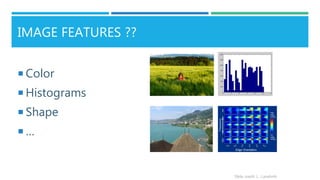
IMAGE FEATURES ??
 Color
 Histograms
 Shape
 …
Slide credit: L. Lazebnik
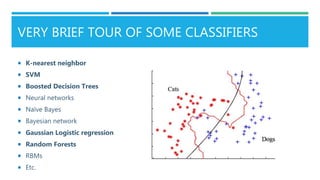
VERY BRIEF TOUR OF SOME CLASSIFIERS
 K-nearest neighbor
 SVM
 Boosted Decision Trees
 Neural networks
 Naïve Bayes
 Bayesian network
 Gaussian Logistic regression
 Random Forests
 RBMs
 Etc.
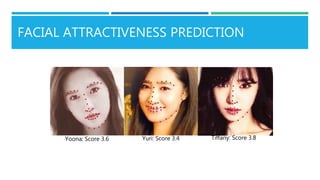
FACIAL ATTRACTIVENESS PREDICTION
Yoona: Score 3.6 Yuri: Score 3.4 Tiffany: Score 3.8
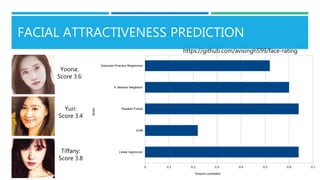
FACIAL ATTRACTIVENESS PREDICTION
https://github.com/avisingh599/face-rating
Yoona:
Score 3.6
Yuri:
Score 3.4
Tiffany:
Score 3.8
What is Deep
Learning?
Computer Vision, Machine, and Deep Learning with Python
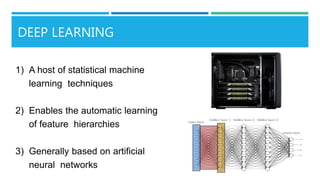
1) A host of statistical machine
learning techniques
2) Enables the automatic learning
of feature hierarchies
3) Generally based on artificial
neural networks
DEEP LEARNING
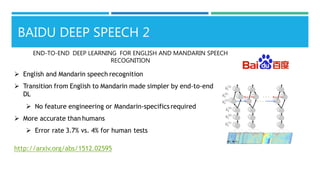
 English and Mandarin speech recognition
 Transition from English to Mandarin made simpler by end-to-end
DL
 No feature engineering or Mandarin-specificsrequired
 More accurate than humans
 Error rate 3.7% vs. 4% for human tests
http://arxiv.org/abs/1512.02595
END-TO-END DEEP LEARNING FOR ENGLISH AND MANDARIN SPEECH
RECOGNITION
BAIDU DEEP SPEECH 2
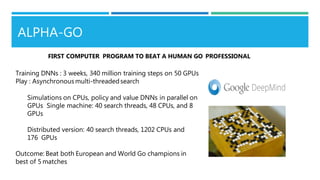
FIRST COMPUTER PROGRAM TO BEAT A HUMAN GO PROFESSIONAL
Training DNNs : 3 weeks, 340 million training steps on 50 GPUs
Play : Asynchronousmulti-threadedsearch
Simulations on CPUs, policy and value DNNs in parallel on
GPUs Single machine: 40 search threads, 48 CPUs, and 8
GPUs
Distributed version: 40 search threads, 1202 CPUs and
176 GPUs
Outcome: Beat both European and World Go champions in
best of 5 matches
ALPHA-GO
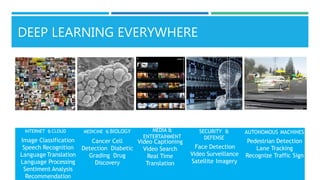
DEEP LEARNING EVERYWHERE
INTERNET & CLOUD
Image Classification
Speech Recognition
Language Translation
Language Processing
Sentiment Analysis
Recommendation
MEDIA &
ENTERTAINMENT
Video Captioning
Video Search
Real Time
Translation
AUTONOMOUS MACHINES
Pedestrian Detection
Lane Tracking
Recognize Traffic Sign
SECURITY &
DEFENSE
Face Detection
Video Surveillance
Satellite Imagery
MEDICINE & BIOLOGY
Cancer Cell
Detection Diabetic
Grading Drug
Discovery
So what’s the f*** there
for Python?
Computer Vision, Machine, and Deep Learning with Python
WHAT IS PYTHON?
 General purpose interpreted programming language
 Widely used by scientists and programmers of all stripes
 Supported by many 3rd-party libraries (currently 21,054 on the
main python package website)
 Free!
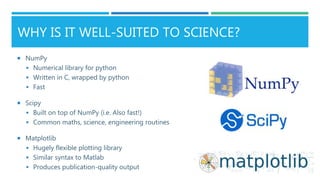
WHY IS IT WELL-SUITED TO SCIENCE?
 NumPy
 Numerical library for python
 Written in C, wrapped by python
 Fast
 Scipy
 Built on top of NumPy (i.e. Also fast!)
 Common maths, science, engineering routines
 Matplotlib
 Hugely flexible plotting library
 Similar syntax to Matlab
 Produces publication-quality output
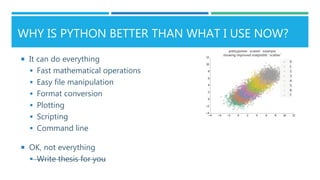
WHY IS PYTHON BETTER THAN WHAT I USE NOW?
 It can do everything
 Fast mathematical operations
 Easy file manipulation
 Format conversion
 Plotting
 Scripting
 Command line
 OK, not everything
 Write thesis for you
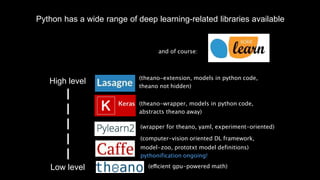
Python has a wide range of deep learning-related libraries available
Low level
High level
(efficient gpu-powered math)
(theano-wrapper, models in python code,
abstracts theano away)
(wrapper for theano, yaml, experiment-oriented)
(computer-vision oriented DL framework,
model-zoo, prototxt model definitions)
pythonification ongoing!
(theano-extension, models in python code,
theano not hidden)
and of course:
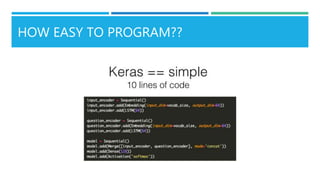
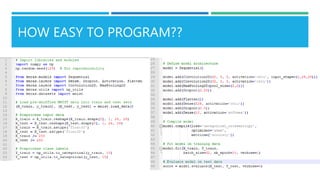
HOW EASY TO PROGRAM??
DEMO

Computer vision, machine, and deep learning

  • 1.
    COMPUTER VISION, MACHINE,AND DEEP LEARNING WITH PYTHON Dr.Eng. Igi Ardiyanto
  • 2.
    PROFILE Igi Ardiyanto Field ofInterest : Robotics Computer Vision Intelligent Transportation System Embedded System Parallel Computing Deep Learning More Information ?? http://te.ugm.ac.id/~igi
  • 3.
    What is Computer Vision? ComputerVision, Machine, and Deep Learning with Python
  • 4.
    COMPUTER VISION Make computersunderstand images and video What kind of scene? Where are the people? How far is the building? Where is Waldo? Like when human “sees” something …..
  • 5.
    VISION IS REALLYHARD  Vision is an amazing feat of natural intelligence  Visual cortex occupies about 50% of Macaque brain  More human brain devoted to vision than anything else Sik…sik…. Iki dolanan opo panganan, cuk?
  • 6.
    OPTICAL CHARACTER RECOGNITION(OCR) Digit recognition, AT&T labs http://www.research.att.com/~yann/ Technology to convert scanned docs to text • If you have a scanner, it probably came with OCR software License plate readers http://en.wikipedia.org/wiki/Automatic_number_plate_recognition
  • 7.
    FACE DETECTION  Manynew digital cameras now detect faces  Canon, Sony, Fuji, …
  • 8.
    SMILE DETECTION Sony Cyber-shot®T70 Digital Still Camera
  • 9.
    What is Machine Learning? ComputerVision, Machine, and Deep Learning with Python
  • 10.
    MACHINE LEARNING  Machinelearning is programming computers to optimize a performance criterion using example data or past experience.  There is no need to “learn” to calculate payroll  Learning is used when:  Human expertise does not exist (navigating on Mars),  Humans are unable to explain their expertise (speech recognition)  Solution changes in time (routing on a computer network)  Solution needs to be adapted to particular cases (user biometrics)
  • 11.
    COMPUTER VISION MEETSMACHINE LEARNING Dog Cat Raccoon Dog Train: Deploy: Training Labels Training Image Features Prediction Image Features Learned model
  • 12.
    IMAGE FEATURES ?? Color  Histograms  Shape  … Slide credit: L. Lazebnik
  • 13.
    VERY BRIEF TOUROF SOME CLASSIFIERS  K-nearest neighbor  SVM  Boosted Decision Trees  Neural networks  Naïve Bayes  Bayesian network  Gaussian Logistic regression  Random Forests  RBMs  Etc.
  • 14.
    FACIAL ATTRACTIVENESS PREDICTION Yoona:Score 3.6 Yuri: Score 3.4 Tiffany: Score 3.8
  • 15.
  • 16.
    What is Deep Learning? ComputerVision, Machine, and Deep Learning with Python
  • 17.
    1) A hostof statistical machine learning techniques 2) Enables the automatic learning of feature hierarchies 3) Generally based on artificial neural networks DEEP LEARNING
  • 18.
     English andMandarin speech recognition  Transition from English to Mandarin made simpler by end-to-end DL  No feature engineering or Mandarin-specificsrequired  More accurate than humans  Error rate 3.7% vs. 4% for human tests http://arxiv.org/abs/1512.02595 END-TO-END DEEP LEARNING FOR ENGLISH AND MANDARIN SPEECH RECOGNITION BAIDU DEEP SPEECH 2
  • 19.
    FIRST COMPUTER PROGRAMTO BEAT A HUMAN GO PROFESSIONAL Training DNNs : 3 weeks, 340 million training steps on 50 GPUs Play : Asynchronousmulti-threadedsearch Simulations on CPUs, policy and value DNNs in parallel on GPUs Single machine: 40 search threads, 48 CPUs, and 8 GPUs Distributed version: 40 search threads, 1202 CPUs and 176 GPUs Outcome: Beat both European and World Go champions in best of 5 matches ALPHA-GO
  • 20.
    DEEP LEARNING EVERYWHERE INTERNET& CLOUD Image Classification Speech Recognition Language Translation Language Processing Sentiment Analysis Recommendation MEDIA & ENTERTAINMENT Video Captioning Video Search Real Time Translation AUTONOMOUS MACHINES Pedestrian Detection Lane Tracking Recognize Traffic Sign SECURITY & DEFENSE Face Detection Video Surveillance Satellite Imagery MEDICINE & BIOLOGY Cancer Cell Detection Diabetic Grading Drug Discovery
  • 21.
    So what’s thef*** there for Python? Computer Vision, Machine, and Deep Learning with Python
  • 22.
    WHAT IS PYTHON? General purpose interpreted programming language  Widely used by scientists and programmers of all stripes  Supported by many 3rd-party libraries (currently 21,054 on the main python package website)  Free!
  • 23.
    WHY IS ITWELL-SUITED TO SCIENCE?  NumPy  Numerical library for python  Written in C, wrapped by python  Fast  Scipy  Built on top of NumPy (i.e. Also fast!)  Common maths, science, engineering routines  Matplotlib  Hugely flexible plotting library  Similar syntax to Matlab  Produces publication-quality output
  • 24.
    WHY IS PYTHONBETTER THAN WHAT I USE NOW?  It can do everything  Fast mathematical operations  Easy file manipulation  Format conversion  Plotting  Scripting  Command line  OK, not everything  Write thesis for you
  • 25.
    Python has awide range of deep learning-related libraries available Low level High level (efficient gpu-powered math) (theano-wrapper, models in python code, abstracts theano away) (wrapper for theano, yaml, experiment-oriented) (computer-vision oriented DL framework, model-zoo, prototxt model definitions) pythonification ongoing! (theano-extension, models in python code, theano not hidden) and of course:
  • 26.
    HOW EASY TOPROGRAM??
  • 27.
    HOW EASY TOPROGRAM??
  • 28.