Datorarkitektur                                           Fö 1 - 1         Datorarkitektur                                       Fö 1 - 2


                                                                                                        Course Information


                                                                                 Web page: http://www.ida.liu.se/~TDTS51
                           DATORARKITEKTUR
                         (Advanced Computer Architecture)

                                                                                 Examination: written, 19 december 2000 kl. 14 - 18


                                       Paul Pop
                        Institutionen för Datavetenskap (IDA)
                                                                                 Lecture notes: available from the web page at least
                                 Linköpings Universitet                                         24 hours before the lecture

                              email: paupo@ida.liu.se
                            http://www.ida.liu.se/~paupo
                                   phone: 28 5628                                Text book: William Stallings: Computer Organization
                                    E++ building                                            and Architecture, 5th edition, Prentice Hall
                                                                                            International, Inc., 2000.


Petru Eles, IDA, LiTH                                                      Petru Eles, IDA, LiTH


      Datorarkitektur                                           Fö 1 - 3         Datorarkitektur                                       Fö 1 - 4


                           Preliminary Course Plan
                                                                                                   Preliminary Course Plan (cont’d)

      Lecture 1.
      Introduction: Outline, Basic computer architecture and                     Lectures 7 and 8.
      organization, Basic functions of a computer and its main
      components, The von Neumann architecture.                                  Superscalar Architectures: Instruction level parallelism
      This is to referesh our memory!                                            and machine parallelism, Hardware techniques for
                                                                                 performance enhancement, Data dependencies, Policies
                                                                                 for parallel instruction execution, Limitations of the
      The Memory System: Memory hierarchy, Cache                                 superscalar approach.
      memories, Virtual memories, Memory management.

      Lecture 2.                                                                 Lectures 9 and 10.
      The Memory System: continuation                                            VLIW Architectures: The VLIW approach - advantages
                                                                                 and limitations. Compiling for VLIW architectures. The
                                                                                 Merced (Itanium) architecture.
      Lectures 3 and 4.
      Instruction Pipelining: Organization of pipelined units,
      Pipeline hazards, Reducing branch penalties, Branch                        Lectures 11 and 12.
      prediction strategies.                                                     Architectures for Parallel Computation: Parallel
                                                                                 programms, Performance of parallel computers, A
                                                                                 classification of computer architectures, Array
      Lectures 5 and 6.                                                          processors, Multiprocessors, Multicomputers, Vector
                                                                                 processors.
      RISC Architectures: An analysis of instruction execution
      for code generated from high-level language programs,
      Compiling for RISC architectures, Main characteristics of
      RISC architectures, RISC-CISC trade-offs.


Petru Eles, IDA, LiTH                                                      Petru Eles, IDA, LiTH
Datorarkitektur                                          Fö 1 - 5         Datorarkitektur                                             Fö 1 - 6


                        COMPUTER ARCHITECTURE                                                            What is a computer?

                             (BASIC ISSUES)


                 1. What is a Computer/Computer System?

                 2. The von Neumann Architecture

                 3. Application Specific vs. General-Purpose

                 4. Representation of Data and Instructions
                                                                                    •      A computer is a data processing machine which is
                                                                                           operated automatically under the control of a list of
                 5. Instruction Execution                                                  instructions (called a program) stored in its main
                                                                                           memory.
                 6. The Control Unit

                                                                                         Computer
                 7. The Computer System

                 8. Main and Secondary Memory                                                         Central
                                                                                                  Processing Unit             Main memory
                                                                                                      (CPU)
                 9. Input - Output Devices

                                                                                                                    data
                                                                                                                    control


Petru Eles, IDA, LiTH                                                     Petru Eles, IDA, LiTH


      Datorarkitektur                                          Fö 1 - 7         Datorarkitektur                                             Fö 1 - 8


                         What is a computer system?                                                The von Neumann Architecture

                                                                                The principles:
          •      A computer system consists usually of a
                 computer and its peripherals.                                      •      Data and instructions are both stored in the main
                                                                                           memory (stored program concept);
                                                                                    •      The content of the memory is addressable by
          •      Computer peripherals include input devices,                               location (without regard to what is stored in that
                 output devices, and secondary memories.                                   location);
                                                                                    •      Instructions are executed sequentially (from one
                                                                                           instruction to the next, in order of their location in
                                                                                           memory) unless the order is explicitly modified.
                                                                                    •      The organization (architecture) of the computer:
       Computer system
                                                                                             - a central processing unit (CPU); it contains the
                                                                                               control unit (CU), that coordinates the execution
                                                                                               of instructions and the arithmetic/logic unit (ALU)
                 Input                                Output                                   which performs arithmetic and logic operations;
                                 Computer
                device                                device                                 - (main) memory.

                                                                                         Computer

                                 Secondary
                                  memory                                                              Central
                                                                                                  Processing Unit             Main memory
                                                                                                      (CPU)


Petru Eles, IDA, LiTH                                                     Petru Eles, IDA, LiTH
Datorarkitektur                                             Fö 1 - 9          Datorarkitektur                                           Fö 1 - 10


                                                                                     General-purpose (von Neumann) Architectures
                        The von Neumann Architecture (cont’d)
                                                                                    In the von-Neumann architecture, a small set of circuits
                                                                                    can be driven to perform very different tasks, depending
                                                                                    on the software program which is executed.
                                                                                                                                      CPU
          •      von Neumann computers are general purpose
                 computers.
                                                                                                      Control unit                    ALU


                 they can solve very different problems depending
                 on the program they got to execute!                                                                 Register


                                                                                                                             data
                                                                                                         instructions
          •      Key concepts here are program and program
                 execution.

                                                                                                                      Main memory


                                                                                        •      The primary function of a CPU is to execute the
                                                                                               instructions fetched from the main memory.
                                                                                        •      An instruction tells the CPU to perform one of its
                                                                                               basic operations (an arithmetic or logic operation,
                                                                                               to transfer a data from/to main memory, etc.).
                                                                                        •      The CU is the one which interprets (decodes) the
                                                                                               instruction to be executed and which "tells" the
                                                                                               different other components what to do.
                                                                                        •      The CPU includes a set of registers which are
                                                                                               temporary storage devices typically used to hold
                                                                                               intensively used data and intermediate results.

Petru Eles, IDA, LiTH                                                         Petru Eles, IDA, LiTH


      Datorarkitektur                                             Fö 1 - 11         Datorarkitektur                                           Fö 1 - 12


                              Representation of Data                                                         Machine Instructions

                                                                                        •      A CPU can only execute machine instructions;
          •      Inside a computer, data and control information                        •      Each computer has a set of specific machine
                 (instructions) are all represented in binary format                           instructions which its CPU is able to recognize and
                 which uses only two basic symbols: "0" and "1".                               execute.
          •      The two basic symbols are represented by                               •      A machine instruction is represented as a
                 electronics signals.                                                          sequence of bits (binary digits).
                                                                                               These bits have to define:
                                                                                                 - What has to be done (the operation code)
          •      Numeric data are represented using the binary                                   - To whom the operation applies (source operands)
                 system, in which the positional values are powers                               - Where does the result go (destination operand)
                 of 2:                                                                           - How to continue after the operation is finished
                 100101 = 1*20 + 0*21 + 1*22 + 0*23 + 0*24 + 1*25
                  10110 = 0*20 + 1*21 + 1*22 + 0*23 + 1*24                                                  0 0 0 01 0 1 11 0 0 01 0 1 1
          •      Binary numbers are added, subtracted, multiplied                                           opcode       operand operand
                 and divided (by the ALU) directly; it is not needed to                                                 (memory) (register)
                 convert them to decimal numbers first.
                 100101 + 10110 = 111011

                                                                                        •      The representation of a machine instruction is
                                                                                               divided into fields; each field contains one item of
                                                                                               the instruction specification (opcode, operands,
                                                                                               etc.); the fields are organized according to the
                                                                                               instruction format.


Petru Eles, IDA, LiTH                                                         Petru Eles, IDA, LiTH
Datorarkitektur                                                 Fö 1 - 13         Datorarkitektur                                                   Fö 1 - 14


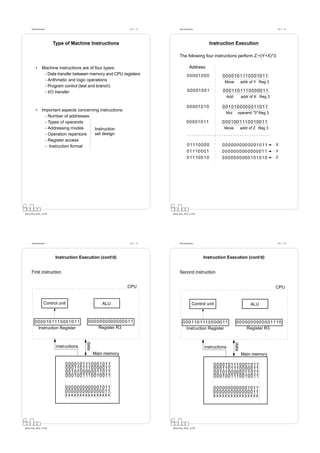
                        Type of Machine Instructions                                                             Instruction Execution

                                                                                        The following four instructions perform Z:=(Y+X)*3:

          •      Machine instructions are of four types:                                          Address
                  - Data transfer between memory and CPU registers                              0 0 0 01 0 0 0         0 0 0 01 0 1 11 0 0 01 0 1 1
                  - Arithmetic and logic operations                                                                      Move          addr of Y Reg 3
                  - Program control (test and branch)
                  - I/O transfer                                                                0 0 0 01 0 0 1          0 0 0 11 0 1 11 0 0 00 0 1 1
                                                                                                                          Add          addr of X Reg 3

                                                                                               0 0 0 01 0 1 0          0 0 1 01 0 0 00 0 0 11 0 1 1
          •      Important aspects concerning instructions:
                                                                                                                         Mul       operand "3" Reg 3
                   - Number of addresses
                   - Types of operands                                                         0 0 0 01 0 1 1          0 0 0 10 0 1 11 0 0 10 0 1 1
                   - Addressing modes      Instruction                                                                  Move           addr of Z Reg 3
                   - Operation repertoire  set design                                           ....................................
                   - Register access
                   - Instruction format                                                        0 1 1 10 0 0 0          0 0 0 00 0 0 00 0 0 01 0 1 1      X
                                                                                               0 1 1 10 0 0 1          0 0 0 00 0 0 00 0 0 00 0 1 1      Y
                                                                                               0 1 1 10 0 1 0          0 0 0 00 0 0 00 0 1 01 0 1 0      Z


Petru Eles, IDA, LiTH                                                             Petru Eles, IDA, LiTH


      Datorarkitektur                                                 Fö 1 - 15         Datorarkitektur                                                   Fö 1 - 16


                         Instruction Execution (cont’d)                                                    Instruction Execution (cont’d)


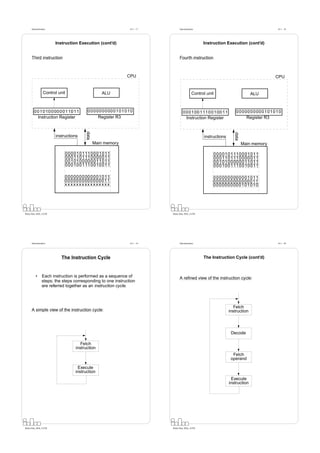
      First instruction                                                                 Second instruction


                                                                    CPU                                                                                  CPU


                   Control unit                      ALU                                             Control unit                           ALU


         0 0 0 01 0 1 11 0 0 01 0 1 1       0 0 0 00 0 0 00 0 0 00 0 1 1                   0 0 0 11 0 1 11 0 0 00 0 1 1          0 0 0 00 0 0 00 0 0 01 1 1 0
           Instruction Register                    Register R3                               Instruction Register                       Register R3
                                           data


                                                                                                                                data


                         instructions                                                                      instructions
                                                  Main memory                                                                          Main memory

                              0 0 0 01 0 1 11 0 0 01 0 1 1                                                        0 0 0 01 0 1 11 0 0 01 0 1 1
                              0 0 0 11 0 1 11 0 0 00 0 1 1                                                        0 0 0 11 0 1 11 0 0 00 0 1 1
                              0 0 1 01 0 0 00 0 0 11 0 1 1                                                        0 0 1 01 0 0 00 0 0 11 0 1 1
                              0 0 0 10 0 1 11 0 0 10 0 1 1                                                        0 0 0 10 0 1 11 0 0 10 0 1 1

                              0 0 0 00 0 0 00 0 0 01 0 1 1                                                        0 0 0 00 0 0 00 0 0 01 0 1 1
                              0 0 0 00 0 0 00 0 0 00 0 1 1                                                        0 0 0 00 0 0 00 0 0 00 0 1 1
                              x x x xx x x xx x x xx x x x                                                        x x x xx x x xx x x xx x x x


Petru Eles, IDA, LiTH                                                             Petru Eles, IDA, LiTH
Datorarkitektur                                                Fö 1 - 17         Datorarkitektur                                                 Fö 1 - 18


                        Instruction Execution (cont’d)                                                    Instruction Execution (cont’d)


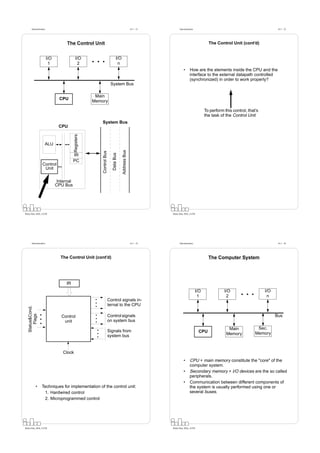
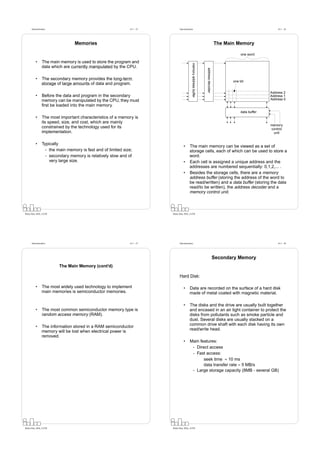
      Third instruction                                                                Fourth instruction


                                                                   CPU                                                                               CPU


                  Control unit                      ALU                                             Control unit                       ALU


        0 0 1 01 0 0 00 0 0 11 0 1 1       0 0 0 00 0 0 00 0 1 01 0 1 0                   0 0 0 10 0 1 11 0 0 10 0 1 1       0 0 0 00 0 0 00 0 1 01 0 1 0
          Instruction Register                    Register R3                               Instruction Register                    Register R3
                                          data


                                                                                                                            data
                        instructions                                                                      instructions
                                                 Main memory                                                                       Main memory

                             0 0 0 01 0 1 11 0 0 01 0 1 1                                                      0 0 0 01 0 1 11 0 0 01 0 1 1
                             0 0 0 11 0 1 11 0 0 00 0 1 1                                                      0 0 0 11 0 1 11 0 0 00 0 1 1
                             0 0 1 01 0 0 00 0 0 11 0 1 1                                                      0 0 1 01 0 0 00 0 0 11 0 1 1
                             0 0 0 10 0 1 11 0 0 10 0 1 1                                                      0 0 0 10 0 1 11 0 0 10 0 1 1

                             0 0 0 00 0 0 00 0 0 01 0 1 1                                                      0 0 0 00 0 0 00 0 0 01 0 1 1
                             0 0 0 00 0 0 00 0 0 00 0 1 1                                                      0 0 0 00 0 0 00 0 0 00 0 1 1
                             x x x xx x x xx x x xx x x x                                                      0 0 0 00 0 0 00 0 1 01 0 1 0


Petru Eles, IDA, LiTH                                                            Petru Eles, IDA, LiTH


      Datorarkitektur                                                Fö 1 - 19         Datorarkitektur                                                 Fö 1 - 20


                            The Instruction Cycle                                                         The Instruction Cycle (cont’d)


          •      Each instruction is performed as a sequence of                        A refined view of the instruction cycle:
                 steps; the steps corresponding to one instruction
                 are referred together as an instruction cycle.


                                                                                                                            Fetch
      A simple view of the instruction cycle:                                                                            instruction


                                                                                                                          Decode

                                      Fetch
                                   instruction
                                                                                                                           Fetch
                                                                                                                          operand

                                    Execute
                                   instruction
                                                                                                                          Execute
                                                                                                                         instruction


Petru Eles, IDA, LiTH                                                            Petru Eles, IDA, LiTH
Datorarkitektur                                                                               Fö 1 - 21         Datorarkitektur                                                  Fö 1 - 22


                                     The Control Unit                                                                                            The Control Unit (cont’d)


                         I/O                 I/O                                 I/O
                          1                   2                                   n
                                                                                                                           •      How are the elements inside the CPU and the
                                                                                                                                  interface to the external datapath controlled
                                                                                                                                  (synchronized) in order to work properly?
                                                                          System Bus

                                                        Main
                                 CPU
                                                       Memory

                                                                                                                                               To perform this control, that’s
                                                                                                                                               the task of the Control Unit
                                                           System Bus
                                CPU
                                           Registers


                     ALU
                                                                                       Address Bus
                                                           Control Bus

                                                                            Data Bus


                                           IR
                                           PC
                   Control
                    Unit

                                Internal
                               CPU Bus


Petru Eles, IDA, LiTH                                                                                            Petru Eles, IDA, LiTH


       Datorarkitektur                                                                               Fö 1 - 23         Datorarkitektur                                                  Fö 1 - 24


                                 The Control Unit (cont’d)                                                                                       The Computer System


                                    IR
                                                                                                                                         I/O              I/O                    I/O
                                                                                                                                          1                2                      n
                                                                         Control signals in-
                                                                         ternal to the CPU
   Status&Cond.
       Flags


                                  Control                                Control signals                                                                                               Bus
                                   unit                                  on system bus
                                                                                                                                                            Main             Sec.
                                                                         Signals from                                                     CPU
                                                                                                                                                           Memory           Memory
                                                                         system bus


                                   Clock
                                                                                                                           •      CPU + main memory constitute the "core" of the
                                                                                                                                  computer system.
                                                                                                                           •      Secondary memory + I/O devices are the so called
                                                                                                                                  peripherals.
                                                                                                                           •      Communication between different components of
            •     Techniques for implementation of the control unit:                                                              the system is usually performed using one or
                   1. Hardwired control                                                                                           several buses.
                   2. Microprogrammed control


Petru Eles, IDA, LiTH                                                                                            Petru Eles, IDA, LiTH
Datorarkitektur                                          Fö 1 - 25         Datorarkitektur                                                                      Fö 1 - 26


                                  Memories                                                                                              The Main Memory

                                                                                                                                                    one word

          •      The main memory is used to store the program and


                                                                                              memory address buffer
                 data which are currently manipulated by the CPU.


                                                                                                                      address decoder
          •      The secondary memory provides the long-term
                                                                                                                                               one bit
                 storage of large amounts of data and program.

                                                                                                                                                                  Address 2
          •      Before the data and program in the secondary                                                                                                     Address 1
                 memory can be manipulated by the CPU, they must                                                                                                  Address 0
                 first be loaded into the main memory.
                                                                                                                                                    data buffer
          •      The most important characteristics of a memory is
                 its speed, size, and cost, which are mainly
                                                                                                                                                                  memory
                 constrained by the technology used for its                                                                                                       control
                 implementation.                                                                                                                                   unit


          •      Typically
                                                                                     •      The main memory can be viewed as a set of
                   - the main memory is fast and of limited size;                           storage cells, each of which can be used to store a
                   - secondary memory is relatively slow and of                             word.
                     very large size.                                                •      Each cell is assigned a unique address and the
                                                                                            addresses are numbered sequentially: 0,1,2,... .
                                                                                     •      Besides the storage cells, there are a memory
                                                                                            address buffer (storing the address of the word to
                                                                                            be read/written) and a data buffer (storing the data
                                                                                            read/to be written), the address decoder and a
                                                                                            memory control unit.


Petru Eles, IDA, LiTH                                                      Petru Eles, IDA, LiTH


      Datorarkitektur                                          Fö 1 - 27         Datorarkitektur                                                                      Fö 1 - 28


                                                                                                                                        Secondary Memory
                          The Main Memory (cont’d)

                                                                                 Hard Disk:

          •      The most widely used technology to implement                        •      Data are recorded on the surface of a hard disk
                 main memories is semiconductor memories.                                   made of metal coated with magnetic material.

                                                                                     •      The disks and the drive are usually built together
          •      The most common semiconductor memory type is                               and encased in an air tight container to protect the
                 random access memory (RAM).                                                disks from pollutants such as smoke particle and
                                                                                            dust. Several disks are usually stacked on a
          •      The information stored in a RAM semiconductor                              common drive shaft with each disk having its own
                 memory will be lost when electrical power is                               read/write head.
                 removed.
                                                                                     •      Main features:
                                                                                             - Direct access
                                                                                             - Fast access:
                                                                                                   seek time ≈ 10 ms
                                                                                                   data transfer rate ≈ 5 MB/s
                                                                                             - Large storage capacity (8MB - several GB)


Petru Eles, IDA, LiTH                                                      Petru Eles, IDA, LiTH
Datorarkitektur                                                 Fö 1 - 29         Datorarkitektur                                                    Fö 1 - 30


                              Secondary Memory (cont’d)
                                                                                                             Secondary Memory (cont’d)


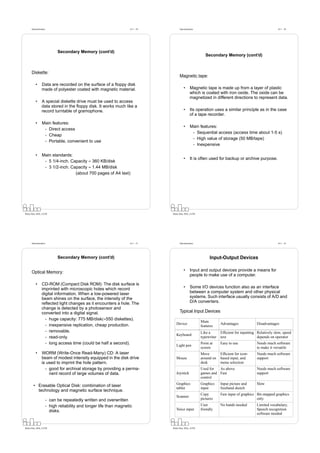
      Diskette:
                                                                                        Magnetic tape:

          •      Data are recorded on the surface of a floppy disk
                 made of polyester coated with magnetic material.                           •      Magnetic tape is made up from a layer of plastic
                                                                                                   which is coated with iron oxide. The oxide can be
                                                                                                   magnetized in different directions to represent data.
          •      A special diskette drive must be used to access
                 data stored in the floppy disk. It works much like a
                 record turntable of gramophone.                                            •      Its operation uses a similar principle as in the case
                                                                                                   of a tape recorder.

          •      Main features:
                                                                                            •      Main features:
                  - Direct access
                                                                                                    - Sequential access (access time about 1-5 s)
                  - Cheap
                                                                                                    - High value of storage (50 MB/tape)
                  - Portable, convenient to use
                                                                                                    - Inexpensive

          •      Main standards:
                                                                                            •      It is often used for backup or archive purpose.
                  - 5 1/4-inch. Capacity ≈ 360 KB/disk
                  - 3 1/2-inch. Capacity ≈ 1.44 MB/disk
                                  (about 700 pages of A4 text)


Petru Eles, IDA, LiTH                                                             Petru Eles, IDA, LiTH


      Datorarkitektur                                                 Fö 1 - 31         Datorarkitektur                                                    Fö 1 - 32


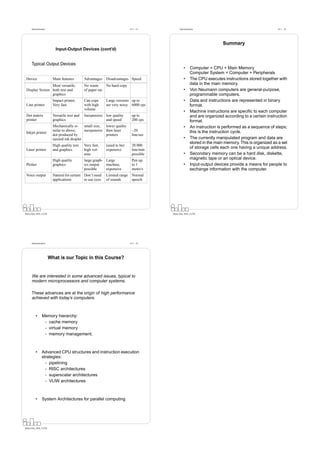
                              Secondary Memory (cont’d)                                                         Input-Output Devices

      Optical Memory:                                                                       •      Input and output devices provide a means for
                                                                                                   people to make use of a computer.

          •      CD-ROM (Compact Disk ROM): The disk surface is
                 imprinted with microscopic holes which record                              •      Some I/O devices function also as an interface
                 digital information. When a low-powered laser                                     between a computer system and other physical
                 beam shines on the surface, the intensity of the                                  systems. Such interface usually consists of A/D and
                 reflected light changes as it encounters a hole. The                               D/A converters.
                 change is detected by a photosensor and
                 converted into a digital signal.                                       Typical Input Devices
                   - huge capacity: 775 MB/disk(≈550 diskettes).
                                                                                                          Main
                   - inexpensive replication, cheap production.                      Device                            Advantages             Disadvantages
                                                                                                          features
                   - removable.                                                                           Like a       Efficient for inputting Relatively slow, speed
                                                                                     Keyboard
                   - read-only.                                                                           typewriter   text                   depends on operator
                   - long access time (could be half a second).                      Light pen
                                                                                                          Point at     Easy to use            Needs much software
                                                                                                          screen                              to make it versatile
          •      WORM (Write-Once Read-Many) CD: A laser                                                  Move         Efficient for icon-     Needs much software
                 beam of modest intensity equipped in the disk drive                 Mouse                around on    based input, and       support
                 is used to imprint the hole pattern.                                                     desk         menu selection
                   - good for archival storage by providing a perma-                                      Used for  As above                  Needs much software
                     nent record of large volumes of data.                           Joystick             games and Fast                      support
                                                                                                          control
                                                                                     Graphics             Graphics     Input picture and      Slow
        • Erasable Optical Disk: combination of laser
                                                                                     tablet               input        freehand sketch
          technology and magnetic surface technique.
                                                                                                          Copy         Fast input of graphics Bit-mapped graphics
                                                                                     Scanner
                        - can be repeatedly written and overwritten                                       pictures                            only
                        - high reliability and longer life than magnetic                                  User         No hands needed        Limited vocabulary,
                          disks.                                                     Voice input          friendly                            Speech recognition
                                                                                                                                              software needed


Petru Eles, IDA, LiTH                                                             Petru Eles, IDA, LiTH
Datorarkitektur                                                       Fö 1 - 33         Datorarkitektur                                           Fö 1 - 34


                                                                                                                           Summary
                            Input-Output Devices (cont’d)


      Typical Output Devices
                                                                                                  •      Computer = CPU + Main Memory
                                                                                                         Computer System = Computer + Peripherals
 Device                   Main features        Advantages   Disadvantages Speed                   •      The CPU executes instructions stored together with
                Most versatile,                No waste      No hard copy                                data in the main memory.
 Display Screen both text and                  of paper etc.                                      •      Von Neumann computers are general-purpose,
                graphics                                                                                 programmable computers.
                          Impact printer,      Can cope     Large versions up to                  •      Data and instructions are represented in binary
 Line printer             Very fast.           with high    are very noisy 6000 cps                      format.
                                               volume
                                                                                                  •      Machine instructions are specific to each computer
 Dot matrix               Versatile text and   Inexpensive low quality       up to                       and are organized according to a certain instruction
 printer                  graphics                         and speed         200 cps                     format.
                          Mechanically si- small size; lower quality                              •      An instruction is performed as a sequence of steps;
                          milar to above;     inexpensive then laser         ~20                         this is the instruction cycle.
 Inkjet printer
                          dot produced by                 printers           line/sec
                          ejected ink droplet                                                     •      The currently manipulated program and data are
                                                                                                         stored in the main memory. This is organized as a set
                          High quality text    Very fast,   (used to be)     20 000
 Laser printer            and graphics         high vol-    expensive        line/min
                                                                                                         of storage cells each one having a unique address.
                                               ume                           possible             •      Secondary memory can be a hard disk, diskette,
                          High quality         large graph- Large            Pen up                      magnetic tape or an optical device.
 Plotter                  graphics             ics output   machine,         to 1                 •      Input-output devices provide a means for people to
                                               possible     expensive        meter/s                     exchange information with the computer.
 Voice output             Natural for certain Don’t need    Limited range    Normal
                          applications        to use eyes   of sounds        speech


Petru Eles, IDA, LiTH                                                                   Petru Eles, IDA, LiTH


      Datorarkitektur                                                       Fö 1 - 35


                        What is our Topic in this Course?


      We are interested in some advanced issues, typical to
      modern microprocessors and computer systems.

      These advances are at the origin of high performance
      achieved with today’s computers.


          •      Memory hierarchy:
                  - cache memory
                  - virtual memory
                  - memory management;


          •      Advanced CPU structures and instruction execution
                 strategies:
                   - pipelining
                   - RISC architectures
                   - superscalar architectures
                   - VLIW architectures


          •      System Architectures for parallel computing


Petru Eles, IDA, LiTH

Computer architecture

  • 1.
    Datorarkitektur Fö 1 - 1 Datorarkitektur Fö 1 - 2 Course Information Web page: http://www.ida.liu.se/~TDTS51 DATORARKITEKTUR (Advanced Computer Architecture) Examination: written, 19 december 2000 kl. 14 - 18 Paul Pop Institutionen för Datavetenskap (IDA) Lecture notes: available from the web page at least Linköpings Universitet 24 hours before the lecture email: paupo@ida.liu.se http://www.ida.liu.se/~paupo phone: 28 5628 Text book: William Stallings: Computer Organization E++ building and Architecture, 5th edition, Prentice Hall International, Inc., 2000. Petru Eles, IDA, LiTH Petru Eles, IDA, LiTH Datorarkitektur Fö 1 - 3 Datorarkitektur Fö 1 - 4 Preliminary Course Plan Preliminary Course Plan (cont’d) Lecture 1. Introduction: Outline, Basic computer architecture and Lectures 7 and 8. organization, Basic functions of a computer and its main components, The von Neumann architecture. Superscalar Architectures: Instruction level parallelism This is to referesh our memory! and machine parallelism, Hardware techniques for performance enhancement, Data dependencies, Policies for parallel instruction execution, Limitations of the The Memory System: Memory hierarchy, Cache superscalar approach. memories, Virtual memories, Memory management. Lecture 2. Lectures 9 and 10. The Memory System: continuation VLIW Architectures: The VLIW approach - advantages and limitations. Compiling for VLIW architectures. The Merced (Itanium) architecture. Lectures 3 and 4. Instruction Pipelining: Organization of pipelined units, Pipeline hazards, Reducing branch penalties, Branch Lectures 11 and 12. prediction strategies. Architectures for Parallel Computation: Parallel programms, Performance of parallel computers, A classification of computer architectures, Array Lectures 5 and 6. processors, Multiprocessors, Multicomputers, Vector processors. RISC Architectures: An analysis of instruction execution for code generated from high-level language programs, Compiling for RISC architectures, Main characteristics of RISC architectures, RISC-CISC trade-offs. Petru Eles, IDA, LiTH Petru Eles, IDA, LiTH
  • 2.
    Datorarkitektur Fö 1 - 5 Datorarkitektur Fö 1 - 6 COMPUTER ARCHITECTURE What is a computer? (BASIC ISSUES) 1. What is a Computer/Computer System? 2. The von Neumann Architecture 3. Application Specific vs. General-Purpose 4. Representation of Data and Instructions • A computer is a data processing machine which is operated automatically under the control of a list of 5. Instruction Execution instructions (called a program) stored in its main memory. 6. The Control Unit Computer 7. The Computer System 8. Main and Secondary Memory Central Processing Unit Main memory (CPU) 9. Input - Output Devices data control Petru Eles, IDA, LiTH Petru Eles, IDA, LiTH Datorarkitektur Fö 1 - 7 Datorarkitektur Fö 1 - 8 What is a computer system? The von Neumann Architecture The principles: • A computer system consists usually of a computer and its peripherals. • Data and instructions are both stored in the main memory (stored program concept); • The content of the memory is addressable by • Computer peripherals include input devices, location (without regard to what is stored in that output devices, and secondary memories. location); • Instructions are executed sequentially (from one instruction to the next, in order of their location in memory) unless the order is explicitly modified. • The organization (architecture) of the computer: Computer system - a central processing unit (CPU); it contains the control unit (CU), that coordinates the execution of instructions and the arithmetic/logic unit (ALU) Input Output which performs arithmetic and logic operations; Computer device device - (main) memory. Computer Secondary memory Central Processing Unit Main memory (CPU) Petru Eles, IDA, LiTH Petru Eles, IDA, LiTH
  • 3.
    Datorarkitektur Fö 1 - 9 Datorarkitektur Fö 1 - 10 General-purpose (von Neumann) Architectures The von Neumann Architecture (cont’d) In the von-Neumann architecture, a small set of circuits can be driven to perform very different tasks, depending on the software program which is executed. CPU • von Neumann computers are general purpose computers. Control unit ALU they can solve very different problems depending on the program they got to execute! Register data instructions • Key concepts here are program and program execution. Main memory • The primary function of a CPU is to execute the instructions fetched from the main memory. • An instruction tells the CPU to perform one of its basic operations (an arithmetic or logic operation, to transfer a data from/to main memory, etc.). • The CU is the one which interprets (decodes) the instruction to be executed and which "tells" the different other components what to do. • The CPU includes a set of registers which are temporary storage devices typically used to hold intensively used data and intermediate results. Petru Eles, IDA, LiTH Petru Eles, IDA, LiTH Datorarkitektur Fö 1 - 11 Datorarkitektur Fö 1 - 12 Representation of Data Machine Instructions • A CPU can only execute machine instructions; • Inside a computer, data and control information • Each computer has a set of specific machine (instructions) are all represented in binary format instructions which its CPU is able to recognize and which uses only two basic symbols: "0" and "1". execute. • The two basic symbols are represented by • A machine instruction is represented as a electronics signals. sequence of bits (binary digits). These bits have to define: - What has to be done (the operation code) • Numeric data are represented using the binary - To whom the operation applies (source operands) system, in which the positional values are powers - Where does the result go (destination operand) of 2: - How to continue after the operation is finished 100101 = 1*20 + 0*21 + 1*22 + 0*23 + 0*24 + 1*25 10110 = 0*20 + 1*21 + 1*22 + 0*23 + 1*24 0 0 0 01 0 1 11 0 0 01 0 1 1 • Binary numbers are added, subtracted, multiplied opcode operand operand and divided (by the ALU) directly; it is not needed to (memory) (register) convert them to decimal numbers first. 100101 + 10110 = 111011 • The representation of a machine instruction is divided into fields; each field contains one item of the instruction specification (opcode, operands, etc.); the fields are organized according to the instruction format. Petru Eles, IDA, LiTH Petru Eles, IDA, LiTH
  • 4.
    Datorarkitektur Fö 1 - 13 Datorarkitektur Fö 1 - 14 Type of Machine Instructions Instruction Execution The following four instructions perform Z:=(Y+X)*3: • Machine instructions are of four types: Address - Data transfer between memory and CPU registers 0 0 0 01 0 0 0 0 0 0 01 0 1 11 0 0 01 0 1 1 - Arithmetic and logic operations Move addr of Y Reg 3 - Program control (test and branch) - I/O transfer 0 0 0 01 0 0 1 0 0 0 11 0 1 11 0 0 00 0 1 1 Add addr of X Reg 3 0 0 0 01 0 1 0 0 0 1 01 0 0 00 0 0 11 0 1 1 • Important aspects concerning instructions: Mul operand "3" Reg 3 - Number of addresses - Types of operands 0 0 0 01 0 1 1 0 0 0 10 0 1 11 0 0 10 0 1 1 - Addressing modes Instruction Move addr of Z Reg 3 - Operation repertoire set design .................................... - Register access - Instruction format 0 1 1 10 0 0 0 0 0 0 00 0 0 00 0 0 01 0 1 1 X 0 1 1 10 0 0 1 0 0 0 00 0 0 00 0 0 00 0 1 1 Y 0 1 1 10 0 1 0 0 0 0 00 0 0 00 0 1 01 0 1 0 Z Petru Eles, IDA, LiTH Petru Eles, IDA, LiTH Datorarkitektur Fö 1 - 15 Datorarkitektur Fö 1 - 16 Instruction Execution (cont’d) Instruction Execution (cont’d) First instruction Second instruction CPU CPU Control unit ALU Control unit ALU 0 0 0 01 0 1 11 0 0 01 0 1 1 0 0 0 00 0 0 00 0 0 00 0 1 1 0 0 0 11 0 1 11 0 0 00 0 1 1 0 0 0 00 0 0 00 0 0 01 1 1 0 Instruction Register Register R3 Instruction Register Register R3 data data instructions instructions Main memory Main memory 0 0 0 01 0 1 11 0 0 01 0 1 1 0 0 0 01 0 1 11 0 0 01 0 1 1 0 0 0 11 0 1 11 0 0 00 0 1 1 0 0 0 11 0 1 11 0 0 00 0 1 1 0 0 1 01 0 0 00 0 0 11 0 1 1 0 0 1 01 0 0 00 0 0 11 0 1 1 0 0 0 10 0 1 11 0 0 10 0 1 1 0 0 0 10 0 1 11 0 0 10 0 1 1 0 0 0 00 0 0 00 0 0 01 0 1 1 0 0 0 00 0 0 00 0 0 01 0 1 1 0 0 0 00 0 0 00 0 0 00 0 1 1 0 0 0 00 0 0 00 0 0 00 0 1 1 x x x xx x x xx x x xx x x x x x x xx x x xx x x xx x x x Petru Eles, IDA, LiTH Petru Eles, IDA, LiTH
  • 5.
    Datorarkitektur Fö 1 - 17 Datorarkitektur Fö 1 - 18 Instruction Execution (cont’d) Instruction Execution (cont’d) Third instruction Fourth instruction CPU CPU Control unit ALU Control unit ALU 0 0 1 01 0 0 00 0 0 11 0 1 1 0 0 0 00 0 0 00 0 1 01 0 1 0 0 0 0 10 0 1 11 0 0 10 0 1 1 0 0 0 00 0 0 00 0 1 01 0 1 0 Instruction Register Register R3 Instruction Register Register R3 data data instructions instructions Main memory Main memory 0 0 0 01 0 1 11 0 0 01 0 1 1 0 0 0 01 0 1 11 0 0 01 0 1 1 0 0 0 11 0 1 11 0 0 00 0 1 1 0 0 0 11 0 1 11 0 0 00 0 1 1 0 0 1 01 0 0 00 0 0 11 0 1 1 0 0 1 01 0 0 00 0 0 11 0 1 1 0 0 0 10 0 1 11 0 0 10 0 1 1 0 0 0 10 0 1 11 0 0 10 0 1 1 0 0 0 00 0 0 00 0 0 01 0 1 1 0 0 0 00 0 0 00 0 0 01 0 1 1 0 0 0 00 0 0 00 0 0 00 0 1 1 0 0 0 00 0 0 00 0 0 00 0 1 1 x x x xx x x xx x x xx x x x 0 0 0 00 0 0 00 0 1 01 0 1 0 Petru Eles, IDA, LiTH Petru Eles, IDA, LiTH Datorarkitektur Fö 1 - 19 Datorarkitektur Fö 1 - 20 The Instruction Cycle The Instruction Cycle (cont’d) • Each instruction is performed as a sequence of A refined view of the instruction cycle: steps; the steps corresponding to one instruction are referred together as an instruction cycle. Fetch A simple view of the instruction cycle: instruction Decode Fetch instruction Fetch operand Execute instruction Execute instruction Petru Eles, IDA, LiTH Petru Eles, IDA, LiTH
  • 6.
    Datorarkitektur Fö 1 - 21 Datorarkitektur Fö 1 - 22 The Control Unit The Control Unit (cont’d) I/O I/O I/O 1 2 n • How are the elements inside the CPU and the interface to the external datapath controlled (synchronized) in order to work properly? System Bus Main CPU Memory To perform this control, that’s the task of the Control Unit System Bus CPU Registers ALU Address Bus Control Bus Data Bus IR PC Control Unit Internal CPU Bus Petru Eles, IDA, LiTH Petru Eles, IDA, LiTH Datorarkitektur Fö 1 - 23 Datorarkitektur Fö 1 - 24 The Control Unit (cont’d) The Computer System IR I/O I/O I/O 1 2 n Control signals in- ternal to the CPU Status&Cond. Flags Control Control signals Bus unit on system bus Main Sec. Signals from CPU Memory Memory system bus Clock • CPU + main memory constitute the "core" of the computer system. • Secondary memory + I/O devices are the so called peripherals. • Communication between different components of • Techniques for implementation of the control unit: the system is usually performed using one or 1. Hardwired control several buses. 2. Microprogrammed control Petru Eles, IDA, LiTH Petru Eles, IDA, LiTH
  • 7.
    Datorarkitektur Fö 1 - 25 Datorarkitektur Fö 1 - 26 Memories The Main Memory one word • The main memory is used to store the program and memory address buffer data which are currently manipulated by the CPU. address decoder • The secondary memory provides the long-term one bit storage of large amounts of data and program. Address 2 • Before the data and program in the secondary Address 1 memory can be manipulated by the CPU, they must Address 0 first be loaded into the main memory. data buffer • The most important characteristics of a memory is its speed, size, and cost, which are mainly memory constrained by the technology used for its control implementation. unit • Typically • The main memory can be viewed as a set of - the main memory is fast and of limited size; storage cells, each of which can be used to store a - secondary memory is relatively slow and of word. very large size. • Each cell is assigned a unique address and the addresses are numbered sequentially: 0,1,2,... . • Besides the storage cells, there are a memory address buffer (storing the address of the word to be read/written) and a data buffer (storing the data read/to be written), the address decoder and a memory control unit. Petru Eles, IDA, LiTH Petru Eles, IDA, LiTH Datorarkitektur Fö 1 - 27 Datorarkitektur Fö 1 - 28 Secondary Memory The Main Memory (cont’d) Hard Disk: • The most widely used technology to implement • Data are recorded on the surface of a hard disk main memories is semiconductor memories. made of metal coated with magnetic material. • The disks and the drive are usually built together • The most common semiconductor memory type is and encased in an air tight container to protect the random access memory (RAM). disks from pollutants such as smoke particle and dust. Several disks are usually stacked on a • The information stored in a RAM semiconductor common drive shaft with each disk having its own memory will be lost when electrical power is read/write head. removed. • Main features: - Direct access - Fast access: seek time ≈ 10 ms data transfer rate ≈ 5 MB/s - Large storage capacity (8MB - several GB) Petru Eles, IDA, LiTH Petru Eles, IDA, LiTH
  • 8.
    Datorarkitektur Fö 1 - 29 Datorarkitektur Fö 1 - 30 Secondary Memory (cont’d) Secondary Memory (cont’d) Diskette: Magnetic tape: • Data are recorded on the surface of a floppy disk made of polyester coated with magnetic material. • Magnetic tape is made up from a layer of plastic which is coated with iron oxide. The oxide can be magnetized in different directions to represent data. • A special diskette drive must be used to access data stored in the floppy disk. It works much like a record turntable of gramophone. • Its operation uses a similar principle as in the case of a tape recorder. • Main features: • Main features: - Direct access - Sequential access (access time about 1-5 s) - Cheap - High value of storage (50 MB/tape) - Portable, convenient to use - Inexpensive • Main standards: • It is often used for backup or archive purpose. - 5 1/4-inch. Capacity ≈ 360 KB/disk - 3 1/2-inch. Capacity ≈ 1.44 MB/disk (about 700 pages of A4 text) Petru Eles, IDA, LiTH Petru Eles, IDA, LiTH Datorarkitektur Fö 1 - 31 Datorarkitektur Fö 1 - 32 Secondary Memory (cont’d) Input-Output Devices Optical Memory: • Input and output devices provide a means for people to make use of a computer. • CD-ROM (Compact Disk ROM): The disk surface is imprinted with microscopic holes which record • Some I/O devices function also as an interface digital information. When a low-powered laser between a computer system and other physical beam shines on the surface, the intensity of the systems. Such interface usually consists of A/D and reflected light changes as it encounters a hole. The D/A converters. change is detected by a photosensor and converted into a digital signal. Typical Input Devices - huge capacity: 775 MB/disk(≈550 diskettes). Main - inexpensive replication, cheap production. Device Advantages Disadvantages features - removable. Like a Efficient for inputting Relatively slow, speed Keyboard - read-only. typewriter text depends on operator - long access time (could be half a second). Light pen Point at Easy to use Needs much software screen to make it versatile • WORM (Write-Once Read-Many) CD: A laser Move Efficient for icon- Needs much software beam of modest intensity equipped in the disk drive Mouse around on based input, and support is used to imprint the hole pattern. desk menu selection - good for archival storage by providing a perma- Used for As above Needs much software nent record of large volumes of data. Joystick games and Fast support control Graphics Graphics Input picture and Slow • Erasable Optical Disk: combination of laser tablet input freehand sketch technology and magnetic surface technique. Copy Fast input of graphics Bit-mapped graphics Scanner - can be repeatedly written and overwritten pictures only - high reliability and longer life than magnetic User No hands needed Limited vocabulary, disks. Voice input friendly Speech recognition software needed Petru Eles, IDA, LiTH Petru Eles, IDA, LiTH
  • 9.
    Datorarkitektur Fö 1 - 33 Datorarkitektur Fö 1 - 34 Summary Input-Output Devices (cont’d) Typical Output Devices • Computer = CPU + Main Memory Computer System = Computer + Peripherals Device Main features Advantages Disadvantages Speed • The CPU executes instructions stored together with Most versatile, No waste No hard copy data in the main memory. Display Screen both text and of paper etc. • Von Neumann computers are general-purpose, graphics programmable computers. Impact printer, Can cope Large versions up to • Data and instructions are represented in binary Line printer Very fast. with high are very noisy 6000 cps format. volume • Machine instructions are specific to each computer Dot matrix Versatile text and Inexpensive low quality up to and are organized according to a certain instruction printer graphics and speed 200 cps format. Mechanically si- small size; lower quality • An instruction is performed as a sequence of steps; milar to above; inexpensive then laser ~20 this is the instruction cycle. Inkjet printer dot produced by printers line/sec ejected ink droplet • The currently manipulated program and data are stored in the main memory. This is organized as a set High quality text Very fast, (used to be) 20 000 Laser printer and graphics high vol- expensive line/min of storage cells each one having a unique address. ume possible • Secondary memory can be a hard disk, diskette, High quality large graph- Large Pen up magnetic tape or an optical device. Plotter graphics ics output machine, to 1 • Input-output devices provide a means for people to possible expensive meter/s exchange information with the computer. Voice output Natural for certain Don’t need Limited range Normal applications to use eyes of sounds speech Petru Eles, IDA, LiTH Petru Eles, IDA, LiTH Datorarkitektur Fö 1 - 35 What is our Topic in this Course? We are interested in some advanced issues, typical to modern microprocessors and computer systems. These advances are at the origin of high performance achieved with today’s computers. • Memory hierarchy: - cache memory - virtual memory - memory management; • Advanced CPU structures and instruction execution strategies: - pipelining - RISC architectures - superscalar architectures - VLIW architectures • System Architectures for parallel computing Petru Eles, IDA, LiTH