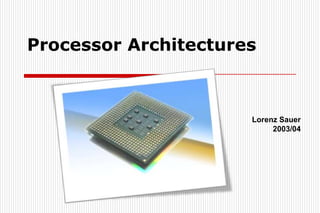
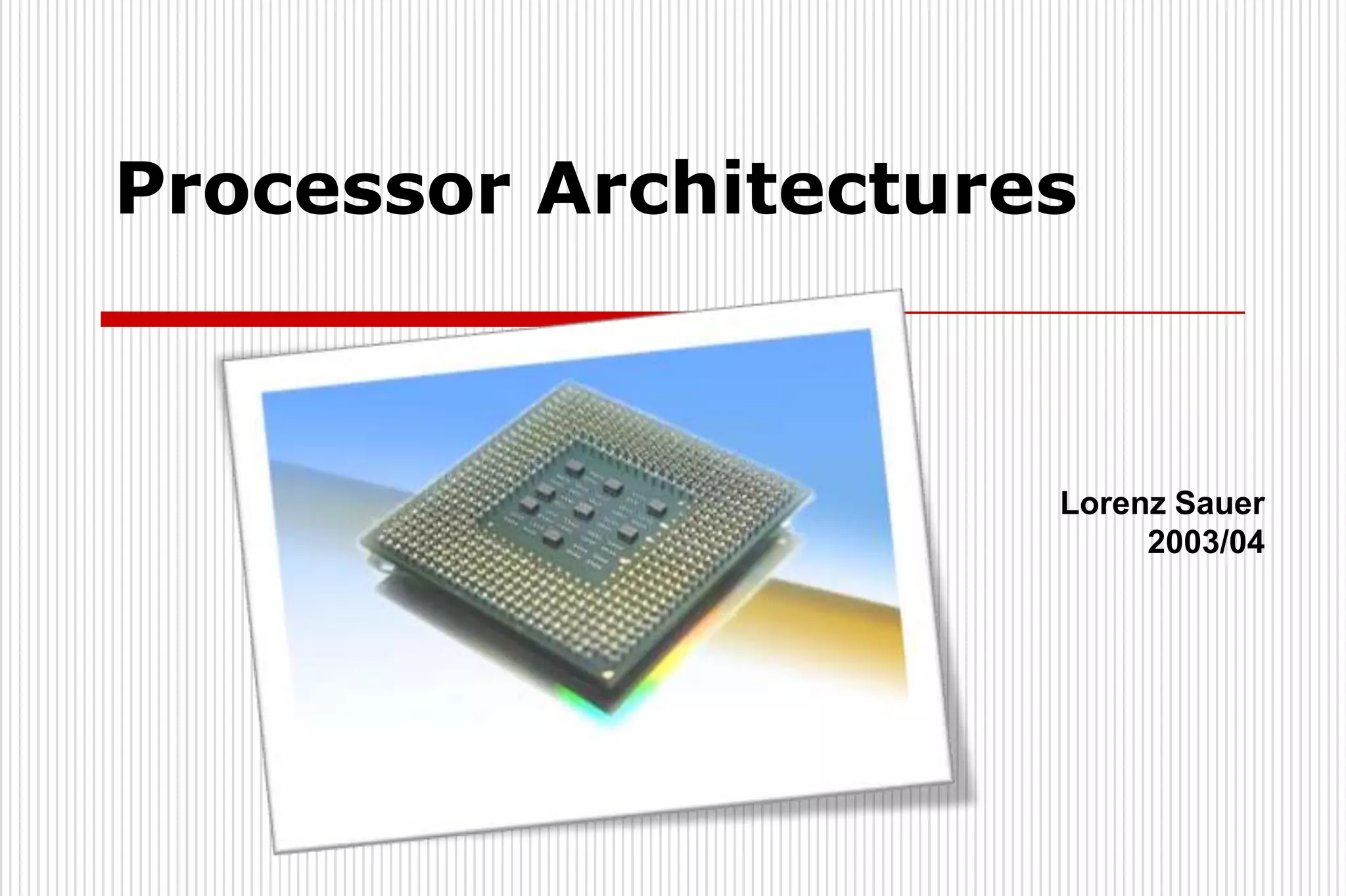
Processor Architectures


                      Lorenz Sauer
                           2003/04
Synopsis
 History of Computing
 Principal Architecture
   Von Neuman Architecture
   RISC, CISC, VLIW
   SIMD, SISD, MISD, MIMD
• Survey
• Outlook
History of Computing
 1st Switches
 2nd Binary Theory (comprehensive)
   Implemented as:
     Tubes
     Transistor
       BiPolar
       FET (especially MOSFET)
     Future (DNA,...)
Hardware-means to the end...
 Tube Technology
   huge, high power dissipation, very slow
 Transistor
     First models: huge
     Minaturization: rapidly
     BiPolar: fast, decent power dissipation
     FET: decent speed, low power dissipation,
      extreme Intregration Density is possible
Computing Timetable
   1949 John von Neumann
   1970s first microprocessor machines
   1980s IBM PC settling in industry
   1990s large-scale mainframes
   2000s GRID, interconnected computing


 >2000
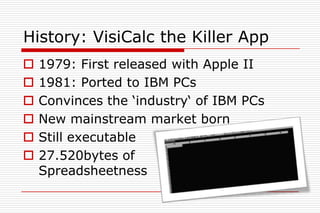
History: VisiCalc the Killer App
   1979: First released with Apple II
   1981: Ported to IBM PCs
   Convinces the „industry„ of IBM PCs
   New mainstream market born
   Still executable
   27.520bytes of
    Spreadsheetness
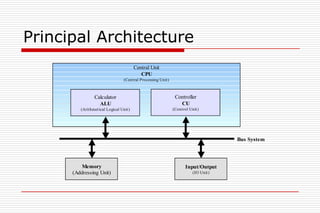
Principal Architecture: Basics
 Processor or Central Processing Unit
   CPU is the heart of a computer
   Execute programs stored in main memory
   Instructions are processed sequentially:
     fetched, examined and executed
     Church–Turing thesis
   The CPU is composed of:
     Control Unit
     Arithmetic logic unit (ALU)
     Registers
Principal Architecture
                                       Central Unit
                                          CPU
                                (Central Processing Unit)


                Calculator                                   Controller
                  ALU                                          CU
         (Arithmetical Logical Unit)                        (Control Unit)


                                                                                  Bus System


          Memory                                                  Input/Output
      (Addressing Unit)                                               (IO Unit)
Instruction Execution
 Pure VN(Von Neuman)-Execution Model
   Nowadays few computers employ pure von
    Neumann architecture
   No Check for Interrupts
   Pure VN computers spend a lot of time
    moving data from and to memory
   So called “Neumann bottleneck“
Instruction Execution
 Advanced VN Model(s)
   Interrupt built in
   Bus Architecture extended over several
    busses (different stepping possible)
   Pipelining
   Caching
   Co-Processor (Math, DSP,..)
   Parallelization of Units
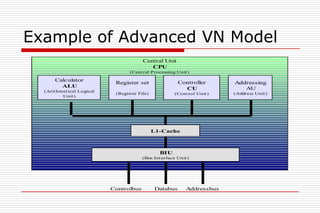
Example of Advanced VN Model
                                          Central Unit
                                             CPU
                                   (Cent ral P rocessing Unit )

      Calculator
                             Register set                  Controller      Addressing
        ALU                                                                   AU
                                                             CU
  (Arit hmet ical Logical
                             (Regist er File)           (Cont rol Unit )   (Address Unit )
          Unit )


                                                L1-Cache


                                                  BIU
                                         (Bus Int erface Unit )


                            Controlbus           Databus     Addressbus
The Instruction Set
 Instruction set:
   “Collection of all instructions used to communicate
    with the CPU“
   sizes vary from 20 to 300+ instructions
   Determined upon the type of machine
   larger instruction sets not necessarily better
   tailored to the use (of the processor)
 Compilers generate many machine
  instructions (Ops) from a highlevel language
  statement
 Most common are: CISC, RISC, VLIW
     Complex / Reduced instruction set computing, VLIW
      ~long instructions used in parallelism: see MIMD
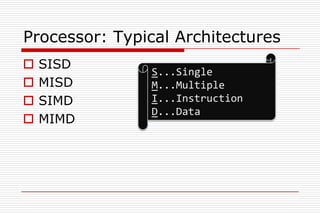
Processor: Typical Architectures
   SISD
               S...Single
   MISD       M...Multiple
   SIMD       I...Instruction
               D...Data
   MIMD
SISD
 Single Instruction Single Data
 Almost any conventional PC is SISD
 VN-model is a pure SISD
MISD
 Multiple Instruction Single Data
 No commercial success
 Example: Systolic Processor
SIMD
 Single Instruction Multiple Data
 Executes operations in parallel
 Example: Vector computer aka Array
  computer (~history of supercomputers)
 Nowadays as SIMD extensions
 Speeds up certain applications: chiefly
  multimedia (~rich in single precision
  floating point data)
MIMD
 Multiple Instruction Multiple Data
 Parallel architecture
 Many functional units
 Performs different operations on
  seperate data
 Example: Multiprocessor,
  interconnected workstations
Other: Vector-, Array-Processor
   Common in supercomputers till 1980s
   performs operations in parallel
   Copes well with large data chunks
   Bad under general purpose conditions
   Nowadays in PC-CPUs as SIMD
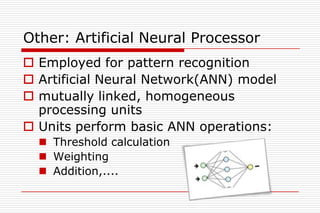
Other: Artificial Neural Processor
 Employed for pattern recognition
 Artificial Neural Network(ANN) model
 mutually linked, homogeneous
  processing units
 Units perform basic ANN operations:
   Threshold calculation
   Weighting
   Addition,....
Other: Parallel Reduction Machine
 Simplification of expressions
 Expressions reshaped into smaller,
  partial ones
 Obtained through recursion of partial
  expressions
 Performs reduction programs
 String reduction vs. Graph reduction
  machines
Other: Systolic Processor
 Array of Processing units (Cells)
 Single cell trivial
 Relay data via n - I/O
 Structure: Rectangular, Hexagonal or
  triangular
 Elements process same calculation
 Edge cells are the main I/O
Other: Fuzzy Processor
 Based on fuzzy logic
   many-valued logic or probabilistic logic
   approximate values rather than fixed (0|1)
   “set of approximate rules”-logic:
     IF variable IS ~property THEN response 1
     IF variable IS >>property THEN response 2
 Examples:
   Washing maschines,Auto focus,...
Other: Digital Signal Processor
   Used for very specific tasks
   Implements algorithms in Hardware
   Very fast at specific tasks
   Useless for general purpose programs
   Sufficient for some applications
     Can lower overall costs
Survey: GRID Computing
 Used in scenarios to big for single
  supercomputers
 Heterogenous structure
   Heterogenous computer-hardware / software and
    structure scattered around the globe
 Common middleware necessary
   E.g. Globus Toolkit
 2 Types, determined by their use:
   Computation Grids
   Data Grids
 Examples:
   SETI Project, @Folding: Protein folding...
Outlook
 Processor Optimization
 DNA Computer
 Quantum Computer
Outlook: Processor Optimization
 Clock Speeds
 Minaturization
 Improved & extended architecture
 Compilers (good at trvial tasks, fail at
  more complicated and parallel tasks)
 Non-trivial to determine the use of
  instruction extensions
 Most unit extensions are not used
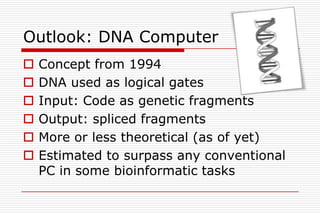
Outlook: DNA Computer
   Concept from 1994
   DNA used as logical gates
   Input: Code as genetic fragments
   Output: spliced fragments
   More or less theoretical (as of yet)
   Estimated to surpass any conventional
    PC in some bioinformatic tasks
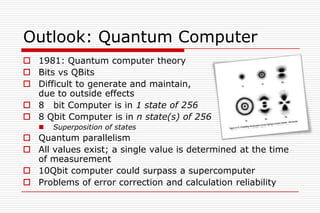
Outlook: Quantum Computer
 1981: Quantum computer theory
 Bits vs QBits
 Difficult to generate and maintain,
  due to outside effects
 8 bit Computer is in 1 state of 256
 8 Qbit Computer is in n state(s) of 256
      Superposition of states
 Quantum parallelism
 All values exist; a single value is determined at the time
  of measurement
 10Qbit computer could surpass a supercomputer
 Problems of error correction and calculation reliability

Processors - an overview

  • 1.
    Processor Architectures Lorenz Sauer 2003/04
  • 2.
    Synopsis  History ofComputing  Principal Architecture  Von Neuman Architecture  RISC, CISC, VLIW  SIMD, SISD, MISD, MIMD • Survey • Outlook
  • 3.
    History of Computing 1st Switches  2nd Binary Theory (comprehensive)  Implemented as:  Tubes  Transistor  BiPolar  FET (especially MOSFET)  Future (DNA,...)
  • 4.
    Hardware-means to theend...  Tube Technology  huge, high power dissipation, very slow  Transistor  First models: huge  Minaturization: rapidly  BiPolar: fast, decent power dissipation  FET: decent speed, low power dissipation, extreme Intregration Density is possible
  • 5.
    Computing Timetable  1949 John von Neumann  1970s first microprocessor machines  1980s IBM PC settling in industry  1990s large-scale mainframes  2000s GRID, interconnected computing  >2000
  • 6.
    History: VisiCalc theKiller App  1979: First released with Apple II  1981: Ported to IBM PCs  Convinces the „industry„ of IBM PCs  New mainstream market born  Still executable  27.520bytes of Spreadsheetness
  • 7.
    Principal Architecture: Basics Processor or Central Processing Unit  CPU is the heart of a computer  Execute programs stored in main memory  Instructions are processed sequentially:  fetched, examined and executed  Church–Turing thesis  The CPU is composed of:  Control Unit  Arithmetic logic unit (ALU)  Registers
  • 8.
    Principal Architecture Central Unit CPU (Central Processing Unit) Calculator Controller ALU CU (Arithmetical Logical Unit) (Control Unit) Bus System Memory Input/Output (Addressing Unit) (IO Unit)
  • 9.
    Instruction Execution  PureVN(Von Neuman)-Execution Model  Nowadays few computers employ pure von Neumann architecture  No Check for Interrupts  Pure VN computers spend a lot of time moving data from and to memory  So called “Neumann bottleneck“
  • 10.
    Instruction Execution  AdvancedVN Model(s)  Interrupt built in  Bus Architecture extended over several busses (different stepping possible)  Pipelining  Caching  Co-Processor (Math, DSP,..)  Parallelization of Units
  • 11.
    Example of AdvancedVN Model Central Unit CPU (Cent ral P rocessing Unit ) Calculator Register set Controller Addressing ALU AU CU (Arit hmet ical Logical (Regist er File) (Cont rol Unit ) (Address Unit ) Unit ) L1-Cache BIU (Bus Int erface Unit ) Controlbus Databus Addressbus
  • 12.
    The Instruction Set Instruction set:  “Collection of all instructions used to communicate with the CPU“  sizes vary from 20 to 300+ instructions  Determined upon the type of machine  larger instruction sets not necessarily better  tailored to the use (of the processor)  Compilers generate many machine instructions (Ops) from a highlevel language statement  Most common are: CISC, RISC, VLIW  Complex / Reduced instruction set computing, VLIW ~long instructions used in parallelism: see MIMD
  • 13.
    Processor: Typical Architectures  SISD S...Single  MISD M...Multiple  SIMD I...Instruction D...Data  MIMD
  • 14.
    SISD  Single InstructionSingle Data  Almost any conventional PC is SISD  VN-model is a pure SISD
  • 15.
    MISD  Multiple InstructionSingle Data  No commercial success  Example: Systolic Processor
  • 16.
    SIMD  Single InstructionMultiple Data  Executes operations in parallel  Example: Vector computer aka Array computer (~history of supercomputers)  Nowadays as SIMD extensions  Speeds up certain applications: chiefly multimedia (~rich in single precision floating point data)
  • 17.
    MIMD  Multiple InstructionMultiple Data  Parallel architecture  Many functional units  Performs different operations on seperate data  Example: Multiprocessor, interconnected workstations
  • 18.
    Other: Vector-, Array-Processor  Common in supercomputers till 1980s  performs operations in parallel  Copes well with large data chunks  Bad under general purpose conditions  Nowadays in PC-CPUs as SIMD
  • 19.
    Other: Artificial NeuralProcessor  Employed for pattern recognition  Artificial Neural Network(ANN) model  mutually linked, homogeneous processing units  Units perform basic ANN operations:  Threshold calculation  Weighting  Addition,....
  • 20.
    Other: Parallel ReductionMachine  Simplification of expressions  Expressions reshaped into smaller, partial ones  Obtained through recursion of partial expressions  Performs reduction programs  String reduction vs. Graph reduction machines
  • 21.
    Other: Systolic Processor Array of Processing units (Cells)  Single cell trivial  Relay data via n - I/O  Structure: Rectangular, Hexagonal or triangular  Elements process same calculation  Edge cells are the main I/O
  • 22.
    Other: Fuzzy Processor Based on fuzzy logic  many-valued logic or probabilistic logic  approximate values rather than fixed (0|1)  “set of approximate rules”-logic:  IF variable IS ~property THEN response 1  IF variable IS >>property THEN response 2  Examples:  Washing maschines,Auto focus,...
  • 23.
    Other: Digital SignalProcessor  Used for very specific tasks  Implements algorithms in Hardware  Very fast at specific tasks  Useless for general purpose programs  Sufficient for some applications  Can lower overall costs
  • 24.
    Survey: GRID Computing Used in scenarios to big for single supercomputers  Heterogenous structure  Heterogenous computer-hardware / software and structure scattered around the globe  Common middleware necessary  E.g. Globus Toolkit  2 Types, determined by their use:  Computation Grids  Data Grids  Examples:  SETI Project, @Folding: Protein folding...
  • 25.
    Outlook  Processor Optimization DNA Computer  Quantum Computer
  • 26.
    Outlook: Processor Optimization Clock Speeds  Minaturization  Improved & extended architecture  Compilers (good at trvial tasks, fail at more complicated and parallel tasks)  Non-trivial to determine the use of instruction extensions  Most unit extensions are not used
  • 27.
    Outlook: DNA Computer  Concept from 1994  DNA used as logical gates  Input: Code as genetic fragments  Output: spliced fragments  More or less theoretical (as of yet)  Estimated to surpass any conventional PC in some bioinformatic tasks
  • 28.
    Outlook: Quantum Computer 1981: Quantum computer theory  Bits vs QBits  Difficult to generate and maintain, due to outside effects  8 bit Computer is in 1 state of 256  8 Qbit Computer is in n state(s) of 256  Superposition of states  Quantum parallelism  All values exist; a single value is determined at the time of measurement  10Qbit computer could surpass a supercomputer  Problems of error correction and calculation reliability

Editor's Notes

  • #2 Modern x86 architecture based chip
  • #8 Church–Turing thesis: a function is algorithmically computable w. a Turing Machine